by Craig C. Rowe | May 22, 2025 | Industry, News Feed
Software company Rechat has named Audie Chamberlain its Head of Strategic Growth and Communications. Chamberlain previously served as CEO of Lion & Orb, a public relations and growth advisory outfit.
Bigger. Better. Bolder. Inman Connect is heading to San Diego. Join thousands of real estate pros, connect with the Inman Community, and gain insights from hundreds of leading minds shaping the industry. If you’re ready to grow your business and invest in yourself, this is where you need to be. Go BIG in San Diego!
Software company Rechat has named Audie Chamberlain its head of strategic growth and communications, Inman learned in a May 22 statement.
The position will marry Chamberlain’s knack for building relationships with Rechat’s momentum and proven technology, blanketing duties like growth strategy, brand building, increasing social media presence and developing go-to-market strategies for customers.
Rechat has been growing quickly thanks to its largely AI-driven marketing solutions for brokerages and industry professionals. It facilitates the creation of email marketing campaigns, social media content, and video and CMA delivery, among other digital business needs. It was founded by CEO Shayan Hamidi.
“We’re excited to welcome Audie to our leadership team,” said Hamidi in the statement. “Brokerages are telling us they want one platform to power their entire business — marketing, CRM, transactions and beyond. That’s exactly what Rechat delivers, and Audie is the right leader to help us expand that message to more customers and markets.”
Chamberlain founded and led industry public relations brand Lion & Orb after serving as Realtor.com’s Director of Marketing. Lion & Orb will continue operating under new leadership.
Chamberlain has long been a vocal advocate for real estate agents and their evolution through smart marketing and technology. He’s led public outreach campaigns for the likes of Concierge Auctions, Luxury Portfolio, Hawaii Life, Contactually and Zillow, among others. The relationship with Rechat developed after Chamberlain was hired to advise Hamidi on new ways to broaden the company’s national presence.
Chamberlain said in a phone call with Inman why he decided to join Rechat.
“It’s the best technology I’ve seen, and after working with them for more than a year, I knew they were building something special,” Chamberlain said. “Seeing how it impacts agents is very exciting, and it’s what I want to do right now. They’re obsessive about what they’re building, and there’s a reason top brokerages like SERHANT. run their entire operation on Rechat. I’m joining because of the product and from what I’ve seen on agents’ faces when they see it.”
Rechat states it has 16,000 users in place among brands like Douglas Elliman, Carolina One and prominent Sotheby’s International Realty affiliates.
The application was reviewed by Inman in 2024.
“Rechat does a lot of what a lot of other apps do separately. It can consolidate a tech stack for tech-savvy brokers wanting to provide a single-point solution for lead nurture, brand-building, sales support and lightweight deal management. The mobile UX is tight and engaging, and that commitment to using front-end design as a tactic to invigorate adoption is reflected in the web version,” the analysis said.
Email Craig Rowe
This post was originally published on this site
by Andrea V. Brambila | May 22, 2025 | Industry, News Feed
Bigger. Better. Bolder. Inman Connect is heading to San Diego. Join thousands of real estate pros, connect with the Inman Community, and gain insights from hundreds of leading minds shaping the industry. If you’re ready to grow your business and invest in yourself, this is where you need to be. Go BIG in San Diego!
The buyer of a Los Angeles home that formerly belonged to a serial killer known as “The Grim Sleeper” has put the home on the market and simultaneously sued the home’s sellers and every agent and real estate company involved with the purchase for allegedly not disclosing the home’s previous notorious occupant.
The murderer, Lonnie David Franklin Jr., was convicted in 2016 of killing nine women and a teenage girl between 1985 and 2007 in Los Angeles and was suspected of killing many others over his lifetime. He was sentenced to California’s death row, but died in prison at age 67 in March 2020.
TAKE THE INMAN INTEL SURVEY FOR MAY
Franklin’s former home, located at 1728 West 81st Street in Los Angeles, was put up for sale on Wed. May 21, according to Redfin’s website. The three-bedroom, two-bathroom 1,770-square-foot house was listed for $865,000.
“The spacious dining and living areas boast a cozy fireplace, while abundant storage cabinets and pantries add to the home’s functionality,” the property’s listing description reads.
“Step outside to the covered patio, ideal for relaxing or hosting guests.”
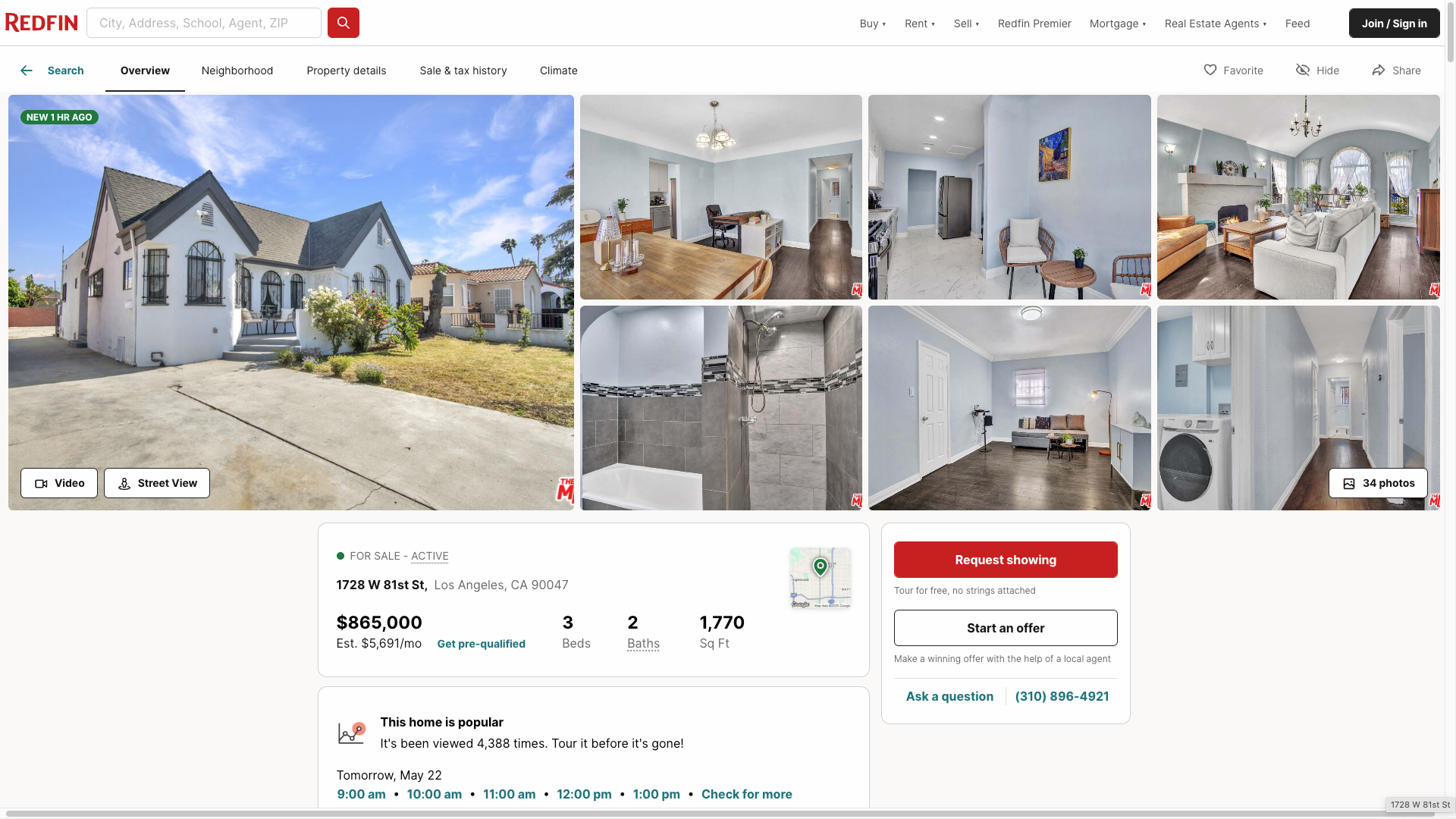
A Redfin listing for the property at 1728 W. 81st St. once owned by “The Grim Sleeper,” Lonnie David Franklin Jr. The listing was uploaded to Redfin on May 21, 2025.
The listing description makes no mention of the home’s previous occupants or the legal imbroglio surrounding the home. Inman has reached out to the listing agent, Joseph M. Rasson of Rasson Realty & Financial Corp., for comment and will update this story if and when a response is received.
On Mon., May 19, the most recent buyer of the home, Suyeon Park, filed a lawsuit against sellers Surendra Pandey and Madav Budhathoki; Khemlal Adhikari, the listing agent; Keller Williams Coastal Properties, the listing brokerage; Jason Anderson, the buyer’s agent; eXp Realty of California, the buyer’s brokerage; Pacific Coastline Escrow, the escrow company for the transaction; and Chicago Title Company, the title company for the transaction.
Park bought the home in February 2025 for about $755,000.
The suit, filed in the state’s Los Angeles Superior Court, accuses the defendants of “sheer laziness in order to make a quick profit” and maintains they knew the house was once owned and lived in by The Grim Sleeper.
“The Grim Sleeper resided at the House during the entire murder spree,” the complaint says.
“Defendants knew that Plaintiff was not aware of this. But either negligently, purposely, knowingly and/or intentionally failed to disclose this information in order for the Transaction to go through and have them get paid.”
“Defendants knew that the House was nowhere near the value of which it was sold to Plaintiff given that a serial killer lived there,” the complaint adds, noting that the defendants assured Park before the deal closed “that there was nothing that Plaintiff needed to be concerned with relating to the House.”
The complaint alleges that when Park moved in, she made improvements to the house costing about $50,000.
A neighbor informed Park that the house was once owned by The Grim Sleeper and when Park asked the neighbor whether the sellers knew, the neighbor said the sellers knew, according to the complaint.
The neighbor also allegedly told Park that the house had once been listed, then taken off the market and re-listed again “after some time” at a “significantly lower price.” The same neighbor also mentioned an incident during an open house when a car drove by and yelled to Adhikari, the listing agent, that the house was where The Grim Sleeper had lived.
The complaint also describes an incident toward the end of February 2025 after Park moved in when a technician came to the property to install internet.
“Unknown to Plaintiff, another passerby drove and parked his vehicle and then approached the technician if he could take a tour of the House given that a serial murderer had lived there,” the complaint says.
“As a result, Plaintiff has lived with constant fear and stress for her safety and well being.”
The complaint makes 10 claims against the defendants: breach of implied covenant of good faith and fair dealings; intentional misrepresentation; concealment; negligent misrepresentation; fraud; conspiracy to defraud; breach of fiduciary duty; constructive fraud; intentional infliction of emotional distress; and negligence.
The filing charges that “there existed an implied promise that Defendants make full disclosures as to issues relating to trespassers and deranged fans of the serial killer that used to live there” and that “in order to reap all the benefits of the Transaction, Defendants purposely did not disclose that a serial murder lived there and that Plaintiff may be bombarded with unwelcome guests.”
The complaint stresses that Park would not have bought the home “[h]ad Defendants disclosed this omitted information.”
The complaint asks for compensatory damages, exemplary and punitive damages, and for attorney’s fees.
Inman has reached out to the defendant agents and companies for comment and will update this story if and when responses are received.
Read the complaint (re-load the page if document is not visible):
Email Andrea V. Brambila.
Like me on Facebook | Follow me on Twitter
This post was originally published on this site
by Verl Workman | May 22, 2025 | Industry, News Feed
Bigger. Better. Bolder. Inman Connect is heading to San Diego. Join thousands of real estate pros, connect with the Inman Community, and gain insights from hundreds of leading minds shaping the industry. If you’re ready to grow your business and invest in yourself, this is where you need to be. Go BIG in San Diego!
Motivating a real estate sales team is more than just offering incentives; it’s about creating an environment where agents feel inspired, accountable and supported. While many leaders focus on external rewards, true motivation comes from within — aligning personal goals with professional success, fostering a culture of accountability, and making the work both fun and fulfilling.
TAKE THE INMAN INTEL SURVEY FOR MAY
That’s how we work, and that’s what we recommend. Here’s how you can do it.
Start with the right people
One of the most effective ways to maintain motivation on your team is to start with the right people. The best team members are self-driven, eager to succeed and willing to put in the work. As a leader, you can’t want success for someone more than they want it for themselves.
One of my favorite books, written by Patrick Lencioni, is The Ideal Team Player: How to Recognize and Cultivate The Three Essential Virtues. He teaches that we need to look for and hire people who are “hungry, humble and intelligent. A motivated agent doesn’t need constant prodding; instead, they should be like a young puppy pulling at the leash — excited and ready to go.”
Accountability: Sticks and carrots
Motivation often comes down to accountability, which can take two forms: the stick (penalties for non-performance) and the carrot (rewards for achievement). Both can be effective when used correctly.
The stick approach
A structured accountability system ensures agents stick to their commitments. One method is a signed commitment document outlining team expectations, such as daily prospecting, attending team huddles and achieving a set number of points per day based on revenue-generating activities. When an agent fails to meet these commitments, remind them of their promise to the team and themselves.
For agents who fall behind, referencing their vision board — a dream home, a trip to Disneyland with their family or a new car — can be a powerful motivator. Remind them that their daily work directly impacts their ability to achieve their personal goals. They are more likely to do hard things for their families or personal reasons than for any leader.
Another stick approach involves lead distribution. If agents aren’t consistently meeting their daily success metrics, they’re removed from team-generated lead distribution. This reinforces that opportunities are earned, not given.
Opportunity cost worksheets and reinforcing what it costs not to do the activities
Each client has a real lifetime value. Depending on your market, it could be as low as $50,000 and as high as $200,000. When you acquire a new client, it’s worth whatever their lifetime value is.
When an agent loses a client because of a lack of follow-up or a lack of consistently adding value to the database, the opportunity cost is as much as $200,000. That is like withdrawing from the family bank account for that amount. When you put your finger on it, the behavior often changes and is replaced with better choices.
The carrot approach
People naturally respond to incentives; the most effective rewards go beyond money. Gamification is a powerful way to keep agents engaged.
For example, some teams use a spinning wheel with various prizes — gift cards, extra vacation time or small luxury items — for agents who hit their goals. Others set up larger team incentives, such as a group outing, a spa day or an all-expense-paid trip to an industry conference.
Some teams also run friendly competitions, such as rewarding the agent who books the most listing appointments in a month. You naturally foster a motivated team by creating an environment where agents enjoy striving toward goals.
Daily huddles: Creating a culture of productivity
A well-structured daily huddle is one of the simplest, yet most effective ways to motivate your team. In a high-performing real estate team, these meetings are non-negotiable. Like a football team huddles before every play, a sales team must huddle daily to review goals, share successes and ensure accountability.
A strong huddle for our clients includes:
- Daily success habits: Have they consistently reached their daily target of 61 points on their prospecting?
- Top 50: Have they reached out to their Top 50 — their SOI, who have agreed to provide at least one referral per year. Have they maintained their outreach as scheduled in their CRM?
- Dollar-producing activities: Are they staying focused on spending their time with dollar-producing activities instead of wasting their time on fake work?
- Accountability check-ins and goals: Team members hold each other accountable, reinforcing a culture of commitment and support. Have they reached their goals?
When done consistently, huddles build momentum and create an environment where motivation and accountability thrive.
Aligning business goals with personal goals
Great leaders recognize that motivation isn’t just about hitting quotas — it’s about helping agents achieve their personal goals. One of the most powerful ways to do this is through vision boards. Each agent should have a board that includes things they aspire to — whether that’s paying off debt, traveling or purchasing a new home.
When an agent struggles, revisit their board and remind them why they’re working hard. If an agent isn’t prospecting consistently, ask them: “If taking your kids to Disneyland is important to you, what’s stopping you from making the calls that will get you there?” Aligning their professional actions with their personal aspirations makes motivation self-sustaining.
Providing growth opportunities
High-performing agents will eventually hit a ceiling without room for advancement. To keep your team engaged long-term, create opportunities for professional growth. This could mean transitioning a top buyer’s agent into a listing role, allowing senior agents to mentor newcomers or even helping them build their own team within yours.
Teams with a clear career progression retain top talent, ensuring continued motivation and performance.
Recognizing and celebrating achievements
Recognition is a simple yet powerful motivator. Whether it’s a public shoutout in a meeting, a personalized note or a social media post highlighting an agent’s success, acknowledging effort and achievement keeps morale high.
Additionally, small rewards, like taking the top performer to lunch or giving out personalized gifts, make agents feel valued and appreciated. Remember, people don’t leave jobs — they leave environments where they don’t feel recognized.
Lead by example
Finally, setting an example is the best way to inspire your team. If you expect agents to prospect daily, show them how it’s done. If you want them to improve their skills, continue your own education. Actions speak louder than words, and your team will be more motivated when they see you putting in the effort.
Motivating a real estate sales team isn’t about pushing people to work harder — it’s about creating a productive environment where motivation naturally flourishes. By fostering accountability, incorporating rewards, holding daily huddles, aligning business with personal goals and providing growth opportunities, you’ll build a team that stays driven, engaged and successful.
When you take the time to understand what truly motivates each team member, success follows naturally. Our goal as leaders is to serve them and help them gain everything they want in business, in life and more.
If we inspire, lead by example and reward the activities that get results, we will increase our positive culture and reduce churn on our teams. Most importantly, we will have helped people build lives of real value.
Verl Workman is founder and CEO of Workman Success Systems. Connect with him on LinkedIn or Instagram.
This post was originally published on this site
by Jeff Tucker | May 22, 2025 | Industry, News Feed
Windermere Economist Jeff Tucker looks at how tariff walkbacks may signal that some of the Trump administration’s potentially damaging policy changes could be reversed.
Bigger. Better. Bolder. Inman Connect is heading to San Diego. Join thousands of real estate pros, connect with the power of the Inman Community, and gain insights from hundreds of leading minds shaping the industry. If you’re ready to grow your business and invest in yourself, this is where you need to be. Go BIG in San Diego!
In this exclusive series on Inman, Windermere’s Principal Economist Jeff Tucker illuminates the latest stats, reports and numbers to know this week.
Number to know: Average effective tariff rate 17.8%
This week I’m jumping right back in to check on the elephant in the room this spring: tariffs. The first number to know is 17.8 percent — the new average effective tariff rate on U.S. imports, which is down sharply from 27 percent last month, but still the highest since 1934 and still about five times the level prevailing at the start of this year. That’s according to the Yale Budget Lab’s latest estimates as of the week of May 12.
TAKE THE INMAN INTEL SURVEY FOR MAY
This smaller tariff hike will still be expected to reduce real GDP in the United States. The Yale Budget Lab’s model predicts a decline in real GDP of 0.36 percentage points in the long run, after a deeper short-run negative shock. But like the tariffs themselves, that impact has shrunk by almost half from what was projected under the much harsher tariffs last month.
Just as important as the reduction in proposed tariffs, is the sense that investors are getting that this means more walkbacks are on their way. The stock market in particular has now fully regained all its losses and has risen slightly year-to-date, or about 20 percent from its early April trough.
That suggests to me that investors have concluded we won’t actually see a major hit to the growth of U.S. companies’ profits and U.S. economic output this year after all.
Number to know: Inflation 2.3%
The tariffs that have gone into effect are still not passing through much of a price shock to consumers. April inflation data came in about as expected, without a spike in goods prices yet, so year-over-year inflation ticked down again, now to 2.3 percent.
Turning to the national housing market, we reached a major milestone of seeing more active listings at the end of April than the same month in 2020 — the first time that has happened since the inventory plunge began that spring. Many parts of the country now have inventory even above 2019 levels, including the Pacific Northwest. Active listings ended the month of April 31 percent higher than the same time last year.
Number to know: Pending sales 2.2%
Pending sales actually ticked up slightly year-over-year in April, by 2.2 percent. This was surprisingly upbeat, given the negative turn in consumer sentiment last month, and I think it masks a lot of regional variation, like a 12.7 percent year-over-year decline in the Seattle metro area this April.
Number to know: Mortgage rates 6.75% – 7%
Finally, I’ll end by checking in with the usual elephant in the room: mortgage rates, which are still stuck in a range between 6.75 percent and 7 percent.
It seems like the bond market just can’t catch a break this year, because even after the stock market recovered from the tariff turmoil, the falling fear of a recession and rising expectations for an explosion in the deficit based on Congressional budget drafts now circulating are conspiring to keep bond yields and mortgage rates high for the foreseeable future.
Jeff Tucker is the Principal Economist for Windermere Real Estate in Seattle, Washington. Connect with him on X or Facebook.
This post was originally published on this site
by Debra Trappen | May 22, 2025 | Industry, News Feed
When passion and purpose align, you become unstoppable. Find out how to cultivate the combination in this new series from Debra Trappen.
Bigger. Better. Bolder. Inman Connect is heading to San Diego. Join thousands of real estate pros, connect with the Inman Community, and gain insights from hundreds of leading minds shaping the industry. If you’re ready to grow your business and invest in yourself, this is where you need to be. Go BIG in San Diego!
Welcome to Lead with Fire, A Soulful Series for Real Estate Game-Changers. This is more than business advice — “Lead with Fire” is a transformative series created for the soulful, visionary humans in the real estate industry who are done with the old playbook and ready to redefine success on their own terms.
Passion fuels the fire; purpose keeps it burning.
If you’ve ever felt wildly excited about something one minute, only to feel totally drained or directionless the next, you’re not alone. Passion alone isn’t enough to sustain you through the long game of building your real estate business or pursuing leadership roles.
That’s where purpose comes in.
TAKE THE INMAN INTEL SURVEY FOR MAY
Passion: The spark
Passion is that electric, can’t-stop-talking-about-it energy. It lights you up, gets your creative juices flowing and inspires you to start something bold. Passion feels fun, expansive and thrilling. Make no mistake here, passion can also flicker. It can burn hot and fast and then fade if it isn’t rooted in something deeper.
Think of passion like the kindling in a fire. It gets things going, but it burns out quickly unless there’s something solid underneath to sustain it.
Purpose: The flame that lasts
Purpose is the steady, grounding force that gives your work meaning. It’s the why behind what you do. It’s what gets you out of bed on the days when motivation is nowhere to be found. When passion wavers (and it will), purpose is what keeps you going.
Where passion is emotional and energetic, purpose is soulful and strategic. And when they’re working together? That’s when you become unstoppable.
Why both matter
We live in a culture that glorifies hustle and idolizes excitement. However, chasing passion without purpose can lead to burnout, disappointment and the phenomenon known as “shiny-object syndrome.” On the flip side, leading with purpose but ignoring what excites you can leave you feeling dry, robotic or uninspired.
Your most powerful path? Passion and purpose in partnership.
That’s when your fire becomes sustainable, sacred and scalable.
Passion asks: “What lights me up?”
Purpose asks: “How can I serve through this light?”
My journey from spark to sacred work
For as long as I can remember, I’ve been passionate about gathering women. I love creating beautiful, meaningful spaces where we can show up fully, be seen, and support each other without judgment or competition. That passion lit me up in grade school playgrounds, dorm rooms, living rooms, and boardrooms. It felt more like a passion project for a long time — something I did for love, not a livelihood.
The shift happened when I gave myself permission to go deeper. I took a sacred pause. I listened to that internal whisper. I realized that my passion wasn’t random; it was pointing me toward my purpose.
That purpose? To guide women back to themselves, their truth, their intuition, their creative fire — and to cultivate a community where they could rise in business and life without sacrificing their soul. That purpose now lives and breathes inside the work I do as an intuitive guide and the founder of Red Threads Collective.
The Collective isn’t a “brand”; it’s the living embodiment of my passion and purpose, working together. It’s where I get to channel the energy that excites me into experiences that elevate others.
When I aligned those two forces, everything changed. My work became lighter, my message clearer, and my results more impactful. And best of all? It felt like me.
Reflective journal prompts
Let’s bring this to life. Take a few moments to reflect and journal on the following:
- What lights you up lately? What activities, conversations, or ideas have been energizing you?
- What impact do you feel called to make? Who are you drawn to serve, and how might your passions help them?
- Where can you blend passion and purpose in your current work or leadership? Look for one opportunity this week to align both.
Mantra to Lead With Fire:
“My passion fuels me. My purpose grounds me. Together, they light my way.”
Next up in the Lead with Fire Series: How to lead with confidence and clarity (even when your voice shakes)
Now that you’ve tapped into your inner fire, it’s time to lead from that place with clarity and confidence. In the next post, we’ll bust the biggest leadership myths and show you how to build real confidence — even in uncertain times. You don’t have to be perfect to be powerful.
Debra Trappen is the founder of the Red Threads Collective, a sacred community for women entrepreneurs. Connect with her on Instagram and LinkedIn.
This post was originally published on this site
by Matt Carter | May 21, 2025 | Industry, News Feed
While Fannie Mae economists see mortgage rates coming down by a full percentage point, forecasters at the Mortgage Bankers Association have issued a more cautious take.
Bigger. Better. Bolder. Inman Connect is heading to San Diego. Join thousands of real estate pros, connect with the Inman Community, and gain insights from hundreds of leading minds shaping the industry. If you’re ready to grow your business and invest in yourself, this is where you need to be. Go BIG in San Diego!
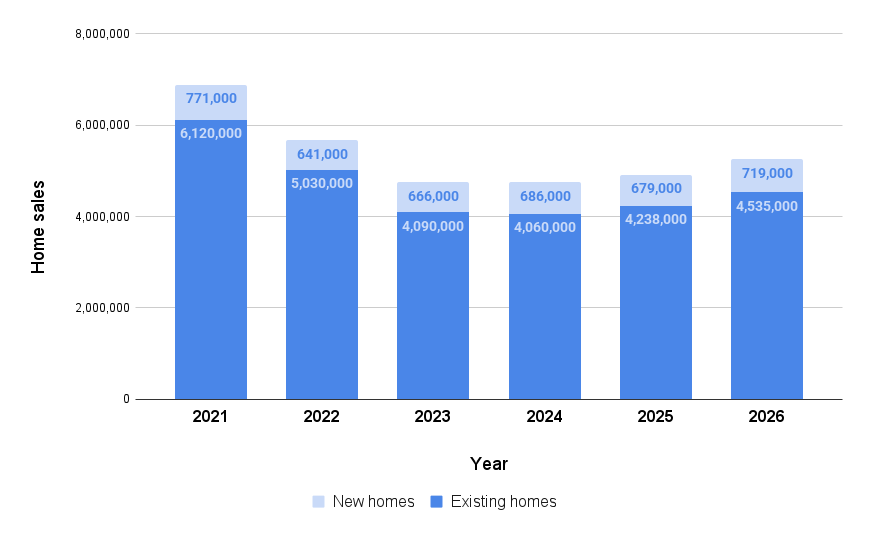
With mortgage rates looking like they could come down a little faster this year and next, Fannie Mae economists think home sales could bounce back by 3.6 percent this year, to 4.92 million homes.
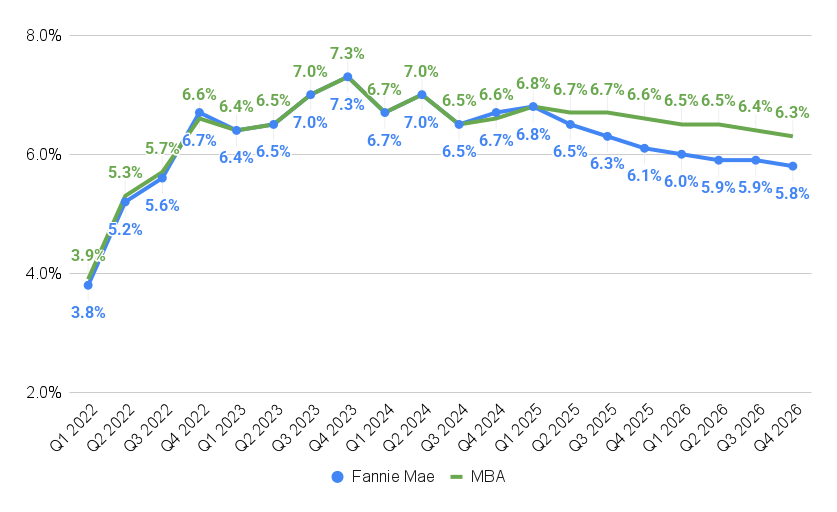
That’s 54,000 more home sales than Fannie Mae was forecasting in April, when economists at the mortgage giant were expecting mortgage rates to still be at 6.2 percent at the end of this year and 6 percent next year.
TAKE THE INMAN INTEL INDEX SURVEY FOR MAY
Fannie Mae’s latest forecast, released Wednesday, projects rates on 30-year fixed-rate mortgages will drop to 6.1 percent by the end of this year and to 5.8 percent by the end of next year.
Home sales expected to accelerate
With sales of new homes projected to shrink by 1 percent this year, to 679,000, the projected bounce in home sales would be driven entirely by 4.4 percent growth in sales of existing homes, to 4.24 million.
Fannie Mae’s Economic and Strategic Research (ESR) Group is forecasting even stronger 2026 growth, with total sales expected to surge by 6.8 percent to 5.25 million.
If that forecast pans out, it would be the first time since 2022 that sales of new and existing homes surpassed five million.
Next year’s gains are also projected to be driven by 7 percent growth in existing home sales, to 4.53 million, with new home sales also forecast to grow by 5.9 percent, to 719,000.
Duelling mortgage rate forecasts
While Fannie Mae economists see mortgage rates coming down by a full percentage point from Q1 2025 levels, forecasters at the Mortgage Bankers Association issued a more cautious take on May 16.
MBA economists think rates will still be averaging 6.6 percent during Q4 2025 and 6.3 percent during Q4 2026.
Home prices keep going up
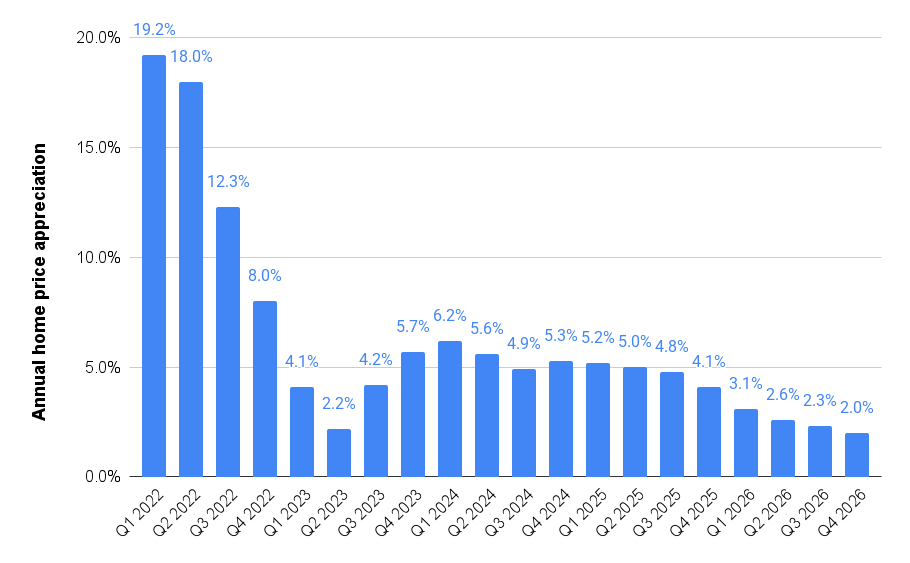
Fannie Mae economists update their home price appreciation forecast four times a year — in the first month of each quarter — rather than monthly.
In January, Fannie Mae economists were expecting annual home price appreciation to cool to 3.5 percent by Q4 2025.
In updating their home price appreciation forecast in April, forecasters at the mortgage giant predicted that home prices will be up 4.1 percent from a year ago in Q4 2025, before appreciation cools to 2 percent by Q4 2026.
Mortgage volume trending up from 2023 low
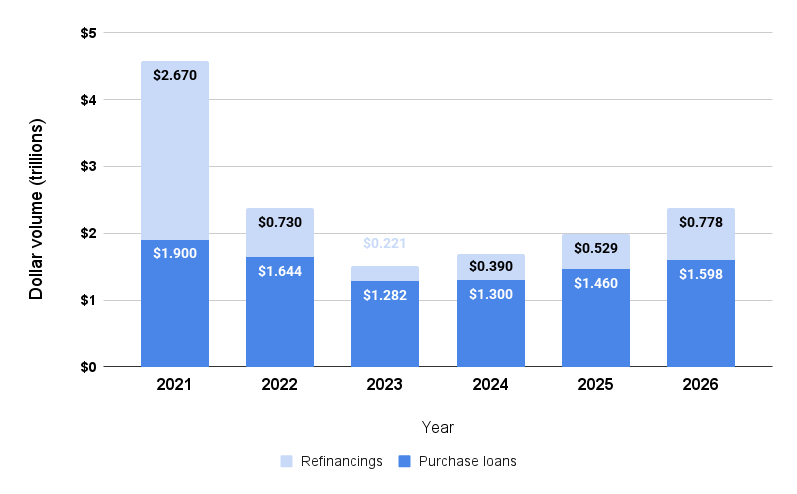
With home sales and home prices both expected to post gains, Fannie Mae economists expect mortgage originations to grow by 17.7 percent this year, to $2 trillion.
While refinancing is projected to grow by 35.6 percent this year, to $529 billion, lenders are on track to do almost three times as much purchase mortgage business.
Fannie Mae economists expect purchase loan volume will grow by 12.3 percent this year, to $1.46 trillion.
Additional easing of mortgage rates next year is expected to boost 2026 refinancing by 47.1 percent, to $778 billion, and purchase lending by 9.5 percent, to $1.6 trillion.
Next year’s projected $2.38 trillion in total mortgage volume would represent 58 percent growth from a 2023 trough of $1.5 trillion.
Housing starts expected to bottom out
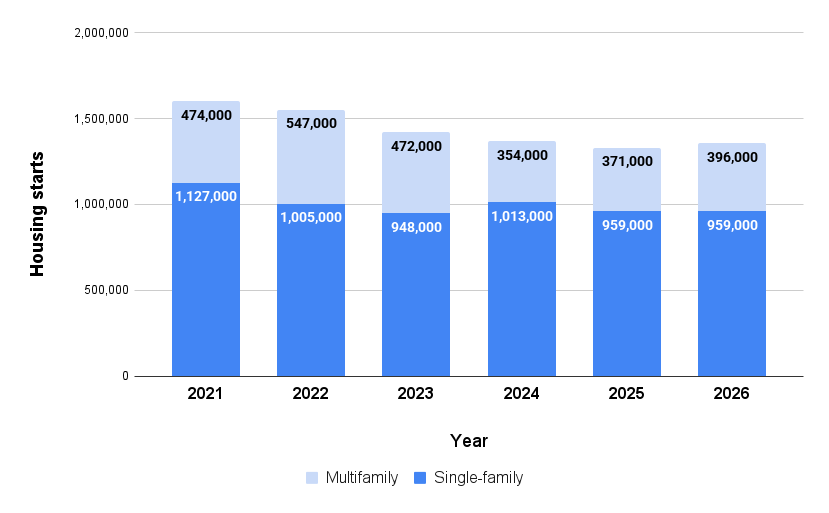
With inventories of new homes for sale on the rise in some markets, Fannie Mae economists expect single-family home starts will shrink by 5.3 percent this year, to 959,000, even as multifamily home starts grow by 4.8 percent to 371,000.
Next year, single-family home starts are expected to be flat at 959,000, with 6.7 percent growth in multifamily home starts, to 396,000.
Get Inman’s Mortgage Brief Newsletter delivered right to your inbox. A weekly roundup of all the biggest news in the world of mortgages and closings delivered every Wednesday. Click here to subscribe.
Email Matt Carter
This post was originally published on this site