by Christy Murdock | May 22, 2025 | Industry, News Feed
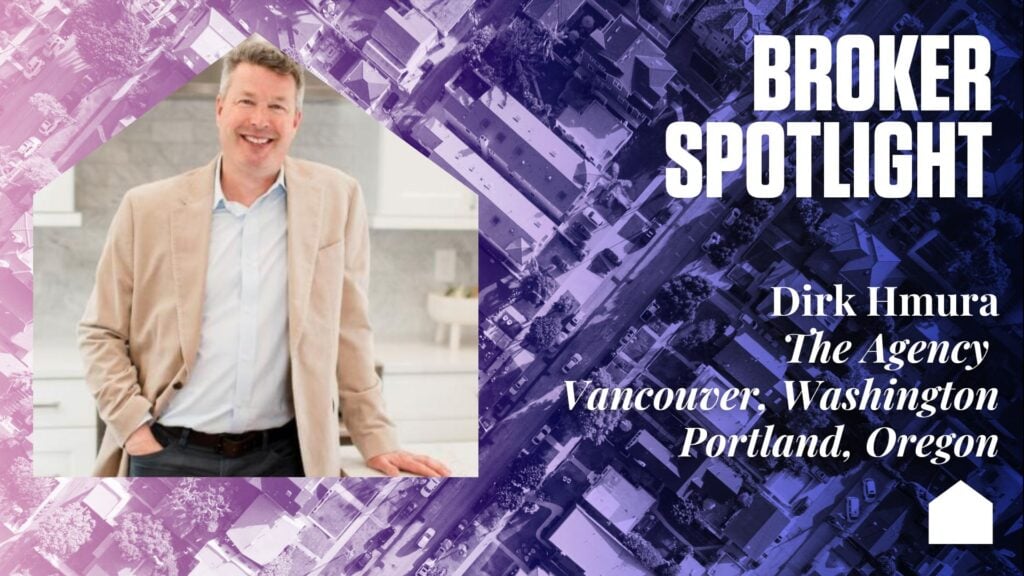
Name: Dirk Hmura
Title: Managing Partner of the Agency Vancouver, Washington, and The Agency Portland, Oregon, and leader of The Dirk Hmura Team
Experience: 22 years
Location: Portland, Oregon
Brokerage name: The Agency Vancouver, Washington, and The Agency Portland, Oregon
Rankings: No. 5 in the Portland metro area
Team size: 4
Transaction sides: 90
Sales volume: $90 million per year
Awards: RealTrends Verified, The Agency Chairman Award, Best of Rose City: Luxury Real Estate Team
How did you get your start in real estate?
I had been working in high tech, and the dotcom meltdown gave me some time to think about what was next for me. In one of my many informational interviews, I met with our Realtor, and he said: “Real estate, it’s tough. It’s exhausting, it’s hard on the family, you have to always be on … but, if you’re up for it, I’d love to have you.”
I had always liked real estate, homes, and people, and I loved the challenge. I got my real estate license in three weeks and immediately got to work. I loved wearing all the different hats. I loved working hard. The harder I worked, the better I was, the more money I made. Coming from the corporate world where bonuses were capped, this was fun!
How did you choose your brokerage (first or current)?
The Agency came calling. Over the years, I had received several recruiting calls. A few were a quick “No.” But this one was different. Ricardo Beer from The Agency called in March of 2021. It was a fun call, he was easy to talk to and it didn’t feel like a sales pitch, but I told him no.
We all remember the market in ’21; I didn’t have any additional time or interest in starting something new. I left the door open and told Ricardo to call me in a year. Fast forward one year, and he came calling again.
The market was starting to shift. My kids were getting closer to college and I had just returned home from Inman Connect New York, where several of the brokers on the stage were from The Agency. I was a bit more receptive this time, so one conversation became two, and then I brought my team into the calls. It just felt right.
Then, I asked our now Managing Principal Broker, Andrew Misk, to grab a drink, hoping he would talk me out of this. He said the opposite. Now, here we are. We have loved our relationship with the Agency. We have enjoyed getting to know Mauricio, Billy, Rainy and everyone in the company. It truly is a family.
What are 5 things you’d like readers to know about you and your brokerage?
Culture: This is why we did this. We are surrounding ourselves with fun, hardworking and smart people. We challenge each other to do better, be better, and we have a hell of a time doing it together.
Collaboration: I didn’t know this existed between offices. I was at a local company before, so it’s fun to be part of something larger. The collaboration between each office in different cities and states and even countries — I didn’t know that was possible.
Events: We love throwing events. We recently had our grand opening party, and we rented out the soccer stadium in Portland. It was quite an event; we kind of blew the budget, but it was one heck of a party.
Marketing: The Agency is known as a marketing machine, and this is one thing that attracted us to the company. But what we love most is the flexibility to make it our own. Portland and Vancouver aren’t Beverly Hills — so instead of Ferraris in our ads, we may feature a Subaru.
Energy: I have a ridiculous work ethic. I show up for my clients every day. You can still find me planting yards, vacuuming or moving heavy furniture. Now, other brokers at The Agency are surprised that I still do this. They assume I have my team to do the heavy lifting.
Where does all this energy come from? Being active and engaged in work, the community, The Agency, my family — I bring my full energy to it all.
What’s your top prediction for 2025?
Back to the basics: This is going to be an interesting year. We all had high hopes for lower interest rates and additional inventory, but the current stock market ups and downs and the unpredictability of interest rates have put the busy spring market in jeopardy.
So, it’s back to the basics. Follow up with clients, collaborate with co-brokers and get involved in your community.
What’s your top tip for freshly licensed brokers?
Join a team or find a mentor who is willing to work with you. When I started, I joined a team and was thrown right into the mix. In my first year, we sold over 50 homes, and I was involved in every single detail. That’s a quick education. If I hadn’t joined a team, I feel I would have floundered, wondering where to even start.
Name 3 people you admire
My team (Yes, I know that isn’t one person): I have been so fortunate to be surrounded by wonderful brokers who pour in so much energy and effort every single day. I wouldn’t have taken this leap without their amazing support. Cathi Render, Kendall Westphal, Josh Gainer and Maggie Deuth, thank you!
Lee Davies: Lee is the person who first offered me a job in real estate. I worked on his team for eight years. When I went out on my own as an independent agent and became the top salesperson at his company, he celebrated my success.
We would challenge each other to be better. I learned so much from him and it gave me the confidence to tackle this new challenge after 22 years.
My Mom: I am the youngest of three kids and have wonderful relationships with my sister and brother. My mom was the glue: an amazing woman. I lost her early when she was 56 (I was 26). She was a single mom, and money was always tight. She worked hard, and we even had a paper route together at one point in high school to help pay the bills.
My mom was always present. She volunteered at every school event and was the loudest cheerleader at my soccer games. As a parent of twins and having a wonderful and supportive wife, I have no idea how my mom did it on her own.
When I talk with my brother and sister about that, we are all blown away as we all felt that we were the favorites. Love you, Mom!
This post was originally published on this site
by Mariya Gordon | May 22, 2025 | Industry, News Feed
The real estate landscape is evolving at breakneck speed, and keeping pace with conflicting takes on commissions, inventory constraints and the rapid rise of AI can feel like trying to read tomorrow’s headlines today. In a time when separating fact from noise is more difficult than ever, Inman Connect San Diego offers three days of insight, strategy and practical advice tailored to the immediate needs of agents, brokers and industry innovators.
From July 30 through August 1, 2025, the Hilton San Diego Bayfront will become the epicenter of real estate’s most compelling conversations. Over the course of three immersive days, you’ll hear from the industry’s leading voices, including Brian Buffini, Wendy Forsythe, Ryan Schneider, Robert Reffkin, Michael S. Liebowitz, Kamini Lane and many more.
Whether you’re grappling with regulatory shifts, looking to refine your AI integration or seeking new ways to navigate high-interest-rate markets, Inman Connect San Diego has the answers you need.
Your 5 most pressing questions, answered:
- How will the 2024 NAR commission settlement reshape your revenue, and how will it affect your commission?
- With high interest rates, how can you persuade sellers to list — and motivate buyers to buy?
- How can AI be seamlessly integrated into your current business operations to save you time and boost your value?
- What are the latest regulatory changes affecting real estate, and how can you stay ahead of the compliance curve?
- How can you harness the power of social media marketing and a robust online presence to grow your real estate business?
*Agenda and topics are subject to change
Laser-focused learning tracks
Gone are the days of generic keynote speeches and buzzword panels. This year’s agenda is organized into targeted learning tracks designed to tackle the exact challenges you face today:
- Agent Connect: Real-world case studies and workflow optimizations that leading agents are using to secure listings and close deals despite market headwinds.
- Broker Connect: Strategies for brokerage owners to strengthen their teams, refine fee structures and maintain profitability in a shifting commission landscape.
- Martech track: A deep dive into the tools and platforms that boost lead generation, streamline campaigns and maximize ROI — no filler, just the tactics top performers swear by.
- Understanding AI (for real): Pragmatic guidance on integrating AI into your daily operations. Learn which applications actually save time, enhance client value and deliver measurable business impact.
- Next-Gen Tech: Explore must-have tactics from the agents, brokers and real estate tech professionals who are in the know so that you can run your business from anywhere at any time.
Why your voice matters
At Inman Connect San Diego, you won’t just passively absorb ideas; you’ll engage directly with speakers and peers in roundtable discussions, hands-on workshops and networking events crafted to foster genuine collaboration. By the end of Day One, you’ll walk away with actionable strategies; by Day Three, you’ll have the connections and confidence to implement them immediately.
Securing your pass today means more than access to sessions; it guarantees a seat at the table where the future of real estate is being decided. Don’t let uncertainty leave you guessing; claim your spot at Inman Connect San Diego.
Inman Connect San Diego
Hilton San Diego Bayfront
July 30 – Aug. 1, 2025
This post was originally published on this site
by Marian McPherson | May 22, 2025 | Industry, News Feed
Redfin will begin banning listings that aren’t added to the multiple listing service (MLS) within 24 hours of being publicly marketed in September. The announcement comes two days after Zillow Group shared its ban timeline.
Bigger. Better. Bolder. Inman Connect is heading to San Diego. Join thousands of real estate pros, connect with the Inman Community and gain insights from hundreds of leading minds shaping the industry. If you’re ready to grow your business and invest in yourself, this is where you need to be. Go BIG in San Diego.
Seattle-based firm Redfin will start banning listings in September, the same month the National Association of Realtors (NAR) says multiple listing services (MLS) must implement the terms of Delayed Marketing Exempt Listings (DMEL) under the Multiple Listing Options for Sellers (MLOS) policy.
TAKE THE INMAN INTEL SURVEY FOR MAY
“We plan to implement the policy in September, which aligns with the timeline for MLSs to roll out delayed exempt policies,” the spokesperson told Inman in an email.
Like Zillow Group, Redfin’s ban impacts listings that aren’t added to the multiple listing service (MLS) within 24 hours of being publicly marketed. The ban won’t impact DMEL, an option where the seller can have their broker delay the public marketing of their listing through an IDX feed. Brokers will still file delayed marketing listings with the MLS and will be allowed to market the listing in other manners the seller has requested.
“If they’re shared in the MLS and disseminated to sites like Redfin through a Virtual Office Website (VOW), where buyers can access them, those listings can be included on Redfin,” a Redfin spokesperson told Inman in April.

Glenn Kelman | Credit: Redfin
Alongside the listing ban, Redfin CEO Glenn Kelman called on MLSs to create a new “coming soon” designation that bans portals from displaying days on market and price history.
“Because we believe that all buyers should be able to see all listings, Redfin.com will not publish any listings that have been publicly marketed before being shared with all real estate websites via the MLS,” Kelman said in a previous Inman article. “To encourage homesellers to market their listings via the MLS, Redfin is also asking MLSs to create a coming soon designation for listings that precludes search sites from showing how long a home has been for sale and at what prices.”
Redfin’s announcement comes two days after Zillow Group outlined the timeline of its listing ban.
Zillow Group will start sending non-compliance listing notices on May 28. Agents will get two non-compliance listing notices before their listing gets banned on Zillow and Trulia beginning June 30. Zillow Group said it will begin enforcing the ban in phases, going nationwide by the end of the summer.
“These listing access standards are how we’re implementing NAR’s Clear Cooperation Policy on Zillow sites and reflect our belief in fair access for all,” Zillow said in a previous Inman article. “The standards apply to listings regardless of any applicable MLS rule. They apply to all listings subject to an exclusive for-sale listing agreement between a broker and a seller and therefore do not apply to builder inventory represented directly by the builder, rental listings or for sale by owner listings.”
“This notification period is designed to give agents ample time to understand and ensure they’re complying with the new listing access standards so all publicly marketed listings can reach the broadest audience of home shoppers online,” they added.
Zillow Group and Redfin’s listing bans are part of a larger debate over Clear Cooperation, private listing networks (PLN), and how much control sellers and listing agents should have over disseminating listing data.
NAR’s policy changes have also added another layer to an ongoing portal war, with major players taking their stake in the CCP debate.
CoStar Group said Homes.com won’t ban listings that aren’t added to the MLS within 24 hours of being publicly marketed. On May 9, Homes.com upped the ante and said it would give listing agents with banned listings free access to its new marketing product, Boost.
Meanwhile, Realtor.com hasn’t shared a policy stance, with a company spokesperson only revealing in April that the portal is giving “thoughtful consideration” on how to handle DMEL.
Email Marian McPherson
This post was originally published on this site
by Daniel Houston | May 22, 2025 | Industry, News Feed
Luxury homes continue to sell in big numbers in prime locations throughout Miami, a market where most price points have seen a protracted dip in transactions.
Bigger. Better. Bolder. Inman Connect is heading to San Diego. Join thousands of real estate pros, connect with the Inman Community, and gain insights from hundreds of leading minds shaping the industry. If you’re ready to grow your business and invest in yourself, this is where you need to be. Go BIG in San Diego!
Even as the lower end of the real estate market remains stuck in limbo, there’s never been a better time to broker real estate deals in the glitzy world of Miami luxury.
TAKE THE INMAN INTEL SURVEY FOR MAY
And for agents of the rich and famous, the future may look even brighter along the Florida coastline, a real estate analytics expert argued this week.
Sales in certain classes of high-end, single-family homes in prime Miami locations were up from the first quarter of last year, reaching an all-time high that was seven times their pre-pandemic transaction counts, Analytics Miami founder Ana Bozovic told Inman On Tour conference attendees Tuesday. Newly constructed luxury condo sales were also booming.
“There’s just a whole ’nother reality happening at the very high end,” Bozovic said, “and it’s separated itself from the rest of the market.”

Analytics Miami founder Ana Bozovic briefs Inman On Tour attendees on the Miami luxury market. (Photo by Mike Nyffeler with AJ Canaria Creative Services)
And Bozovic sees this dynamic continuing indefinitely.
An increasingly disparate interstate tax environment is expected to drive even more wealth from high-tax strongholds like New York and California into the waiting arms of Florida and Texas, Bozovic said.
“Nothing is forever,” she said. “New York was the capital of the 20th century world; before that it was London; before that it was Amsterdam. There’s always an inevitable shift in focus.”
On top of that economic shift to places like Florida and Texas, she said that general wealth-creation trends nationwide will ensure a steady pool of new buyers for the top luxury markets.
Advancements in technology, she said, may only serve to widen the wealth gap — further supporting top-dollar transactions in today’s hottest luxury markets.
Bozovic is particularly focused on the role that AI tools might play in propelling early adopters into the wealthy class, even as many workers on the lower rungs are displaced by the new technology.
“Yes, it’s wealth moving to Miami, but on top of that, … it’s a wealth gap in action that’s growing,” she said.
Bozovic rejected the notion that the luxury market in Miami is in a bubble that might burst anytime soon.
She pointed out how more than 80 percent of deals are conducted entirely with cash in the highest-rung portions of the Miami market.
“Bubbles are built on debt,” Bozovic said. “We have cash — heavy, heavy cash — that is buoying up the highest parts of our market, and I don’t see this changing either.”
Email Daniel Houston
This post was originally published on this site
by Taylor Anderson | May 22, 2025 | Industry, News Feed
Craig Steinley was voted out Wednesday by a two-thirds majority of the Institute’s 28-member board, less than two weeks after a New York Times exposé surfaced harassment and misconduct allegations.
Bigger. Better. Bolder. Inman Connect is heading to San Diego. Join thousands of real estate pros, connect with the Inman Community and gain insights from hundreds of leading minds shaping the industry. If you’re ready to grow your business and invest in yourself, this is where you need to be. Go BIG in San Diego!
The vice president of the Appraisal Institute, a professional association of real estate appraisers, was voted out of his leadership position on Wednesday, less than two weeks after an exposé highlighted allegations of sexual harassment and retaliation against him.
The New York Times reported that the 28-member board of directors voted by a two-thirds majority on Wednesday to oust Craig Steinley, who served as the institute’s president in 2023, from his role as vice president.
TAKE THE INMAN INTEL SURVEY FOR MAY
The vote followed a May 8 report by The Times that exposed allegations that Steinley had groped women without their consent. Steinley stepped away from his role following the initial report, which sent the institute into turmoil as it debated how to move forward before voting to remove him.
The Times found that Steinley was named in a May 8 wrongful termination lawsuit filed by former Appraisal Institute CEO Cynthia Chance, who accused Steinley of groping her and making lewd comments about her.
Separately, Alissa Akins, the Appraisal Institute’s former director of education and publications, sued the association on March 28, alleging she was fired from her job in December in retaliation for exposing problems with the administration of licensing exams used by state regulators.
The swirling allegations sent the institute into a crisis response that culminated in Steinley’s ouster on Wednesday night.
Steinley has denied the allegations, and the institute itself “categorically and whole-heartedly denies that it has at any time engaged in fraudulent or retaliatory conduct,” in its administration of licensing exams or in its dealings with Akins.
Steinley’s attorney didn’t immediately respond to a request for comment on Thursday morning.
A web page that earlier this month listed Steinley as the organization’s vice president no longer includes him as of Thursday morning.
Through a statement shared by his attorney, Craig Capilla, Steinley told The Times on Wednesday evening that the decision to remove him was “a deliberate act of retaliation driven by internal politics.”
The original exposé was written by The New York Times‘ Debra Kamin — whose 2023 exposé of allegations of sexual harassment at the National Association of Realtors led to the resignation of NAR President Kenny Parcell. The latest investigation included details from interviews with 12 women “who said they have had uncomfortable interactions with Mr. Steinley.”
Kamin, who interviewed more than 20 appraisers and former Appraisal Institute staff members, obtained a confidential legal settlement in which the association paid $412,000 to settle a sexual harassment claim by former Chief Financial Officer Beata Swacha.
The Appraisal Institute maintains that allegations it ignored Akins’ warnings about its examination processes or retaliated against her “are not true, and we will fight this lawsuit in court.”
In her March 28 complaint, Akins said that after being hired in February 2024, she discovered that due to inconsistent updates of minimum passing scores that vary by state, the Appraisal Institute had in some years mistakenly passed students who failed, and in other years failed students who passed.
A rescoring of a random sample of 300 Appraisal Institute exams found at least 17 percent had been scored incorrectly — raising the possibility that hundreds of people were wrongly certified as appraisers — or were told they’d flunked exams they’d actually passed, Kamin reported.
When Akins discovered the issue and put forward a plan to correct it, the Appraisal Institute “refused to take action or make any of the suggested improvements,” her lawsuit claims. So Akins “demanded that her signature be removed from the certificates evidencing successful completion of a course, including passing the course exam.”
Akins claims in her suit that she was told if she did not resign, Steinley “will make it hell for you as long as you stay” and that she was fired when she refused.
In seeking to dismiss Akins’ lawsuit in a May 2 filing, attorneys for the Appraisal Institute said her complaint “fails to state any claim upon which relief may be granted,” and that even if proven, her allegations “are inadequate to allege fraud.”
Email Taylor Anderson
This post was originally published on this site
by Lillian Dickerson | May 22, 2025 | Industry, News Feed
Bigger. Better. Bolder. Inman Connect is heading to San Diego. Join thousands of real estate pros, connect with the Inman Community and gain insights from hundreds of leading minds shaping the industry. If you’re ready to grow your business and invest in yourself, this is where you need to be. Go BIG in San Diego!
A classy sign and some nice photos used to be all it took for an agent to call it a day on their marketing efforts. But these days, getting a well-shot home tour up on Instagram isn’t always enough to catch a potential buyer’s eye.
Brokerages and their agents — not to mention portals and mortgage lenders — are looking for more ways to win clients’ attention all the time. From recruiting celebrities for ad spots, to hosting wow-worthy events, to employing artificial intelligence and more, real estate professionals are stepping up their game, because in today’s uncertain market, there’s more competition for a less enthusiastic client pool.
TAKE THE INMAN INTEL SURVEY FOR MAY
Some new entrants to the real estate marketing space, including Mickey Alam Khan’s Luxboro and Compass agent Khaki Wennstrom’s invite-only network Métier Maison, have sought to expand expectations surrounding real estate marketing, but individual agents and other companies are also pushing boundaries in new ways through the use of AI and their own creativity.
What follows are a few new names and trends shaping the real estate marketing space today, as agents try to break through a challenging market in 2025.
A few new market entrants
Industry players are continuing to innovate with their marketing efforts by identifying gaps and building bridges between verticals.
This week, Mickey Alam Khan, former president of Luxury Portfolio International, launched a new luxury marketing firm called Luxboro that, in addition to helping firms and agents craft marketing and branding strategies, also provides agent upskilling services, curated events and conferences, and help customizing in-house research teams.

Mickey Alam Khan
“Having run so many firms in the luxury space … I realized the no. 1 thing that was missing, especially in luxury real estate, is a proper knowledge exchange and connection with genuine luxury brands,” Khan told Inman. “Because everybody’s so involved in their own industry, they don’t look beyond. And when you’re dealing with luxury, you can’t just be focused entirely on one vertical.”
Khan added that he saw a lot of “cookie cutter” solutions in the industry that only focus on one area, like marketing or technology, but fail to address a more complete picture to drive agent success.
“So what I’m trying to do,” Khan said, “is bring all these ingredients together for brokerages and for networks and say, ‘All right, I can help you. Our firm could help you with a marketing branding to help position you as a leader. We can help train your agents, not just give them all the Kool Aid about, you know, using one formula, and you’ll get 10 times more listings.’ A real education on what goes on in the larger world of luxury and how they can emulate that best practice stuff that I’ve done as an operator.”

Lauren Fox
HomeSmart also recently elevated its marketing offerings for agents through a revamped marketing platform called the Marketing Design Center. The MLS-integrated platform includes new AI and other automated tools for agents, including automated listing marketing packages, email client integration, a video editor, AI content and image editing, social media caption generation and scheduling, hundreds of customizable templates, QR code generation and more.
“It was really about [empowering] the agents with a seamless, AI-enhanced platform. To me, that’s what’s critical in today’s environment, is that it brings those modern marketing elements right to their fingertips,” Lauren Fox, the company’s vice president of marketing, told Inman. “It’s really not just keeping up with the latest trends, but about making sure that our agents stay ahead of those trends and have that accessibility available to them.”
Fox added that one of the biggest pain points for many agents is dealing with what she calls the “tech tax” in deploying their marketing, meaning piecing together various subscriptions and tools in order to create a full marketing package, which can get annoying and costly. That’s one of the advantages to the Marketing Design Center, is that it’s a one-stop shop for agent needs that is at no additional cost to them.

Khaki Wennstrom
Compass agent Khaki Wennstrom about a year-and-a-half ago softly launched a brokerage-agnostic referral network for top luxury agents across the country and select international markets that is also breaking new ground in luxury marketing and cross-collaborations.
Dubbed Métier Maison, the invite-only network connects agents with one another and other clients in different markets, as well as interior designers and other luxury brands that can help promote properties through bespoke collaborations.
Métier Maison recently brought fashion and lifestyle brand La Ligné to debut their spring collection at a $42.5 million Malibu listing represented by top Malibu agent Chris Cortazzo, who is also affiliated with Compass. The immersive experience brought high fashion and luxury real estate together to elevate a video home tour to a new level.
“We did an incredible all-day photo shoot, video shoot, and it’s been all over Instagram and social media, bringing eyes to that property from coast to coast,” Wennstrom said. “[It’s about] the exposure and aligning the right brands with each property and doing real estate differently.”

One of the photos taken during La Ligné’s photo shoot at Chris Cortazzo’s Malibu listing | Credit: Joao Canziani @joaocanziani
Artificial intelligence
From generating listing descriptions to video captions to editing videos and more, AI is quickly changing real estate and helping to ease certain pain points for agents when developing marketing materials.

Luxury Presence CEO Malte Kramer
Malte Kramer, CEO of marketing firm Luxury Presence, said that he sees virtual assistants, or AI-powered bots, changing consumer search behavior with ChatGPT, and AI-informed CRMs as having a big impact on agent marketing now and in the next few years. Kramer compared virtual assistants to having an intern that can monitor a website and make updates to it automatically.
“They still need supervision, they still make mistakes, but they can do a lot of work,” Kramer said. “So if you add them to an existing team, you can just be a lot more productive.”
With consumer search behaviors, Kramer added, more and more people are turning to ChatGPT rather than Google when they want to look up information about something. And Google, likewise, has started featuring AI snippets in their search results. That means that instead of solely focusing on SEO, agents and others who want to optimize their search results should also start doing so with optimizing for Large Language Models (LLMs) in mind.
“There are a lot of similarities to SEO, but there are also some very specific things that you need to do to make sure that your website and brand shows up when someone searches for, say, ‘Who’s the best real estate agent in Los Angeles?’ on ChatGPT,” Kramer said.
The CEO also said he foresees CRM experiences improving because new, AI-informed CRMs will be able to track client details and make updates more quickly to CRMs in real time.
“There will also be more voice-based data entry, so you can imagine just talking into your phone after you’ve met with the client, and the result of this and why it matters for marketing is that I think we’ll see much better data as a result,” Kramer said. “And obviously, better data means better targeting and better marketing.”
Events
Bolstering up a marketing plan with a well-executed event can also help a listing gain traction, Matt Lionetti of The Real Brokerage told Inman, but many agents tend to miss the mark.

Matt Lionetti
“I think there’s a lot of things, like parallels, and a lot of things you can do together to bring your event marketing, bring it back to your social and vice versa,” Lionetti said. “So I think if it’s done properly, it could be effective. And I think this is kind of a year to do it, when it’s a tougher year and I think a lot of people are pulling back on some of those things, like events. I think this is a year, if you can, to put your foot on the gas pedal. It could really separate you from the pack when the market does start coming back stronger.”
Métier Maison leans into this strategy with an event during Paris fashion week in coordination with the network’s Paris-based agent, Melissa Regan. The network is also hosting an exclusive dinner part in Aspen during the Food & Wine Classic in June at a $65 million listing in downtown.
“We’ve partnered with top luxury brands to bring experiences into these properties,” Wennstrom said. “So, I always ask my agents, ‘Oh you have a new listing, would they want to do anything? A dinner party? A photo shoot?’ And really get you the most exposure. Some clients are very private, and then there are some clients that are like, ‘Oh my goodness, we would love to have a fashion photo shoot here at our property to get more exposure.’ So really looking at each property and figuring out which properties are open to doing these very creative ways of getting your property seen.”
Video and visuals
Lionetti, who is known for his attention-grabbing videos and being a host of the Over Ask podcast, said that video continues to be a leading marketing strategy for agents across social media outlets. When creating his video content, Lionetti tries to figure out what the listing’s story is and lean into that story.
“The industry is moving so fast with AI and all that, that I think we can capture an actual emotion and make people feel like they can see themselves in the property, it goes such a long way,” Lionetti said. “So I think I’ve seen storytelling pick up more than I have in recent years. I think people are really trying to put that into their listings as well.”
Instagram carousel posts, in which users can share multiple photos or videos in a single post, also appear to be making a comeback in terms of performance, Lionetti added.
“It’s because you have more of a chance to be seen by more people,” Lionetti said. “Because when you have 10 photos in the carousel post, if someone you know looks at your post, then gets off the app, when they go back on the app, they’re probably going to see that post again with just a different photo from the carousel post. You have a higher likelihood of people actually seeing the content, which is always nice.”
Channeling the unexpected
Whether it’s funny, weird, emotional, or something else, the agents that do something unexpected with their marketing are often those who reap the biggest benefits in their business — and that’s a trend that will never go stale.
Take Janice Samson’s video posted a few weeks ago on social media, in which she begins the video by adopting the role of barista — which many people supposedly assume is her profession (incorrectly), due to her RE/MAX’s office’s location in the same building as a cafe. It’s a quick, 21-second video, but by the end, the viewer knows her name, her credentials, where she’s located and her RE/MAX affiliation.
@remax.jaret.cohn How does Jessica pull this off?! ☕️ We have no idea, but call Janice to sell your Midcoast Maine home
This post was originally published on this site