by Andrea V. Brambila | May 23, 2025 | Industry, News Feed
Bigger. Better. Bolder. Inman Connect is heading to San Diego. Join thousands of real estate pros, connect with the Inman Community and gain insights from hundreds of leading minds shaping the industry. If you’re ready to grow your business and invest in yourself, this is where you need to be. Go BIG in San Diego!
This story will be followed later today with an interview with Howard Hanna Real Estate Services CEO Howard “Hoby” Hanna IV. Check back in a little bit.
Howard Hanna Real Estate Services is drawing a line in the sand.
On Wednesday evening, company CEO Howard “Hoby” Hanna IV sent a letter to the National Association of Realtors and more than 70 multiple listing services the brokerage belongs to, informing them it will no longer consider itself bound by the organization’s Clear Cooperation Policy, Inman has learned exclusively.
TAKE THE INMAN INTEL SURVEY FOR MAY
The policy requires brokers to submit listings to the Realtor-affiliated MLSs they belong to within one business day of marketing to the public. After months of consideration and vigorous debate across the industry, NAR chose in March to keep the policy as-is while adding a new delayed marketing option for sellers.
But it wasn’t enough. In the letter, Hanna describes Clear Cooperation as “bad policy” that Hanna Holdings — Howard Hanna’s parent company — never agreed to and voted against when it was adopted in 2020. “It deters innovation in the industry by restricting how Realtors market homes,” he wrote in the letter.
“Indeed, it was adopted in response to a fear that brokers were pursuing novel marketing strategies and taking advantage of new technologies. Stamping down on that innovation harms brokerages and it harms their customers.”
NAR, the letter continues, should not dictate how brokerages conduct business.
“Hanna Holdings does not consider the Clear Cooperation Policy binding and, accordingly, no Hanna Holdings affiliate or franchisee will adhere to the policy as a matter of course,” Hanna wrote.
“Instead, Hanna Holdings and its affiliates and franchisees will determine on a market-by-market basis whether to require their listing brokers to submit listings on a multiple listing service within one business day of marketing the property to the public.
“It will make these decisions based on its own business interests and independent of NAR and of any other brokerage.”
In a statement, a NAR spokesperson told Inman, “Clear Cooperation remains a mandatory policy, and MLSs are responsible for enforcing MLS policies. By joining a Realtor association-owned MLS, participants and subscribers agree to comply with the MLS rules and regulations.”
NAR did not respond to questions asking whether there will be any consequences for the company or its brokers if they don’t follow the policy, whether NAR will be taking any action as a result of the letter, whether any other brokerages have informed NAR they won’t follow the mandate, whether NAR had responded to Hanna’s letter and when NAR planned to respond.
Hanna told Inman in a phone interview that he called NAR CEO Nykia Wright before sending her and NAR’s chief legal counsel the letter and said it was “a very cordial call.”
“I said, ‘I just felt that [it was] probably better to make you aware of the situation, rather than just getting a blind letter,’ and she appreciated the call ahead of time, but we haven’t heard anything back,” Hanna said.
He said some MLS executives, such as those at West Penn MLS in Pennsylvania, Bright MLS in the Mid-Atlantic region and MLS Now in Ohio, had responded that they “want to have some dialogue,” while others, such as the Charlottesville Area Association of Realtors MLS in Virginia and a small MLS in North Carolina, had said “that they have to do whatever NAR tells them.”
Hanna told Inman that that doesn’t make sense to him.
“We have to make independent decisions, not just follow suit,” he said. “That’s what gets industries in trouble.”
Looming large in Hanna’s mind is that Howard Hanna was one of more than 90 large brokerages that were not covered under NAR’s $418 million settlement of multiple commission-related antitrust lawsuits nationwide last year, which meant that the company had to fight, and then settle, litigation it otherwise would not have.
Hanna believes MLSs should make their own participation rules rather than adopting a nationwide policy from NAR that mandates a particular way of doing business.
“[That] makes all of us complicit in that form of business if we belong to MLS,” he said. “To me, that looks like antitrust, and that looks like we’re all having to do something if we want to participate. I think there should be individual participation rules.”
None of the MLSs who said they had to follow NAR’s rules had thus far threatened fines, according to Hanna. But MLSs across the country have instituted hefty fines, some in the thousands of dollars, for violations of the CCP.
“We won’t pay the fines,” Hanna said. “We don’t think our agents should pay the fines if a seller has choice.
“What does that lead to, if we don’t pay the fines, then, okay, they’re going to say we can’t participate in the MLS? Well, is that really what they want to do? They want to have less inventory in the MLS? Do they want to destroy the MLS?”
Hanna has previously said his company was considering leaving the MLS due to NAR’s mandatory MLS policies.
“We could still put everything on our website and say to cooperative brokers, you guys can come in, look at the homes here, and we’ll still cooperate with you,” Hanna said.
The company would leave it up to its brokers whether to follow the CCP and whether to pay the fines or require their agents to pay the fines if they choose not to, according to Hanna.
“They make their overall decision,” Hanna said.
“But as a holding company, we’re making it clear that we do not believe that Clear Cooperation as it exists is in the best interest of the industry or in the best interest of Howard Hanna being an innovative, technology-based leading broker.
“We don’t think it captures seller choice if seller choice is disclosed. We do a pretty good job of making sure they understand their options. And we think that just everybody blindly [following the policy] just puts too much exposure on future litigation.”
Read the letter (re-load page if document is not visible):
Email Andrea V. Brambila.
Like me on Facebook | Follow me on Twitter
This post was originally published on this site
by Troy Palmquist | May 23, 2025 | Industry, News Feed
Troy Palmquist offers insight to help you focus on what really matters for the future of your business, along with proven tools that get results.
Bigger. Better. Bolder. Inman Connect is heading to San Diego. Join thousands of real estate pros, connect with the Inman Community, and gain insights from hundreds of leading minds shaping the industry. If you’re ready to grow your business and invest in yourself, this is where you need to be. Go BIG in San Diego!
One of the hardest lessons I’ve had to learn in this business — and relearn, frankly — is that shiny objects don’t close deals. Discipline does.
As a former broker-owner, I’ve seen the cycle too many times: Agents chase the next tool, the next platform, the next “can’t-miss” lead source, only to find themselves back at square one looking for another “new” solution. I’ve been guilty of it myself.
TAKE THE INMAN INTEL SURVEY FOR MAY
The reality is, you don’t need more leads. What you need is to do more, to do better with the leads you already have.
Stay top-of-mind with your sphere of influence
That means focusing on your sphere of influence. Really working it — not just sending a holiday postcard and calling it a strategy. I’m talking about consistent, meaningful engagement — the kind that builds trust and turns relationships into transactions.
Dustin Brohm said something recently on his Massive Agent podcast that stuck with me: “Scaling comes from repeat actions, not randomness.” Randomness is chasing every new hack that pops up in your feed. Repetition is refining the proven playbook until it runs like clockwork.
And that’s where discipline comes in.
Tom Ferry nailed it on a recent Monday Morning Motivation. “Discipline is prioritizing the needs of your future self,” he said. Read that again. It’s not about doing what feels urgent now. It’s about doing what actually moves the needle long-term.
Your future self doesn’t need another $99 per month software subscription. Your future self needs systems, follow-up, relationships, better messaging, and consistent outreach to people who already know, like and trust you.
Improve the value of the content you provide
One tool that’s helped me stay consistent when I hit a creative block is Listing Leads — the scripts, the templates, the way it’s built to plug right into what you’re already doing. I’ve used it, and I’ve seen it work.
Garry Eberhardt, a friend and former agent of mine, recently landed a $1.3 million listing in the Channel Islands Harbor in Oxnard using a Scout campaign and a simple Listing Leads email script. The framework gave him just enough of a nudge to deliver a message that resonated.
He wasn’t doing anything drastically new; he just improved the delivery.
That’s the key. You don’t always need to reinvent the wheel. You just need to say the right thing to the right people in a way that gets heard.
Why everyone, from agents to brokerages, needs a content plan
Brokerages often struggle with this, too — creating content that serves both buyers and sellers, that fits the market and the moment, and that agents can actually use.
At both of my brokerages, I made it a priority to give my agents something valuable they could send each month — a smart, timely email for their SOI. I’d also include market data from Altos Research because it gave real insight, not just fluff.
But doing that at scale, every single time, for every market segment? It’s tough, which is why discipline matters even more. Not every outreach needs to be perfect. It just needs to be consistent. When you stay visible, you stay valuable.
“Lead gen has gotten out of control,” Jimmy Mackin said recently. “You shouldn’t have to become a full-time marketer just to stay in business.”
Here are his three tips for building a predictable business without having to invest in an overengineered lead-gen “system”:
- Show up to your database consistently. That can be in the form of a regular email newsletter, videos, blogs or other core content offerings that add value and educate members of your sphere of influence, including past clients, referral sources, colleagues, friends and family.
- Use social media to stay visible and valuable. Distribute that core content through consistent posting, engaging with commenters and direct messages. Starting from scratch or rebooting your social media? Commit to just one platform, then build your presence over time.
- Have marketing that runs even when you’re busy closing. An updated and robust online presence works for you 24/7, warming up cold leads. Properly search engine optimized, it will generate leads on your behalf without the 30 percent to 40 percent fees charged by referral networks and portals.
So no, you don’t need another lead source. You need better follow-through. You need to make the most of the people already in your world.
Future you is counting on today you. So get busy.
Troy Palmquist is the founder and principal at HomeCode Advisors. Connect with him on LinkedIn.
This post was originally published on this site
by Craig C. Rowe | May 23, 2025 | Industry, News Feed
Handwrytten’s 185 robots hold ballpoint pens to craft and automate the mailing of more than 15,000 pieces of mail a day.
Bigger. Better. Bolder. Inman Connect is heading to San Diego. Join thousands of real estate pros, connect with the Inman Community, and gain insights from hundreds of leading minds shaping the industry. If you’re ready to grow your business and invest in yourself, this is where you need to be. Go BIG in San Diego!
Handwrytten is an automated direct mail provider.
Platforms: Web; iOS; Android
Ideal for: All agents and brokerages
Top selling points:
• Cards physically written by robots
• 185 robots in-house
• Scalable, customizable
• Large array of templates
• QR-code based recipient tracking
Top concern(s):
Handwrytten can curry a great deal more favor with the industry by integrating directly with at least a few more real-estate specific CRMs to more tightly marry direct mail with existing databases and marketing campaigns. For now, it works with Salesforce and Hubspot. It does offer a Zapier connection.
What you should know
Handwrytten is a direct mail company that uses 185 robots to “hand” write postcards, notes, letters and all forms of mailed marketing collateral. It sends more than 15,000 pieces a day with written envelopes, QR-coded trackers and in any size or format for any type of marketing campaign.
TAKE THE INMAN INTEL SURVEY FOR MAY
In both mobile and browser environments, customers are offered an administrative experience that reflects modern UI design trends, fast to react and easy to step through. There’s a template library for lead-generation campaigns, just sold announcements, open house promotions, birthday recognition, and just about any other reason to send something to an existing contact or potential lead.
Users can design their own mailing campaign, filter recipients using their own database or through a national data partner that Handwrytten uses to build lists. Logos, images, and visual assets can be added as needed and saved for ongoing use, such as quick resends should a campaign’s reach want to be expanded to more streets or communities, for example. The software also has a smart address suppression feature to ensure some on your list don’t get a repeat mailing of the same campaign.

The robots can be directed to write content in a number of naturalistic fonts, and they use actual ink pens. They also translate users’ typed text onto paper and can mimic your actual signature.
If I wasn’t clear, the backend is terrific. This isn’t what you might expect from your direct mail partner. It functions like most modern CRMs or marketing platforms, allowing users to log in, build out a campaign or execute a few tasks, and rest assured it’ll be carried out.
I suppose a byproduct of having robots handwrite mailings is that it also leads to better automation on the customer-facing side of the business.

Users are presented with simple breakdowns of each campaign’s cost, volume and logistics before hitting the purchase button. It’s monumentally less vague than a lot of paid social media experiences I’ve seen.
Handwrytten provided me with a consumer survey they had conducted on their behalf about direct mail’s impact in marketing. I wasn’t surprised by the results. Only 1 in 5 rely on handwritten notes for daily communication. No surprise there. But when it comes to marketing? One in 3 said “they would be the most surprised to receive a handwritten note or card.”
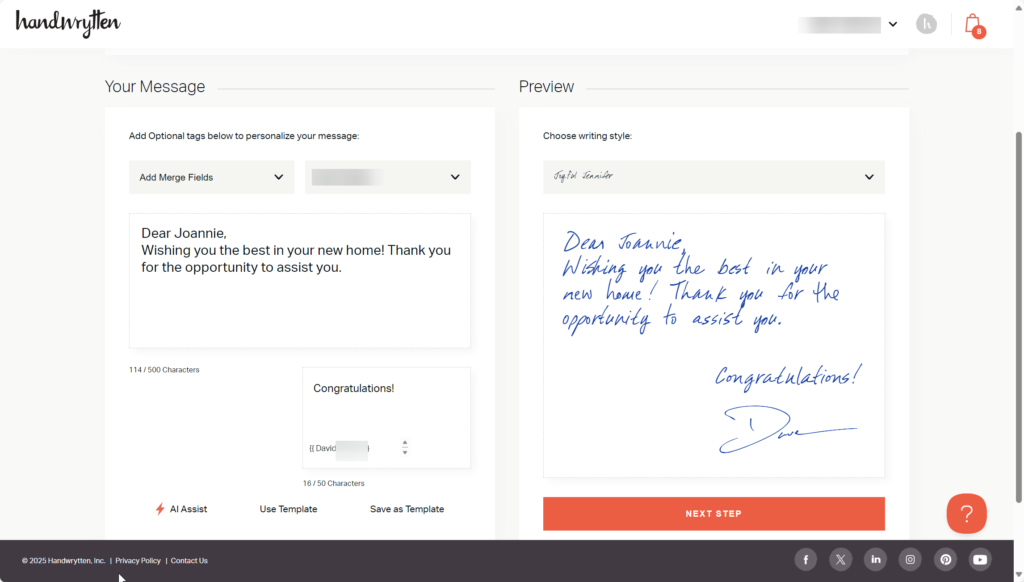
The survey also found that only phone calls outweighed handwritten letters when it comes to being “most meaningful.” Again, makes sense to me.
Any of my readers who have been reading my work for a while know that I’m a strong advocate for direct mail. It should be part of any strategic marketing campaign and is even more effective when connected to other media types, such as landing pages and email.
My career started in marketing for real estate companies, and it’s always been my experience that direct mail is more consistent in its impact than robo-calling, AI texting and, by all means, purchased leads. It undercuts the digital noise, spam regulations and lack of attention given to inboxes, and it never comes with a “report to spam” option a mere click away.
Robots are here, people. We might as well put pens in their hands.
Have a technology product you would like to discuss? Email Craig Rowe
Craig C. Rowe started in commercial real estate at the dawn of the dot-com boom, helping an array of commercial real estate companies fortify their online presence and analyze internal software decisions. He now helps agents with technology decisions and marketing through reviewing software and tech for Inman.
This post was originally published on this site
by Rachael Hite | May 23, 2025 | Industry, News Feed
Bigger. Better. Bolder. Inman Connect is heading to San Diego. Join thousands of real estate pros, connect with the Inman Community, and gain insights from hundreds of leading minds shaping the industry. If you’re ready to grow your business and invest in yourself, this is where you need to be. Go BIG in San Diego!
In a push to reverse declining birthrates that sounds suspiciously like The Handmaid’s Tale, the current presidential administration, backed by advocates including JD Vance and Elon Musk, are promoting policies designed to “help or convince women to have more babies,” according to recent reporting in The New York Times.
It’s no secret that the current administration loves to talk about women, babies and how “great” everything will be for women in the near(?) future. But the reality is that moms and potential moms can’t house, support, feed and educate their families on enthusiasm alone.
TAKE THE INMAN INTEL SURVEY FOR MAY
There is big business in “Momopoly.” Having children impacts every aspect of our current and future economy. Credit Karma released an estimate in April based on original projections by the Department of Agriculture, showing that if a family were to have a child in 2025, it would cost $318,949 to raise the child to 18. This means a family would need an additional $18,761 a year of income to raise a child comfortably.
Let’s break down the incentives offered and what moms need to help make this new “baby boom” happen.
A house with a picket fence and good schools
In this economy, finding your dream home is unrealistic for most Americans living paycheck to paycheck, who cannot find sufficient affordable housing.
JP Morgan released its housing outlook in February, and it cited several issues that real estate agents are very familiar with: high interest rates, new construction that has been underbuilt against the demand, not enough multifamily housing options, and fewer people moving because they are “rate locked.”
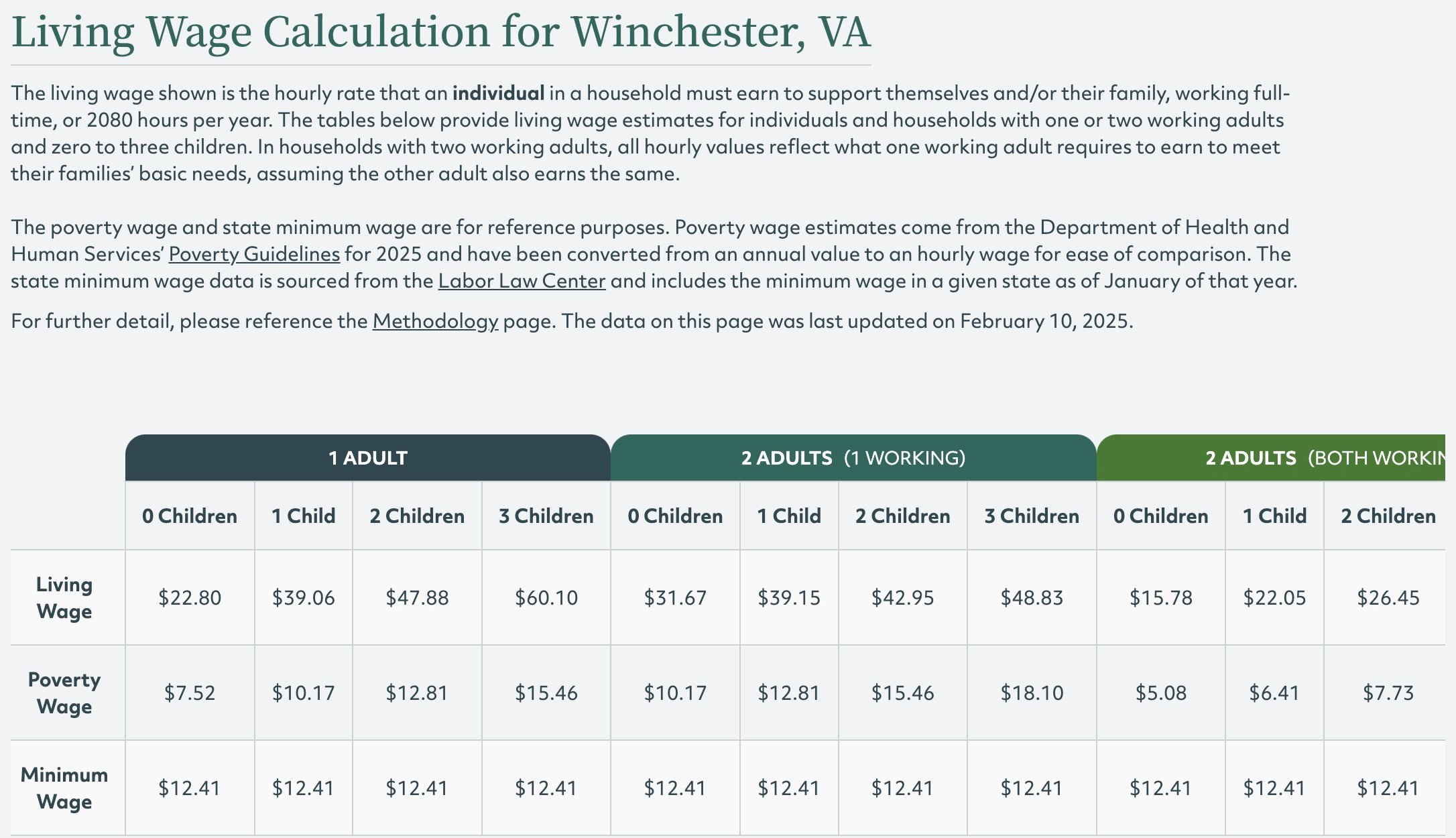
For kicks and giggles, I used the Living Wage Calculator to estimate the household income that we would need to raise a family of four in our rural suburban town, about 60 minutes outside of Washington, D.C.
Finding a modest three-bedroom, two-bath home is a challenge. Even a small home would likely cost over $300,000. This recently listed home is just over 1,000 square feet and will likely be under contract in days.
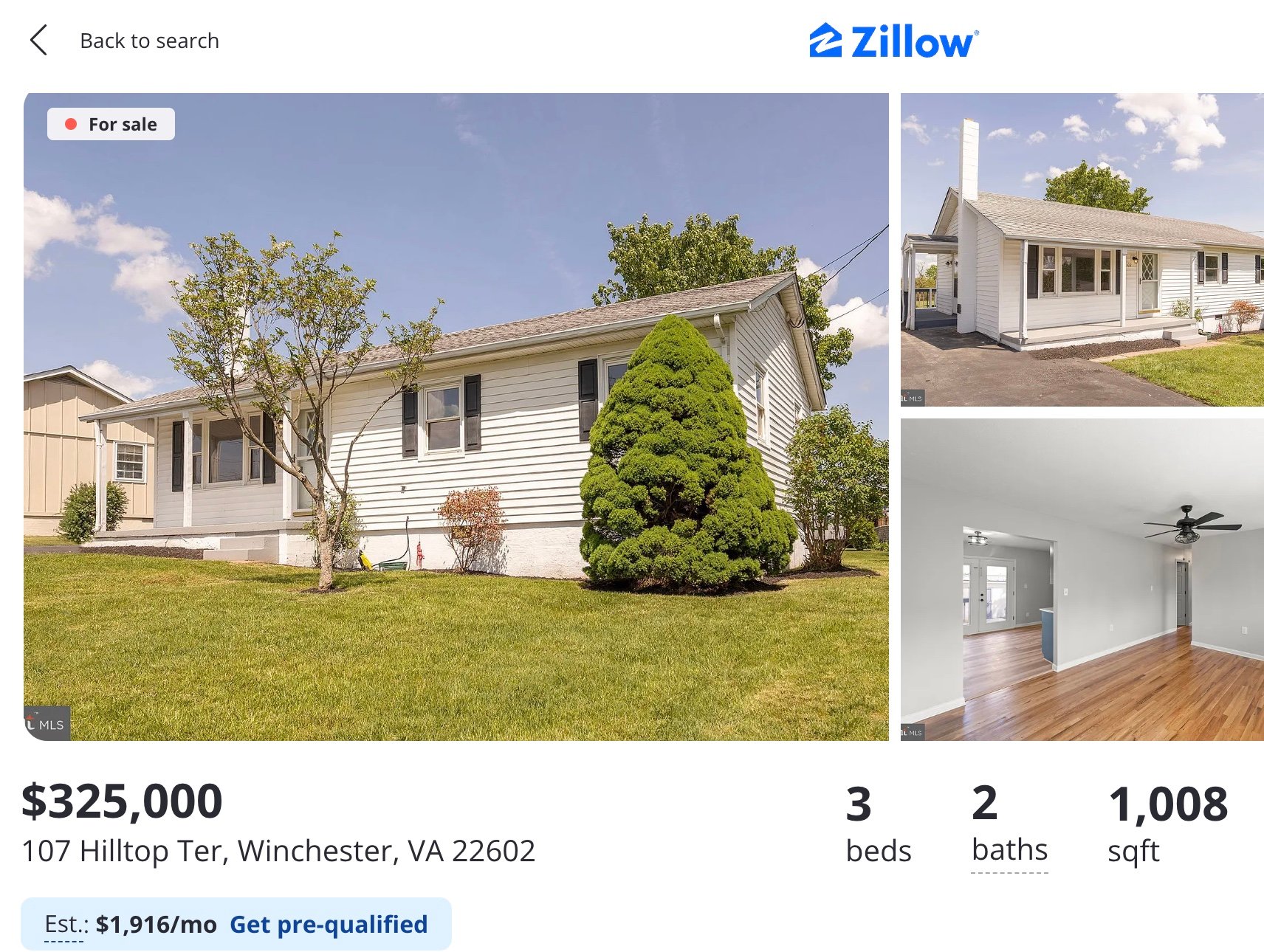
To qualify for a conventional mortgage, either one or both working adults would need to have an income of over $100,000 and a hefty down payment.
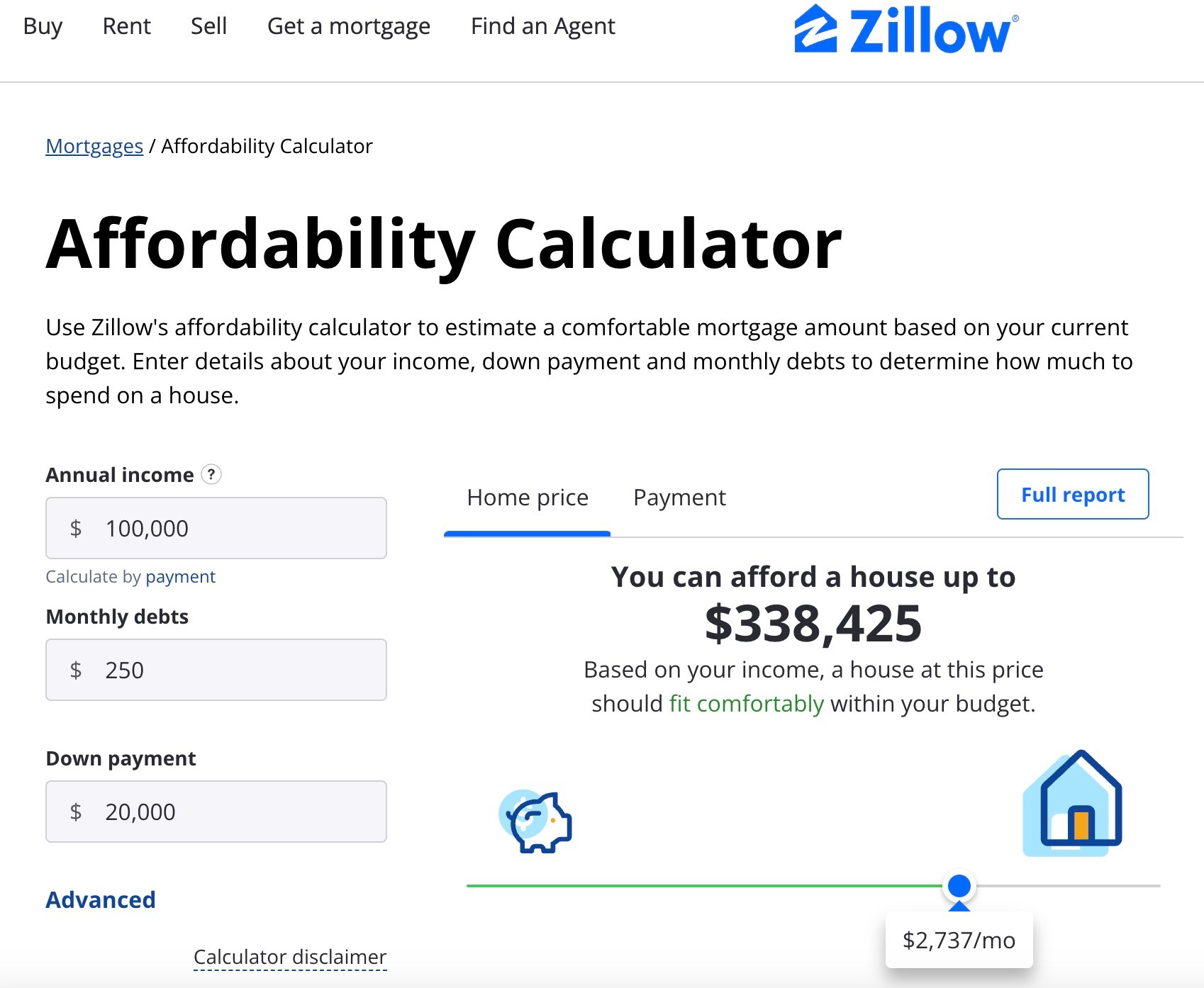
This means that one or both adults need to be working in middle to manager-level jobs in our area to have the income even to come close to supporting the purchase of this modest home.
I’m a rich girl, but this has gone too far
On average, managers in Winchester, Virginia, make around $124,000, but the reality is that we all cannot be managers. Factor in how much child care is (and the waiting lists) in our area, so we can work to pay the mortgage, or my household would have to make the hard call of who would have to stay home with the kids.
A popular blog called MyKidReports.com estimates that infant child care in my area for five days a week could cost the following:
Full-day rates for infant daycare in Virginia
- For 5 days per week: $1,000-$2,000 per month
- For 3 days per week: the range is $600-$1,200 per month
- For 2 days per week: the range is $400-$800 per month.
Full-day rates for toddler daycare in Virginia
- For 5 half-days: per week $1,000-$1,500 per month
- For 3 half-days: per week $600-$900 per month
- For 2 half-days: per week $400-$600 per month
Full-day rates for preschool in Virginia
- For 5 days per week: $2,000-$3,000 per month
- For 3 days per week: $1,500-$2,250 per month
- For 2 days per week: $1,000-$1,500 per month
Full-day rates for Pre-K in Virginia
- For 5 days per week: $400-$1,000 per month
- For 3 days per week: $240-$600 per month
- For 2 days per week: $160-$400 per month
The incentives being offered
I know many women are asking if there was even a woman in the room when these incentives, developed by the Trump administration to solve America’s slowing birth rates, were being floated around the room before being released to the press.
Incentives like classes on women’s anatomy and natural conception practices, a $5,000 baby bonus, expanding IVF access (which is now in conflict with many states’ current abortion laws) and the potential of earning a medal for having six or more children are not only tone deaf, but essentially useless to American women who are interested in expanding their families.
What the hell are we talking about here?
The March of Dimes currently rates American health care services for baby and maternal health care in the U.S. with a D+ rating. Not only is having a baby costly in terms of health costs associated with pregnancy, childbirth and postpartum care, but the average total is $18,865, and the average out-of-pocket payments total $2,854 for women enrolled in large group plans.
Childbirth is dangerous, and many women have no paid maternity leave to recover from childbirth.
I know many women who would love to have more children, but friends, as I have pointed out before, the math isn’t mathing.
So what incentives would make sense?
This isn’t rocket science; women have been asking for these incentives for decades, but policymakers continuously try to come up with everything but what American families need for success.
- Building and offering affordable housing with tax incentives
- Paid maternity leave
- Affordable health and maternity care services that are safe and based on science
- Affordable childcare
- Flexible work week and remote work options to support busy families
- Affordable before-and-after-school childcare and summer camp options for school-age children
All moms deserve a medal
If you have ever battled the parent drop-off line, been vomited on multiple times, answered the dreaded what’s-for-dinner question, and sat on the sidelines freezing as you watch the kiddo run up and down the field, you deserve a medal.
For working moms, especially those trying to figure out how to get to work on time, have childcare and still be everything to everyone, the mom’s job is not easy, but the rewards are so very special.
Real talk: If America wants more moms, our country needs to make women feel safe, welcome and heard.
We need safe schools so we don’t have nightmares about sending our babies into a mass shooting.
We need affordable housing so we can avoid living in poverty as we try to make ends meet and have enough room to grow.
We need to make adoption more accessible and affordable so the children who are already here in foster care have more opportunities for a better life.
We must treat existing humans better and improve the quality of life here.
More babies? Better policy and programs first. That’s the real incentive that women need.
Rachael Hite is a seasoned housing counselor and thought leader in the real estate industry. Connect with her on Instagram and LinkedIn.
This post was originally published on this site
by Matt Carter | May 22, 2025 | Industry, News Feed
Bigger. Better. Bolder. Inman Connect is heading to San Diego. Join thousands of real estate pros, connect with the Inman Community, and gain insights from hundreds of leading minds shaping the industry. If you’re ready to grow your business and invest in yourself, this is where you need to be. Go BIG in San Diego!
Shares in mortgage giants Fannie Mae and Freddie Mac soared Thursday after President Trump posted on his social media platform, Truth Social, that he’s giving “very serious consideration” to “bringing [both companies] public.”
Fannie and Freddie are already publicly traded on an over-the-counter market. But investors interpreted Trump’s comments to mean that the federal government will soon put forward a plan to restructure the companies — perhaps generating a windfall for the government and existing investors in the process.
TAKE THE INMAN INTEL INDEX SURVEY FOR MAY
There’s been talk that the government could invest its stake in Fannie and Freddie into a sovereign wealth fund that would provide investors who fund most home loans reassurance about continued government backing.
Treasury Secretary Scott Bessent has endorsed the idea of creating a U.S. sovereign wealth fund, and acknowledged in March that the government’s stakes in Fannie and Freddie — which the Congressional Budget Office estimates are worth about $270 billion — is one of a number of government assets that could fund it.
One way the Trump administration could monetize its stake in Fannie and Freddie would be to buy out public common shareholders — including billionaire Bill Ackman — and then issue preferred shares that pay dividends, Whalen Global Advisors LLC Chairman Christopher Whalen told Yahoo Finance.
That plan would leave the U.S. as the sole voting shareholder of Fannie and Freddie, and “give Treasury all the cash they need,” Whalen said.
“The reason they’re talking about this is they need the cash in order to make their tax cuts and their budget reconciliation bill work,” Whalen said.
An industry veteran, whose past experience includes senior research positions at Kroll Bond Rating Agency and Carrington Holding Co., Whalen has connections at Fannie Mae and Freddie Mac.
Trump said he’ll be speaking to Bessent, Secretary of Commerce Howard Lutnick, and Bill Pulte, whom he appointed to oversee Fannie and Freddie’s federal regulator, “making a decision in the near future.”
“Fannie Mae and Freddie Mac are doing very well, throwing off a lot of CASH, and the time would seem to be right,” Trump posted Wednesday.
Hoping for a plan like the one laid out by Whalen, investors bid common shares in Fannie Mae and Freddie Mac up by more than 40 percent Thursday, to new 52-week highs. Preferred shares in Fannie and Freddie, which were delisted in 2010 but still trade over the counter, posted more modest double-digit gains.
The grandson of PulteGroup Inc. founder William J. Pulte, Bill Pulte in March appointed himself the chairman of Fannie Mae and Freddie Mac’s boards in a purge in which 14 board members were removed from their positions.
Banker, investor and lawyer Omeed Malik — dubbed “MAGA world’s premier financier” and a “close friend” of Donald Trump Jr. by New York Magazine — joined Fannie Mae’s board in April.
Democrats, including Sen. Elizabeth Warren, questioned the legality of Pulte’s purge of Fannie and Freddie’s boards. They’ve been keeping an eye on the administration’s plans for the mortgage giants, and some are wary of plans to create a sovereign wealth fund and the Trump family’s crypto investments.
The challenge for presidents who have tried to release Fannie and Freddie from conservatorship in the past — including Barack Obama and Trump in his first term — is how to restructure the companies to not only shield taxpayers from risk, but protect homebuyers from paying higher mortgage rates.
“My fundamental concern is that without a well-defined vision, exit from conservatorship could cause havoc in financial markets and in the U.S. housing market,” the Urban Institute’s Laurie Goodman wrote in an April analysis. “And I do not believe there is any consensus on what this vision should be.”
Real estate industry groups like the National Association of Realtors the Mortgage Bankers Association have proposed a “utility-style” model for Fannie and Freddie that preserves their mandate to support affordable housing.
Fannie and Freddie have been in government conservatorship since 2008, when the Bush administration determined they needed to be bailed out, with the government taking a large stake in the companies to keep them afloat during the 2007-2009 housing crash and Great Recession.
During Trump’s first term as president, his administration laid the groundwork for releasing Fannie and Freddie from government conservatorship but were, ultimately, unable to finish the jobs.
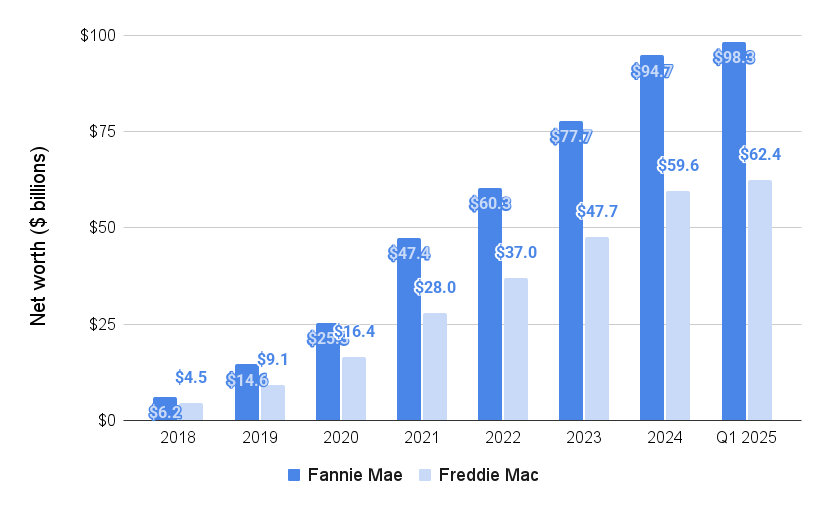
One important step taken was the first Trump administration’s decision in 2019 to discontinue the Treasury’s “sweeps” of Fannie and Freddie’s profits, which allowed the companies to begin rebuilding their net worths, which totalled $161 billion as of March 31.
Fannie and Freddie rebuilding net worth
Goodman estimates that Fannie and Freddie are about $132 billion short of the net worths they would need to meet the capital requirements Congress has mandated for privatization — a problem the Trump administration wouldn’t have to deal with if it buys out common shareholders, as proposed by Whalen.
Fannie and Freddie don’t make loans themselves, but protect investors who buy mortgage-backed securities (MBS) from losses. The guarantees Fannie and Freddie provide to MBS investors make mortgages a safe bet for institutional investors who are willing to accept modest returns that keep borrowing costs low.
Together, the companies were guaranteeing payments to investors on $6.74 trillion in single-family mortgages as of March 31. When times are tough, defaults on those loans can take a heavy toll on Fannie and Freddie’s bottom lines.
But in good times, the companies generate big profits that have helped them repay a $191 billion taxpayer bailout. The guarantee fees that the companies charge lenders helped the companies generate combined 2024 profits of $28.9 billion.
Get Inman’s Mortgage Brief Newsletter delivered right to your inbox. A weekly roundup of all the biggest news in the world of mortgages and closings delivered every Wednesday. Click here to subscribe.
Email Matt Carter
This post was originally published on this site
by Richelle Hammiel | May 22, 2025 | Industry, News Feed
Anywhere Real Estate is introducing a new way for its agents to connect with clients with no paper cards, no app downloads and no hassle. Through a new enterprise agreement Real Grader, agents now have access to InstaCard, a digital business card designed to streamline networking.
Bigger. Better. Bolder. Inman Connect is heading to San Diego. Join thousands of real estate pros, connect with the Inman Community and gain insights from hundreds of leading minds shaping the industry. If you’re ready to grow your business and invest in yourself, this is where you need to be. Go BIG in San Diego!
Anywhere Real Estate is introducing a new way for its agents to connect with clients — no paper cards, no app downloads, no hassle. Through a new enterprise agreement with online reputation manager and tech company Real Grader, agents now have access to InstaCard, a digital business card designed to streamline networking and grow their digital footprints, the company informed Inman.
TAKE THE INMAN INTEL SURVEY FOR MAY
Real Grader, a 2023 member of NAR REACH, first landed an enterprise deal with Anywhere in August 2024. Now, the brand is taking it a step further, giving agents across the entire Anywhere brand, including Coldwell Banker, Sotheby’s International Realty and The Corcoran Group, access to yet another one of its tools geared towards empowering agents.

Alex Montalenti | Real Grader CEO
InstaCard was created by Real Grader in 2019 to bring together key elements of an agent’s professional profile, including contact information, bios, reviews, listings and more, into one shareable digital card.
According to Real Grader CEO Alex Montalenti, Real Grader has been a part of the industry for over two decades and understands the need to bridge the gap between technology hurdles, and InstaCard does just that.
“InstaCard empowers agents with the tools to connect instantly and effectively,” Montalenti said in a statement. “This product can equip agents to grow their networks, showcase their professionalism and streamline their digital presence with cards that are pre-made for agents — no tech expertise required.”
Here’s how it works:
When meeting a prospective client, an agent can simply pull up a QR code on their phone. With one quick scan, the client is directed to the agent’s InstaCard, where they can find agent details, property listings and more, all in one place.
Some of the key features of InstaCard include:
- Sharing instantly: Connect via QR codes, text, email or social media
- Building reputation: Highlight Google Reviews and boost credibility
- Customizing designs: Present a professional and branded image
- Capturing leads: Collect and manage client details
- Integrating video: Add personalized videos or property tours

Source: Real Grader
InstaCard Pro includes expanded features for those who want to step it up a notch, including Google review integration, custom menu items, custom QR codes, links to property search and home valuations.
“Our mission is to give agents the tools to stand out and stay relevant in a digital-first world,” Montalenti said. “By integrating InstaCard into the Anywhere ecosystem, we’re giving thousands of agents a modern edge that’s fast, flexible and built for results.”
Email Richelle Hammiel
This post was originally published on this site