by Christy Murdock | Jul 31, 2024 | Industry, News Feed
CHICAGO (August 1, 2024) – The National Association of Realtors® reminds members, real estate professionals, and consumers that on August 17, 2024 the practice changes following NAR’s Settlement Agreement that would resolve claims brought on behalf of home sellers related to broker commissions will be implemented across the country.
NAR recommends all MLSs implement practice changes by August 17. Realtor® MLSs (those owned exclusively by one or more Realtor® Associations) must implement the changes by this date to remain in compliance with NAR policy.
Under the settlement, the following practice changes will take effect:
- Offers of compensation will be prohibited on Multiple Listing Services (MLSs). Offers of compensation will continue to be an option consumers can pursue off-MLS through negotiation and consultation with real estate professionals. Offers of compensation help make homeownership and the benefits of professional representation more accessible to buyers—especially first-time homebuyers—increase homeownership opportunities for historically underserved groups, and benefit sellers by expanding the potential buyer pool and ensuring they receive the best offer possible for their property.
- Agents working with a buyer must enter into a written buyer agreement before touring a home. The practice changes do not require an agency agreement or dictate any type of relationship. NAR encourages all members to address form changes and prepare to educate real estate professionals and consumers about revised forms as soon as possible ahead of August 17. NAR policy does not dictate terms of buyer agreements, but NAR has created resources to assist with implementation of the settlement terms—such as tips on clarity and emphasizing consumer choice and a “Written Buyer Agreements 101” resource.
“NAR members are dedicated, intelligent, and highly adaptable experts in their fields—that’s why Realtors® are such an integral part of the homebuying and selling process,” said Kevin Sears, President of NAR. “These changes help to further empower consumers with clarity and choice when buying and selling a home. As the August 17 practice change implementation date approaches, I am confident in our members’ abilities to prepare for and embrace this evolution of our industry and help to guide consumers in the new landscape.”
Consumers can find additional information on what these changes mean for their homebuying and selling experiences in NAR’s buyers and sellers guides. For NAR members, the practice changes are outlined in detail here, and detailed information is available in NAR’s FAQ. Please visit facts.realtor for the latest updates on the settlement and practice changes.
About the National Association of Realtors®
The National Association of Realtors® is America’s largest trade association, representing 1.5 million members involved in all aspects of the residential and commercial real estate industries. The term Realtor® is a registered collective membership mark that identifies a real estate professional who is a member of the National Association of Realtors® and subscribes to its strict Code of Ethics.
# # #
by Chris Morrison | Jul 31, 2024 | Industry, News Feed
HAPPENING NOW! At Inman Connect Las Vegas, July 30-Aug. 1, 2024, the noise and misinformation will be banished, all your big questions will be answered, and new business opportunities will be revealed. JOIN US VIRTUALLY.
Uncertainty in the housing market has failed to slow down Compass this year, with a new earnings report showing the brokerage’s revenue, transactions and agent count all made significant gains in the second quarter — results CEO Robert Reffkin described as a best-ever performance.
In an earnings report Wednesday, Compass revealed it brought in $1.7 billion in revenue between April and June. That’s a 14 percent increase compared to the second quarter of 2023. The company attributed the higher revenue to an 11.4 percent increase in transactions — a number the brokerage achieved even though, the report notes, “transactions declined by 3.3 percent for the entire residential real estate market.”
TAKE THE INMAN INTEL INDEX SURVEY FOR JULY
The jump in revenue also helped Compass turn a profit of $20.7 million during Q2 — a turnaround from the $47.8 million net loss the company suffered during the same period a year earlier.
The new report also shows that at the end of the second quarter, Compass had a total of 16,997 principal agents. That’s up considerably from the 13,698 it had at the end of Q2 2023. The company noted in the report that it added “543 principal agents organically and approximately 2,375 principal agents from the acquisitions of Latter & Blum and Parks Real Estate in Q2 2024.”

Robert Reffkin
In a call with investors Wednesday afternoon, Reffkin described Q2 by saying “we had the best performance we ever had as a company.” In the report, he added that he was “particularly pleased” with the brokerage’s latest financial results.
“Capitalizing on the structural advantages created by our end-to-end proprietary technology platform, national scale, top agent network and exclusive inventory, we have positioned Compass for what we believe will be significant upside when the market begins to recover,” Reffkin said in the report.
In addition to revenue and transactions, the report further shows that Compass saw free cash flow of $40.4 million in the second quarter. That’s significant because Compass has a long-stated goal of becoming free cash flow positive. The company originally believed it would hit that target last year but, amid a tough market, ultimately missed. However, Q2 is the second consecutive quarter Compass has managed to have positive free cash flow, suggesting it may be on track to hit its goal this year.
During Wednesday’s investor call, Compass Chief Financial Officer Kalani Reelitz confirmed that the company expects to be free cash flow positive for all 2024. However, free cash flow will only be “slightly” positive in Q3 and is likely to be negative in Q4. Reelitz attributed these likely results to seasonality.
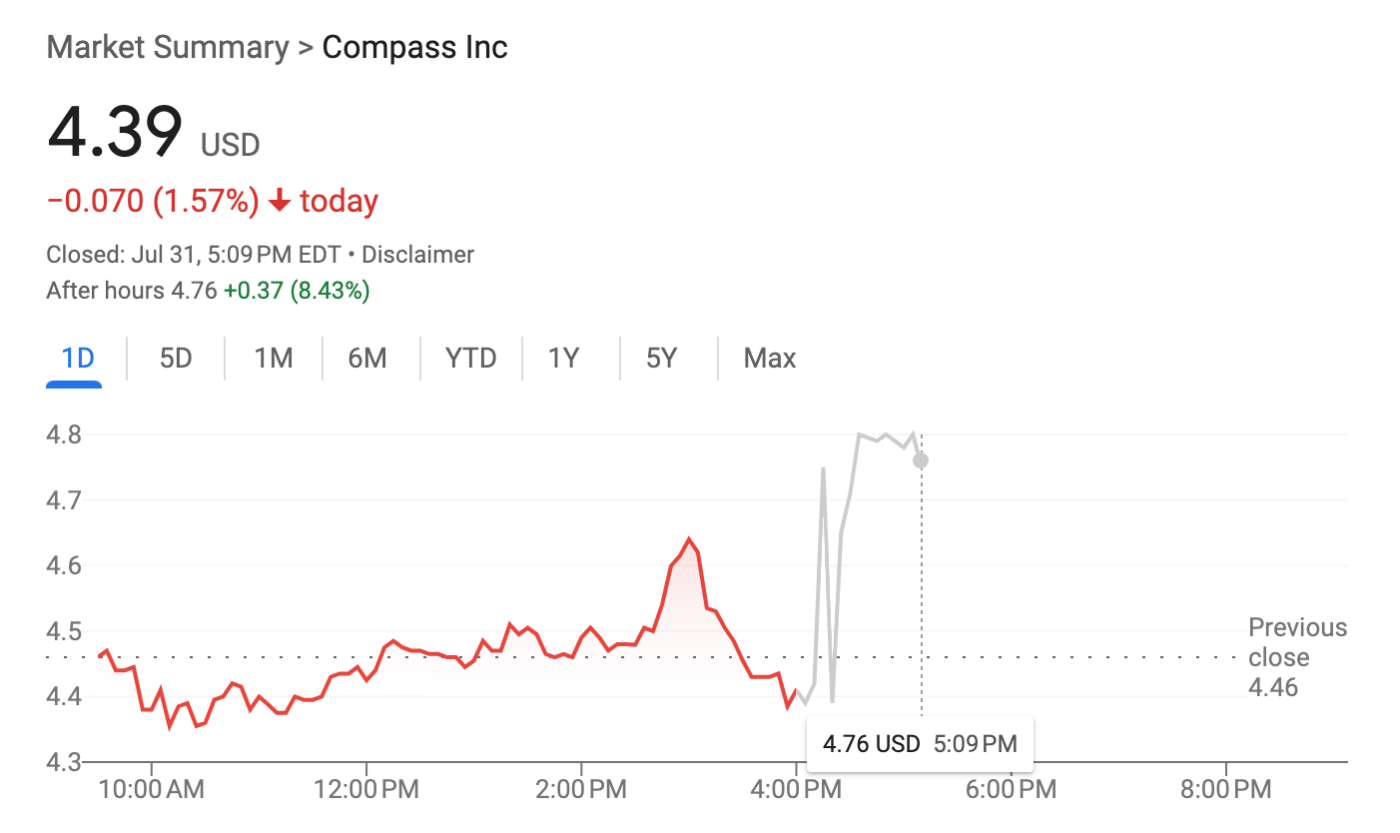
Heading into Wednesday’s earnings report, Compass shares were trading in the mid $4 range. That was down slightly for the day and up slightly for the week. But it was up significantly — about 24 percent — from where shares were at the beginning of the year.
Shares fluctuated but ultimately made significant gains in after-hours trading following the publication of Wednesday’s earnings report.
Credit: Google
Compass had a market cap of $2.17 billion as of Wednesday afternoon.
Compass last reported earnings in May. At the time, it revealed that it earned $1.05 billion in revenue between January and March. That number represented a 10 percent jump compared to the first quarter of 2023. In the May report, Compass attributed the higher Q1 revenue to a 7.1 percent increase in transactions.
Aside from financial numbers and agent counts, Wednesday’s report further states that Compass had a national market share of 5.13 percent in the second quarter of the year. The report describes that number as “an increase of 50 basis points compared to Q2 2023 and an increase of 37 basis points sequentially from Q1 2024.”
During his investor call, Reffkin said Compass wants to achieve 30 percent market share in its top 30 markets by 2026. The company calls this plan its “30-30 Vision” and, according to Reffkin, can achieve that objective thanks to various “structural advantages.” Those advantages include a unique tech platform, a national scale, a top agent network, and the “depth and breadth of our inventory,” according to Reffkin.
Reffkin also said Compass plans to make the company the “required destination for real estate,” with “more inventory than third-party websites.”
Compass’ website already includes a portal, which years ago caused some tension between the company and Redfin, which is also a portal-brokerage operator. However, in more recent years, Compass has largely been absent from the discussion of real estate portals and the so-called portal wars — which have become crowded thanks to the entrance of CoStar. Reffkin’s comments, however, suggest that Compass may have an appetite to vie for portal traffic after all.
Asked how close Compass is to achieving 30 percent market share in its top 30 markets, Reffkin said during the call that “we’re more than halfway there.”
Later during the investor call, Reffkin weighed in on antitrust commission lawsuits. Among other things, he said the settlements seem to have shown the benefits of working at a large real estate company, and that Compass is seeing increased interest from agents who want to join the brokerage.
Reffkin also said that since the National Association of Realtors agreed to settle multiple antitrust commission suits, there has not been a noticeable change in the number of sellers offering buyer agent commissions. Most sellers also continue to offer buyer agent commissions of 2 percent or more.
According to Reffkin, these findings suggest the commission suit settlements — and the August deadline for various new NAR rules — will not have a significant deleterious impact on real estate professionals, and that the biggest fears about the situation have “simply not materialized.”
“The data clearly shows,” Reffkin said, “that sellers continue to value incentivizing buyer agents.”
Update: This story was updated after publication with additional information from Compass’ earnings report, and with commentary from the company’s investor call.
Email Jim Dalrymple II
by Matt Carter | Jul 31, 2024 | Industry, News Feed
A new draft seller contract that eXp Realty is distributing to its brokers and agents is largely consistent with a newly issued set of criteria from the Consumer Federation of America, the watchdog group said this week.
HAPPENING NOW! At Inman Connect Las Vegas, July 30-Aug. 1, 2024, the noise and misinformation will be banished, all your big questions will be answered, and new business opportunities will be revealed. JOIN US VIRTUALLY.
With just over two weeks to go until a key deadline, a consumer advocacy group has unveiled a new set of guidelines for seller contracts intended to help protect consumers and ensure full compliance with the NAR settlement requirements.
The Consumer Federation of America (CFA) on Wednesday released its proposed criteria for seller contracts, which are largely consistent with guidance the group issued on buyer contracts earlier this month.
The organization also provided to Inman a copy of an eXp Realty seller contract that is currently being distributed to eXp brokers and agents. This contract is an example of a document that the CFA says is largely consistent with its criteria.
“These criteria will assist regulators, consumer groups, and the industry itself in evaluating the fairness of new seller contracts,” CFA senior fellow Stephen Brobeck said in a statement. “Recent CFA research has shown that these contracts have the potential to harm or help home sellers depending on their clarity and content.”
TAKE THE INMAN INTEL INDEX SURVEY FOR JULY
Among other provisions, the eXp seller contract includes language that spells out explicitly that the buyer may request a seller concession that would cover a variety of costs, including the “buyer’s broker fee.” It also states that all seller concessions are negotiable, and are not required or fixed by law.
CFA described the eXp contract as “understandable and fair to consumers.” However, the eXp document did appear to depart from some of the CFA standards in a few meaningful ways.
While CFA proposes the seller’s commission “should always be stated as a dollar figure or hourly rate,” the eXp contract provides options to define the seller’s commission in terms of a dollar value, a percentage of the sale price, or an empty “other” field that can be filled in by the broker or client.
Read the CFA’s full list of criteria for evaluating brokerage homeseller contract forms below.
Form: Is the contract readable and understandable?
- Length: The contract should not include marginal provisions designed solely to protect the interest of the broker, and the agency agreement should be in a separate document.
- Type size: Most courts recommend 12-point. Any size smaller will be difficult for some people to read.
- Organization: The most important information, including compensation arrangements, should be at the beginning of the document and clearly labeled.
- Plain language: The contract should be written so that it can be understood by homesellers. It should not contain words and language that can be understood only by lawyers.
Content: Is the content of the contract fair to home sellers?
- Length of contract: The contract should clearly state when it will end.
- Termination of contract: Brokers have the right to terminate contracts at any time; sellers should have the same right with no fees charged.
- Compensation, continuing obligation: A seller can be obligated to compensate a broker who showed a home that was purchased after termination of the contract. But this obligation should last for a reasonable period of time, no more than 60 days.
- Compensation, disclosure: The contract should state prominently that the broker fee is not set by law and is fully negotiable.
- Compensation, commission: The listing agent’s commission should be completely separate from any concession to a buyer that may include funds used to compensate the buyer’s agent. This commission should always be stated as a dollar figure or hourly rate.
- Compensation, fees: In a home sale, any additional fees should be deducted from the commission.
- Compensation, when owed: Only upon successful closing of the sale.
- Seller concessions: Concessions should never include a dollar figure representing buyer agent compensation. Instead, the contract should simply indicate whether the seller is prepared to consider negotiating concessions.
- Unrepresented buyers: Unrepresented buyers must be shown the property. The contract can include a provision for a modest administrative fee (expressed in dollars) if a buyer is unrepresented and does not cover this cost. This provision should be initialed by the seller.
- Buyer offers: The contract should state that all written offers from buyers will be shown to and decided on by the seller.
- Dual agency: Dual agency should not be pre-approved by the contract. If a dual agency situation arises—e.g., a buyer wants to purchase a listing of the seller’s broker—written seller approval should be secured at this point.
- Seller remedies: There should be no limits on seller remedies. Sellers should not be required to submit first to mediation or arbitration to pursue a grievance.
Read the full eXp seller contract language at this link.
Email Daniel Houston
by Brad Inman | Jul 31, 2024 | Industry, News Feed
Delian Asparouhov, a partner at Founders Fund, talked on Wednesday about his plans to manufacture drugs in space and urged real estate agents to lean into tech.
HAPPENING NOW! At Inman Connect Las Vegas, July 30-Aug. 1, 2024, the noise and misinformation will be banished, all your big questions will be answered, and new business opportunities will be revealed. JOIN US VIRTUALLY.
When Delian Asparouhov was just a boy, his parents moved from Bulgaria to the U.S. in the wake of the Soviet Union’s collapse. The experience, Asparouhov said Wednesday on stage at Inman Connect Las Vegas, made him a believer in capitalism and the importance of commercial enterprise.
Growing up in the U.S., Asparouhov — who today is a partner at venture capital firm Founders Fund — also became a fan of science fiction and aerospace — so much so that, when he reached adulthood, he began looking for ways to work in the industry. Asparouhov specifically wanted to find ways to make money in space, but, he recalled to the packed Connect ballroom, the technology just didn’t exist to make commerce viable miles above the earth’s surface.
TAKE THE INMAN INTEL INDEX SURVEY FOR JULY
Then something changed. Asparouhov said that in 2018 and 2019, Elon Musk’s Space X began deploying reusable rockets. He compared the development to the advent of the railroad, which once enabled industrialists like the Rockefellers to ship oil with new efficiency.
“Today, in 2024, these types of rockets launch and land every 36 hours,” Asparouhov said of Space X’s technology. “Somebody clearly built the railroads to space; somebody just had to figure out what the oil was going to be.”

Delian Asparouhov on stage at Inman Connect Wednesday. Credit: AJ Canaria Creative Services
Over the ensuing years, Asparouhov focused on ways to harness that new technology and identify the “oil” to be won by working in space. He eventually hit upon pharmaceutical manufacturing. The idea, he explained, is that without gravity, drug companies can do much more precise chemistry, to the point that at least one popular drug could be converted from an IV drip to an at-home syringe system.
The idea could be revolutionary, but it also sounds ludicrous. Manufacturing drugs in space?
But, it turns out, Asparouhov has apparently already done it. While on stage, he showed the audience pictures of an object that looked like a Starlink satellite. However, he added, it was in fact a capsule that created drugs while in orbit and returned this last February.
“The worst environment they saw,” he joked about the drugs’ incredible journey, “was the UPS truck in Houston.”
Though Asparouhov’s efforts to create an orbital drug manufacturing business are unrelated to real estate, he has invested in real estate startups and said that similar principles apply across industries. The point of his presentation, in other words, was that new technologies have the ability to revolutionize industries.
In space, that new technology was reusable rockets. A century ago, it was the railroads. And today, Asparouhov argued, it could be artificial intelligence.
“It’s as fundamental as the steam engine,” Asparouhov argued.
He consequently urged real estate professionals to lean into and understand new technology, and to be prepared for the changes it might bring.
“There will be fewer agents in 10 years than there are today,” he said, “but almost certainly those agents will be able to handle more client volume.”
Email Jim Dalrymple II
by Michael Zaransky | Jul 31, 2024 | Industry, News Feed
In his first Inman Connect appearance since 2021, Zillow CEO Rich Barton discussed accelerating tech innovation and the next evolution of the residential portal experience.
HAPPENING NOW! At Inman Connect Las Vegas, July 30-Aug. 1, 2024, the noise and misinformation will be banished, all your big questions will be answered, and new business opportunities will be revealed. JOIN US VIRTUALLY.
When Zillow launched in 2006, the site looked nothing like it does today.
There were no listings, no interactive videos and floor plans, or photos that homebuyers and daydreamers could scroll through for hours on end. All the site offered was a comprehensive list of transaction histories that, with some algorithmic magic, turned into the Zestimate — the industry’s first automated valuation model (AVM).
“[It was an] unbelievably provocative, interesting feature that had not existed before,” Zillow CEO Rich Barton recalled Wednesday at Inman Connect Las Vegas. “That Zestimate fueled all kinds of voyeurism and fantasies. It was incredibly entertaining, which is one of the reasons we were mobbed.”
“But it turns out that it is also a critical piece of marketplace information for anyone in the process of moving,” he added. It was this kind of intermingling, this kind of yin and yang of entertainment and practicality that helped create what the Zillow brand is today: this big trusted consumer brand that stands for consumer empowerment and customer advocacy.”
TAKE THE INMAN INTEL INDEX SURVEY FOR JULY
Barton said the focus on consumer empowerment and advocacy is the key to success for Zillow and the entire industry as it strives to make the dream of a quick, frictionless homebuying experience a reality.
Although the atmospheric rise of artificial intelligence has stoked fear, Barton said focusing on consumer empowerment will ensure that agents will be able to accelerate through change rather than be consumed by it.
“We are accelerating, and that queasiness we’re all feeling is natural,” he said, recalling a recent experience he had racing at 140 mph on a closed BMW track. “As a species, we haven’t really had time to catch our breath and process the last lap around the track, which was the smartphone lap. And now we’re being told to accelerate on the next lap. Here comes AI, [and] around we go again.”
Barton said it’s time to accelerate past the “Portal 1.0 experience” and begin bringing order to a complicated “multi-party, multi-partner, multistage” transaction process by investing in technology, partnering with competitors, and staying in tune with what consumers and agents need to have a positive — even joyful — experience.
“You all may not know this, but less than half of our company’s revenue now comes from buyers agents, lead generation or original business model,” he said. “Our growth and opportunity as a company now comes from investing in this array of digital workflow, tools and technologies for the industry as a whole.”
“Showingtime has been a big success for us. Follow-up Boss, Listing Showcase dotloop, Aryeo … we’ve been putting together these products, building and putting together these products for quite some time,” he added. “We did not build, invest in and integrate these products to keep them inside the walled garden. We did it to make them broadly available and to power your businesses.”
Barton said the next iteration of residential portals will focus on coordination, integration and digitization — the three steps to making buying a home as easy as buying a latte.
“It’s not unlike Brad Inman’s latte transaction [keynote] from 2013. Who remembers that?” he said. “His vision was organizing this mess and saying moving should be as easy as buying a latte. Well, we’re getting there. We’re getting there. It’s taking a while, but we’re getting there.”
Although tech is a key component of bringing Inman’s latte vision to life, Zillow said the plan doesn’t work without people — tech developers and researchers, C-Suite leaders and agent partners.
“This would not be possible if we didn’t have great agent partners,” he said. “It would not be possible if we didn’t prioritize them, and it would not be possible if we weren’t helping drive real business for them.”
“As we accelerate faster to the future, I am really pleased that we are pitching a really big tent and inviting everyone underneath,” he added. “We do not believe this is a zero-sum game. We digitize the industry, and we all win. You grow, we grow, and our customers get what they want.”
Email Marian McPherson
by Inman Content Studio | Jul 31, 2024 | Industry, News Feed
CHICAGO (August 1, 2024) – The National Association of Realtors® today announced the roster of its 2025 Leadership Academy class. Twenty Realtors® from across the country have been chosen to participate in the 10-month program, which will prepare emerging state and local volunteers for future leadership positions at NAR.
“The Leadership Academy develops and prepares upcoming leaders to help shape the real estate landscape at the local, state and national levels,” said 2024 NAR President Kevin Sears, broker-associate of Sears Real Estate/Lamacchia Realty in Springfield, Massachusetts. “The diverse backgrounds and qualifications of this class are evidence of NAR’s commitment to inclusive growth, representation and professional development.”
The 20 Realtors® selected will participate in a diverse range of educational experiences as they join a nationwide community of volunteer leaders. During the 10-month journey, participants will learn the history, structure and inner workings of NAR while gaining key insights designed to prepare them to serve in prominent leadership positions at all levels of the association.
The 2025 NAR Leadership Academy roster is as follows:
- James Britto, California
- Nakia Brooks, Georgia
- Donna Cade, Georgia
- Omar Capellan, Florida
- William Curtis, Texas
- Esteban Flores, Texas
- Jennifer Flynn, New York
- Danielle Fontes, California
- Jennifer Higgins, California
- Jessica Kish, Indiana
- Betsy Laughlin, Colorado
- Caron Ling, Hawaii
- Tyson Lynch, Massachusetts
- Heather Mull, Virginia
- Lee Porter, Minnesota
- Jennifer Swendiman, Kentucky
- Jenni Viger, Georgia
- Tiea Vincent, Florida
- Kara Wisely, Florida
- Soo Yu, New Jersey
The program will begin in January 2025 and culminate in November 2025 at NAR NXT, The REALTOR® Experience in Houston, Texas. For more information about NAR’s Leadership Academy, including individual session summaries and resources for prospective 2026 applicants, visit nar.realtor/leadershipacademy. The application period for the 2026 class runs from November 4, 2024, through February 13, 2025.
About the National Association of Realtors®
The National Association of Realtors® is America’s largest trade association, representing 1.5 million members involved in all aspects of the residential and commercial real estate industries. The term Realtor® is a registered collective membership mark that identifies a real estate professional who is a member of the National Association of Realtors® and subscribes to its strict Code of Ethics.
# # #


