Despite an improvement in housing affordability, property sales continue to decline. Pending home sales dropped 5.7 percent year over year, Redfin reported Thursday.
HAPPENING NOW! At Inman Connect Las Vegas, July 30-Aug. 1, 2024, the noise and misinformation will be banished, all your big questions will be answered, and new business opportunities will be revealed. JOIN US VIRTUALLY.
Despite improvements in housing affordability, homebuyers are showing little interest as property sales continue to decline.
Pending home sales have dropped 5.7 percent year over year, the biggest decline in nine months, Redfin reported on Thursday. Mortgage-purchase applications are down 14 percent or 2 percent week-over-week.
Although it is becoming more affordable to purchase a home, prices and payments are still near record highs.
The median U.S. monthly house payment was $2,667 during the four weeks ending July 28, according to Redfin, the lowest level since March. Falling mortgage rates and sale prices are causing payments to decline.
The weekly average mortgage rate sits at 6.78 percent, down from May’s five-month high of 7.22 percent. The median home-sale price is down nearly $4,000 from its early July peak at $392,563.
Redfin agents report that some prospective homebuyers are waiting to learn the outcome of the upcoming election before purchasing a home.
A lack of desirable listings has also contributed to the decline of home sales.
New listings have shown the smallest increase since November, up 4 percent year over year. With nearly two-thirds of homes sitting on the market for 30 days without going under contract, it is fair to say that listings are not matching buyer expectations.
The small increase in listings can also be attributed to limited demand, though Redfin agents have seen a demand for turnkey homes in desirable neighborhoods.
Agents expect sales to pick up as mortgage rates are projected to decline. In comments yesterday, Federal Reserve Chair Jerome Powell dropped hints that the central bank may be ready to cut rates if it sees the economy weakening in the months ahead, possibly as early as September.
“Local buyers are still worried about affordability, especially since wages haven’t caught up with home-price growth and inflation has cut into their budgets,” Boise, Idaho, Redfin agent Nicole Stewart said. “But now that rates are declining, some fence-sitters are getting off the fence.”
Learn how this California-based broker-owner went from unpaid intern to agent to independent brokerage founder
HAPPENING NOW! At Inman Connect Las Vegas, July 30-Aug. 1, 2024, the noise and misinformation will be banished, all your big questions will be answered, and new business opportunities will be revealed. JOIN US VIRTUALLY.
After graduating college, I had a general interest in pursuing real estate as a career, but I wasn’t interested in joining a big-box brokerage to be a traditional residential real estate agent. I had a greater passion for building businesses and learning the ins and outs of the real estate industry as a whole.
I knew this would only come from hands-on experience in a smaller brokerage environment. I was able to break into the real estate industry as an unpaid intern at an independent brokerage in Los Angeles, Manhattan Pacific Realty.
During my time as an intern (and eventually as a licensed real estate agent), I learned everything from the inner workings of the financial operations of a brokerage to the pros and cons of different commission split structures, to how to be a good leader (kudos to my former broker, Richard Haynes), to scaling a business. This was the knowledge I needed to be able to take my next step as a real estate professional, which was starting my own brokerage.
What’s something you know now that you wish you knew when you started?
The ability to say no to clients. As a newly licensed agent, it’s hard to be selective about the people you choose to work with. As a young real estate agent, I was hungry to build my business to its greatest scale. As a result, I ended up working with everyone I could, including people who didn’t have realistic expectations about buying or selling property.
As I progressed in my career, I was able to narrow down my client list. Instead of working with everybody and anybody, I focused the majority of my day-to-day efforts on my closest clients who were actively buying and selling. This allowed me to not only strengthen my pre-existing relationships with these people but made my time that much more efficient.
The biggest point to newer real estate agents is to go broad and wide at the beginning of your career, and then start to hone in your day-to-day efforts as your real estate practice matures.
Tell us about a high point in your brokerage career
I’ve had many highs and lows in my real estate career, but there is one moment in time that sticks out as a highlight. I started my real estate career as an unpaid intern attempting to soak up all of the knowledge about the real estate industry. After a few months of being a licensed real estate agent (and many more months of being an unpaid intern) I ended up putting my first deal together.
I was representing a buyer who wanted to purchase a single-family home in Manhattan Beach, California, for its development potential. While my buyer was working through due diligence, it was discovered that this particular home sat very close to the neighbor’s lot line. So much so that it was unclear if this home could be torn down and rebuilt by my buyer.
At this point in time, I was about 10 months into my career and had been living off of savings. If this deal didn’t close, I was out of money (and probably out of the real estate business).
After an agonizing few weeks of due diligence with architects, contractors, and surveyors, this lot ended up clearing the neighbor’s lot by three inches, and my buyer was able to close on the property. That commission from my first sale allowed me to not only stay in the business but gave me incredibly valuable experience.
What’s your top tip for freshly licensed brokers?
As with any sales position, the effort that someone puts into building their real estate practice is directly correlated to the results they get out of it. The freedom and day-to-day flexibility this career offers can be both a gift and a curse. If someone is a self-starter with great time management skills and a people person, that individual would have a great foundation of skills to work off of.
However, building a sustainable business is all about consistency — especially through the ups, the downs and the uncontrollable. Having the ability to pivot your strategies with buyers and sellers based on current market conditions, interest rate fluctuations and macroeconomic factors are all characteristics of excellent real estate professionals.
What makes a good leader?
A good leader has the ability to be empathetic with the people that they are leading. Whether those people are members of their team, their employees, or their peers within the industry. Having the ability to not only connect with people on an emotional level, but to understand their strengths, their weaknesses, and their overall “why” allows someone to lead at a much higher level.
It’s also essential that good leaders are great communicators — especially to the people who are following them. If the vision and direction of an organization is understood and accepted by everyone within the organization, then it becomes much easier to lead. Disorganization and lack of communication leads to people feeling left in the dark with no sense of direction.
As a leader, make sure that you are confident with your overall vision, you understand the “whys” of your agents, employees and staff, and the members of your organization have an overall sense of direction of the company.
Innovation is in our DNA at Inman — that’s why we’re excited about August’s Technology and Innovation Month. We’ll kick it off by celebrating the companies and individuals pushing the industry forward with an expanded slate of Inman Innovator Awards at Inman Connect Las Vegas. Then, we’ll continue to celebrate the brightest minds in real estate all month long.
As we kick off Technology and Innovation Month at Inman Connect Las Vegas, we’ll recognize the brightest minds in real estate with Inman’s Innovator Awards.
Then we’ll spend the rest of the month looking ahead at the future of technology in real estate and the innovations that are currently in progress.
What to expect
As we dig into the best that the industry has to offer, look for:
Tips for doing due diligence on new tech
Roundups of the best tech of the year thus far
A look at the future of home search
In-depth discussions with women in proptech
Follow-ups on past tech acquisitions
Weekly tech reviews from our tech expert Craig Rowe
How to get involved
Each week, watch for innovative questions in our Pulse survey. Please weigh in with your insights and experiences in our anonymous, one-question survey, and we’ll share the results the following week.
Have more to say? We’d love for you to become a contributor. For more information on that, reach out to our contributors editor.
Rumors surrounding the couple’s split have grown in recent months. Affleck and Lopez, meanwhile, have been transacting their own separate home deals as they jointly try to offload their shared Beverly Hills home.
HAPPENING NOW! At Inman Connect Las Vegas, July 30-Aug. 1, 2024, the noise and misinformation will be banished, all your big questions will be answered, and new business opportunities will be revealed. JOIN US VIRTUALLY.
Ben Affleck and Jennifer Lopez have each been transacting their own separate real estate deals as the couple also tries to sell their joint home, all while rumors of an imminent divorce have swirled in the media.
Affleck has purchased a $20.5-million, five-bedroom home in LA, TMZ reported. The property also reportedly features a separate guest house.
Located in the Sullivan Canyon community, the property is an equestrian home that includes horse stables as well as a central courtyard and spa, according to Robb Report. Affleck reportedly purchased the property from David Calvert-Jones, nephew of media mogul Rupert Murdoch.
The home Ben Affleck recently purchased for $20.5 million | Zillow
Meanwhile, Lopez has sold her Manhattan penthouse at 21 East 26th Street for $23 million, The Real Deal reported. Lopez had most recently asked $25 million for the apartment after having listed it on and off since 2017. The buyer was an anonymous LLC from West Palm Beach, according to records.
Chris Pomeroy and Richard Orenstein of Brown Harris Stevens represented the listing. The apartment is situated in the 1924-built row house known as The Whitman; previous notable residents include Chelsea Clinton and race car driver Jeff Gordon.
The Whitman | StreetEasy
Affleck and Lopez, who were married in July 2022, purchased their joint home in the Wallingford Estates neighborhood of Beverly Hills for $61 million last June after a year of house hunting. About two months ago, the couple started to shop the property off-market but opted to put it on the market one month later. The home is currently listed for $68 million, with Santiago Arana of The Agency repping the property.
The Wallingford Estates home Affleck and Lopez listed for $68 million | Zillow
For months, rumors have swirled about Affleck and Lopez’s marriage troubles. Reports have shown the couple spending time apart, with Lopez on the East Coast and Affleck on the West, but no divorce has been confirmed.
Get Inman’s Luxury Lens Newsletter delivered right to your inbox. A weekly deep dive into the biggest news in the world of high-end real estate delivered every Friday. Click here to subscribe.
HAPPENING NOW! At Inman Connect Las Vegas, July 30-Aug. 1, 2024, the noise and misinformation will be banished, all your big questions will be answered, and new business opportunities will be revealed. JOIN US VIRTUALLY.
Bond market investors who fund most home loans have cleared mortgage rates to continue their descent from 2024 highs after Fed policymakers dropped hints Wednesday that a September rate cut could be in the cards.
Wrapping up a two-day meeting Wednesday, members of the Federal Open Market Committee (FOMC) said they’d leave their target for the short-term federal funds rate at between 5.25 percent and 5.50 percent, as expected.
But the committee made some subtle changes to the language of its post-meeting statement explaining its rationale, Pantheon Macroeconomics Chief Economist Ian Shepherdson noted in an email to clients.
Ian Shepherdson
“Progress towards the committee’s 2 percent inflation objective has been upgraded to ‘some,’ from ‘modest,’ and inflation now is described as only ‘somewhat’ elevated,” Shepherdson wrote of the changes from June’s statement. “Meanwhile, the risks to achieving the employment and inflation goals ‘continue to move into better balance,’ and the committee now is ‘attentive to the risks to both sides of its dual mandate,’ rather than just to the inflation risks.”
In other words, Fed policymakers are acknowledging that while they’re determined not to cut rates until they’re certain that inflation is tamed, they’re also afraid of waiting too long to ease and throwing the economy into a tailspin.
Data released last week showed the Federal Reserve’s preferred measure of inflation, the personal consumption expenditures (PCE) price index, dropped to 2.51 percent in June from a year ago — just half a percentage above the Fed’s 2 percent target.
Mike Fratantoni
“The FOMC did not change its target for the federal funds rate but did shift its statement to acknowledge that inflation is slowing, unemployment is rising, and that there are now more balanced risks to the economy,” Mortgage Bankers Association Chief Economist Mike Fratantoni said in a statement. “While the Fed still hopes for a slower rate of inflation, there is a greater risk now that keeping monetary policy overly tight for too long could lead to unnecessarily higher unemployment.”
At a press conference following the meeting, Fed Chair Jerome Powell dropped more hints that the central bank will be ready to cut rates if it sees signs the economy is weakening.
“We know that reducing policy restraint too soon or too much could result in a reversal of the progress that we’ve seen” on inflation, Powell said. “At the same time, reducing policy restraint too late or too little could weaken economic activity and employment.”
Powell: ‘We are prepared to respond’
“If the economy remains solid, inflation persists,” Powell warned. “We can maintain the current target range for the federal funds rate as long as appropriate. If the labor market were to weaken unexpectedly or inflation were to fall more quickly than anticipated, we are prepared to respond.”
But the CME FedWatch tool, which tracks futures markets to gauge the odds of future Fed moves, shows investors are not only certain that the central bank will cut rates by at least 25 basis points in September but that there’s an 18 percent chance it will approve a more drastic cut of 50 basis points. A basis point is one-hundredth of a percentage point.
Bets placed by futures market investors as of Wednesday also suggest they see a 75 percent chance the Fed will cut rates by at least 75 basis points by the end of the year, up from 20 percent a month ago.
Shepherdson said forecasters at Pantheon Macroeconomics are only expecting the Fed to cut rates by 25 basis points in September, but that it will follow up with 50 basis-point reductions in both November and December.
That would bring the short-term federal funds rate down 1.25 percentage points, to a target range of 4 to 4.25 percent.
“Our view remains that the Fed is recognizing too slowly that the labor market is cooling and that high inflation is yesterday’s problem,” Shepherdson wrote. “With rates well above neutral, the easing cycle likely will be much faster than markets currently anticipate if, as we expect, the labor market data continue to weaken and inflation prints remain benign.”
Fratantoni said MBA forecasters are holding to their call for two rate cuts totaling 50 basis points this year.
Barometer for mortgage rates falls
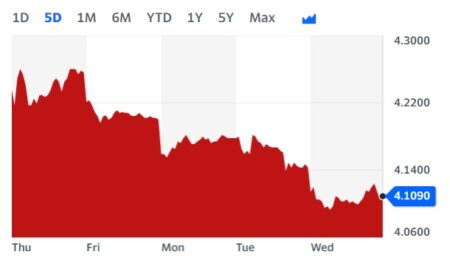
Yields on 10-year Treasury notes flirted with 4 percent Wednesday. Source: Yahoo Finance.
Yields on 10-year Treasury notes, a barometer for mortgage rates, remained on track for another weekly and monthly decline after Powell’s press conference. Since hitting a 2024 high of 4.74 percent on April 25, rising demand for bonds by investors who expect the economy to slow has brought yields on 10-year Treasurys down more than half a percentage point.
After closing at 4.14 percent Tuesday, 10-year Treasury yields touched a low of 4.09 percent Wednesday morning before rebounding to close at 4.11 percent Wednesday. That’s a 38 basis-point drop from July 1 and a 63 basis-point drop from a 2024 high of 4.74 percent on April 25.
Conforming mortgage rates in free fall
Rates for 30-year fixed-rate conforming mortgages averaged 6.71 percent Tuesday, down 30 basis points from July 1, according to rate lock data tracked by Optimal Blue.
Since hitting a 2024 high of 7.27 percent on April 25, rates on conforming mortgages have come down by 56 basis points — more than half a percentage point.
Borrowers seeking jumbo mortgages that exceed Fannie Mae and Freddie Mac’s $766,550 conforming loan limit haven’t seen as much relief, as the “spread” between jumbo and conforming loans has widened.
Borrowers were accepting locks on jumbo loans Tuesday at an average rate of 7.22 percent — a more modest drop of 34 basis points from a 2024 high of 7.56 percent registered on April 15.
Before the pandemic, rates on jumbo mortgages tended to be lower than conforming loans by an average of 9 basis points from 2017-2019, according to Optimal Blue data. But tightening by regional banks, which are major providers of jumbo loans, has flipped the spread, with rates on jumbo mortgages averaging 16 basis points above conforming loans in 2023 and 30 basis points so far this year.
With Fed rate cuts on the horizon, bond market investors who fund most conforming mortgage loans are happy to accept lower yields on mortgage-backed securities (MBS) backed by conforming loans. But jumbo lenders typically hold loans on their books, and their funding costs may come down more slowly.
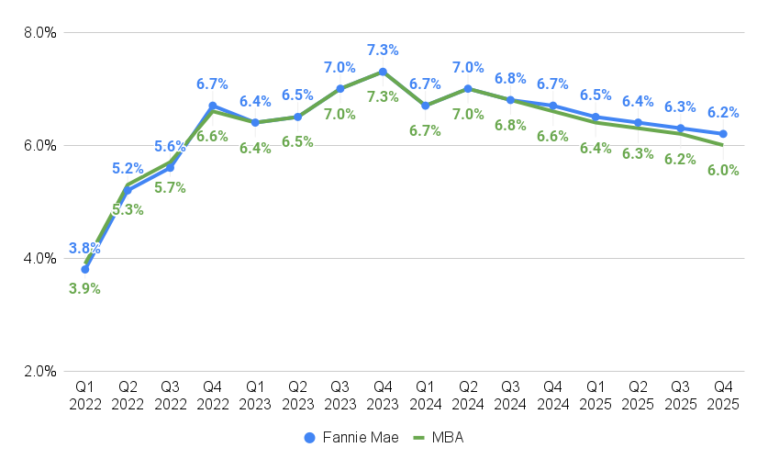
Economists at Fannie Mae and the Mortgage Bankers Association (MBA) predict the rate on conforming loans will continue to drop into the low sixes by the end of next year.
“Mortgage rates are now well below 7 percent, and there has been some modest pickup in refinancing activity in recent weeks,” the MBA’s Fratantoni said. “We expect that mortgage rates will continue to drift lower through the remainder of the year, particularly if the Fed does launch a series of rate cuts in September.”
So far, homebuyers have been slow to respond to the decline in rates, as the runup in home prices during the pandemic and elevated rates have priced many would-be buyers out of the market.
A weekly survey of lenders by the MBA showed applications for purchase loans were down by a seasonally adjusted 2 percent last week compared to the week before and were 14 percent lower than a year ago. Applications to refinance were down 7 percent week over week, but up 32 percent from a year ago.
Eric Orenstein
“Even with a September rate cut possible, mortgage companies will continue to face meaningful earnings headwinds for the foreseeable future,” Fitch Ratings Senior Director Eric Orenstein said, in a statement. “With most outstanding mortgages still carrying rates below 5 percent and record home prices driving down affordability, it may be a long road back to higher origination volumes.”
Get Inman’s Mortgage Brief Newsletter delivered right to your inbox. A weekly roundup of all the biggest news in the world of mortgages and closings delivered every Wednesday. Click here to subscribe.
HAPPENING NOW! At Inman Connect Las Vegas, July 30-Aug. 1, 2024, the noise and misinformation will be banished, all your big questions will be answered, and new business opportunities will be revealed. JOIN US VIRTUALLY.
Virtual brokerage leader EXp World Holdings’ revenue rose 5 percent year over year to $1.295 million during the second quarter, according to an earnings release on Wednesday.
The company was profitable for the quarter with its net income rising 3 percent to $11.8 million, despite higher taxes on continuing operations. The second-quarter adjusted EBITDA (earnings before interest, taxes, depreciation, and amortization) also experienced a boost, rising 22 percent year over year to $32.8 million.
EXp Realty seemed to begin turning the tide on agent loss in Q2, with the number of agents and brokers on the brokerage’s platform declining 1 percent year over year to 87,111 — an improvement from Q1, when the agent count slid 2 percent compared to the previous year.
Although 87,000 is far from eXp World Holdings founder, chairman and CEO Glenn Sanford’s bold five-year goal of reaching 500,000 agents by 2026, the brokerage said the drop in agents is due to the company offloading less productive members. Those measures were reflected in eXp’s real estate transactions and sales volume, which grew 1 percent year over year to 120,613 and 7 percent year over year to $51.9 billion, respectively.
Glenn Sanford, eXp World Holdings
“The power of the eXp platform is paying off for our agents and eXp worldwide,” Sanford said in a prepared statement ahead of the company’s earnings fireside chat. “We believe the investments we’ve made to provide our agents with the best tools, technology and training during this downturn are helping them outpace the industry in productivity while increasing our agent NPS score.”
“It’s clear that we have established the winning playbook for agents in the U.S. while our international segment is an untapped opportunity where I have taken a more active role guiding our ongoing growth,” he added. “Moving forward, we will continue to relentlessly pursue our core objective of being the most agent-centric real estate brokerage on the planet.”
Leo Pareja
EXp Realty CEO Leo Pareja said the brokerage’s performance during the quarter reflects its investment in agent initiatives, such as the launch of eXp Elevate Coaching and the decision to instantly release vested shares to heirs upon agent death through the eXtend A Hand program.
“After gathering feedback from agents during my first quarter as eXp Realty CEO, it is clear that our initiatives to support agent productivity are gaining traction,” he said in a written statement. “Agents love the expanded learning and development options, faster payouts and Gen AI-based self-service capabilities we have introduced, and they are eager for what’s to come.”
“I remain committed to seeking new ways to leverage technology to operate more efficiently, which will both fund our investments in agent productivity and drive agent satisfaction as increasingly automated processes enable agents to devote more of their time to serving their clients,” he added.
In the company’s Wednesday evening fireside chat (i.e. earnings call), Sanford and Pareja discussed the brokerage’s performance and highlighted the impressive growth outside of the U.S. and Canada. International revenues grew a startling 69 percent year over year during Q2, as the company focused on recruiting experienced agents for eXp Global.
“There was a strong performance in both sales, volume and productivity,” Sanford said of eXp Global. “Our agent count really didn’t change a whole bunch overall, but that’s because a lot of our agents that were in international in the initial launch into international were nonproductive.”
“We actually changed it to looking at agents who have two years or more experience are the ones that we’re actually bringing over to eXp now,” he added. “And that’s really changed the trajectory internationally.”
Sanford said the focus on expanding eXp’s global footprint means there’s a recruitable agent pool of roughly 20 million agents. That number, he said, has reignited the brokerage’s growth goals. EXp could have 1 million agents worldwide by 2034 — double the goal he set in late 2021.
“We’re really excited about that long-term vision — we’ll just say 10-year vision of where we’re going,” he said. And even more recently, I’ve been working directly with the international team, personally bringing a lot of the startup culture into international and working with various team leaders, country leaders and our existing amazing team that we’ve got growing [internationally].”
Although there are plenty of tailwinds pushing eXp’s sails, Pareja took time to address two primary headwinds. The first, he said, are current market trends, such as sticky mortgage rates, worsening affordability and weak existing-home sales.
The second is the looming Aug. 17 deadline for several landmark procedural changes connected to the National Association of Realtors’ buyer-broker commission lawsuit settlement. These include the removal of offers of compensation to buyer’s agents in Realtor-affiliated multiple listing services and the requirement that buyers’ brokers sign representation agreements with buyers before taking them on a home tour.
EXp has already made a push to be ahead of the curve with the rollout of a new listing agreement that said the company “does not share commissions with a buyer’s broker.” However, the agreement does leave room for homebuyers to request concessions from homesellers, which could be used to compensate a buyer broker.
The brokerage said it’s training its agents on how to discuss the new listing agreement and comply with the new rules. “All of our goals with listing agreements are to interpret the rules that are going to be enforced by the MLS,” Pareja said in a previous Inman article. “Our position as of right now is we’re going to make sure we’re going to reflect that broker-to-broker commission sharing on the MLS is no longer allowed.”
In the call, Pareja said there will be “an adjustment period” after the Aug. 17 deadline and that eXp leadership is prepared to help agents and brokers navigate challenges through continued rallies, virtual calls and educational toolkits.
“We’ve been providing as much education and tools through our regional rallies, virtual meetings and as many places as we can communicate with our agents,” he said. “Our buyer representation toolkit, which includes a buyer-broker representation agreement that the [Consumer Federation of America] recently recognized as much simpler, clearer and pro-consumer than any other agreement that’s been created recently, is something we’ve open-sourced so all agents in the industry have access to what’s being considered the best-in-class documents in order to make this transition as smooth as possible.”
EXp’s stock (NASDAQ: EXPI) rose in after-hours trading, with the price per share reaching $14.49 — 0.9 percent higher than the closing price of $14.36.
The company’s market cap stands at $2.22 billion.
Update: This story was updated after publication with additional details from eXp’s earnings call.