by Matt Carter | Apr 29, 2025 | Industry, News Feed

In April, we’ll go deep on money and finance for a special theme month, by talking to leaders about where the mortgage market is heading and how technology and business strategies are evolving to suit the needs of buyers now. Inman’s Best of Finance returns for 2025, celebrating the leaders in this space. And subscribe to Mortgage Brief for weekly updates all year long.
Wells Fargo could soon be rid of a $1.95 trillion asset cap that’s limited the bank’s growth after the Consumer Financial Protection Bureau lifted a 2018 consent order aimed at resolving issues in mortgage and auto lending, the bank confirmed Monday.
It’s the 12th consent order closed by Wells Fargo’s regulators since 2019 and the sixth this year, leaving in place only two of the 14 consent orders drawn up by regulators recent years over concerns about the bank’s past business practices.

Charlie Scharf
“I am proud of the work done by our teams and remain confident that we will complete the work needed to close our other open consent orders,” Wells Fargo CEO Charlie Scharf said in a statement. “Wells Fargo is a different and stronger company today as we focus on creating long-term value for our customers, clients, communities and shareholders.”
The latest consent order to be lifted was tied to the CFPB’s issues with how some borrowers were charged for mortgage interest rate-lock extensions, and the bank’s administration of a mandatory insurance program on auto loans. The CFPB fined Wells Fargo $1 billion in that enforcement action and drew up a consent order outlining how the bank would remedy the issues.
Wells Fargo had previously announced in January that the CFPB had lifted a 2022 consent order related to a $3.7 billion settlement over the bank’s alleged mismanagement of mortgages, auto loans and deposit accounts.
The Federal Reserve Board in February lifted two 2011 consent orders tied to alleged deficiencies in mortgage loan servicing and mortgage lending practices at a former Wells Fargo subsidiary.
Wells Fargo’s progress in closing consent orders, along with the Trump administration’s push to loosen regulations, means an asset cap that has limited the bank’s growth could be lifted as soon as the second quarter, RBC Capital Markets analyst Gerard Cassidy told Reuters.
The CFPB under the Trump administration has dropped at least nine pending consumer lawsuits, and has also taken the unusual step of attempting to undo a fair lending settlement negotiated by the bureau before the November election.
But Scharf said that doesn’t mean regulators are more relaxed about lifting consent orders than they were during the Biden era.
“I [have been] very consistent in my belief that the regulators are objective when it comes to these things,” Scharf told investment analysts on the bank’s April 11 earnings call. “They’re very fact-based. They want to see us do the work. They want us to do their validation. And if we do that, they’ll close the orders. I don’t think the change in administration suggests that we need to do anything differently.”
But broader regulatory changes that are being discussed by the Trump administration for the banking industry as a whole, “would allow us to better support our customers,” Scharf said. “That means make more loans, take more deposits, and provide more liquidity to the markets, while still preserving robust regulatory oversight.”
If Wells Fargo’s asset cap is lifted, it could have more room on its books to originate and hold jumbo mortgages that exceed Fannie Mae and Freddie Mac’s $806,500 conforming loan limit in most markets. Lenders who make such loans often hold them on their balance sheet, since they’re more difficult to bundle up and sell to investors.
Scharf said that while the asset cap remains in place, Wells Fargo will do what it has for the past several years, which is “focus on growing businesses where we don’t rely on our balance sheet,” like credit cards and wealth management services.
But once the asset cap is lifted, that will give Wells Fargo more leeway to expand its deposit base and fund more loans, he said.
“We are a different company today than when this new management team arrived,” Scharf said. “These recent closures reflect that we have completed much of the common risk and control infrastructure work across the company that is required by other orders.”
The fact that the consent orders are closed “doesn’t mean we’re going to stop doing the work,” he said. But Wells Fargo can operate more efficiently, “because now we have a much better understanding of the control environment and how to run it properly.”
While Scharf wouldn’t put a number on how much Wells Fargo might grow its deposit base and loan fundings when the asset cap is lifted, “it does give us more degrees of freedom in terms of how we run the place.”
Wells Fargo’s dwindling appetite for mortgages
Once the nation’s largest mortgage lender, Wells Fargo was overtaken by direct lender Quicken Loans (now Rocket Mortgage) in 2017.
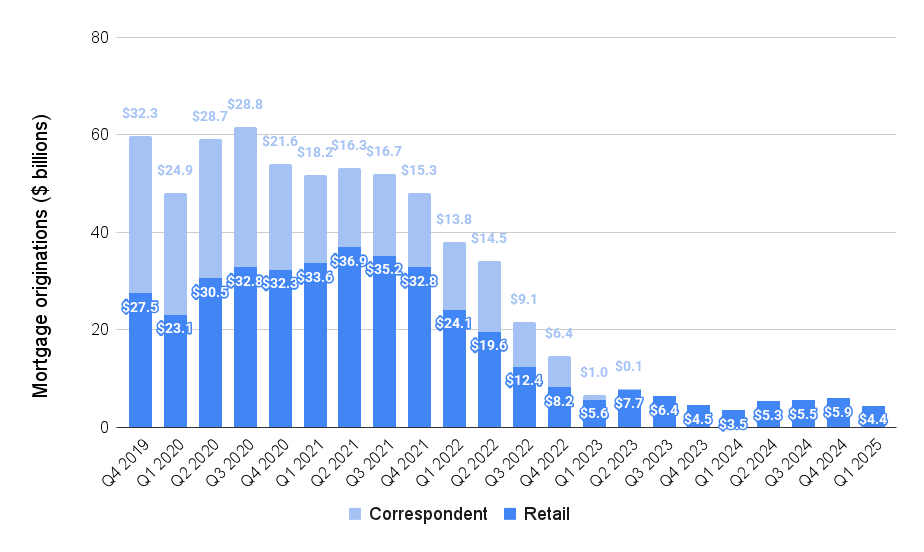
As rising mortgage rates put an end to the pandemic era refinancing boom, Wells Fargo’s mortgage volume also shrank as bank executives reassessed their appetite for risk as a buyer of mortgages from correspondent lenders.
In January 2023, Wells Fargo shut down the bank’s correspondent lending channel and announced a new strategic direction in home lending — a smaller, less complex business focused on the bank’s existing customers and minority communities.
With all of Wells Fargo’s mortgage business now coming through its retail channel, it originated just $20.2 billion in loans last year, less than a tenth of the $223 billion in mortgages originated during the 2020 refinancing boom.
In reporting a $4.9 billion first-quarter profit on April 11, the bank said it originated $4.4 billion in mortgage loans, up 26 percent from Q1 2024.
Growth in both purchase mortgages and refinancings helped drive the double-digit annual growth in home lending, and Wells Fargo continues to streamline the business with headcount down 47 percent, Wells Fargo Chief Financial Officer Mike Santomassimo said on the April 11 earnings call.
More customers, fewer branches
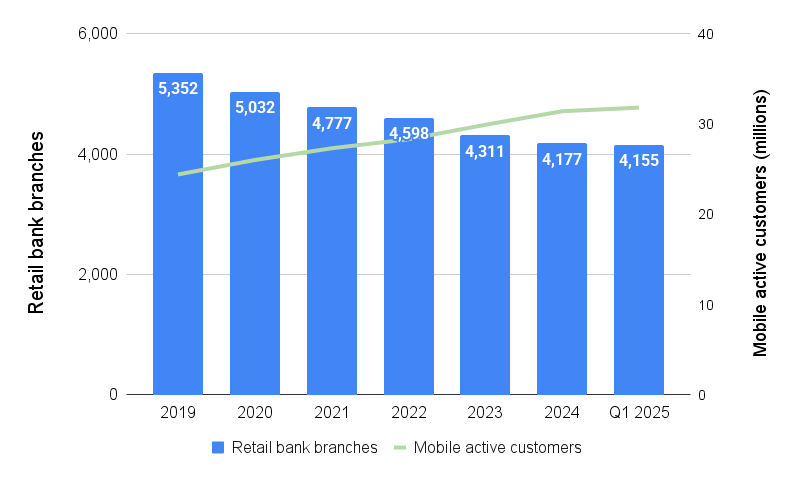
With 4,155 branches open as of March 31, Wells Fargo has trimmed its branch count by 22 percent from the 5,325 branches open at the end of 2019 on the eve of the pandemic.
Wells Fargo continues to shrink its brick-and-mortar operations, closing 22 branch offices during the first quarter.
But Wells Fargo also boosted its “mobile-active” customer count by 30 percent since 2019, to 31.8 million as of March 31. That growth continued in Q1, with the bank adding about 400,000 mobile-active customers — consumers and small business users who have logged into their accounts using a mobile device in the past 90 days.
While Wells Fargo is scaling back its brick-and-mortar presence, it is investing in refurbishing the branches that will stay open, accelerating the process in 2024 by completing 730 branch makeovers.
Scharf said Wells Fargo continued to invest in refurbishing its branches during the first quarter, and following the termination of a sales practices consent order over a year ago, has been taking “measured actions” to generate “modest growth” of metrics like net checking account growth and credit cards originated in branches.
“When we think about our consumer lending business, almost all of our businesses in our consumer lending segment are earning far below the ROTCEs (return on tangible common equity) that they should be earning for different reasons,” Sharf said.
Wells Fargo’s investments in building its credit card business, for example, are “front-loaded,” with modest returns as balances grow over time.
“But as long as the results play out on top of the models that we assumed, we know that’s just a matter of time until those returns increase significantly,” he said.
Get Inman’s Mortgage Brief Newsletter delivered right to your inbox. A weekly roundup of all the biggest news in the world of mortgages and closings delivered every Wednesday. Click here to subscribe.
Email Matt Carter
This post was originally published on this site
by Lillian Dickerson | Apr 29, 2025 | Industry, News Feed
The franchisor’s performance was driven by its luxury brands during the first quarter. President and CEO Ryan Schneider also reaffirmed during an investors’ call the company’s stance on recent moves by NAR, Zillow and Redfin in regards to Clear Cooperation.
Bigger. Better. Bolder. Inman Connect is heading to San Diego. Join thousands of real estate pros, connect with the Inman Community and gain insights from hundreds of leading minds shaping the industry. If you’re ready to grow your business and invest in yourself, this is where you need to be. Go BIG in San Diego!
Real estate franchisor Anywhere grew revenue by 7 percent year over year during the first quarter of 2025, hitting $1.2 billion in a solid start to the year as luxury continued to drive the company’s performance.
Quarterly revenue was down slightly from fourth-quarter 2024 revenue of $1.4 billion. The company’s net loss was $78 million during the first quarter of 2025, an improvement of $23 million on an annual basis. Adjusted net loss was $64 million, improved by $21 million from the previous year.
TAKE THE INMAN INTEL SURVEY FOR APRIL
Transaction volume also increased 6 percent annually, with units down about 4 percent and price up about 11 percent. This figure bested the National Association of Realtors’ 3 percent annual market volume growth, Anywhere noted. Transaction volume was boosted largely by the success of the franchisor’s luxury brands and growth in California and New York City.
“Anywhere continues to prove the advantage of our unique assets, including our unmatched scale, high-margin franchise network, luxury leadership, and integrated end-to-end transaction experience,” Anywhere President and CEO Ryan Schneider said in a statement. “Those assets are driving differentiated success today and help fuel our growth and transformation as we look to the future.”
The previous quarter, Anywhere announced that it had grown revenue, improved quarterly net losses on an annual basis and increased closed transaction volume by 13 percent year over year. During the fourth quarter of 2024, Anywhere increased revenue by $112 million year over year to $1.4 billion.
“Anywhere is on offense, seizing opportunities to fortify our market-leading position today while making smart moves to transform our operations, accelerate our strategic momentum, and build on our financial progress,” added Anywhere Executive Vice President, Chief Financial Officer and Treasurer Charlotte Simonelli.
Coldwell Banker Global Luxury, Corcoran and Sotheby’s International Realty outperformed the market during the first quarter, with closed transaction volume up about 16 percent on an annual basis.
Anywhere added 11 new U.S.-based franchisees during the first quarter and two new international franchisees.
Agent commission splits rose 39 basis points year over year to 80.4 percent.
The company realized $14 million in cost savings during Q1 2025 and said it is on track to realize cost savings of $100 million for the full year.
Anywhere added that it would be making three one-time payments during 2025 that will add up to about $115 million, the first $54 million of which will be the final payment toward its antitrust litigation settlement.
Anywhere, which was one of the first major real estate companies to settle its part in the commission lawsuits, paid $10 million toward the settlement in Q4 2023 and another $20 million in Q2 2024.
The franchisor’s second payment of $41 million will go toward addressing a 1999 Cendant legacy tax issue and the third payment will be a roughly $20 million payment for the January 2025 settlement of the Company’s Telephone Consumer Protection Act (TCPA) litigation, which is still subject to final court approval.
Schneider also addressed recent industry changes, including NAR’s new Delayed Marketing Exempt Listings option and Zillow and Redfin’s choices not to display listings on their portals that have previously been marketed privately.
“Anywhere Real Estate is aggressively advocating for transparency and the broad public distribution of all listings,” Schneider said during an investors call on Tuesday, adding that starting listings as private was not a winning strategy.
“We remain committed to doing what’s right for buyers and sellers which … starts with advocacy, consumer choice and the broad distribution of public listings.”
He added that Anywhere will continue to build out private listing networks within its brands because of industry trends in this direction, but believes that private listings, ultimately, disadvantage both buyers and sellers, even though they respect the wishes of those sellers who choose to list privately. Simonelli likewise added that from a financial standpoint, marketing listings publicly to the widest possible audience made the most sense for the business.
When asked about recent economic volatility and its impact on Anywhere’s performance, Schneider said that, thus far in April, there had not been a significant change to Days on Market or contract cancellation rates. Low inventory and high home prices are continuing trends, however. “But it is pretty volatile out there, so we’re watching it closely and not extrapolating too far,” Schneider said.
Schneider added that Anywhere had proven its ability to deliver results during a tough housing market and said the franchisor is “ready to charge ahead” moving further into 2025.
Email Lillian Dickerson
This post was originally published on this site
by Lillian Dickerson | Apr 29, 2025 | Industry, News Feed
The franchisor’s performance was driven by its luxury brands during the first quarter. President and CEO Ryan Schneider also reaffirmed during an investors’ call the company’s stance on recent moves by NAR, Zillow and Redfin in regards to Clear Cooperation.
Bigger. Better. Bolder. Inman Connect is heading to San Diego. Join thousands of real estate pros, connect with the Inman Community and gain insights from hundreds of leading minds shaping the industry. If you’re ready to grow your business and invest in yourself, this is where you need to be. Go BIG in San Diego!
Real estate franchisor Anywhere grew revenue by 7 percent year over year during the first quarter of 2025, hitting $1.2 billion in a solid start to the year as luxury continued to drive the company’s performance.
Quarterly revenue was down slightly from fourth-quarter 2024 revenue of $1.4 billion. The company’s net loss was $78 million during the first quarter of 2025, an improvement of $23 million on an annual basis. Adjusted net loss was $64 million, improved by $21 million from the previous year.
TAKE THE INMAN INTEL SURVEY FOR APRIL
Transaction volume also increased 6 percent annually, with units down about 4 percent and price up about 11 percent. This figure bested the National Association of Realtors’ 3 percent annual market volume growth, Anywhere noted. Transaction volume was boosted largely by the success of the franchisor’s luxury brands and growth in California and New York City.
“Anywhere continues to prove the advantage of our unique assets, including our unmatched scale, high-margin franchise network, luxury leadership, and integrated end-to-end transaction experience,” Anywhere President and CEO Ryan Schneider said in a statement. “Those assets are driving differentiated success today and help fuel our growth and transformation as we look to the future.”
The previous quarter, Anywhere announced that it had grown revenue, improved quarterly net losses on an annual basis and increased closed transaction volume by 13 percent year over year. During the fourth quarter of 2024, Anywhere increased revenue by $112 million year over year to $1.4 billion.
“Anywhere is on offense, seizing opportunities to fortify our market-leading position today while making smart moves to transform our operations, accelerate our strategic momentum, and build on our financial progress,” added Anywhere Executive Vice President, Chief Financial Officer and Treasurer Charlotte Simonelli.
Coldwell Banker Global Luxury, Corcoran and Sotheby’s International Realty outperformed the market during the first quarter, with closed transaction volume up about 16 percent on an annual basis.
Anywhere added 11 new U.S.-based franchisees during the first quarter and two new international franchisees.
Agent commission splits rose 39 basis points year over year to 80.4 percent.
The company realized $14 million in cost savings during Q1 2025 and said it is on track to realize cost savings of $100 million for the full year.
Anywhere added that it would be making three one-time payments during 2025 that will add up to about $115 million, the first $54 million of which will be the final payment toward its antitrust litigation settlement.
Anywhere, which was one of the first major real estate companies to settle its part in the commission lawsuits, paid $10 million toward the settlement in Q4 2023 and another $20 million in Q2 2024.
The franchisor’s second payment of $41 million will go toward addressing a 1999 Cendant legacy tax issue and the third payment will be a roughly $20 million payment for the January 2025 settlement of the Company’s Telephone Consumer Protection Act (TCPA) litigation, which is still subject to final court approval.
Schneider also addressed recent industry changes, including NAR’s new Delayed Marketing Exempt Listings option and Zillow and Redfin’s choices not to display listings on their portals that have previously been marketed privately.
“Anywhere Real Estate is aggressively advocating for transparency and the broad public distribution of all listings,” Schneider said during an investors call on Tuesday, adding that starting listings as private was not a winning strategy.
“We remain committed to doing what’s right for buyers and sellers which … starts with advocacy, consumer choice and the broad distribution of public listings.”
He added that Anywhere will continue to build out private listing networks within its brands because of industry trends in this direction, but believes that private listings, ultimately, disadvantage both buyers and sellers, even though they respect the wishes of those sellers who choose to list privately. Simonelli likewise added that from a financial standpoint, marketing listings publicly to the widest possible audience made the most sense for the business.
When asked about recent economic volatility and its impact on Anywhere’s performance, Schneider said that, thus far in April, there had not been a significant change to Days on Market or contract cancellation rates. Low inventory and high home prices are continuing trends, however. “But it is pretty volatile out there, so we’re watching it closely and not extrapolating too far,” Schneider said.
Schneider added that Anywhere had proven its ability to deliver results during a tough housing market and said the franchisor is “ready to charge ahead” moving further into 2025.
Email Lillian Dickerson
This post was originally published on this site
by Jim Dalrymple II | Apr 29, 2025 | Industry, News Feed
The brokerage’s federal court complaint acknowledges that clients have canceled listings and that agents have departed amid a battle with Northwest MLS over how they’re marketed.
Bigger. Better. Bolder. Inman Connect is heading to San Diego. Join thousands of real estate pros, connect with the Inman Community and gain insights from hundreds of leading minds shaping the industry. If you’re ready to grow your business and invest in yourself, this is where you need to be. Go BIG in San Diego!
Compass escalated its battle over private listings in Washington state last week via a new lawsuit but, in doing so, revealed that waging war has come at a cost: The brokerage has lost both agents and listings in the course of the fight.
That information comes from Compass’ complaint, which the company filed Friday and which accuses Northwest MLS (NWMLS) of limiting competition. Among other things, the complaint recalls an episode earlier this month during which NWMLS cut off Compass’ IDX feed. An IDX feed takes data — such as listings — from an MLS and sends it to MLS members; in the complaint, Compass describes the move as a “group boycott” meant to “undermine” its business.
Eventually, Compass claims, that is exactly what happened.
“Brokers have reported clients fully canceling listing agreements because Compass can no longer offer them Compass Private Exclusive listings as an option,” the complaint states. “Brokers have likewise lost business opportunities because potential clients no longer wish to list their homes for sale at all as a result of the brokers’ inability to offer Compass Private Exclusive listings.”
TAKE THE INMAN INTEL INDEX SURVEY FOR MARCH
“Compass Private Exclusives” are properties the company markets exclusively through its own platform. Such listings are the first part of the brokerage’s “3-Phase Marketing Strategy” that sees homes put into the MLS only after they’re first marketed privately, then as “Coming Soon.”
The new complaint also indicates that multiple brokers left Compass after NWMLS shut off the IDX feed, and that three of those brokers “specifically cited NWMLS’s actions as the reason for their departure.” Moreover, according to the complaint, a managing broker at another company tried to recruit Compass agents during the IDX shutdown. The broker allegedly claimed in an email that “we’re fully in compliance with NWMLS rules. Our IDX [listings data] feed is live, accurate, and working exactly as it should.”
“No dramas, no disruption — just a stable, trusted platform to run your business on,” the broker’s pitch continued, according to the complaint.
Compass ultimately concludes in the complaint that “NWMLS’s actions against Compass were intended to, and did, have a chilling effect on Compass’s business — both with consumers and with its own brokers.”
That claim is key to Compass’ case, which rests on the idea that the brokerage is suffering thanks to alleged anticompetitive behavior on the part of NWMLS and various Washington brokerages.
For its part, however, NWMLS has previously defended its actions, saying that it shut off Compass’ IDX feed after the company broke the rules.
Inman has reached out to NWMLS this week and will update this story with any information the multiple listing service provides.
The new complaint also offers a detailed glimpse into how both parties ended up in conflict in the first place. The situation began, the complaint notes, when Compass first asked NWMLS to make a rules change in July 2024. The change would have allowed Compass to market private listings in Washington the way it does in other states, but in February of this year, NWMLS declined to make the change, according to the complaint.
In response, Compass pivoted to looking at NWMLS rules that it could interpret in ways that would allow it to market listings privately. NWMLS responded to Compass’ strategy by changing one rule, then telling the brokerage it was out of compliance when it pivoted to a different rule, the complaint states.
The complaint describes Compass’ Exclusives-friendly rules interpretations as a “competitive threat to” NWMLS’s “monopoly.”
Though the conflict is taking place in a single state, it is a case study in tensions over private listings. Compass began publicly leaning into the concept last year and has been open about its desire to build its own private listing network — an idea that has strongly polarized the real estate industry. Tensions over the concept flared just over a week ago when CEOs of multiple companies — including Compass, eXp Realty and others — began arguing about the issue in the comments section of a LinkedIn post.
In the case of Washington state, Compass CEO Robert Reffkin began criticizing NWMLS — as well as Washington-based franchisor Windermere — last month on Instagram. That prompted a war of words, with Windermere Co-President OB Jacobi firing back on several occasions. Friday’s lawsuit was just the latest salvo in the battle.
It remains to be seen who will prevail, but for now, Compass’ new legal complaint offers insights into the degree to which Compass is leaning into private listings.
“Outside of Washington,” the complaint reveals, “in the first quarter of 2025, approximately 48.2 percent of homeowners who listed their home with Compass started their listing using the Compass 3-Phased Price Discovery and Marketing Strategy; this equates to approximately 19,393 new listings in the first quarter of 2025.”
Read the full complaint here:
Email Jim Dalrymple II
This post was originally published on this site
by Melanie Klein | Apr 29, 2025 | Industry, News Feed
Bigger. Better. Bolder. Inman Connect is heading to San Diego. Join thousands of real estate pros, connect with the power of the Inman Community, and gain insights from hundreds of leading minds shaping the industry. If you’re ready to grow your business and invest in yourself, this is where you need to be. Go BIG in San Diego!
The world of permitting and pre-construction is notorious for being complex, oftentimes sluggish and fragmented. For many, navigating the bureaucracy of approvals, zoning and planning is an overwhelming burden. But in Santa Barbara, California, two inspiring young entrepreneurs in their early twenties, Corban Pampel and Tristan Cravens, are changing that narrative.
TAKE THE INMAN INTEL SURVEY FOR APRIL
Through their company, SB Permitting, they have taken an industry riddled with inefficiencies and built a streamlined, innovative and highly effective system that makes the permitting process as frictionless as possible. While their business has filled an industry gap, the larger story is one about innovation, conscious leadership and a prime example of collaborative partnership — cornerstones of their rapid success.
From opportunity to innovation
For Corban Pampel and Tristan Cravens, SB Permitting wasn’t born out of a long-term strategic vision. Instead, it was a response to an immediate and pressing need in their community.
“It was really just an opportunity that the two of us identified and capitalized on,” Pampel recalls. “At the time, we were both enrolled at Santa Barbara Community College. Tristan had his own business hosting events on and off while I was working for my parents’ design studio.
“My parents had a project that needed a permit in the historic district of Santa Barbara, so I went by the city to see exactly what the process looked like. Upon a brief examination, I came to the same conclusion many do — I didn’t want to touch it with a six-foot pole.”
Faced with a convoluted process and no clear solutions, Pampel approached Cravens with an idea. Together, they realized they had discovered a niche market that was completely unserved. Their initial concept was simple: Provide consultation services to individuals and businesses trying to navigate the permitting process.
“Starting Santa Barbara Permitting was really just acting on a problem we saw,” Cravens explains. “There was no grand vision, no five-page business plan, no ‘marketing analysis.’ The only thing there was were people who said they needed help, and so we did something about it.”
Expanding the vision
What started as a small consulting endeavor quickly grew into something far more ambitious. Pampel and Cravens’ perspective shifted dramatically after a business competition at their community college.
“One of the judges told us that he thought there was so much potential that we were leaving off the table,” Pampel says. “That really changed our perspective because we started wondering just what we could accomplish. The outcome of this was we shifted our question from what we tell people to do, to what we ourselves can do to get a client from ‘I want to do ____’ to a builder breaking ground.”
This mindset shift led to a complete transformation of SB Permitting’s offerings. Instead of just providing advice, they built a full-service operation that managed every aspect of the permitting process. They would not only consult but also manage plans, oversee permits, coordinate with regulatory agencies and ensure a seamless pre-construction process.
“We would no longer be a company you asked how to pull a permit,” Pampel explains. “We would become a company where you could say, ‘I want a house,’ and you wouldn’t have to lift a finger to make it happen. We would manage the plans. We would manage the permit. We would manage the auxiliary bodies such as Edison and Environmental Health and Safety.”
The secret to exponential growth
The rapid expansion of SB Permitting has been nothing short of extraordinary. In a notoriously slow-moving industry, the company has grown at an exponential rate, securing over 50 clients in just 18 months. But what’s at the heart of their success?
“I think the heart of our exponential growth is a desire to innovate and have an impact on the communities we are a part of,” Pampel says. “A big part of what defines us is a client base that feels like they are out of options and out of luck when it comes to creating their dream space.”
For Cravens, the key to their success lies in their deep understanding of what the client truly needs.
“We’re exponential because we have such a thorough understanding of what the client needs,” he explains. “We know where we’re most helpful, and we fill in the gaps. We spot what needs to be done and we do it. We encounter a new problem, and we come up with a unique way to deal with it.”
A leadership style that sets them apart
Both Pampel and Cravens embody leadership styles that complement each other and drive SB Permitting forward. Pampel emphasizes adaptability and flexibility.
“I’d say one of the first words that comes to mind when I think about my leadership style is that I’m flexible,” he says. “I’ve always believed that it’s impossible to account for everything in any given environment or situation, but as long as you are capable of pivoting quickly, you can accomplish anything.”
Cravens, on the other hand, focuses on being a visionary and keeping both their team and clients aligned with a compelling future.
“I would describe myself as someone who really understands the value of being a good visionary,” he says. “It’s important that not only our team members but our clients remember why they’re doing what they’re doing.”
Collaboration with Realtors and industry professionals
SB Permitting plays a crucial role in the real estate industry by bridging the gap between property transactions and the reality of construction and permitting.
“For most of the Realtors we work with, we are that next step in the process for their clients,” Pampel explains. “We can generate plans for a general contractor to bid on, give insight into local regulations, and establish project feasibility and timelines before a client has even closed on a home.”
Cravens adds, “Realtors aren’t really supposed to know a lot about permitting and the details of design and construction — they aren’t walking ‘code books.’ So, we go onsite with Realtors to help provide that certainty and knowledge around home improvements, additions, ADUs and whatever else homebuyers envision.”
An inspiring partnership
Beyond their individual strengths, Pampel and Cravens’ partnership is a key factor in their company’s success.
“We’re very young people,” Cravens acknowledges, “and going into business together allowed us to build up each other’s strengths and shun each other’s bad habits, and really that’s the most valuable part of it. It’s made us not just better leaders but better people.”
For Pampel, their impact on Santa Barbara is deeply fulfilling.
“Santa Barbara is known to be one of the hardest places in the nation to get a building permit,” he says. “For us to be able to make it look easy at times is something that really validates the work and the care we have put into what we have done here.”
A call to action for industry professionals
For real estate agents, developers and professionals in the construction space, the question is simple: How can we rethink how we approach these processes to create a better experience for our clients? The answer may just lie in the kind of forward-thinking, problem-solving mindset that has propelled SB Permitting to the forefront of their industry.
As SB Permitting grows and redefines industry standards, Pampel and Cravens offer a compelling vision of what’s possible when innovation meets action. Their story serves as a reminder that opportunities for transformation exist in even the most bureaucratic and cumbersome industries.
Melanie C. Klein, M.A., is an empowerment and mindset coach.
This post was originally published on this site
by Kevin Van Eck | Apr 29, 2025 | Industry, News Feed
Bigger. Better. Bolder. Inman Connect is heading to San Diego. Join thousands of real estate pros, connect with the power of the Inman Community, and gain insights from hundreds of leading minds shaping the industry. If you’re ready to grow your business and invest in yourself, this is where you need to be. Go BIG in San Diego!
Recruiting pressure is at an all-time high, as shown in the latest Inman Intel Index, and how you handle it says everything about your company. When your first touchpoint is lazy, impersonal or misleading, agents don’t chalk it up to a bad day. They assume that’s your culture and your leadership and what working with you would feel like.
TAKE THE INMAN INTEL SURVEY FOR APRIL
Here are five tactics that need to go and what to replace them with.
1. Mass emailing and blind outreach
Agents know when they’re part of a list, and they talk.
Years ago, I received a recruiting email from a brokerage leader praising my “recent production” and “impressive sales.” The only problem? I hadn’t sold anything that year as I was a non-selling managing broker. They were clearly blasting a roster without doing their homework. It reminded me of the third-party award programs I still get invited to … despite still having no production.
In talking with Sean Soderstrom, co-founder and CEO of Courted.io, he put it plainly: “Just like you’d never walk into a listing presentation without knowing the comps, you shouldn’t reach out to an agent without doing your homework. The difference now is that modern tech can do that homework for you instantly.”
He’s right. Research shows that personalized communication significantly increases response rates and improves the perception of your organization. A recent McKinsey research study shows that 76 percent of people are frustrated by impersonal interactions. If you’re still mass-blasting and calling it a strategy, you’re sending the wrong message and alienating your audience.
What to do instead: Take the time to research, or use smart tools like Courted, to personalize your outreach. The time and effort will be validated in the responses and results. Lead with relevance, not desperation.
2. Copy-and-paste messaging (via text, social and anywhere else)
Yes, it’s easier. It’s also the way to be dismissed, or worse.
A brokerage executive once sent the same generic message to thousands of agents. Another firm turned it into a contest: If you received the message and sent a screenshot, your office got a raffle entry to win a happy hour.
What was meant to be outreach became a punchline. The happy hour contest sounds cutthroat, but it was effective in erasing any sense of exclusivity, and it devalued the message entirely.
“Agents are savvy,” Soderstrom said. “They’ve seen it all before. If you can copy and paste it, it’s probably not worth sending.”
What to do instead: Mention a standout transaction they handled. Reference feedback from one of your agents who enjoyed working with them. Point to a marketing campaign or listing that caught your attention. The best outreach feels like it was written for one person, the person you’re messaging.
3. ‘Let’s grab coffee. No recruiting; I promise’
This one has to go.
A top-producing agent recently told me she agreed to a “casual, no-pressure coffee,” the first meeting she’d taken in years. Within five minutes, the broker launched into a full-on filibuster about tools, culture and their entire brokerage offering. She left the meeting and said she had no interest in working with that brokerage, now or in the future.
There’s a trust gap in recruiting, and tactics like this bait-and-switch widen it.
What to do instead: Be upfront. Say, “I’d love to talk about the possibility of working together. Here’s why I think it could be a good fit.” Honesty like that is rare enough to stand out.
4. ‘We’re like a family’ (and other clichés)
Agents aren’t looking for a new family. They’re looking for a place to grow their business and professional sphere.
I’ve lost count of how many brokers and recruiters still lead with “We’re like a family.” In most industries, that phrase has become a meme, usually signaling blurred boundaries, unrealistic expectations or a lack of professionalism. It doesn’t resonate, and it doesn’t work.
The Inman Intel Index backs this up: Nearly a third of agents responding ranked cultural fit as their top priority, but not in a vague or sentimental way. They want mentorship, strong leadership and a collaborative environment that pushes them forward.
What to do instead: Highlight real stories and case studies of mentorship, collaboration and growth. If your culture is what you say it is, agents will feel it without you needing to lure them with your “family.”
5. Overpromising support, tools and resources
This may be the most damaging tactic of all, especially when word gets out.
I’ve spoken with agents who were interested in and joined a brokerage based on promises of robust support, marketing tools and coaching, starting with their first interaction.
One told me she was promised full marketing support with a shared designer and marketing coordinator. When she reached out to utilize that support, multiple staff members ghosted her. She left after four weeks, and her entire peer group heard about it.
Soderstrom was direct, “Saying you offer ‘the best tools’ means nothing if you can’t show how those tools actually grow an agent’s business. Results speak for themselves — especially when your agents can share their own success stories.”
What to do instead: Use data. Share case studies. Show how your value proposition solves the problem that the agent is experiencing without inflating. Enlist your top agents and brand advocates to speak directly to recruits, sharing your company’s value proposition as they live it. Peer proof beats your polished pitch, every time.
It’s not a numbers game
Recruiting isn’t about sending more messages, duping someone into meeting you or exaggerating your offering. It’s about sending the right message in the right way.
Agents are looking for leadership, systems and culture that align with and support their goals. Your message and the delivery set the tone. It either builds trust or breaks it. A miss now may result in a lost opportunity for years to come.
When recruiting is your biggest challenge, refining your approach, investing in the right tools and committing to personalization can turn it into a strength. Don’t just reach out. Reach out in a way that reflects who you are and why you’re worth joining.
Kevin Van Eck is the EVP of innovation and education at @properties in Chicago, Illinois. Connect with him on Instagram or Facebook.
This post was originally published on this site