by Matt Carter | Apr 29, 2025 | Industry, News Feed
Consumer confidence sank to a five-year low in April over concerns about tariffs, while trade deficit surged to an all-time high in March, and job postings shrank more than expected

In April, we’ll go deep on money and finance for a special theme month, by talking to leaders about where the mortgage market is heading and how technology and business strategies are evolving to suit the needs of buyers now. Inman’s Best of Finance returns for 2025, celebrating the leaders in this space. And subscribe to Mortgage Brief for weekly updates all year long.
Mortgage rates are on the retreat this week as the latest data on the economy has investors who fund most home loans worried that tariffs will not only fuel inflation but lead to a recession.
The Conference Board reported Tuesday that its Consumer Confidence Index dipped for the fifth consecutive month in April, to 86 — the lowest level since May 2020, the onset of the COVID pandemic.
Mark Zandi
TAKE THE INMAN INTEL INDEX SURVEY FOR APRIL
The U.S. trade deficit hit an all time high in March and job postings shrank more than forecasters were expecting, with a federal hiring freeze in place and uncertainty over the economy putting a chill on private sector hiring.
The 19-point drop in the Consumer Confidence Index over the past three months is “just shy of the recession threshold of 20,” Moody’s Analytics Chief Economist Mark Zandi posted on X. “Unless the trade war cools off very (very) soon, recession appears dead-ahead.”
Consumer confidence falters
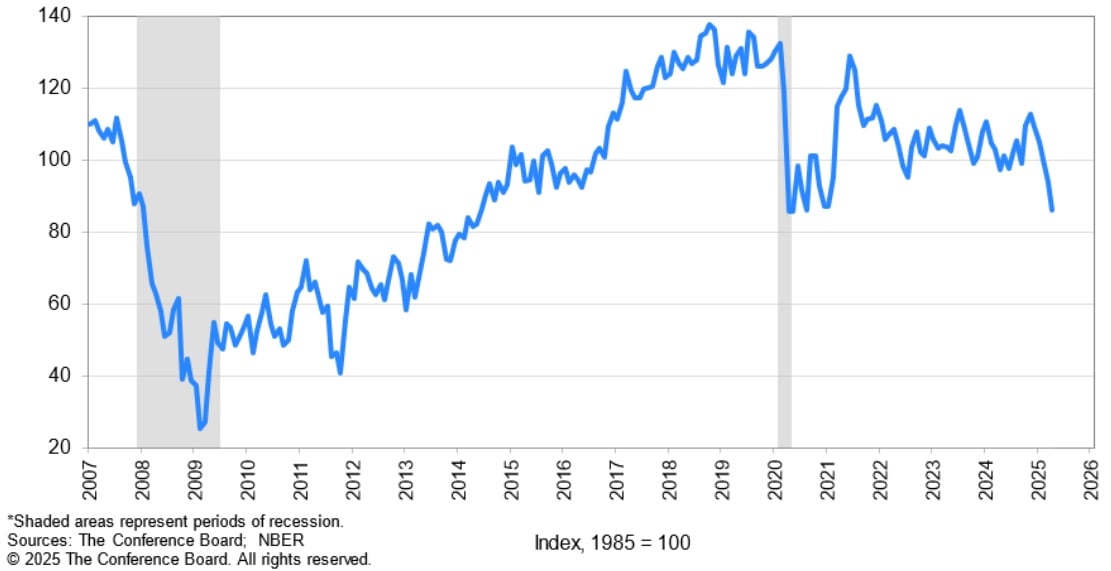
“One positive note is that the slide in confidence was mostly due to weaker consumer expectations,” Zandi added. “Present assessments are holding up better. This suggests confidence could recover quickly with good news on the trade war, heading off a recession.”
In the latest back and forth on tariffs, President Trump signed an executive order Tuesday aimed at providing U.S. automakers some relief by “de-stacking” tariffs to avoid the cumulative effect of overlapping tariffs on other items like steel and aluminum.
The Conference Board reported that its Expectations Index, which tracks consumers’ short-term outlook for income, business and labor market conditions, fell 12.5 points to 54.4 — the lowest level since October 2011, and below a threshold of 80 that usually signals a recession ahead.
Stephanie Guichard
Consumers surveyed by the Conference Board through April 21 said they expect inflation will hit 7 percent in the next year, the most pessimistic reading since November 2022, when the U.S. was experiencing “extremely high inflation,” Conference Board economist Stephanie Guichard said, in a statement.
The decline in consumer confidence was shared across all political affiliations, and consumers “explicitly mentioned concerns about tariffs increasing prices and having negative impacts on the economy” in write-in responses, the Conference Board said.
Job openings trend down again
Employers were looking to fill 7.192 million job openings in March — a drop of 288,000 from February and 901,000 from a year ago, the Bureau of Labor Statistics reported Tuesday. Economists had expected job openings to hold steady at 7.5 million.
Federal government job openings fell by 36,000 in March, while “the surge in economic policy uncertainty in March, mostly relating to tariff policy,” was the primary driver of the 229,000 decline in private sector job openings, Pantheon Macroeconomics Chief U.S. Economist Samuel Tombs said in a note to clients.
Samuel Tombs
“In particular, openings in the transportation, warehousing and utilities sector dropped by a relatively large 59,000, as businesses geared up for lower levels of demand for goods,” Tombs said. “Meanwhile, healthcare job postings fell by 45,000 and now are back in line with their long-run level, relative to the number of jobs.”
Tariffs on some goods from China have been increased by as much as 170 percent this year, with most of that hike taking effect April 9.
The Trump administration’s threats to raise tariffs on China and other U.S. trading partners prompted a rush of imports in March that pushed the U.S. trade deficit to a record high of $162 billion, according to an advance reading published by the Census Bureau Tuesday.
Trade deficit widens
U.S. companies imported an all-time high of $342.7 billion in goods last month, up $16.3 billion from February.
Economists have forecast that economic growth slowed to an annual rate of 0.4 percent during the first quarter, down from 2.4 percent in the final three months of 2024. The Bureau of Economic Analysis is scheduled to release an estimate of Q1 gross domestic product (GDP) growth on Wednesday.
The latest advance economic indicators pushed the Atlanta Fed’s GDPNow forecasting model’s estimate of Q1 annual GDP growth down to -2.7 percent Tuesday, from -2.4 percent on April 24.
Mortgage rates retreat from 2025 high
At 6.76 percent on Monday, rates on 30-year fixed-rate mortgages were down four basis points from Friday and 29 basis points from a 2025 high of 7.05 percent registered Jan. 14, according to rate lock data tracked by Optimal Blue.
Yields on 10-year Treasury notes, a barometer for mortgage rates, fell five basis points Monday and another four basis points Tuesday.
Get Inman’s Mortgage Brief Newsletter delivered right to your inbox. A weekly roundup of all the biggest news in the world of mortgages and closings delivered every Wednesday. Click here to subscribe.

Email Matt Carter
This post was originally published on this site
by Richelle Hammiel | Apr 29, 2025 | Industry, News Feed
Mexican sculptor Enrique Cabrera purchased the property known as the “Darth Vader House” for $3.4 million and plans to transform it into an artistic landmark of its own creation.
Bigger. Better. Bolder. Inman Connect is heading to San Diego. Join thousands of real estate pros, connect with the Inman Community and gain insights from hundreds of leading minds shaping the industry. If you’re ready to grow your business and invest in yourself, this is where you need to be. Go BIG in San Diego!
The Houston home dubbed the “Darth Vader House” has a new owner — and a new identity in the works.
Mexican sculptor Enrique Cabrera purchased the property for $3.4 million and plans to transform it into an artistic landmark of his own creation, the Houston Chronicle recently reported.
TAKE THE INMAN INTEL SURVEY FOR APRIL
Designed by Houston architect Brett Zamora, the home earned its name thanks to its dark facade and angular, helmet-like design, evoking the Star Wars villain, Nan & Co. Properties shared in an article announcing the sale.
Nancy Almodovar of Nan & Co. Properties represented Cabrera in the transaction.
Wikimedia Commons: Darth Vader/Berniethomas68
Over the years, the property has changed hands multiple times and cycled on and off the market.
Most recently, it was listed by local real estate broker and House of Ho star Washington Ho.
When the home didn’t sell, it returned to the hands of listing agent and owner Jason Junkin of Nitya Realty, who held onto it for around three years.
Just six days after the property was listed for $3.3 million this time around, Cabrera snapped it up with plans for a bold rebranding.
“The former Darth Vader house now is officially ‘The Black Bull House’ by Enrique Cabrera,” he told the Chronicle.
The name isn’t just symbolic — Cabrera plans to install a $2.4 million black bull statue of his own design at the home’s entrance.
Enrique Cabrera (Photo by Johnny Nunez/WireImage courtesy Getty)
Cabrera told The Real Deal that he intends to give the property a complete artistic transformation, turning it into a hub of creative energy.
At 7,000 square feet, the home sits on an enormous 18,000-square foot lot in Houston’s prestigious West University enclave. According to the property’s listing description, the house sits “mysteriously lurking in its striking dark slate and aluminum clad armor.”
Inside, the home’s design could be considered just as dramatic, featuring two floating glass staircases, floor-to-ceiling windows, a wine wall, a pool and hot tub. The home also includes four bedrooms and five bathrooms.
Originally built in 1992 by Houston plastic surgeon Dr. Jean Cuckier — a devoted fan of Star Wars — the home has long captured the imagination of locals and architecture lovers and is considered a local landmark.
Email Richelle Hammiel
This post was originally published on this site
by Lillian Dickerson | Apr 29, 2025 | Industry, News Feed
Bigger. Better. Bolder. Inman Connect is heading to San Diego. Join thousands of real estate pros, connect with the Inman Community and gain insights from hundreds of leading minds shaping the industry. If you’re ready to grow your business and invest in yourself, this is where you need to be. Go BIG in San Diego!
A bill currently under consideration in the Texas Senate may threaten the existence of the National Association of Realtors’ speech code in the state.
Senate Bill 2713, first introduced to the Texas Senate on March 13, 2025 by Senator Mayes Middleton (R-Galveston), proposes that trade organizations within the state be prohibited from denying anyone membership in their organization due to race, color, religion, sex, disability, familial status or national origin, or “because of the person’s exercise of the person’s freedom of speech or assembly, notwithstanding any provision of the association’s or organization’s bylaws.”
TAKE THE INMAN INTEL SURVEY FOR APRIL
SB 2713 also states that someone who is aggrieved by a violation of the bill may bring action against the trade organization for damages, which might include court costs and attorney fees.
The bill is currently pending with the Senate committee.
A committee hearing to discuss the bill that took place on Monday showed legislators responding positively to the bill. Likewise, Texas Association of Realtors Director of Public Policy Julia Parenteau and Chief Operating Officer David Jones said during the hearing that the association is neutral to the bill’s proposal.
Individuals who testified in favor of the bill during the hearing included current or former real estate professionals Brian Talley, Brandon Huber, Chad DeVries, Wilson Fauber and Jamie Haynes — all of whom had received complaints in the past in relation to their expression of free speech and its alleged violation of the Realtor Code of Ethics, and who said their careers had been negatively impacted by those complaints.
“Across Texas, individuals are being potentially shut out of their own professional communities for nothing more than expressing their views on social media or in public forums,” Sen. Middleton said during the hearing.
“Senate Bill 2713 ensures that no Texan will be denied membership or access in professional or trade associations because of their race, religion, sex or disability, which is already law, but also because of their constitutional protected right to speak and freely assemble. In other words, this bill reaffirms that your ability to work and practice your trade in Texas does not depend on your political or religious beliefs or who you associate with.
“This bill closes the door on ideological discrimination by trade organizations. It remembers the first amendment does not end when you clock in, and yet too many Texans today find themselves faced by adverse action and forced to choose between staying silent or risking expulsion from their trade industry.”
If passed, the new law would take effect on Sept. 1, 2025, and would impact the execution of NAR’s Standard of Practice 10-5 in the state, as well as other similar guidelines laid out by other professional associations in different industries in Texas. The bill does not mention NAR or any other professional organization by name, but just mentions “professional or trade association[s] or organization[s]” more generally.
NAR and the Texas Association of Realtors did not immediately provide a comment for this story.
NAR’s speech code under Article 10 of the Code of Ethics stipulates that Realtors “must not use harassing speech, hate speech, epithets, or slurs based on race, color, religion, sex, handicap, familial status, national origin, sexual orientation, or gender identity.”
In order to qualify as a violation of the code, an individual’s speech must first be determined to be “harassing, hate speech, epithets, or slurs,” and secondly, must be speech based on one of the protected designations mentioned. In updated guidelines released in Nov. 2020, NAR explained that the standard of practice was intended to “not deny equal professional services or be parties to a plan to discriminate.”
“Specifically, bias against protected classes revealed through the public posting of hate speech could result in Realtors not taking clients from certain protected classes or not treating them equally, which would lead to violations of the Fair Housing Act due to overt discrimination or disparate impact,” NAR’s guidance elaborates.
Real estate blogger Rob Hahn listened to the committee hearing on Monday and distilled his takeaways in a post on his blog, NotoriousROB.
“From what I saw during that committee hearing, this bill will sail through Committee,” Hahn wrote. “The Texas Senate is 20 Republicans and 11 Democrats; it will pass there. The Texas House is 88 Republicans and 62 Democrats; it will pass there. There is little likelihood that Greg Abbott will not sign it into law.
“What’s more, the Texas Association of Realtors got on the record saying that they would not oppose it.
“The deal is done, y’all. NAR’s Speech Code will die a well-deserved death, and not soon enough.”
In 2022, NAR contributed $10,000 to Sen. Middleton’s political campaign, according to political funding tracker OpenSecrets.
NAR has been dragged into legal battles before because of the Article 10 speech code. In 2022, Realtor and pastor Brandon Huber (who testified on Monday) sued NAR and his local association, the Missoula Organization of Realtors, for unlawfully terminating his membership after he stopped his church’s donations to the Missoula Food Bank because of their support of LGBTQ Pride Month, and for sharing anti-LGBTQ sentiments.
Huber’s lawsuit against NAR and MOR ultimately fell flat, and MOR’s Board of Ethics found him guilty of violating Article 10 of the Code of Ethics, but said he could keep his membership if he paid a $5,000 fine and completed sensitivity training. Instead, Huber declined the offer and opted to end his real estate career.
Recognizing a disconnect between political candidates in Texas that NAR supports and the association’s own speech code, the LGBTQ+ Real Estate Alliance launched a campaign in the state in 2023 to try and hold Realtor associations accountable and not fund those who violate the speech code.
“Texas Realtors is therefore holding its members to a higher standard than those politicians [Texas Association of Realtors Political Action Committee] supports,” then-Alliance CEO Ryan Weyandt said in a statement at the time. “We are asking all Realtor associations around the nation, including Texas Realtors, to recognize that those who discriminate should not receive funding even if they support legislation favorable to our industry. Article 10 should be a uniting force for all of us. It is a common-sense consideration.”
Email Lillian Dickerson
This post was originally published on this site
by Cara Ameer | Apr 29, 2025 | Industry, News Feed
Bigger. Better. Bolder. Inman Connect is heading to San Diego. Join thousands of real estate pros, connect with the Inman Community and gain insights from hundreds of leading minds shaping the industry. If you’re ready to grow your business and invest in yourself, this is where you need to be. Go BIG in San Diego!
As we pass President Trump’s first 100 days in office, let’s face it — It’s been one heck of a ride. No matter what side of the aisle you are on, many hoped 2025 would be the year the real estate market started to come back. Perhaps not roaring like 2021, but there was hope for lower interest rates and promises of making things more affordable, from gas to groceries to homes.
What we have seen has been anything but. If we thought the market slowdown was tough during 2023-2024 as interest rates started to rise, coupled with the collision of inflation and high prices coming off the pandemic real estate boom, we hadn’t seen anything yet.
TAKE THE INMAN INTEL SURVEY FOR APRIL
Flash forward to 2025, which started with optimism for an active market, has turned out to be anything but in many areas across the country. Here’s a recap of Trump’s 100 days from the real estate practitioner’s point of view.
Return to office and DOGE
The beginning of the year started with cuts by the Department of Government Efficiency (DOGE) and the slashing of jobs left and right. Whatever your opinion on those jobs, the point is that everyone has to live somewhere, so incomes were slashed, which affected those who lost their jobs with respect to housing, whether that was renting or buying.
Buying plans were pushed back or canceled, and in some cases, people needed to sell their property to free up cash, uncertain when they would find a job again.
Ask anyone who has been in the job market, and no matter how talented or well-connected you are, finding a job is beyond a full-time job in and of itself, with tons of applicants vying for the same position to the point where recruiters only look at the first handful of resumes. Others lived on pins and needles, waiting to hear their fate and couldn’t plan for the future.
Return-to-office mandates also affected the real estate market, as some people had to move from the locations they had fled to during the COVID pandemic. This meant they had to sell their home, and buying at the height of the market doesn’t leave a lot of room for profit.
In addition, DOGE cuts impacted the commercial office market, which has already been struggling post-COVID. The federal government was looking to downsize a large portfolio of thousands of leases that could impact numerous cities, including Chicago, New York, Los Angeles, and Arlington, Virginia.
CFPB funding slashed
Speaking of DOGE, the Consumer Financial Protection Bureau (CFPB) funding was slashed in the blink of an eye. What was long known as a trusted institution consumers could go to for assistance with resolving financial matters, like credit cards, checking and savings accounts, auto loans, mortgages, etc., was upended. While a federal judge has blocked some attempts to completely shut down CFBP, the future of this agency remains uncertain, placing consumer protection at risk.
HUD Overhaul
DOGE continued on, making cuts to the Department of Housing and Urban Development, laying off thousands of employees — nearly half of its workforce. HUD addresses issues with regard to fair housing, housing assistance and community development.
Scott Turner was nominated to be the secretary of this agency, and though his nomination was not without controversy, he was confirmed in a relatively low-drama vote, 55-44. Turner said he would expand the Opportunity Zones Program, loosen zoning regulations and fees, and reduce the size of the Section 8 housing voucher program.
His confirmation hearing left more questions than answers, with few concrete plans or solutions to address serious questions about various topics, including affordable housing, illegal immigration and its relation to housing and insurance, as well as numerous critical issues.
As of this writing, I don’t think we have a good idea of what is going on with HUD since Turner was confirmed, and its impact on a myriad of housing issues remains to be seen.
Pulte at the helm of Fannie and Freddie
Bill Pulte, the grandson of the homebuilder and founder of the Pulte Group, was confirmed as head of the Federal Housing Finance Corporation, which regulates Fannie Mae and Freddie Mac.
Pulte has shaken things up and purged 14 board members. He claims he is going to work to make buying a home more affordable and cut unnecessary fraud and waste. One of Pulte’s first cuts was gutting Fannie and Freddie minority homeownership programs.
In addition, there is talk about privatizing Fannie Mae and Freddie Mac, but how that would be handled is tricky. Privatizing these institutions could result in higher mortgage rates, which we are already dealing with.
More to be determined on how Pulte will make housing more affordable in light of all of this disruption. While privatizing Fannie Mae and Freddie Mac may sound like a good idea, in reality, it will be far more difficult than it appears.
Tarrifs
When President Trump announced the implementation of tariffs, all started to go haywire with the stock market, treasury bonds and interest rates, which ultimately rolled to the real estate market. The uncertainty of tariffs and what would be implemented wreaked havoc on consumer confidence.
Homebuilders were concerned about the impact of costs on building materials and how that would ultimately cause increased prices for consumers. Consumers whose livelihoods could be impacted by tariffs were concerned about job stability and security, not to mention general concern over prices for everyday goods and possible shortages due to countries perhaps scaling back doing business with the United States, which supplied those goods.
There has been a different narrative every week with respect to tariffs, with threats and then delays, followed by more threats, scaled-back tariff amounts and then delays. Interest rates have been see-sawing depending on what the stock market was doing. The verbal football between President Trump and Federal Reserve Chairman Jerome Powell did not help.
Mortgage lenders shared they were going through multiple price changes during a single day, and it was difficult to counsel buyers who had just gone under contract on a home as to when to lock in a rate.
Some buyers who were under contract to buy a home cancelled due to the uncertainty of how all of this would affect them. Maybe it wasn’t such a good idea to buy that second home if they could lose their job or their business would be impacted. Showings have been paused on properties in many parts of the country.
I experienced this on a listing I had in Florida that had great activity before the tariff talk started. Then things began to freeze with little to no activity. Others with listings in the same community reported the same.
On the West Coast, while working with a couple of different buyers who were actively writing offers, we were one of only two offers on properties.
This was very different from March, where in one case, my buyer was one of 13 offers on a property in a hot price point of under $1.4 million. The impact of the tariffs on the real estate market was somewhat mitigated, allowing both of my buyers to open escrow successfully. However, the stock market’s volatility was not comforting to my first-time homebuyer clients, as they watched their down payment money fluctuate daily.
The bottom line is that markets, businesses and consumers don’t like uncertainty. It can be hard to plan through the unknown when the only certainty is uncertainty.
The first four months of 2025 have been a wild ride. Real estate markets in many areas of the country were already struggling against challenges from high home prices, inflation and insurance in a post-pandemic world. Now, some of these markets are seeing sellers who bought during the pandemic at high prices sell their homes.
Some of these properties have been lingering on the market due to being overpriced in the first place, and many properties are undergoing price adjustments to find the sweet spot at which buyers will respond. Anything overpriced relative to condition continues to sit on the market as more buyers seek turnkey and move-in-ready homes.
No one seems to have the bandwidth to take on things that need a lot of work, and sometimes it’s about price and avoiding the hassle. So, turnkey homes that are well priced will still command a premium in many markets and see multiple offers, though the offers may not be comparable to the crazy $100,000-plus amounts during the early 2020s.
Sellers are having to readjust expectations after having little showing activity or fewer offers than anticipated. Some buyers are bowing out during the counteroffer process. Consumer sentiment is fragile right now, and buyers can find many reasons not to move forward. Sellers who don’t have to sell are frustrated, and some are taking their homes off the market or opting to rent them out instead.
Will there be any winners?
New construction has been the winner through all of this, as builders have been adjusting to a different market reality over the past few years and aggressively offering interest rate buydowns and other incentives to reduce the price and credit toward closing costs, that made it nearly impossible for a buyer to resist buying a brand new home. Those sellers with homes trying to compete against these kinds of communities are facing a challenging road ahead.
What the rest of this year will look like under Trump 2.0 with regard to real estate is anyone’s guess. While cutting waste, fraud and abuse and leveling the playing field with respect to tariffs all sound like great talking points, the reality is: Decisions have consequences. You can’t pull one lever or two or three without them affecting something else.
No one really knows which way the wind blows, and watching how the tariffs shake out is likely to impact a lot of what happens next in our industry. For some, opportunity will be created, but for others, they may be sidelined due to a lack of affordability and high interest rates. Stay tuned.
Cara Ameer is a bi-coastal agent licensed in California and Florida with Coldwell Banker. You can follow her on Facebook or on X, formerly known as Twitter.
This post was originally published on this site
by Mariya Gordon | Apr 29, 2025 | Industry, News Feed
This accomplished group of real estate professionals will provide timely insights, capture key takeaways from the stage and offer a front-row perspective on the most impactful moments unfolding at Inman Connect San Diego on July 30 – Aug. 1.
Inman, the leading voice in real estate news and events, is proud to announce the Inman Ambassadors for Inman Connect San Diego, taking place July 30–Aug. 1, 2025, at the Hilton San Diego Bayfront.
As the real estate landscape continues to evolve at breakneck speed, the value of trusted relationships, shared insights and strategic alliances has never been more critical. That’s where the Inman Ambassadors come in. Led by this year’s Head Ambassador Matt Richling, team lead at New Purveyors, brokered by RE/MAX Hallmark, this standout group of industry leaders plays a vital role in making Inman Connect the definitive gathering place for real estate professionals to grow, adapt, and thrive.
These ambassadors are handpicked for their influence, professional excellence and ability to create meaningful connections that elevate the industry. Their presence helps shape the energy and experience of Inman Connect, both on-site and year-round, by driving engagement, fostering collaboration and creating continuity across the Inman community.
Whether you’re navigating market uncertainty, exploring new tech or scaling your business, the 2025 Ambassadors will be your connection points — ready to welcome you, guide you and introduce you to the right people at the right time.
Meet the 2025 Ambassadors:
- Matt Richling, New Purveyors Brokered by RE/MAX Hallmark + Inman Head Ambassador
- Liz Alarcon, eXp Realty
- Elias Astuto, #TeamFAST by eXp Realty
- Brandon Blankenship, Keller Williams
- Toni Carone, Long & Foster Real Estate WV/VA/MD/DC
- Brad Cook, REAL Brokerage
- Heather Cook, REAL Brokerage
- Susan Culverhouse, Sotheby’s International Realty
- Michael DeVita, Mackey Realty
- Nikki Taylor Friedman, Douglas Elliman
- Thalina Garcia, Nan and Company Properties
- Gabrielle Gilbert, SERHANT.
- Jeff Goodman, Brown Harris Stevens
- Alex Guckenberger, Compass
- Tiare Kabazawa, Coldwell Banker Realty
- Emilie Levecque, Portside Real Estate Group
- Kristine Milkovich, The Milkovich Team
- Crystal Miller, JMG Real Estate
- Joe Oz Ossichak, Oz Group — eXp Realty
- Audrey Rozier, Keller Williams
- Lindsey Schmidt, Fathom Realty
- Zak Shellhammer, Marketing coach
- Scott Steadman, Windermere
- Karen Stone, REAL Brokerage
- Jasmine Sunkara, eXp Realty
- Dina Williams, Ladera Realty Group
- Vernon Williams III, #TeamFAST by eXp Realty
Set against the vibrant backdrop of San Diego, Inman Connect’s premier event promises visionary speakers, unmatched networking moments and strategic opportunities that spark real growth. From transformative insights to connections that last well beyond the event, this is where the next chapter of your real estate journey begins.
Secure your spot at Inman Connect San Diego today and join the leaders and innovators redefining the future of real estate.
This post was originally published on this site