by Matt Carter | Jul 7, 2025 | Industry, News Feed
Fannie Mae survey echoes polls by the University of Michigan and the Conference Board that found uncertainty over tariffs is weighing on consumer confidence.
Real estate is changing fast, and so must you. Inman Connect San Diego is where you turn uncertainty into strategy — with real talk, real tools and the connections that matter. If you’re serious about staying ahead of the game, this is where you need to be. Register now!
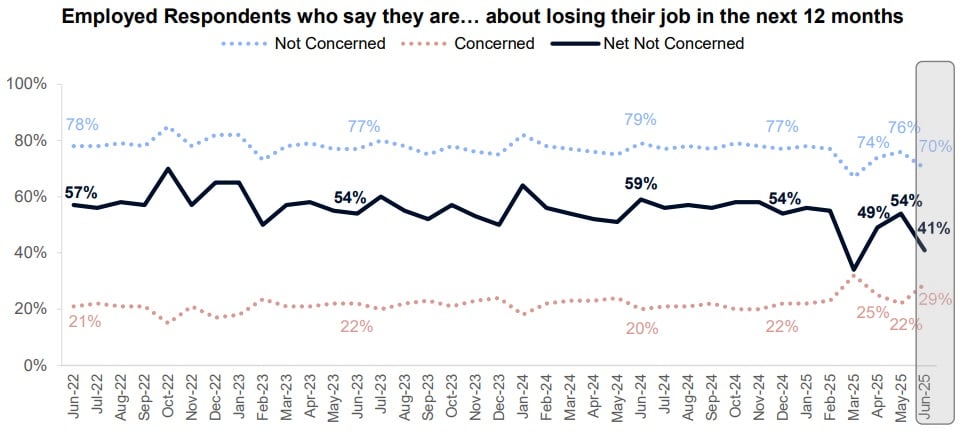
After hitting its highest level of the year in May, consumer sentiment toward housing deteriorated in June as Americans became more concerned about losing their jobs and less certain that mortgage rates will come down in the next year.
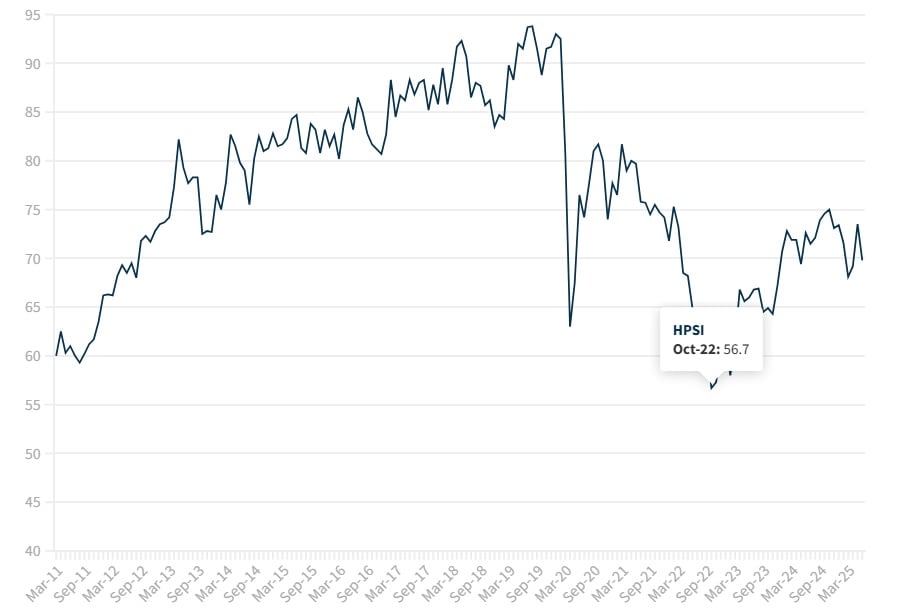
At 69.8, Fannie Mae’s Home Purchase Sentiment Index (HPSI) was down 3.7 points from May to June and 2.8 points from a year ago, the mortgage giant announced Monday.
The decline in Fannie Mae’s HPSI echoes consumer sentiment surveys conducted in June by the University of Michigan and the Conference Board, which showed uncertainty over tariffs weighing on consumer confidence. Consumers are currently paying an average effective tariff rate on imports of 15.8 percent — the highest since 1936, according to a June 17 analysis by The Budget Lab at Yale.
The Trump administration has delayed until Aug. 1 additional country-specific “reciprocal tariffs” that had already been postponed once to July 9. The White House said Monday that 14 countries were notified that they’ll face reciprocal tariffs next month, with additional notifications to go out in the days ahead, CNBC reported.
Goods from Japan and South Korea will be hit with a 25 percent import tax on Aug. 1, for instance, Trump informed the countries in letters shared on Truth Social.
“Tariffs remained on top of consumers’ minds and were frequently associated with concerns about their negative impacts on the economy and prices,” Conference Board Senior Economist Stephanie Guichard said in a statement. “Inflation and high prices were another important concern cited by consumers in June.”
Fannie Mae HPSI tracks consumer housing sentiment
Launched in 2011, Fannie Mae’s HPSI distills six questions from the mortgage giant’s monthly National Housing Survey into a single number.
The index plummeted in the spring of 2020 at the outset of the COVID-19 pandemic and hit an all-time low of 56.7 in October 2022, when home prices and mortgage rates were climbing.
At its current level, the HPSI is about where it was in the summer of 2012, when home purchase sentiment was rebounding from the 2007-2009 housing crash and Great Recession.
While “similar in spirit” to the University of Michigan and Conference Board surveys, the HPSI “is specifically devoted to the housing market,” and increases in the index “have been quite reliably followed by stronger housing markets,” Fannie Mae researchers said in an overview.
Five out of six HPSI components decreased in June. In addition to being more worried about losing their jobs and less convinced mortgage rates will fall, Americans were less certain that home prices will keep rising in the year ahead and that conditions are good for sellers.
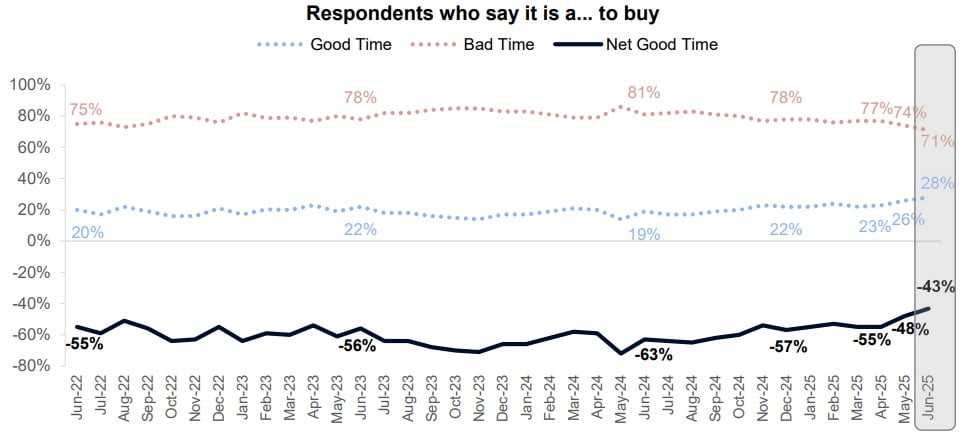
While just 28 percent of the 1,313 household financial decision makers surveyed by Fannie Mae between June 1 and June 17 said it was a good time to buy, that’s up two percentage points from May and nine percentage points from a year ago.
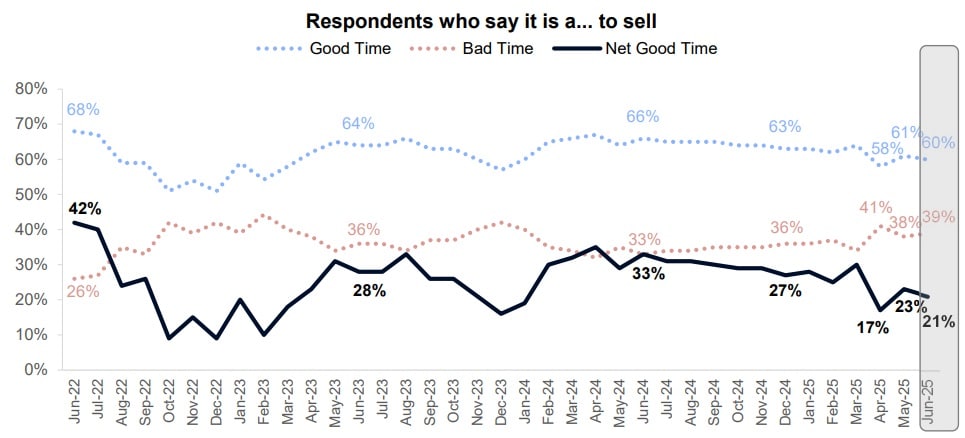
Although six in 10 Americans surveyed in June (60 percent) said it was a good time to sell, that’s down from 61 percent in May and 66 percent a year ago.
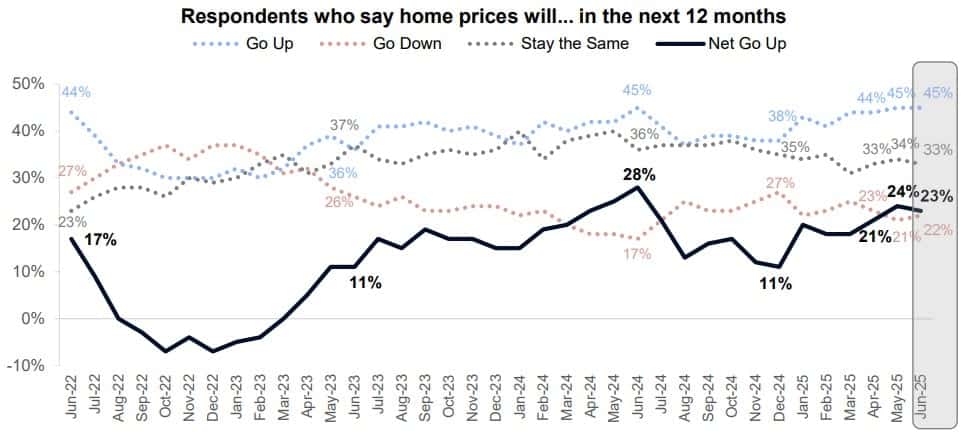
The share of survey respondents who expect home prices will go up in the next 12 months was unchanged in June at 45 percent.
But the share who said they expect home prices to go down — 22 percent — was up one percentage point from May and five percentage points from a year ago.
Although falling home prices might help boost sales, Fannie Mae’s HPSI treats a decline in home price expectations as a negative for consumer housing sentiment.
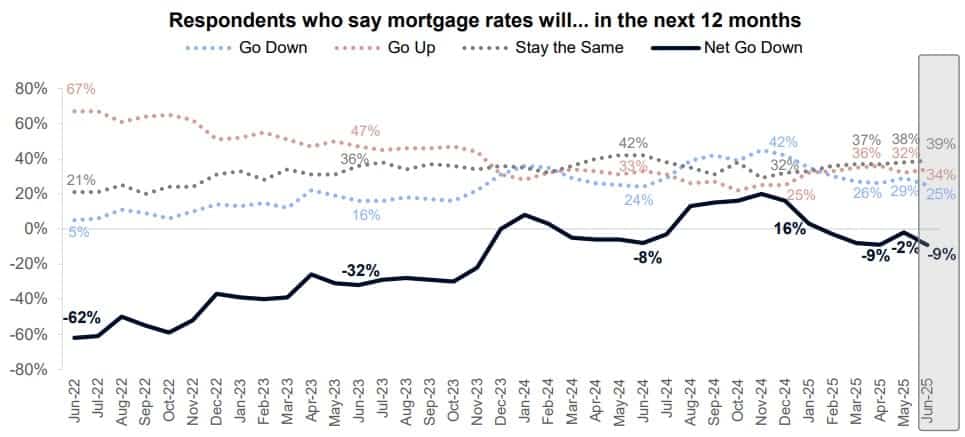
While close to one in three Americans (29 percent) surveyed in May said they expected mortgage rates to come down in the year ahead, that share dropped to 25 percent in June.
The Federal Reserve is expected to hold short-term interest rates steady until September, as policymakers assess the impact of the Trump administration’s tariffs, tax cuts, deregulation and deportations.
Fannie Mae economists last month predicted mortgage rates will drop to 6.5 percent by Q4 2025 and to 6.1 percent by the end of next year. Forecasters at the Mortgage Bankers Association have a more cautious outlook, predicting rates for 30-year fixed rate loans will end the year at 6.7 percent and drop to 6.4 percent by the end of next year.
Although only 29 percent of Americans polled in June said they were concerned about losing their jobs, that’s up from 22 percent in May and 20 percent a year ago.
At 4.1 percent, the unemployment rate in June was down slightly from 4.2 percent in May. But 7 million Americans were out of work, an increase of 1 million from June 2023.
Although not factored into the HPSI, 67 percent of household decision makers surveyed in June said they thought the economy was on the wrong track, up from 64 percent in May.
Get Inman’s Mortgage Brief Newsletter delivered right to your inbox. A weekly roundup of all the biggest news in the world of mortgages and closings delivered every Wednesday. Click here to subscribe.
Email Matt Carter

by Leo Pareja | Jul 7, 2025 | Industry, News Feed
In an Inman Exclusive, Leo Pareja, CEO of eXp Realty, writes that exposure sells homes, while shielding listings hurts sellers, limits buyers and undermines trust.
Real estate is changing fast, and so must you. Inman Connect San Diego is where you turn uncertainty into strategy — with real talk, real tools and the connections that matter. If you’re serious about staying ahead of the game, this is where you need to be. Register now!
Leadership isn’t about saying what’s easy. It’s about doing what’s right, especially when the stakes are high. Throughout my journey from selling nearly 4,000 homes to leading the No. 1 brokerage in the country by transaction count, one truth has always guided me: Silence in moments of chaos is complicity.
That often means speaking up when staying quiet would be easier. But the cost of silence is always greater than the criticism that comes with courage.
Since the NAR settlement first hit our radar in March of last year, I’ve led eXp through one guiding principle: Do what’s best for the consumer. It’s why we decided not to participate in broker-to-broker compensation moving forward.
It’s how we developed a straightforward, consumer-centric buyer agency, listing agency and most recently, seller disclosure documents. All open-sourced and shared freely with the entire industry. At a time when real estate is under a microscope, we’ve chosen to double down on putting the consumer first.
Recently, Compass filed a lawsuit against Zillow. While eXp is not named as a defendant, Compass accused us of being a “co-conspirator.” That’s a serious claim. One we categorically reject.
EXp charts its own course. We collaborate where it benefits consumers. We do not conspire. We do believe that the decision by Compass to forego sharing its listings with local MLSs is bad for consumers, and we will continue to stand against anything that hides listings, limits access or restricts opportunity.
Let’s talk about what this is really about: Compass wants to control inventory. They’re not hiding that motivation.
Take their “Three Phase Marketing” model. On paper, it’s positioned as “consumer choice.” In reality? It’s about controlling listing exposure. In Q1 of 2025, Compass reported that 48.2 percent of its listings entered this funnel. Nearly half of their homes were shielded from the broader market at the outset. No matter what language you wrap it in, that’s steering.
Below is a direct excerpt from an internal Compass email, sent by a managing broker to a former Compass agent (identifying info withheld, originals retained):
Let’s be clear: This isn’t about helping sellers or offering consumers more options. It’s about rigging the game, keeping inventory out of sight to create artificial scarcity, confusing the public and boosting agent commissions. That email doesn’t talk about the seller’s goals. It doesn’t mention fair housing or inclusive access. It’s about funneling deals inside a closed loop.
That’s not a marketing strategy. It’s market manipulation, plain and simple. And the consumer is the one being played.
Last week, Compass went a step further and declared it won’t comply with participation rules. Compass wants full access to display local MLS listings through IDX while keeping their own listings gated behind Compass.com. That’s not consumer advocacy. That’s bait-and-switch.
On a recent podcast with Ricky Carruth, Compass’s President of Growth, Rory Golod, confirmed this entire strategy is designed to win more listings and close more deals. Not once did he mention consumer value. Not once did he talk about transparency. He said the quiet part out loud, on repeat.
And Compass CEO Robert Reffkin? He already spoiled the plot of Compass’s end game when he said in a Q2 2024 earnings call:
“The foundation of every entity’s success in real estate is access to inventory. The source of success for all players in the industry whether MLSs, aggregators, buyer agents or listing agents is access to inventory.”
Access is power. And Compass wants to be the only one holding the keys.
But here’s the twist. They admit that 94 percent of their “exclusive” listings end up on the MLS anyway. If “exclusivity” was really serving the seller, why does nearly every listing eventually go public?
Because the data tells the truth: Exposure sells homes. Shielding listings hurts sellers, limits buyers and undermines trust. Period.
Let’s call this what it is: “Seller choice” is being weaponized, used as a Trojan horse by Compass to fragment the market, reduce transparency and create artificial scarcity that prioritizes agent interests over consumer needs. That’s not leadership; it’s exploitation.
We’re not here to play that game. At eXp, we believe in an open, transparent marketplace. We’ll keep building tools that serve the public, sharing resources that elevate everyone, and calling out the noise when it distracts from what really matters.
Because the future of real estate deserves truth, not spin.

by Christy Murdock | Jul 7, 2025 | Industry, News Feed
Real estate is changing fast, and so must you. Inman Connect San Diego is where you turn uncertainty into strategy — with real talk, real tools and the connections that matter. If you’re serious about staying ahead of the game, this is where you need to be. Register now!
Each week on The Download, Inman’s Christy Murdock takes a deeper look at the top-read stories of the week to give you what you’ll need to meet Monday head-on. This week: After a topsy-turvy spring, some markets are seeing more inventory this summer. Here’s how to lead gen for buyers and listings to take advantage of the opportunity.
For many agents who were convinced that spring 2025 would make up for the sluggish markets of the post-pandemic years, the past few months have been pretty disappointing. Despite increases in inventory, a combination of political and economic uncertainty combined to keep many buyers on the fence, hoping for lower interest rates or worrying that their jobs were in jeopardy.
Within the industry, ongoing sturm und drang around private listings, major brokerages and powerhouse portals have kept agents on edge, unsure about how to move forward in today’s market and what to tell leads when they call. Will the advice you give today come back to bite you months or even years from now? Will your brokerage’s listings philosophy make it harder to sell your services? Who really knows at this point?
Well, the good news is that Inman’s staff writers and contributors always keep their boots firmly on the ground, bringing you up-to-the-minute news and advice designed to ensure that you’re always the most informed real estate pro in your market.
We want to get you all caught up on the latest lead gen and lead nurture strategies, plus marketing ideas for your business and your listings. (Done the right way, you won’t just get that listing sold. You’ll develop a whole host of new leads for the months and years ahead.)
Bookmark this story: You’re going to want to come back to it. Then send the link to your favorite agent — mentee or colleague — so they can put these ideas to work, too. After all, we’re all in this market together.
Inman staff writers
The nation’s largest real estate portal has begun enforcing its ban on private listings, 10 weeks after announcing its new standards. Here’s what you need to know now.
CEO Robert Reffkin said the real estate brokerage doesn’t consider “any national NAR MLS rule impacting clients as binding,” but will continue to train agents to comply with local MLS rules.
Robust new construction activity and subdued homebuyer demand has led to an inventory boom in 22 of the 50 largest markets, with some metros seeing active inventory double vs 2019.
Umansky’s PLS alleges NAR controls competition in the residential real estate industry by controlling a large network of MLSs in the country.
Bernice Ross
Saving clients and prospects money is the best marketing you’ll ever do. You’re building trust and creating an unbeatable personal connection.
Carl Medford
After owning a staging company for 20 years, the team leader lists seven categories of critical questions to ask before selecting a stager for you and your listings.
Those who understand the requirements of today’s market and are willing to roll up their sleeves will reap the rewards.
Zillow’s brokerage license and algorithmic pricing suggestions could be setting it up for a legal showdown that threatens its entire business model.
Ken Baris
The best lead generation comes from genuinely valuing and nurturing the relationships you already have and keeping in touch with your network.
Lindsey Harn
An organized and proactive process can help keep the peace between family members and sell your client’s home efficiently.
Josh Ries
The broker and lead gen consultant shares strategies for demonstrating to sellers how your tech tools will get the results they’re looking for.
Stop chasing leads and start creating memorable outreach in person and online with these helpful circle prospecting strategies.
Molly McKinley
While competitors focus on traditional SEO tactics, forward-thinking pros can build a review foundation to drive AI recommendations for years to come.
Chris Pollinger
The leadership team at LA’s Elite Home Staging talk about the features that get luxury homes sold in the summertime.
Amy Stockberger
Serve your clients so well that they can’t help sharing the good news about the service you provide, sending new clients to you along the way.
Darryl Davis
Success in real estate is a lot like producing Broadway — build the right cast, believe in your story and deliver an unforgettable experience.
Jessi Healy
Meta’s mass group bans are the latest sign that automated moderation is breaking the platforms we rely on.
Livestreams are selling, AI is oversharing, and Facebook is quietly confirming what we already knew about links. Here’s what to pay attention to now.
Real estate pros can build trust — and a lasting brand — by leading with values, not just visuals.
From voice notes to video hooks, the latest updates across Instagram, TikTok and LinkedIn prove one thing: Connection is personal.
Verl Workman
Just starting out on a real estate team as a buyer’s agent? Here’s what you should know to hit the ground running and help your clients.
Alyssa Stalker
From odd punctuation to generic phrasing, here’s how to spot AI’s fingerprints, and keep your real voice front and center.
Starting strong means building systems early. Learn how to set up the right tools and habits from Day One.
Troy Palmquist
After years being out of production, the broker is going back to sales, and he’s betting big on this platform to help him maintain consistent, smart communication with his sphere.
As the market shifts, it’s important that your listing stands out from the competition. Here’s how to help your sellers get market-ready fast.
Holly Brink
Learn agent Abby Goodell’s no-frills strategy for turning Facebook Marketplace posts into legit buyer leads, and examine why most agents overlook the platform.
Jimmy Burgess
by Daniel Houston | Jul 7, 2025 | Industry, News Feed
Intel observed a notable rise in late June in the share of agents who said their buyer client pools were “substantially” slimmer than at the same point last year.
This report is available exclusively to subscribers of Inman Intel, the data and research arm of Inman offering deep insights and market intelligence on the business of residential real estate and proptech. Subscribe today.
A weaker-than-expected lineup of buyer clients to open real estate’s most crucial closing season forced agents to downgrade their outlook for the year ahead, a new Intel survey shows.
The share of agent respondents to June’s Inman Intel Index survey who said they experienced a year-over-year decline in buyer pipelines rose from 52 percent in May to 57 percent in June, according to the latest results.
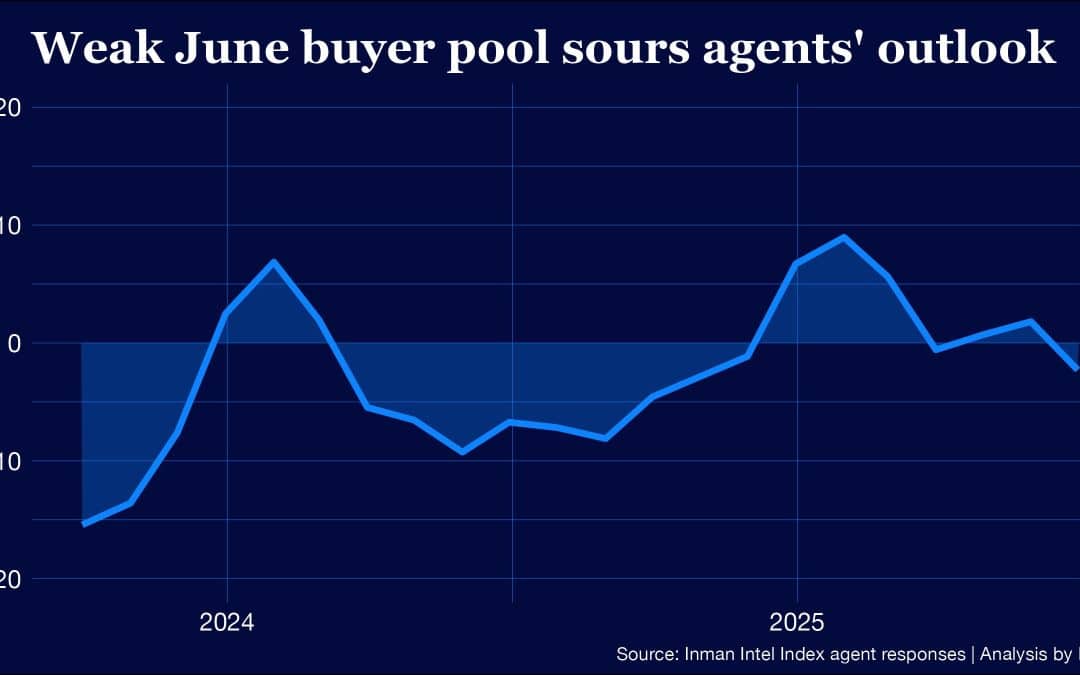
And that helped push overall agent sentiment to its lowest point since September, as measured by Intel’s Client Pipeline Tracker metric.
Client Pipeline Tracker score in June: -2
- Previous score: +2 in May
- Recent high point: +9 in January
Short-term listing client conditions remained mostly unchanged as the page turned to summer and an inventory recovery continued apace. Still, the agents Intel surveyed had substantially scaled back on their optimism for future business on both sides of the transaction.
This week’s report breaks down all the survey components that inform the score — and lays out what they mean for the months ahead.
A weak start to summer
Intel’s Client Pipeline Tracker is a compilation of how agents feel about their buyer and seller pipelines — both over the past year and in the near future.
Intel described the methodology in this post, but here’s a quick refresher on how to interpret the scores.
- A score of 0 represents a neutral period in which client pipelines are neither improving nor worsening.
- A positive score reflects a market in which client pipelines have been improving, or are widely expected to improve in the next 12 months. The higher the rating, the more confident agents are in that conditions are moving in a positive direction.
- A negative score suggests client pipeline conditions are worsening, or are widely expected to get worse in the year to come.
An extremely positive combined score falls somewhere around the +20 mark. This type of score would signify that much of the industry is in agreement with the fact that pipelines are improving and will continue to improve.
An extremely negative combined score, on the other hand, falls closer to -20. That’s a bit lower than where the industry stood in September 2024, the first time Intel surveyed agents about their pipelines.
For each of the four individual components that go into the score, results as high as +50 or as low as -50 are sometimes observed.
Here are the component scores from the most recent survey, and how each sentiment category changed from the previous one.
Tracker component scores
May → June
- Present buyer pipelines: -27 → -33
- Future buyer pipelines: +11 → +6
- Present seller pipelines: -9 → -9
- Future seller pipelines: +13 → +9
Summer is supposed to be the season where agents close on the highest volume of transactions — and secure the biggest chunk of their revenues for the year.
And while that seasonal ramp-up is likely happening, the momentum has not been as strong as agents are accustomed to at this time of year.
- 24 percent of agent respondents described buyer pipeline declines from last June that were “substantial” in scope, while another 33 percent described more moderate hits to buyer-side client pools.
- The previous month, fewer than 21 percent of respondents told Intel they observed “substantial” year-over-year declines in their buyer pipelines, and another 31 percent said they experienced a smaller fall.
These buyer-side struggles coincided with declining outlooks for the year ahead.
- On the buyer side, the share of agents who told Intel that they expected to be working with more clients 12 months from now fell from 40 percent in May to 34 percent in June.
- The seller-side trend was even more pronounced, with 44 percent of agent respondents in May expressing optimism for their listing pipelines in the year ahead, and just under 37 percent doing the same in June.
But for many of these agents, the optimism wasn’t replaced with pure pessimism, but with more of a wait-and-see stance.
- The share of agent respondents who said they expect their buyer pipelines to be “about the same” a year from now crept up from 43 percent in May to 46 percent in June.
- Meanwhile, seller pipelines were expected to remain about the same 12 months from now by 46 percent of respondents in June, up from 38 percent the month before.
Where the market stands
Despite this relatively weak start to real estate’s busy season, agents are still more or less treading water with their listing clients amid a slow but steady climb in inventory.
- Drawing from both ends of the spectrum, the share of agents in June who told Intel that their listing client pools were “about the same” as last year rose from 27 percent in May to 34 percent in June.
As a result, the present condition of listing pipelines were the only component of the Client Pipeline Tracker that didn’t meaningfully worsen in the early weeks of summer.
These results come in the context of a general rising tide of new listings that have served as a silver lining to the nation’s ongoing depressed sales environment.
But as Intel explored a few weeks ago, many markets have yet to fully participate in that recovery, including many large metros sprawling throughout the Midwest and Northeast.
As the market recovery enters a distinct new chapter, Intel will continue to closely follow these and other trends.
Methodology notes: This month’s Inman Intel Index survey was conducted June 21-July 3, 2025, and received 522 responses. The entire Inman reader community was invited to participate, and a rotating, randomized selection of community members was prompted to participate by email. Users responded to a series of questions related to their self-identified corner of the real estate industry — including real estate agents, brokerage leaders, lenders and proptech entrepreneurs. Results reflect the opinions of the engaged Inman community, which may not always match those of the broader real estate industry. This survey is conducted monthly.
Email Daniel Houston

by Amy Stockberger | Jul 7, 2025 | Industry, News Feed
Text replacements and keyboard shortcuts are the OGs of automation, broker-owner Amy Stockberger writes. They’ve saved her business hundreds of hours and thousands of decisions.
Real estate is changing fast, and so must you. Inman Connect San Diego is where you turn uncertainty into strategy — with real talk, real tools and the connections that matter. If you’re serious about staying ahead of the game, this is where you need to be. Register now!
Let’s talk automation. Not the robust CRM you’re building your pipeline with. Not the AI-driven platforms that are reshaping how we work — I’ve previously shared why you absolutely need those, and I stand by it.
But today, I’m talking about the automation hiding in plain sight — the kind built into the tools you already use daily.
No onboarding. No learning curve. No extra cost.
Text replacements and keyboard shortcuts are what I call the OGs of automation, and they’ve quietly saved our business hundreds of hours and thousands of decisions for over a decade.
They don’t just save time. They protect your energy, your consistency and your brand voice.
If you’re serious about building a business that runs on systems, not stress, this is the fastest, frictionless place to start.
If you’re not building a SADD business, you’re building burnout
Every process in our company runs through one filter: Systematize it. Automate it. Delegate it. Or Delete it.
That’s what we call the SADD filter, and it’s how we decide whether a task belongs on our plate or in our process.
Most agents are buried in busywork because they’re defaulting to memory. They’re typing the same emails. Writing the same texts. They’re slowly burning out because there’s no system to catch the repeatables.
But here’s the truth: If you’re doing it more than twice, it needs a code.
Text replacements: Your brand’s secret weapon (right in your pocket)
Text replacements are pre-set shortcuts you can program into your phone. You type in a short code — like byrtmp — and your phone instantly expands it into a full paragraph, prewritten by you, that delivers a clear, on-brand message.
We use them for everything (literally everything):
- byrtmp → Buyer inquiry response with next steps and value positioning
- sllrtmp → Seller inquiry response with next steps and value positioning
- rlcfm → Relocation onboarding for families (we have a different message we send to individuals, too)
- ofr / cntr → Offer submitted / counter update to co-agent
- rrbc → Referral thank-you (sent instantly, reinforcing referral behavior of our clients)
- lu → “Love you!” (I work with a lot of my fam so get to say this a lot during the day but do not have time to type it all out)
- dddb → “Did you do the dishes, babe?” (Yes, even for my son back when he lived at home)
These are fast, frictionless and powerful.
They help us maintain excellence even when we’re moving fast.
Desktop shortcuts: High touch at high volume
On desktop, we use Text Blaze to expand our automation across departments:
- Buyer and seller onboarding emails
- CRM notes with smart fields (autofill names, addresses)
- Internal messages for recruiting, onboarding, transaction updates
- Admin and accounting process responses
These codes are shared across teams, so whether it’s my listing coordinator, executive assistant or transaction manager, everyone uses the same phrasing, the same tone, the same timing.
And guess what? That consistency compounds trust. Clients feel like they’re dealing with one seamless company, not a jumble of disconnected emails.
Text Blaze now includes built-in AI, but honestly, the shortcut feature alone is worth its weight in gold.
And when you have new staff stepping into roles, these shortcuts ensure there is zero learning curve — just follow the shortcuts. We have a shortcut sheet for all to reference.
Real results from these OG automations
These OG automations fuel:
- Buyer/seller conversion speed
- Referral reinforcement (in minutes, not days)
- Internal task routing and communication
- Vendor handoffs and scheduling
- Lead nurture (even cold leads get hot when followed up properly)
- Recruiting and agent retention (same system, same voice, less ramp-up)
In other words: We’re not winging it. We’re replicating it. That’s how you build a business that grows without adding chaos.
The simplicity multiplier: Less thinking = more serving
Most people underestimate how much energy goes into small decisions.
- “Should I say this differently?”
- “Where’s that old email?”
- “Did I remember to follow up?”
When you automate what’s repeatable, you free up cognitive capacity to do what matters — serve your clients, connect with your community and lead your team.
That’s how you move from reactive to proactive. From chaotic to clear.
Software and systems are essential, but even the best platforms only perform when your foundation is strong. Text replacements and keyboard shortcuts are where that foundation begins. They’re fast. Frictionless. And proven.
Start here. Scale smarter. Build the system your business and your future deserve.
Amy Stockberger is the founder of Amy Stockberger Real Estate. Connect with Amy on Instagram.

by Troy Palmquist | Jul 7, 2025 | Industry, News Feed
As Troy Palmquist refreshes his consumer-facing real estate brand online, he takes you along on the journey, including the nuts and bolts decisions related to content marketing.
Real estate is changing fast, and so must you. Inman Connect San Diego is where you turn uncertainty into strategy — with real talk, real tools and the connections that matter. If you’re serious about staying ahead of the game, this is where you need to be. Register now!
One of the tasks I’m working on as I move back into production is refreshing my consumer-facing online presence. I’m pivoting some of my digital content toward buyers and sellers, updating my bio and working on search engine optimization.
In an effort to make my consumer-focused website more effective for lead generation and brand building, I’ve purchased my name in both the .realtor and .realestate domains. The .realtor domain is available exclusively for members of the National Association of Realtors and the Canadian Real Estate Association, while anyone can purchase a .realestate domain.
Here are seven reasons why I decided to make the switch:
1. Strong professional branding and credibility
For agents and brokers who want to lean into their professional status through their NAR or CREA membership, the .realtor extension is a great way to communicate it. In addition, top-level domains that are industry-specific — like .realtor as opposed to .com or .net — are easier to remember, keeping agents top-of-mind with the people they meet.
2. Cost-effective marketing
Realtors get the full first year of a .realtor domain at no cost, while renewals begin at $39.95/year. The .realestate domain starts at $69/year. Multi-year and multi-domain discounts between 10 percent and 25 percent are also available. That’s an affordable investment for ongoing branding and is, in many cases, far cheaper than other domains.
3. Strategic hybrid domain approach
If you’re wanting to explore multiple approaches to branding and marketing — for example, content marketing that focuses on both your local market and a specialty niche — you can cover multiple audiences, highlight your authority and attract traffic with multiple SEO strategies. With both domain types, you also have a better chance of dominating search results.
4. Setup and technical support
For those who are tech-savvy, the complimentary website offered with a domain name purchase is a simple DIY process, often under five minutes. However, for those who need a little more help, there are premium options that allow you to outsource customization, optimization and content development. SSL security, ADA compliance and reliable hosting are baked in, so your site can be up and running almost immediately.
5. Lead generation and SEO lift
Among the tools offered are built-in contact forms, pop-ups, MLS integrations and done-for-you blog posts aimed at converting website visitors into warm leads. In addition, case studies show that some clients have seen significant spikes in both traffic and engagement, suggesting that there may be an SEO boost as well.
6. Domain forwarding and multi-domain strategy
If you have an existing .com website, you can route traffic to or from your .realtor or .realestate site, creating more comprehensive domain authority. By owning multiple domains, you strengthen your online presence and reduce the risk of a copycat competitor horning in on your brand. In my case, I’ll be pointing to my website sellingtheaddress.com built on the access.com, Agent Image-designed website, giving me multiple domains for better brand coverage.
7. Exclusivity and brand differentiation
Since only NAR/CREA members can access .realtor domains, you’ll enhance your credibility and deter so-called “cybersquatters” who buy desirable domains and sell them back at a premium. In addition, a .realestate domain can help you more accurately communicate your niche or location along with what you do, often far more affordably than a .com domain.
As an example, take my local market, Oxnard, California. I can purchase OxnardRealEstate.com from GoDaddy for $9,699. I can grab Oxnard.realestate, a premium URL, for $500/year, or I can niche down to OxnardHomes.realestate or OxnardWaterfront.realestate for only $69/year.
For enhanced professionalism, differentiation and affordability, a .realtor or .realestate URL just makes sense, and I’m looking forward to seeing how it will boost my online presence. It’s a simple step that puts me in control of my brand and gives clients one more reason to trust they’ve come to the right place.
Troy Palmquist is the founder and principal at HomeCode Advisors. Connect with him on LinkedIn.