by Lillian Dickerson | Jul 8, 2025 | Industry, News Feed
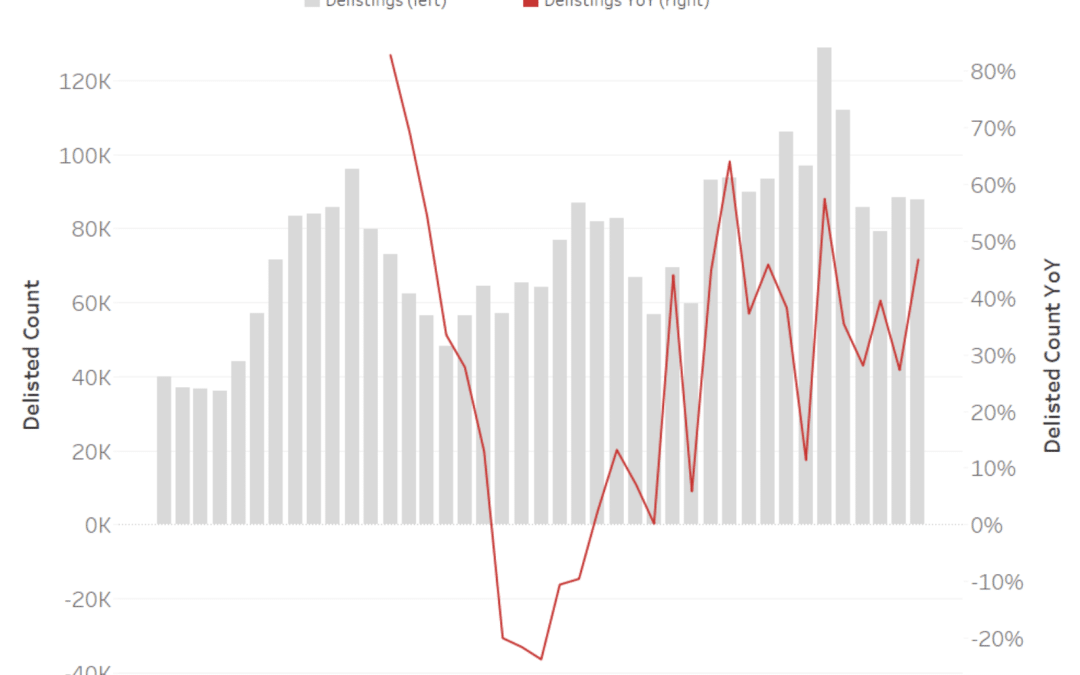
Delistings outpaced inventory growth in June even as price cuts surged, showing that a growing number of sellers are unwilling to compromise when it comes to their selling goals.
Real estate is changing fast, and so must you. Inman Connect San Diego is where you turn uncertainty into strategy — with real talk, real tools and the connections that matter. If you’re serious about staying ahead of the game, this is where you need to be. Register now!
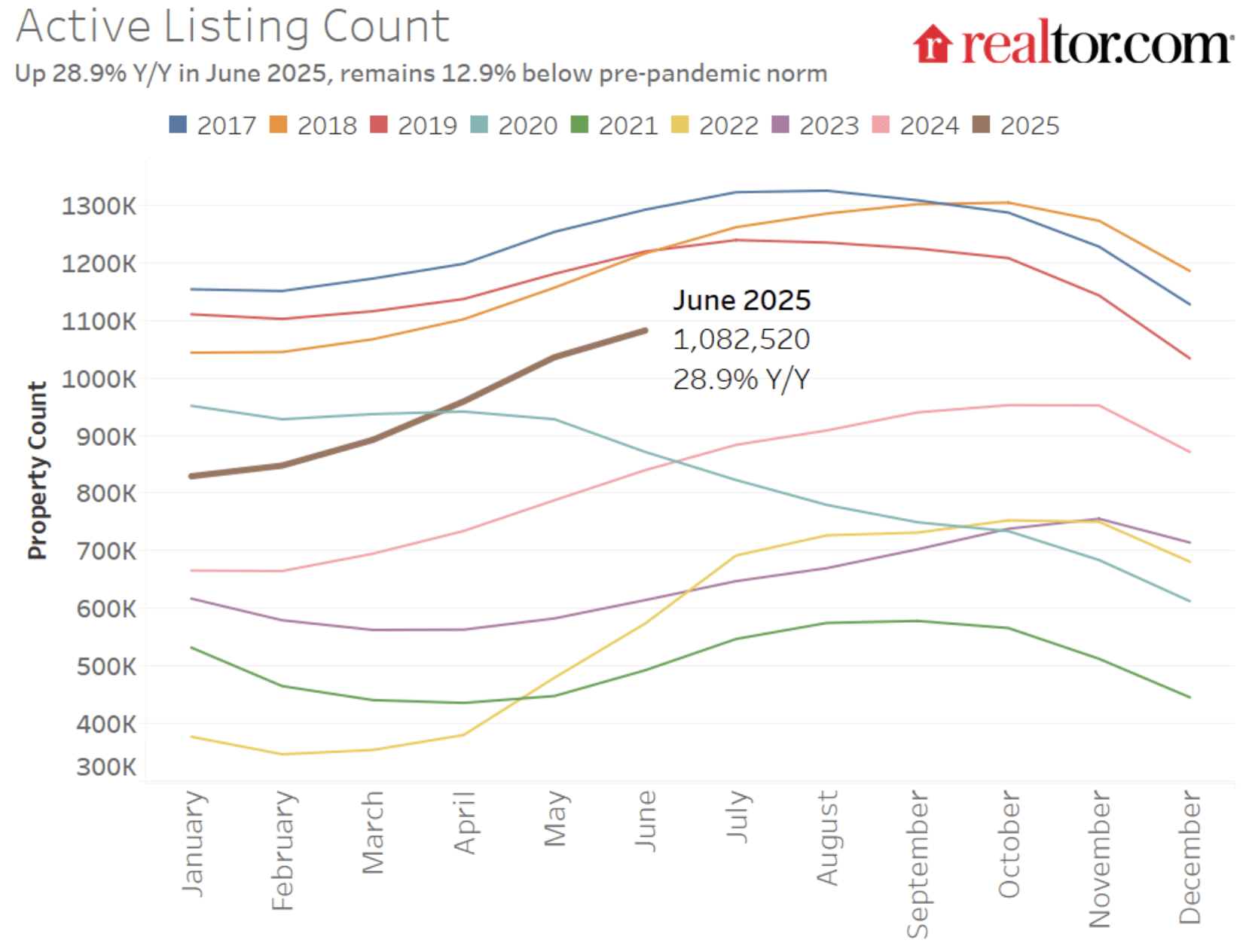
Active inventory hit a post-pandemic high in June as it grew 28.1 percent year over year, yet sellers are showing signs of becoming impatient with slower buyers, as delistings are also on the rise.
In fact, growth in delistings outpaced inventory growth, with delistings up 35 percent year-to-date and up 47 percent year over year in May, according to Realtor.com’s June Housing Trends Report. Even so, delistings make up a relatively small number of listings — 90,000 out of 452,000 new listings that went up in June.
As inventory continues to grow, it’s putting increased pressure on home prices, spurring some sellers to slash asking prices and causing home prices to decline significantly in some markets.
The data shows that many buyers and sellers today are engaging in a face-off of sorts.
All four major regions in the U.S. saw inventory increase in June, with inventory in the West up by 38 percent and, in the South, up by 30 percent. All 50 top metros saw annual inventory gains, too, with Las Vegas (up 77.6 percent) and Washington, D.C. (up 63.6 percent), in the lead.
Price cuts also surged in June, hitting their highest level for any June since at least 2016, with 20.7 percent of listings reducing their prices. Price cuts and growing inventory have not yet made a dent in the national median list price though, which remained roughly the same year over year at $440,950.
Credit: Realtor.com
“This year’s market is a study in contrasts,” Danielle Hale, chief economist at Realtor.com, said in a statement. “Buyers are seeing more choices than they’ve had in years, but many sellers, anchored by peak price expectations and upheld by strong equity positions, are deciding to step back if they don’t get their number. Looking forward, this dynamic will affect whether we tip from a balanced to buyer’s market, and if so, how quickly that happens.”
There’s no doubt that more homeowners are opting to take their listings off the market now, but even so, buyers still have more options at their fingertips than since the COVID-19 pandemic started. Active listings in the U.S. exceeded 1 million for the second consecutive month, Realtor.com said, placing inventory levels just 13 percent below pre-pandemic levels.
Meanwhile, delistings now make up about 4.1 percent of the market, compared to 3.2 percent of all active listings in May 2024.
Even with more active inventory on the market, it seems a growing number of sellers who aren’t gaining attention on their listings at their preferred price today are electing to delist instead of compromise with a price cut or continue to rack up days on market. From March through May, the ratio of delistings to new listings hit 13 percent, compared to the 10 percent seen during the same periods in 2024 and 2023, and the 6 percent seen in 2022.
Agents say that sellers in hot markets (Miami; Phoenix; Riverside, California) are especially likely to be selective about which offers to accept, oftentimes choosing to delist instead of compromising on their selling goals.
“We’re seeing hesitation on both sides of the market,” Anthony Djon, founder of Anthony Djon Luxury Real Estate, said in Realtor.com’s report. “Inventory is rising, giving buyers more options and making them more price-sensitive and selective. At the same time, some sellers — especially those not getting immediate traction — are stepping back. The market has clearly shifted from the urgency and intensity of recent years, and today’s homeowners are having to recalibrate their expectations.”
Update: This story was updated after publication with additional context.
Email Lillian Dickerson
by Mariya Gordon | Jul 8, 2025 | Industry, News Feed
Inman, the leading source of real estate news, education and insights, is excited to announce that Inman On Tour Texas is back for 2025, bringing together the industry’s top agents, brokers and thought leaders for a one-of-a-kind event.
Inman On Tour Texas, taking place Oct. 9, 2025, at Union Station in Dallas, is thrilled to unveil its first speakers.
As the real estate landscape accelerates — driven by AI innovation, evolving commission structures and shifting buyer behaviors — this event is designed to equip agents, brokers, technologists and investors with the strategies and connections needed to seize the moment.
Inman On Tour Texas will bring together hundreds of forward-thinking professionals for a day of cutting-edge discussions, hands-on workshops and high-impact networking. Our program is built around three pillars:
- Cutting-edge tech insights: Unlock the latest in AI, big data and proptech, so you can stay ahead of the curve.
- Strategies to elevate your business: Learn proven approaches that scale your operations and capitalize on emerging trends.
- Engage and collaborate: Forge meaningful partnerships with the industry’s brightest minds in an interactive, peer-powered environment.
Today, we’re proud to introduce the first five speakers who embody the entrepreneurial spirit and innovative drive at the heart of Inman On Tour Texas:
- Beth and Michael Silva | founders, Happen Houston & Harvard Homes: Beth creates award-winning, architect-driven residences that reflect how modern families live. Michael has built over 100 homes and facilitated 3,000+ transactions by combining brokerage, construction and investment to deliver seamless real estate experiences.
- Dee Dee Guggenheim Howes | Realtor, Compass: With 25+ years in Houston’s luxury market, Howes orchestrates every detail to ensure top-dollar outcomes and multiple bid scenarios. Her forensic grasp of legal and financial aspects has made her a trusted advocate for buyers and sellers alike.
- Tracy Tutor | founder, The Tracy Tutor Team, Douglas Elliman: A powerhouse in Beverly Hills and now Texas, Tutor has shaped $400 million in branded real estate sales and represented landmark developments like Atlantis The Royal in Dubai. Her confidence and deep network open doors to elite clients and high-profile projects.
- Katie Kossev | managing broker, Texas, Side: An eighteen-year industry veteran, Kossev mentors brokers and agents to balance growth with well-being. A 2017 Inman Innovator of the Year, she’s guided countless entrepreneurs to achieve peak performance while building purposeful lives, earning her a reputation as a true industry champion.
- Ryan Rodenbeck | broker-owner, Spyglass: From a solo agent in 2008 to leading a 100-agent brokerage by 2022, Rodenbeck combines tech savvy with systematized processes to turbocharge agent productivity, recruitment and automation. His advisory roles with leading proptech firms inform his hands-on guidance for agencies ready to scale.
As real estate professionals confront turbulent market conditions, one truth becomes clear: Uncertainty is the new normal. From shifting commission structures to the rise of generative AI and ongoing tariff legislation, the rules of the game are being rewritten in real-time. The question is no longer whether the industry is changing, but how you will keep up.
Attendance is limited to ensure an intimate, high-energy experience. Join us in Dallas on Oct. 9, 2025, for the real estate event of the year.
Register now to claim your spot, and stay tuned for more speaker announcements.
Union Station, Dallas, Texas
Oct. 9, 2025
Taking place this October, Inman On Tour Texas will make a stop in Dallas, offering a full day of learning, networking and market-specific insights designed to empower real estate professionals with the tools and strategies needed to thrive in a rapidly changing landscape.

by Lillian Dickerson | Jul 8, 2025 | Industry, News Feed
July is Luxury Month at Inman. We’ll take the temperature of the luxury market, talk to top producers in the ultra-luxury space and dive into the luxe trends of today — all culminating at Luxury Connect in San Diego, where we’ll announce this year’s Golden I Club honorees.
With almost exactly half of 2025 now in the books, its clear this is turning into a year of challenges. Global uncertainty spread, the economy rested on shaky ground, and political divisions have deepened — all of which are weighing on the minds of real estate professionals.
But amid all the challenges raining down on the housing market right now, one segment is still chugging along: luxury. In fact, in conversations with Inman, experts who specialize in the higher end of the market said that broader challenges notwithstanding, what they’re seeing right now looks more like resilience than collapse.
Mickey Alam Khan, CEO of full-service marketing agency Luxboro, was among those experts. He told Inman tariff policies have largely driven recent ups and downs in the economy, and will certainly impact the cost of construction materials and appliances, which will trickle down to the new development market. But otherwise, ultra-luxury buyers remain active.

Mickey Alam Khan
“So that impacts the future development of branded residences and new projects in that area,” Khan said. “That uncertainty is definitely hurting the overall market. When it comes to actual sales of luxury homes across the country, I feel that it’s the same situation as last year — the ultra-luxury market, or over $10 million, is always cash. So I think that market is as strong as ever, and ironically, it will grow stronger simply because of the swings and the volatility in the stock market.
“[Real estate] is becoming a more tangible asset of stored value,” he added.
Luxury real estate consistently outperformed the market at-large in 2024 and the first few months of 2025, adding to luxury agent optimism, Sotheby’s International Realty President and CEO Philip White told Inman, despite any other “noise” in the market right now.
“Luxury real estate agents must maintain unwavering focus on their business fundamentals rather than being swayed by daily market noise,” White said in an email to Inman. “Consistent client communication is paramount — ensuring buyers and sellers have current, accurate market intelligence positions agents as trusted advisors.”
Luxury trends
With interest rates still elevated, luxury buyers are heavily favoring cash transactions. There’s also little appetite for properties that require any kind of work, White said.

Philip White
“We’re observing a compelling dynamic where limited inventory of premier properties is driving competitive bidding for the most desirable locations,” White said in an email.
“Properties that have undergone strategic repricing to align with market comparables are moving successfully. There’s particularly strong demand for new construction and turnkey properties that require minimal renovation. Additionally, the vast majority of transactions are being completed as all-cash purchases. In fact, nearly 90 percent of our agents surveyed in the 2025 Mid-Year Luxury Outlook agent survey reported that the top transaction method for luxury property was cash.”
A wave of “smart luxury” buyers are also on the rise. According to Coldwell Banker Global Luxury’s 2025 Mid-Year Report, buyers who are seeking out perceived deals and investment opportunities want homes that have sat on the market.
With the value of the dollar weakened, more luxury buyers are being attracted to invest in U.S. real estate, Khan also pointed out, and even more are being compelled by President Trump’s “Gold Card” visa program, which creates a path to citizenship for individuals who invest $5 million in the U.S.
The program has received nearly 70,000 applicants, Commerce Secretary Howard Lutnick told the Financial Times, although it still faces legal challenges. Still, if those 70,000 applicants go through, it could mean a $350 billion investment in the country — much of which would likely be made in real estate.
“Where will that money go? It will go into buying either residential real estate or commercial real estate, investing in machinery, investing in talent,” Khan predicted. “But, I personally feel at least one-fifth of it will go into buying a home.”
Biggest deals of the year
There has been no shortage of big-ticket residential transactions so far this year, as investors have proven a continued penchant for luxury real estate.
The year’s priciest sales thus far have largely been concentrated in hot markets in South Florida and communities in and around Los Angeles. But other old-standbys like Manhattan, Honolulu and Aspen have seen their share of high-end deals too.
A three-home estate in Naples, Florida, marks the most expensive public sale of the first half of 2025 so far, with a jaw-dropping total sales price of $225 million. The property spans more than 15 acres and includes 800 feet of beach frontage. Michael McCumber of Gulf Coast International Properties represented the listing.
That sale was the only one thus far to surpass the $200 million mark — but there have also been several sales that have gone above and beyond $100 million, showing that ultra-high-net-worth individuals aren’t slowing down when it comes to buying the most elite luxury properties.
Stay tuned for a full list of the year’s top deals later in July.
Private listing networks
Few luxury brokerages have held back from weighing in on the private listings/office exclusives debate that has gripped the industry this year.
From staunch proponents of a client’s right to privately market their home (i.e. Compass, The Agency) to those who only support office exclusives in the rarest of circumstances (i.e. eXp Realty), brokerage opinions on the matter run the gamut.
It remains to be seen how and when the real estate industry may reach some sort of sustained status quo on this issue, and executives continue to weigh in — and call each other out. Compass, Corcoran Group and Douglas Elliman also all recently announced new platforms for their private listings.
And while any listing could theoretically be a private listing, the trend in practice is much more likely to concentrate at the higher end of the market. That’s because luxury homeowners are more likely to have wealth or notoriety that leads to privacy concerns, and thus an interest in selling without a traditional listing.
As a result, it’s already clear that the rise of private listings is poised to become one of the most consequential trends in the luxury space.
Get Inman’s Luxury Lens Newsletter delivered right to your inbox. A weekly deep dive into the biggest news in the world of high-end real estate delivered every Friday. Click here to subscribe.
Email Lillian Dickerson

by Darryl Davis | Jul 8, 2025 | Industry, News Feed
The real estate agents who rise to the top, coach Darryl Davis writes, are the ones who commit to daily growth, connection and service.
Real estate is changing fast, and so must you. Inman Connect San Diego is where you turn uncertainty into strategy — with real talk, real tools and the connections that matter. If you’re serious about staying ahead of the game, this is where you need to be. Register now!
Here’s the truth most agents won’t say out loud: Feeling like an expert doesn’t come naturally. It’s built over time through small consistent actions that add up to big time confidence.
The good news? You don’t need 20 years of experience or a wall of awards to be seen as the go-to agent in your market. What you need is intention, plus the willingness to show up, stay curious, and yes, do the work.
Whether you’re brand new to the business or trying to get your groove back in a shifting market, here’s how to position yourself as a local expert even when you’re still finding your footing.
1. Know the numbers, know the neighborhoods
This is the foundation. Dive into your MLS. Study market reports. Tour listings — even the ones you’re not showing. Learn what’s moving, what’s sitting and what price points are turning heads. When someone asks, “How’s the market?” you’ll have real answers, not just vibes.
2. Become a student of the bigger picture
Understanding your local market is key. But pairing that with national trends, economic shifts and policy updates? That’s how you level up. Stay plugged into industry news. Follow experts you trust (like our friends here at Inman News). Learn the “why” behind the market movement; it gives your conversations more depth and authority.
3. Find (or create) your niche
You don’t have to serve everyone. In fact, focusing on a specific area — whether it’s first-time buyers, relocation clients or waterfront properties — can help you fast-track your credibility.
My mentor, Mac Levitt, knew everything there was to know about waterfront homes. He became the name agents and consumers alike would call with questions. You don’t need to know it all. Just aim to be the best in your lane.
4. Show up online (and offline)
Being an expert doesn’t mean hiding behind a feed full of just-sold graphics. It means showing up with useful, timely, human content on social, in person and in conversations. Think: quick market updates, helpful tips or one real estate convo a day. Visibility builds trust, and trust builds business.
5. Build your brain trust
Join local associations. Attend events. Connect with inspectors, lenders, attorneys, builders, appraisers and even journalists covering your beat. Learning from smart people sharpens your own expertise and puts you in the path of opportunity.
6. Teach what you know
This one’s a secret weapon. Write. Speak. Post. Host a first-time buyer webinar. Explain how appraisals work in a video. The act of teaching something forces you to understand it more deeply and positions you as the person others turn to for clarity.
7. Lead with curiosity, not ego
This one’s a classic: The best experts are also the best learners. If you don’t know something, ask. If you’re unsure, say so — but follow up with the answer. Clients don’t expect perfection. They expect honesty, confidence and someone who’s willing to go the extra mile to find the truth.
Bonus tip: Stop waiting to feel ‘ready’
Here’s the deal: Confidence isn’t a finish line. It’s a muscle. And you build it by doing the things that make you feel like a pro: studying, showing up, speaking out and staying connected. You don’t have to feel like the expert to act like one. The funny thing is that when you act like one long enough? You become one.
No matter where you are in your real estate journey — just starting out, starting over or leveling up — expert status isn’t something you wait for. It’s something you build. Start small. Stay curious. Keep showing up.
Because the agents who rise to the top of their markets aren’t always the loudest or the longest tenured: They’re the ones who commit to growth, connection and service. Every day.

by Josh Ries | Jul 8, 2025 | Industry, News Feed
Real estate is changing fast, and so must you. Inman Connect San Diego is where you turn uncertainty into strategy — with real talk, real tools and the connections that matter. If you’re serious about staying ahead of the game, this is where you need to be. Register now!
When I started working online leads, I did what most agents were trained to do: Call fast, follow a script and jump straight into qualifying. I’d ask things like how soon they were looking to move, whether they were pre-approved or if they needed a lender. And depending on the script I was using that day, probably a few more questions I hadn’t earned the right to ask.
But it didn’t take long to realize something was off; it wasn’t working. Every call felt more like checking boxes than building real connection.
‘Did you earn it?’
After a while of not feeling right, I had lunch with two mentors (thanks, Jason Preuit and Donnie Owen). I complained about how no one would talk to me. Lead after lead, no one answered, and the ones who did barely stuck around.
One of them asked me a question I’ll never forget: “Did you earn it?”
I didn’t get it. I’d followed the training, used the scripts, called fast, asked the right questions. I’d never heard I needed to earn something first.
Then he explained that to get someone’s time, I had to give them a reason. Their time was just as valuable as mine, and I was treating the call like a transaction, not a relationship.
That hit hard!
Today’s consumers have been burned, hard-pitched, ghosted or pressured into bad decisions. You’re lucky if they gave you a real number.
Thanks to YouTube and social media, buyers and sellers recognize scripts instantly. What should be helpful sounds like an interrogation.
The real problem wasn’t speed. It was what we did with it
Speed wasn’t the problem; it was how we used it. We qualified too early and without value. We asked for commitment before earning trust.
I learned in a previous career that introducing anything adversarial too early kills momentum. And let’s be honest: The qualification process often feels adversarial, especially when it’s your opening move.
When I stopped trying to qualify fast and focused on earning attention, everything shifted. Conversations got easier. I started enjoying the work again.
Why qualifying too early kills trust
Agents are told to “strike while the iron is hot,” but no one explains what that actually means.
With online leads, qualifying too soon puts people on defense and creates friction before a relationship can form. This is especially true with top-of-funnel internet leads; most are months away from being ready.
While NAR offers conflicting data, we’ve found these leads typically convert 12 to 16 months after entering our system, and that window is growing. Buyers start earlier and move slower than they used to.
We found early qualification rarely led to real conversations or long-term engagement. So we flipped the script: Delay qualification and lead with value. That one change made all the difference. Now, we don’t qualify until the third call, often later.
Here’s the framework we use
Call 1: Initial contact (10 to 15 seconds)
Offer something useful, a market report or neighborhood update, or something already posted on social or our site. Confirm their contact info, and offer to text the link.
We end the call with:
“Thanks. Unless you need anything else from me?”
Then pause.
That line is the safety net. If the lead is lower in the funnel, like someone who signed up after seeing a property they want to see in person, they’ll tell you. That’s how we uncover urgency without forcing it.
Short. Helpful. No pressure.
Call 2: Follow-up (10 to 15 seconds, 5 to 7 days later)
Confirm they got the resource we sent after the first call. Ask if they have questions about it. End the call the same way.
Again: “Thanks. Unless you need anything else from me?”
Pause.
Same safety net.
This builds familiarity, shows we’re consistent, and proves we follow through.
Call 3: Qualify the lead (longer, if appropriate)
About a week before the third call, send something new to offer value, and create a reason to follow up.
If the rapport is there, begin qualifying. If not, hold back. You earn the right to ask deeper questions by showing up consistently and providing value first.
If you still haven’t earned the right after the third call, just repeat it. Send another resource, then check in.
No pressure, just keep building trust.
What earning it really means
What I’ve learned is that speed-to-lead isn’t about how fast you can qualify. It’s about how quickly you earn the right to keep the conversation going.
If your first touchpoint is focused on your needs, not theirs, don’t be surprised when they stop answering. People don’t want to be sold. They want help, and that starts with relevance, not pressure.
When we stopped trying to sort people and started serving them, everything changed: better conversations, more trust, more deals.
So yes, call fast. Follow up fast. Be present.
Speed gets you noticed, but trust gets you hired. And trust? You have to earn it.
Josh Ries is a real estate broker and a lead generation consultant. You can connect with him on TikTok and Instagram.
by Matt Carter | Jul 7, 2025 | Industry, News Feed
Real estate is changing fast, and so must you. Inman Connect San Diego is where you turn uncertainty into strategy — with real talk, real tools and the connections that matter. If you’re serious about staying ahead of the game, this is where you need to be. Register now!
Home prices have come down by at least a full percentage point in nearly one-third of the 100 largest U.S. housing markets even as many homebuyers stretch their finances to the limits to take out a mortgage.
Several markets have seen double-digit price declines from recent peaks, as price softening continues to spread from the Sunbelt into the Western U.S., ICE Mortgage Technology reported Monday.
While the inventory of homes for sale continues to grow at an accelerating pace, it remains to be seen whether softening home prices will keep some would-be sellers on the sidelines — as happened in late 2022 and early 2023, ICE reported.
ICE’s latest Mortgage Monitor Report suggested the market is on track to return to pre-pandemic inventory levels this fall, with listings already normalized in 39 of the 100 largest markets and 11 more on pace to get there by the end of the year.
Denver, where listings are up 100 percent from 2017-2019, has posted the biggest inventory gains, followed by Lakeland, Florida and Colorado Springs, Colorado (up 87 percent), Austin (up 69 percent) and Seattle (up 61 percent).
“California continues to be an area to watch closely, with the 10 largest markets seeing 42-75 percent inventory growth over the past 12 months,” ICE analysts noted. “While only three of its 10 largest markets (San Francisco, San Jose, and Stockton) have normalized, the remaining seven are on pace to do so by the end of this year, which could lead to softening price dynamics across the state.”
Swelling inventory and mortgage rates in the high sixes continues to cool home price growth, with early June data showing national home prices appreciated by just 0.3 percent on a seasonally adjusted annualized rate, ICE reported.
While home prices continue to climb in many Midwest and Northeast markets, 41 Sunbelt and Western markets saw prices drop on a seasonally adjusted basis in June.
Markets in Texas and Florida have seen double-digit price declines from peak levels, and parts of California, Arizona, Colorado, and Idaho have also seen prices come down more than 3 percent from recent highs.
“Thirty-one of the 100 largest markets in the U.S. have now seen prices dip by at least a full percentage point from their recent highs, suggesting the number of markets experiencing annual price declines may be poised to trend higher in coming months,” ICE analysts said.
Markets with biggest price declines from peak
- Austin, Texas (-19.7 percent)
- Cape Coral, Florida (-13.3 percent)
- North Port, Florida (-11.2 percent)
- San Francisco, California (-8.9 percent)
- Phoenix Arizona (-5.7 percent)
- San Antonio, Texas (-5.2 percent)
- Boise City, Idaho (-5.2 percent)
- Deltona, Florida (-4.0 percent)
- Stockton, California (-3.7 percent)
- Denver, Colorado (-3.6 percent)
- Tampa, Florida (-3.5 percent)
- Dallas, Texas (-3.2 percent)
- Palm Bay, Florida (-3.1 percent)
- Lakeland, Florida (-3.1 percent)
- Sacramento, California (-3.0 percent)
- San Jose, California (-2.9 percent)
- Provo, Utah (-2.8 percent)
- Miami, Florida (-2.3 percent)
- Colorado Springs, Colorado (-2.3 percent)
- Jacksonville, Florida (-2.2 percent)
- Oxnard, California (-1.9 percent)
- Orlando, Florida (-1.9 percent)
- Seattle, Washington (-1.9 percent)
- Portland, Oregon (-1.8 percent)
- Ogden, Utah (-1.6 percent)
- Los Angeles, California (-1.4 percent)
- Salt Lake City, Utah (-1.3 percent)
- San Diego, California (-1.3 percent)
- Bakersfield, California (-1.2 percent)
- Memphis, Tennessee (-1.2 percent)
- Riverside, California (-1.1 percent)
Seasonally adjusted price changes from local market post-pandemic peaks. Source: ICE Mortgage Monitor, July 2025.
While mortgage lenders are seeing an uptick in applications, underwriting standards remain tight and buyers face “significant affordability challenges,” ICE noted.
With average back-end debt-to-income ratios hitting 40 percent in May, borrowers needed an average credit score of 738, close to last year’s high.
“Loan amounts for purchase loans topped an average of more than $375,000 in May, and the average loan-to-value ratio topped 85 percent, so affordability is very stretched,” ICE reported.
To get their foot in the door, just over 5 percent of homebuyers are relying on adjustable-rate mortgages, and another 3 percent are opting for temporary interest rate buydowns.
More homeowners are underwater
While falling home prices could provide relief for homebuyers, they could also leave more homeowners underwater on their loan — owing more than their house is worth.
For now, ICE estimates that only about 538,000 homeowners are underwater, up from 339,000 a year ago.
But another 2.5 million homeowners have less than 10 percent equity in their home, up from 2 million a year ago.
If home prices fall by 10 percent, they’ll be underwater too — making it harder to avoid foreclosure if they have trouble making their mortgage payments.
“While the number of homeowners underwater on their mortgage is still relatively low, it’s beginning to grow in some markets, especially among mortgage holders who purchased more recently,” ICE noted.
Buyers who made small down payments are most likely to have no equity, with close to 5 percent of VA mortgages and 2.6 percent of FHA loans underwater.
Only 3.2 percent of homeowners were delinquent on their mortgage payments in May, close to the all-time low.
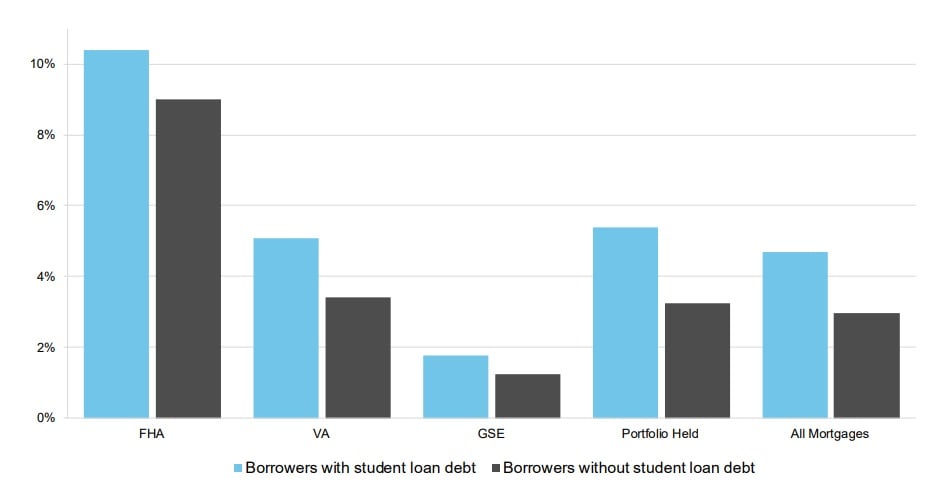
Mortgage delinquencies by loan type
Source: ICE McDash and Tradelines powered by TransUnion.
While delinquency rates are low on portfolio loans made by private lenders and “GSE” loans backed by Fannie Mae and Freddie Mac, late payments on FHA and VA loans have been on the rise.
One issue among those borrowers is student loan debt. After pausing collections on defaulted student loans during the pandemic, the Department of Education resumed those efforts in May.
Nearly 30 percent of FHA borrowers and 20 percent of VA borrowers also have student loan debt.

Tim Bowler
“We’re seeing early signs of risk building within specific markets and within specific borrower populations, like borrowers with limited equity or who are behind on student loans,” ICE Mortgage Technology President Tim Bowler said, in a statement. “This is when proactive monitoring and data-driven risk management become essential. Identifying and engaging these borrowers early may prevent hardship later.”
Get Inman’s Mortgage Brief Newsletter delivered right to your inbox. A weekly roundup of all the biggest news in the world of mortgages and closings delivered every Wednesday. Click here to subscribe.
Email Matt Carter
