by Leo Pareja | Jul 7, 2025 | Industry, News Feed
In an Inman Exclusive, Leo Pareja, CEO of eXp Realty, writes that exposure sells homes, while shielding listings hurts sellers, limits buyers and undermines trust.
Real estate is changing fast, and so must you. Inman Connect San Diego is where you turn uncertainty into strategy — with real talk, real tools and the connections that matter. If you’re serious about staying ahead of the game, this is where you need to be. Register now!
Leadership isn’t about saying what’s easy. It’s about doing what’s right, especially when the stakes are high. Throughout my journey from selling nearly 4,000 homes to leading the No. 1 brokerage in the country by transaction count, one truth has always guided me: Silence in moments of chaos is complicity.
That often means speaking up when staying quiet would be easier. But the cost of silence is always greater than the criticism that comes with courage.
Since the NAR settlement first hit our radar in March of last year, I’ve led eXp through one guiding principle: Do what’s best for the consumer. It’s why we decided not to participate in broker-to-broker compensation moving forward.
It’s how we developed a straightforward, consumer-centric buyer agency, listing agency and most recently, seller disclosure documents. All open-sourced and shared freely with the entire industry. At a time when real estate is under a microscope, we’ve chosen to double down on putting the consumer first.
Recently, Compass filed a lawsuit against Zillow. While eXp is not named as a defendant, Compass accused us of being a “co-conspirator.” That’s a serious claim. One we categorically reject.
EXp charts its own course. We collaborate where it benefits consumers. We do not conspire. We do believe that the decision by Compass to forego sharing its listings with local MLSs is bad for consumers, and we will continue to stand against anything that hides listings, limits access or restricts opportunity.
Let’s talk about what this is really about: Compass wants to control inventory. They’re not hiding that motivation.
Take their “Three Phase Marketing” model. On paper, it’s positioned as “consumer choice.” In reality? It’s about controlling listing exposure. In Q1 of 2025, Compass reported that 48.2 percent of its listings entered this funnel. Nearly half of their homes were shielded from the broader market at the outset. No matter what language you wrap it in, that’s steering.
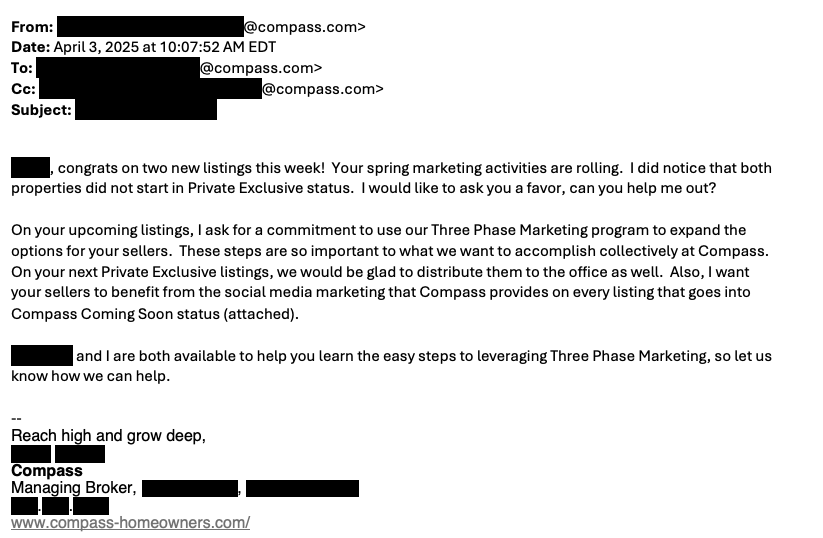
Below is a direct excerpt from an internal Compass email, sent by a managing broker to a former Compass agent (identifying info withheld, originals retained):
Let’s be clear: This isn’t about helping sellers or offering consumers more options. It’s about rigging the game, keeping inventory out of sight to create artificial scarcity, confusing the public and boosting agent commissions. That email doesn’t talk about the seller’s goals. It doesn’t mention fair housing or inclusive access. It’s about funneling deals inside a closed loop.
That’s not a marketing strategy. It’s market manipulation, plain and simple. And the consumer is the one being played.
Last week, Compass went a step further and declared it won’t comply with participation rules. Compass wants full access to display local MLS listings through IDX while keeping their own listings gated behind Compass.com. That’s not consumer advocacy. That’s bait-and-switch.
On a recent podcast with Ricky Carruth, Compass’s President of Growth, Rory Golod, confirmed this entire strategy is designed to win more listings and close more deals. Not once did he mention consumer value. Not once did he talk about transparency. He said the quiet part out loud, on repeat.
And Compass CEO Robert Reffkin? He already spoiled the plot of Compass’s end game when he said in a Q2 2024 earnings call:
“The foundation of every entity’s success in real estate is access to inventory. The source of success for all players in the industry whether MLSs, aggregators, buyer agents or listing agents is access to inventory.”
Access is power. And Compass wants to be the only one holding the keys.
But here’s the twist. They admit that 94 percent of their “exclusive” listings end up on the MLS anyway. If “exclusivity” was really serving the seller, why does nearly every listing eventually go public?
Because the data tells the truth: Exposure sells homes. Shielding listings hurts sellers, limits buyers and undermines trust. Period.
Let’s call this what it is: “Seller choice” is being weaponized, used as a Trojan horse by Compass to fragment the market, reduce transparency and create artificial scarcity that prioritizes agent interests over consumer needs. That’s not leadership; it’s exploitation.
We’re not here to play that game. At eXp, we believe in an open, transparent marketplace. We’ll keep building tools that serve the public, sharing resources that elevate everyone, and calling out the noise when it distracts from what really matters.
Because the future of real estate deserves truth, not spin.
by Leo Pareja | Apr 10, 2025 | Industry, News Feed
CEO of eXp Leo Pareja calls for courage, clarity and collaborative leadership in meeting threats to market transparency head-on.
Bigger. Better. Bolder. Inman Connect is heading to San Diego. Join thousands of real estate pros, connect with the power of the Inman Community, and gain insights from hundreds of leading minds shaping the industry. If you’re ready to grow your business and invest in yourself, this is where you need to be. Go BIG in San Diego!
The summer of 2023 marked a shift in industry when two defining events collided, demanding immediate action.
First, the Rapattoni MLS system went dark, disabling our ability to update or input listings across 12 markets. It was a jarring reminder, exposing how fragile our dependency is on systems that aren’t built for resilience. Then came Burnett et al. v. NAR et al., a legal reckoning heading to trial with the potential to upend how we do business entirely.
These weren’t isolated challenges: they were flashing red lights, warning signs that the industry status quo was no longer sustainable. We knew we had a fiduciary responsibility to future-proof our ability to serve clients, no matter what disruptions came next.
So we moved fast. We found a direct path to national listing portals — Zillow, Realtor.com, Homes.com and Redfin — so if the MLS failed again, we’d be able to keep our clients moving forward. And in doing so, we launched eXp Access, our CCP-compliant office exclusive inventory powered by Zenlist.
Private listings, public responsibility
I’ve always been a loud supporter of CCP because I believe in giving consumers choice — real, intentional choice. There are legitimate, important reasons a property may need to be off-market:
- A federal judge presiding over a human trafficking case.
- A DEA agent protecting their identity.
- A tenant-occupied home that’s inaccessible.
- Or high-net-worth individuals who require discretion.
These are all valid. And for over two years, we’ve made sure those consumers had that option.
But let me be crystal clear — using that rationale to steer every seller into off-market listings is a complete disregard for our fiduciary responsibility.
Anyone who’s sold real estate at scale knows this; the highest form of client service is full market exposure. That’s how we get the best price, in the shortest time, with the highest net proceeds. Period.
Don’t dismantle the system that works
In 2024, out of over 350,000 transactions at eXp, fewer than 1,000 were off-market. Why? Because we believe in the power of a transparent marketplace. We believe every buyer and seller deserves fair access to opportunity.
Yet somehow, what we’ve built in the U.S. — the envy of the global real estate community — is now under attack. I’ve seen firsthand what happens when transparency breaks down.
In France, buyers must check eight different sites to see 70 percent of inventory — and that’s if they’re lucky. Sellers pay per listing, per month to appear online. And agents? They’re navigating chaos, all while the most vulnerable buyers are left behind, priced out, shut out or simply overlooked.
The consequences are already here
Just this week, I heard about a deal that closed at 23 percent below every comp in the neighborhood. One company, both sides, zero days on market. No exposure. No transparency. No fairness. The seller lost hundreds of thousands. And now, every homeowner in that neighborhood has to answer to that sale when refinancing or listing their own property.
That’s the road we’re heading down. And if we don’t course-correct now, we are going to financially harm sellers and rob buyers, especially those from historically underserved communities, of the chance to build generational wealth through homeownership.
This is bigger than us
We aren’t just talking about industry strategy. We’re talking about access. About equity. About maintaining the single most impactful system for wealth creation in America. Four to seven million families move every year in this country. They’re counting on us to get this right.
At eXp, our agents already operate in 25 countries. We’re not afraid of competition, we face it daily on a global stage. But our preference? Always, and I mean always, is cooperation. Because it’s what’s best for the consumer. And that should be the North Star for every decision we make.
The path forward
So here’s where I stand.
We will not sit back and watch the most transparent, trusted and efficient real estate ecosystem in the world be dismantled.
We will lead. We will innovate. And above all, we will protect the public trust.
And yes — we will compete if we have to. But I’d much rather collaborate with every broker, every MLS and every agent who shares our commitment to doing what’s right.
This industry doesn’t need more finger-pointing. It needs more courage. More clarity. More leadership.
Let’s be that.
This post was originally published on this site
by Leo Pareja | Aug 23, 2024 | Industry, News Feed
Whether it’s refining your business model, mastering new technologies, or discovering strategies to capitalize on the next market surge, Inman Connect New York will prepare you to take bold steps forward. The Next Chapter is about to begin. Be part of it. Join us and thousands of real estate leaders Jan. 22-24, 2025.
The U.S. luxury real estate market has made a stronger showing during the first half of 2024 than it did in the first half of 2023, according to midyear luxury reports from Coldwell Banker, Compass and Sotheby’s International Realty.
The number of ultra-luxury homes (those $10 million and higher) that sold during the first half of the year increased by 3.9 percent from the first half of 2023, according to Compass’ report.
TAKE THE INMAN INTEL INDEX SURVEY FOR AUGUST
Sales of single-family properties across the full spectrum of the luxury market (defined as the top 10 percent of the market) were up 2.66 percent year over year, according to Coldwell Banker’s report, while attached luxury sales only increased by 0.25 percent year over year.
Luxury prices also hit new heights, with the median price for the top 10 percent of U.S. luxury homes up 37.5 percent as of June 2024 from June 2020 levels to $1.695 million, according to Coldwell Banker.
“Premium properties remain timeless, and the findings of this report demonstrate a strong commitment from both buyers and sellers to complete transactions,” Felipe Hernandez Smith, head of Compass Luxury, said in a statement. “There are exceptional homes nationwide catering to every lifestyle, and it’s encouraging to see that premium real estate is always in vogue.”
Overall, luxury agents and brokers are optimistic about how 2024 has shaped up thus far and where it seems to be heading, with nearly 70 percent of Coldwell Banker Global Luxury property specialists expressing optimism in this year’s market. A few key factors agents will keep an eye on as the year continues, as brokerage midyear luxury reports suggest, include dream homebuying trends, elections, the economy, and growing and emerging markets.
Consumer trends: unicorns and dream homes
Desirable inventory continues to drive market demand, particularly those homes that don’t require any work before moving in, Coldwell Banker’s report noted.
More than 44 percent of the firm’s luxury specialists said that well-priced, well-presented homes, especially those that are “unicorns,” meaning move-in ready, brand-new or with many amenities, continue to see high demand.
“Demand for luxury spec houses and townhomes remains particularly strong,” Coldwell Banker’s report said. “Modern aesthetics with natural materials like wood, an open plan, eco-friendly features and the latest smart home technology — these are all on the must-have list, along with flexible and functional living spaces that cater to a variety of experience, wellness and a sense of community. This shift seems to be driven by growing numbers of younger affluent buyers who have different priorities than previous generations.”
A growing number of luxury homebuyers today are also seeking out their forever dream home, Coldwell Banker luxury agents said. During the pandemic, clients scrambled for a place in which to shelter, but now that their lives have normalized and many remote work policies are shifting, agents said that buyers are looking for new homes that match their long-term goals. Life transitions, like starting a family, are also increasingly a source of motivation for buyers who are moving, agents added.

Credit: Canva
Elections
Time Magazine has called 2024 “the ultimate election year” for a reason — about half of the world’s voting-age population, or more than four billion people across 80 countries, will be eligible to vote in elections this year. How things shake out in the polls in the U.S. could have a significant impact on the real estate market, Sotheby’s midyear report noted.
Democrat and Republican platforms are also moving in different directions when it comes to real estate — Democrats are targeting housing affordability through initiatives like tax credits and down-payment assistance, while Republicans are hoping to stimulate economic growth through pro-business policies, like low taxes and low regulations.
Seasoned agents know that buyers and sellers tend to take a break from the market during elections.
“From my experience, what we see again and again is that our market gets quieter around October,” in anticipation of the election in November, Christie-Anne Weiss with TTR Sotheby’s International Realty in Washington, D.C., said in the firm’s report. “Once the election is over and we know who the president is, business will resume as normal. It is buyer psychology; people do not make major investment decisions when there is imminent uncertainty.”
The same holds true for other countries across the globe, international agents affiliated with Sotheby’s International Realty suggested. But political stability can also have a positive impact on the market.
Since India’s incumbent Bharatiya Janata Party retained power in this year’s elections, India Sotheby’s International Realty’s Ashwin Chadha expects the real estate market to benefit.
“The current government has reiterated its intentions for high spending, drawing in investments to boost the manufacturing section,” Chadha said. “Both infrastructure spending and manufacturing augur positively for the property market, including luxury real estate.”
Economic factors
The political landscape will undoubtedly have some kind of impact on the market, but interest rate movements may impact buyers and sellers even more, Sotheby’s luxury specialists said.
“There’s a lot more conversation about politics this year and a lot of polarization,” Russ Anderson, president and CEO of Briggs Freeman Sotheby’s International Realty in Dallas said. “But, when it comes to real estate, people are more focused on interest rates than politics. No matter who wins, if interest rates start falling, I think people will buy. If they stay elevated, people will remain on the sidelines.”
The expected drop in interest rates has not come as quickly as consumers and real estate agents might have hoped. Now, economists are estimating that rate drops will come by 2025. The Mortgage Bankers Association (MBA) anticipates that rates will fall to about 5.9 percent by 2025 and Wells Fargo estimated that they would drop to 6 percent.
“I believe we can say with some certainty that U.S. mortgage rates will be lower at the end of the year,” Anthony Chan, former chief economist of JPMorgan Chase, said in Sotheby’s International Realty’s report. “As buyers see lower rates, they will be less worried about the ‘lock-in effect’ — the hesitancy of selling their house if it means taking out a higher-rate mortgage for their next home. This will ultimately support housing activity if the economy avoids a slowdown.”
In addition to interest rates, rising prices and low inventory also continue to present challenges to homebuyers. Until inventory hits normal levels of about six months, prices will continue to experience upward pressure. Experts from Goldman Sachs told Sotheby’s International Realty that home prices could increase by 5 percent in 2024 and by 3.7 percent in 2025.
Luxury buyers may be more concerned with U.S. equity markets than interest rates, however, Sotheby’s International Realty’s report noted. “If investors are doing well, as they did in 2023 and have so far in 2024, that will boost demand for luxury housing,” Anthony Chan added.
Changes in U.S. interest rates will also ultimately have an indirect and somewhat delayed impact on the economies of other countries throughout the globe.
“Some estimates suggest that it takes between one and two years for U.S. monetary policy to have its maximum effect,” Julian Brown of New Zealand Sotheby’s International Realty said. “However, there is a large degree of uncertainty because the structure of the economy changes over time, and conditions vary.”

Nashville has seen a surge in ultra-luxury sales so far this year | Canva
Market highlights
Los Angeles saw the greatest number of $10 million-plus transactions during the first half of the year with 135 sales accounting for $2.67 billion in sales volume, according to Compass’ midyear ultra-luxury report. Manhattan, Palm Beach County, Miami-Dade and Orange County rounded out the top five markets with the most ultra-luxury sales.
The number of ultra-luxury sales rose year over year in 20 markets, including Florida markets in Palm Beach, Miami-Dade and Orange County, as some buyers used these investments as a means to hedge against inflation, and often relied on their cash-buying power to acquire properties to circumnavigate high mortgage rates.
Emerging markets and second-home markets, especially those with tax-favorable policies, saw the greatest growth during the first half of the year, Compass reported, with the greater Nashville region seeing a 600 percent annual increase in ultra-luxury sales with a total of seven ultra-luxury sales, and Central Jersey seeing a 500 percent increase in such sales with a total of six ultra-luxury sales.
Out of those markets with 10 or more $10-million-plus sales during the first half of the year, Orange County, Telluride and Greater Palm Springs saw the greatest annual increase in ultra-luxury sales.
“With an increased supply of luxury listings, our sales would undoubtedly climb even higher,” Valery Neuman, a Compass Palm Springs agent, said. “Looking ahead, the second half of the year holds great promise as more people discover the allure of Palm Springs.”
Get Inman’s Luxury Lens Newsletter delivered right to your inbox. A weekly deep dive into the biggest news in the world of high-end real estate delivered every Friday. Click here to subscribe.
Email Lillian Dickerson
by Leo Pareja | Aug 12, 2024 | Industry, News Feed
According to Van Conover, the Prevost motorhomes typically belong to “A-list artists, top of the top in the music industry, F1 racers and high-level entrepreneurs” who can customize the motorhome however they see fit from the floors, the color of the leather to the entire buildout.”
Inman Connect is moving from Las Vegas to San Diego in 2025 and it’ll be bigger, better, and bolder than ever before. Join us for Inman Connect San Diego on July 30-Aug. 1, 2025 with the brightest minds in real estate to shape the future of the industry. Reserve your spot today for an exclusive discount.
Demand for vacation homes has plummeted from sky-high pandemic-era demand, but what if you could have that second home anywhere, without giving up any of the amenities you’re used to?
What has been described as “the world’s most expensive, most futuristic motorhome” has hit the road. It’s priced at $2.5 million, according to YouTuber Erik Van Conover.
Van Conover, known for highlighting high-end properties, recently gave the world a tour of the motorhome in which he lived and slept trackside during this summer’s Montreal Formula 1(F1) event.
According to Van Conover, Prevost motorhomes typically belong to “A-list artists, top of the top in the music industry, F1 racers and high-level entrepreneurs” who can customize the motorhome however they see fit from the floors, the color of the leather to the entire buildout.”
This lofty motorhome features a cockpit with white leather seats, costing $20,000 a piece. Extending down from the cockpit is a retractable, 65-inch television with a built-in soundbar.
Beyond the cockpit is a lounge area with high ceilings and wide space extending two feet on each side, which Van Conover states is wider than the narrowest NYC apartment. The lounge features a convertible sofa bed, privacy glass for the windows and light bars that line the interior.
The vehicle was built not only for comfort but for efficiency and is powered by two lithium batteries that allow it to run for a week using solar energy.
Ten touchscreen Garmin tablets are spread throughout the motorhome, allowing passengers to easily control everything inside, from the lighting to the televisions. There are also charging ports for smartphones.
Other interior features include a laundry area, kitchen and dining room, two bathrooms and two bedrooms.
The motorhome seats eight and sleeps four people.
Van Conover believes that the most remarkable part of the motorhome lies in the master suite.
The master bedroom holds a king-sized bed, rare for even an NYC apartment, a retractable 50-inch television and two dual closets. The master bathroom has finishes often seen in mega-mansions, including a shower that features a built-in bench, LED light bar and hidden drain.
On the exterior of the motorhome is an outdoor kitchen, including a grill and cutting board, a 55-inch flat-screen television and an E-mirror that allows for 360-degree visibility with no blind spots on the journeys ahead.
Email Richelle Hammiel
by Leo Pareja | Aug 5, 2024 | Industry, News Feed
Join the exceptional and become a Sotheby’s International Realty agent.
Learn More
Despite its status as a busy metropolis, Chicago, Illinois is known for its approachability and friendly midwestern charm. “It gives people a lifestyle that’s hard to find in other cities,” says Sam Jenkins, Real Estate Professional at Jameson Sotheby’s International Realty. “It’s accessible and easy to navigate, has an incredible system of parks, lakes and beaches and is a global hub for dining and industry.” Jenkins himself relocated to Chicago from the UK. “It was my first big-city experience and I fell in love with it and wanted to stay,” he says.
Jenkins was working as an elite personal fitness consultant when he was first introduced to the real estate industry by a client, entrepreneur Sean J. Conlon — and went on to work for him. “A lot of the skill sets required were very transferable,” he says. “You’re working with people who are busy and who have a goal.” Jenkins has now been working in real estate for 20 years and his team has made over $700 million in closed transactions.

Understanding your client
These initial people skills have remained a core part of Jenkins’ practice to this day. “If you’re able to interact with and understand people, then it gives you an advantage because a real estate transaction is ultimately an emotional journey,” he says. Building that trust, he adds, makes the process “easy.”
Communication is vital, especially during the initial interview stage with a new client. “Often buyers don’t actually know what they want,” Jenkins says. “Talking with people, letting them speak, understanding where they are on their journey and why they’re going where they’re going — that’s a huge part of the process.” Then, he says, you can give people options, find off-market deals, or open them up to new neighborhoods.
Once a strong connection has been built with a client, it needs to be maintained. “Don’t look at it as one deal, look at it as a lifetime of deals with that person,” says Jenkins. “That person needs to hear from you regularly — if you haven’t been in touch with them, they’re not going to use you again, they’ll use someone else.”

A global network
Referrals are another hugely important element of the job. For Jenkins, his connection to the Sotheby’s International Realty network means that he is connected to respected brokers around the world that he can refer clients to without any fear. “You don’t end up at a Sotheby’s International Realty brand unless you know what you’re doing,” he says.
The connection to Sotheby’s auction house is also useful when dealing with international clients who may be new to an area and unfamiliar with the market there. “The strength of the brand gives comfort to luxury buyers,” says Jenkins. “They feel comfortable because they’ve heard of the brand. That is a big part of what helps us to be successful.”
Managing the process
Of course, there are times when you have to manage expectations of buyers and sellers, especially when they differ. “The emotional aspect is the biggest obstacle,” says Jenkins. “When two people want the last word, deals can fall apart.”
 On the other hand, successful sales — where things fall into place, and real change is made — have a lasting positive impact. “When you help a first-time buyer close a deal, you see this new chapter of someone’s life opening up before them,” he says. “You know you helped them to get there, and that is incredibly rewarding.”
