by Matt Carter | Jun 30, 2025 | Industry, News Feed
Payment options, including Automated Clearing House (ACH), card payments, pinless debit and real-time disbursements, simplify loan servicing, improve cash flow management for lenders.
Real estate is changing fast, and so must you. Inman Connect San Diego is where you turn uncertainty into strategy — with real talk, real tools and the connections that matter. If you’re serious about staying ahead of the game, this is where you need to be. Register now!
Cloud-based mortgage customer relationship management (CRM) tool Mortgage Automator now boasts a suite of payment processing options provided by Usio Inc., including Automated Clearing House (ACH), card payments, pinless debit and real-time disbursements.
San Antonio, Texas-based Usio — which provides payment solutions to merchants, billers, banks, service bureaus, integrated software vendors and card issuers — announced Monday that integration with Mortgage Automator went live in June.
TAKE THE INMAN INTEL INDEX SURVEY FOR JUNE
Launched in 2013 as a document-generating tool for a small private lender in Toronto, Canada, Mortgage Automator has evolved into a full-fledged originations, servicing and investor management tool with automation
Mortgage Automator became available in the U.S. in 2019 and continues to evolve, offering integrations with CoreLogic, DocuSign, Doss Docs, Hubspot, Lightning Docs, OSC Insurance Services, PrivateLenderLaw.com and Twilio, among others.

Pavel Tchourliaev
“Our mission has always been to provide private lenders with the most powerful and intuitive software solutions,” Mortgage Automator CEO Pavel Tchourliaev said in a statement. “Partnering with Usio allows us to further enhance our platform by offering integrated payment processing that simplifies loan servicing and improves cash flow management for our clients.”
Founded in 1998 as Billserv.com, Usio is a publicly traded fintech company with a $39 million market capitalization.
Usio entered the payment facilitation business with the 2017 acquisition of Singular Payments LLC, launching its “PayFac-in-a-Box” platform the following year to partner with app and software developers in the legal, healthcare, property management, utilities and insurance verticals.
Usio’s 202 acquisition of Information Management Solutions LLC (IMS) put it in the electronic and paper billing business in 2020, and it now serves hundreds of customers in industry verticals including financial institutions and utilities.
Competitors include Fiserv Inc., Elavon Inc., WorldPay, Stripe and Block Inc. (formerly known as Square).
Usio Chief Revenue Officer Greg Carter said the company is excited to partner with Mortgage Automator “and help modernize how private lenders manage payments.”

Greg Carter
“Embedding our payment technology into Mortgage Automator’s platform gives lenders the tools they need to operate more efficiently, reduce friction, and deliver a better experience for their borrowers,” Carter said in a statement. “This is another example of how software vendors in all industries can benefit from the implementation of our unique PayFac-in-a-box technology.”
Get Inman’s Mortgage Brief Newsletter delivered right to your inbox. A weekly roundup of all the biggest news in the world of mortgages and closings delivered every Wednesday. Click here to subscribe.
Email Matt Carter
by Taylor Anderson | Jun 30, 2025 | Industry, News Feed
The nation’s largest real estate portal began enforcing its ban on private listings on Monday, 10 weeks after announcing its new standards. Here’s what you need to know now.
Real estate is changing fast, and so must you. Inman Connect San Diego is where you turn uncertainty into strategy — with real talk, real tools and the connections that matter. If you’re serious about staying ahead of the game, this is where you need to be. Register now!
Zillow’s ban on private listings took effect on Monday, the latest development in an ongoing battle that will determine the future landscape for marketing and home search in the U.S.
The ban set up a test for sellers: You can market your home off the multiple listing service as long as you’re comfortable with your listing also not showing up on the biggest real estate portal in the country.
TAKE THE INMAN INTEL SURVEY FOR JUNE
Zillow Group, which, along with subsidiaries like Trulia, collectively attract 227 million users each month, took the latest step toward its stated goal of providing consumers with broad and transparent access to as many listings as possible.
The months leading up to the day of reckoning were filled with legal battles and questions about the definition of private listings themselves as agents, brokers and their clients continued to navigate a tumultuous time in the industry.
Here’s what you need to know about the new state of affairs on Zillow.
What listings are impacted?
The updated policy bans listings that aren’t added to the MLS within 24 hours of being publicly marketed.
“What’s not allowed under the listing access standards,” Zillow wrote, is “publicly marketing that off-MLS listings are available if a buyer is willing to work with an agent or brokerage.”
The portal also clarified that listings within a brokerage’s private listing network would be prohibited if the network itself is marketed to consumers on a public-facing website.
Zillow Group said the ban does not apply to Delayed Marketing Exempt Listings — a type of listing status created via recent changes to the National Association of Realtors’ Clear Cooperation Policy — as long as they’re submitted to an MLS within one day of public marketing.
“Coming soon” and office exclusives also comply with Zillow’s listing access standard as long as listing brokers are adhering to NAR’s guidance for each listing status. That guidance says that office exclusives are required to be submitted to the MLS, but aren’t widely distributed to other subscribers.
Zillow said that for sale by owner (FSBO) listings, rental listings and new construction listings sold by the builder are also permitted.
The ban arrives amid growing industry focus on private listings, with Compass leading the charge in creating a network of such properties.
Though different industry players have debated just exactly which listings might ultimately fall under the terms of the ban, Zillow has already begun warning agents that their listings are not in compliance.
Compass Private Exclusives
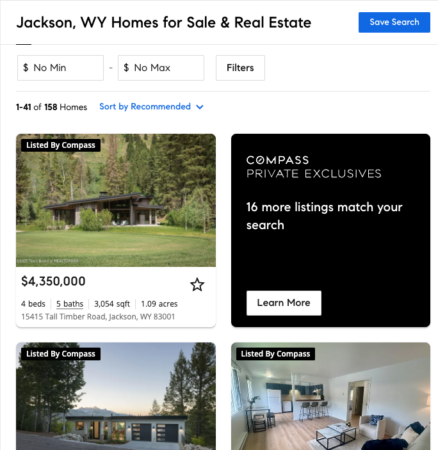
Zillow and Compass are also currently locked in a lawsuit over the nature of the ban. In its complaint that initiated the suit, Compass argues that Private Exclusives — or listings marketed exclusively via Compass’ platform — “that are referenced in advertisements on Compass.com mentioning the number of Private Exclusive listings available in a city or specific geography, or similarly returned in response to a search result on Compass.com, will trigger the Zillow Ban.”
“Put plainly,” the complaint adds, “Zillow has granted itself the power to ban every Compass Private Exclusive listing from going to Zillow because of the way in which Compass markets and executes its Private Exclusive listing strategy internally and externally.”
Zillow didn’t respond to a request for comment about whether Compass’ Private Exclusive network is specifically banned by its updated policy.
How many listings are impacted?
Compass notes on its website and seller disclosure form that Private Exclusives aren’t initially listed on the MLS, which it says could reduce the number of potential buyers who see the listing, reduce the number of showings, reduce the number of offers and reduce the final sale price for the property.
Still, the company says, nearly half of its clients in the first three months of this year chose to start with a private listing. Most of them, 94 percent, ultimately moved on to list the home on the MLS, the company says.
For Compass, the first three months of 2025 included 19,393 listings that started as Private Exclusives.
Compass’ Private Exclusives network was an expansion of existing options for more tailored private home sales for celebrities, judges or politicians, for example.
That was before Zillow announced the update to its listing access policy.
It’s difficult to say how many listings throughout the country would be in violation of Zillow’s updated policy, though the number would likely represent only a small percentage of all listings.
‘The life of the listing’
Zillow said that listings that violate its policy are banned for the “life of the listing.” That refers to the time a home is being sold by a broker who did not follow Zillow Group’s listing access standard, resulting in that listing being banned from Zillow and Trulia’s sites.
However, if the seller terminates the listing agreement with that broker and signs a new agreement with a broker who follows the listing access standard, Zillow and Trulia will lift the ban and display the listing.
What else?
Compass filed a federal antitrust lawsuit against Zillow last week and later asked the judge in the case to stop Zillow from enforcing its updated policy.
A ruling on that latter request isn’t expected until later this summer or in the fall, putting in place a question about how many sellers will ultimately decide to go with a private listing.
Meanwhile, Homes.com has said it would continue to show all listings despite the moves by Redfin and Zillow. Realtor.com hasn’t revealed any plans for a ban.
Email Taylor Anderson

by Darryl Davis | Jun 30, 2025 | Industry, News Feed
Real estate is changing fast, and so must you. Inman Connect San Diego is where you turn uncertainty into strategy — with real talk, real tools and the connections that matter. If you’re serious about staying ahead of the game, this is where you need to be. Register now!
Back in high school, all I wanted was to be on stage. Not the kind of stage where I’m training agents or speaking at events (although that is my life now). I mean acting and performing on the Great White Way of Broadway.
Acting was the dream. So, when I got into real estate at 19, it wasn’t out of a deep love for square footage. It was a strategy: Real estate would pay the bills while I auditioned in New York City.
TAKE THE INMAN INTEL SURVEY FOR JUNE
Then something unexpected happened. I started doing really well. Like, really well. Real estate went from part-time hustle to full-time career, and eventually, I phased out of acting completely. I remember telling myself, “You know what? One day, I’ll make enough to produce my own show.”
Well … I didn’t quite become a Broadway producer. But I did get close. I’ve had the incredible opportunity to invest in Broadway through one of the best in the business — Ken Davenport, a two-time Tony Award-winning producer behind hits like Kinky Boots, Godspell, Oh Mary! and Othello. (By the way, he has an incredible new show called Joy – check it out!)
My first investment was in his revival of Gypsy (yep, that Gypsy, with Audra McDonald starring in the revival) — and even though I wasn’t the one calling the shots, being part of that world gave me a front-row seat to what it takes to put on a successful production.
Let me tell you something: It’s a lot like running a real estate business.
Here are five producer-style principles that every real estate agent can borrow from Broadway to put on a show-stopping business.
1. It’s not about being the star. It’s about assembling the right cast and crew
Sure, the lead gets the spotlight, but no Broadway show survives without a solid ensemble, a killer director and a behind-the-scenes crew that keeps the whole thing running. Same goes for real estate.
You might be the one with your face on the sign and your name on the business card, but you can’t do this alone — not if you want to scale up your business (and stay sane).
Your crew might include your mortgage broker, your home inspector, your stager, your transaction coordinator, your photographer and your go-to handyman. Every one of them plays a role in making you look good — and in making sure your clients have a smooth ride.
And when you surround yourself with people who are not only competent, but also care about your clients the way you do? That’s when the magic happens.
2. You’ve got to take risks, but smart ones
Nobody puts millions into a Broadway show unless they believe in the story. And yet, even with belief, talent and the best marketing, you still don’t know if it’s going to be a hit or a flop. That’s part of the thrill and part of the gamble.
Real estate is no different. Every listing is a bit of a risk. Every marketing campaign, every shift in your farming strategy, every door you knock or prospecting call you make — it’s a leap of faith. But the key is to take informed risks.
Track your numbers. Test new ideas in small batches. Know your audience. Invest in yourself and your business like a producer does: with heart and a spreadsheet.
3. You’re building an experience, not just a product
People don’t go to Broadway just to watch a show — they go to feel something. They want the emotion, the story, the energy, the escape. They want the full package: the lights, the music, the atmosphere, the wow moment when the curtain rises.
Real estate is no different.
You’re not just helping someone buy or sell a property. You’re guiding them through one of the biggest emotional and financial moments of their life. That means how you show up matters. How you communicate, how you listen, how you make them feel during the process — those things stick with people far longer than the final price on a contract.
Members of our coaching program have started to shift their mindset this way. One shared how they stopped focusing solely on the transaction itself and started focusing on the experience — surprising clients with handwritten notes, giving thoughtful closing gifts, even staging welcome-home photo shoots. The result? More referrals, more repeat business and more clients saying, “You were the best part of this whole process.”
It’s not about the paperwork. It’s about the performance. And when you treat each client like an audience member whose experience matters, you’ll always get a standing ovation.
4. You have to believe in the project because not everyone else will
On Broadway, there are times when it’s not the show that’s in question — it’s the people behind it. Actors get passed over, producers get told “It’ll never work,” and directors are second-guessed at every turn. But the ones who make it? They believe in their talent, their voice, their purpose, even when others don’t.
The same goes for real estate. You’re going to have moments when a listing doesn’t sell, a client ghosts you, or someone questions your worth as an agent.
You’ll face markets that feel impossible and buyers or sellers who think they know better than you do. But here’s the thing — you don’t need to believe in every property, but you do need to believe in yourself. You need to believe that your guidance makes a difference. That your knowledge helps buyers build wealth and helps sellers move on to their next level in life.
You’re not just opening doors to houses; you’re opening doors to new eras in people’s lives.
When you believe in the contribution you make to others, in the heart you bring to this business, that’s what will carry you through the tough days. Not the price tag on a listing. Not the outcome of a transaction. But the impact you have along the way.
5. Your reputation offstage matters just as much as your performance
In Broadway, a producer’s name carries weight. If they’re known for putting on quality shows and treating people right, investors line up, actors want to work with them, and audiences trust the brand. But the moment a producer gets a bad reputation behind the scenes — being difficult, shady or cutting corners — it catches up to them fast.
It’s the same exact thing in real estate. You can crush it on listing appointments, stage homes like a rockstar and negotiate like a boss. But if other agents dread working with you, or clients feel like you’re only in it for yourself, your long-term success takes a hit. Word travels. Fast.
One of our coaching members shared that a big chunk of their business started coming from other agents — agents they had worked with on deals in the past who remembered them as professional, respectful and fantastic to work with. Those agents chose to refer their friends and family to someone they technically competed with. When that starts happening, you know you’re doing it right.
Your reputation is your real brand. Make sure it shines, even when the spotlight’s not on you. Especially when the spotlight’s not on you! As Charles Marshall said in his book Shattering the Glass Slipper, “Integrity is doing the right thing, even when no one is watching.”
So yeah, I never did star in a Broadway show, but I still found my stage. I coach and train real estate professionals across the country, helping them become the “producers” of their own careers. I may not be listing and selling anymore, but I still invest in real estate — and I see the business from both sides of the curtain.
And, just like Broadway, success in real estate is about more than just knowing your lines. It’s about casting the right team, believing in your vision, taking smart risks, building unforgettable experiences and protecting your reputation like it is opening night.
Now, go out there and break a leg

by Daniel Houston | Jun 30, 2025 | Industry, News Feed
The urban-suburban divide that helped define the housing market’s early pandemic boom has continued to shape its downturn and inventory rebalancing, according to an Intel analysis of hyperlocal data.
This report is available exclusively to subscribers of Inman Intel, the data and research arm of Inman offering deep insights and market intelligence on the business of residential real estate and proptech. Subscribe today.
It’s been a rough few years for brokerages in densely packed employment centers.
As if it’s not enough that urban housing markets missed out on some of the windfall from the early pandemic housing boom, their suburbs have continued to outperform them in sales, new supply and price support amid the ensuing transaction downturn, an Intel data analysis of thousands of ZIP codes suggests.
TAKE THE INMAN INTEL SURVEY FOR JUNE
This analysis contributes to a deeper understanding of how the U.S. housing market’s replenishing supply of inventory, long hoped-for by real estate agents, has been a mixed bag for the brokerage world.
It also highlights how a split in buyer-seller dynamics is more than just a regional story — it’s an in-market divide that’s deeply felt within the nation’s most prominent metro areas.
The full list of insights is available to Intel subscribers.
Intel’s approach
For this analysis, Intel analyzed ZIP-code-level data from Realtor.com for each of the nation’s largest metropolitan population centers. The ZIP codes were then placed in buckets according to government definitions of the rural and suburban areas that surround a metro’s urban core, and the urban core itself.
This exercise might not match everyone’s definition of suburb.
By the government’s definition, municipalities like Beverly Hills, Pasadena and Long Beach, for example, are not treated as suburbs but are instead considered part of the Los Angeles urban core.
You have to reach as far out as Santa Clarita — which has a significant share of residents who brave an hour-plus southeast commute into L.A. — to see a significant population center categorized as a high-commute suburb by this government definition.
Still, the suburbs that are considered part of a metro’s “urban core” likely share some of the dynamics of the outer suburbs and exurbs, in addition to some dynamics of more densely packed downtowns and neighborhoods further in.
An urban-driven rebalancing
A couple weeks ago, Intel explored the stark regional split that has divided the country as its housing markets rebalance in favor of buyers.
Markets throughout much of the South and West of the country have rapidly reached a point where they are more buyer-friendly than they had been before the pandemic. Markets in the Northeast and Midwest, on the other hand, are rebalancing more slowly, and remain more seller-leaning than they were before the pandemic.
This week’s analysis reveals that another split is occurring within individual markets.
- The urban cores of major metro areas have seen activity levels on the typical listing drop by 21 percent year-over-year, outpacing the 17 percent decline in metro suburbs over the same period.
- This leaves outflow activity in urban cores 15 percent lower as a percentage of total listings than it was before the pandemic, compared to a 5 percent decline in suburbs.
At first glance, we might expect this to mean that this fast-paced rebalancing of urban-center markets implies that big cities are also leading the way in new-listing inflow. But interestingly, that’s not the case.
- Urban core ZIP codes have notched 8 percent growth year-over-year in the number of new listings coming online, but that only brings them just within 19 percent of their prepandemic new-listing levels.
- Meanwhile, commuting suburbs have seen new-listing inflow that’s 10 percent higher year over year. And because their new-listing activity had already weathered the pandemic years better than urban cores, these suburbs are now just outside of 7 percent below where they stood before the pandemic.
So what does this all mean?
For dense urban population centers constituting a great bulk of real estate activity in the U.S., the Great Rebalancing has been caused by an unhealthy combination of depressed sales activity that’s been outpaced by a still-tepid boost in new inventory.
This has allowed big-city markets to rebalance in favor of buyers without experiencing a particularly robust recovery in new-listing opportunities for brokerages.
The suburban boom, revisited
There’s no doubt that urban and suburban markets alike have cooled.
But if dense urban employment centers have undergone a more passive rebalancing in the last few years, their in-commuting suburbs have done so in a way that’s allowed them to remain hotter for longer, and produce more returns for the real estate industry.
- Total listing outflow — a metric that tracks closely with pending-sales trends — is up 6 percent year-over-year in suburbs, compared to only up 4 percent in the major urban centers they feed into.
But this understates just how much better off suburban housing markets are in terms of transaction levels.
- Even in this down market, listing outflow in suburbs is now back within 15 percent of pre-pandemic norms for the group of markets Intel reviewed.
- Urban cores, on the other hand, still lag their pre-pandemic outflow levels by 25 percent.
New construction has doubtless been part of the picture.
Far-out suburbs tend to have more undeveloped land to build out, and often come with fewer local hurdles to clear on zoning and permitting. This ensures a steadier access to one key source of new supply.
But that’s not the only reason why the suburbs are still faring better than their urban counterparts.
- List prices in high-commuting suburbs remain 52 percent higher than where they stood before the pandemic housing era reshaped the real estate market. Low-commuting exurbs remain on an even higher perch, at 61 percent above normal price levels.
- But the fact that urban pandemic price gains of 39 percent have failed to keep up with their outlying communities despite weaker new-inventory trends suggests that suburbs simply remain hotter in the eyes of buyers and sellers.
For brokerages, the bottom line is clear: The suburban and exurban growth patterns that were so game-changing in the early pandemic — as remote work reshaped people’s choices of how to work and where to live — remain partly intact, even as the market has cooled.
To examine this, Intel used a rough estimate of the potential commission pool available to brokerages. The estimate used listing outflow levels as a rough proxy for sales, then multiplied that value by the typical list price for each area.
- Brokerages only had about 4 percent more potential commission revenue to earn this spring from deals in urban areas than they did in pre-pandemic years. That wasn’t even close to making up for the value lost to inflation in that time.
- But even after their own substantial dip in sales activity, high-commuting suburban communities produce 29 percent more in potential revenue for brokerages than they did before the pandemic struck, roughly double the rate of inflation in that time.
Email Daniel Houston

by Lillian Dickerson | Jun 30, 2025 | Industry, News Feed
Real estate is changing fast, and so must you. Inman Connect San Diego is where you turn uncertainty into strategy — with real talk, real tools and the connections that matter. If you’re serious about staying ahead of the game, this is where you need to be. Register now!
At one time, luxury broker Rod Watson was fortunate enough to play professional basketball for a living — in Brazil, no less.
Those days are 20 or so years behind him now, but the experience was invaluable in shaping his current career serving professional athletes and entertainment professionals in LA’s luxury market.
TAKE THE INMAN INTEL SURVEY FOR JUNE
Today, Watson also owns his own independent luxury firm, Distinct Concierge Real Estate, which he proudly runs with his family.
Next month, Watson will speak on the Inman Connect San Diego stage to share insights he’s gained over the years as a luxury broker and business owner. In advance of that, he sat down with Inman to share thoughts on the market, challenges of serving elite clients, potential business expansion and what he’s looking forward to at the event. This is what he had to say, edited for brevity and clarity.
Inman: Tell me about your background as a professional athlete and how you ended up transitioning into the industry.
Rod Watson: I played sports the majority of my life — in high school, college, and then was fortunate enough after finishing up a successful college basketball career to play basketball in Sao Paulo, Brazil, which was a great experience. I coached in college while I was getting my MBA, after playing professionally. So that opened up a lot of doors for me, which I believe really made it a seamless transition into what I’m doing now, working with athletes and representing [them] when it comes to real estate.
When I look back on [my career in sports, I] think, man, if I hadn’t stuck with it, and gone through those challenges and the ups and downs of just trying to pursue my dreams, it wouldn’t be possible for me to do the things I’m doing today.
You work with a lot of high-profile clients, particularly athletes and entertainers. What do you see as the biggest challenge today in assisting them with their real estate transactions?
I think understanding their needs and the personalities of each individual and working with their team in a cohesive manner, getting everyone on the same page and getting everyone to understand the mission and the goal. We like to go deeper, meaning that if a player says, ‘Hey, I want to buy a home in LA for the off-season,’ it’s like, why? What does that entail? And are you aware of the oftentimes overlooked cost that comes with maintaining an estate?
The biggest thing is understanding the players’ needs, the why behind wanting to buy, whether it’s a second home or primary residence, and working cohesively with their teams to reach the goal, which is to have a successful transaction in a discrete, private manner, where it’s a good deal for the player and something that can help them going forward.
I’m sure that they appreciate that insight, too.
There are a lot of moving pieces when it comes to the channels that you have to go through to successfully navigate the transaction with each individual who’s involved, from the business manager to the agent to the attorney, mom and dad or wife and any other family members who are involved in the transaction and have an opinion.
You really have to be able to balance those expectations, personalities, egos, and then, of course, be able to assert myself and be confident in my ability and my over 20 years in the business.
That’s great. And how is the luxury market in LA doing right now?
The ultra-luxury market and overall luxury market are seeing a correction. We’re seeing inventory go up and a large number of price reductions right now. I think in the last four-and-a-half months, we’ve seen 15 percent to 20 percent price reductions. And that hasn’t happened since maybe 2016.
Average days on market is around 100-plus, 120-plus. Obviously, in the ultra-luxury market, you’re still seeing some big-ticket sales. Recently, we had a $51 million sale in Beverly Hills, a $56 million sale in Bel Air, a $200 million sale three months ago. We saw Paris Hilton buy Mark Wahlberg’s old estate for $61 million. So that market is never going to truly be impacted by what’s going on in the economy and overall market itself, just because those people have the wealth, and they make decisions when they’re ready.
Good to know. As an independent brokerage owner, do you feel any pressure, in this economy, to consolidate or merge with another brokerage, as many are doing now?
I don’t. I know that a lot of companies are choosing that route for longevity, but we have a different focus in regards to who our ideal client is. That independence means a lot, because it’s a family business that my wife, my daughters and I work in, and we have 10 other agents who work with us, and we have a very cohesive group that is learning how to be successful in this space.
You previously mentioned to me you’re considering expanding into Africa, which sounds interesting. Tell me more.
I have a high school friend, and he’s been in Tanzania reaching out to me for probably three years, telling me, ‘You really need to make a strong consideration of Tanzania, because it is a really new country — only 60 years old — and they’re starting to see a lot of transformation with their real estate market, primarily in Zanzibar and the coast of Tanzania.’
Tanzania is going through a redevelopment phase right now. In Zanzibar, specifically, there’s a lot of development that’s taking place in hotels, new construction, communities … And there’s also a growing [number of] African Americans who are choosing to live abroad now. They’re leaving the U.S. and building their future wealth in Tanzania, specifically in the real estate space.
But that’s a future endeavor, I would say, something that, if we were going to fully go through with it, it would be in the next three to four years that we would announce.
What are you looking forward to at Inman Connect San Diego?
I look forward to the opportunity to collaborate with Inman and also learn and connect with other high-level, producing professionals who will be attending the event. Hopefully, learn a few new things when it comes to service in the luxury market that other agents are actually doing and successfully utilizing to grow, not only their brands, but their businesses.
San Diego is right in our backyard, and I went to college in San Diego, [so] it’s my second home. Being able to walk away, even with one trade secret or one thing that I didn’t know, that I can go back and apply in our business to help us grow, is something I’m looking forward to.
Get Inman’s Luxury Lens Newsletter delivered right to your inbox. A weekly deep dive into the biggest news in the world of high-end real estate delivered every Friday. Click here to subscribe.
Email Lillian Dickerson

by Lindsey Harn | Jun 30, 2025 | Industry, News Feed
An organized and proactive process can help keep the peace between family members and sell your client’s home efficiently, Lindsey Harn writes.
Real estate is changing fast, and so must you. Inman Connect San Diego is where you turn uncertainty into strategy — with real talk, real tools and the connections that matter. If you’re serious about staying ahead of the game, this is where you need to be. Register now!
Selling a home in 2025 isn’t as simple as staking a red “For Sale” sign in the front yard. It’s accompanied by stress surrounding home preparation, client communication, and pricing — and all while coordinating the move-out.
These usual stressors that come with selling a home are compounded by the noise of multiple generations of family members providing input. Whether the family lives in a multi-generational family dynamic or you’re selling a house that has sentimental value to the family, it can be overwhelming to hear contradicting opinions and orders being presented to you.
TAKE THE INMAN INTEL SURVEY FOR JUNE
Each generation has a distinct lived experience in terms of what they consider the most effective approach to selling a home.
For example, Grandma Lucy may think that displaying her best doilies and ornate ceramic birds will make the house appear classy and attract buyers. At the same time, Dad Mitch might believe that keeping the space clean and hiding evidence that children have lived there will make it the most marketable.
The point is that selling a home and filtering through multitudes of family opinions can be draining, so we’ve compiled a list of tips and simple adjustments to make to allow the process of selling your client’s home to be as pain-free as possible.
Establish a leader
Assigning a person from the start who will have the final say in decisions is crucial to ensure consensual decisions about the home and to make this a well-organized effort. This assigned leader will communicate primarily with you and maintain clear communication to ensure the process is organized and efficient. When it comes to assigning the leader, it doesn’t always have to be the person who is financially bound.
It can be the family member you see as the most coordinated, or the grandmother who is most attached to the home. Regardless of who is assigned as the leader, it is essential to establish this at the beginning of the process to maintain streamlined communication among the leader, you and the buyers.
The leader needs to be someone who takes into account family opinion, but filters it through and makes the best decision overall for the home’s successful sale. It’s not your responsibility to decide who the leader is, but rather to express to the family that having a leader would be very helpful.
Why selling a vacant home saves stress
Circumstances vary for why families decide to sell their homes, whether that be to immediately move into a new home or for financial investment reasons. With this being said, because situations differ, it’s not always feasible to show a vacant house, but it can be fruitful. It can assist in sales by allowing the buyer to envision their own space when touring the home and prevent deterring specific generational audiences with outdated furniture, decor, etc.
When buyers decide to embark on the journey of buying a home, they are looking for a house to turn into their own, and that’s important to keep in mind. Overall, making the home a clean and empty space creates a blank canvas that attracts any buyer to the physical layout of your client’s home.
On a different subject, familial issues tend to be lessened when there isn’t a conversation about how to present the home to potential buyers. Each generation has a distinct creative approach to decorating the home, and debating which furniture, pictures and decor to hide is an argument that could be avoided by selling the home vacant.
Invest in profitable home improvements
When putting a home on the market, it’s natural for clients to want their home to look its best. Often, families begin to go manic with renovating their homes, redoing bathrooms, kitchens and changing light fixtures, etc. While these all contribute to making the house more modern structurally, these renovations can be costly and don’t directly ensure profit.
When investing money in a home you’re selling, you want to confirm that if the family puts $1 into the house, they will receive a $2 return. Renovations such as painting are cost-effective but can still dramatically change a space. So, you can tell your client it’s okay to listen to their Gen Z child talking about aesthetic home renovations, but keep in mind the cost, so they don’t break the bank.
Renovations such as updating hardware, painting and maintaining the lawn are low-cost and low-energy updates that revamp the home and make it a more marketable space. Additionally, these changes are all minor enough that each generation can input their unique design changes, ensuring everyone is included.
Intentionality and organization
Selling a home, regardless of the circumstances, is stressful for most Americans, and a house is the most significant investment most families will ever make. There are high stakes when putting a home on the market, and it can be especially overwhelming when considering family opinion.
These tips won’t make selling your client’s home a suddenly smooth experience, but they can help mitigate unnecessary issues that usually arise. Ultimately, the goal for everyone is to sell the house at the highest market price possible promptly with the least inconvenience.
Assigning a leader, selling a vacant home and investing in cost-effective renovations can help keep the peace between family members and sell your client’s home efficiently.
Lindsey Harn is an agent with Christie’s International Real Estate Sereno and a certified Divorce Real Estate Expert. Connect with her on Instagram and Linkedin.
