
by Andrea V. Brambila | Jun 3, 2025 | Industry, News Feed
NAR’s Professional Standards Committee on Tuesday moved to make the Realtor Code of Ethics applicable only to real estate-related activities. The board of directors will take a vote on Thursday.
Bigger. Better. Bolder. Inman Connect is heading to San Diego. Join thousands of real estate pros, connect with the Inman Community, and gain insights from hundreds of leading minds shaping the industry. If you’re ready to grow your business and invest in yourself, this is where you need to be. Go BIG in San Diego!
Following hours of passionate debate, proposed changes to the National Association of Realtors’ hate speech policy went forward largely unchanged Tuesday morning and now head to the trade group’s board of directors.
At its meeting on Tuesday, NAR’s Professional Standards Committee approved the changes to the Realtor Code of Ethics’ Standard of Practice 10-5, which currently prohibits Realtors from using “harassing speech, hate speech, epithets, or slurs based on race, color, religion, sex, disability, familial status, national origin, sexual orientation or gender identity.”
The policy, which was approved in 2020, currently applies to all of a Realtor’s activities, not just those related to real estate. A Realtor who violates the policy is charged under Article 10 of the Code of Ethics, which prohibits denying equal professional services to anyone in those protected classes.
At the meeting, which took place at NAR’s midyear conference, the Realtors Legislative Meetings, the committee voted to amend SOP 10-5 so that it reads:
“Realtors, in their capacity as real estate professionals, in association with their real estate businesses, or in their real estate-related activities, shall not harass any person or persons based on race, color, religion, sex, disability, familial status, national origin, sexual orientation, or gender identity.
As used in this Code of Ethics, harassment is unwelcome behavior directed at an individual or group based on one or more of the above protected characteristics where the purpose or effect of the behavior is to create a hostile, abusive, intimidating environment which adversely affects their ability to access equal professional services or employment opportunity.”
The amendment removes the language referencing “harassing speech, hate speech, epithets, or slurs” and adds a definition of harassment that NAR says aligns with its Member Code of Conduct.
The committee also voted to amend Policy Statement 29 to change the Code of Ethics’ applicability so that Realtors would be encouraged, but not required, to follow the code “in all of their activities.” That amendment reads:
“While Realtors are encouraged to follow the principles of the Code of Ethics in all of their activities, a Realtor shall be subject to disciplinary action under the Code of Ethics only with respect to their capacity as real state professionals, in association with their real estate businesses, or in their real estate-related activities.”
The NAR board of directors will vote on the proposed changes at its meeting on Thurs. June 5.
Email Andrea V. Brambila.
Like me on Facebook | Follow me on Twitter
by Richelle Hammiel | Jun 3, 2025 | Industry, News Feed
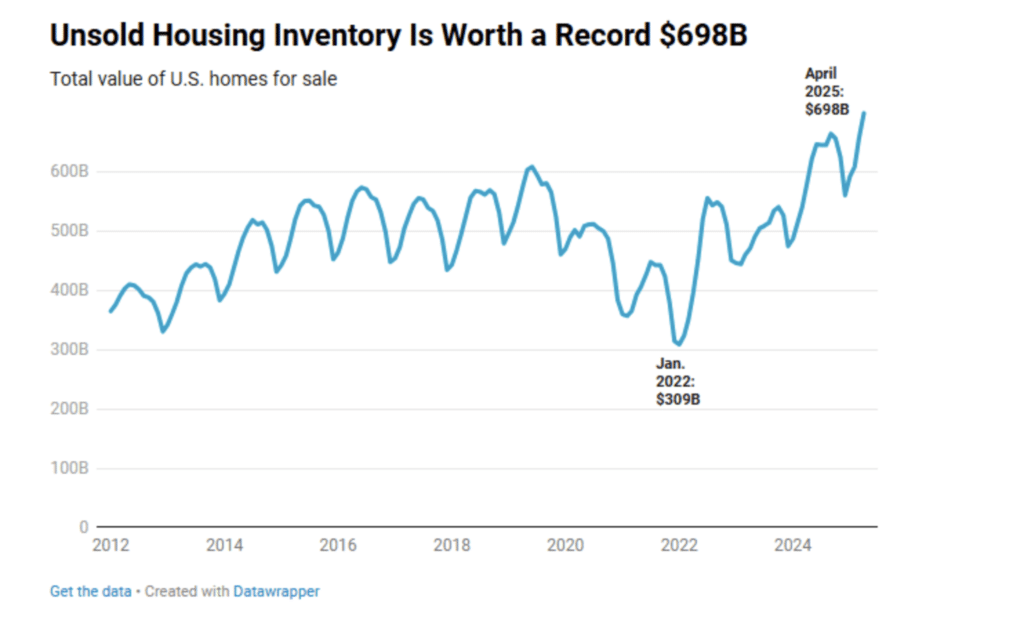
U.S. home inventory hit a record $698 billion in April, a 20.3 percent increase from the previous year. However, sales aren’t keeping pace, a new analysis from Redfin shows. While listings are rising, buyer activity remains muted, leaving many homes sitting unsold far longer than usual.
Bigger. Better. Bolder. Inman Connect is heading to San Diego. Join thousands of real estate pros, connect with the Inman Community and gain insights from hundreds of leading minds shaping the industry. If you’re ready to grow your business and invest in yourself, this is where you need to be. Go BIG in San Diego!
U.S. home inventory hit a record $698 billion in April — a 20.3 percent increase from the previous year — but sales aren’t keeping pace, a new analysis from Redfin shows.
While listings are rising, buyer activity remains muted, leaving many homes sitting unsold far longer than usual.
Redfin | Unsold Housing Inventory
In April alone, total listings jumped 16.7 percent year over year, the highest level in five years, while new listings rose 8.6 percent, hitting a three-year high, yet buyers haven’t followed. Redfin reports there are now nearly 500,000 more sellers than buyers nationwide.
Homes are lingering on the market and getting stale. The typical home took 40 days to go under contract in April — five days longer than last year. More than 44 percent of listings were on the market for 60 days or more. That stale inventory alone accounts for $331 billion, nearly half the total market value.
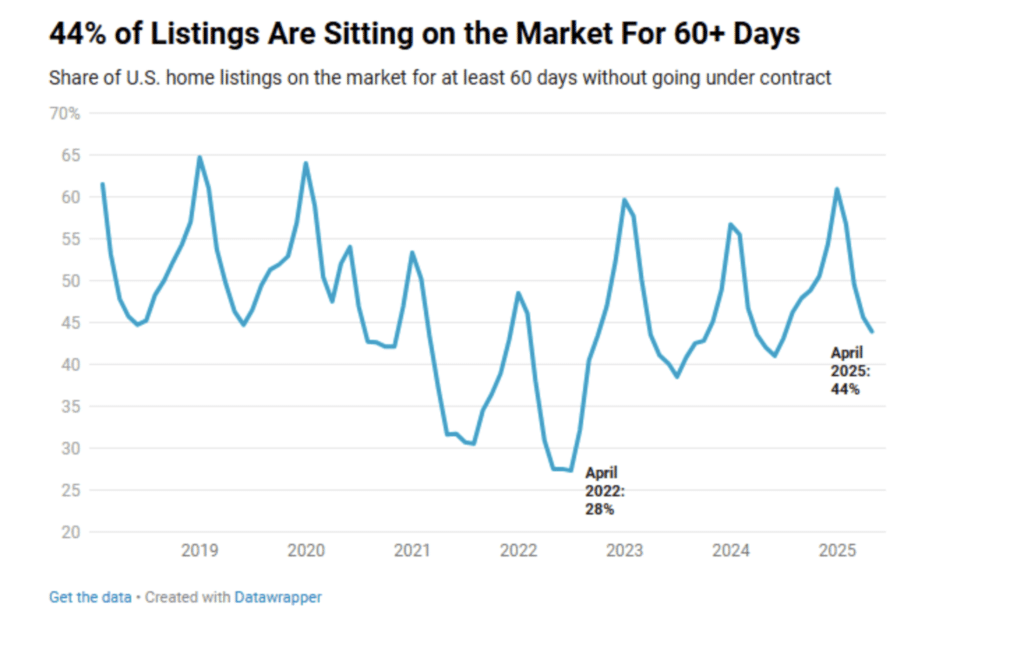
Redfin

Chen Zhao | Redfin’s Head of Economics Research
“The record-high dollar value of all homes listed for sale is one way to quantify this buyer’s market,” Chen Zhao, Redfin’s head of economics research, said in Redfin’s analysis. “Not only are there more homes for sale than there have been in five years, but the value of those homes is higher than it has ever been.”
Contributing to this slowdown are record-high monthly housing costs, economic uncertainty and rising home-sale prices. The median U.S. home-sale price in April was up 1.4 percent from the previous year, but many sellers are now willing to negotiate.
“A huge pop of listings hit the market at the start of spring, and there weren’t enough buyers to go around,” Matt Purdy, a Redfin Premier agent in Denver, said. “House hunters are only buying if they absolutely have to, and even serious buyers are backing out of contracts more than they used to. Buyers have a window to get a deal; there’s still a surplus of inventory on the market, with sellers facing reality and willing to negotiate prices down.”

Matt Purdy | Redfin Premier Agent
In stark contrast to today’s slower market, inventory in early 2022 bottomed out at $309 billion. Mortgage rates hovered around 3 percent, and homes sold in a median of just 24 days. Now, with rates near 7 percent and affordability stretched thin, the stockpile of unsold homes keeps growing.
Zhao says there may be a silver lining for buyers as incomes continue to increase.
“We expect rising inventory, weakened demand, and the prevalence of stale supply to push home prices down 1 percent by the end of this year, which should improve affordability for buyers because incomes are still going up,” she said.
Email Richelle Hammiel

by Marian McPherson | Jun 3, 2025 | Industry, News Feed
Scammers posing as wealthy homebuyers are roping agents into elaborate crypto investing schemes, resulting in some agents losing their life savings and drawing Secret Service scrutiny.
Bigger. Better. Bolder. Inman Connect is heading to San Diego. Join thousands of real estate pros, connect with the Inman Community and gain insights from hundreds of leading minds shaping the industry. If you’re ready to grow your business and invest in yourself, this is where you need to be. Go BIG in San Diego!
Between debates on hate speech and three-way agreements at its midyear conference, the National Association of Realtors issued a dire warning about the rapid rise of cryptocurrency scams targeting real estate agents.
“Cybercrime — particularly wire fraud — continues to be a top concern in the real estate industry,” the Association’s broker risk reduction homepage read. “The U.S. Secret Service has informed NAR about a new cryptocurrency scam targeting real estate professionals, some of whom have lost a significant amount of money.”
TAKE THE INMAN INTEL SURVEY FOR MAY
In the scam, con artists reach out to real estate agents as an all-cash homebuyer. Con artists may use social media or emails to strike up a conversation, but the most common method is through a text directed to someone else about an important document or deal. When the agent texts back, usually to let the scammer know they’ve texted the wrong number, they’ll strike up a conversation and begin the con.
After building rapport, the con artist explains how they made their fortune through cryptocurrency and encourages the agent to create an account on a legitimate platform, like Coinbase, and convert a small amount of money — $1,000 or less — into cryptocurrency. From there, they direct the agent to download another investment app through a fake App Store or Google Play link. When the link doesn’t work, they’ll send them another link to their fraudulent investment site.
The agent follows through, gets a robust return, and then, at the behest of the con artist, withdraws their funds. The con artist then asks the agent to keep making larger investments through the fraudulent site, which shows false metrics on how much their investment is growing. However, when the agent is ready to make another withdrawal, the con artist shuts down the site, takes their money and disappears.
Zack Schuler | Credit: LinkedIn
NINJIO Founder and CEO Zack Schuler said this tactic, which is known as the Pig Butchering Scam, has been around for several years and coincides with the rise in cryptocurrency. The scam often happens over a few months, with con artists leaning on psychological tactics, artificial intelligence and deep-fake technology to rope in victims.
“Know that even if you meet up with somebody on video, on FaceTime, on whatever, if they look real and they sound real, they aren’t necessarily real,” Schuler, an Inman contributor, said. “It could be somebody in Eastern Europe, it could be somebody in Cambodia that is using AI to make themselves look the same race, gender, etc., to make themselves seem more relatable. They can even disguise their voice. They can do everything.”
“So don’t trust video anymore,” he added. “AI has figured that out.”
Schuler said AI has helped con artists circumvent typical online vetting tactics, so the key way to mitigate risk is by doing in-person investment meetings only.
“Before you do anything with anybody, get together in person and verify that that person is real,” he said. “And remember, if it’s too good to be true, then it usually is.”
If you’ve been scammed, Schuler said the first step is reporting the incident to local law enforcement. From there, local law enforcement can escalate the incident to the local Federal Bureau of Investigation (FBI) field office, which can connect you with mental health or financial resources.
If you’re still in contact with the scammer, Schuler said it’s important to stay calm and not scare them away with demands to get your funds back. Instead, it’s best to keep the conversation going so authorities have a higher chance of locating the scammer and getting your funds back.
“For most people, once [the money] is gone, it’s gone,” he said, recounting the story of an agent who lost $1.8 million.
The FBI estimates victims lost $16.6 billion last year from cyber investment scams, including the Pig Butchering Scam. If you believe you’ve been scammed, contact the FBI Internet Crime Complaint Center (IC3).
Email Marian McPherson
by Amy Corr | Jun 3, 2025 | Industry, News Feed
There are plenty of factors you can’t control in the broader economy, Amy Corr writes, but there are ways to implement more control and consistency in your business.
Since the NAR commission suit settlement, buyer agents have faced new rules, new documents and a new normal. This month, Inman drills down on Today’s Buyers Agent with the fresh marketing strategies, skills and tools buyer agents are using to prosper in changing times.
Let’s face it — there’s a lot of noise in the real estate industry right now. Between Zillow’s new listing policy and chatter about interest rates, inventory and tariffs, we as agents start feeling anxious and overwhelmed about things we can’t control. And when fear creeps in, we tend to stop taking action. But here’s the truth: we have more control than we think.
TAKE THE INMAN INTEL SURVEY FOR MAY
Yes, you have to work hard and recognize that deals aren’t going to come easy. But people still need to buy and sell real estate – and the agents who are mindful of that will dominate in a market where others pull back. Here are eight aspects of your business that you can take control of today.
Control your visibility
You don’t have to look far for prospecting opportunities in the summer. Whether you’re at the beach, a graduation party, baseball game or 4th of July barbecue, you’re naturally around more people this time of year. That doesn’t mean you have to be in business mode all the time, but be intentional, knowing that every social interaction could be a potential lead.
And don’t stop marketing and advertising. The more visible and engaged you are now, the more momentum you’ll build heading into the fall and winter markets.
Control your knowledge
When you’re out and about, you’re inevitably going to be asked the age-old question: “How’s the market?” So be prepared: Stay on top of local news and industry updates. Track local market data. Participate in broker caravans and talk with your colleagues.
Agents pick up on trends before they’re reflected in the data, and these insights can give you an edge. Even if you’re talking to someone who’s just curious about the market, your knowledge positions you as an expert and opens the door for referrals.
Control the conversation
Don’t shy away from hot topics, like Zillow’s new policy that bans listings unless they go in the MLS within one day of public marketing. Use it as an opportunity to reach out to your clients and explain what it means for them.
You can’t control Zillow, but you can control your conversations around it. So, ask clients what they’ve heard and share your point of view. It’s a simple way to show them that you’re following what’s happening and here to guide them.
Remember, consumers usually aren’t getting the full picture — they’re getting bits and pieces from headlines and social media. If you’re not giving them your perspective, someone else will.
Control your client’s perspective
Speaking of headlines, buyers and sellers are seeing conflicting messages every day. The Chicago Tribune recently published an article titled “Chicago Housing Market Off to Slightly Busier Start in 2025.” That same week, The Chicago Sun-Times reported “Chicago’s Housing Market Could Be Further Dampened by Recession Fears and Tariffs.”
The headlines obviously don’t tell the full story, and that’s where you come in. As a local agent who’s actively transacting, you’re the most valuable resource for your clients. Educate them with your insights and use data to give context.
Control your mindset
In any market, especially this one, you need to have a positive mindset to advise your clients with confidence. I’ve heard agents say, “I feel bad selling my client this house — it’s so overpriced.” That feeling comes from a good place, and I appreciate that. But the reality is that it’s not overpriced. The price is exactly what buyers are willing to pay. That’s market value. You influence your client’s view of the market, so shift your mindset and stay confident.
Control your value
You know your value better than anyone. As we approach the second half of the year, focus on what sets you apart and how you can articulate that more effectively, so you can charge what you’re worth.
Keep in mind that people connect with stories. Instead of saying you’re the best negotiator or touting your market position, show how you’ve created success for others in similar situations.
Maybe you helped another buyer successfully navigate a bidding war. Or maybe you directed a sales and marketing strategy that helped a seller get way over list price. Whatever the case, bring those stories into your conversations, presentations and testimonials to demonstrate your value.
Control your routine
Consistency. Time-blocking. Structure. You’ve heard those terms hundreds of times, and for good reason. As an agent, your time is valuable. Of course, you’re always going to be reacting to things, but it’s important to have a game plan for how you’re going to spend your day. That includes the time you wake up, the time you focus on your business, and the time you set aside for yourself and your friends and family. Having a framework for simple daily tasks can make a big impact.
Control your investment in your business
If you want to grow your business, you have to invest in it. One of the easiest ways to do that is by leaning into the resources your brokerage offers. Look for training opportunities, mentoring programs or coaching stipends.
Investing in your growth doesn’t always mean spending money. Sometimes it just means fully engaging with the resources that are right in front of you.
Amy Corr is the chief brokerage officer for @properties Christie’s International Real Estate. Find her on Instagram, Twitter and LinkedIn.

by Verl Workman | Jun 3, 2025 | Industry, News Feed
No team? No problem! You don’t have to go it alone when you align yourself with colleagues and strategies that optimize your service, coach Verl Workman writes.
Bigger. Better. Bolder. Inman Connect is heading to San Diego. Join thousands of real estate pros, connect with the Inman Community, and gain insights from hundreds of leading minds shaping the industry. If you’re ready to grow your business and invest in yourself, this is where you need to be. Go BIG in San Diego!
Being a solo real estate agent has its advantages — flexibility, full commission and complete control over your business. However, one of the biggest challenges solo agents face is the lack of built-in support that teams provide. That said, lone agents can still create their own network of support to help them grow and stay competitive. Here’s how:
TAKE THE INMAN INTEL SURVEY FOR MAY
1. Brokerage support
Your brokerage is your first line of support. Some brokerages offer extensive resources, including:
- Training and mentorship: Many brokerages provide new agents with coaching or mentorship programs; no team required.
- Marketing assistance: Some brokerages offer templates, CRM systems and digital advertising resources.
- Transaction coordination: A few brokerages provide transaction coordinators to handle paperwork. They’re either included in your fees or you would pay per transaction.
- Legal and compliance guidance: Your broker can help ensure contracts and disclosures are in order. Compliance is good for everyone.
If your brokerage lacks robust support, you may want to consider moving to one that aligns better with your needs.
2. Leverage a virtual assistant (VA) or freelancer
As a solo agent, you don’t need a full-time team, but outsourcing tasks can free up time for client relationships. Consider hiring:
- A virtual assistant for administrative work, appointment scheduling and email follow-ups.
- A transaction coordinator to ensure contracts, paperwork and compliance are handled smoothly.
- A marketing specialist to manage social media, advertising and branding.
3. Join a mastermind group or real estate coaching program
Many successful solo agents invest in real estate coaching or mastermind groups where they can:
- Get advice from top-producing agents
- Learn new business strategies
- Stay accountable for their goals
- Create leverage
- Exchange referrals and networking opportunities
There are established programs like Workman Success Systems and others that provide structured coaching for solo agents.
4. Develop a strong vendor network
Having a trusted network of lenders, inspectors, title companies, attorneys and contractors makes a solo agent’s life much easier. These professionals can:
- Offer quick solutions for client concerns
- Help with last-minute deal-saving strategies
- Refer clients back to you for future business
We consider our vendors as partners and involve them in the areas where they have true expertise and set standards of care so our clients are blown away by the services we provide.
5. Use technology and systems to your advantage
A great CRM (customer relationship management system) is like having a personal assistant. These platforms help solo agents automate lead follow-ups, manage transactions and stay organized.
6. Partner with other agents as needed
Solo doesn’t necessarily mean alone. Some solo agents create informal partnerships with other independent agents for:
- Coverage when on vacation
- Co-listing or referral opportunities
- Brainstorming and market analysis
You can also consider joining a brokerage with a collaborative culture where solo agents support each other. Again, if your brokerage lacks robust support, you may want to consider moving to one that aligns better with your needs.
7. Invest in personal branding and marketing
Without a team’s name recognition, solo agents must build their personal brand to stand out. This means:
- Maintaining an active social media presence
- Creating video content for local market updates
- Sending regular email newsletters to past clients and leads
Marketing yourself as the go-to expert in your area builds trust and keeps your pipeline full.
8. Consider a hybrid approach
Some agents find success by joining a team with flexibility, meaning they still work independently but get access to resources like lead generation, admin support and training. If you want some support but don’t want to give up full control, this might be an ideal balance.
There are so many definitions of a team, and I believe that no one should tell anyone else what kind or type of business they must build. It’s your business and it’s up to you. To me, all “team” means is “leverage.” It’s using or leveraging technology, systems and people so you can serve more clients and still have a life — however you choose.
Verl Workman is founder and CEO of Workman Success Systems. Connect with him on LinkedIn or Instagram.

by Josh Ries | Jun 3, 2025 | Industry, News Feed
Bigger. Better. Bolder. Inman Connect is heading to San Diego. Join thousands of real estate pros, connect with the Inman Community, and gain insights from hundreds of leading minds shaping the industry. If you’re ready to grow your business and invest in yourself, this is where you need to be. Go BIG in San Diego!
Circle prospecting isn’t dead, but the way most agents are doing it might as well be. The method still has legs, but it’s long overdue for an upgrade. While agents have modernized their dialing tools and data sources, their follow-up strategy hasn’t evolved since the Blackberry era.
TAKE THE INMAN INTEL SURVEY FOR MAY
Here’s how to bring it into 2025.
Why circle prospecting still crushes lead cost and conversions
When done right, circle prospecting can deliver some of the best ROI in real estate. That’s because you’re reaching homeowners before they start waving the “I’m thinking of selling” flag.
Get in early, and two things happen: You avoid other agents, and your cost per lead stays low. That combination is precisely what makes this method so powerful.
Why phone and email alone aren’t cutting it anymore
Let’s face it, most people don’t answer calls from unknown numbers. And even if they do, you’re lucky to get 30 seconds before they mentally check out.
To adjust, agents have tried a new approach: Keep the initial call short, gather the email and attempt to nurture the relationship from there. The logic makes sense. You may not get another shot at real voice time until the lead is actively ready to list.
The problem? Email is becoming less effective by the year. Between spam filters, crowded inboxes and AI-powered screening, phone and email alone just aren’t enough to build a relationship anymore.
You need a better way to stay top of mind and build a relationship.
Where most agents miss: Separating prospecting from content
This is where most agents typically fall short. They treat circle prospecting like a disconnected task: Make the call, send the email, move on. Separately, they create content, hoping it will build their brand over time.
But modern lead generation doesn’t work in silos. It needs continuity. You want every touchpoint — call, email, content — to reinforce the same message and build toward conversion.
The content is the follow-up. It’s how people get to know you when you’re not in their inbox or showing up as a missed call.
The 2025 playbook: How I combine prospecting with content
Here’s how I run circle prospecting today.
Before I make a single call, I record a short video about something hyperlocal. It doesn’t need to be fancy, just real, relevant and valuable to the people in that neighborhood: a new coffee shop, a park renovation and school zoning updates. The point is to show you’re informed and plugged into their area.
I post the video to my social platforms and copy the direct link. Then I start calling.
If the call goes well, I’ll try to follow up with an email and ask if it’s okay to stay in touch. If they say yes, I follow with,
“Hey, I made a short video about something happening in your neighborhood. Want me to text it over to this number?”
Most say yes.
Now I’ve created three points of contact: phone, email and social content. I’m not pushing for a listing. I’m giving them something worthwhile — something that makes my follow-up natural and relevant.
If they decline the email, I’ll still offer the video via text. Many people are hesitant to share their email address, but they’re fine with receiving a link via a phone number they’ve already provided.
While I’m making calls, I track who I’ve sent the video to. After the session, I added all of those contacts to my phone.
The real magic: Social platforms start working for you
Here’s where this gets powerful.
Once someone opens that video link, social platforms start connecting the dots. If they’ve got your number or email in their contacts, Instagram, Facebook and others will start showing them more of your content, even if they’ve never followed you.
Instagram states this in its user agreement.
Now, without doing anything else, your face, voice and videos are showing up in their feed. You’re no longer just a cold call; you’re providing value regularly.
The real goal: Don’t cold call, warm them up first
This is where modern prospecting wins. You’re not just checking boxes. You’re building familiarity through content, timing and positioning.
By the time you follow up again, they will have seen your face. They’ve heard your voice. You’re not a stranger; you’re a known local expert in their digital world and have also proved you understand digital marketing, which is a great selling point on the listing presentation.
Arrive early, bring value. Repeat
Circle prospecting isn’t outdated; it’s just not being utilized correctly in the digital age.
To succeed in today’s market, you need more than just a dialer and a templated follow-up email. You need a system that builds awareness, creates familiarity and earns trust before your competitors even show up.
The agents who stay top of mind are the ones who consistently deliver local, relevant value. And when it’s time to list, they’re the only call that makes sense.
That’s how you win. Not by chasing more leads, but by being the one they remember.
Josh Ries is a real estate broker and a lead generation consultant. You can connect with him on TikTok and Instagram.
