
by Jessi Healey | Jun 29, 2025 | Industry, News Feed
Real estate is changing fast, and so must you. Inman Connect San Diego is where you turn uncertainty into strategy — with real talk, real tools, and the connections that matter. If you’re serious about staying ahead of the game, this is where you need to be. Register now!
Each week on Trending, digital marketer Jessi Healey dives into what’s buzzing in social media and why it matters for real estate professionals. From viral trends to platform changes, she’ll break it all down so you know what’s worth your time — and what’s not.
AI isn’t coming — it’s here, it’s everywhere and it’s already changing how people search, shop and scroll. Whether you’re creating content, running Facebook Groups or relying on platforms like TikTok to reach your audience, AI systems are increasingly the ones making decisions behind the scenes.
That means your visibility, your voice and even your business could be at the mercy of tools you don’t control. If you’re not paying attention to how AI is reshaping the rules, you’re already behind.
However, this isn’t about chasing shiny new apps and tools; it’s about understanding the systems that shape your reach. From how LLMs decide which sites to cite, to what gets your Facebook Group shut down without warning, AI isn’t neutral. It reflects the data it’s trained on and the priorities of the companies behind it.
If you’re not actively adapting, you’re passively accepting whatever happens next. And in this market, passivity isn’t a strategy — it’s a liability.
Mass bans hit Facebook Groups, fueling more frustration with Meta moderation
Group admins are sounding the alarm after Meta’s moderation systems triggered mass bans across Facebook, shutting down thousands of groups, including massive communities with hundreds of thousands to millions of members. Many received vague notices for “terrorism-related” content or nudity, even in groups focused on innocuous topics like Pokémon, interior design or bird photography.
A Meta spokesperson confirmed to TechCrunch that a technical error was to blame and said a fix is in progress. Some admins who pay for Meta Verified were able to reach support, but many others say they’re still locked out of groups they’ve built over the years. Users have launched a petition and are even pursuing legal action as frustration mounts.
The situation mirrors similar waves of unexplained bans on Instagram, Pinterest and Tumblr — all of which appear to be tied to overly aggressive AI moderation systems. Pinterest acknowledged an internal error, while Tumblr cited a new content filtering test.
What this means for agents
If your Facebook Group is central to your business, this is a wake-up call. Meta holds all the power, and even Verified status doesn’t guarantee protection. Now’s the time to export your group contact lists, back up valuable content and consider building more direct lines of communication (like email or a private community platform). And always assume that what’s working today could disappear tomorrow — because it just might.
Disney sues Midjourney over AI-generated likenesses of copyrighted characters
The gloves are off. Disney, Universal and other major studios have filed suit against AI image generator Midjourney, accusing it of violating character copyrights. This marks the first major legal action by Hollywood against a generative AI company — and it’s not about specific images, but the characters themselves.
The complaint includes side-by-side examples of Disney-owned characters generated by Midjourney, even when prompts didn’t mention the characters by name. A prompt like “superhero fight scene” still produced what looked like Spider-Man vs. Spider-Man. Some generated images even appear to be ripped directly from Marvel films like Avengers: Infinity War.
The studios argue there’s no way to remove copyrighted material from Midjourney’s training data without a full retrain — and that the tool effectively enables copyright infringement at scale. Midjourney, notably, hasn’t taken outside VC funding and runs on a subscription model, making it an unusual AI company in today’s landscape. Disney likely isn’t trying to kill it — just to extract a hefty licensing fee.
What this means for agents
This lawsuit could set the stage for how AI-generated content is treated across industries — including real estate. If you’re using AI tools to create visuals, listings or branding materials, don’t assume you’re in the clear. Be cautious when using prompts that reference known brands or properties, and understand the legal gray area you may be operating in. The line between inspiration and infringement is about to get sharper.
The next big algorithm: Why LLM SEO matters more than you think
Traffic from AI tools like ChatGPT, Perplexity and Claude isn’t just real — it’s growing. Fast. In some cases, it’s already beating Google. If your website content isn’t showing up in those answers, you’re invisible to a whole new layer of search.
This isn’t about tricking an algorithm. It’s about creating the kind of content LLMs want to surface: Real, useful, well-structured and written by humans. Think schema markup, fresh updates and branded search. It’s not a time for growth hacks; it’s a time to go back to the fundamentals of good copywriting and SEO.
What this means for agents
If your content helps people — and it’s written like a person — LLMs are more likely to serve it up. If you’re just phoning it in or using AI to write for you, don’t expect to be cited. Think of LLM SEO like a new kind of local search: Either you show up, or you don’t.
Unhinged is overdone: What audiences actually want from brand voice
What started as edgy has now become expected. The chaotic, unfiltered brand voice once reserved for a few bold players is now just another social media playbook — one that doesn’t land for most. A new Sprout Pulse Survey shows that only 23 percent of consumers think “unhinged” brands are bold. The rest? They’re craving honesty.
The Sprout Social Index backs it up: Consumers favor brands with standout products and original content, not the ones trying too hard to go viral. The brands getting it right are the ones that sound like themselves, across social and real life. They don’t cause chaos. They build trust.
What this means for agents
The same rule applies in real estate: Trying to be outrageous won’t win you business. Consistency, clarity and connection will. Be memorable for the right reasons, not because your content feels like a gimmick. Let your voice reflect your values and your service, not someone else’s trend.
TikTok ban extended again, but will it ever happen?
President Trump has once again extended the TikTok ban deadline, marking the third time he’s used an executive order to keep the app running while claiming a deal is close. No clear legal basis, no real progress, just another 90 days of political limbo for a platform with 170 million U.S. users.
TikTok praised the move, and analysts say the app isn’t acting like it’s in danger. It’s launching new tools and rolling out updates like business as usual. The longer this drags on, the more it resembles political theater. A Pew survey found that only a third of Americans still support a ban, a significant decline from 2023.
With no legal challenge and no clear plan, this “deadline purgatory,” as one analyst called it, feels less like a ban and more like a campaign strategy.
What this means for agents
If you’ve been holding off on using TikTok due to the threat of a ban, it may be time to reconsider. The political drama may drag on, but the app remains thriving, and consumers, especially younger ones, continue to use it daily. If your audience is there, your brand should be too. Just remember: Own your content and maintain a diversified presence in case the winds change again.
TL;DR (Too Long, Didn’t Read)
- Facebook Group admins are being mass-banned, and even having a Verified status doesn’t guarantee help.
- Disney sues Midjourney in a move that could reshape AI copyright law.
- LLM SEO is real — and it’s already outperforming Google in some cases.
- “Unhinged” is out, honesty is in — consumers want consistency, not chaos.
- The TikTok ban has been extended again, but the threat is losing steam, and users aren’t leaving.
The pace of change isn’t slowing down, and neither are the consequences of falling behind. Whether it’s AI lawsuits, algorithm shifts or unstable platforms, the rules are being rewritten in real time — often without warning. Don’t wait for permission or certainty. Stay sharp, stay flexible and keep your marketing strategy ready to pivot.
Jessi Healey is a freelance writer and social media manager specializing in real estate. Find her on Instagram, LinkedIn, Threads, or Bluesky.

by Christy Murdock | Jun 28, 2025 | Industry, News Feed
Amid private listing debates and portal wars, agents should be asking one question: How does my business benefit from the outcome?
Real estate is changing fast, and so must you. Inman Connect San Diego is where you turn uncertainty into strategy — with real talk, real tools and the connections that matter. If you’re serious about staying ahead of the game, this is where you need to be. Register now!
Each week on The Download, Inman’s Christy Murdock takes a deeper look at the top-read stories of the week to give you what you’ll need to meet Monday head-on. This week: Amid private listing debates and portal wars, agents should be asking one question: How does my business benefit from the outcome?
Whether you’re signing with a brokerage or choosing a portal as a source of paid leads, your business is, well, the whole point. How will the branding, marketing and decisions they make impact you and your business?
TAKE THE INMAN INTEL SURVEY FOR JUNE
As the battle between Compass and Zillow heats up this week, and amid the ongoing controversies surrounding private listings, Clear Cooperation and the portal wars, agents are asking themselves whether they’re going to come out a winner or be left behind when the dust settles.
In an antitrust lawsuit filed in U.S. District Court in the Southern District of New York, Compass sued Zillow over its new rules banning privately marketed listings from the platform. The suit alleges that Zillow employed “anticompetitive tactics to protect its monopoly and revenues in violation of the antitrust laws.”
The lawsuit escalates tensions between industry-leading Zillow, the country’s largest portal, and Compass, the No. 1 brokerage by sales volume.
READ: Sanford fires back at Compass, argues against ‘walled gardens’
“This lawsuit is about protecting consumer choice. No one company should have the power to ban agents or listings simply because they don’t follow that company’s business model,” Compass CEO Robert Reffkin said in a statement. “That’s not competition. It’s coercion. Imagine if Amazon banned a seller for offering a product on their own website first. That’s what Zillow is doing in real estate. Consumers should have the right to choose how they sell their homes.”
In its response, Zillow said, “At the heart of this issue is a simple principle: when a listing is publicly marketed, it should be accessible to all buyers — across all platforms, including Zillow. Hiding listings creates a fragmented market, limits consumer choice and creates barriers to homeownership, which is bad for buyers, sellers, and the industry at large, especially in this inventory and affordability-constrained environment.”
READ: Compass asks judge to block Zillow’s ban on publicly marketed private listings
Depending on which side you believe, everyone involved says they’re standing up for agents and their businesses. So how can you ensure that you’re standing up for your own best interests as well? By staying as informed as possible and understanding your numbers — both in your business and in the market at large.
This week, Inman contributors talked about both sides of the Compass/Zillow fight and Windermere’s Jeff Tucker looked at some rare good news from the spring market.
Team leader Carl Medford writes that Zillow’s brokerage license and algorithmic pricing suggestions could be setting it up for a legal showdown that threatens its entire business model.
Broker and attorney Greg Hague writes that the Compass vs. Zillow lawsuit will ultimately democratize real estate tech, empower innovation and put consumers back in control.
Windermere Economist Jeff Tucker looks at recent economic indicators, including some surprising upside despite a disappointing spring market.
by Amy Stockberger | Jun 28, 2025 | Industry, News Feed
Serve your clients so well that they can’t help sharing the good news about the service you provide, sending new clients to you along the way, broker Amy Stockberger writes.
Since the NAR commission suit settlement, buyer agents have faced new rules, new documents and a new normal. This month, Inman drills down on Today’s Buyers Agent with the fresh marketing strategies, skills and tools buyer agents are using to prosper in changing times.
This is a “have to move” market. While there are still curiosity clicks and weekend browsers, most transactions are happening to those in a “have to move” season of life. Homebuying and selling is always triggered by life events — because most life changes come with a housing need trailing right behind.
TAKE THE INMAN INTEL SURVEY FOR JUNE
But in a slower market, the focus sharpens. Attention must shift to the “have-to-move” moments: divorce, relocation, downsizing or a family transition. And one of the smartest, most sustainable ways to stay in front of those moments? Turn your forever clients into lead gen machines. Serve them so well, so consistently, that when someone in their world hits a life change, your name is already in the conversation.
Stop chasing leads. Start training loyalty
We train people how to treat us. We train our spouses. We train our kids. We train our pets. We also need to train our clients.
Not through forced scripts or gimmicks, but by creating structured, ongoing value before and during the transaction and forever after.
Before: From lease buyout to legacy
We’ve built out unique value propositions (UVPs) for every phase of the homeownership journey, starting long before the first tour.
- Lease buyout program: Helping first-time buyers break rental agreements and step into equity
- Relocation integration program: Full-family onboarding into our community, from schools to stylists to healthcare
- Vetted local vendor network: Homeowners need high-trust help, and we deliver that at every level.
- Golden age guided move: A structured downsizing and transition system for clients entering assisted living or their final home sale. This program is also highly tailored to the Sandwich Generation, which is likely very involved in this critical last move for their parent(s).
These aren’t one-off ideas. They’re named, engineered systems our clients remember and repeat.
During: High-touch value + built-in referral reinforcement
Our client support model is presented at every consult — not as a pitch, but a promise.
Every client receives full access to our VIP Club and Home Support Team (HST) Network, which saves them over $20,000 in their first year alone.
That includes:
- Access to our company-branded moving truck
- Free moving supplies like boxes, tape and pads — because let’s be honest, they’re moving. The jig is up.
- Our tool and equipment lending library — ladders, power washers, carpet cleaners and more
- Event and party rental center — tables, chairs, coolers and decor, all branded and no cost to our clients
- An online discount center saving $5,300+ annually on services and products they already use
- Connections to our vetted Home Support Team partners for everything from electrical work to dog walking
These aren’t “extras.” They’re engineered to solve real needs, and they’re built to be talked about. We also reinforce referral behavior intentionally throughout the process:
When we receive a referral:
- We send a handwritten card and a thoughtful gift, delivered to the referrer’s place of work, where it gets noticed
- A personalized video message follows, thanking them and affirming our commitment to provide top-tier care
- Once the referral is under contract, the referrer receives another update and appreciation message
- In our CRM, we tag the referrer as “ReferralGiftNeeded” so nothing slips post-close
- After closing, we send a final gift—again, to their workplace whenever possible
These aren’t favors — they’re systems. This is how referrals become habits. This is how we scale with trust.
Forever: A system for clients staying put
In today’s market, a lot of clients aren’t going anywhere. They’re sitting on 2 percent, 3 percent or 4 percent rates — and choosing to stay, improve and enjoy the homes they already own.
That’s precisely why we launched Home Sweet Concierge to support our forever clients with real service while keeping our brand visible, valuable and referrable.
Our clients may not be moving, but they’re still making significant decisions about their home, and we’re intentionally part of those conversations.
It’s not a follow-up touch. It’s a visibility engine built on top of our full Lifetime Home Support perks.
Here’s what it includes:
- Project ROI guidance: Helping clients make smart upgrade decisions that build future equity
- Contractor and vendor referrals: Straight to our trusted Home Support Team partners
- Equity strategy conversations: Because upgrades today could fuel their next move tomorrow
- Maintenance and prevention support: To protect their investment and keep them out of reaction mode
- Referral-ready results: Every wow-worthy upgrade becomes an opportunity to refer us with confidence
Because one day, life will change enough for them to move. And when that day comes, the house will be dialed in, the trust will be built and we’ll be the only call they make. When they stay, we stay relevant — and referral-ready.
Pulling it all together
All the loyalty in the world won’t save an agent who isn’t sharp. That’s why our team trains weekly on:
- Market velocity and absorption rate shifts
- Inventory levels and pricing trends
- DOM by price point and neighborhood
- Active-to-pending ratios and microstat patterns by school district
- Economic signals that drive buyer urgency and seller leverage
We’re not just memorizing scripts—we’re mastering strategy. Right now, we’re building out a full golf simulator lounge inside our climate-controlled, in-house storage facility — not for entertainment, but to fuel culture and competition. The keypad code to enter the room changes weekly to reflect a key local market stat, like the average sales price in ZIP code 57108, or the DOM trend for new construction under $500,000.
It’s fun, sure. But more importantly, it reinforces what matters. Remember, you can’t lead the market if you don’t know the market.
Amy Stockberger is the founder of Amy Stockberger Real Estate. Connect with Amy on Instagram.

by Matt Carter | Jun 27, 2025 | Industry, News Feed
Recission of a dozen regulatory policies is aimed at “slashing red tape that drives up costs and shuts families out of the market,” HUD Secretary Scott Turner said.
Real estate is changing fast, and so must you. Inman Connect San Diego is where you turn uncertainty into strategy — with real talk, real tools and the connections that matter. If you’re serious about staying ahead of the game, this is where you need to be. Register now!
The Trump administration lifted “a pile of regulations” from FHA lenders Friday afternoon, eliminating a dozen policies governing flood risk management, inspections in disaster areas, appraisals, underwriter qualification and data collection.
The move is aimed at “slashing red tape that drives up costs and shuts families out of the market,” Department of Housing and Urban Development (HUD) Secretary Scott Turner said in an announcement.
TAKE THE INMAN INTEL SURVEY FOR JUNE
The policy recissions, published in a series of Mortgagee Letters, are effective immediately and will be incorporated into a future version of the Federal Housing Administration’s Single Family Housing Policy Handbook for lenders.
Builders constructing new homes in special flood hazard areas or FEMA-designated “coastal high hazard areas” will no longer be required to build homes at least two feet above the base flood elevation for their homes to qualify for FHA financing.
The new elevation standard, announced in November by the Biden administration, “would have limited the land available for development and increased the cost of construction for FHA-insured single family properties, thereby contributing to the insufficient supply of New Construction housing and rising home prices,” HUD said in rescinding it.
Lenders signing off on FHA loans in Presidentially Declared Major Disaster Areas (PDMDAs) will no longer be required to obtain mandatory damage inspection reports that identify and quantify any dwelling damage.
Instead, they “must exercise reasonable due diligence to determine if additional inspections or repairs are necessary,” HUD said.
Requiring inspections by FHA-approved appraisers in disaster areas regardless of whether any damage had occurred, “sometimes resulted in a lengthy waiting period” for mortgage approvals, and led to “unnecessary inspections, delayed loan closings, and postponed issuance of FHA insurance,” HUD maintains.
In scaling back the several requirements for appraisers, HUD said FHA “has historically imposed more extensive property appraisal protocols and more stringent procedures than those required for other mortgage lending purposes.”
Appraisers will no longer be required to confirm that the remaining economic life of a property is longer than the mortgage term. Fewer photos of properties will be required — they won’t be required to take photos of attics or crawl spaces, for example.
When analyzing the housing market in which a property is located, appraisers will still be required to determine if property values are increasing, stable or declining, but won’t have to assess whether the current trend appears to be changing.
“Current appraisal standards no longer support the need for certain FHA-specific protocols, rendering them outdated and misaligned with broader industry norms,” HUD said. “In addition, FHA’s internal collateral valuation technology and data capabilities have significantly improved, further reducing the necessity of these duplicative and antiquated appraisal requirements.”
HUD is also lowering the experience requirements for “Direct Endorsement” underwriters who have the authority to sign off on loans without prior FHA review or approval, and allowing lenders to employ them on a part-time basis.
“FHA recognizes that the financial landscape for smaller lending institutions has evolved significantly over the past decade, presenting both opportunities and challenges in sustaining growth and meeting customer needs,” HUD said of the change.
In eliminating a requirement that lenders collect information about the borrower’s language preference and any homeownership education and housing counseling they may have received, HUD said only 1.2 percent of FHA borrowers completed the form “in a manner that provided any potential benefit to them.”
Get Inman’s Mortgage Brief Newsletter delivered right to your inbox. A weekly roundup of all the biggest news in the world of mortgages and closings delivered every Wednesday. Click here to subscribe.
Email Matt Carter
by Matt Carter | Jun 27, 2025 | Industry, News Feed
Two closely watched surveys show Americans remain concerned that the U.S. is headed for the dual challenge of an economic slowdown and an increase in inflation.
Real estate is changing fast, and so must you. Inman Connect San Diego is where you turn uncertainty into strategy — with real talk, real tools and the connections that matter. If you’re serious about staying ahead of the game, this is where you need to be. Register now!
Uncertainty over what tariffs the Trump administration will ultimately impose on U.S. trading partners continues to weigh on consumer confidence, according to two closely watched surveys.
The latest reading from the University of Michigan surveys of consumers released Friday showed consumer sentiment improved for the first time in six months in June, rising 16 percent from May.
University of Michigan Index of Consumer Sentiment
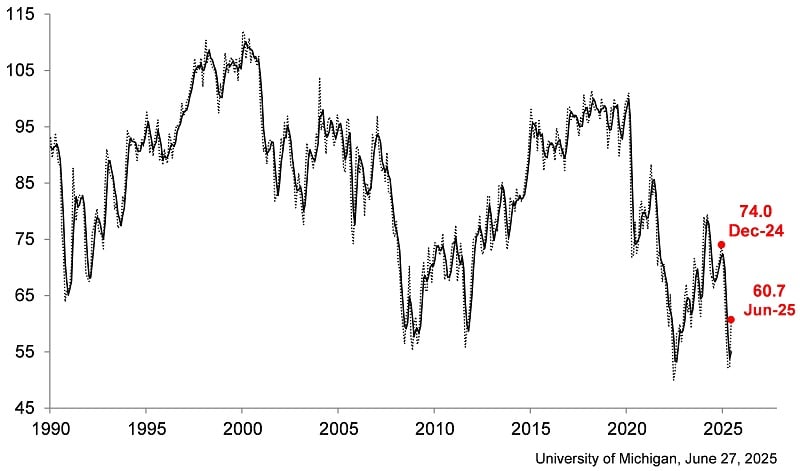
But at 60.7 in June, the U of M Index of sentiment was down 18 percent from December 2024, and “consumer views are still broadly consistent with an economic slowdown and an increase in inflation to come,” survey director Joanne Hsu said in a statement.

Joanne Hsu
“Consumers continue to be concerned about the potential impact of tariffs, but at this time they do not appear to be connecting developments in the Middle East with the economy,” Hsu said.
While rising tensions with Iran initially sent oil prices up by 20 percent in June, they’ve since retreated after attacks on Iran by Israel and the U.S. did not escalate into an all-out war.
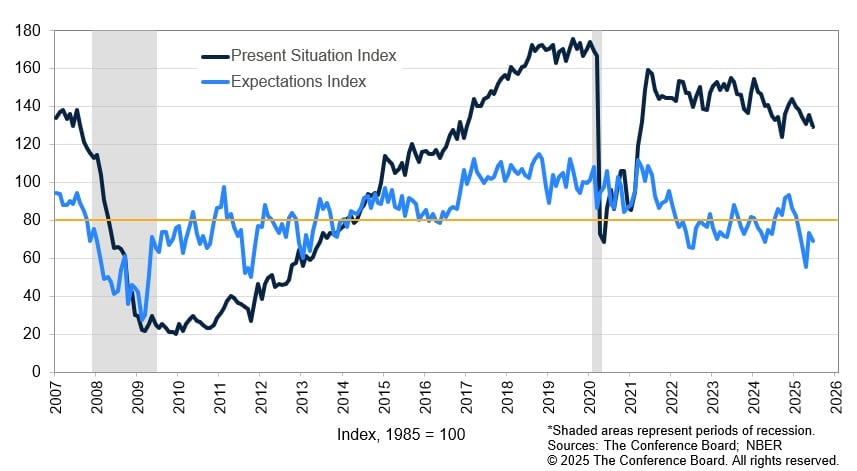
The Conference Board Consumer Confidence Index, released on June 24, retreated by 5.4 points in June, to 93. That index had previously posted its first gain in five months in May, rising 12.3 points.

Stephanie Guichard
“Tariffs remained on top of consumers’ minds and were frequently associated with concerns about their negative impacts on the economy and prices,” Conference Board Senior Economist Stephanie Guichard said in a statement. “Inflation and high prices were another important concern cited by consumers in June.”
Conference Board Present Situation and Expectations Indexes
The Conference Board’s Expectations Index, which is based on consumers’ outlook for income, business and labor market conditions, fell 4.6 points to 69, well below the threshold of 80 that often signals a recession ahead.
While many economists expect tariffs will have an inflationary impact on prices, they could also cause the economy to slow if consumers buy less and hiring slows.
Federal Reserve policymakers have signalled that while they expect to cut short-term interest rates twice later this year to keep unemployment in check, they’ve been waiting to see what impact tariffs have on prices.
The latest reading of the Federal Reserve’s preferred inflation gauge, the personal consumption expenditures (PCE) index, showed consumer spending shrank by $29.3 billion in May, and that the annual rate of inflation moved away from the Fed’s 2 percent goal, to 2.3 percent.
Ongoing negotiations have added to the uncertainty over tariffs, with the Trump administration pushing back many country-specific “reciprocal tariffs,” which were originally slated to go into effect in April, until July 9.
U.S. stock indexes hit new all-time records on Friday on news that the U.S. and China are close to reaching a trade deal, only to reverse course when President Trump said he was ending trade talks with Canada.
In the meantime, consumers are paying an average effective tariff rate of 15.8 percent on imported goods — the highest since 1936, according to a June 17 analysis by The Budget Lab at Yale.
Get Inman’s Mortgage Brief Newsletter delivered right to your inbox. A weekly roundup of all the biggest news in the world of mortgages and closings delivered every Wednesday. Click here to subscribe.
Email Matt Carter
by Lillian Dickerson | Jun 27, 2025 | Industry, News Feed
Former mortgage loan originator Andrew Josephson claims the company failed to adequately pay him and other employees for time worked in an effort to cut costs and gain a leg up on competitors.
Real estate is changing fast, and so must you. Inman Connect San Diego is where you turn uncertainty into strategy — with real talk, real tools and the connections that matter. If you’re serious about staying ahead of the game, this is where you need to be. Register now!
A mortgage loan originator who previously worked for Zillow Home Loans has filed a class action lawsuit against the portal giant’s mortgage lending arm, alleging that it failed to adequately pay him and other employees for time worked in an effort to cut costs and gain a leg up on competitors.

Andrew Josephson | Credit: LinkedIn
The disgruntled former employee and lead plaintiff in the case is Andrew Josephson, who worked for Zillow Home Loans from 2023 to 2025, according to his LinkedIn profile. Josephson is now a product specialist at Federal First Lending and has worked in the past at Escrow.com and Network Capital.
TAKE THE INMAN INTEL SURVEY FOR JUNE
Representatives for Zillow said they were unable to comment on pending litigation. Lawyers for Josephson did not immediately respond to Inman’s request for comment.
The complaint filed on Wednesday in Orange County, California, alleges that Zillow Home Loans failed to pay minimum wages and overtime, provide meal and other breaks, reimburse business expenses, provide accurate itemized wage statements, pay all wages within a timely period of Josephson’s separation from the company, and violated business and professional codes.
The suit further alleges that Zillow Home Loans intentionally created “an artificially lower cost of doing business in order to undercut their competitors and establish and/or gain a greater foothold in the marketplace.”
The plaintiffs are requesting a jury trial and damages to recover unpaid wages, non-reimbursed business expenses, benefits and attorneys’ fees and expenses. California citizens currently or previously employed by Zillow Home Loans, any time between June 25, 2021, and the date of class certification, who have similar grievances as those outlined by the lawsuit, may be included in the class of plaintiffs.
This is not the first time that Zillow or one of its entities has been on the receiving end of a lawsuit regarding wages. In 2019, business consultant Nicole Correa filed a class action suit against Zillow Group, alleging labor code violations, including a failure to pay overtime wages, and Zillow settled that suit in 2021 for a little over $342,000. In 2014, former inside sales consultant Ian Freeman also sued Zillow Group in a class action suit that alleged the company violated wage laws. Zillow settled the case in 2016 for $6 million.
Read Josephson’s full complaint here.
Email Lillian Dickerson
