Shares in Better get a boost from $534M debt restructuring

Investors bid up mortgage lender’s share price by 21 percent as company says deal with investor investor SB Northstar LP will improve its balance sheet and better position it for growth and a return to profitability.

Bigger. Better. Bolder. Inman Connect is heading to San Diego. Join thousands of real estate pros, connect with the Inman Community and gain insights from hundreds of leading minds shaping the industry. If you’re ready to grow your business and invest in yourself, this is where you need to be. Go BIG in San Diego!

Investors in tech-driven mortgage lender Better Home & Finance are cheering its plans to restructure more than half a billion dollars in debt, which the company said Monday will improve its balance sheet and position the company to grow and return to profitability.

Better will retire $534 million in convertible notes held by investor SB Northstar LP in exchange for $110 million in cash and $155 million in new notes at a 6 percent interest rate due in 2028. The notes that are being retired carried a 1 percent rate and were due in 2028.

Vishal Garg

“This transaction will create approximately $265 million of positive pre-tax equity value for the company and its shareholders, as well as create a path to long-term value creation for our equity holders,” Better CEO Vishal Garg said in a statement. “We continue to invest in building the leading AI platform in the mortgage industry, and fulfilling our mission of making homeownership cheaper, faster and easier, and just plain better for all Americans.”

Shares in Better, which in the last 12 months have changed hands for as much as $30 and as little as $7.71, initially jumped 27 percent Monday on news of the debt restructuring, which is expected to close by April 28. After briefly climbing above $13 from Friday’s close of $10.28, shares in Better gave up some of those gains but closed up 21 percent at $12.40.

Better’s board of directors in January approved a $25 million share repurchase program, a strategy that often signals company executives think their shares are undervalued.

Better, which did a booming business in refinancing during the pandemic when mortgage rates hit historic lows, struggled when interest rates rebounded and has racked up $1.9 billion in losses since its inception.

The New York-based lender inched toward profitability in 2024 as growth in home equity and refinancing helped the company grow funded loan volume for the first time in three years even as it slashed expenses.

Better finished 2024 with 1,250 employees — down 88 percent team from a Q4 2021 peak of 10,400 — but claimed its adoption of AI will fuel more profitable growth, with loan fulfillment costs that are 35 percent lower than the industry average of $9,000 per loan.

Revenue, expenses, earnings moving in right direction
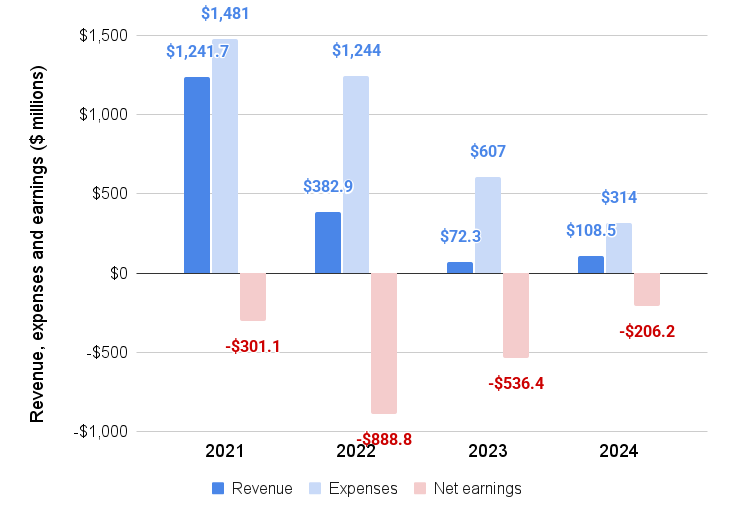
Source: Better Home & Finance Holding Company earnings reports. 

Better’s automated “One Day Mortgage” product represented 73 percent of all direct-to-consumer lending in Q4, helping the company achieve loan fulfillment costs it says are 35 percent lower than the industry average of $9,000 per loan.

While Better racked up a $206 million 2024 net loss, that was an improvement from $536 million in 2023 and $888.8 million in 2022.

Purchase mortgage lending accounted for nearly 74 percent of Better’s business last year, even though business from homebuyers was down 3 percent year from 2023, to $2.65 billion.

At $479 million, 2024 home equity funding volume was up 86 percent from a year ago, while refinancing volume grew by 56 percent, to $463 million.

But Better is losing one of its biggest partners this year, Detroit-based Ally Financial Inc., which announced in January that it was laying off hundreds of employees and getting out of the mortgage business.

Ally originated $1 billion in mortgages in 2023 through its partnership with Better and is also an investor in the company, which went public in a 2023 special purpose acquisition company (SPAC) merger.

While Better once relied on its business-to-business (B2B) partnerships for nearly half of its business, the partner channel accounted for only 19 percent of Q4 2024 loan volume.

Better executives have said they plan to grow the company’s partner channel by offering its technology through co-branded or white-label solutions.

In November, Better announced a partnership with NEO Home Loans to use Better’s Tinman technology stack to power local loan officers.

Better hired NEO Home Loans executives Ryan Grant and Danny Horanyi to lead the “NEO Powered by Better” partnership and build out a distributed retail channel.

Get Inman’s Mortgage Brief Newsletter delivered right to your inbox. A weekly roundup of all the biggest news in the world of mortgages and closings delivered every Wednesday. Click here to subscribe.


Email Matt Carter

This post was originally published on this site

Redfin to follow Zillow as it rolls out portal ban on some private listings

CEO Glenn Kelman on Monday also called on MLSs to create a “coming-soon” designation for listings that would conceal Days on Market and historical pricing data from consumers.

Bigger. Better. Bolder. Inman Connect is heading to San Diego. Join thousands of real estate pros, connect with the Inman Community and gain insights from hundreds of leading minds shaping the industry. If you’re ready to grow your business and invest in yourself, this is where you need to be. Go BIG in San Diego.

Days after Zillow rocked the real estate industry with changes to its rules on private listings, Redfin followed suit with a ban on listings that don’t begin on a multiple listing service, CEO Glenn Kelman said in a statement Monday.

The two-paragraph announcement, which also calls on multiple listing services to create a “coming-soon” designation for listings that would conceal Days on Market and historical pricing data from consumers, is the latest twist to come as a result of an adjustment to NAR’s Clear Cooperation Policy last month.

“Because we believe that all buyers should be able to see all listings, Redfin.com will not publish any listings that have been publicly marketed before being shared with all real estate websites via the MLS,” Kelman said in the statement. “To encourage home-sellers to market their listings via the MLS, Redfin is also asking MLSs to create a coming-soon designation for listings that precludes search sites from showing how long a home has been for sale and at what prices.”

Last month, NAR announced it would keep in place its Clear Cooperation Policy, which requires agents to put a listing onto an MLS within one business day of publicly marketing the property.

But it also created an exemption and new category of listings called “delayed marketing exempt listings,” which would allow sellers to have their listing agent delay putting a listing on the Internet Data Exchange (IDX) for a set period of time that would be determined by each multiple listing service.

In response, Zillow announced last week it would prohibit listings that are marketed privately for longer than a day. Listings that aren’t shared with an MLS within 24 hours of being marketed would be banned “for the life of the listing,” according to Zillow’s policy.

The change came in response to an ongoing push by major brokerages to create their own private listing networks.

Redfin said that it was fair to say its policy update, which it would implement after working through technical details over the coming months, was similar to Zillow’s and would apply to the life of the listing.

Other brokerages moved to align themselves in favor or against Zillow’s new policy. EXp and NextHome announced they supported the decision. Compass, @properties and others said they were opposed. Some opponents suggested Zillow was attempting to preserve its pipeline of leads that it generates through its platforms and sells to agents.

Kelman said Redfin, which is set to be acquired by Rocket Holdings, would advocate MLSs to create a new designation indicating a home is coming soon to the market.

“Other brokers have supported the idea of coming-soon listings, but with access limited to agents, and potentially only to their own agents,” Kelman said in a continuation of his statement. “This violates the principle established in the last great real-estate anti-trust battle, settled in 2008, that all brokerage customers should be able to see all MLS listings, online or via an agent. And that principle exists for a reason: once brokers give our clients control over how their listing appears online, every client will want that listing to appear everywhere.”

Homes.com so far has sought to distinguish itself from Zillow and Redfin’s policies, with CoStar CEO Andy Florance saying in a post over the weekend that Zillow’s policy update was “incredible move of audacity and a pure power play of epic proportion.”

“Rest assured, if Zillow does block your listing, it will still be seen on Homes.com and the other sites,” Florance wrote.

Email Taylor Anderson

This post was originally published on this site

Caution! 3 ways your buyer’s love letter could violate Fair Housing

Jonathan Pressman offers real-world examples of the way buyer love letters can violate fair housing, along with fixes to help your clients write right.

Bigger. Better. Bolder. Inman Connect is heading to San Diego. Join thousands of real estate pros, connect with the power of the Inman Community, and gain insights from hundreds of leading minds shaping the industry. If you’re ready to grow your business and invest in yourself, this is where you need to be. Go BIG in San Diego!

Love ‘em or hate ‘em, buyer love letters are still a thing, especially in competitive housing markets. While many people believe love letters give buyers an edge, they could put you at risk of inadvertently violating the Fair Housing Act.

The Fair Housing Act prohibits discrimination against seven protected classes: race, color, religion, sex, national origin, familial status, and disability. So how might a buyer love letter violate the Fair Housing Act? Here are three everyday examples: 

Violation No. 1: Familial status

Writing something like, “This is the perfect place to raise our family,” or worse, a buyer including a photo of their family in a love letter, could result in potential discrimination that violates the Fair Housing Act. Sellers should evaluate offers based on terms, and are prohibited from choosing a buyer because they’re married, single, have children or are expecting a child.

If a seller decides to research potential buyers and make a decision that’s influenced by the buyer’s familial status, that’s on the seller and their agent. But as the buyer’s agent, you can make sure your clients don’t make the mistake of revealing any details about their familial status before closing.

Violation No. 2: Religion

For many buyers, proximity to houses of worship is a key consideration. A buyer might think it’s OK to share that they love the house because it’s close to their church, mosque or synagogue; however, divulging their religion might cause the seller to accept or decline their offer on the basis of that affiliation, which would constitute a violation of the Fair Housing Act.  

Violation No. 3: National origin

A buyer might share how much they appreciate the local cuisine or cultural offerings in a certain area, but if they mention their own national origin along the way, it could lead to discrimination on the basis of national origin.

For example, let’s say a buyer writes a letter to the seller that highlights how much they want to be near Chinatown, since it reminds them of their hometown.  They talk about how they’d like to enjoy the Chinese restaurants and speak their native language with neighbors and local business owners.

If the seller uses that information to determine which offer to choose — whether it benefits the buyer or not — they’d violate the Fair Housing Act in the process.

The fix: What to do instead

Fix No. 1: Avoid buyer love letters altogether 

For some buyer agents, the easiest way to avoid liabilities from buyer love letters is to advise clients not to write them at all. Though they might offer some benefits, the risks could outweigh any potential reward, which has led many Realtor associations to discourage buyer love letters altogether.

The State of Oregon took an even stronger position against love letters in July 2021 when it passed a law banning them to prevent seller discrimination. (The law was later blocked by a federal judge, who deemed it unconstitutional.)

Fix No. 2: Educate buyers and encourage them to focus on objective facts

If your buyers are determined to write a love letter, you can help by educating them about fair housing laws and encouraging them to stick to objective facts about the home and the neighborhood.

If a buyer is excited about raising their children somewhere, they can talk about how much they love the spacious yard, local parks and highly rated school district (without ever mentioning kids).

Suppose a buyer with a physical disability is interested in a ranch house with accessible bathrooms. In that case, they don’t have to mention their disability and can instead share how much they like the home’s layout. 

Jonathan Pressman is a Realtor who writes on a wide range of financial topics. Connect with him on LinkedIn and Instagram.

This post was originally published on this site

Lesson Learned: Stay levelheaded, unflappable, and go with the flow

Learn how New York City agent Jennifer Roberts navigates the ups, downs and indecisions of real estate clients while keeping her cool.

Bigger. Better. Bolder. Inman Connect is heading to San Diego. Join thousands of real estate pros, connect with the power of the Inman Community, and gain insights from hundreds of leading minds shaping the industry. If you’re ready to grow your business and invest in yourself, this is where you need to be. Go BIG in San Diego!

With nearly 40 years of experience in New York City’s residential real estate market, Jennifer Roberts knows a thing or two about navigating the unexpected and keeping pace with “the city that never sleeps.”

“I am a daily listmaker,” Roberts said, “which serves me well in not wasting time and accelerates accomplishing what I need to do.”

An avid reader and architecture aficionado who has taken many walking tours of NYC, Roberts leaves no stone unturned in serving her clients. Find out how she fell in love with real estate and what she’s learned from the ups and downs of her market.


Name: Jennifer Roberts

Title: Licensed associate real estate broker

Experience: 39 years in the industry

Location: New York City

Brokerage name: Coldwell Banker Warburg

Sales volume: Over $550 million


1. What’s one big lesson you’ve learned in real estate?

I’ve been a real estate agent now for almost four decades, and I learned a big lesson in the very first week of my real estate career. I started in my first real estate firm on a Monday and took out a buyer two days later who gave me a bid on the first home I showed him.

I was so excited and ran to the home of my manager, who helped me negotiate my first real estate transaction. The offer was accepted, and I recall saying to myself that this was an easy business. How wrong I was!

The deal fell through a few days later. I don’t remember the reason the buyer backed out, but I was crushed.

The important lesson I learned, and it has remained with me, is that things happen in this business, and you must go with the flow. You’ll have your ups and downs, but it is a people business, meaning people change their minds about things.

The lesson is you need to remain levelheaded and unflappable under all circumstances. That will serve you well.

2. What TV show has taught you the most?

My go-to TV station is CNBC, which offers business and financial news and analysis. I have gained vast knowledge from their many programs. The varied segments offer in-depth comments on real estate trends, such as the use of AI in real estate and how the economic and political climate affects the housing market and mortgage rates.

This assists me in being a smarter agent, and I can use what I have learned to intelligently guide my clients to make better decisions in the current buying and selling environment.

3. As a child, what did you want to be when you grew up? How does real estate relate to that childhood goal? 

My father was a dentist, but he had a side business as a developer. With a partner, he built residential apartment buildings in Northern New Jersey and some strip malls. When I was little, I loved to hear his stories about real estate ventures, and I accompanied him to various sites occasionally.

I wasn’t sure what I wanted to be, but I knew I liked business and wanted to work for myself rather than have a “boss.” After getting my MBA and working for various corporations — American Express, Dun & Bradstreet and Bloomingdale’s — I decided to become a residential real estate agent in Manhattan, where I lived.

Almost 40 years later, I am still going strong. My dad’s love of real estate, which he passed on to me, was passed on to my son, who is a partner in the real estate department of a law firm.

4. What would you tell a new agent before they start in the business?

I would tell new agents that this is not a part-time business, and they must be prepared to put in long hours and work smart. By that, I mean they should develop a business plan on how they intend to grow their business and how they will master the neighborhoods they are covering as agents. To educate themselves on pricing and layouts, they should go to as many open houses as possible.

Another thing I would tell them is that real estate is an up-and-down business, and anything could happen between an accepted offer and the closing table, where even then complications could arise. If an issue comes up at any time during the process, you are the one who must remain calm, even if the parties involved are being high-strung. There is always a solution.

5. If you could do anything other than real estate, what would it be?

If I could do anything other than real estate, I would want to be a clothing designer, particularly a woman’s dress designer. While I can’t really sew, I do like to sketch design ideas now and then.

Plus, when I see certain dresses, I imagine how I could improve the look and fit. Designing dresses would be a way to express my creative side and craft a unique vision.

It would make me happy to give people confidence by wearing my designs. As with real estate, designers need to develop networking skills to build relationships.

Email Christy Murdock

This post was originally published on this site

Trending: Ownership shifts, joyful strategy and smarter reach

From TikTok uncertainty to Snapchat’s joy-driven ad strategy, Jessi Healey unpacks how platforms are reshaping visibility, engagement and emotional connection.

Bigger. Better. Bolder. Inman Connect is heading to San Diego. Join thousands of real estate pros, connect with the power of the Inman Community, and gain insights from hundreds of leading minds shaping the industry. If you’re ready to grow your business and invest in yourself, this is where you need to be. Go BIG in San Diego!

Each week on Trending, digital marketer Jessi Healey dives into what’s buzzing in social media and why it matters for real estate professionals. From viral trends to platform changes, she’ll break it all down so you know what’s worth your time — and what’s not.

Social platforms aren’t just changing — they’re redefining what it means to show up, stand out and stay in control. From TikTok’s uncertain future and the rise of decentralized video apps to Snapchat’s happiness-fueled ad research and Instagram’s new experiments with exclusivity, each update signals something deeper: The growing importance of emotional intelligence, audience intention and content flexibility.

As the social media ecosystem splinters and refocuses, success is less about chasing trends and more about understanding how and where your content connects.

TikTok’s US sale deadline gets pushed again

President Donald Trump has once again extended the deadline to sell TikTok’s U.S. operations, with potential buyers ranging from Oracle and Amazon to Perplexity and Walmart. The uncertainty lingers — and with it, the potential for major shifts in how the platform operates.

For real estate professionals, this is a reminder to keep your short-form content strategy diversified because where you post can matter just as much as what you post.

A new Skylight on short-form video

Skylight, a TikTok alternative built on Bluesky’s decentralized AT Protocol, is now live — and it’s already turning heads. Backed by Mark Cuban and developed in just 10 weeks, Skylight offers familiar features like in-app editing, comments and follows, but adds something TikTok doesn’t: Openness.

The AT Protocol (short for Authenticated Transfer Protocol) powers a growing ecosystem of decentralized apps, meaning content shared on Skylight can also be seen on compatible platforms like Bluesky and Flashes. It’s a social web that’s more connected — and less controlled by any single company.

Co-founder Tori White, a former influencer, built buzz by documenting the app’s development on TikTok, creating a ready-made user base before launch.

For real estate professionals, this is a reminder that the future of short-form video may be more open and decentralized — and staying visible might soon mean showing up beyond just the big-name platforms.

Snapchat finds joy sells — literally

Snapchat, in partnership with IPG Mediahub and Amplified Intelligence, released a global study showing that happiness is a key driver of ad performance, especially on its own platform. Using eye-tracking and machine learning to gauge emotional responses, researchers found that Snap ads generating the most joy also earned the most attention and long-term brand lift, outperforming TikTok, Instagram and YouTube.

What worked?

  • Sound, bright colors and strong storytelling
  • Messaging tied to security, celebration or belonging
  • Creativity that aligns with the joyful connections users seek on Snapchat

For real estate professionals, this is a reminder that emotional tone matters. Ads that spark positivity and connection — especially on platforms like Snap — can drive deeper, longer-lasting engagement.

Instagram tests lockable posts with passcode access

Instagram is experimenting with lockable posts — content that stays hidden until the viewer enters a creator-provided code. Think of it like a gated Story sticker, but for feed posts, designed to spark curiosity and reward loyal followers.

For real estate professionals, this is a reminder that exclusivity can drive engagement. Offering gated content like sneak peeks or special updates could help strengthen the audience connection.

LinkedIn levels up: Video trends and targeted company posts

LinkedIn is doubling down on engagement with two new features: Targeted organic posts for company pages and a video trends hub prompting users to contribute to popular formats like “a day in the life.”

Together, these updates signal a push toward more personalized, participatory content, without the need for paid promotion. Brands can now tailor messaging to specific audiences while also joining trend-driven conversations to boost visibility.

For real estate professionals, this is a reminder that LinkedIn isn’t just for job updates — it’s a growing space for niche storytelling, lead gen and local relevance.

TL;DR (Too Long, Didn’t Read)

  • TikTok’s U.S. sale delayed again. Platform uncertainty continues, with big names like Oracle, Amazon and Perplexity in the mix. Diversify your video strategy now.
  • Skylight launches as a TikTok alternative. Built on Bluesky’s AT Protocol, Skylight points to a more decentralized future for short-form video.
  • Snapchat study shows happy ads perform better. Joyful content with sound, color and storytelling drives stronger engagement and brand lift.
  • Instagram tests lockable posts. Creators can now gate content behind a custom passcode, adding an exclusive layer to feed posts.
  • LinkedIn rolls out organic targeting and trend prompts. Company pages can now tailor posts by audience, and new video trends encourage participation.

As platforms test new tools and reframe how content flows, the real opportunity lies in adapting with intention. Whether it’s leaning into joy, experimenting with exclusivity or expanding beyond the usual apps, staying flexible — and focused on what resonates — is the signal worth following.

Jessi Healey is a freelance writer and social media manager specializing in real estate. Find her on Instagram, LinkedIn, Threads, or Bluesky.

This post was originally published on this site

Tariffs, stalled construction threaten to end rent stability

As of March, the median asking rent dipped slightly year over year to $1,610. That’s just a 0.6 percent decline from the previous year and a slight 0.4 percent increase from February. While those very subtle changes have offered some relief to renters, Redfin economists say that the landscape is shifting, and fast.

Bigger. Better. Bolder. Inman Connect is heading to San Diego. Join thousands of real estate pros, connect with the Inman Community and gain insights from hundreds of leading minds shaping the industry. If you’re ready to grow your business and invest in yourself, this is where you need to be. Go BIG in San Diego!

Rent prices have been steady over the past 13 months, but that calm may not last much longer. According to a new report from Redfin, mounting economic pressures, including tariffs and slowing construction, could soon put upward pressure on rents.

As of March, the median asking rent dipped slightly year over year to $1,610. That’s just a 0.6 percent decline from the previous year and a slight 0.4 percent increase from February. While those very subtle changes have offered some relief to renters, Redfin economists say that the landscape is shifting — and fast.

A major reason for the shift is the 10 percent blanket tariff on imports, which took effect April 5 under President Trump. While additional “reciprocal” tariffs have been paused, at least temporarily, for most trade partners, China was notably left out of that pause, meaning the supply chain for many goods, including building materials, could still take a hit.

Apartment construction is especially vulnerable as many of the materials needed to build housing, like softwood lumber, are imported. As tariffs drive up those costs, developers may pull back. With fewer new units being built, a supply crunch could drive rents higher — especially in markets where demand remains strong.

However, that’s not the only pressure point. According to Redfin Economics Research Lead Chen Zhao, economic uncertainty is also playing a role.

“Tariffs could also drive up rents by increasing demand,” Zhao said. “People may opt to rent instead of buy homes because the turmoil around tariffs has fueled widespread economic uncertainty. Tariffs have already caused huge swings in the stock market, and they will lead to higher prices for many goods and services, along with increased unemployment.”

That uncertainty is already showing up in renter behavior. In Northern Virginia, Redfin Premier agent Matt Ferris says one of his clients is even thinking about selling their home and renting for a year out of fear of a layoff. Federal employees in the D.C. area, in particular, have been impacted by widespread cuts tied to Elon Musk’s Department of Government Efficiency (DOGE).

At the same time, the cost of homeownership is becoming increasingly out of reach. Redfin reports that the average American now needs to earn over $116,000 annually to afford a median-priced home, nearly double the $64,160 needed to afford a typical apartment.

Some cities are still seeing rents fall, thanks to a backlog of newly built units. In Austin, for example, the median asking rent has dropped 10.7 percent year over year to $1,420. Similar declines were seen in San Diego (-9.7 percent) and in Portland, Oregon, and Minneapolis (-7.8 percent).

Others are trending in the opposite direction. Rents rose the most in Cincinnati (12.1 percent), Providence, Rhode Island (11.4 percent) and Cleveland (10.6 percent). If construction slows and demand rises as expected, more markets could join that list in the coming months.

Email Richelle Hammiel

This post was originally published on this site