by Matt Carter | Apr 15, 2025 | Industry, News Feed
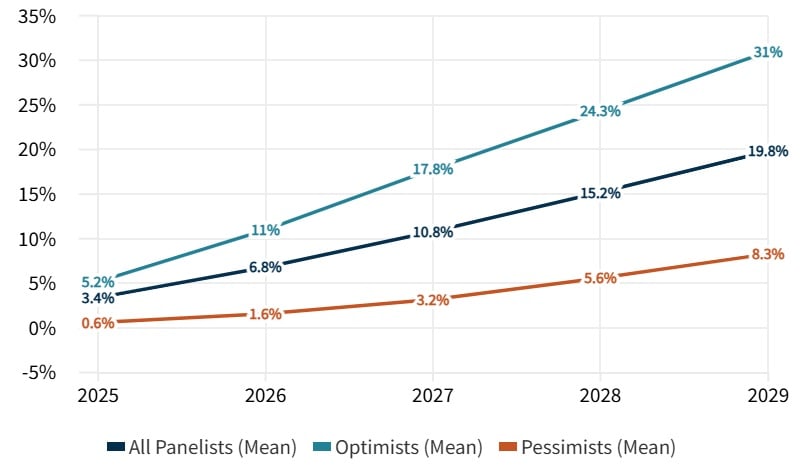
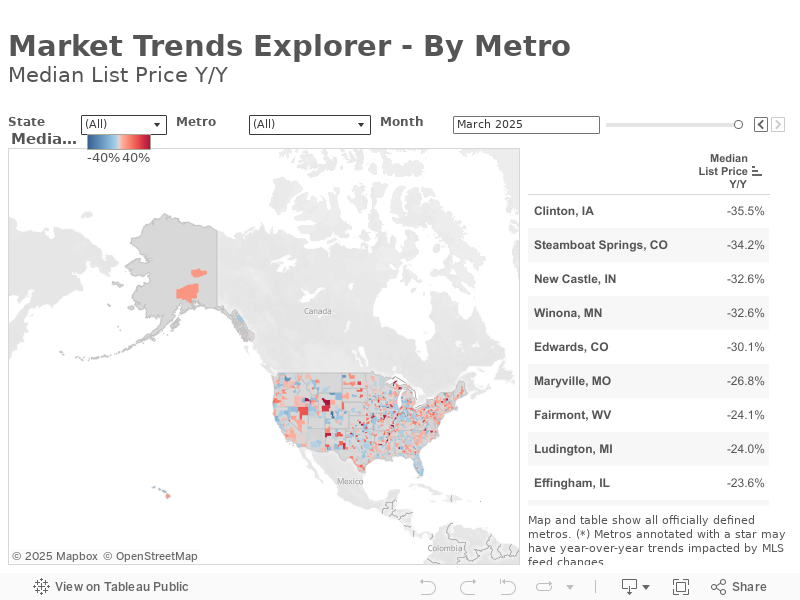
Experts surveyed by Fannie Mae expect national home prices to grow by 3.4 percent in 2025. Median list prices in 69 markets were down by 10 percent or more from a year ago in March.

In April, we’ll go deep on money and finance for a special theme month, by talking to leaders about where the mortgage market is heading and how technology and business strategies are evolving to suit the needs of buyers now. Inman’s Best of Finance returns for 2025, celebrating the leaders in this space. And subscribe to Mortgage Brief for weekly updates all year long.
Housing experts surveyed by Fannie Mae expect national home price appreciation to cool this year as inventories continue to swell, with dozens of local markets already seeing double-digit annual declines in median list price.
Fannie Mae’s latest Home Price Expectations Survey (HPES), released Tuesday, showed more than 100 housing and mortgage industry experts expect home price growth to slip to 3.4 percent in 2025, down from 5.8 percent last year.
The latest quarterly survey shows experts are less optimistic than they were in January, when they were forecasting 3.8 percent price appreciation in 2025.
The HPES panel expects price appreciation to continue to cool to 3.3 percent next year, down from the 3.6 percent forecast for 2026 issued in January.
Pessimists see home price appreciation flattening
But the most pessimistic quartile of survey panelists sees national home price appreciation flattening to 0.6 percent this year and remaining weak until 2028.
While prices could go up more sharply in some markets, they’re also expected to fall in some metros where listings come onto the market faster than buyers can snatch them up.
At the national level, there were 1.75 million new and existing homes on the market in February, up 15 percent from a year ago, according to data tracked by the National Association of Realtors and the U.S. Census Bureau.
Inventory of new and existing homes
The inventory of existing homes grew by 17 percent, to 1.24 million, according to NAR data, while the number of new single-family homes on the market grew by 7 percent, to 500,000, the Census Bureau reported.
Realtor.com was tracking 1.3 million listings in March, up 17 percent from a year ago.
The latest readings from the S&P CoreLogic Case-Shiller Indices showed national home prices were up 4.1 percent from a year ago in January, with Tampa the only market in the 20-City index to see prices slip over that period, by 1.5 percent.

Nicholas Godec
But the second half of the year “told a different story,” S&P Down Jones Indices’ Nicholas Godec said in a press release, with only four of 20 cities — New York, Chicago, Phoenix and Boston — managing to “eke out” price increases during that period.
San Francisco posted the largest six-month decline at 3.4 percent, followed by Tampa at 3.2 percent, Godec said.
Selma Hepp, chief economist at Cotality (formerly CoreLogic), said flattening home price changes over the last six months “suggest further price deceleration is ahead.”

Selma Hepp
“While this year’s cold winter and large natural disasters play a role in dampening demand, falling consumer sentiment suggests potential homebuyers are wary of the short-term economic outlook and future inflation,” Hepp said in a March 30 report.
Home prices are driven by local supply and demand, and Realtor.com data shows median list prices in 69 metros were down by 10 percent or more from a year ago in March.
Median list price declines in 69 markets
Markets experiencing double-digit annual declines in median list price included Steamboat Springs, Colorado (-34.2 percent); Winona, Minnesota (-32.6 percent); Wenatchee, Washington (-22.1 percent); Flint, Michigan (-21.1 percent); Marion, Indiana (-19.7 percent); Enid, Oklahoma (-17.6 percent); Santa Fe, New Mexico (-14.5 percent); Ukiah, California (-13.7 percent); Dublin, Georgia (-13.4 percent); Montgomery, Alabama (-11.3 percent); Cedar Rapids, Iowa (-10.9 percent); Wausau, Wisconsin (-10.5 percent); and Boulder, Colorado (-10.2 percent).
“There are many ways to slice and dice housing data,” Realtor.com Chief Economist Danielle Hale said in her most recent weekly housing market update. “Through the lens of geography, our data reveals some commonalities.”

Danielle Hale
Realtor.com’s last Hottest Housing Markets report found that homes are selling more quickly in many markets in the Northeast and Midwest, and that a separate Down Payment Trends report showed buyers were putting more down on homes in the Northeast and Midwest and less in the South and West.
Last month, Fannie Mae economists said a pullback in mortgage rates should provide a “small boost” to home sales this year, in part because tariffs implemented by the Trump administration might inflate prices and slow economic growth. But tariffs announced this month have sent mortgage rates on the rebound, jeopardizing such forecasts.
Get Inman’s Mortgage Brief Newsletter delivered right to your inbox. A weekly roundup of all the biggest news in the world of mortgages and closings delivered every Wednesday. Click here to subscribe.
Email Matt Carter
This post was originally published on this site
by Matt Carter | Apr 15, 2025 | Industry, News Feed
Omeed Malik, founder of investment bank Farvahar Partners and venture capital firm 1789 Capital, is a business partner and “close friend” of Donald Trump Jr.
In April, we’ll go deep on money and finance for a special theme month, by talking to leaders about where the mortgage market is heading and how technology and business strategies are evolving to suit the needs of buyers now. Inman’s Best of Finance returns for 2025, celebrating the leaders in this space. And subscribe to Mortgage Brief for weekly updates all year long.
Banker, investor and lawyer Omeed Malik — recently dubbed “MAGA world’s premier financier” by New York Magazine — is the latest addition to mortgage giant Fannie Mae’s board of directors, Federal Housing Finance Agency Director Bill Pulte announced on social media Monday.
Before founding the investment bank Farvahar Partners and venture capital firm 1789 Capital — where Donald Trump Jr. became a partner in November — Malik was managing director and global head of the hedge fund advisory business at Bank of America Merrill Lynch.
Pulte said Malik “brings great capital markets, legal and investment experience” to Fannie Mae’s board of directors.
As chairman and CEO of Colombier Acquisition Corp., Malik helped take PublicSquare — which touts itself as a marketplace for “patriotic businesses and consumers” — public in a 2023 SPAC merger with Colombier, a special purpose acquisition company.
Malik stepped down from PublicSquare’s board on Dec. 3 — the same day Trump Jr. joined it, along with Willie Langston, a partner at wealth management firm Corient and a former national finance chair for Ted Cruz’s presidential campaign.
Described as a “close friend” of Trump Jr. in a November New York Magazine profile, Malik on March 3 reposted a picture the president’s son published on X the day before — in which Trump Jr. thanked Malik for co-hosting a fundraiser for Vivek Ramaswamy’s bid to become Ohio’s next governor in the 2026 election.
Malik is also an investor in The Daily Caller, the conservative news outlet co-founded by Tucker Carlson. His addition to Fannie Mae’s board follows Pulte’s purge of 14 board members at the mortgage giant and its sister company Freddie Mac, in March.
Pulte — the grandson of homebuilder William J. Pulte, the founder of PulteGroup Inc. — appointed himself the chair of Fannie and Freddie’s boards less than a week after he was confirmed by the Senate as Trump’s choice to lead their federal regulator.
Board Chair Michael Heid was one of eight Fannie Mae board members removed by Pulte, who declared, “DEI is dead at Fannie Mae and Freddie Mac.”
Fannie Mae CEO Priscilla Almodovar was one of five board members who kept their seats. They’ve been joined by Pulte’s other appointments to Fannie Mae’s board: Mike Stucky, a former Pulte Group division president, and FHFA General Counsel Clinton Jones.
Jones, who joined the FHFA in 2019 and was promoted to general counsel in 2021, was also appointed to Freddie Mac’s board.
One of Pulte’s other picks — Christopher Stanley, a staffer from the Department of Government Efficiency (DOGE) — was appointed to Fannie Mae’s board on March 17 but resigned the next day.

Mike Stucky
Stucky, who, according to his LinkedIn profile, is a retired heating, ventilation and air conditioning (HVAC) executive, was appointed vice chair of Fannie Mae’s board on April 10, the company disclosed Monday in a regulatory filing.
The FHFA has determined that Fannie Mae’s board should have at least five and no more than 13 directors. With Malik’s addition, the board will have nine members.
In addition to Chair Lance Drummond, Pulte removed five other directors from Freddie Mac’s board, the company said in a March 17 regulatory filing. In addition to Pulte and Jones, new additions to Freddie Mac’s board included Brandon Hamara and Ralph “Cody” Kittle.
Hamara is the vice president of land acquisition at homebuilder Tri Pointe Homes Inc., a Nevada-based homebuilder that completed 6,460 homes last year. Kittle is a partner at RenWave Kore, a Greenwich, Connecticut-based private equity firm.
On March 24, Freddie Mac board member Grace Huebscher announced her resignation, and Pulte appointed Michael Parrott, CEO and founder of consulting firm 480th Company, as her replacement.
Freddie Mac now has 10 board members, including interim CEO Mike Hutchins, who took on that role after Pulte fired Freddie Mac CEO Diana Reid and Head of Human Resources Dionne Wallace Oakley last month.
Appointed as CEO in September, Reid was the first woman to lead Freddie Mac. With Almodovar having served as Fannie Mae’s CEO since 2022, both mortgage giants were briefly led by women for the first time in history.
Get Inman’s Mortgage Brief Newsletter delivered right to your inbox. A weekly roundup of all the biggest news in the world of mortgages and closings delivered every Wednesday. Click here to subscribe.
Email Matt Carter
This post was originally published on this site
by Nina Dosanjh | Apr 15, 2025 | Industry, News Feed
Bigger. Better. Bolder. Inman Connect is heading to San Diego. Join thousands of real estate pros, connect with the power of the Inman Community, and gain insights from hundreds of leading minds shaping the industry. If you’re ready to grow your business and invest in yourself, this is where you need to be. Go BIG in San Diego!
Compass CEO Robert Reffkin’s recent posts criticizing NAR’s spending, the Clear Cooperation Policy, and the structure of the MLS have sparked lots of conversation in our industry. As someone who has been in this business, works alongside agents every day, and has seen both the challenges and the impact of sound policy, I felt compelled to respond.
Setting the record straight
Trying to rewrite history without understanding it is not only misleading, it’s dangerous. Let’s set the record straight: 2023 was not the worst real estate market since 1995. Those of us who’ve been in this business long enough and understand the full history know that’s simply not true. The real crisis was 2007–2010, when the market imploded due to systemic failures fueled by Wall Street, not by NAR, not by MLSs and not by practitioners.
But what is true is what came next: It was NAR and its partners who showed up to help rebuild, advocate and push for policy that protected homeowners, housing rights and the long-term stability of our industry.
And that’s precisely why we have to remember the full context before throwing stones. Wall Street’s “innovation” led to the 2008 financial collapse — the worst housing market in modern U.S. history — packaging risky subprime loans into complex mortgage-backed securities (MBS), selling them as safe investments and fueling a housing bubble with unsustainable lending practices.
When it all collapsed, millions of homeowners in underserved and first-time buyer communities were left holding the bag, while the financial institutions responsible were bailed out. That wasn’t a failure of organized real estate. That was unchecked greed.
Let’s also call this what it is: The effort to dismantle an entire industry and its trade organization under the banner of “consumer choice” is yet another Wall Street-style “innovation” — one engineered not to empower consumers, but to protect investor returns.
When policies that promote transparency and cooperation are undermined, we should all be asking: Who truly benefits? Because if history tells us anything, these strategies rarely serve the people buying and selling homes.
NAR’s fight for fair housing
Meanwhile, despite its flaws, NAR has consistently been one of the few organizations advocating for homeownership rights at the federal level. They fight for mortgage interest deductions, fair housing, disaster relief and the right for agents to remain independent contractors, a foundational freedom allowing agents to build their businesses on their own terms. That advocacy matters; most agents would feel the impact if it disappeared.
Clear Cooperation isn’t perfect — no policy is — and NAR is not perfect either. But suggesting that the organization and its policies exist purely as a dues-protection racket ignores the real intent: The protection of the profession, a shared Code of Ethics, and a rules-based infrastructure designed to ensure transparency in the marketplace and equal protection for buyers and sellers.
Specifically, the Clear Cooperation Policy was created to prevent off-market manipulation with practices that tend to benefit only a select few while limiting access and opportunity for the broader public. Tearing down a policy that is intended to promote equal opportunity for all buyers, and that requires listings to be entered into the MLS where they are visible and accessible to all, undermines this industry’s stated commitment to fair housing and transparency.
Yes, certain aspects of the policy, including carve-outs for exclusives, deserve further scrutiny. The industry hasn’t always been on the right side of history here, but this is an opportunity — an opportunity for companies and brokerages across the board to come together and acknowledge that cooperation benefits the entire market.
Instead of strategies that protect a company’s bottom line, we should be advocating for policies that serve all sellers and all buyers through transparency, standards, exposure and equal access to data. If we truly believe in a fair and functional marketplace, then it’s time to align our business strategies with the values we say we stand for, not just for what’s profitable, but what’s right.
Examining brokerage motives
What we can’t overlook here is the fact that Compass is a publicly traded company. Their board is accountable to shareholders, and that accountability is also about profit. To criticize NAR while conveniently skipping over the profit-driven motives of your own platform? That’s not transparency. That’s selective outrage.
Yes, it’s fair to question spending and structure. Yes, reform is necessary. However, there are thousands of professionals who deeply care about the real estate industry and its future. Every major organization — nonprofit or corporate — has dealt with bad behavior.
But tearing down an entire institution because of a few bad actors ignores the real, meaningful progress being made. If you want change, you show up. You work toward a common goal: Protecting homeowners, building equity, driving the adoption of data standards and making the system better for everyone.
For further clarification, when we talk about doing deals outside the MLS, we’re talking about exclusivity and giving access to properties only to those connected to specific agents working with specific brokerages. That hurts communities of color, it hurts first-time buyers, and countless studies have shown it also hurts — you guessed it — sellers. It creates barriers where there should be bridges.
Fair housing isn’t just a slogan, it’s a responsibility. So how can leaders at companies that claim to stand for consumers and equal access not support policies that ensure every agent and every buyer has access to every listing — and every seller receives the full exposure they deserve in the marketplace?
MLSs and greater transparency are not the problem. They are part of a proven infrastructure, built over a century, with model rules and shared data standards that evolve as the market changes. We don’t benefit from a broken system — and this one isn’t broken. It’s imperfect, yes, but it’s functioning and always improving because of the people who keep showing up to make it better.
People who show up to make it better do the work, not just for themselves, but to strengthen this industry for the communities we serve.
Nina Dosanjh is Chief Technology and Strategy Officer at Vanguard Properties. Connect with her at LinkedIn and Instagram.
This post was originally published on this site
by Craig C. Rowe | Apr 14, 2025 | Industry, News Feed
Ben Bacal and Harry Dheedene have launched Rila Auctions, an off-shoot of social media app Rila, designed to help agents market homes in an Instagram-like video-search environment.
Bigger. Better. Bolder. Inman Connect is heading to San Diego. Join thousands of real estate pros, connect with the power of the Inman Community, and gain insights from hundreds of leading minds shaping the industry. If you’re ready to grow your business and invest in yourself, this is where you need to be. Go BIG in San Diego!
A new auction brokerage called Rila Auctions has launched in southern California, promising to create “urgency and competition through transparent bidding, ensuring homes reach peak market value while giving buyers of all budgets equal access to compete,” Inman learned exclusively in an April 14 statement.
The company was founded by Ben Bacal of Revel Real Estate and broker of record Harry Dheedene.
Rila states its goal is to change the way the industry works in the auction environment by focusing on transparency and technology. It can close in under six weeks, according to the statement, and is designed to be agent-friendly, offer competitive fees and remove uncertainty in an opaque market.
“After working with several auction platforms, I realized there was an opportunity to create a smarter, more transparent solution that puts agents and sellers first,” said Bacal in the release. “Rila Auctions offers the efficiency, clarity, and competitive edge the modern market demands — with a flat-fee structure and full-service support that agents can trust.”
Bacal and Dheedene also founded the social media app Rila to help agents market homes in an Instagram-like video-search environment. A Bel Air home will be the first property marketed on Rila Auctions, a four-bedroom, four-bathroom house launching at $4.6 million. It is being brought to the platform by Enzo Fiore of Revel Real Estate, who is co-listing with Dheedene.
Bacal said his platform will pay buyer agents and is “the future of real estate” in a video announcement shared with Inman. “Buyers know exactly where they stand with an auction and sellers know that their properties are attracting maximum interest,” he said. “I firmly believe this avenue of selling real estate is going to revolutionize the way we sell properties.”
Rila Auctions isn’t alone in the space. Final Offer is a technology-forward competitor while Concierge Auctions, backed by Sotheby’s and Anywhere Real Estate, is more traditional in its service delivery.
“Final Offer gives buyers an elegant search experience, a UI that lists all activity on a home, alerts agents and even interested buyers to changes and new offers, and plainly lists what it’ll take to meet the seller’s terms, as well as offering calendar views of all activity and a history of homes sold on the platform,” Inman’s review stated.
The intent of auction-based sales is to surface competitive offers instead of hiding them behind traditional practices. For example, listing agents are often reticent about sharing exact terms of each offer when there is competition over a listing, a practice that is generally explained with “It’s always been done that way.”
In a transparent auction experience, buyers are often encouraged to increase an offer when able to clearly see what other buyers are submitting, such as price, earnest money, financing and other contingencies.
If a listing agent’s most important job is to get as much value as possible out of a property for its seller, then there is little argument against an auction format. However, the model hasn’t gained any notable traction, despite a number of opportunities for greater adoption over the years. It seems to be often sold as an either-or instead of as a marketing supplement to a standard listing. One hangup is the need to obtain an auction license per each state’s regulations, which takes time and money.
Rila Auctions, in conjunction with others, could provide the spark the format needs to catch the attention of sellers. Its founders’ collective experience and industry presence could help.
Email Craig Rowe
This post was originally published on this site
by Marian McPherson | Apr 14, 2025 | Industry, News Feed
Bigger. Better. Bolder. Inman Connect is heading to San Diego. Join thousands of real estate pros, connect with the Inman Community and gain insights from hundreds of leading minds shaping the industry. If you’re ready to grow your business and invest in yourself, this is where you need to be. Go BIG in San Diego!
As the debate over the National Association of Realtors’ Clear Cooperation Policy takes a new turn, an industry watchdog has now called on the U.S. Department of Justice to investigate private listing networks.
Stephen Brobeck, a senior fellow at the Consumer Policy Center, penned a blog post on Monday lauding Zillow for refusing to display listings that aren’t added to the multiple listing service (MLS) within 24 hours of being publicly marketed. Zillow said public marketing includes yard signs, social media posts and brokerage private listing networks.
The ban, which goes into effect in May on Zillow and Trulia, does not apply to delayed marketing exempt listings as long as they’re submitted to a Multiple Listing Service (MLS) within one day and published on Zillow and other sites that receive listing feeds.
Hours after the blog post went live, Redfin joined Zillow in banning listings that have been publicly marketed before “being shared with all real estate websites via the MLS.” Redfin CEO Glenn Kelman also called on MLS leaders to adopt a “coming-soon” designation that would conceal Days on Market and historical price points data to alleviate homesellers’ concerns about placing their homes on the MLS.

Steve Brobeck
“We encourage all brokers to support Zillow’s efforts to maintain the transparency of real estate markets and prevent their balkanization,” he said. “The efforts of some big brokers are likely to not only disadvantage buyers and sellers but also reduce competition. The U.S. Department of Justice should take a close look at potential antitrust violations by those brokers who use deceptive practices to try to dominate markets.”
Brobeck, alongside CPC fellow Wendy Gilch, argued that private listing networks are anti-competitive and disadvantage most homesellers, homebuyers and small brokerages without connections to larger brokerages with these networks. Brobeck and Glich said private listing networks prevent homesellers from getting the maximum offer for their home and minimize homebuyers’ choices as they’re unable to access all available listings in the market.
The lack of transparency, the duo said, will enable brokers with private listing networks to boost commissions by “double-ending” a greater share of sales, have an unfair recruiting advantage in attracting the best agents, and have more influence over the market, industry associations, and state regulators. Brobeck and Glich said Compass is the perfect example of what they fear the market will look like if the DOJ doesn’t step in.
Compass co-founder and CEO Robert Reffkin has been one of the CCP’s biggest opponents, arguing that the policy prevents listing agents from meeting their fiduciary duty to clients who don’t want their homes on the MLS. Reffkin lobbied to have the rule fully repealed; however, he was pleased with NAR’s decision to add the delayed marketing exemption alongside a longstanding office exclusive exemption.
Reffkin said the new exemption, which allows MLSs to determine how long listings can be seen by other MLS participants without being publicly listed, was “a small step in the right direction” to “expand consumer choice.”
In the weeks since the exemption announcement, Compass has doubled down on advertising its private listing network, which includes nearly 10,000 private exclusive and coming-soon listings. Luxury stalwarts Douglas Elliman and Corcoran rolled out private listing networks on April 8, and Redfin, despite disagreeing with the practice, said it will become more “aggressive about pocketing listings” if the industry continues its push toward off-market options.

Wendy Gilch
“It will be both predictable and telling to watch brokerage CEOs who denounce private exclusives today quietly adopt them tomorrow,” Reffkin said on LinkedIn several weeks ago. “The same leaders insisting these strategies are harmful to sellers will, within a year, be packaging and promoting their own ‘exclusive off-market solutions.’ It’s not a question of if — it’s a question of when. Consumer demand drives industry evolution…”
While Gilch and Brobeck said off-market sales are necessary in limited circumstances, the duo said they offer little value to the typical homseller. That’s why, Gilch said, homesellers should “think twice” before selling their home through a private listing network.
“Sellers will attract the most buyer interest when their home is visible across as many major real estate websites as possible — some, like Zillow, draw over a billion visits a year, far surpassing any other platform in reach,” she said. “And buyers should be skeptical of private listers who try to sign buyers to contracts by claiming to have access to off-market properties.”
While Brobeck and Gilch call on the DOJ to quash private listing networks, CoStar founder and CEO Andy Florance is hoping the DOJ will force Zillow to drop its ban.
Florance said Zillow’s ban is “anti-competitive” and “a pure power play of epic proportion.” The ban, he surmised, is a reflection of the behemoth’s fears that agents will lean into private listing networks and abandon Zillow’s platform. He urged agents to report Zillow to the DOJ’s antitrust division while reminding agents they “deserve control” over how to market clients’ listings.
“Zillow has overplayed its hand. I believe they panicked at the thought that agents might have real choice in how they market their listings.
And when agents have a choice, many won’t rush to publish listings
on a site that siphons off their leads,” he said in an op-ed on Monday. “Even if just a few agents hold back from listing on Zillow, buyers will quickly follow suit — and stop searching there. Zillow’s lead diversion business model is coming under threat.”
Reffkin sided with Florance on social media, saying, “Andy and Homes.com support agents. So, I support Andy and Homes.com.”
It’s unclear whether the DOJ will answer either side’s clarion call, as the department hinted that it’s less interested in CCP now that NAR has scrapped the Participation Rule.
In a Supplemental Statement of Interest filed in the class-action commission lawsuit Nosalek v. MLS PIN on March 18, the DOJ signaled that Clear Cooperation — on its own — is not anticompetitive. However, in situations where non-NAR governed MLSs, like MLS PIN, enforce CCP while still allowing cooperative compensation, the DOJ might look at CCP with more scrutiny.
“Of note, industry participants have made public statements about the Division’s purported position on Clear Cooperation policies that are misleading and out of context,” the DOJ filing said, according to a previous Inman article. “The Division has not taken a position that such policies standing alone (i.e., without mandated MLS publication of offers of compensation or exceptions benefitting primarily large brokerages) are anticompetitive.”

Ed Zorn
California Regional MLS VP and General Counsel Ed Zorn told Inman on Friday that Zillow’s policy was likely safe from DOJ scrutiny.
“Zillow is an independent company with their own board of directors, right? Their board of directors is not made up entirely of horizontal competitors like an MLS or an association board,” he said.
“So, they don’t have that automatic challenge that any action taken by an association or an MLS instantaneously is a decision of horizontal competitors, right? It’s [the] chairs on our board of directors that make decisions. I don’t see how that’s relevant to an independent company like Zillow deciding what they want to do for the benefit of their business. I don’t see any kind of anti-trust or DOJ type of issue.”
As for private listing networks, the outcome might not be as favorable. Despite the DOJ’s comments in the Nosalek lawsuit, Brobeck said he believes the addition of the delayed marketing exemption will attract the department’s ire.
“I think that DOJ will be particularly concerned about the anti-competitive implications of extensive private listings by some of the big national brokerages,” Brobeck told Inman on a phone call. “Those listings would deprive small and local firms of important information about available properties, and would lead, over time, to increasing dominance by the large firms. I think that the DOJ will be particularly concerned about that.”
“I don’t have evidence they’re looking at it, but I’m sure they are,” he added. “We sent them our news release, and they thanked us. But, you know, the DOJ doesn’t tell anybody what they’re thinking or what they’re going to do until they actually do it.”
Email Marian McPherson
This post was originally published on this site