by Lauren Fox | May 19, 2025 | Industry, News Feed
Many real estate professionals say that building a marketing plan — and staying on top of communication trends — can feel like a second job. In the past, agents needed to be tech-savvy or hire an assistant. Time, effort and cost were major hurdles.
Today’s tools help remove those barriers. Knowing best practices — and using technology to support them — is essential to keeping your brand visible and competitive.
Here are five strategies to sharpen your marketing toolkit.
Automate your listing marketing
MLS integration is an integral component of any effective real estate marketing system. Importing photos and details directly into templates saves countless hours, eliminates errors and keeps marketing efforts on track.
HomeSmart’s new Marketing Design Center platform takes this concept further with preset, automated listing packages.
“The listing packages are generating a lot of excitement,” Rich La Rue, HomeSmart Designated Broker and Vice President of Corporate Brokerages, Western Region, told me recently. “The efficiency of having a full set of digital and print assets instantly produced for each listing — not to mention, the ability to customize packages — is a major game changer.”
Embrace “augmented Intelligence”
While artificial intelligence (AI) can spark debate, it’s hard to deny its value as a powerful marketing tool. I often think of it as Augmented Intelligence — because when used intentionally and skillfully, it enhances productivity in ways that are hard to ignore.
Take something as simple as creating a property flyer. With AI-powered tools, you can write captions, retouch listing photos (like changing day to night), tighten up descriptions, check spelling and even translate content — in just a few minutes.
Don’t shy away from the camera
Not everyone is a natural in front of the camera, but that shouldn’t deter you from incorporating video into your strategy — especially on social media. According to the National Association of Realtors, 73 percent of homeowners say they are more likely to list with agents who use video. It not only allows your audience to connect with your personality; it helps attract potential buyers to your listings.

You don’t have to be a professional to pull it off; cutting-edge platforms like our Marketing Design Center come equipped with video templates, a built-in editor, a copyright-free music library and GIF support. Combined with a social media scheduler, this tool makes creating engaging content — whether preplanned or on-the-fly — perfectly accessible.
Give the people what (emails) they want
Email remains an effective lead-nurturing tool when done right. Keeping contact lists organized and sending valuable content helps you stay top-of-mind when clients are ready to buy or sell.
Newsletters featuring local events, market stats, seasonal reminders, personal stories and more are a great way to stay connected. Promotional emails with recent sales or new listings highlight your expertise and local presence.
Our marketing platform includes a variety of email and newsletter templates, plus integrations with tools like Mailchimp and Constant Contact — making it easy to export and send campaigns quickly.
Remember: Print isn’t dead
Traditional mailers remain a marketing staple for good reason: they leave tangible, personal impressions and are especially effective with older demographics. According to Fannie Mae, 44 percent of homeowners are 60 or older, and that percentage is expected to grow.

Pro tip: You can still bring tech into print. QR codes add interactivity and help tailor campaigns to hyperlocal areas.
Built-in mailing list tools — complete with mapping and farming features — are a major asset. Our platform lets agents design, map, print and distribute mailers all in one seamless process.
Get more details on HomeSmart’s fully-MLS-integrated, automation-enhanced Marketing Design Center.
Founded in 2000 with a revolutionary 100 percent commission, full-service model, HomeSmart is a top national real estate enterprise powered by its proprietary end-to-end technology platform. HomeSmart exists to unlock the transformative power of real estate for everyone, providing integrated solutions to agents, franchise partners and, ultimately, consumers.
HomeSmart’s footprint covers over 25,000 agents across 250+ offices in 48 states.
This post was originally published on this site
by Jessi Healey | May 18, 2025 | Industry, News Feed
Bigger. Better. Bolder. Inman Connect is heading to San Diego. Join thousands of real estate pros, connect with the power of the Inman Community, and gain insights from hundreds of leading minds shaping the industry. If you’re ready to grow your business and invest in yourself, this is where you need to be. Go BIG in San Diego!
Each week on Trending, digital marketer Jessi Healey dives into what’s buzzing in social media and why it matters for real estate professionals. From viral trends to platform changes, she’ll break it all down so you know what’s worth your time — and what’s not.
What started as a joke — national parks throwing flirty insults at each other — has turned into one of the most unexpectedly effective awareness campaigns on TikTok. These unofficial park accounts aren’t just going viral because they’re funny. They’re connecting because they know how to speak directly to their audience, with voice and purpose.
Are Yellowstone and Joshua Tree National Parks … flirting with you?
If you’ve been on TikTok recently, chances are you’ve come across some pretty spicy stitches from — *checks notes* — national parks? Yes, many national parks are going viral for spicy content (spicy in an R-rated way), and it seems to be working. Those accounts on TikTok aren’t official — they’re clever, fan-run profiles giving public lands a personality and a little bit of edge.
It all started as a joke: “Mount Rainier” and “Mount Hood” trading flirty insults in the comments. But when budget cuts hit the National Park Service in February, those same creators pivoted — using humor, thirst traps and sharp copy to raise awareness for conservation efforts.
It’s absurd. It’s effective. And it’s a masterclass in tone.
These creators didn’t just chase attention — they used a specific voice to turn a serious topic into something worth watching. And their success didn’t come from perfect content — it came from knowing what would resonate with their audience.
For real estate professionals, this is a reminder that you don’t have to sound like everyone else — you just have to sound like you, in a way your audience connects with.
Before chasing trends or mimicking a viral style, ask yourself:
- What kind of energy does your ideal client respond to — calm and informative, or bold and playful?
- Are they looking for lifestyle inspiration, practical education or a trusted local voice?
- Do your posts reflect your personality, or just what you think “content” should look like?
When your tone aligns with your values and your audience’s expectations, that’s when content hits. You don’t need to thirst-trap for clicks (unless that’s your thing); you just need to communicate with purpose.
TikTok adds alt text and contrast tools for accessibility
In honor of Global Accessibility Awareness Day, TikTok rolled out a wave of new features aimed at making the platform more inclusive. Most notably, users can now add alt text to photos, either during upload or after publishing. TikTok also improved text presentation options, added a color contrast switch, and now supports bold text from device settings for users with low vision.
These changes may seem small, but they reflect a bigger shift toward platforms designing for access, not just aesthetics.
For real estate professionals, this is a prompt to make your content more inclusive — and by extension, more impactful.
Adding photo descriptions, captions or alt text doesn’t just support accessibility — it improves clarity, SEO and reach. If someone can’t hear your audio or see your visuals clearly, what are they walking away with?
Creating with inclusion in mind ensures that everyone can connect with what you’re sharing. And that’s the kind of thoughtful content that resonates far beyond the algorithm.
Instagram experiments with lockable Reels
Instagram is officially testing lockable Reels — content that’s only viewable with a code. The Weeknd was the first to use it publicly, with fans needing a passcode to unlock the post.
The feature is still in testing, but it signals a growing push toward exclusivity as engagement, inviting followers into a more private or gated experience.
For real estate professionals, this is a reminder that scarcity can drive value.
Think sneak peeks, VIP content for buyers, or behind-the-scenes looks shared only with select clients or mailing list subscribers. Used thoughtfully, locked content could build curiosity and deepen loyalty.
Threads quietly tests video ads
Threads is now testing video ads, just weeks after opening up global access to advertisers. It’s a small update with big implications: Meta is serious about monetizing Threads, and video is the next frontier.
For real estate professionals, this is a cue to watch and wait.
Threads is still a conversation-first platform, but if you’ve built engagement there, video ads might eventually offer a soft-sell way to reach warm audiences. For now, focus on sharing value — and keep an eye on how users respond to the shift.
YouTube builds new tools for brand + creator partnerships
YouTube just dropped a suite of tools to make creator partnerships easier and smarter. New features include:
- Creator Search Hub to help brands find influencers
- Insights Finder to understand creator audiences
- Partnership Ads that let creators and brands run joint campaigns
- Affiliate integrations for measurable results
It’s all part of YouTube’s strategy to make itself the go-to place for serious branded content.
For real estate professionals, this is a sign that YouTube isn’t just for long-form video anymore — it’s a scalable influencer platform.
If you’ve considered partnering with local creators or micro-influencers, YouTube’s new tools might make those collaborations easier to track, target and monetize.
Facebook’s new ‘creator guide’ lives … on Instagram
Meta has launched a Facebook for Creators profile, but instead of hosting it on Facebook, it’s on Instagram. Like its “Instagram for Business” sibling, the account shares helpful insights, content tips and updates for those trying to grow across Meta platforms.
For real estate professionals, this is a reminder to mine the tools already built into the apps you use.
If you’re feeling stuck on what or how to post, creator hub accounts like these offer free, platform-backed guidance you can implement immediately.
Mosseri says: Keep your Stories under 5 a day
Instagram head Adam Mosseri says the “ideal” number of Stories per day is less than four or five — any more, and your audience may start tapping through or dropping off.
For real estate professionals, this is permission to be brief.
Rather than flooding your Stories, focus on three or four slides that move with intention, think teaser, context, takeaway and call to action. Less clutter; more clarity.
TL;DR (Too Long, Didn’t Read)
- National Park parody accounts are going viral by using humor and sex appeal to raise awareness, proving that tone and voice can drive deeper engagement.
- TikTok adds new accessibility tools, including alt text and higher contrast modes.
- Instagram begins testing lockable Reels — gated video content viewable only with a code.
- Adam Mosseri recommends fewer than five Stories per day.
- YouTube launches new tools to support brand and creator collaborations.
- Threads begins testing video ads globally, expanding its monetization strategy.
- Facebook launches a “For Creators” guide on Instagram.
From national park satire to alt text rollouts, the message is clear: If you want to build something lasting, you need to know who you’re talking to — and say it like only you can.
Trending sounds may not drive reach, but thoughtful structure does. Eye-catching content may go viral, but purpose is what makes it stick. When you lead with intention, your content doesn’t just show up — it resonates.
Jessi Healey is a freelance writer and social media manager specializing in real estate. Find her on Instagram, LinkedIn, Threads, or Bluesky.
This post was originally published on this site
by Inman | May 16, 2025 | Industry, News Feed
Bigger. Better. Bolder. Inman Connect is heading to San Diego. Join thousands of real estate pros, connect with the power of the Inman Community, and gain insights from hundreds of leading minds shaping the industry. If you’re ready to grow your business and invest in yourself, this is where you need to be. Go BIG in San Diego!
Want to level up your business? Inman Access offers expert-led tutorials with insights, advice and ideas designed to help you build your skills every day.

The number one challenge today is getting your team off the sidelines and into production. Vija Williams, head of industry at Place, shares four strategies used by top-performing teams for increasing agent productivity.
Elevate your skills and set yourself up for success in 2025. Watch the session above, plus get fresh content added weekly, with Inman Access.
Watch now.
This post was originally published on this site
by Lillian Dickerson | May 16, 2025 | Industry, News Feed
The 14-agent team, which was previously affiliated with Berkshire Hathaway HomeServices under a different team name, closed over $100 million in sales last year, and has closed more than $410 million since 2020.
Bigger. Better. Bolder. Inman Connect is heading to San Diego. Join thousands of real estate pros, connect with the Inman Community, and gain insights from hundreds of leading minds shaping the industry. If you’re ready to grow your business and invest in yourself, this is where you need to be. Go BIG in San Diego!
Compass is growing its foothold in New York’s Hudson Valley with the addition of the Unlock Upstate Team in Kingston, the firm has informed Inman.
The team, previously known as the Clement, Brooks & Safier Team, comes to Compass from Berkshire Hathaway HomeServices (BHHS), where they were the No. 1 BHHS-affiliated team in New York State and No. 15 team nationally, according to sales volume. In 2024, the team closed over $100 million in sales and has closed more than $410 million since 2020.
Led by Donna Brooks, Harris Safier and Hayes Clement, the rebranded team has also moved into a new office at 16 Hurley Avenue, Kingston, New York, with the move.
“We’ve always viewed ourselves as hyper-local experts,” Brooks said in a statement. “But as the industry has evolved, we knew it was time to move on to a brokerage with next-generation tools and a vast New York City referral network. That’s how we continue to deliver above and beyond for our clients.”

From left to right: Donna Brooks, Hayes Clement and Harris Safier | Courtesy of Unlock Upstate Team
The 14-agent team serves clients across the Hudson Valley, and has crafted a niche in assisting clients with dual citizenship who want a home that is easily commutable to New York City.
“The Hudson Valley has become much more than a weekend retreat,” Clement said in a statement. “It’s a place where people want to spend more time, while staying connected to city life. Our job is to help them find the lifestyle, community and the home that works.”
Clement is a former publishing and TV executive who has become a shrewd real estate negotiator over the years, as well as an advocate for affordable housing initiatives, and previously served as board president of the social services agency Family of Woodstock Inc.
Brooks grew up in Queens and later moved to the Hudson Valley. Prior to starting her real estate career about eight years ago, she worked in business and sales and owned a coffee shop for several years.
Safier is a Brooklyn native and formerly a brokerage owner and construction advisor. He served as Ulster County Board of Realtors president for two terms, and has also served on the board of the Boys & Girls Club in Kingston.
With a market currently constrained by high prices and low inventory, the team said that Compass’ tech platform was a draw.
“Compass gives us a way to connect with more sellers and buyers alike,” Safier said in a statement. “It’s about innovative solutions and a best-in-class marketing platform. That’s the future of real estate, and we’re excited to be a part of it.”
All told, Compass now has about 20 offices across Westchester and the Hudson Valley combined.
Get Inman’s Luxury Lens Newsletter delivered right to your inbox. A weekly deep dive into the biggest news in the world of high-end real estate delivered every Friday. Click here to subscribe.
Email Lillian Dickerson
This post was originally published on this site
by Craig C. Rowe | May 16, 2025 | Industry, News Feed
RentSpree is working with TransUnion to improve how leasing agents and property managers determine a lease applicant’s background.
Bigger. Better. Bolder. Inman Connect is heading to San Diego. Join thousands of real estate pros, connect with the Inman Community, and gain insights from hundreds of leading minds shaping the industry. If you’re ready to grow your business and invest in yourself, this is where you need to be. Go BIG in San Diego!
RentSpree is working with TransUnion to improve how it screens tenants for evictions and criminal records, Inman learned in a May 15 statement.
The partnership will help RentSpree improve how leasing agents and property managers determine a lease applicant’s ability to carry out their financial and general usage commitment to a property.
TransUnion’s access to state and local court records and its national reach will buoy RentSpree’s ability to adjust its screening to the ever-evolving state and local laws surrounding personal privacy, determining what data can be used to screen tenants and what agents and property managers are allowed to share and consider.
To accommodate for variable regulations, the partnership enables RentSpree to apply “conditional acceptance,” for example. This workflow will approve or deny based on traditional applicant metrics before criminal records are considered. The company said this will ensure compliance with local fair housing rules and help cut down on bias in leasing decisions.
“With these enhancements, RentSpree is reaffirming its commitment to empowering real estate professionals with tools that reduce risk, improve efficiency, and ensure compliance in an increasingly complex rental landscape,” RentSpree said.
RentSpree provides automation solutions for all stakeholders of the rental industry, including residential sales agents. It processes payments, flattens tenant screening, empowers marketing and automates the application process, among other features.
The company has partnerships in place with a large number of multiple listing services to assist real estate agents in how they serve leasing prospects and work with tenants as future buyers.
RentSpree updated its attention to tenants’ backgrounds last year, too, when it partnered with Finicity to help property management providers more accurately verify the income of lease applicants.
The company said in its statement that fraud reports in the rental industry include instances of identity theft and fake listings, as well as document forgery.
It should be noted that at least one industry report contradicts RentSpree’s data on the rate of fraud in 2024.
Citing fraud prevention technology company Snappt, Multi-housing News’ Lew Sichelman reported in a May 7 column that “the rate of fraud in the multifamily sector fell last year from 7.9 percent in 2023 to 6.4 percent in 2024. Total bad debt avoidance grew from $142.8 million to $156.7 million.”
Fraud rates, however, are market-dependent, according to Sichelman. “Memphis, with a fraud rate of double the national average, remained the market where scams were the most prevalent,” he said. “And the rates in Atlanta and Houston were four points higher than average.”
Email Craig Rowe
This post was originally published on this site
by Matt Carter | May 16, 2025 | Industry, News Feed
Bigger. Better. Bolder. Inman Connect is heading to San Diego. Join thousands of real estate pros, connect with the Inman Community, and gain insights from hundreds of leading minds shaping the industry. If you’re ready to grow your business and invest in yourself, this is where you need to be. Go BIG in San Diego!
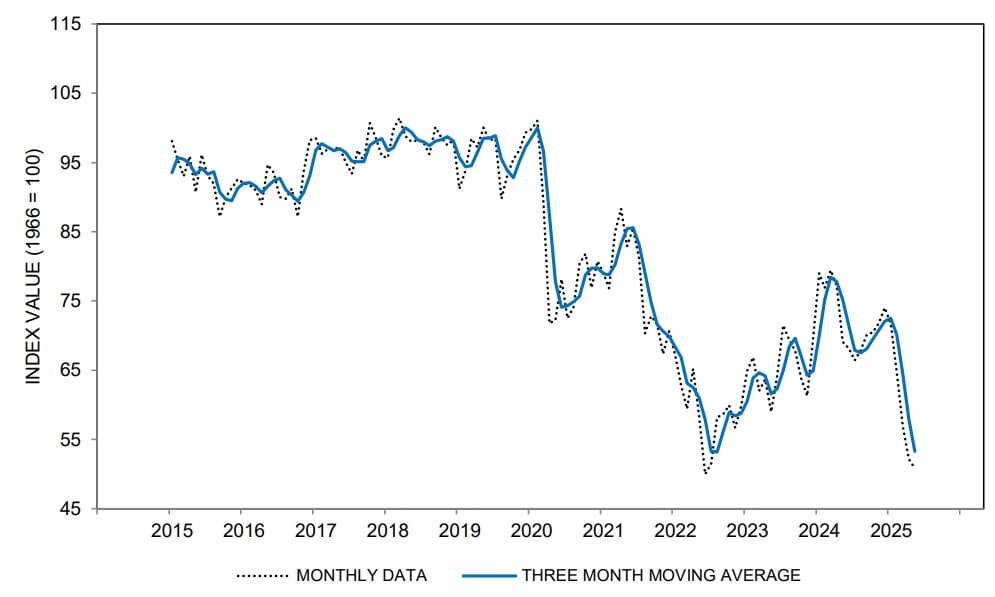
A closely followed measure of consumer sentiment deteriorated for the fifth month in a row in May and is approaching an all-time low, but the economy continues to do better than it and other surveys might imply, economists say.
The University of Michigan Index of Consumer Sentiment slipped to 50.8 in May, down 3 percent from April and 26 percent from a year ago, according to preliminary data released Friday.

Joanne Hsu
Three-quarters of those surveyed cited tariffs as a cause for concern, and “uncertainty over trade policy continues to dominate consumers’ thinking about the economy,” survey director Joanne Hsu said in a statement.
The survey was fielded between April 22 and May 13, so many responses were gathered before the Trump administration announced a pause on some tariffs on goods from China on May 12.
UofM Index of Consumer Sentiment
The Consumer Sentiment Index hit an all-time low in records dating to 1978 in June 2022, when inflation as measured by the Consumer Price Index was hitting a post-pandemic high of 9.1 percent.
The Consumer Price Index for April, released Tuesday, showed prices were up 2.3 percent from a year ago last month, closer to the Fed’s 2 percent goal than the 3 percent annual inflation registered in January.
“The Michigan report continues to paint, at face value at least, a grim picture,” Pantheon Macroeconomics Senior U.S. Economist Oliver Allen said in a note to clients.
The Index of Consumer Expectations — which historically has been a better guide to growth in consumers’ real spending — was down 32 percent from a year ago in May, to 46.5 — the lowest reading since 1980, Allen noted.
It’s not just the prospect that tariffs will reignite inflation that has consumers worried. Confidence in the labor market “has taken a heavy blow, with the net share of households expecting higher unemployment remaining around its highest level since the global financial crisis,” Allen said.
There’s little doubt the economy is decelerating — an advance estimate of real gross domestic product (GDP) suggested that the economy shrank by 0.3 percent during the first quarter, thanks to a tariff-driven surge in imports and a decrease in government spending.
But forecasters at Pantheon Macroeconomics suspect consumer surveys — and the University of Michigan survey in particular — paint an “unduly negative” picture of consumer outlook.
Retail sales posted gains in March and April, and “most near-real indicators of consumers’ discretionary spending on services are holding up well,” he said.

Oliver Allen
“Our view is that consumers’ spending will soften as the wave of pre-tariff purchases unwinds, higher prices for imported goods take a bite out of real incomes, and policy uncertainty further undermines hiring and the labor market,” Allen concluded. “But we doubt consumption growth will slow nearly as sharply as the Michigan survey currently implies.”
Surveys by the Mortgage Bankers Association show demand for purchase mortgages has increased for two weeks in a row, as would-be homebuyers responded to growing inventories of listings in many markets and stabilizing interest rates.
Fannie Mae’s latest monthly National Housing Survey, which polled 1,181 household decision makers between April 1 and April 18, found consumer sentiment toward housing was up slightly from March to April.
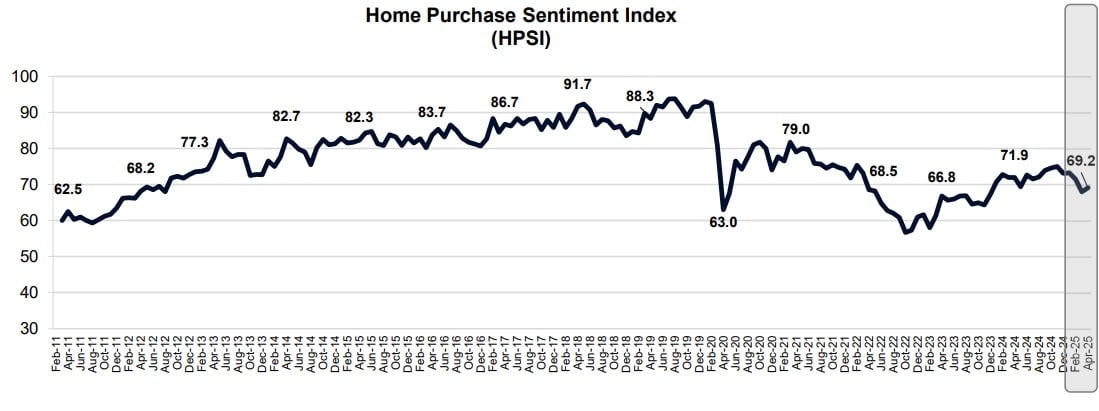
At 69.2, Fannie Mae’s Home Purchase Sentiment Index (HPSI) was up 1.1 points from March but down nearly three points from a year ago.
Three of the index’s six components improved: Americans were less concerned about losing their jobs than in March, more had seen their incomes increase, and more expected home prices to increase in the next year.
But consumers were more pessimistic about selling conditions and the prospect for mortgage rates to come down in the year ahead.
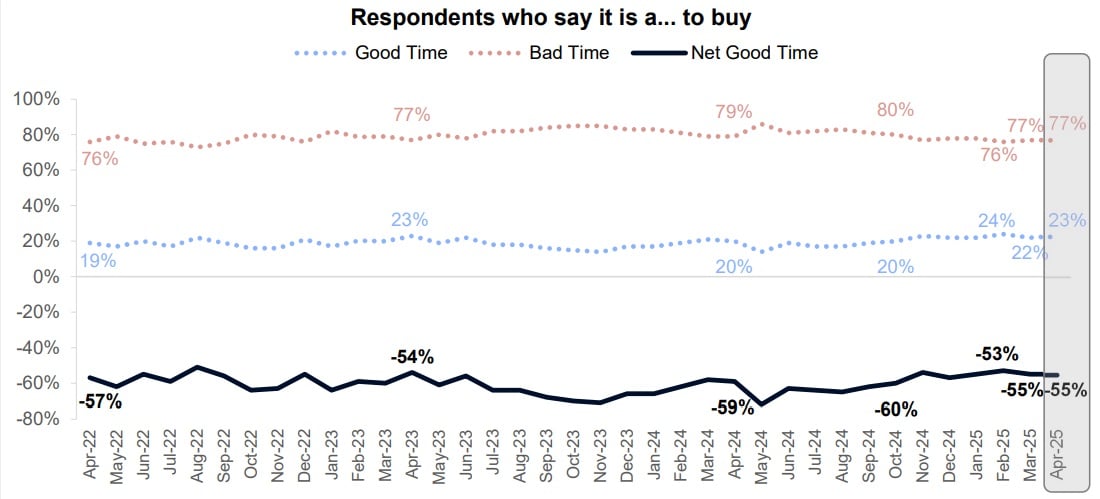
Only 23 percent of Americans surveyed in April said it was a good time to buy, but that was up from 22 percent in March. The share who said it was a bad time to buy (77 percent) remained unchanged.
The share of consumers who say they would buy a home if they were going to move was unchanged at 65 percent.
The share who said they would rent if they were going to move increased one percentage point from March to April, to 35 percent.
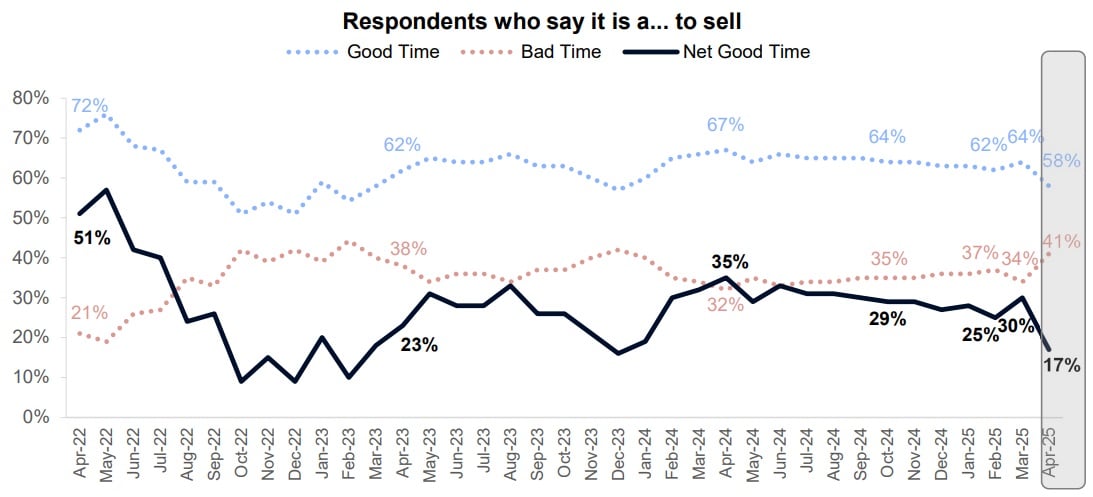
The percentage of household decision makers who said it was a good time to sell fell from 64 percent in March to 58 percent in April.
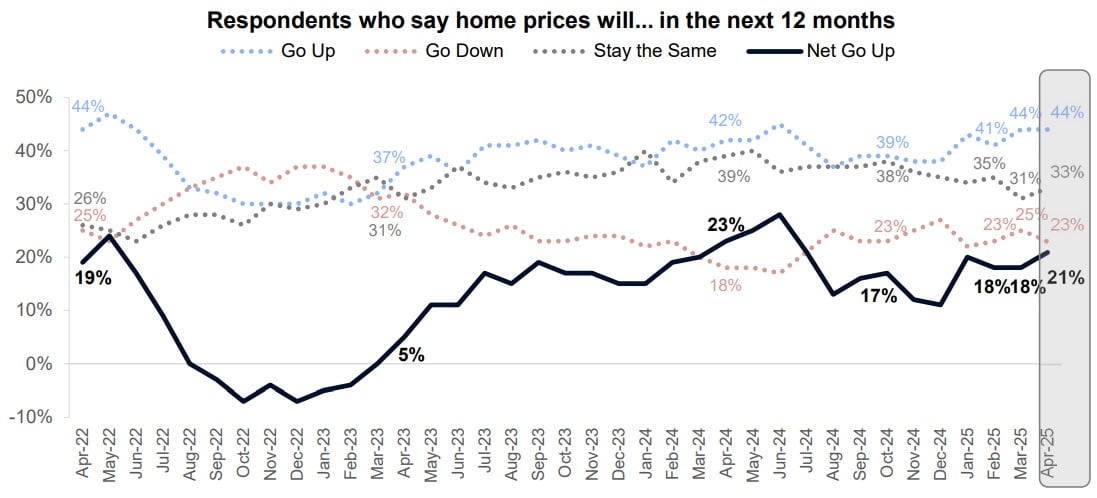
Only 23 percent of Americans surveyed in April thought home prices would go down in the next 12 months, compared to 25 percent in March.
While that would be bad news for would-be bargain hunters, it’s viewed as a positive for the HPSI as it reflects consumer confidence that housing markets aren’t on the verge of crashing.
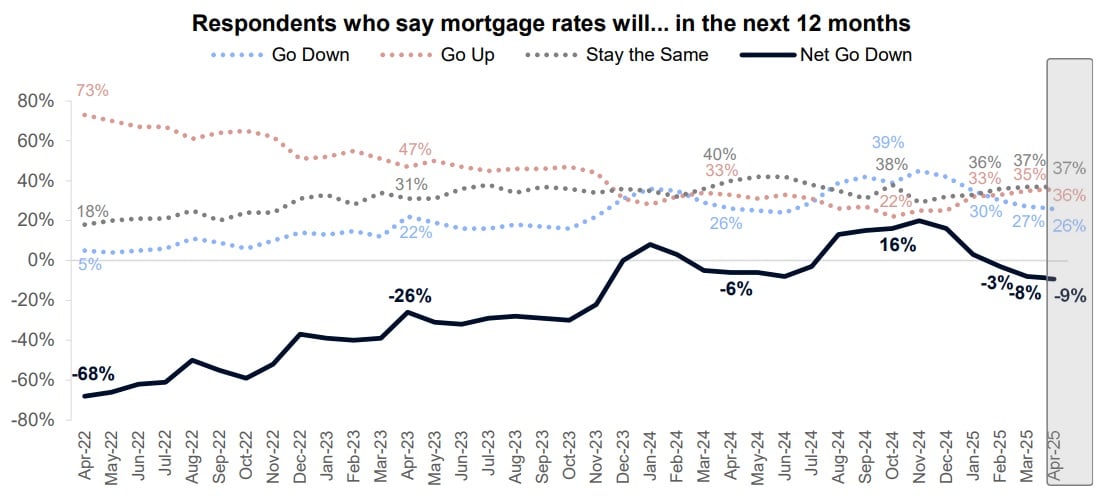
About one in four households surveyed in April (26 percent) expect mortgage rates will come down in the next 12 months, about the same as March (27 percent) but down sharply from November, when 45 percent were expecting lower rates in the year ahead.
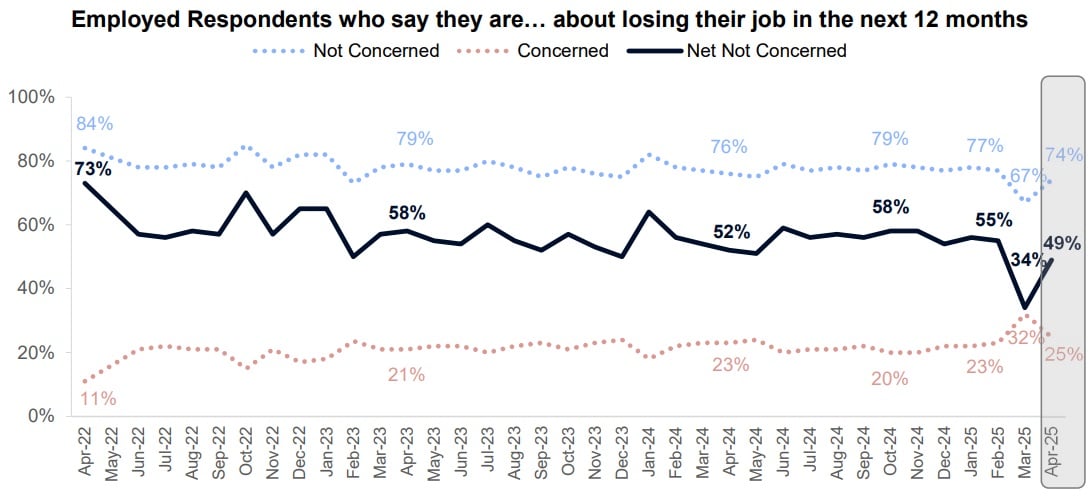
Only one in four employed Americans (25 percent) said they were concerned about losing their job in April, down from a spike in March to 32 percent.
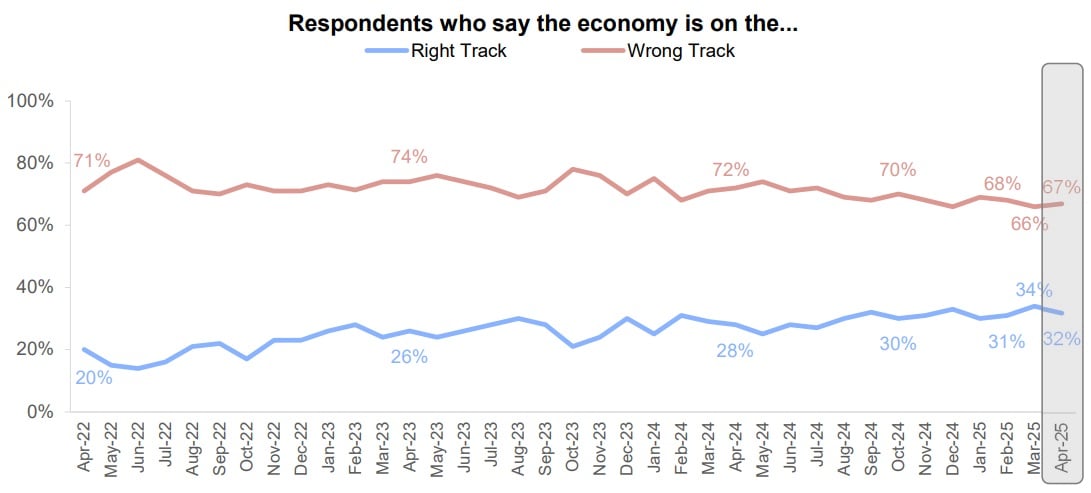
While not factored into the HPSI, only one in three households (32 percent) thought the economy was on the right track in April, down from 34 percent in March but up from 28 percent a year ago.
Get Inman’s Mortgage Brief Newsletter delivered right to your inbox. A weekly roundup of all the biggest news in the world of mortgages and closings delivered every Wednesday. Click here to subscribe.
Email Matt Carter
This post was originally published on this site