Bigger. Better. Bolder. Inman Connect is heading to San Diego. Join thousands of real estate pros, connect with the power of the Inman Community, and gain insights from hundreds of leading minds shaping the industry. If you’re ready to grow your business and invest in yourself, this is where you need to be. Go BIG in San Diego!
Want to level up your business? Inman Access offers expert-led tutorials with insights, advice and ideas designed to help you build your skills every day.
Every brand and team is different, but using Vija Williams’ Rules of 3s to evaluate your agents will help you build a recruiting plan and determine what agent productivity systems are needed to hit your business goals.
Elevate your skills and set yourself up for success in 2025. Watch the session above, plus get fresh content added weekly, with Inman Access.
With interactive maps and charts, Inman’s data team helps track the course of 500 local housing markets in this new monthly series.
This is the first installment of Inman Market View, an ongoing monthly data series. The goal: to put more local data in the hands of the Inman community, and to place it in a context that’s highly relevant for the U.S. brokerage industry.
Real estate agents and brokerage leaders are inundated with data each month from dozens of sources.
But that data can often be incomplete, siloed or otherwise difficult to place in a useful context.
That’s why we’re launching Inman Market View, a new interactive project from Inman’s data and news team that seeks to put more local market data directly in the hands of real estate professionals.
This new series aims to allow our Select subscribers to see how their own local market has navigated the treacherous path through a pandemic boom and resultant slowdown, and to compare its path to that of other markets across the country. The tools below utilize listing data from Realtor.com and data wrangling and analysis by the Inman team.
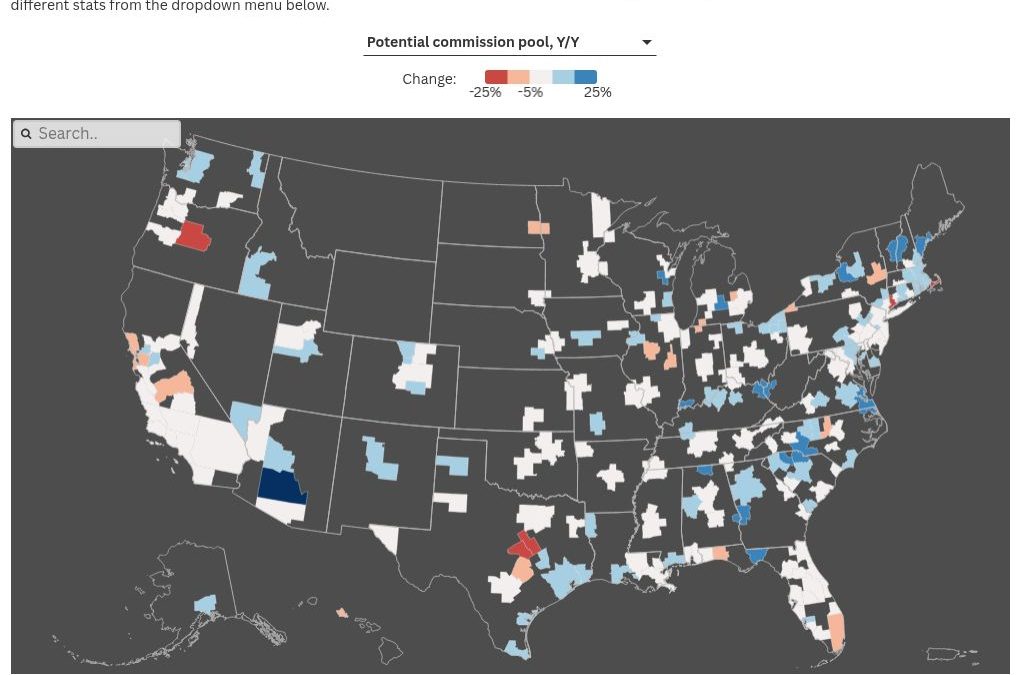
The first result is an interactive map of 500 major metro areas, which together account for nearly 90 percent of the U.S. population.
In the tool below, you can toggle between metrics. Each metric has two views: a “Y/Y” approach that compares the most recent three months’ data to the same period last year; or a “vs. 2017-19” option that compares the same recent three-month period against a 2017-2019 baseline to see how the pandemic era has reshaped different parts of the country.
(For the best experience, view the tool on a desktop browser or in landscape mode in mobile.)
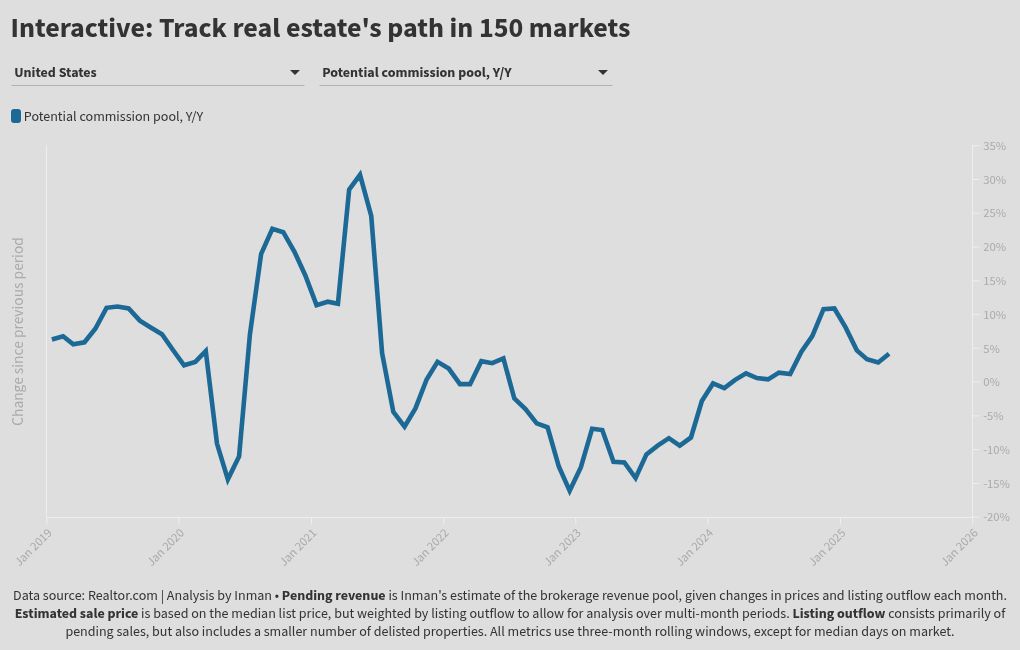
To drill down even deeper into the path each market has taken through the pandemic years, explore the interactive chart tool below.
Use the first dropdown menu to select from any of the nation’s 150 largest housing markets — a collection of metros that contains nearly 75 percent of Americans. Then, use the second dropdown menu to select from the same metrics seen in the map above.
With the tools above, special care has been taken to help account for the occasional noisiness of month-to-month data in small and midsize markets.
By using three-month rolling windows, these tools are able to avoid much of the month-to-month volatility and spot durable trends. And by comparing all recent periods to the same span of time in previous years, the tools account for seasonal patterns in this highly seasonal business.
Each of the metrics above is intended to represent a core concept that Inman tracks on a regular basis. Understand the definitions below to get the most out of the tools.
Metric glossary
Below are the main core concepts that Inman is tracking, and definitions and other notes for each of the metrics.
SUPPLY — New listings
The number of new listings that entered the market in a given month
DEMAND — Listing outflow
The number of properties that left the active-listing pool in a given month, either due to a pending sale or a delisting from the market
This level of listing outflow offsets the number of new listings coming online to explain the total monthly change in the active-listing pool
Note: Delistings are a problematic component of this metric, but cannot be removed due to data limitations. The vast majority of outflowing properties consist of pending sales, and the metric generally tracks closely with sales trends over time. Still, Inman’s listing outflow metric will be less accurate than your local sales data.
INVENTORY SNAPSHOT — Active listings
The total number of active listings on the market that are not marked as “pending” at a given point in time
SPEED OF SALE — Median days on market
The amount of time a typical property sits on the market before it either closes on a sale or is removed from the market
Half of listings spend longer than this on the market, while the other half spend less
Note: This is the only metric in the tools above that is expressed in terms of a single month, instead of a three-month rolling window.
BUYER COMPETITION — Outflow rate per active listing
A market’s listing outflow over a given period, expressed as a share of its active-listing pool at any given time during the same period
This is essentially the inverse of “months supply” — higher outflow rates generally indicate more buyer demand for a typical listing, and higher upward pressure on home prices
PRICE MOVEMENT — Weighted list price
The price level assumed for a given three-month window, using each month’s median list price weighted by each month’s total listing outflow
BROKERAGE REVENUE — Potential commission pool
The value of the estimated pool of commissions that were available to brokerages during a given period, based on list price multiplied by total listing outflow
Note: This metric is blind to important factors that vary by market, such as average commission rates and splits, as well as the number of serious agents competing for business in the area. It’s not adjusted for inflation. It also doesn’t consider how much real estate activity is a result of new construction. The metric best used for a broad overview and tracking trends over time.
This is a deep dive into a local real estate market powered by Inman Market View. The goal: To put more local data in the hands of the Inman community, and to place it in a context that’s highly relevant for the U.S. brokerage industry.
One of the biggest housing stories this spring has been a much-needed boost in inventory in many parts of the U.S.
Nationwide, inventory exceeded 1 million for the first time since the winter of 2019, with 50 of the largest metros in the country posting annual inventory gains in May.
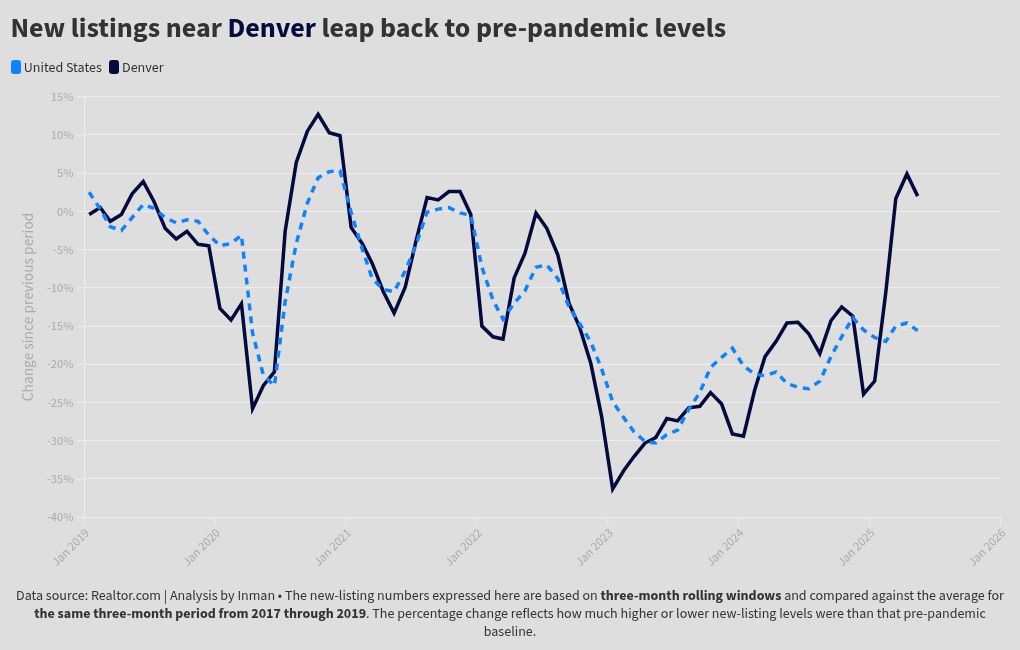
Out of those metros, one that has seen a significant inventory improvement is Denver. The Western mountain market posted a 20 percent annual growth in new listings during the three-month period of March through May, the second-highest jump among any large U.S. market, according to listing data from Realtor.com.
In a market where many buyers have felt locked into their existing low-rate mortgages, and where current prices are unaffordable for many, some have pointed to new construction as a possible explanation of a listing resurgence in places like Denver.
But local agents and Denver market experts who spoke with Inman suggested that existing homeowners — not builders — have done the most to provide new supply to the market over the past year.
The reasons Inman’s sources gave were complex, ranging from broad factors that much of the country is experiencing alongside the greater Denver housing market, and unique issues with regulations and ownership costs that are sending some investors and other owners packing.
These are the numbers — and reasons — behind Denver’s year of extraordinary inventory gains.
Steady gains
The Denver-Aurora-Centennial, Colorado, metro area has seen sustained growth in new listings this spring, providing buyers with more options and opportunities.
Almost 20 percent more new listings hit the market in the greater Denver area this spring than during the same period last year, bringing overall new supply levels to roughly where they were in a typical spring before the pandemic began.
Active listings over the same three-month period were up 65 percent in the metro on an annual basis, and were 89 percent higher than their 2017-2019 levels at the same time of year, according to data from Realtor.com. All in all, inventory in May represented a solid, three-months’ supply.
Still, there were signs that this robust momentum in new supply might be slowing down in recent weeks.
During the month of May alone, new listings were up only 4 percent year over year to 7,017 new listings, according to REcolorado numbers that align closely with those tracked by Realtor.com.
As inventory has grown, sales have also been a mixed bag.
Closed listings were down 5 percent year-over-year in May, according to REcolorado. In perhaps a more encouraging sign for June sales, however, the number of pending listings over the same period was up 12 percent from the year before.
Buyers taking their time
While new listings are up across the board, subdued demand for homes in Denver and nearby areas has further pushed the local market in a more buyer-friendly direction, Inman found.
Because of high prices (the median closed price on Denver homes has hovered around $600,000 since 2022, according to REcolorado) and mortgage rates, as well as general economic uncertainty in the U.S., many potential buyers have taken a more careful approach to homebuying than has been typical in recent years.
Christine Dupont-Patz | RE/MAX of Cherry Creek
“I feel right now that the buyers are just being very selective,” Christine Dupont-Patz, broker and co-owner of RE/MAX of Cherry Creek Inc., told Inman. “There seems to be no rush.”
Jackie White of Your Castle Real Estate said she sees a lot of what she calls “tire-kickers” these days: buyers who want to take their time and do more due diligence than they’ve been afforded in recent years during what used to be a rapid-fire market.
“With the cost of insurance having gone up in recent years as well as the interest rate [increasing the cost of homeownership], it’s just making [buyers] do a lot more due diligence before making an offer,” White said. “The total cost of ownership is being met with more scrutiny because of those increasing costs, and with homes having longer days on market, they feel like they have time to consider the home and it’s OK if it goes under contract and they lose out because there’s likely several other homes active that they would consider.”
By contrast, in the years during and shortly after the COVID-19 pandemic, buyers were scrambling to find any home that would suffice, Dupont-Patz explained, both to find shelter and hop on low interest rates. Without those factors at play today, and with more inventory at their finger tips as well as impending economic uncertainty in response to tariffs, there’s no real urgency for buyers.
“Now, you really feel where buyers are, ‘I want this to be my forever home. I want this to be where I’m going to raise my kids,’” Dupont-Patz said. “And I have clients who are downsizing, so the big thing is, how can they age in place? Is the neighborhood walkable for them? Does it have the amenities that they want as they get older? So it’s really taking a much longer term view of what they want to buy.”
People from all over the country for a long time have found Denver an attractive market to move to because of its city amenities paired with easy access to nature. But some buyers from out-of-state today can be surprised by the area’s price points, Dupont-Patz said. As she’s seen the parents of millennials and Gen Z’ers start to move to the area to be closer to their grandchildren, their homebuying process is often more prolonged than expected because those transplants have slightly unrealistic expectations about how much property their can get for their dollar.
Insurance and homeowners association fee hikes have also put a significant damper on demand in the condo market in Denver, Dupont-Patz said.
Insurance premiums increased by an average of 58 percent between 2018 and 2023, according to the Rocky Mountain Insurance Information Association, and are expected to rise by about 11 percent this year in response to wildfire and hailstorm risks, according to Insurify.
One of Dupont-Patz’s clients decided to pull their relatively new one-bedroom one-bath condo from the market after two months without a single showing.
“Unfortunately, we were not the only condo in the building that did not have one showing,” Dupont-Patz continued. “[Other agents and I] all came together and said, ‘OK, we’re all going to have an open house at the same time on a Saturday. We’re going to all cross-advertise it.’ If people came to the open house, we would give them a gift card to see the Rockies — and you can make all the jokes you want, ‘Well you can’t give that shit away with your Rockies,’ I know that’s a whole ‘nother conversation — no one, no one came to see the condos.”
Sellers ready to cash out
Jackie White | Your Castle Real Estate
White said that many condo owners are wanting to list now because those higher insurance fees, which are spurring higher HOA fees, are making it so that it’s more expensive to own a condo than to rent an apartment. “So we’re finding much longer days on the market for condos and townhomes and a really big inventory in that product.”
Some investors are likewise considering offloading rental properties because of recent legislation in the state that places more restrictions on landlords, White said.
As of last year, restrictions were put in place that make it more difficult for landlords to evict tenants, put limits on the cost of pet security deposits and rent and prohibit municipalities from limiting the number of people who can live together in a unit based on familial relationships, among other measures.
“So there are investors that are opting to cash in on the equity that they’ve gained on their properties as well,” White said. “When they look at the annual cash flow compared to the equity in their home, in many cases, the returns are 3 to 4 percent and so choosing to take that money and invest it elsewhere, perhaps out of state or in the stock market, would serve them well compared to hanging onto these properties with a lot of the legislation and regulation that’s in place.”
New construction’s part
Denver’s commitment to building during and after the pandemic seems to have had some role in its current healthy inventory levels, according to a Realtor.com report.
“Metros that built more housing like Austin, Nashville and Denver have generally returned to pre-2020 inventory levels,” the report stated. “Those with less new construction like New York, Boston and Buffalo, New York, have not.”
Ted Leighty | Colorado Association of Home Builders
However, more recent new construction is contributing little to new inventory this spring, Ted Leighty, CEO of the Colorado Association of Home Builders, told Inman.
“We do not believe that new construction is adding a lot of homes to the current number of properties on the market in the metro Denver area,” Leighty said in an email. “In 2024, our members pulled about 650 to 700 permits per month, and those homes are either coming to the market now or are already sold to their future owners. These new homes would represent a small fraction of the 13,000-plus homes currently on the market.”
In 2021, 30,006 building permits were issued in the Denver metro area, according to the U.S. Census Bureau’s Building Permits Survey, and in 2022, 23,009 permits were issued. By comparison, just 15,570 permits were issued in 2024.
That support from new construction was further weakening in the early months of this year, the data shows.
Only 4,881 residential permits were issued in the first four months of this year, down 10 percent from the year before. This annual decline was driven primarily by a 17 percent reduction in permits for single-family homes, while permits for multifamily units remained steady.
This multiyear decline has yet to feel much impact from the Trump administration’s tariffs on the kinds of imported goods that are used in residential construction, Leighty said.
According to the National Association of Home Builders, roughly $204 billion worth of goods were used in constructing new multifamily and single-family homes in 2024, $14 billion (or about 7 percent) of which were imported from outside of the U.S.
Colorado has not felt an impact as of yet, Leighty said, but builders are trying to prepare for them.
“At this point, we are not seeing tariffs having a direct impact on permits here in Colorado,” Leighty said in an email. “Mostly we are hearing that our members are adjusting their supply chains and budgets to adapt to the tariff situation. Like other markets across the U.S., we believe that mortgage rates and a general lack of consumer confidence are having a bigger impact on home sales and demand for new construction.”
Transaction hesitation is real, but deals are getting done. Here’s how broker-owner Jaclyn Kelley and her agents have been keeping business steady in a tough market.
Since the NAR commission suit settlement, buyer agents have faced new rules, new documents and a new normal. This month, Inman drills down on Today’s Buyers Agent with the fresh marketing strategies, skills and tools buyer agents are using to prosper in changing times.
Unpredictability is nothing new in real estate, especially in vacation and second-home markets like the Florida Keys. Lately, however, the hesitation on both sides of the transaction has become louder. Buyers are waiting. Sellers are second-guessing. And brokers? We’re adapting.
Some days, it feels like half my job is logistics, and the other half is keeping people calm and focused. But deals are still happening — just not in the same way they used to. To keep pace, I’ve leaned into a mix of new tools, steady leadership, and a very human approach to service.
Here’s how we’ve been keeping business steady — and what other brokers might take from our playbook.
Less noise, more intentionality
Blanket marketing doesn’t work in a selective market. Today, every listing needs a strategy, not just a sign in the yard and a blast email.
We recently took over a home that had sat unsold for months. It wasn’t the property — it was the presentation. We restaged it, hired a professional photographer, rewrote the listing copy and created a campaign targeting the right buyer profile. It sold.
The key? Straightforward, honest storytelling and hands-on effort. Educating your client isn’t extra — it’s essential. Every market shift is a chance to be more thoughtful and precise.
Combine AI with actual effort
Tech alone won’t make you a better broker. But when used well, it can enhance your strategy and outreach.
We use AI tools to find seller leads, refine messaging and streamline content, but always in combination with real conversations and consistent follow-up. That means digital ads, handwritten notes, automated insights and actual phone calls. It’s not “either/or” — it’s both.
When things get challenging, people look for clarity. I don’t just hand my agents new tools and hope for the best — I show them how to use them and stay with them.
We do weekly check-ins, monthly masterminds and shared campaigns. If I expect my agents to prospect, I’m on those calls. If we’re testing AI, I’m the one piloting it first. Culture starts at the top, but it’s built shoulder-to-shoulder.
Learn your buyer’s patterns — and speak directly to them
Key Largo has rhythms. Winter brings snowbirds. Summer brings South Floridians. If you don’t track those shifts, you’re missing opportunities.
We monitor SEO data, website traffic and search behavior to time our outreach and tailor our messaging. Geo-targeted ads, seasonal content and timely follow-ups help us stay relevant, not just visible. Success here isn’t about shouting louder. It’s about listening better and responding with purpose.
3 things that still work — no matter what the market’s doing
Use AI to get smarter, not lazier: It’s a tool, not a replacement. Make it work for you, not instead of you.
Show up with your sleeves rolled up: Your team needs to see you doing the work, not just giving direction.
Get specific. Stay consistent: The right message, in the correct format, at the right time — that’s how you gain traction.
Real estate isn’t about avoiding the hard stuff but handling it well. If we stay proactive, keep learning and put relationships at the center of our strategy, we’re not just surviving a challenging market — we’re building something more substantial for the next one.
Jaclyn Kelley is broker-owner of Better Homes and Gardens Real Estate serving the Florida Keys. Connect with Jaclyn on Instagram and LinkedIn.
When you say yes to something misaligned, you’re saying no to your deeper purpose, Debra Trappen writes. Discover the power of saying no and claiming your value.
Real estate is changing fast, and so must you. Inman Connect San Diego is where you turn uncertainty into strategy — with real talk, real tools, and the connections that matter. If you’re serious about staying ahead of the game, this is where you need to be. Register now!
Welcome to Lead with Fire, A Soulful Series for Real Estate Game-Changers. This is more than business advice — “Lead with Fire” is a transformative series created for the soulful, visionary humans in the real estate industry who are done with the old playbook and ready to redefine success on their own terms.
There’s a sacred power in the word no, especially when you’ve spent a lifetime saying yes to keep the peace, prove your value or avoid disappointing others. But here’s the truth: Every time you say yes to something misaligned, you’re saying no to your deeper purpose.
And that misalignment? It adds up.
I’ve seen this play out with people in all stages of business and leadership. Smart, soulful humans who have poured their hearts into their work … only to realize they’re still undercharging, overdelivering or overcompensating.
Why? Because somewhere along the way, they learned their worth had to be earned or proven. Take a listen to this Thread Talk I had with Rebekah Radice, where we deep dive into the mindset, societal conditioning and personal transformation needed to elevate our pricing and embrace the wealth we deserve.
Let’s rewrite that story.
You are not for everyone — and that’s a good thing
The moment you start owning your value, with your time, energy, pricing and presence, not everyone will understand. That’s OK. The people who are meant for you will rise to meet you. And the ones who don’t? Bless and release.
You are not required to make yourself more palatable to be worthy.
This isn’t about arrogance or entitlement. It’s about energetic integrity. It’s about trusting that when you stop watering down your worth, you become magnetic to the people and opportunities aligned with your vision.
From external validation to internal anchoring
Owning your worth means detaching from applause, likes or approval and anchoring into something deeper. It’s about asking: What do I believe I’m worth — even if no one is clapping?
This shows up in:
How you negotiate your fees or salary
How you respond to feedback
How you hold your boundaries
How you show up for yourself, even when no one else is watching
Your worth is not up for negotiation
You don’t need to explain why you charge what you charge.
You don’t need to justify a new direction.
You don’t need to shrink to keep someone else comfortable.
You get to evolve. You get to raise your standards. You get to make empowered decisions that protect your peace and fuel your purpose.
Because here’s the truth: You are the asset. Your energy, experience, intuition and insight are not extras. They are your edge.
Reflective journal prompts:
Where in my life or business am I settling for less than I’m worth? What would shift if I raised the bar?
What beliefs about money, success or validation no longer serve me? Whose voice am I still trying to please or prove myself to?
What boundary or decision have I been avoiding, and what would it look like to lovingly claim it? Even if it’s uncomfortable, is it aligned?
What does it feel like in my body when I am fully rooted in my worth? How can I practice that energy today?
What are 5 things that make me valuable beyond money? Your worth is deeper than the numbers. Name it. Feel it. Own it.
Mantra to Lead With Fire:
“My worth is not up for negotiation. I say no with love and stand tall in my value.”
Next up in the Lead with Fire series: How to build a soul-aligned support circle that elevates your vision
What if your growth wasn’t meant to be a solo journey? In our next post, we’ll explore the power of sacred circles and how to cultivate a community that cheers for you and champions your evolution.
Real estate is changing fast, and so must you. Inman Connect San Diego is where you turn uncertainty into strategy — with real talk, real tools, and the connections that matter. If you’re serious about staying ahead of the game, this is where you need to be. Register now!
One of the most transformative real estate practices over the past 20 years has been the countrywide adoption of professional home staging. Given that homes now take between 7-10 seconds to sell and that in many markets, the online pictures must sizzle if a seller hopes to get any traffic through the home, staging has become critical.
It’s generally recognized that the home staging industry started in 1972. Barb Schwartz, a real estate agent and interior designer, is considered the visionary behind the concept, coining the term “staging” to describe the process of decorating and maximizing a home’s potential for sale.
As owners of a staging company that has been in business for over 20 years, it has been remarkable to see the industry grow to the point where staging is considered mandatory for homes going onto the market in markets such as ours.
We have also seen some crazy things over the years. We have had furniture come back with scribble marks from children, odors from cigarettes, cooking and animal smells, pet damage and more. We’ve had items stolen, discovered that our staging items have been used for personal “liaisons,” had listing agents fail to notify us that the property had closed, had buyers move in, steal some items and put the remainder on the curb where they were snatched up by opportunist passers-by and more.
We have also had sellers, once the home was staged, decide not to sell, saying, “We had no idea our home could look this amazing! Why would we move?” It has been wonderful to see sellers tear up as they return to their staged property, amazed at the transformation.
On the other side of the coin, the most frequently asked question we receive is from buyers who, in love with the look of a staged home, ask if they can purchase all the staging items and move in “as-is.”
There have also been horror stories: Some sellers have absolutely hated the finished result, not understanding that the staging is designed to catch a buyer’s eye, not to resonate with the seller’s personal tastes.
Some sellers have also been insulted at recommendations/suggestions that the 1970s suite of furniture that cost them a mint back when the Ford Motor Company was selling Pintos may not be suitable for current tastes.
If you have never used a staging company, getting started can be a bit daunting. Here are seven categories of questions that can be asked to determine if any given company will be a match for you and your sellers.
7 categories of questions to ask when interviewing stagers
Are you a formally trained stager with any certifications?
How long have you been in business as a professional stager?
Do you have experience staging in our local market?
Do you understand local buyer preferences?
Have you staged homes like ours before?
Do you have a portfolio or website we can look at?
Do you have any reviews?
Are you bonded and insured?
Do you have a current business license?
2. Inventory and style
Not all homes are created equal, and most staging companies focus on properties that fit into the “normal” range.
On the other hand, staging a high-end luxury home is a world apart from a standard tract home. Although some staging companies can handle both ends of the spectrum, luxury staging is really in a class of its own and, in many cases, the furnishings provided are rented specifically for the individual property in question and are moved in and out by professional moving companies.
As a result, luxury staging can be dramatically more expensive than for normal properties and require a substantially different skill set to get the exclusive look that matches the property.
Questions include:
What is the predominant theme/style of your inventory?
Do you own your inventory, or are you renting it?
How old is your inventory?
Is your inventory in good condition?
Do you have luxury-level inventory for upscale homes?
Do you have inventory that matches the seller’s existing furnishings (for partial stagings)?
What type of staging do you do outside?
3. Process and procedures
Every staging company works a bit differently. Some cover specific price points, others focus on certain geographical areas. Some want the home completely vacant and cleaned the day before the crew arrives to stage, while others will apply penalties if the seller decides they want to stay and watch.
Questions include:
What geographical areas do you cover?
What is your process from start to finish?
Do you charge for your preliminary evaluation?
Which rooms do you recommend I stage, and which rooms can be left vacant?
Will you stage a home that will be occupied? If yes, how do you handle children? Pets?
Can the client be present during the staging process?
Do I have to clean the home before it is staged?
Will you stage a home if it reeks of specific odors such as cigarette smoke, cooking smells such as curry, fried fish or intense pet smells?
4. Pricing and contracts
The truth is: Staging does not really work in all price points. For this reason, especially in lower-priced markets, partial or “light” staging may be the best option, and it’s even possible to add in some virtual staging.
It’s important to understand how much your staging package will actually cost and, especially in markets where homes are staying active for longer periods of time, what happens when the contract is up.
Here are some relevant questions:
Do you have different packages?
Do you do partial stagings (if applicable)?
How much do you charge, and what is the pricing based on (options include square footage, number of bedrooms, possible ADU, level of inventory required, time desired for the staging to remain in place, whether staging is rented and so on)?
Are there increased fees for a lot of stairs, or if the use of an elevator is required (if applicable)?
What do you do if parking for loading and offloading is not readily available (if applicable)?
What is the normal length of your contracts?
What happens at the end of our contract if the home is still not sold?
Are extensions available and, if so, how much are they?
Do you have any penalties I need to be aware of?
Do you want payment up front, or will you bill to escrow?
What types of payment do you accept?
5. Timing and logistics
Larger staging companies usually have projects booked back-to-back. It is common for our company to have a complete set of furnishings for a four-bedroom home in one truck and a comparable three-bedroom set in another truck that have just been unloaded from one home and are scheduled to enter another property the very next day.
In a perfect world, the inventory seldom ends up back in the warehouse — it simply goes from one home to another with minor changes along the way. As a result, communication is critical, and changes in timelines can result in a mess.
Here are some essential questions to ask:
How much lead time do you need to schedule staging?
How long will it take to stage my property?
Can you accommodate last-minute staging?
What happens if I find out at the last minute that the home is not ready to stage on the contract date?
What type of notice do you need to remove the staging?
What happens if that notice comes late?
Who maintains/cleans the staging during the contract?
6. Potential issues
Stuff happens, and it goes without saying that over 20 years in the business, we have seen lots of crazy. Read the fine print in the contract very carefully — you will most likely be on the hook if things go missing, are damaged or do not meet the seller’s expectations.
Here are questions that should be addressed:
What happens if the client is not happy with the staging once it’s completed?
How do you handle the remaining holes in the walls once inventory is removed (magic fasteners can fail, causing damage to items, so most stagers prefer nails in the walls to hold up artwork)?
What happens if damage is done to the home during the placement or removal of staging items?
Who is responsible for damaged or stolen pieces of inventory?
7. Additional services
Some staging companies go above and beyond to provide additional levels of service. You may not need any of these, but it doesn’t hurt to ask.
Do you work with buyers who may want interior design services after they have moved into the home?
Do you coordinate with and/or provide cleaning services?
Do you coordinate with and/or provide photography services?
Do you facilitate any storage for sellers who may need to store items that need to be removed prior to staging?
Questions NOT worth asking
Lastly are questions that simply do not apply:
1. What is the average days on the market for homes you have staged?
While this question might appear logical on the surface, it is meaningless. The seller and their agent are the ones who determine how long a home will take to sell — the staging company merely sets the stage to bring in the highest possible number of potential buyers and stimulate their emotions while they are there.
Days on the market is also determined by location, current market conditions and more. Do not make a stager respond to this question — quite frankly, many of them do not make any attempt to keep track.
2. Does your staging come with a guarantee?
Although it may guarantee that the home will look nice, there is absolutely no way it will guarantee a sale, based on the reasons given in Question No. 1 above.
3. Can you install your staging in such a way as to hide defects?
Quite simply, that is illegal and a violation of disclosure laws. Although the best place to locate a throw rug may be over a defect in the floor, no stager should put it there on purpose to hide the defect. Additionally, it’s the agent and seller’s job to disclose what is under that rug (rules differ state to state).
4. Will our home look like a magazine when you are done?
Only if it was nice to begin with. Staging only accentuates what is there; it is not designed to transform a home from ugly to spectacular. No amount of lipstick will turn a pig into a prancing pony.
5. Can a buyer purchase all of the staging items?
We get asked this question all the time. The simple answer is “no.” The reasons behind the answer are a bit more complicated:
Staging inventory is purchased based on how it looks, how heavy it is and how it blends with other pieces. When our designers go shopping, they will actually try lifting a corner of the furniture to ensure it is not too heavy: Imagine moving heavy furniture in and out of homes multiple times. The bottom line is that it’s not always easy to find good pieces, so stagers are very reluctant to let items leave their inventory.
If we sell pieces, they have to be replaced. That not only means an expense for the item being replaced (often at a higher price than the original item cost), it also means time spent looking for replacement pieces, in some cases assembling them, getting them back to the warehouse and placing them into active inventory. Buyers, however, never want to pay full price for “used” inventory and will not only try to bargain, but they will never consider paying extra for the time and effort required to go out and buy replacement items.
Staging can make all the difference, and an effective relationship between a staging company and a real estate agent can be very rewarding. Once you have found a company that works well for you, you are off and running.
If you are like us, however, even though our team owns our own staging company, we cover our expenses by staging for many other agents in our market, and, occasionally, we need a backup company to handle our volume.
My recommendation is to have a couple of carefully vetted companies in your pocket so that you can always ensure the highest level of service for your clients.