Turn up the volume on your real estate success at Inman On Tour: Nashville! Connect with industry trailblazers and top-tier speakers to gain powerful insights, cutting-edge strategies, and invaluable connections. Elevate your business and achieve your boldest goals — all with Music City magic. Register now.
Every Friday, Inman Service Editor Dani Vanderboegh rounds up the most popular, most read, most critical stories of the week to give you a quick catchup on the big headlines you might have missed in the hustle and bustle of the workweek. Here’s this week’s Top 5 as chosen by our readers.
P.S. Don’t miss The Download, our weekly column that breaks down one of the week’s top stories and equips you with what you’ll need to meet next Monday head-on.
The daily habits of top agents allow them to separate themselves from the competition, so they can thrive in any market, Real’s Jimmy Burgess writes.
Anthony Lamacchia
Ahead of Inman Connect San Diego in July, Lamacchia revealed what he said at Trump’s West Palm Beach golf club this year that drew the president’s ire. “He was not happy to hear it,” he told Inman.
Master the power and potential of artificial intelligence, and you’ll position yourself for success in the years to come, trainer Terry LeClair writes.
AJ Canaria of PlanOmatic
The real estate brokerages want to pause a commission case known as Gibson while they wrap up a different lawsuit. But the Gibson homeseller plaintiffs don’t want their case put on ice.
Rawpixel/Unsplash
“All low-commission brokers employ at least some competent, experienced agents,” but sellers should comparison shop, according to a new analysis by advocacy group Consumer Policy Center.
Real estate is changing fast, and so must you. Inman Connect San Diego is where you turn uncertainty into strategy — with real talk, real tools, and the connections that matter. If you’re serious about staying ahead of the game, this is where you need to be. Register now!
The luxury real estate market is changing, and it’s all about who’s buying and what they’re looking for. Baby boomers (ages 60–78) are dominating the housing market, making up 42 percent of buyers and 53 percent of sellers.
This is a massive shift from millennials, who now only account for 29 percent of buyers (a record low). Boomers are in a strong position to buy, often without financing, thanks to the equity they’ve built up in their homes, and about half of boomers are purchasing homes in cash.
The average age of first-time buyers is now 38, and their share of the market has dropped to just 24 percent. While many younger buyers are delaying homeownership due to financial trouble, their influence is not unseen; in-law suites and properties that offer flexible spaces are becoming in demand, accommodating multigenerational living.
Even though they’re waiting longer to buy, many have built up substantial savings or secured high-paying remote tech jobs. These younger generations are now entering the market with the ability to invest in more luxury homes.
To them, luxury doesn’t just mean big square footage and fancy finishes; it’s all about smart technology, sustainability, and versatile living spaces. Features like accessory dwelling units (ADUs), home office sheds and energy-efficient systems are now highly sought after. These buyers aren’t just purchasing homes but changing the very definition of what luxury means.
Tech-savvy buyers are redefining luxury
We are seeing tech-savvy buyers, specifically younger ones from Asia and the Middle East, who have built wealth through the tech industry and startups, and are now bringing that innovation mindset to the real estate market. These buyers are looking for the latest in smart home technology.
Smart homes are no longer a neat, futuristic idea; they’re a necessity. Security systems, climate control, automated lighting and voice-activated assistants are now basic features buyers expect.
In fact, 44 percent of Americans looking for move-in-ready homes say smart home technology is non-negotiable, and it’s no surprise that 61 percent of millennials feel the same way. So, if you’re looking to attract today’s luxury buyers, you’d better be ready to embrace the latest in home tech.
Since the pandemic, technology has been increasingly influencing the luxury real estate landscape. Buyers are prioritizing homes that offer privacy, space and luxury amenities, such as home offices and health-focused features (like a standing desk or cold plunge). As remote work continues to grow in popularity, the need for a home that suits this lifestyle also increases.
Sustainability in luxury living
Sustainability is becoming the new expectation in luxury real estate. Buyers are now seeking eco-friendly homes that align with their values, and developers are beginning to take notice of this trend. Sustainable living is revolutionizing the design and marketing of luxury properties, proving that “green living” is no longer a niche but a mainstream trend.
Remote work redefines luxury
Remote work has fully renovated the way people think about home design. Almost 14 percent of the entire U.S. workforce, approximately 22 million people, are now working fully remote, and most people prefer to work from home at least part-time. The more time people spend in their house, the more they want their house to have all the new perks and look great.
This change has created a boost in demand for homes that are ideal for both living and working. Buyers now seek spacious offices, high-speed internet infrastructure and wellness-focused amenities, such as home gyms and spas.
New features are being introduced into luxury homes, including circadian lighting systems, soundproof rooms, and purified air systems. Buyers are increasingly seeking spaces that promote health, productivity and overall well-being, while also offering the comfort and luxury they expect. This shift is one of the key factors reshaping the luxury market, with more emphasis on functionality alongside opulence.
The luxury real estate market is evolving
With younger generations seeking out homes that reflect their tech-savvy, sustainable and wellness-oriented lifestyles, luxury real estate is becoming more personalized than ever. At the same time, older generations remain a driving force in the market, with a focus on homes that support aging in place and multigenerational living.
This shift is also affecting mid-tier markets, where we’re seeing a rise in prices as wealthy buyers seek to expand beyond major cities. Real estate developers are blurring the lines between luxury and more standard living, introducing high-end design features into more accessible properties. However, while luxury real estate is thriving, this trend also exacerbates the broader housing affordability crisis, making it even more challenging for middle-class buyers to gain a foothold.
As millennials and Gen Z continue to take center stage in luxury homeownership, the industry will have to adapt to meet the needs of these buyers, who demand more from their homes than just luxury; they want spaces that align with their values, needs and ambitions.
With remote work becoming a permanent fixture and sustainability at the forefront, the future of luxury real estate is exciting, and we can expect to see tremendous growth in demand in the coming years.
Lindsey Harn is an agent with Christie’s International Real Estate Sereno and a certified Divorce Real Estate Expert. Connect with her on Instagram and LinkedIn.
Since the NAR commission suit settlement, buyer agents have faced new rules, new documents and a new normal. This month, Inman drills down on Today’s Buyers Agent with the fresh marketing strategies, skills and tools buyer agents are using to prosper in changing times.
Every agent dreams of building a business that has a consistent flow of referrals. Not just because it reduces marketing spend or shortens sales cycles, but because it’s a business built on trust, service and long-term relationships. The best agents I know, the ones who weather every shift in the market, have one thing in common: Their business is powered by referrals.
This article outlines seven strategies to help you build your own referral machine. These are timeless, proven approaches that agents across the country are using right now to create businesses that grow regardless of market conditions.
1. Create a digital referral farm
You’ve heard of geographical farming. But what about farming agents in other markets?
Start by building an email list of real estate agents from outside your area. These are people you’ve met at conferences, connected with on social media or worked with on deals in the past. This collection of individuals is your “digital farm,” and it’s one of the most overlooked yet powerful referral strategies.
At least once a month, send an email that adds real value to these agents. Share something that helped your business, like a script that worked, a marketing strategy you implemented, or templates for high-converting direct mail campaigns. It’s even more personal and impactful if you include a short video walking them through the tip you’re sharing.
Sign off each email with something like:
“This is your friend in real estate in [Your City]. Thanks in advance for keeping me in mind if someone is moving to the area.”
The key is consistency. Lead with value. Ask them to forward your emails to other agents and to let you know if they want to be added to the list. Over time, this positions you as the go-to referral partner in your market.
2. Create an MVP list for referrals
Just like you’d farm a neighborhood, you need to cultivate your most valuable relationships. These are your MVPs. These are past clients and sphere contacts most likely to send you referrals.
Create a list of 25, 50 or 100 people. Then, focus on showing up intentionally in their lives. Don’t just “check in.” Engage with their lives. DM them to congratulate them on life events. Comment meaningfully on their social media posts. Notice them, celebrate them, and let them know you care.
The goal is to remain top-of-mind. This isn’t achieved through constantly asking them for referrals, but through authentic connection. This builds goodwill and ensures that when the opportunity for a referral arises, you’ll be the name they recommend.
3. Build relationships with former agents
The past few years have pushed many agents out of the business. Some went part-time; others left entirely. These individuals still have contacts, relationships and influence, and they’re often open to earning referral fees.
Reach out to former agents, and show them how to keep their license active in a referral-only capacity. If your brokerage offers a referral company, explain how it works and how they can earn passive income by sending business your way.
Reassure them that you’ll treat their referrals like family and that you’ll keep them in the loop. When they see a path to stay connected to the industry and be compensated for their past efforts, many will jump at the opportunity, and you’ll gain a new referral source.
4. Post with purpose
Want to generate organic referrals on social media? Start posting with a clear purpose.
Instead of just posting closings, share “little help” posts — specific buyer needs or sneak peeks of upcoming listings.
For example:
“I’m working with a couple moving to [your city] looking for a 3-bed, 2-bath in [neighborhood] under $600K. If you know someone who’s been thinking about selling, please share this or DM me.”
These posts tap into the law of reciprocity. People want to help. They’ll tag friends, DM you, and engage with the post. That interaction puts your content in their feed more often, expanding your reach.
5. Focus on feeder markets
Where are the buyers for your area relocating from? These are called feeder markets, meaning the other city feeds a steady stream of buyers to your market. Identify where your buyers are coming from, then build a referral strategy to tap into those markets.
Send handwritten notes to top agents in those cities. Include something simple like:
“I love paying referral fees for buyers moving to (Your City).”
You can increase the likelihood of referrals from specific agents in feeder markets by:
Following agents in those markets on social media
Commenting consistently on their content
Adding them to your digital farm email list
When those agents have clients relocating to your area, you’ll be their go-to local expert.
6. Tell referral stories publicly
Every time you receive a referral, tell the story on social media. Here are a few ideas on how to share these stories publicly:
Thank the referring agent on social media
Explain the referral process and your system for keeping agents updated on social media
Share the story of helping a referral you received, and thank the referring agent in the story
When agents see you making other agents’ clients happy and they see you publicly thanking the referring agent, they’re more likely to send you a referral when the opportunity arises for them. Sharing these stories publicly builds your reputation and shows how easy you make the referral process.
7. Reward referring agents generously
Finally, show appreciation to the agents who trust you with their clients. A 30 percent referral fee instead of the usual 25 percent speaks volumes. A thoughtful thank-you gift or handwritten note after closing leaves a lasting impression.
Treat them like you treat your best clients. Show them you value their partnership and want more of it.
If you want more referrals, start by giving more value. Give ideas, resources, recognition and gratitude. Build relationships with agents and clients alike. Create systems that make it easy for others to send you business and reward them when they do.
A referral-based business isn’t built overnight — but it’s built to last. And when done right, it becomes the foundation of a business that thrives in any market.
JimmyBurgess is the Chief Coaching Officer for HomeServices of America and Berkshire Hathaway HomeServices. Connect with him on Instagram and LinkedIn.
Bigger. Better. Bolder. Inman Connect is heading to San Diego. Join thousands of real estate pros, connect with the power of the Inman Community, and gain insights from hundreds of leading minds shaping the industry. If you’re ready to grow your business and invest in yourself, this is where you need to be. Go BIG in San Diego!
Let’s be honest — few things deflate a listing appointment faster than hearing: “Well, another agent said we could get $100,000 more.”
Cue the crickets.
Or how about this one: “Maybe we’ll just go with the agent we used last time.”
That can feel like a double punch to the confidence if you’re not ready for it. But here’s the good news: Objections aren’t rejection. They’re just requests for more information. And when handled right, they’re the gateway to winning trust — and the listing.
Let’s break down two of the most common objections sellers throw our way and how to handle them like a seasoned pro.
Objection No. 1: ‘Another agent told me I could get more money’
Classic, right? A homeowner hears a big shiny number and starts mentally spending that imaginary money. Suddenly, you’re the bad guy for bringing them back down to earth.
Here’s how I coach my agents to handle it: Stop saying, “This is what your home is worth.” That opens the door for opinion-based ping-pong.
Instead, shift your language to:
“This is what your home will likely appraise for.”
Why that distinction matters: When you say worth, it feels personal. Subjective. Open for negotiation. But appraisal? That brings the bank into the conversation. And nobody argues with the bank — not even your cousin Sal, who still thinks Bitcoin’s coming back.
Ask the seller to imagine they are the appraiser. Three similar homes in the area sold for $500,000, $515,000, and $525,000. Which number are they going to pick to protect the bank’s interest? Probably the lowest. Not because they’re cheap, but because they’re covering their assets — literally.
Remind them: The bank isn’t just loaning money — they’re investing in the property. And after 2008? Let’s just say banks got real cozy with caution. So, no matter which agent they hire, the home still has to pass the appraisal test.
I like to lighten the mood by saying:
“I’d love to be wrong — if it sells for $100,000 more, that’s more commission for me!”
That kind of transparency builds trust. You’re not chasing a paycheck — you’re preparing them for reality. And that’s exactly what they want: a straight shooter.
Objection No. 2: ‘We’ll just use the agent we had last time’
Sometimes this sounds like loyalty — but more often, it’s about comfort and assumed advantage. The sellers might figure, “We’ve worked with them before … they know us … they’ll probably cut us a deal or work harder to get us top dollar.”
But here’s the reality: Just because you know an agent doesn’t mean their strategy is right for this market — or for your goals.
Try something like this:
“If you had a great experience last time, that’s awesome. But even great agents can get too comfortable using the same approach. My job is to give you a pricing strategy that works in today’s market — and get your home sold at a price the bank will support, not just what sounds good on paper.”
Then bring it back to the facts:
“At the end of the day, no matter who you hire, the home still has to appraise. No agent — no matter how friendly or familiar — can change that.”
And if you want to sprinkle in a little humor?
“If I could promise $100,000 over asking just for being nice, I’d be out here hugging every homeowner in town.”
That line usually gets a laugh — and diffuses any lingering tension.
The goal isn’t to bash the other agent. It’s to position yourself as the one with the most relevant, up-to-date, and bank-backed strategy. The relationship might earn the old agent a seat at the table — but it’s pricing smarts that earn the paycheck.
Presenting a strategy that works
Try this: Present a pricing range instead of a fixed number. Give them the high and low ends of what similar homes are selling for, and explain:
“We can test the higher end if you’d like — but I want to make sure we don’t scare off qualified buyers or risk losing the deal in appraisal.”
Let them make the final call. After all, it’s their home. Your job is to educate and guide, not arm-wrestle.
Here’s how you win the listing
When a seller says, “We’re thinking of listing with someone else,” don’t panic. Pivot. Use it as a chance to prove your value.
Here’s the game plan:
Reframe the pricing convo around appraisal, not opinion
Teach them how banks determine value
Use a pricing range to give them control
Position yourself as a marketer, not a price-guesser
Stay calm, stay clear, and stay kind
At the end of the day, sellers aren’t looking for the slickest pitch or the biggest promise. They’re looking for someone who will tell them the truth, guide them through the process, and help them make informed decisions without the salesy pressure.
And when you can do that with confidence, clarity and a little humor? You don’t just win listings. You win clients for life.
Broker and lead gen consultant Josh Ries shares strategies for demonstrating to sellers how your tech tools will get the results they’re looking for.
Bigger. Better. Bolder. Inman Connect is heading to San Diego. Join thousands of real estate pros, connect with the Inman Community, and gain insights from hundreds of leading minds shaping the industry. If you’re ready to grow your business and invest in yourself, this is where you need to be. Go BIG in San Diego!
When I first got into real estate, my listing presentations were rough. I’m a tech nerd, obsessed with data and systems, so I’d spend the entire appointment talking about all the tools I used to market properties.
CRM automations, email sequencing, targeted ads — I thought it was impressive. But here’s the truth I learned the hard way: Sellers don’t care how slick your systems are. They care about what those systems do for them.
And more importantly, they care about seeing those results before they even hire you.
Your tech stack isn’t the selling point. Execution is
What sellers want is implementation, not explanation.
You can talk about CRMs and ad platforms all day, but it doesn’t land unless you connect it to an outcome they actually want. Selling their home faster. For more money. With less hassle.
So we stopped talking about the tools and started showing what those tools could do. Before the listing appointment even happens.
How we get sellers noticing our marketing before we even meet
Here’s how we changed our process.
As soon as a seller books a listing appointment with us, we send them a link to a custom landing page. The page is framed as a quick survey about their home — basic stuff like number of bedrooms, condition, timing and so on.
What they don’t realize is that the page also has a Google conversion tag embedded in it.
So the moment they open the link, whether it’s on their phone or laptop, they get added to a custom audience inside our Google Ads account.
That means the next time they go online, they start seeing our branding across the web.
And it works.
Turning the tables during the appointment
By the time we sit down for the actual listing appointment, the marketing has already started doing the heavy lifting.
One of the first questions we ask is, “Have you seen any of our ads since we booked this appointment?”
Most of the time, the answer is yes.
That’s when we let them in on the secret.
“Remember that page we sent you? That had a Google conversion tag built in. So when you filled it out, we were able to start showing you ads across the internet.”
Suddenly, everything clicks.
We’re not just talking about digital marketing. We’re already demonstrating it in real time.
What if they don’t see the ads?
This system isn’t perfect. Sometimes you don’t have enough time between booking and the appointment. Or the seller is using a privacy-focused browser that blocks ad tracking.
That’s OK. You can still walk them through the process and explain how it works. Even if the ads didn’t hit them, the explanation still builds trust and shows that your marketing has real strategy behind it.
But more often than not, as long as you have a couple of days, the seller does see the ads. And when that happens, the conversation changes.
Why this works so well
This approach does two things.
First, it builds credibility immediately. You’re not just another agent making promises. You’ve already delivered on one.
Second, it shows instead of tells. You’re not asking them to imagine what your systems might do. You’re letting them experience it firsthand.
It’s one thing to say, “We use advanced digital targeting to market your home.”
It’s another to say, “You’ve already seen how we do it — because you’re part of the system.”
Forget the CRM. Prove you know how to use it
Sellers don’t care how impressive your tech is. They care whether it helps them sell their home.
The best way to prove that? Show them.
If you’re using great tools, don’t just explain them. Demonstrate them. Build them into the seller journey before the listing agreement is signed. That’s how you turn systems into signed contracts.
Josh Ries is a real estate broker and a lead generation consultant. You can connect with him on TikTok and Instagram.
The progress came even as competition for listings cooled across the country. Inman breaks down how the industry navigated the spring homebuyer season using insights powered by Market View.
This is a monthly breakdown of national market data powered by Inman Market View. The goal: to put more local data in the hands of the Inman community, and to place it in a context that’s highly relevant for the U.S. brokerage industry.
Brokerage revenues made sneaky gains over the past year even as a rising tide of new listings — not a decline in sales — continued to erode the homeseller’s once-intractable negotiating edge.
The pool of potential commissions available to real estate brokerages was 4 percent higher this spring than it was during the same period last year, according to an Inman Market View analysis of listing data from Realtor.com.
These revenue gains were made possible by home prices that were bid up to unprecedented heights in the early pandemic real estate boom, then proved durable even through the subsequent downturn in transactions.
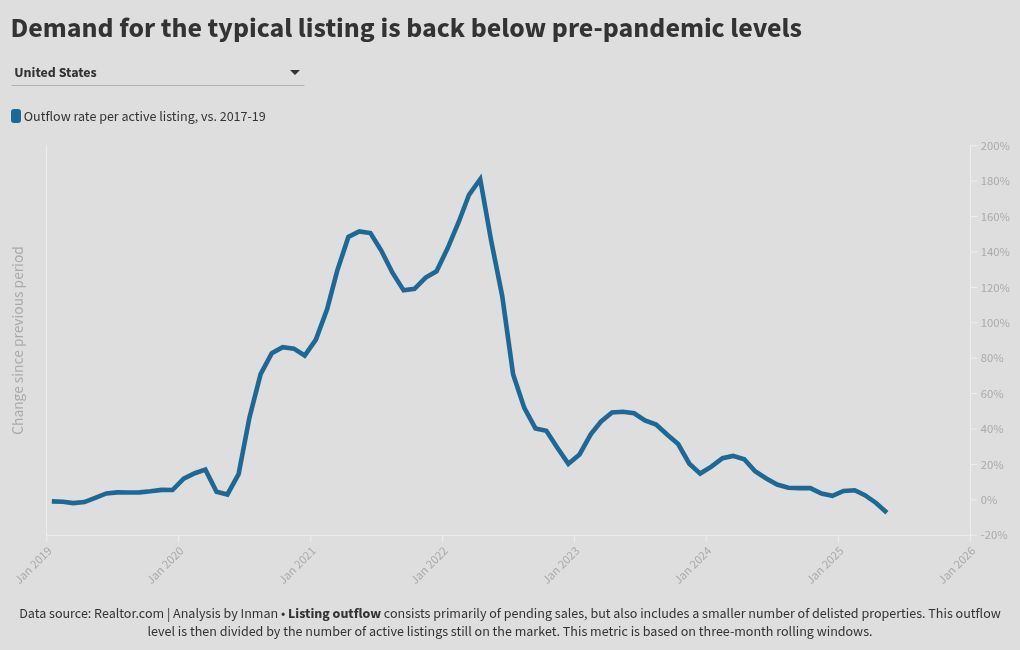
But notably, the spring market, which officially makes way for summer on Friday, also blew past a significant milestone: For the first time, the demand for the typical home listing has dropped below where it was in a typical pre-pandemic spring.
The result? A national environment that is still admittedly seller-friendly, but the least seller-friendly it’s been since well before the pandemic housing era.
And the elevated price levels that have supported agent income for years could become a casualty in many markets as inventory further rebalances.
A healthier path — and a looming risk
To understand where real estate stands right now, it’s essential to place data in context of where it stood before record-low mortgage rates and a pandemic-fueled demand boom completely warped the contours of the market.
But first, let’s take an extra close look at how the business has evolved in the last year alone.
Change in March-May levels, year-over-year
New listings: +9%
Listing outflow: +4%
Weighted list price: +0.1%
Potential commission pool: +4%
We see here the reason behind the buyer-friendly shift in most parts of the country: Not a decline in listing outflow — which is Inman’s proxy for sales activity — but a bump in new listings that outpaced a more modest increase in transactions.
From a brokerage-business perspective, this represents a healthier path through a rebalancing period than what happened in 2022, when the primary driver of the inventory shift was a precipitous drop in home sales.
Still, despite the recent replenishing of inventory, the national market is a far cry from normal.
As every real estate agent is painfully aware, mortgage rates remain elevated far above the rates most homeowners have locked in on their existing loans, and also well above the rate levels that made today’s price levels affordable for buyers.
Zooming out, we see how distorted the market remains compared to what we thought of as “normal” before the pandemic housing boom.
Change in March-May levels, vs. pre-pandemic baseline
Spring 2024 → Spring 2025
New listings: -23% → -16%
Listing outflow: -26% → -23%
Weighted list price: +47% → +48%
Potential commission pool: +10% → +14%
For the most part, price growth during the pandemic has held up even amid the downturn in sales, allowing many brokerages to weather the sales drought.
But it’s worth noting that while the raw value of the commission pool is technically higher than in the spring seasons of 2017-19, consumer-price inflation over that same period has more than offset these nominal gains. This means that in real terms, brokerage earnings are still worth less today than they were six years ago.
And downward pressure on prices may only be beginning.
The level of transaction activity on a typical active listing was 16 percent above pre-pandemic levels in spring of 2024. Even though the market had already substantially rebalanced by this point, this ensured that most markets remained deep seller’s markets.
This spring, the typical listing saw 7 percent less demand than it did pre-pandemic — taking substantial pressure off prices in the process.
As a national matter, the rebalancing toward buyers isn’t complete. After all, we were in a national seller’s market long before the pandemic.
But it does appear to be entering a new era — one where today’s buyers have a noticeably more prominent place at the table.