by Stephanie Alfonso | Jun 23, 2025 | Industry, News Feed
Driven by technological advancements and shifting consumer expectations, the real estate industry is undergoing a transformation, presenting both challenges and opportunities. In our recent research report, “The State of Real Estate Marketing,” we found that agents are still tackling traditional challenges, but are also struggling to learn and adapt to technology that will help them grow their marketing success.
The marketing burden
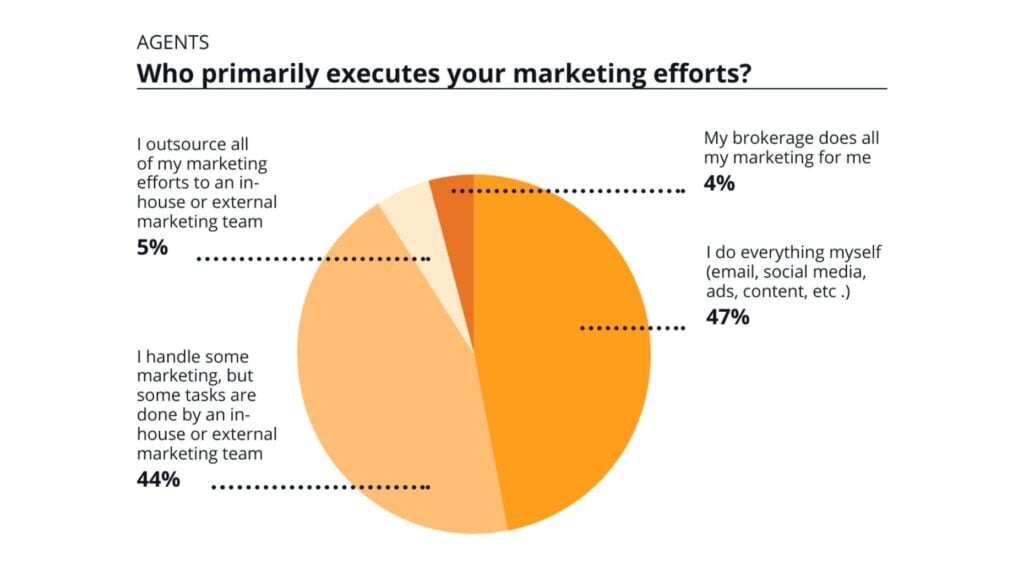
It’s no surprise that only 9 percent of real estate agents have handed their marketing over entirely to a brokerage or in-house team. After all, the personal touch is critical for real estate success. But it may be surprising to learn that nearly half (47 percent) actually do all their marketing alone, and only 13 percent of those solo marketers would rate their marketing as very effective.
And while these agents are facing some timeless challenges, like generating and converting leads and standing out against competitors, there are new challenges emerging: nearly one-third are struggling to implement the right technology, and another third feel they can’t keep up with the pace of changing tech.
To achieve success and stay competitive, agents need technology that’s easy to use, and strategic direction to get the most out of it.
Effective and efficient
While agents struggle to keep up with technological advances, the benefits of those advances are clear: those utilizing digital tactics like social media, email marketing, search engine optimization and paid social report more marketing success across the board, while also relying less on tactics like events and direct mail.
What specifically is driving that success? The most successful marketers share some things in common:
- Automation and integration — They are nearly one and a half times more likely to use automated follow-ups and drip campaigns, and to integrate their contacts across platforms like CRM, email, and advertising tools.
- Personalization and testing — They are two times more likely to test and refine things like marketing messaging and timing.
- Embracing AI — They are nearly twice as likely likely to use AI tools in their marketing efforts.
Ultimately, these agents are embracing advanced technologies, but with the explicit outcome of streamlined marketing — making the most of their limited hours.
How brokerages can help bridge the gap
It might seem like a foregone conclusion that agents who are part of a brokerage struggle less with access to technology; however, only one in five are satisfied with the technology their brokerage provides, and often seek out alternative tools. So, how can brokerages drive agent tech adoption, satisfaction and success?
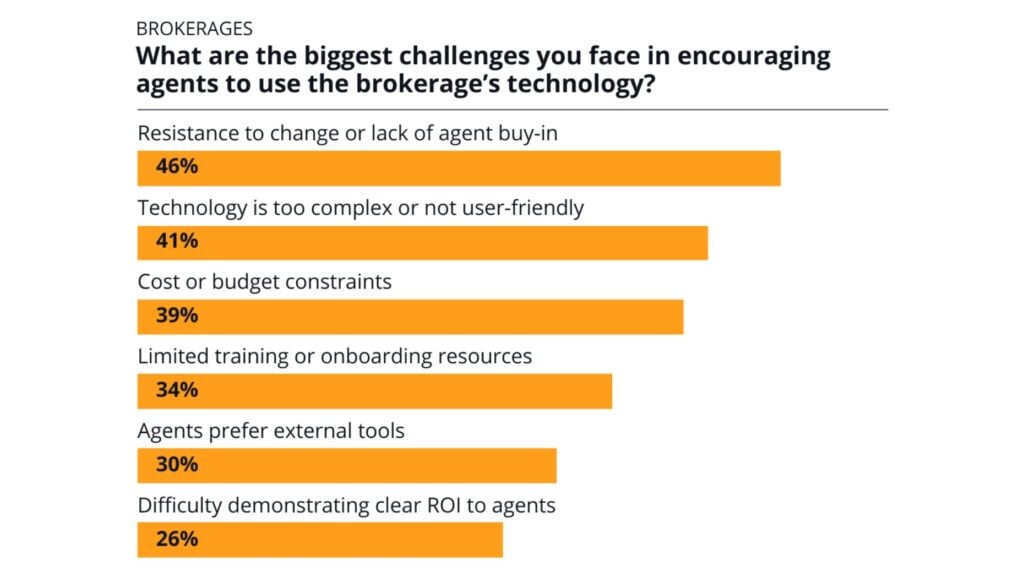
First and foremost, brokerages must recognize the importance of contact list ownership; 96 percent of agents say exclusive, protected access to their own list is critical, and 90 percent view owning their list as a competitive advantage.
Next, brokerages must balance their desire for advanced measurement with agents’ need for a solution that’s streamlined and easy to use. Agents need to actually feel able to use the tools selected.
Finally, agents are more successful when they have guidance: offerings like coaching, online training, webinars and support centers help agents adopt and utilize brokerage-provided technology.
Moving ahead with confidence
There’s no question that agents must embrace tech to drive marketing success; both agents and brokerages can set their sights on success by implementing flexible, robust marketing tools that both offer scalable features and agent independence and provide an easy-to-use, streamlined experience.
Constant Contact helps real estate professionals supercharge their marketing beyond CRM functionality. Easily create content, build your client audience and seal more deals with automated email, SMS, social media marketing, landing pages and more. Learn more at Constant Contact.

by Matterport Editorial Team | Jun 23, 2025 | Industry, News Feed
The real estate landscape is evolving, and artificial intelligence (AI) is at the forefront of this transformation. For residential real estate agents, adopting the latest technology is no longer optional — it’s essential. AI in real estate isn’t just a passing trend; it’s redefining how agents showcase properties, engage with clients and close deals faster than ever before.
Why AI in real estate matters
AI in real estate brings sophisticated tools that automate time-consuming tasks, enhance property presentations and offer data-driven insights. For real estate agents, this means more efficient workflows, higher client satisfaction and ultimately, more closed deals. Here’s why AI is becoming an indispensable ally for agents:
- Enhanced productivity: AI automates property measurements, listing descriptions and client recommendations, saving hours of manual work.
- Better client service: Tailored recommendations and rapid responses improve the overall client experience.
- Winning marketing strategies: AI-driven tools create polished, professional property presentations that make listings stand out.
As AI continues to develop, agents who adopt these tools now will gain a competitive edge in an increasingly tech-driven industry.
Leading the AI revolution in 3D
Among the leaders driving this innovation is Matterport, with its cutting-edge Property Intelligence tools designed to revolutionize how residential agents market and sell homes. Matterport has long been renowned for its ability to create immersive 3D virtual tours through its digital twin technology. But with their latest suite of AI-powered Property Intelligence tools, they are setting a new standard for how homes are marketed.
Here’s how AI is empowering real estate agents with smarter solutions:
- Immersive virtual tours: Create true-to-life digital representations of properties that buyers can explore in full detail.
- AI-powered insights: Automatically generate room names, property dimensions and accurate measurements in seconds.
- Compelling descriptions: Craft professional-grade property descriptions in moments, optimized for search engines and tailored to attract buyers.
But there’s one specific feature you absolutely need to know about…
The jaw-dropping Auto-Defurnish Tool
A standout AI innovation for 3D tours is the Auto-Defurnish Tool. This AI-powered feature automatically removes furniture and personal clutter from a 3D tour with one click, presenting a clean, blank canvas. For residential agents, this tool is a game-changer:
- Maximizes buyer imagination: Buyers can more easily envision their personal style in the space.
- Simplifies property prep: Skip costly and time-consuming physical staging or decluttering.
- Removes barriers: Overcomes objections from buyers who struggle to “see past” current furnishings.
The Auto-Defurnish Tool empowers agents to present properties at their best, driving buyer interest and faster decision-making.
Additional tools driving value for real estate agents
AI-powered tools extend beyond visual enhancements, offering agents a complete toolkit to streamline their operations:
- Auto-generated descriptions: Save time by letting AI craft polished, SEO-friendly property descriptions that highlight a property’s best features.
- Auto-measurements and room labels: Provide precise property dimensions directly within 3D tours to help buyers make informed decisions without additional inquiries.
- Data-driven marketing: Leverage AI insights to tailor your strategies for maximum engagement and outreach.
All of these value-add features work seamlessly together to simplify your workflow and create an exceptional experience for your clients.

Start your AI journey today
For real estate agents looking to future-proof their business, the time to act is now. AI is no longer a luxury; it’s a necessity to stay relevant and competitive. With tools like Matterport’s Property Intelligence suite, you’ll not only save time and effort but also unlock new levels of client satisfaction and professional success.
Transform your approach to real estate marketing. Explore Matterport’s AI-powered real estate solutions today and revolutionize your business. Explore AI-powered solutions now.

by Jessi Healey | Jun 22, 2025 | Industry, News Feed
Real estate is changing fast, and so must you. Inman Connect San Diego is where you turn uncertainty into strategy — with real talk, real tools, and the connections that matter. If you’re serious about staying ahead of the game, this is where you need to be. Register now!
Each week on Trending, digital marketer Jessi Healey dives into what’s buzzing in social media and why it matters for real estate professionals. From viral trends to platform changes, she’ll break it all down so you know what’s worth your time — and what’s not.
TikTok is turning livestreams into serious sales, YouTube wants creators to double down on Shorts, and Meta is — not so quietly — reshaping Facebook into a reels-first platform while confirming what we’ve all suspected: Links in captions kill reach.
Add in Apple’s iOS overhaul, which changes how your clients even see and sort your content, and it can feel overwhelming with how fast the platforms are moving — and not always in a direction that helps real estate agents.
If you’ve been relying on the same posting habits or content formats, this is your cue: It’s time to adapt. Whether it’s a new algorithm push, another privacy misstep or a shift in video strategy, one thing stays true: The platforms make the rules, and they’ll rewrite them without warning.
The good news is, it’s never too late to adapt; you’re just in time for the next shift.
TikTok Shop sales jump as livestream buying grows
TikTok Shop is gaining serious traction in the U.S., with a 120 percent year-over-year sales increase and more than 70 million products now available in-app. According to TikTok, 76 percent of users who engaged with TikTok Shop made a purchase via livestream in the past year, and 83 percent discovered a new product through this channel.
Top categories include womens wear, beauty, health, sports gear and electronics. More than 171,000 small businesses are now selling through TikTok Shop, and creators have hosted over 8 million hours of live shopping.
To maintain momentum, TikTok is introducing new seller tools, along with a special promotion and campaign.
What this means for agents
Livestream content is fueling discovery and conversion, not just entertainment. Real estate pros testing TikTok should pay attention to how creators explain value in real-time, engage directly with viewers and use storytelling to drive action.
Even if you’re not selling products, you are selling expertise. Think walkthroughs, market updates and Q&As — live.
YouTube pushes deeper into short-form shopping and brand deals
YouTube is betting big on creators — and shoppable content — with a batch of new tools designed to boost engagement and brand partnerships.
First up: Shopping in Shorts is getting an upgrade. Instead of the small banner in the corner, tagged products will now appear as prominent stickers you can move around the screen. Early tests show a 40 percent increase in product clicks with the new format, especially when used in livestreams or high-interest Shorts.
Meanwhile, YouTube’s Communities feature is rolling out to more creators, offering a dedicated space for audience interaction beyond the comment section. Think of it as a built-in discussion board with sorting options like “Top Posts” and “Newest,” plus visibility boosts for quality content.
And in an effort to make influencer-brand deals more accessible, YouTube’s new Open Call system allows brands to post partnership briefs that creators can apply to. This shift gives creators — regardless of size — more opportunity to pitch themselves for paid collaborations.
What this means for agents
Take notes on how YouTube is blending visibility, community and monetization. Try experimenting with short-form video that includes strong visual storytelling and subtle product placement (Think: neighborhood perks, not just listings). And don’t sleep on the power of audience connection — comment threads and community posts can build trust just as much as video views.
Meta’s AI missteps raise privacy concerns as Facebook doubles down on reels
As Meta pushes forward with new AI tools and video features, it’s facing serious backlash over unintentional data exposure on its chatbot platforms. Users interacting with Meta AI — thinking they’re having private conversations — have accidentally shared deeply personal content to public feeds, including medical questions, private travel plans and even phone numbers.
Despite Meta’s disclaimer that posts are only public when shared, the UI and user confusion suggest a design issue, not just user error.
At the same time, Facebook is streamlining all video uploads into its Reels format — removing the distinction between traditional videos and reels entirely. There are no length limits, and creators will get access to the same editing tools across the board. The Video tab is being renamed to Reels, and audience settings are being unified to help users better manage who sees what.
What this means for agents
There’s a clear gap between what platforms intend and what users understand. Make sure your content — especially anything AI-assisted — is clearly reviewed and intentionally shared. And if you’re using Facebook for community building, the shift to all-video-as-reels could be an opportunity.
Longer listing videos, walkthroughs and client testimonials can now get the same algorithmic push as short-form clips, so don’t be afraid to experiment across video lengths.
Meta confirms what marketers suspected: Links in captions hurt reach
Social media managers have long debated the best place to put a link on Facebook — in the caption or the first comment. Now, Meta is quietly confirming what most already suspected: Links in the post body can hurt performance. New post-level insights in Facebook’s Professional Dashboard suggest that placing your link in the first comment might help maximize reach.
It’s a subtle but important shift for agents who rely on Facebook to drive traffic to listings, blogs and lead forms. According to Meta’s own “Widely Viewed Content Report,” 97.3 percent of U.S. post views go to updates that don’t include a link to an outside site. If you’re still dropping links in your caption, you may be limiting your exposure.
What this means for agents
Rethink how you share listings and lead-gen links. Skip the default link drop and lean into visuals, captions that drive interest and first-comment links. Test the performance of these approaches — small changes could result in significantly more views from potential buyers and sellers.
Pro tip: Let Facebook generate the link preview, then delete the URL from your caption. Or try posting a high-quality image and dropping the link in the first comment — a tactic used by top-performing Pages. It requires more manual effort, but could lead to more eyeballs on your content. Agents should test both methods to see which gets the most traction.
iOS 26 redesign and AI features will change how clients experience your content
Apple’s newest iPhone update isn’t just about aesthetics — it’s a major shift in how your clients interact with content, communication and even your listings. With iOS 26, Apple introduces a striking new design, AI-powered features and seamless app integrations that will impact how agents show up in clients’ digital lives.
The biggest shift: Apple Intelligence — a suite of AI tools built into the iPhone — enables smarter message translation, live summaries, and real-time suggestions that enhance communication. That means your listing updates, client check-ins and showing reminders could be filtered or flagged differently based on what the AI prioritizes.
Apple’s new design also places more focus on visual content through dynamic widgets and full-screen web flows, meaning your mobile-optimized site, images and videos need to be sharper and more engaging than ever.
Messages and Phone apps now screen unknown contacts by default, and new layout changes might bury less relevant interactions. If your follow-ups aren’t clearly personalized, they may get lost. Apple Maps now offers encrypted “Visited Places,” which could be a gold mine for retargeting — or a challenge, depending on privacy settings.
And with video now even more immersive across Safari and CarPlay, real estate agents need to assume that buyers are watching listing videos, walkthroughs and branding content on the go.
What this means for agents
The way your clients interact with your brand on iPhone just changed. Don’t let their first impression be your last — it’s time to audit your mobile presence, messaging strategy and visual assets for the new Apple standard.
TL;DR (Too Long, Didn’t Read)
- TikTok Shop is booming with livestream sales up 120 percent. Watch how creators use real-time engagement to convert — it’s a model for value-driven, interactive content.
- YouTube doubles down on Shorts and creator tools. New shopping stickers, open brand deals and expanded community features point to deeper engagement opportunities.
- Meta’s AI raises privacy red flags as user confusion leads to accidental public posts. Meanwhile, all Facebook video is now Reels — a major shift with algorithmic upside.
- Facebook confirms it: Links hurt reach. Move your links to the first comment, or delete them after preview generation to improve visibility.
- Apple’s iOS 26 redesign means clients will see your content differently. AI filters, enhanced video and mobile-first design demand sharper, more strategic communication.
Features come and go, algorithms shift, and what worked last month might tank tomorrow. But here’s what doesn’t change: The way you show up for your clients.
You don’t need to chase every update or hop on every trend. You just need to understand what tools are out there, how people are actually using them, and how that lines up with the way you do business.
Keep showing up with clarity, stay nimble with your strategy, and remember — the real power isn’t in the platform. It’s in how you use it.
Jessi Healey is a freelance writer and social media manager specializing in real estate. Find her on Instagram, LinkedIn, Threads, or Bluesky.
by Daniel Houston | Jun 21, 2025 | Industry, News Feed
Bigger. Better. Bolder. Inman Connect is heading to San Diego. Join thousands of real estate pros, connect with the Inman Community, and gain insights from hundreds of leading minds shaping the industry. If you’re ready to grow your business and invest in yourself, this is where you need to be. Go BIG in San Diego!
To help figure out where the industry is heading next, Inman invites you to take real estate’s most ambitious monthly survey: the Inman Intel Index.
Each month, the Intel Index survey leans on the expertise of Inman’s readership to discover what’s top of mind for agents, mortgage professionals, proptech players and industry executives.
TAKE THE INMAN INTEL INDEX SURVEY
The insights gathered from these responses help illuminate industry sentiment on real estate’s most important topics: the NAR settlement, inventory opportunities, new U.S. tariff policy and its impact on real estate, and more.
Click through to add your insights to the industry’s knowledge base, and check back for analysis of the results in the weeks to come.
Thank you,
Team Inman
by Darryl Davis | Jun 21, 2025 | Industry, News Feed
Are your clients “waiting for the market to recover”? They’re often talking about fear and uncertainty, coach Darryl Davis writes. Ask these questions to shift from uncertainty to clarity.
Since the NAR commission suit settlement, buyer agents have faced new rules, new documents and a new normal. This month, Inman drills down on Today’s Buyers Agent with the fresh marketing strategies, skills and tools buyer agents are using to prosper in changing times.
Let’s talk about one of the most common phrases I hear from agents lately: “My clients say they’re going to wait until the market recovers.”
Sound familiar?
It’s an easy thing for buyers or sellers to say. But let’s pull the curtain back a little — because when someone says, “We’re waiting for the market to get better,” they’re often not talking about real estate at all. They’re talking about fear. About uncertainty. About wanting guarantees in a world that’s anything but predictable.
The problem is, they’re trying to drive with one foot on the gas and one on the brake.
And your job? It’s not just about selling homes — it’s about helping people get unstuck.
‘We’re waiting for the market to recover’
But what does that even mean?
This came up in a coaching call recently. I said, “Recover from what? A bad breakup? The sniffles?” We all laughed, but the truth underneath that joke is important: Recovery is vague — and vagueness keeps people stalled.
Is your client waiting for rates to drop? Prices to rise? Inflation to ease? Political changes? A cosmic sign?
It’s like standing on the shore, waiting for the “perfect wave,” but the tide keeps shifting. If you wait too long, the opportunity passes.
That’s why one of the best things you can do in these moments is ask a question that shifts the conversation from external uncertainty to internal clarity.
Flip the focus: From market conditions to life decisions
Try this with a client:
“Are you committed to waiting for interest rates, or are you committed to making the move that supports your life goals?”
That one question changes everything.
It’s like switching the lens from a telescope (always scanning the horizon) to a mirror (what do I want?). It gets people out of waiting mode and into decision mode.
For a buyer renting or living with family:
“Are you committed to renting for another year, or are you ready to step into the next chapter of your life as a homeowner?”
You’re not pressuring. You’re coaching. You’re helping them reconnect with what they can control — their decisions, not the market’s whims.
Because here’s the truth …
The market will shift. Rates will rise and fall. Inventory will tighten and loosen. That’s the nature of the business.
But if your clients are waiting for all the stars to align before they act, they’ll be standing still while others move forward.
Imagine someone sitting in a car, engine running, GPS ready, but refusing to hit the road until every light on the highway turns green. It’s not realistic, and it’s not necessary.
You serve the committed
Let me be clear: Not everyone is ready to move. And that’s OK.
Some sellers will say, “If I get my price, I’ll sell,” but deep down, they’re just testing the waters. There’s no urgency, no vision, no commitment. You can’t coach someone who isn’t ready to play.
You serve the ones who are ready to take that next step, even when it feels a little uncomfortable.
Your role is to help them move from Point A to Point B, not just physically, but emotionally and mentally. And that means bringing empathy, clarity and courage to the table.
Try these conversation starters:
When someone says, “We’re waiting for the market to improve,” try asking:
- “What would ‘recovered’ look like for you?”
- “How will you know when it’s the right time?”
- “What’s more important to you — external timing or personal progress?”
- “What would moving now make possible in your life?”
We teach agents to lead conversations, not chase them. To guide with heart. To stop selling and start serving.
Because at the end of the day, this business isn’t just about keys and contracts; it’s about people and possibilities.
And if you’re reading this thinking, “Yes, but I’m feeling the weight too,” let me say this: You’re not alone. These are challenging times. But they’re also full of opportunity, especially for agents who know how to help clients cut through the noise and make decisions that serve their future.
You’re not just in real estate. You’re in the business of transformation. Keep leading with questions. Keep listening. And keep helping people move forward — one thoughtful conversation at a time.
Darryl Davis is the CEO of Darryl Davis Seminars. Connect with him on Facebook or YouTube.

by Taylor Anderson | Jun 20, 2025 | Industry, News Feed
The chair of the Federal Housing Finance Agency, Fannie and Freddie has spent the past day calling on Powell to step down, saying he’s responsible for high home prices.
Real estate is changing fast, and so must you. Inman Connect San Diego is where you turn uncertainty into strategy — with real talk, real tools, and the connections that matter. If you’re serious about staying ahead of the game, this is where you need to be. Register now!
The chair of the Federal Housing Finance Agency (FHFA) is in an outright war against Jerome Powell, chair of the Federal Reserve, saying he is responsible for housing unaffordability and demanding that he resign.
Bill Pulte took to the social media platform X as well as national cable TV to call for Powell’s resignation in the days after the Federal Reserve opted to hold rates steady — a decision it made earlier this week. Pulte blamed Powell for keeping interest rates high.
“Jerome Powell is a main reason for the Housing Supply Crisis in this Country,” Pulte wrote Thursday in one of several X posts on the topic. “By improperly keeping interest rates high, Jerome Powell is trapping homeowners in low-rate mortgages and choking off existing home sale — directly fueling the housing supply crisis. He must lower rates.”
Pulte and President Donald Trump have both been putting pressure on Powell — who was appointed to the chair position in 2018 during Trump’s first term in office — to lower the federal funds rate. The federal funds rate can indirectly impact mortgage rates, automobile loans and credit card rates.
Powell’s term ends in May 2026. Pulte took to Fox News to spread his message on Friday morning, saying that Powell should either lower rates before the end of his term or resign.
“Peoples’ mortgage affordability has been crushed in the last four years,” Pulte said. “People have to pay double what they had to pay compared to President Trump’s first term in order to buy a home.”
Pulte said that Powell was “one of if not the biggest reason for the housing supply crisis that we have in this country.”
“It’s hurting Americans right now. Nobody wants to sell their existing homes,” he said. We need to get that inventory churning in this country again.”
Pulte didn’t answer when asked if he had heard from Powell since calling for his resignation.
Trump took to his Truth Social platform to share Pulte’s message.
“Too Late—Powell is the WORST. A real dummy, who’s costing America $Billion!” Trump wrote. In a separate message he wrote that the federal funds rate should be 2.5 points lower than it is.
The Federal Reserve began quickly raising the federal funds rate in March 2022 to combat high inflation and an overheated labor market. It stopped raising the rate in August 2023 and implemented a brief series of cuts in September 2024 but has not cut them since Trump’s second inauguration.
The board has continued to express caution, saying it was waiting to see the impact of Trump’s tariff policy before moving to lower rates.
Powell said this week that he expects a “meaningful amount of inflation” to arrive in the coming months.
“We have to take that into account,” Powell said.
“Increases in tariffs this year are likely to push up prices and weigh on economic activity,” Powell said. “The effects on inflation could be short-lived, reflecting a one-time shift in the price level. It’s also possible that the inflationary effects could be more persistent.”
Email Taylor Anderson
