by Stephanie Alfonso | Jun 23, 2025 | Industry, News Feed
Driven by technological advancements and shifting consumer expectations, the real estate industry is undergoing a transformation, presenting both challenges and opportunities. In our recent research report, “The State of Real Estate Marketing,” we found that agents are still tackling traditional challenges, but are also struggling to learn and adapt to technology that will help them grow their marketing success.
The marketing burden
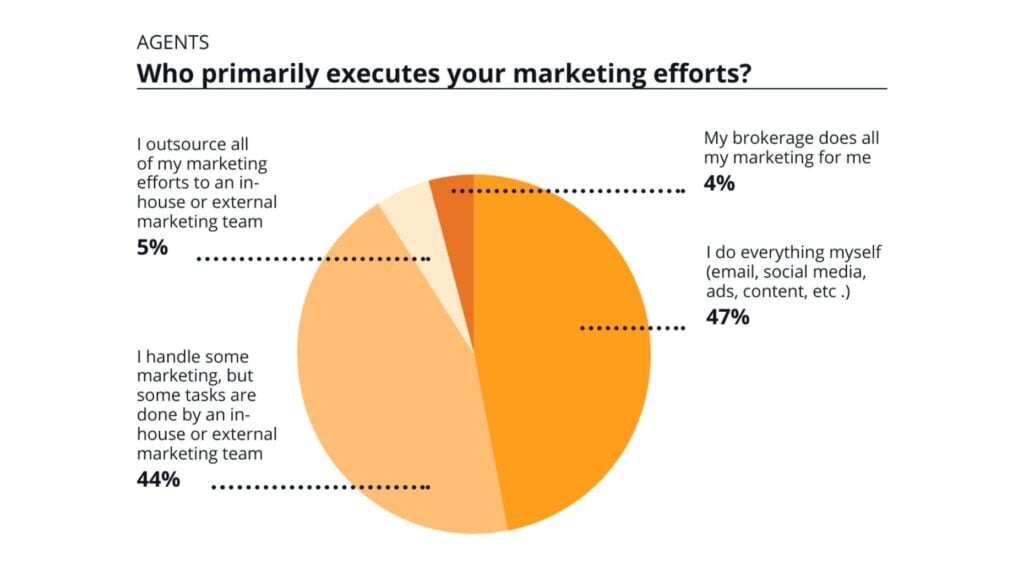
It’s no surprise that only 9 percent of real estate agents have handed their marketing over entirely to a brokerage or in-house team. After all, the personal touch is critical for real estate success. But it may be surprising to learn that nearly half (47 percent) actually do all their marketing alone, and only 13 percent of those solo marketers would rate their marketing as very effective.
And while these agents are facing some timeless challenges, like generating and converting leads and standing out against competitors, there are new challenges emerging: nearly one-third are struggling to implement the right technology, and another third feel they can’t keep up with the pace of changing tech.
To achieve success and stay competitive, agents need technology that’s easy to use, and strategic direction to get the most out of it.
Effective and efficient
While agents struggle to keep up with technological advances, the benefits of those advances are clear: those utilizing digital tactics like social media, email marketing, search engine optimization and paid social report more marketing success across the board, while also relying less on tactics like events and direct mail.
What specifically is driving that success? The most successful marketers share some things in common:
- Automation and integration — They are nearly one and a half times more likely to use automated follow-ups and drip campaigns, and to integrate their contacts across platforms like CRM, email, and advertising tools.
- Personalization and testing — They are two times more likely to test and refine things like marketing messaging and timing.
- Embracing AI — They are nearly twice as likely likely to use AI tools in their marketing efforts.
Ultimately, these agents are embracing advanced technologies, but with the explicit outcome of streamlined marketing — making the most of their limited hours.
How brokerages can help bridge the gap
It might seem like a foregone conclusion that agents who are part of a brokerage struggle less with access to technology; however, only one in five are satisfied with the technology their brokerage provides, and often seek out alternative tools. So, how can brokerages drive agent tech adoption, satisfaction and success?
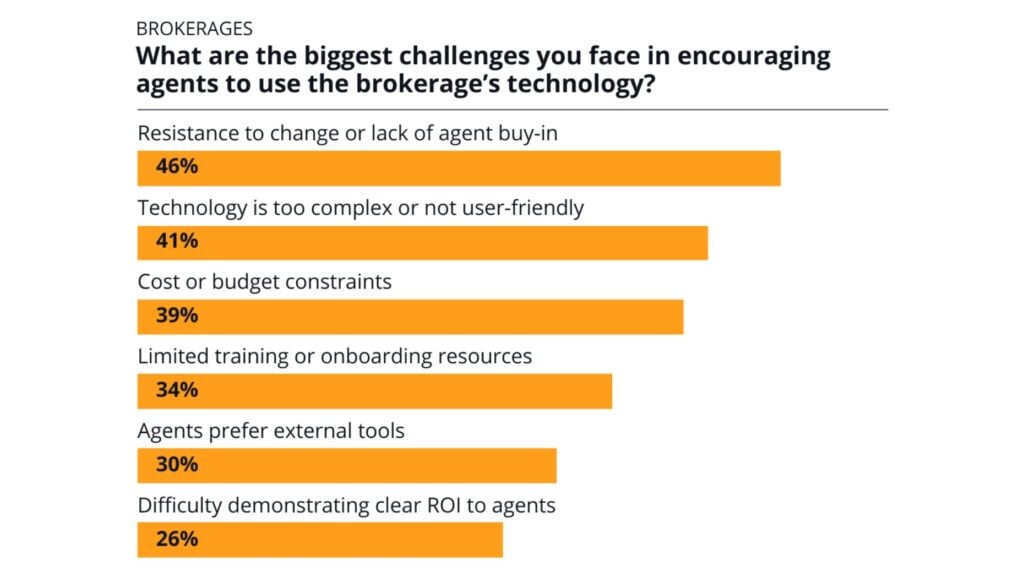
First and foremost, brokerages must recognize the importance of contact list ownership; 96 percent of agents say exclusive, protected access to their own list is critical, and 90 percent view owning their list as a competitive advantage.
Next, brokerages must balance their desire for advanced measurement with agents’ need for a solution that’s streamlined and easy to use. Agents need to actually feel able to use the tools selected.
Finally, agents are more successful when they have guidance: offerings like coaching, online training, webinars and support centers help agents adopt and utilize brokerage-provided technology.
Moving ahead with confidence
There’s no question that agents must embrace tech to drive marketing success; both agents and brokerages can set their sights on success by implementing flexible, robust marketing tools that both offer scalable features and agent independence and provide an easy-to-use, streamlined experience.
Constant Contact helps real estate professionals supercharge their marketing beyond CRM functionality. Easily create content, build your client audience and seal more deals with automated email, SMS, social media marketing, landing pages and more. Learn more at Constant Contact.
by Stephanie Alfonso | Aug 17, 2024 | Industry, News Feed
NAR buckles up for a new legal brouhaha as Michigan agents and brokers head to court over “compulsory” Realtor membership to access the MLS after removing “guaranteed broker commission.”
Whether it’s refining your business model, mastering new technologies, or discovering strategies to capitalize on the next market surge, Inman Connect New York will prepare you to take bold steps forward. The Next Chapter is about to begin. Be part of it. Join us and thousands of real estate leaders Jan. 22-24, 2025.
Each week on The Download, Inman’s Christy Murdock takes a deeper look at the top-read stories of the week to give you what you’ll need to meet Monday head-on. This week: NAR buckles up for a new legal brouhaha as Michigan agents and brokers head to court over “compulsory” Realtor membership to access the MLS after removing “guaranteed broker commission.”
The March settlement by the National Association of Realtors (NAR) in the commission lawsuit cases sparked a wave of outrage among real estate professionals, expressed in overheated social media posts and frustrated op-eds.
As frustration mounted with the sometimes confusing rollout of rule changes and paperwork, agents and brokers actively sought to push back against what they perceived as an unfair resolution.
In one of the bigger understatements of recent days, the American Real Estate Association (AREA), the upstart trade group headed by NYC agent Jason Haber and The Agency founder Mauricio Umansky, announced its tiered membership plan this week, aiming to offer an alternative to NAR because there is a “lot of dissatisfaction with the status quo,” according to Haber.
EXTRA: American Real Estate Association debuts membership program
Coincidentally, we also heard from NAR’s interim chief Nykia Wright for the very first time this week. She defended the settlement and encouraged aggravated Realtors to bring their criticisms in-house to avoid “confusing consumers” and help NAR “be the best organization [it] can be.”
EXTRA: NAR interim CEO: Settlement was ‘unequivocally’ the right move
No doubt you’re used to hearing about legal wrangling between consumers and the industry by now. Well, it seems some Realtors are taking a page out of that playbook, airing their grievances in the courtroom:
Three Michigan real estate professionals have filed a class-action antitrust lawsuit against national, state and local Realtor associations challenging the requirement that they must belong to the trade groups to access the local multiple listing service.
The two brokers and an agent filed the suit after the National Association of Realtors came to a proposed settlement of multiple antitrust lawsuits, whose rule changes the pros say will harm agents, brokers and consumers.
The suit was filed in U.S. District Court for the Eastern District of Michigan, and names NAR, the Michigan Association of Realtors, the Grosse Pointe Board of Realtors, the Greater Metropolitan Association of Realtors, the North Oakland County Board of Realtors, and Michigan’s largest MLS, Realcomp II, as defendants. The filing accuses them of civil conspiracy, economic coercion and unfair restraint of trade in violation of the federal Sherman Antitrust Act and the Michigan Antitrust Reform Act.
EXTRA: A brave new world awaits the real estate industry. Are you prepared?
While Michigan Realtors vent their frustration in court and AREA adds new names to its membership roster, everybody else is just out here trying to get paid post-Aug. 17. Fortunately, from optimal mindset to practical strategies, we’re hearing from industry leaders in this week’s Download, offering insight into game-changing tech, compensation plans and new ways to prepare for the road ahead.
In what’s turning out to be a pivotal year for real estate, a few software companies have emerged to speed up search, improve internal operations, build custom apps, improve sales skills and more, Inman tech expert Craig Rowe writes.
Renovations don’t just apply to your home, the Better Homes and Gardens Real Estate president Ginger Wilcox writes. They can also apply to your professional and personal endeavors.
by Stephanie Alfonso | Jul 26, 2024 | Industry, News Feed
At Inman Connect Las Vegas, July 30-Aug. 1, 2024, the noise and misinformation will be banished, all your big questions will be answered, and new business opportunities will be revealed. Join us.
Navigating the complexities of downsizing can be a daunting task for anyone, but it becomes especially challenging for people who have spent decades in the same home or who might be facing normative changes associated with age.
As the largest group of home sellers in recent years, baby boomers (ages 59 to 77) are at the forefront of the downsizing trend, making up 45 percent of home sellers in 2023, according to the NAR’s 2023 Profile of Home Buyers and Sellers. Meanwhile, the silent generation (78 and up) accounts for 6 percent. Combined, these two groups comprised over half of all home sales in the U.S., a trend expected to continue in the coming years.
This shift means that real estate agents are increasingly encountering clients who need more than just transactional assistance. Those selling homes they’ve lived in most of their adult lives tend to face unique emotional and logistical challenges associated with relocating. These obstacles are tied not just to age but to the profound life changes involved in letting go of a long-term residence.
Age-related physical limitations and cognitive declines sometimes associated with aging or illness can add layers of complexity to the downsizing process. Coupled with the sheer volume of possessions accumulated over decades, these factors can turn what might seem like a straightforward move or home sale into a significant emotional and logistical undertaking.
