by Sean Frank | Sep 9, 2024 | Industry, News Feed
The NBA superstar’s Highland Park estate at 2700 Point Drive was first listed for $29 million in 2012. By 2014, the price had dropped to $16 million, and it is now on the market for $14.8 million.
Whether it’s refining your business model, mastering new technologies, or discovering strategies to capitalize on the next market surge, Inman Connect New York will prepare you to take bold steps forward. The Next Chapter is about to begin. Be part of it. Join us and thousands of real estate leaders Jan. 22-24, 2025.
The future of Michael Jordan’s $14.8 million Chicago mansion remains a toss up after sitting on the market for 12 years, despite drastic price reductions, The Wall Street Journal reported on Thursday.
The NBA superstar’s Highland Park estate at 2700 Point Drive was first listed for $29 million in 2012. By 2014, the price had dropped to $16 million, and it is now on the market for $14.8 million.
Katherine Malkin of Compass is representing the listing.
According to The WSJ, the 56,000-square-foot mansion still reflects Jordan’s personal touch, and there are no plans of that changing, despite his desire to sell.
“We haven’t really talked about that because it’s part of the draw. We don’t look at that as being a hindrance,” Malkin told The Wall Street Journal.
In 1994, Jordan spent $50 million building the property, which includes nine bedrooms, 15 full bathrooms, a home theater, a putting green and doors from the Playboy Mansion. Custom features include a wrought iron gate adorned with Jordan’s iconic number 23, a basketball court with his and his children’s names, and a cigar room.

Compass | Regulation-sized basketball court
While the listing has attracted attention, it’s mostly from fans rather than serious buyers.
Fans lacking the necessary funds have contacted Malkin, requesting tours and special discounts on the property. Last year, a break-in attempt occurred despite the estate’s full-time security.
Jordan’s team remains patient, with no intention of lowering the price further. The property was even pulled from a 2013 auction when bids fell short of a minimum reserve price of $13 million.

Compass | Sitting area
Real estate agent Kofi Nartey previously attempted to lure buyers with creative marketing, including a promise of every Air Jordan sneaker model.
Numerous proposals to transform the property into a museum or conference center have surfaced but none have materialized, due in part to zoning issues, according to Highland Park City Manager Ghida S. Neukirch.
Malkin attributes the lack of residential interest to its location, two miles inland from Lake Michigan where high-end buyers prefer to live.
“Most people who are spending that kind of money in the Chicago area want to live on the lake,” she said. “He chose to not live on the lake because they wanted privacy.”
According to Malkin, prospective buyers who tour the house must sign a nondisclosure agreement. Dozens of qualified buyers have gone through in the past few years, she added, but no deals were made.
Jordan, who bought the house in 1991 and assumed full ownership after his 2006 divorce, is selling because his children are grown, and he splits his time between homes in North Carolina and Florida, he previously told The Wall Street Journal.
Email Richelle Hammiel
by Christine Cruz | Sep 9, 2024 | Industry, News Feed
Seattle-based brokerage Redfin is taking its commission-based payment model, Redfin Next, nationwide on Oct. 27. Redfin Next enables agents to keep their W-2 status and benefits while earning competitive commission splits.
Whether it’s refining your business model, mastering new technologies, or discovering strategies to capitalize on the next market surge, Inman Connect New York will prepare you to take bold steps forward. The Next Chapter is about to begin. Be part of it. Join us and thousands of real estate leaders Jan. 22-24, 2025.
After several expansions over the past 11 months, Seattle-based brokerage Redfin is taking its commission-based payment model nationwide. Starting Oct. 27, all Redfin agents will have access to Redfin Next, which enables agents to keep their full-time W-2 status and traditional benefits while getting variable commission splits of 70 to 75 percent based on the average home price in their market.
With Redfin Next, Redfin still covers agents’ business expenses, provides a 401k alongside medical and stock equity benefits, and offers technology, support programs and leads.

Jason Aleem. Image: Redfin
“We’re fully committing to Redfin Next because it has played a significant role in transforming our business and propelling our growth,” Redfin Chief of Real Estate Services Jason Aleem said in a blog Monday morning. “Redfin Next has empowered our agents to amplify their businesses and unlocked the opportunity for them to earn more money, while also inspiring other entrepreneurial agents to join us.”
“Having the best agents in the industry is critical to our mission to make real estate better for consumers, and with Redfin Next, we know we can continue to grow our impact,” he added.
Aleem said Redfin Next has significantly improved the brokerage’s retention and recruitment efforts, with top producers in their biggest markets breaking seven figures in commissions in 2024.
“I have always made a great living at Redfin, but under Redfin Next I’m setting and exceeding goals that I never knew were possible,” Orange County-based Redfin agent Maryam Amiri said in a written statement. “When I talk to other agents, they can’t believe the quality of technology, marketing, and leads I get for free through Redfin on top of the other employee benefits. Redfin understands that when those things are taken care of, I am free to focus on my customers and let my expertise shine. I’ve never been so confident in the future of my business.”

Glenn Kelman
In August, Redfin CEO Glenn Kelman said Redfin Next was an integral part of the brokerage’s growth during the second quarter, with market share reaching 0.77 percent of U.S. existing home sales by units — a 2.66 percent increase from Q2 2023. The brokerage also added 200 agents across the 36 markets where Redfin Next currently exists.
“The capacity that Next has given us to hire more and better agents, with less financial risk, has been why we could become more disciplined about requiring a lead agent to host the first meeting with a home buyer, in the all-you-can-meet program we launched broadly this spring,” Kelman said. “In years past, Redfin asked the contractors we hired for short-notice property access to handle up to 40 percent of our customers’ first tours. Our lead agents make the Redfin case far better than these contractors.”
“We’ve hired more than 200 top producers over the last six months. Over the next nine months, our lead-agent census is likely to keep increasing, but without the capital risk of salaried agents,” he added. “This month, Next will be how we pay agents in markets that accounted for 74 percent of 2023 revenue, up from 17 percent in January and 30 percent in May.”
Kelman and Aleem have said Redfin Next is also an integral part of Redfin’s post-settlement strategy. The company settled Gibson for $9.25 million on May 6.
“In the wake of the NAR settlement, customers are telling us this is more important to them than ever before,” Aleem said in a previous statement to Inman. “We’ve always been focused on giving consumers a better deal, so we’re well equipped to support them.”
“We believe Redfin Next will be transformational for our brokerage, helping us retain our best agents, recruit top talent, and grow market share faster through both the ups and downs in the market,” he added.
The brokerage is hosting a reservation-only webinar about Redfin Next’s nationwide expansion on Sept. 26.
Email Marian McPherson
by Ken Baris | Sep 9, 2024 | Industry, News Feed
Whether it’s refining your business model, mastering new technologies, or discovering strategies to capitalize on the next market surge, Inman Connect New York will prepare you to take bold steps forward. The Next Chapter is about to begin. Be part of it. Join us and thousands of real estate leaders Jan. 22-24, 2025.
Shares of Fathom Real Estate’s parent company have more than doubled in value in less than three months as the company continues to add agents and pursue plans to expand operations to all 50 states and Canada.
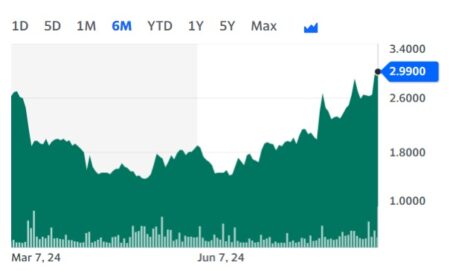
Shares in Fathom Holdings Inc., which were changing hands for as little as $1.33 on June 21, have gained 125 percent since then, closing at $2.99 Friday.
In reporting a $1.3 million second quarter loss on Aug. 12, Fathom said it grew its agent count by 12 percent from a year ago, to 12,224. Although elevated mortgage rates and home prices were a drag on transaction volume, Fathom introduced new agent commission plans aimed at boosting profits while aiding agent recruitment and retention.
Fathom shares up 125% from June
Shares in Fathom gained 13 percent last week alone after CEO Marco Fregenal detailed the company’s long-term growth strategy and held one-to-one meetings with investors Wednesday at the Gateway Conference in San Francisco.
At the conference, Fregenal said he’s confident that Fathom Realty’s flat-fee model will help it continue to attract agents, and that he expects U.S. residential real estate transactions to grow from roughly 4.2 million this year to 5.5 million in 2025.
While many real estate brokerages are bracing for new commission rules to dent their revenue, Fregenal doesn’t think commissions paid to buyer’s agents will come down much in the long run.
Any declines are likely to be short-lived, because “it’s now no longer a transparent system. In a sense, if you’re selling your house, you no longer know what other people are offering, right? So I think the lack of transparency eventually may drive prices.”
Fathom raised its agent transaction fees by 10 percent in 2023, to $550 for the first 15 completed transactions. After the first 15 transactions, agents were paying $150, up from $99 before the increase. Fathom raised agent fees again this year, boosting the annual agent fee by $100, to $700, and adding a new high-value property fee on sales of properties valued at more than $600,000.
In August, Fathom announced two new agent commission plans aimed at boosting profits while aiding agent recruitment and retention. The new plans give agents the option of choosing a flat-fee or commission-split model.
One plan, Fathom Max, offers a “highly competitive” transaction fee of $465 with a $9,000 annual cap, the company said. The other plan, Fathom Share, features what the company claims is an industry-low 12 percent commission split with a $12,000 annual cap, “providing twice the revenue share opportunity over the Max plan.”
“We believe that if commissions go down, our value [to agents] becomes even greater, right?” Fregenal said. “Because agents will pay less money to join our company. So if that happens, we’ll benefit from that. And if it doesn’t happen, that’s perfectly fine as well.”
Fregenal said two things separate Fathom from many of its competitors in real estate brokerage.
To further its goal of building an end-to-end real estate services platform integrating residential brokerage, mortgage, title and insurance, in 2021 Fathom acquired E4:9 Holdings and subsidiaries Encompass Lending Group, Real Results and Dagley Insurance for $28.88 million.
Although Fathom announced in May that it was selling Dagley Insurance back to its founder, Fregenal said the higher profit margins in the company’s mortgage and title insurance operations will continue to provide a boost to its bottom line.
“We just brought in John Gwin to run our mortgage and title businesses,” Fregenal said of the 20-year industry veteran who was named as Fathom’s chief operating officer in May. Gwin has 20 years of experience in legal, compliance, and sales in the mortgage, real estate, securities and insurance industries.
“It’s an incredibly profitable business for us, and so it will continue to make a significant impact,” Fregenal said of mortgage and title.
Second, Fregenal said, Fathom’s efforts to build its entire technology platform in-house give it an advantage over competitors who rely on third-party providers.
“The best way to describe it is it will be an ERP system for a brokerage,” Fregenal said of enterprise resource planning software many businesses use to manage all aspects of their day-to-day operations. “It runs and it manages the entire life cycle, all the way from an agent joining the company to closing a transaction and integration with title and mortgage. So one of the great benefits of that is it allows us to compete at a much lower cost.”
Fathom’s expansion plans
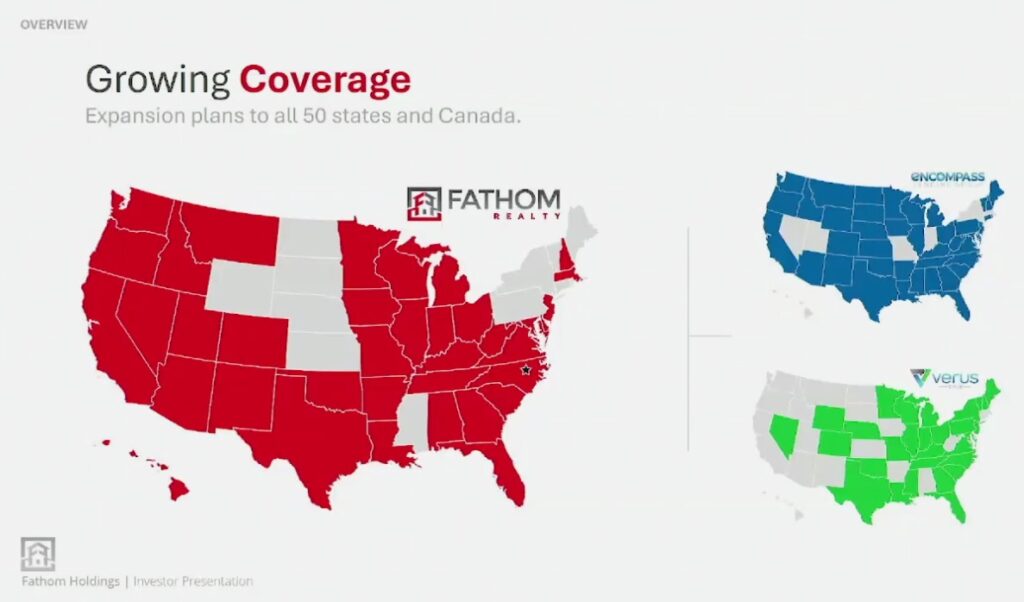
Fregenal said the company’s real estate brokerage, Fathom Realty, plans to be operating in all 50 states by mid-2025.
“Probably the biggest states that we’re not in are New York and Pennsylvania, but Pennsylvania actually is open already,” he said. “New York will probably be open within the next 60 days. And then after that, we’ll cover the rest of the country. We’ll probably expand into Canada sometime next year as well.”
It’s a similar story for Fathom’s mortgage business, Encompass Lending Group, which Fregenal said “will cover the whole country, with probably the exception of New York,” by the end of next year.
“If you’re from New York, I apologize, but mortgage in New York is a nightmare” from a regulatory standpoint, Fregenal said.
Fathom’s title insurance business, Verus Title, is also jumping through regulatory hurdles in “three or four states, but must likely we’ll cover 45 or 46 states” next year.
After going public in 2020, Fathom acquired North Carolina-based Verus Title for $1.7 million, — $700,000 in cash, and $1 million in Fathom stock, the company later disclosed.
In April, Fathom launched a new joint venture, Verus Title Elite Texas LLC, with individual teams and top-producing Fathom agents throughout Texas. Fathom said it plans to have joint ventures in most of the states where its Verus Title subsidiary operates by the end of next year.
Two months later, Verus Title announced it had boosted its coverage area in three states with Fathom’s acquisition of Utah-based LW Traveling Title.
Annual meeting
At the company’s annual meeting on Aug. 19, Fathom Holdings shareholders approved a proposal to increase the number of shares reserved for employee stock incentives by 1.6 million shares, boosting the number of shares set aside for incentives by 28 percent, 7.36 million.
Founder Josh Harley, who stepped down in November as CEO and a board member, remains the largest individual shareholder in the company, Fathom said in providing advance notice of the annual meeting. As of June 21, Harley owned 4.5 million shares, constituting 21.5 percent of outstanding common stock.
Harley’s father-in-law and former board member Glenn Sampson owned 7.4 percent of the company, or 1.6 million shares, followed by Fregenal, whose 1.3 million shares amounted to a 6.4 percent ownership stake in the company.
Other shareholders owning 5 percent or more of the company are AWM Investment Company Inc. (8 percent) and Cannell Capital LLC (7.9 percent).
Sampson, who was named to Fathom’s board in 2019, was one of Fathom’s earliest investors. Having turned 83, Sampson decided not to run for re-election to the board in August. The board elected to downsize from seven to six members, with the remaining directors reelected to one-year terms.
Fathom Holdings board of directors
Marco Fregenal

Marco Fregenal
Fregenal, who before replacing Harley as CEO last year had served as Fathom’s CFO and COO, was named to Fathom’s Board in 2019 and is credited with diversifying the company’s market presence, developing its technology, and completing multiple acquisitions.
Scott Flanders

Scott Flanders
A CPA and former CEO of companies including eHealth Inc., Freedom Communications and Columbia House Company, Flanders has served on Fathom’s board since August 2022. He also serves on the board of directors of Deepwell Inc., 890 5th Avenue Partners and 200 Park Avenue Partners.
Ravila Gupta

Ravila Gupta
As the CEO of Bagchi Group Inc., Gupta leads the company’s efforts to provide business strategy, financial services, and board and executive coaching support to clients. Named to Fathom’s board in March 2021, she also serves on the board of Marsh Cabinets, a privately held cabinetry company, and holds an advisory board role at Primo Partners LLC, a real estate and Ben & Jerry’s franchise development company.
David C. Hood

David Hood
An audit partner at Ernst & Young from 2005 until his retirement in 2015, Hood has served on Fathom’s board since May 2019. As an executive at contract research services provider IQVIA Holdings Inc. from 1993 to 2000, he helped take the company public. A CPA, Hood has experience in taking organizations public, raising capital and mergers and acquisitions.
Stephen Murray

Steve Murray
A co-founder, partner and senior advisor at REAL Trends Consulting Inc. and senior advisor to HW Media, Murray joined Fathom’s board in July 2023. Murray’s “extensive experience in the residential and brokerage industry” qualifies him to serve on the board, Fathom said.
Jennifer B. Venable

Jennifer Venable
As vice president and general counsel at Capitol Broadcasting Company for 11 years, Venable has experience with complex legal issues, corporate governance, international business and project management. Before being named to Fathom’s board in February 2019, Venable was general counsel at Alfresco Software Inc. and also served as commercial counsel and senior partner manager of Red Hat Inc.
Get Inman’s Mortgage Brief Newsletter delivered right to your inbox. A weekly roundup of all the biggest news in the world of mortgages and closings delivered every Wednesday. Click here to subscribe.
Email Matt Carter
by Makenzie Green | Sep 9, 2024 | Industry, News Feed
This report is available exclusively to subscribers of Inman Intel, the data and research arm of Inman offering deep insights and market intelligence on the business of residential real estate and proptech. Subscribe today.
The Aug. 17 deadline has come and gone, and on the surface, real estate professionals report it’s been mostly business as usual — even if there have been a few more headaches for everyone involved.
Listing clients are still overwhelmingly agreeing to cover the buyer’s agent commission. And few homebuyers are negotiating lower-than-usual commission rates with their buyer’s agent.
But under the surface, some agents and brokers were already reporting interactions with clients that — if they continue to play out — could place downward pressure on commissions in the months and years ahead.
- 70 percent of real estate agent respondents to the latest Inman Intel Index survey either said that commissions have stayed the same as a percentage of the purchase price since the Aug. 17 deadline, or that it’s too early to tell.
- But another 28 percent of agents say they’re already observing a downward trend in commissions as a percentage of the purchase price since the deadline, compared to fewer than 3 percent who said commissions had gone up.
What’s been behind this rising sense of angst over commissions? Intel sought to find out.
From Aug. 19-30, Intel asked 779 real estate agents, brokers and other professionals a series of detailed questions about their interactions with buyers and sellers, how their local MLS has handled the switch, and other topics related to the post-deadline environment.
Their responses suggested there has been little change so far. But a growing number of buyers and sellers are seriously inquiring about their options. And the agents who field these questions the most lately have seen their seller clients increasingly take a hardline stance.
Intel explores the effect this may have on the future of the industry.
Expectation game
When more than 1 in 4 respondents to a survey of this size say they’re seeing commissions dropping already, it’s not immediately clear what specifically that looks like.
Some of these responses were submitted mere days after the change, when many agents had likely not conducted a new transaction themselves.
In some cases, these respondents may be talking with fellow agents, reading accounts of buyer negotiations, or taking in other information that appears to confirm their prior expectations.
- In the weeks immediately prior to the deadline, 42 percent of agents told Intel they expected real estate commissions to drop at least slightly as a result of the change.
With so many agents expecting a drop in commissions from the start, it would make sense if some responded overly strongly to signs of falling commissions now.
That’s why Intel asked a more detailed series of questions to get to the bottom of how agent client relations — in the form of buyer contracts, listing strategies, and more — have shifted in recent weeks.
Nuts and bolts
First off, Intel wanted to know: Now that the compensation field has been removed from the MLS, have agents been provided with a seller-concession field?
The answer, for most agents, is no.
- Only 28 percent of agent respondents told Intel that their MLS now offers a field in which listing clients can signal their willingness to cover the buyer-side commission.
- Of that group, fewer than half — amounting to a mere 12 percent of all agent respondents — say that they see these fields used frequently.
So how are buyer’s agents confirming whether a listing covers the buyer-side fee or not? Mostly, by placing a lot of extra calls, Intel found.
- 63 percent of agents say they have been reaching out to their listing counterpart to confirm the seller’s position on the buyer-side commission, when possible.
- 21 percent of agents say they have not reached out to the listing agent in advance and instead have encouraged their clients to submit an offer that entails the seller will cover their commission, then learning the seller’s position as a part of normal negotiations.
- Only 5 percent said they were still primarily relying on the MLS — including any potential seller-concession field — for signs of the seller’s willingness to cover the buyer fee.
The result? Agents are overwhelmingly still taking steps to confirm these details. Those conversations are just no longer happening on the MLS. And it’s leading to extra calls, texts and emails between agents that otherwise might not have been necessary.
More interesting, perhaps, is what Intel learned about how the changes are affecting conversations with clients.
A relationship altered
Beginning in August, Intel introduced a list of recurring questions to its survey that will help track the evolution of the agent-client relationship in this new environment.
The new questions are designed to track how quickly — if at all — clients are changing their behavior to react to some of the provisions of the settlement.
Through these questions, Intel also hopes to track how much downward pressure real estate commissions undergo from month to month.
- Over the three-month period ending in August, 76 percent of agents told Intel that none of their prospective buyer clients tried to negotiate a lower commission than what is typical for their market.
- A greater share, 79 percent, said that none of their signed agreements with buyer clients featured a commission below what’s typical for their market over the same period.
Still, a small number of agents did report a significant chunk of clients had negotiated below-market commissions in recent months.
- Just over 10 percent of agent respondents said that more than 1 in 10 of their signed buyer contracts in the last three months were at below-market commission.
- About 6 percent of all agents said that more than half of their buyer contracts came in at below-market commission.
On the other side of the transaction, agents are already fielding tons of questions from potential seller clients.
In most cases, agents are successfully talking their sellers into covering the buyer-side commission as a means of making the listing attractive to buyers.
But already, there are signs of cracks in this longstanding practice.
- Only 36 percent of agents told Intel that none of their prospective seller clients have inquired whether they are obligated to cover the buyer commission over the past three months.
- Another 35 percent of agents say that at least 1 in 10 of their seller clients have asked about this, including 21 percent of all agents who said at least half of their sellers are asking these questions.
This means most agents aren’t yet dealing with this in a majority of their conversations with seller clients. And for this group, most are able to convince clients to take the traditional approach of covering the buyer’s fee.
- Over the last three months, 73 percent of agents told Intel that none of their seller clients actually took a hard-line approach against covering the buyer’s agent commission.
- 11 percent of agents said at least 1 in 10 of their sellers took such a hard-line approach, including 5 percent of all agents who said this made up more than half of their seller clients.
But when an agent is bombarded with questions from a majority of their sellers, the results start to look quite different.
- Of the agents who reported “more than half” of their recent sellers have inquired about whether they are required to cover the buyer-side commission, only 38 percent said that none of their sellers actually went forward with a hard-line approach.
- 34 percent of this group that has been bombarded with client questions said at least 1 in 10 sellers took the hard-line approach, including 22 percent of all agents who said more than half of their sellers actually went forward with this position.
Clearly a small number of agents are dealing with more questions from listing clients, and potentially having a harder time convincing sellers to stick with the traditional approach.
Intel will continue to track these trends in the months to come.
Methodology notes: This month’s Inman Intel Index survey was conducted Aug. 19-30, 2024, and had received 779 responses. The entire Inman reader community was invited to participate, and a rotating, randomized selection of community members was prompted to participate by email. Users responded to a series of questions related to their self-identified corner of the real estate industry — including real estate agents, brokerage leaders, lenders and proptech entrepreneurs. Results reflect the opinions of the engaged Inman community, which may not always match those of the broader real estate industry. This survey is conducted monthly.
Email Daniel Houston
by Erin Krueger | Sep 9, 2024 | Industry, News Feed
Whether it’s refining your business model, mastering new technologies, or discovering strategies to capitalize on the next market surge, Inman Connect New York will prepare you to take bold steps forward. The Next Chapter is about to begin. Be part of it. Join us and thousands of real estate leaders Jan. 22-24, 2025.
What happens to a “power buyer” when buyers have the power?
Tim Heyl, CEO of the Austin-based power buyer Homeward, has an answer.
The company had to rapidly scale to meet the demand for cash offers in 2020 and 2021, when homes sold quickly, garnered multiple offers and went for over asking price.
Demand for companies to turn consumers into so-called power buyers spiked as homebuyers sought ways to edge out multiple competing bidders on homes. Homeward adjusted to meet the need.
During that same market, Homeward gave homeowners the flexibility to buy their next home before selling their existing one.
That all largely froze when interest rates spiked in 2022 and 2023, and homeowners remained rate-locked in their existing homes, unwilling to take on the added cost of buying even a less-expensive home.
Heyl said Homeward shifted to give homeowners an instant cash offer, the certainty to close within days, and the ability to receive full price for their homes in exchange for an administrative fee.
It’s an alignment of interests that’s distinct from traditional iBuyers who have struggled to achieve consistent profitability in a variety of market types, Heyl said.
Heyl will be on stage at the inaugural Inman Connect Austin next month. He met with Inman this month to dish on how Homeward shifted in the high-rate, low-sales environment to meet the needs of sellers in a buyer-friendly environment.
The following interview has been edited and condensed for clarity.
Inman: The last time we talked was December 2022. It’s been an interesting 18 months. Tell me where your mind is at right now. How have the past 18 months been and what are you looking forward to?
Heyl: This huge need for a first-time homebuyer to make an all-cash offer declined fast. The other challenge is that for existing homeowners who need to buy and sell simultaneously, that’s typically not a buyer’s market or seller’s market problem. That’s a liquidity problem that exists in all markets.
There’s one very unique market where it doesn’t exist as much, and that’s when interest rates change as fast as they did; it sort of just froze that buy-sell customer or buy-sell consumer in the marketplace. It became more expensive to buy a less expensive home. For most of these buyers to move down was actually more expensive. There’s no incentive to do that.
And then, to move up costs so much more than what it used to that these move-up and move-down customers just kind of froze in the market. So you saw a lot of power buyers who were helping buyers buy; those products declined in demand.
On the other side, you saw something different with the iBuyer model in that when the market softened, the demand from a seller for a reasonable cash offer skyrocketed because homes are taking longer to sell. Sellers were less certain of if they would sell their home at all. And if they did, what price would it sell for? It became months and months of going through this process.
So how did you adjust?
Homeward launched another product into the market; it’s the Homeward Cash Offer for Sellers. What we realized is that while the trade up and trade down customer is sitting on the sidelines right now, there are still 4 million transactions a year happening. And a lot of these sellers, they’re just selling. They’re not trying to buy another home simultaneously.
We wanted to be able to bring an offer to these sellers to fill that gap in the marketplace that I just described. We knew that we needed to be able to protect our risk. We can’t go in and make a full-price offer. But we also know that sellers don’t want to give all their money away. The majority of their net worth is tied up in their home equity.
We’ll buy their house and we’ll cash the seller out just like an iBuyer would, in a matter of days. After they move out, we’ll go and get the home ready in its best-selling condition and work with their real estate agent to sell the home on the open market for its full price. When we do resell it for its full market value, we pass all of those upside proceeds back to the seller.
What’s the upside for Homeward?
It’s kind of the best of both worlds. It’s the seller’s ability to generate a cash offer on demand and sell in a matter of days, get most of their home equity, and move on and not have to deal with repairing the house and going through a multi-month sale process. But it’s paired with all of the benefits of a traditional market sale with their real estate agent actually going and getting that full market price.
The sellers pay us a transaction fee in order to provide this service for them. We charge a 6 percent fee. So unlike an investor who is flipping the house and trying to monetize the home price appreciation or the bulk of the equity in the home, we’re simply charging a service fee, cashing them out of their home, and going out and getting them their full market value on the back end after they’ve moved out.
What happens if a house doesn’t sell or doesn’t hit the price point that you were expecting? Is it the seller that’s on the line to make up the gap, or what happens in that situation?
When we buy the seller out of their home, they never have to bring any more money to the table. So they’ve cashed out and their certainty of sale is done.
But we buy the home at a discount to create a buffer to make sure that the home is going to sell above that price. And so, if it sells below that discounted offer that we initially made, then, you know, then that’s a loss that Homeward will take.
It’s very rare. We do take that discount up front. But all of the upside, whether it sells for the amount that Homeward thought it would sell for or more than that amount or less than that amount, whatever those upside proceeds are, they do go back to the seller.
This seems distinct from traditional iBuyers, and I wanted to ask you about them, generally. They struggled to make a profit when things were hot. They’re struggling when things are cold. Will they ever have a Goldilocks moment?
You have to align incentives between the business and the customer. Some of these models that exist today don’t align those incentives. With an iBuyer model, the higher the cash offer, the better it is for the consumer, but the more risky and less profitable it is for the iBuyer. The lower the cash offer amount, the worse it is for the consumer, but the better it is for the iBuyer. They’re at odds.
It’s an investor buying a house from a consumer. You know, it’s an investor flipping somebody’s house and taking their upside. And so the challenge is there was incredible demand when the iBuyers were paying full market price.
And so the challenge is for these companies, can they find a spread that is good for the consumer, good for the seller and good for their economics? I think we’ve yet to see that.
On the ground, I see headlines where it’s like Austin’s at the top, Boise’s next. There are these pandemic-era darling markets that now are also at the top for the inverse reason. Give me a little flavor of Austin as an agent.
I just took a listing. A $3 million, $3.5 million home in central Austin. In that neighborhood, there are 25 homes for sale between $2.5 million and $4.5 million. There’s one home that’s pending in that price point in that neighborhood — 25 for sale, one pending.
That’s a bit of an extreme. Austin is a bit of an extreme in and of itself. But this is the challenge that we’re living in. This is the challenge that homesellers are increasingly having.
Austin is, without question, one of the more challenging markets across the country because it boomed really fast. Like with most things that go up, they come down, and Austin is definitely paying the price for how fast it grew.
It reminds me of 2009, when I first got in. Taking a listing in 2021 was exciting as a real estate agent because you knew you were going to make some money. Now, in 2024, you take a listing and it doesn’t exactly mean you’re going to make some money. It means you better go do your job and price it right and go get the thing sold because many of the homes that are listing are not actually getting offers and not actually selling.
Email Taylor Anderson
by Troy Palmquist | Sep 9, 2024 | Industry, News Feed
Land and ranch living has never been more appealing to consumers, and the highest standard in ethics and professionalism has never been more sought after. Since 2020, the migration of urban dwellers seeking open, natural spaces has continued, sparking a new wave of clientele and a need for specialized land and ranch expertise among real estate professionals.
Ranchers, land advocates, sporting enthusiasts and agriculture experts themselves, Engel & Völkers Land and Ranch Group is a network of advisors specializing in the purchase and sale of working, recreational and residential ranches. These advisors lend a level of first-hand expertise to this nuanced sector of real estate for unfamiliar buyers and are skilled at representing all types of properties, from legacy ranch operations and sporting/recreation retreats to income-producing agricultural operations and unimproved land.
Equally as important, they understand the complexities associated with the purchase and sale of land and ranch properties. These can include any changes or potential changes in natural resources and conditions, relevant state and federal regulations, local infrastructure and amenities, and applicable due diligence issues such as water and mineral rights, environmental impacts and more.
Experience in owning, managing and selling land and ranch properties is a must to best serve this clientele. But there is also another intangible “Code of the West” that applies to today’s land and ranchers, as it should to all real estate professionals, just as much as it does to the cowboys and ranchers who’ve long lived by this unwritten standard of ethics. For those who genuinely inhabit and embrace the land and ranch community, these rules are truly a way of life and really boil down to trying to do what’s right in every situation.
Here is a modern-day Code of the West for land and ranch real estate professionals:
- Live each day with courage. Never be afraid to tell a seller the truth about the value of their property or to tell a buyer that a property may not be right for them. While land may appear to be simple, being a responsible steward and protecting its value can be very complex. This responsibility often involves proper staffing, management and collaboration with neighbors who share the landscape and its resources.
- Take pride in your work. Do sweat the details and present information in a clear, concise and professional manner.
- Always finish what you start. Leave no detail to chance, find the answer to every question and ride through the challenges. It will pay off.
- Do what has to be done. There is an ethos among ranchers to roll up their sleeves and do what it takes to get the job done. Not every deal, client or property is easy to navigate. Land and ranch advisors will do whatever it takes to get a listing ready to market or to find the right buyer.
- Be tough but fair. Advocate for your clients and customers through principled negotiation.
- When you make a promise, keep it. Honor the commitments you make to all parties in and around a transaction – whether to the buyer, seller, cooperating broker or neighbor.
- Ride for the brand. Be true to your core values and align yourself with a company and colleagues who stand for the same. Collaborate with them to level up your business.
- Talk less, say more. Find value in every word you hear, and deliver value in every word you speak. Realize that you say more by doing rather than talking.
- Know where to draw the line. Don’t be afraid to walk away from a transaction or person that diminishes your worth.
- Remember that some things aren’t for sale. Enough said.
Led by ranchers who truly understand and embody the value, legacy, future and nuances surrounding the complexities of land and ranch properties, the Engel & Völkers Land and Ranch Group brings invaluable expertise to these one-of-a-kind properties with an unmatched, down-to-earth approach.