by Darryl Davis | Sep 10, 2024 | Industry, News Feed
Whether it’s refining your business model, mastering new technologies, or discovering strategies to capitalize on the next market surge, Inman Connect New York will prepare you to take bold steps forward. The Next Chapter is about to begin. Be part of it. Join us and thousands of real estate leaders Jan. 22-24, 2025.
Pulse is a recurring column where we ask for readers’ takes on varying topics in a weekly survey and report back with our findings.
For so many reasons, communicating just seems to be harder these days. Some of us got out of face-to-face communication practice during the pandemic and never regained that gift of gab. For others, the commission lawsuit settlement has left us tongue-tied and unsure about what we can say, should say or absolutely need to avoid saying. It’s making for some pretty bad communication moments.
via GIPHY
That’s why we wanted you to tell us about the big communication blunders you’re seeing now. Are agents stumbling over post-settlement talking points? Are they struggling with real-life versus online communication? Is everyone texting when a phone call would be better? Let us know below:
We’ll compile a list of the top responses and post them on Inman next Tuesday.
by Debra Trappen | Sep 10, 2024 | Industry, News Feed
Both companies help investors find, lease-up and simplify the acquisition of rental property. There are differences in each company’s approach, but its focus on financing attracted Doorvest to Getaway.
Whether it’s refining your business model, mastering new technologies, or discovering strategies to capitalize on the next market surge, Inman Connect New York will prepare you to take bold steps forward. The Next Chapter is about to begin. Be part of it. Join us and thousands of real estate leaders Jan. 22-24, 2025.
Software-powered real estate investing platform Doorvest has bought category competitor Getaway for an undisclosed sum, Inman has learned.
Both companies help investors find, lease-up and simplify the acquisition of rental property. There are differences in each company’s approach, but its focus on financing attracted Doorvest to Getaway, according to a Sept. 10 press release.
“Through this acquisition, Doorvest will now be able to offer customers a truly end-to-end experience with the launch of Getaway’s financing products,” the release stated.
Doorvest provides a suite of web and mobile tools to aid users in sourcing, analyzing and acting on rental property opportunities. Its software offers annual revenue projections, expense tracking, renovation management and a number of other resources typically assembled by an investor from a range of fragmented systems and products.
Doorvest is planning to launch a lending product, according to the release, which led to the Getaway deal. Part of the latter’s services include connecting investors to financing sources, including taking their own stake in a property that they aim to hold for five years. The buyer can then refinance with a new loan or pay Getaway directly.
“These products have armed real estate investors with the tools to expand their portfolios and we’re eager to offer this to current and future Doorvest customers,” said Andrew Luong, CEO and co-founder of Doorvest in a statement. “With the addition of financing capabilities, we’ll further streamline every step of the investment journey and provide our customers with a seamless and fully integrated experience that empowers them to achieve their financial goals.”
Financial technology, or fintech, is helping flatten and simplify the traditional real estate investing process. With secure digital conduits between personal bank accounts and the regulated mechanisms that drive sophisticated investing, it’s quickly become much easier for non-accredited investors (net income below $200,000 annually) to secure a stake in property. For example, Here, Landa, Arrived and Groundfloor are other apps aiming to make it easier to own income real estate.
Getaway states it has 34,000 investor customers.
“At Getaway, we’ve always been driven by the mission to make real estate investing more accessible,” said Ali Nichols, CEO and co-founder of Getaway, in the release. “Combining forces with Doorvest allows us to expand our impact, offering a broader range of solutions to help more people diversify into real estate. Together, we are simplifying the investing process and enhancing consumer choice, setting a new standard in the industry.”
Email Craig Rowe
by Matt Carter | Sep 10, 2024 | Industry, News Feed
Whether it’s refining your business model, mastering new technologies, or discovering strategies to capitalize on the next market surge, Inman Connect New York will prepare you to take bold steps forward. The Next Chapter is about to begin. Be part of it. Join us and thousands of real estate leaders Jan. 22-24, 2025.
At long last, the commission lawsuits saga appears to be entering a new chapter. The big names have settled, new rules have rolled out, and while unknowns remain, the big question of yesteryear — Will the industry bend? — has been answered (the answer was yes).
But that doesn’t mean the fight over real estate rules is over. Enter Clear Cooperation.
Clear Cooperation is a National Association of Realtors policy that requires agents to put their listings into their NAR-affiliated multiple listing service. The policy’s goal was to crack down on “pocket listings,” which are properties that get marketed privately, but it has been polarizing from the get-go. Some heralded it as a way to improve equal access to housing, but others have criticized it as legally dubious or an example of micromanaging.
The policy was somewhat eclipsed as a headline-grabber during the height of commission lawsuit litigation. But later this week, an NAR committee will return to the policy to begin considering whether it needs to change — or even end entirely.
It remains to be seen what may come of this meeting. But Clear Cooperation remains a central focus of federal regulators, it’s still polarizing in the industry, and with other antitrust litigation moving into the rearview mirror, it may represent the next and biggest frontier in the fight over the future of real estate. In other words, it is quickly becoming an issue du jour when it comes to questions over how agents live, work and get paid.
What exactly is happening now?
The upcoming NAR meeting will take place in Chicago on Thursday and Friday and will include the organization’s Emerging Issues Advisory Board, which is a subgroup of NAR’s MLS Committee. The board includes 23 members who work as brokers, MLS executives and in technology, among other things. The meeting is closed to the public, but the board can invite interested parties to submit comment.
The meeting could lead to a variety of outcomes. The board could, for example, opt to send the issue to the MLS Committee to take some sort of action or to another governing body within NAR. It could also choose to continue gathering information, including but not exclusively during its upcoming NAR NXT conference, which will take place in Boston.
The board meeting consequently does not guarantee any particular outcome but is effectively a first step if change of some sort were to eventually take place.
In anticipation of the meeting, the WAV Group conducted a survey on Clear Cooperation in recent days. The survey elicited 670 responses from members of brokerages, MLS leadership and MLS staff. According to a statement on the survey, 28 percent of respondents recommended keeping the rule as-is, while “the majority want to change or remove the policy.”
“Interest in removing the policy completely or making it optional and reworking it differed between MLSs and brokerages,” the WAV Group further reported. “Fifty-one percent of brokerage respondents recommended removing the policy. Forty percent of MLS respondents suggested making the policy optional and/or reworking the policy, the predominant answer for MLS leaders and staff.”
A history of polarization
This week’s meeting comes nearly five years after NAR adopted Clear Cooperation via overwhelming support from the organization’s board. The rule specifically states that “within one (1) business day of marketing a property to the public, the listing broker must submit the listing to the MLS for cooperation with other MLS participants.”
However, despite the broad support from NAR’s board, Clear Cooperation has been polarizing. Some industry heavyweights, such as Chicago area-based MLS Midwest Real Estate Data (MRED) and Bright MLS, publicly backed the policy in 2019. Redfin CEO Glenn Kelman was also a prominent voice in favor of cracking down on pocket listings and passing Clear Cooperation.
But other industry figures did not support the rule. They included the Austin Board of Realtors (ABoR) MLS, as well as prominent brokers such as Mauricio Umansky and Gary Gold — the latter of whom argued against a pocket listing ban by saying agents should not be “treated like children.”
Much of the debate in 2019 centered on issues of privacy versus equitable access to housing. On the one hand, agents such as Gold argued that homesellers were entitled to keep their homes and identities out of the public eye. They also argued that agents should be allowed to market properties as they see fit.
However, others argued that by keeping listings private, some consumers — especially minorities and those without powerful social networks — were effectively blocked from considering certain homes or neighborhoods. Proponents also argued that consumers generally benefit from having all listings available to them in one place.
One of the other lingering questions surrounding clear cooperation is whether or not the policy is actually effective. So far, the results appear mixed.
Two years after NAR approved Clear Cooperation, for instance, Inman reported that pocket listings remained common despite Clear Cooperation. Redfin found similar results, revealing in December 2021 that 43 percent of agents felt pocket listings had actually become more common in the wake of Clear Cooperation’s adoption. Nearly two years later, in 2023, Redfin Senior Director of Operation Joe Rath told Inman Clear Cooperation could be backfiring.
Last week, Inman reached out to Jonathan Miller — president and CEO of Miller Samuel, Inc. — who tracks pocket listings in Los Angeles. Miller has found that such listings do appear to be trending downward as a share of overall listings.

Credit: Jonathan Miller
However, when asked about the cause of this downward trend, Miller pointed to a softer market and L.A.’s so-called “mansion tax.” Which is to say, it’s unclear what relationship the waning of pocket listings in Los Angeles has to Clear Cooperation specifically.
A key part of the industry’s ongoing legal saga
Clear Cooperation was somewhat overshadowed recently by NAR’s now-defunct Participation Rule, which required sellers’ agents to offer compensation to buyers’ agents. That rule was a centerpiece of numerous commission lawsuits. That litigation and the subsequent settlements led to new NAR policies and the end of the Participation Rule.
However, one of the looming unknowns in the broader commission saga has been the U.S. Department of Justice — and the DOJ is very much interested in Clear Cooperation.
The DOJ is currently locked in a legal battle with NAR that began in 2020 with a lawsuit and simultaneously announced settlement. The DOJ later backed out of the settlement and resumed its investigation, focusing on both the Participation Rule and Clear Cooperation. This legal battle is now potentially headed for the U.S. Supreme Court. Critically, the Participation Rule is now gone but Clear Cooperation is not, setting the stage for further wrangling over the issue.
Clear Cooperation is also the subject of other legal action. Private listing networks The PLS.com and Top Agent Network (TAN) have both sued over the policy. Last month, a court set a Nov. 3 trial date in TAN’s case. Clear Cooperation is additionally a part of Homie’s lawsuit against NAR.
Battle lines are drawn
A number of key players have weighed in on the issue recently.

Robert Reffkin
One of the most prominent is Compass CEO Robert Reffkin, who used his company’s most recent earnings call to describe the policy as “anti-homeowner” and a “killer of value.” Reffkin also argued Clear Cooperation is ultimately doomed, pointing to litigation over the issue.
Last week at a RISMedia event, Reffkin reiterated criticism of Clear Cooperation, describing the policy as “forced cooperation” and urging NAR to repeal it.
Compass additionally told Inman that it is one of “nearly 70 brokerages” that are calling for the repeal of Clear Cooperation.
Inman reached out to a sampling of companies and individuals that may oppose Clear Cooperation, but those that responded declined to comment on the record. However, part of the argument against the rule appears to be that it hampers innovation and that it opens up the industry to further major and disruptive litigation.
The WAV Group survey identified similar issues, noting in a statement that “brokers interested in removing the policy were most concerned about getting named in another round of litigation.” The survey also found that support for removing Clear Cooperation was higher among larger brokerages.

Leo Pareja
But not everyone wants to jettison Clear Cooperation. For instance, eXp Realty CEO Leo Pareja also appeared at the RISMedia event and said he disagrees with Reffkin.
“I fundamentally believe in organized real estate and how it functions in North America,” Pareja said. “We have a complete, accurate, liquid marketplace, which is the beauty of the MLSs.”
When Inman reached out to eXp about the comments, the company provided a statement from Holly Mabery, senior vice president of broker operations, who said “a centralized platform like the MLS” will ensure “a comprehensive and robust marketplace.”
In an email to Inman last week, Consumer Federation of America Senior Fellow Stephen Brobeck spoke out in favor of Clear Cooperation.

Stephen Brobeck
“In most instances, it does not benefit sellers or buyers for a broker to only promote listings within their own agency,” Brobeck said. “Sellers are likely to receive a lower sale price, and buyer choice is restricted to a limited group of properties.”
Brian Boero, CEO of real estate branding and strategy company 1000Watt, also weighed in via a blog post on Friday. Boero expressed support for the policy, arguing that Clear Cooperation “should stand, and be fought for.” But his commentary was also notable for breaking down battle lines in the debate. Companies such as Zillow, he argued for example, “have created big consumer audiences around MLS data and earn significant parts of their revenue by referring leads to buyer agents.” According to Boero, they have an incentive to preserve Clear Cooperation.
On the other hand, whether brokerages benefit or suffer from the rule depends on their structure, Boero said.

Brian Boero
“A brokerage like Compass has concentrated market share in several key areas,” he argued. “Keeping more listings private will create more in-house deals for them. Other big brokerages, especially those that are virtual, like eXp, have broad market share — lots of agents spread relatively thinly. In-house networks aren’t as powerful for them, and they are therefore more likely to support leaving [Clear Cooperation] in place.
Boero also wrote that MLSs may support Clear Cooperation because “they do not want yet another piece pulled from their Jenga tower.”
Time will tell if pressure to change Clear Cooperation ends up amounting to anything. But Boero’s analysis highlights the way the issue intersects with different parts of the industry in different ways. And that means pressure to change is unlikely to abate any time soon.
Email Jim Dalrymple II
by Richelle Hammiel | Sep 10, 2024 | Industry, News Feed
Whether it’s refining your business model, mastering new technologies, or discovering strategies to capitalize on the next market surge, Inman Connect New York will prepare you to take bold steps forward. The Next Chapter is about to begin. Be part of it. Join us and thousands of real estate leaders Jan. 22-24, 2025.
Many clients may prioritize emotional connections when hunting for resale homes, but Harrison Polsky of The Polsky Porpino Team at Douglas Elliman takes a deliberate, data-driven approach, focusing his team’s efforts on newly-built properties. This approach is one that few have caught on to, and Polsky uses that to his advantage.
As principal of Douglas Elliman’s leading team in the Dallas-Fort Worth (DFW) metroplex, Polsky leverages his commercial real estate background and residential expertise to provide innovative solutions and top-tier service, fostering long-term client trust.
In a recent conversation with Inman, Polsky shared insights on his sales approach, artificial intelligence (AI), the upcoming election and his plans for Inman Connect Austin in October.
Below is the conversation, edited for brevity and clarity.
Inman: Inman Connect Austin is just over a month away. Do you know what you will be focusing on? Is there anything that you are looking forward to?
Polsky: The topic of my panel is Channeling Market and Economic Forecasts to Attract More Clients. It’s a very broad topic that can go in 20 different directions. A couple of other colleagues of mine will be speaking as well, so I’ll be going into some other panels.
Over half of The Polsky Porpino Team’s sales are from newly constructed homes. Could you share the reasons behind your team’s emphasis on new builds?
I come from a commercial background and work for some of the largest developers in Texas, so I understand that process better than I do resale clients. When I started growing the team, I was looking for agents in that space or people who worked for larger corporations, like Toll Brothers or Lennar, that were salespeople for them because that’s what they understand as well.
There has not been a team that I know of in Texas that has geared towards that one side of the business, and I saw an opportunity there to capitalize on that. I thought, if I can gather a group of individuals who understand that space, I can train them down the road and have a team that holds market share on new construction, which is what we do.
It’s closer to 95 percent of our sales, so of our $140 million that we do a year — next year, we’re slated for $225 million — 95 percent of that is new construction. That’s the service that we offer to builders, which gives us a competitive advantage against other agents because we have so much insight into the market space.
With the influx of people moving within your market leading to a tight inventory supply, is there hope that the market will find balance, and how does that happen?
There are two answers here that need to be understood about balance. DFW is a major metroplex. The data is pooled together in a way that I don’t find to be legitimate, and it skews things in all sorts of different directions.
For example: Dallas proper — Highland Park, Preston Hollow are about 40 minutes from Frisco, 40 minutes from Fort Worth, 30 minutes from South Lake. When we talk about relocation, it’s not all these people relocating to Dallas proper. Yes, Goldman is moving downtown and feeder companies, complementary companies to Goldman are moving near, bringing high-level executives. However, many others are moving up north to Frisco.
When you pull this data together with DFW looped into one data pool, it’s similar to taking Bronx, Queens, Yonkers, New Jersey and Connecticut, and saying that’s one market. There are still a lot of people moving here, but not as many as you think.
The second part of that conversation is the high-end luxury market where most of these people are moving to, whether it’s in Frisco or Dallas proper. For inventory to be released up, rates must drop to the mid- to high-$400,000s. For people to sell their house, they must be able to afford a new one. The problem is that these pockets are so small that most of the people who have been here and bought a house, in say, University Park, for $1.7 million, are not going to sell that house today for $3.4 million, then go buy the same house they just sold. They have to jump up to a different price point, which is going to be $6 million plus.
To do that, you would need to see “the golden handcuff rule.” They’re not only tied into their low interest rate; they have to be able to purchase something else. To loosen inventory up, you have to see places like Frisco thrive — more private schools up north and better public school systems.
AI has been adopted across various industries. Can you detail any AI tools or technologies that you currently employ, and tell me how those tools improve the client experience during your transactions?
I’ve never used AI to interface with my clients to help a transaction. If I’m in the car or on a run and I need to write an email, I’ll say, ‘Hey, ChatGPT this. Copy and paste this email. I need a response and this is the tone I’m looking for,’ which frees up about two hours. That way, when I get to the office, I’m ready to focus on something else.
When I’m trying to articulate to designers, architects or clients what a house is going to look like, there are multiple AI tools where I can say, ‘I need a modern, neoclassical house,’ and they’ll find around 40 different images for inspiration.
Are there any specific policies or proposals from [this year’s presidential] candidates that you believe could influence property values or demand?
We’re real estate people, so this capital gains tax, as proposed by Harris, is disastrous. It’s not going to get passed, so I’m not really worried about it. There have been multiple other California Democrats that have also agreed on that topic, that it would be disastrous to the economy and to entrepreneurs alike.
I don’t believe politics affects anything in our state. We are a pretty red state. We are pretty bullish on real estate, and we’re pretty good [on] taxes here.
Do you anticipate a slowdown or surge in real estate activity leading up to or following the election?
It’s always slow in every election a couple months before. It’s pretty standard after, depending on where you live. That will be geographically specific, but Dallas has always been a really strong economy, no matter who’s in the White House.
Austin seems to have a little bit more ebb and flow depending on that. Austin is heavy tech. Houston depends on that because of Houston’s oil-based economy. Dallas is not so dependent on one industry. If your tech guys are winning and your oil guys are losing, those people are buying and selling.
Have your clients expressed any concerns about the election’s impact on the housing market?
Everyone’s concerned when it comes to an election; that’s why there’s an election. Every four years, people are concerned about one thing or another.
When we talk real estate, we talk data and we talk numbers, and we keep there. Numbers don’t lie, emotions do, so, therefore, that’s what I stay focused on. We work with projections, we look at models, and that’s what we make decisions based on. I don’t make decisions based on which way the wind’s blowing and how I feel today about what someone said on CNBC or CNN or Fox News. I don’t think that’s smart.
Email Richelle Hammiel
by Juston Martinez | Sep 10, 2024 | Industry, News Feed
Whether it’s refining your business model, mastering new technologies, or discovering strategies to capitalize on the next market surge, Inman Connect New York will prepare you to take bold steps forward. The Next Chapter is about to begin. Be part of it. Join us and thousands of real estate leaders Jan. 22-24, 2025.
There’s a lot of confusion around the particulars of the National Association of Realtors (NAR) commission lawsuit settlement and the resulting business practice changes. Compliance expert Summer Goralik is here to help clear up some of the looming questions so that we can move forward together as an industry.
Read the entire series.
This week’s question
How is hiding an offer of compensation from the seller in the MLS supposed to make things more transparent?
Compliance expert answer
Before diving into how removing compensation offers from the multiple listing service (MLS) relates to transparency, I want to share an analogy that I can’t seem to shake.
With the new practice rules, changing guidance, and diverse opinions on how agents should comply or proceed, it reminds me of an early computer game called “The Oregon Trail.” This educational game required players to make decisions that impacted their journey westward. Choices like which supplies to take or how to cross a river determined whether you survived, leading to a variety of outcomes.
Similarly, in the post-National Association of Realtors (NAR) era, today’s Realtors face a complex time in the industry, filled with critical decisions on how best to implement the new practice changes. But unlike a game, these choices directly impact their careers and livelihoods. With this in mind, let me address this week’s question from the beginning.
Communication, transparency and disclosure are the cornerstones of real estate compliance, grounded in the fiduciary duty that requires agents to put their clients’ interests above their own. These principles are key for maintaining client trust and professional integrity within the industry.
Good agents embrace these fundamentals not just because they’re required by law, but because they are committed to fulfilling their duties to their clients.
Given these standards, it’s understandable why recent changes stemming from the NAR settlement, particularly the removal of offers of compensation from the MLS, have sparked confusion and concern.
The NAR settlement, effective Aug. 17, 2024, mandates that listings in the MLS no longer include or display offers of compensation from listing brokers or sellers to buyer brokers or other buyer representatives.
As a result, MLSs have eliminated all broker compensation fields and related information from their platforms.
Many practitioners have questioned how this aligns with the goal of transparency about real estate commissions.
At first glance, it seems contradictory: How does removing compensation details from the MLS enhance transparency?
Some agents and brokers argue that this change directly undermines open communication and disclosure rather than prioritizing them. Others have raised concerns that replacing public offers of compensation on the MLS with private communications about commissions between agents could potentially lead to unethical conduct and fair housing issues.
Interestingly, Realtors may recall a prior lawsuit filed by the United States Department of Justice (DOJ) against NAR in 2020, which partially addressed the lack of disclosure of offers of compensation on the MLS.
Although the DOJ has since reneged on that agreement, the details of the complaint remain noteworthy. The Antitrust Division of the DOJ filed a civil lawsuit and proposed a settlement that required NAR to repeal or modify certain rules to provide greater transparency to homebuyers about the commissions offered to their brokers.
Notably, NAR could no longer recommend that their affiliated MLSs prohibit the disclosure of commissions offered to buyer brokers.
Fast forward to 2024, and as a result of the NAR settlement, we see a complete reversal with the demand to remove offers of compensation from the MLS entirely, along with new rules requiring buyer representation agreements before home tours and changes to existing commission structures.
Naturally, these changes have elicited a wide range of reactions from Realtors, and this week’s question is just one example of how licensees are trying to make sense of the new rules of engagement regarding real estate commissions.
But the dust has yet to settle, and it seems that the industry dialogue about these new practice rules — and how agents apply them — is continuing to evolve.
Initially, many Realtors questioned where offers of compensation could be made if they were no longer displayed in the MLS. Now, some are debating whether listing brokers and sellers should offer compensation to buyers’ agents in advance of receiving purchase offers.
The federal government’s push toward decoupling commissions is driving this conversation and reshaping the landscape of real estate transactions.
One revealing moment in this topic of discussion, previously reported by Inman, was a legal brief filed by DOJ attorney Jessica Leal in the Nosalek case in February.
Leal wrote, “The critical issue is not how much a seller should offer a buyer broker, but whether a seller should set buyer-broker compensation at all.”
Months later, and after the NAR settlement was proposed, Leal publicly commented that the DOJ would neither support nor oppose the agreement. She also stated that the DOJ did not want to see offers of compensation being made on the MLS or anywhere else.
Collectively, these remarks reinforce the DOJ’s position on the decoupling of commissions, where sellers negotiate their commissions with listing brokers, while buyers negotiate separately with their brokers. This standard of practice aims to support the competition the DOJ wants to see and believes has been historically absent in the real estate industry.
Considering this perspective, the removal of offers of compensation from the MLS isn’t about obscuring information or finding alternative ways to display commission splits; it’s about adhering to a more consumer-centric model where commission arrangements are negotiated independently by each party.
Under this dynamic, buyer-broker commissions are no longer predetermined by sellers or listing brokers.
Even if some agents and brokers don’t fully agree with this course of action, or choose to implement changes differently, they would be remiss not to consider this government guidance.
Speaking of regulators, there is one thing I know for sure: From my experience working as an investigator for the California Department of Real Estate, when a governmental entity tells real estate licensees what they believe is right and wrong or what compliance should look like, they are essentially giving stakeholders a preview of how they intend to enforce the law and regulate licensed activity.
Returning to the “Oregon Trail” analogy, Some real estate professionals might focus on preserving traditional practices, such as determining where to display cooperative compensation or how best to communicate buyer-broker commissions before submitting purchase offers.
Some may even devise workarounds that, if they’re fortunate, align with the NAR settlement; if not, they could put themselves and their brokers at risk.
In contrast, those adopting a more consumer-driven approach are figuring out how to communicate compensation and concessions with sellers and buyers in a way that complies with the decoupling of commissions.
Transparency about commissions in real estate will now stem from direct negotiations with clients, especially between buyer agents and their homebuying clients, rather than from historical arrangements that relied on offering cooperative compensation in the MLS.
It’s worth noting that, despite these two opposing strategies, the outcome could sometimes be the same — for example, the seller ends up paying the buyer broker’s compensation.
What sets them apart, however, is the path taken to achieve that result, which may involve different market forces, client needs and instructions, agent-client communications, advertising methods, brokerage policy, party negotiations and real estate documents executed by the buyer and seller.
Each method also carries its own set of risks, with potential implications for compliance, client satisfaction and legal outcomes.
Whatever changes licensees are advocating for in this evolving real estate environment, and considering that the best solution may not be as simple as choosing between two extremes, it’s crucial to identify the central compliance issues involved. Only then can they ask the right questions, analyze different solutions and make informed decisions.
Listen, if this were easy, all the noise about the commission litigation, the NAR settlement and practice changes would have surely died down by now. But it persists because the situation is neither entirely clear nor straightforward, and in my opinion, competing arguments about the path forward don’t help.
Even still, agents who thoughtfully consider the challenges at hand and understand the potential risks will be better equipped to identify opportunities, make smarter choices, and thrive.
Although it hardly needs reminding at this point, this is not a game — it’s a journey through significant changes in the industry, and agents’ choices will dictate their outcomes and success.
Editor’s note: Licensed real estate agents should always check with their responsible brokers for guidance, direction and policy regarding the new practice changes, and licensed real estate brokers would be wise to consult with a licensed attorney for legal clarification and support.
The opinions, suggestions or recommendations contained in this discussion are based on Summer Goralik’s experience working for, and knowledge of the laws enforced by, the California Department of Real Estate and must not be considered legal advice or relied upon as legal advice. You should consult with your brokerage, and/or appropriate legal counsel in your jurisdiction, for further clarification.
Summer Goralik is a real estate compliance consultant and former CA DRE Investigator in Huntington Beach, California. Connect with her on LinkedIn.
by Chris Morrison | Sep 9, 2024 | Industry, News Feed
Whether it’s refining your business model, mastering new technologies, or discovering strategies to capitalize on the next market surge, Inman Connect New York will prepare you to take bold steps forward. The Next Chapter is about to begin. Be part of it. Join us and thousands of real estate leaders Jan. 22-24, 2025.
A growing number of Americans expect mortgage rates and home prices to come down in the year ahead, but fewer than one in five consumers polled by Fannie Mae last month thought August was a good time to buy a home.
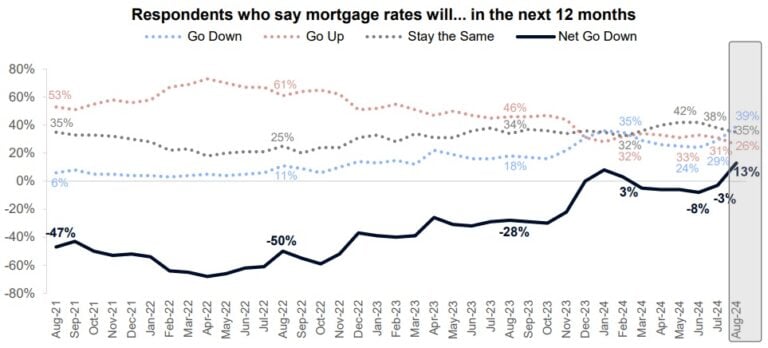
Fannie Mae’s latest monthly National Housing Survey, fielded Aug. 1-19 to 1,044 households, showed the net share of consumers who think mortgage rates will go down over the next 12 months shot up 16 percentage points to a new survey high.
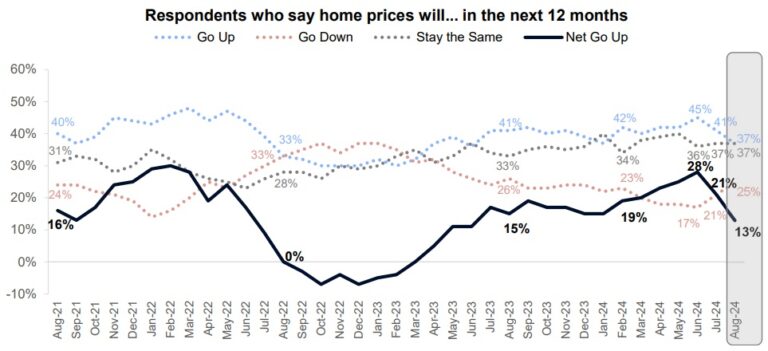
Most Americans still think home prices will keep rising or stay the same in the year ahead. But the net share who think home prices will go up fell by eight percentage points from July to August — an indication that consumers understand home price appreciation is decelerating in many markets and that prices have peaked in others.
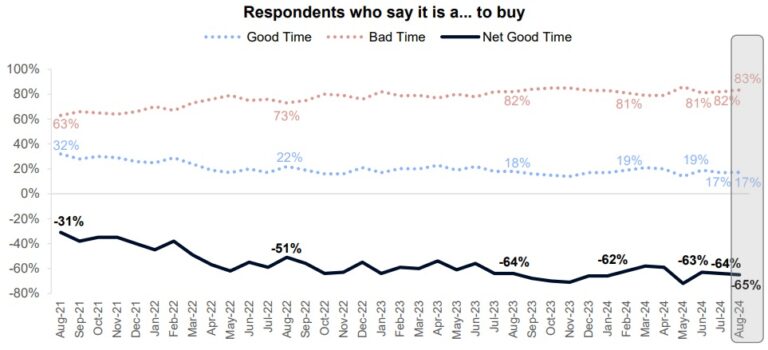
Despite growing optimism about the future, only 17 percent of renters and homeowners surveyed in August thought last month was a good time to buy a home — unchanged from July, and not much better than the all-time low of 14 percent seen in May.

Mark Palim
“Despite significantly greater optimism that mortgage rates and home prices will move in a more favorable direction for potential homebuyers, most consumers remain apprehensive about the housing market and continue to point to the lack of affordability and supply as the chief reasons for their pessimism,” Fannie Mae Deputy Chief Economist Mark Palim said in a statement.
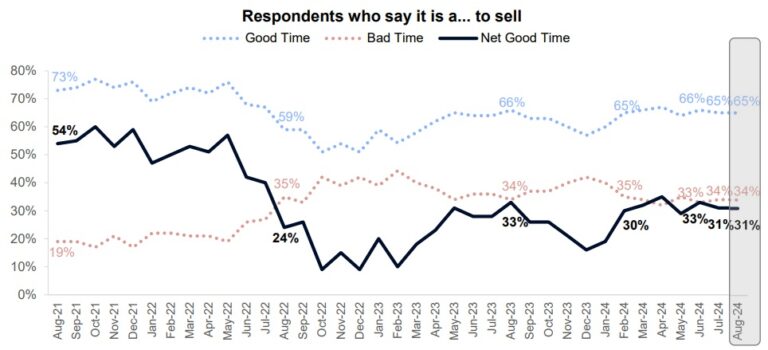
While 65 percent thought it was a good time to sell, they were much less likely to say that if they lived in the South (56 percent), where inventories of homes for sale are on the rise in many markets, than in the Northeast (80 percent), Midwest (70 percent) or West (66 percent).
Palim chalked regional differences to wide geographic variation in new home construction activity.
“In the regions that had a stronger construction response following the pandemic, our latest survey data suggest that sellers may be losing some of their negotiating power due to the increased supply,” Palim said. “That said, we also know from previous research that some potential homebuyers may be feeling additional pressure to move for non-financial reasons.”
Declining mortgage rates are likely to bring more listings onto the market as homeowners feel less constrained by the “lock-in effect” — the reluctance to sell a home mortgaged at a bargain basement rate.
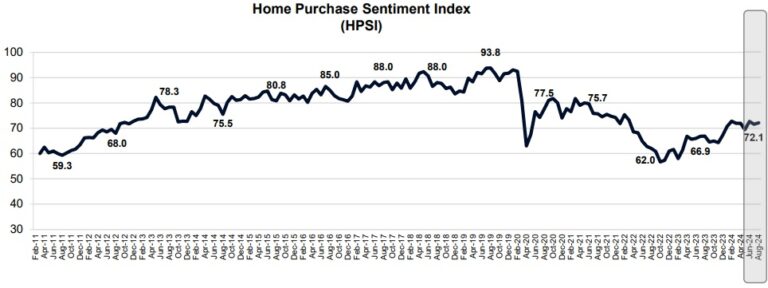
Fannie Mae’s Home Purchase Sentiment Index (HPSI), which distills six questions from the National Housing Survey into a single number, ticked up 0.6 points from July to August, to 72.1, up 5.2 points from a year ago.
Only two of six components of the HPSI improved — mortgage rate outlook and job loss concern (Fannie Mae considers a decline in sentiment about the prospects for future home price appreciation as a negative).
“On a national level, housing sentiment was largely unchanged in August despite some positive developments for affordability, including a meaningful decline in actual mortgage rates and an uptick in home listings in certain markets, particularly in the Sunbelt,” Palim said.
Data tracked by Optimal Blue showed rates on 30-year fixed-rate loans hitting a 2024 low of 6.22 percent Friday following the release of weak jobs reports last week.
While mortgage rates have now dropped more than a full percentage point from a 2024 high of 7.27 percent on April 25, economic forecasters see more room for rates to fall as the Federal Reserve pivots from fighting inflation to protecting jobs.
Economists at Fannie Mae and the Mortgage Bankers Association believe the Federal Reserve is on the verge of launching a rate-cutting campaign on Sept. 18 that will help bring rates on 30-year fixed-rate mortgages below 6 percent by the fourth quarter of 2025.
While mortgage rates have been falling steadily for three months, it’s taken a while for consumers to get the message.
One in four consumers surveyed in August (26 percent) said they expected mortgage rates to go up in the year ahead, down from 31 percent in July and 47 percent last October, when rates were hitting post-pandemic highs.
With the percentage of respondents who said they expect mortgage rates to go down in the next 12 months jumping 10 percentage points, to 39 percent, the net share of those expecting rates to go down rose to 13 percent — the highest level in survey records dating to 2010.
Most Americans agree that home prices will either fall (25 percent) or stay the same (37 percent) over the next 12 months. While 37 percent of consumers surveyed in August still thought home prices would keep going up in the year ahead, that’s down from 41 percent in July.
The net share of consumers who say home prices will go up decreased eight percentage points to 13 percent.
With the percentage of respondents saying August was a good time to buy remaining unchanged from 17 percent in July, and the percentage who say it was a bad time to buy increasing to 83 percent, the net share of those who said August was a good time to buy decreased one percentage point month over month to -65 percent.
While there was considerable variation by region, the net share who said August was a good time to sell was unchanged from July. With 65 percent saying August was a good time to sell and 34 percent saying it was a bad time, the net share saying it was a good time to sell was 31 percent.
Get Inman’s Mortgage Brief Newsletter delivered right to your inbox. A weekly roundup of all the biggest news in the world of mortgages and closings delivered every Wednesday. Click here to subscribe.
Email Matt Carter