
by Melanie Klein | Jul 2, 2025 | Industry, News Feed
Real estate is changing fast, and so must you. Inman Connect San Diego is where you turn uncertainty into strategy — with real talk, real tools and the connections that matter. If you’re serious about staying ahead of the game, this is where you need to be. Register now!
This series highlights inspiring stories of women who have created successful and sustainable careers in real estate and/or invested in real estate to achieve financial independence, gain lifestyle flexibility and create lives built on their own terms.
For much of U.S. history, women’s ability to build independent wealth was not only discouraged — it was denied. Women couldn’t open credit cards in their own names until 1974, when the Equal Credit Opportunity Act made it illegal to require a male co-signer. Before that, financial autonomy was a luxury reserved largely for men.
That legacy still ripples today. After divorce, women’s household income drops by an average of 41 percent, compared to just 23 percent for men. Compounding the challenge, women — especially single mothers — often face limited access to financial resources, networks, and upward mobility.
Jennifer Leahy’s story is a masterclass in rewriting that narrative
Now the leader of one of Connecticut and New York’s most respected real estate teams, Leahy has closed over $1 billion in sales, including the $85 million transaction of Connecticut’s Great Island estate — one of the largest residential sales in the country in 2023.
TAKE THE INMAN INTEL SURVEY FOR JUNE
But her ascent to the top of the industry wasn’t inevitable. It began at rock bottom.
“I was pregnant with my second child when I knew my marriage wouldn’t last,” she recalls. “By the time we divorced, my kids were two and four. I was newly licensed, and I was broke.”
What she had was a relentless vision. Every morning, she visualized her goals, down to the exact dollar she wanted to earn, what she would save and where she’d take her children on vacation. “I wouldn’t sleep until I completed my daily checklist. That’s how determined I was to change our lives.”
And she did.
Raised in the world of real estate development by her mother’s partner, Leahy was exposed early to the value of vision, craftsmanship and collaboration. “Long before ‘starchitects’ were a trend, I saw him assemble visionary teams to build timeless homes. That shaped my understanding of what’s possible when people are treated with care and respect.”
Yet entering the industry as a young woman brought its own set of challenges. “I had never experienced bullying until real estate,” she says. “Women I looked up to judged me, doubted me and even spread rumors that my success was due to inappropriate relationships.”
This phenomenon — women judging other women — is not uncommon. Research published in Psychology of Women Quarterly shows that women can be more critical of each other in male-dominated environments due to internalized gender norms and a scarcity mindset around opportunities.
These behaviors ultimately uphold the very systems that marginalize women. As more women enter leadership roles, building cultures of solidarity is essential.
Rather than retreat, she doubled down. “I decided to succeed on my own terms — with integrity, service and relentless drive.”
Now, as a leader in the field, Leahy is deeply committed to helping other women claim their power. “We can’t afford to tear each other down,” she emphasizes. “When another woman seeks your guidance, take the time to offer it. That one conversation could change her entire trajectory.”
She continues with a call to action: “If you’ve made it, reach back and pull someone up. Mentor. Speak. Share your story. Not everyone has the courage to be a guide, but those who do can change the industry.”
Build real freedom for ourselves and for the women coming next
Leahy’s professional path began in the mortgage industry, where she closed nearly half a billion dollars in loans. When she transitioned into brokerage, she quickly earned a reputation for unmatched client service, an expansive network and a results-driven approach.
In addition to her real estate success, Leahy is deeply devoted to service. She sits on the board of the Domestic Violence Crisis Center, has taught meditation to real estate professionals since the pandemic and is a certified yoga instructor.
She also holds a Master’s degree in Special and General Education from Bank Street College of Education, and a B.A. in Theater and Religious Studies from Fordham University — a reminder that success is rarely linear, but often rooted in passion, presence and adaptability.
Real estate, she says, is a powerful vehicle for financial freedom, but it’s not for the faint of heart. “You’ll deal with uncertainty, emotional ups and downs, and clients who will test your limits. You need a thick skin and an unshakable ‘why.’ But if you have that, this industry can change your life.”
It certainly changed hers.
For women looking to reclaim their independence — after divorce, a career shift or personal upheaval — real estate can offer more than just income. It offers agency. It offers legacy.
Today, Leahy lives in Fairfield County with her husband, four children, and two dogs, proof that it’s possible to build a thriving business and a beautiful life on your own terms.
And to the woman standing at the beginning of her own real estate journey, Leahy offers this:
“Be bold. Be relentless. Visualize the life you want, and then go build it. You’re far more powerful than you think.”
Melanie C. Klein, M.A., is an empowerment and mindset coach.

by Andrea V. Brambila | Jul 1, 2025 | Industry, News Feed
Real estate is changing fast, and so must you. Inman Connect San Diego is where you turn uncertainty into strategy — with real talk, real tools and the connections that matter. If you’re serious about staying ahead of the game, this is where you need to be. Register now!
Real estate brokerages may have thought commission-related class-action lawsuits were on their way out in the real estate industry after nationwide settlements with homesellers, but they’re getting a rude awakening. Some homebuyers have a message for them: You can’t get away that easily.
On June 28, Illinois resident Kevin Cwynar became the latest buyer to file a class-action antitrust lawsuit against several brokerages: The Real Brokerage, Realty One Group, Vanguard, and The Agency, alleging they have caused potentially hundreds of thousands of homebuyers to pay up to thousands of dollars in excess commissions.
“Defendants and their co-conspirators adopted and implemented anticompetitive practices that harmed consumers and homebuyers by, among other things, increasing and artificially sustaining the commissions paid to real estate brokers as part of residential real estate transactions,” the complaint says.
TAKE THE INMAN INTEL SURVEY FOR JUNE
“Because brokers’ commissions are incorporated into the price of a home, Defendants’ anticompetitive practices have burdened homebuyers nationwide with increased home prices and unnecessarily high costs in residential real estate transactions.”
Real declined to comment for this story. Inman has reached out to the other defendants for comment and will update this story if and when responses are received.
The suit is similar to other commission-related class-action suits filed by homebuyers, which are known as Batton 1, Batton 2, Lutz and Davis, and claims the same National Association of Realtors rules at issue in homeseller cases nationwide have resulted in inflated prices paid by buyers.
This includes NAR’s now-defunct cooperative compensation rule, also known as the Participation Rule, which required listing brokers to make an offer of compensation to buyer brokers in order to submit a listing to a Realtor-affiliated MLS.
“[T]his rule eliminated competition between buyer-agents with respect to their commission rate and the quality of their services,” the complaint says.
“This lack of competition led to homebuyers paying inflated commission rates and receiving lower quality services.”
The suit also took aim at Realtor-affiliated MLSs allowing agents to filter listing searches by commission amount — a practice NAR’s 2024 settlement with homesellers eliminated.
“Naturally, this conflict of interest led to buyer-agents promoting properties that would maximize their commission, which lowered demand for properties that offered lower commissions and thus eliminated competition from discount brokers,” the complaint says.
“This harmed homebuyers, who received diminished, biased services from buyer-agents who steered homebuyers toward purchasing homes that offered high commissions.”
Just because NAR has gotten rid of the policies at issue, doesn’t mean the damage they allegedly caused to homebuyers has been addressed, according to the complaint.
“[The harms caused to American homebuyers for decades have not been remedied, nor have the billions in ill-gotten commissions been disgorged,” the filing says.
The Cwynar suit was filed in the same court as the Batton suits — Chicago’s U.S. District Court for the Northern District of Illinois Eastern Division — but is not suing the same defendants. Notably, NAR is named as a co-conspirator, but not as a defendant in the Cwynar suit.
The suit stresses the broker defendants’ involvement with NAR, including that broker leaders “attend NAR meetings, provide input on NAR’s operations, and review, lobby for, and vote on NAR rules,” “assist in NAR’s enforcement of the rules,” and ”required their brokers and agents to comply with NAR rules.”
“Defendants’ market power means that their involvement was crucial to the success of the conspiracy with NAR and other brokers,” the complaint says.
“To this end, Defendants consented to engage in, facilitate, and execute the conspiracy, playing a significant role within NAR and mandating that their affiliates comply with NAR’s anticompetitive rules and policies as a prerequisite for accessing the benefits of Defendants’ brands and infrastructure, including access to MLSs.”
“Defendants are jointly and severally liable for the acts of their co-conspirators, whether named or not named as party defendants in this action,” the complaint adds.
The complaint seeks to represent two classes:
- A nationwide class made up of “[a]ll persons who, during the applicable limitations period, purchased residential real estate listed on a NAR MLS in the United States.”
- An Illinois subclass made up of “[a]ll persons who, during the applicable limitations period, purchased residential real estate listed on a NAR MLS in the state of Illinois.”
The suit does not define “the applicable limitations period.” The complaint alleges violation of the federal Sherman Antitrust Act and unjust enrichment on behalf of all class members, and violation of the Illinois Antitrust Act and the Illinois Consumer Fraud and Deceptive Business Practices Act on behalf of the Illinois subclass members.
Whether the federal claims, at least, won’t be swiftly dismissed is an open question. As indirect purchasers of buyer brokerage services, buyers are not allowed to sue under federal antitrust laws, but may sue under state antitrust laws, which has limited the claims that still stand in the other buyer commission suits.
In addition, the seller-side litigation settlements have limited the size of any potential homebuyer class in that they prevent sellers who also bought homes from suing as buyers over the same challenged rules. This would drastically cut down the number of class members should any of the buyer commission suits receive class-action status.
Read the complaint (re-load page if document is not visible):
Email Andrea V. Brambila.
Like me on Facebook | Follow me on Twitter

by Taylor Anderson | Jul 1, 2025 | Industry, News Feed
The 32,000-member Northwest Multiple Listing Service wrote in a new legal filing that Compass “cannot have it both ways” by receiving listings via the MLS while holding half of its own listings privately
Real estate is changing fast, and so must you. Inman Connect San Diego is where you turn uncertainty into strategy — with real talk, real tools and the connections that matter. If you’re serious about staying ahead of the game, this is where you need to be. Register now!
The Northwest Regional Multiple Listing Service said that Compass is trying to have it “both ways” when it comes to receiving access to listings in the MLS while building its own private network of listings, according to a new legal filing.
Compass filed the lawsuit against Washington-based Northwest MLS in April, calling the multiple listing service a “monopolist.” The suit was one of several escalations made by Compass — others included criticism on social media — in its quest to pursue a marketing strategy that includes holding listings within its own Private Exclusives network before potentially adding them to the MLS at a later date.
TAKE THE INMAN INTEL INDEX SURVEY FOR JUNE
However, such listings violate NWMLS rules that are in place to ensure transparent access to the broadest pool of listings, the MLS wrote in response to Compass’ complaint. NWMLS also asked a judge to dismiss Compass’ suit.
“NWMLS has no antitrust or common-law obligation to promote Compass’ exclusionary, free-rider strategy,” the MLS wrote. “NWMLS’ rules were designed to prohibit conduct like Compass’, which destroys competition in the real estate market, harms consumers, and contravenes NWMLS’ founding purpose.”
Among those rules is a requirement that the MLS’ 32,000 member brokers who get access to competitors’ listings also submit their own.
“That requirement ensures that all members have fair access to each other’s listings and eliminates the possibility that one member may extract value from others without a corresponding contribution for that value,” NWMLS wrote.
The MLS specifically pointed to Compass’ 3-Phased Marketing Strategy, an approach that involves testing a listing off-MLS to gain insights on pricing, the home itself and buyer interest. If homes don’t sell while in the private status, the listing enters “coming soon” status, followed by broader public marketing on the MLS as an active listing.
Nearly half of the brokerage’s listings outside of Washington in the first quarter started as Private Exclusives, while most (94 percent) eventually went onto the open market, the company said in its complaint.
NWMLS wrote that the strategy was designed “to steer those listings to a Compass-represented buyer.”
“Compass, however, cannot have it both ways,” NWMLS wrote.
In footnotes within the legal filing, NWMLS called into question the private nature of Compass’ Private Exclusives.
“The only thing ‘private’ about the Private Exclusive phase is that Compass disseminates the listing to its 34,000 ‘nationwide’ agents and their ‘millions of buyers,’ but not to non-Compass agents, thus contradicting the Complaint’s conclusory assertions about owner security and privacy,” NWMLS wrote. “Compass wants its agents’ ‘millions of buyers’ to know about the listing, but not competing NWMLS member firms, and their potential buyers.”
After a behind-the-scenes back-and-forth between NWMLS and Compass, the MLS cut off Compass’ license to the MLS’ IDX data feed for two days in April.
“The suspension of the IDX data feed merely meant that, for two days, Compass could not transfer other members’ listings from NWMLS’ database to Compass’ public facing website,” NWMLS wrote.
The MLS asked the court to dismiss the case with prejudice, meaning that, if the judge agrees, Compass couldn’t refile the lawsuit.
Compass is now fighting a multi-front battle against organizations and companies that are enforcing rules that would undermine the company’s private listings strategy.
Last week, it filed suit against Zillow, the largest real estate portal, seeking to block the company’s policy banning private listings that have been marketed publicly.
Read NWMLS full filing here:
Email Taylor Anderson
by Matt Carter | Jul 1, 2025 | Industry, News Feed
With closure of merger, homebuyers get temporary rate buydown or up to $6,000 in lender credits from Rocket Mortgage when the buyer or seller is represented by a Redfin agent.
Real estate is changing fast, and so must you. Inman Connect San Diego is where you turn uncertainty into strategy — with real talk, real tools and the connections that matter. If you’re serious about staying ahead of the game, this is where you need to be. Register now!
Mortgage giant Rocket Companies closed its deal to acquire real estate brokerage Redfin Tuesday, and immediately rolled out “preferred pricing” to borrowers involved in deals in which the buyer or seller is represented by a Redfin agent.
The new program, Rocket Preferred Pricing, provides a 1 percent temporary rate buydown for the first year of a loan, or up to $6,000 in lender credits to homebuyers taking out a conventional, FHA or VA mortgage from Rocket.
The program is available not only to homebuyers represented by a Redfin real estate agent, Redfin partner agent or Rocket Homes Partner Agent, but is also offered on listings represented by Redfin agents.
TAKE THE INMAN INTEL INDEX SURVEY FOR JUNE
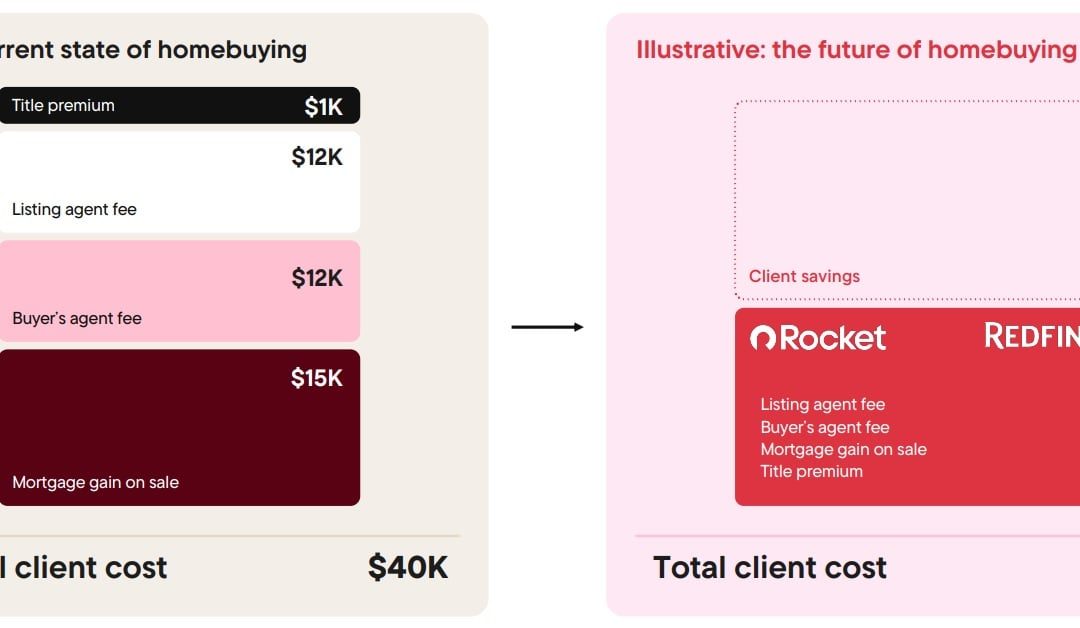
In announcing an agreement to acquire Redfin in March, Rocket executives said the deal could cut consumers’ transaction costs in half by trimming agent fees, mortgage gain-on-sale and title premiums.
By handling every aspect of homebuying and selling — from home search to mortgage financing, and title and closing — Rocket aims to cut transaction costs on the median priced home from $40,000 to $20,000.
Rocket: merger will cut transaction costs by $20K
In a March 10 investor presentation, Rocket broke down transaction costs for a $430,000, median priced home price that included $15,000 in lender profits, $12,000 each to listing and buyer’s agent, and $1,000 in title insurance.
Although the company didn’t break down savings for each category, it says it intends to bring total costs of clients who use both Rocket and Redfin down by 50 percent.

Varun Krishna
“For far too long, the homeownership process has been outdated and disconnected,” Rocket CEO Varun Krishna told investment analysts in March. “Home search, brokerage, mortgage, title, closing, servicing, all exist in separate ecosystems, forcing consumers to piece together a complex and frustrating journey.”
Senate Democrats including Elizabeth Warren, Bernie Sanders and Cory Booker expressed skepticism about claimed benefits to consumers in a June 3 letter to antitrust regulators, claiming the Redfin deal and Rocket’s plans to acquire the nation’s largest loan servicer, Mr. Cooper, creates “the potential for Rocket to steer homebuyers to its own products, hike prices based on private data, and block competition.”
Rocket will retire its home search portal, hosted on Rocket.com and Rocket’s mobile app, on Aug. 4, in favor of Redfin’s site, which it’s rebranded “Redfin powered by Rocket.”
“I’ve used Redfin every day for the last 20 years. It helped me find and fall in love with my first home, completely changing how I thought about real estate,” Krishna said in a statement Tuesday. “The Redfin team is best-in-class in building a product experience focused on simplicity. It was a perfect fit for Rocket’s vision of what the homeownership experience should be.”
Redfin will remain headquartered in Seattle, with CEO Glenn Kelman continuing to lead the business and reporting to Krishna.

Glenn Kelman
“Rocket’s and Redfin’s approaches to lending and brokerage service have always just been two halves of one vision to make the whole homebuying process magical,” Kelman blogged in March.
After leading the nation in mortgage refinancing last year, Rocket hopes acquiring Redfin will help it do more business with homebuyers.
Rocket Mortgage was the nation’s second biggest mortgage lender in 2024, with $97.6 billion in funded loans accounting for 5.4 percent of originations by volume, according to Home Mortgage Disclosure Act (HMDA) data tracked by iEmergent.
Speaking at an investment conference in May, Krishna said Rocket has set a goal of handling 8 percent of purchase mortgages and 20 percent of refinancings.
Last week, Rocket Mortgage introduced a new bridge loan product that lets existing homeowners buy before they sell and make non-contingent offers to compete with cash buyers.
Rocket on Monday announced that it had completed a reorganization of its capital structure — a move that paves the way for the acquisition of its next big acquisition target, Mr. Cooper Group Inc., the nation’s biggest loan servicer, for stock valued at $9.4 billion.
Assuming that deal closes later this year as planned, Rocket will be collecting payments on about one in six U.S. mortgages with $2.1 trillion in outstanding balances — giving the company a leg up on recapturing homeowners’ business when they’re ready to refinance.
Editor’s note: This story has been updated to note that Rocket’s home search site is hosted on Rocket.com and Rocket’s mobile app.
Get Inman’s Mortgage Brief Newsletter delivered right to your inbox. A weekly roundup of all the biggest news in the world of mortgages and closings delivered every Wednesday. Click here to subscribe.
Email Matt Carter

by Terry LeClair | Jul 1, 2025 | Industry, News Feed
Real estate is changing fast, and so must you. Inman Connect San Diego is where you turn uncertainty into strategy — with real talk, real tools and the connections that matter. If you’re serious about staying ahead of the game, this is where you need to be. Register now!
In real estate, skill is only part of the game. The rest? Mindset, clarity and daily habits. That’s why The Success Principles by Jack Canfield continues to be one of the most valuable personal development books I’ve ever read — and one I recommend to every agent I coach or manage.
Canfield breaks success into 64 principles (yes, 64), but the first 20 are foundational. They’ll change how you work, how you lead and how you live. And when you apply them through the lens of real estate — where rejection, risk and rollercoaster commissions are baked into the business — you gain more than inspiration. You get a tactical advantage.
20 foundational Success Principles
Here’s how each principle applies to your real estate journey:
1. Take 100% responsibility for your life
You can’t blame the market, your clients or your broker. If your listing didn’t sell, ask yourself: Did I market it well enough? Did I manage the seller’s expectations? Taking responsibility gives you control — and control is power.
Real estate tip: Own your outcomes. When deals fall apart, use it as fuel to refine your process.
2. Be clear why you’re here
Why did you get into real estate? Money? Freedom? Helping people? Your “why” is your anchor when a transaction falls apart or a client ghosts you.
Real estate tip: Revisit your mission. Align your prospecting, marketing and branding with that core purpose.
3. Decide what you want
Winging it won’t cut it. Want to close 25 deals? Move into luxury? Build a team? Decide — and get specific.
Real estate tip: Don’t just set income goals. Set unit goals, listing appointments and calls per day. Effort creates opportunity.
4. Believe it’s possible
If you don’t believe a $2 million sale is possible for you, you’ll never do the prospecting strategies to land it. Belief precedes behavior.
Real estate tip: Study agents doing what you want to do. If they can, you can. Success leaves clues.
5. Believe in yourself
Confidence shows up in your listing presentations, your pricing recommendations and your negotiations. Self-belief is your competitive edge.
Real estate tip: Revisit your wins often. Keep a “success folder” with past testimonials, photos of closings or thank-you notes. Practice and hone your skills consistently, and that will give you more confidence, which strengthens your belief in yourself.
Your energy is magnetic. If you walk into every open house drained and discouraged, guess what you’ll attract? Disengagement. But if you lead with enthusiasm and value, you’ll start pulling out opportunities.
Real estate tip: Start your day with visualization. Picture the ideal client conversation, showing, signed contract or a well-presented homeseller marketing presentation.
7. Unleash the power of goal setting
Goal setting isn’t wishful thinking — it’s strategic universal command. Agents with written goals earn significantly more. Period.
Real estate tip: Write down monthly transaction goals, then reverse-engineer your daily activities to support them. Knowing how many pipeline leads you need to attain your goals is crucial to the process.
8. Chunk it down
That $500,000 income goal? It’s overwhelming until you break it into daily calls, weekly appointments and monthly closings.
Real estate tip: Use tools like Follow-Up Boss, Bold Trail (kvCore), Trello or a simple Excel tracker to chunk and track your pipeline stages.
9. Success leaves clues
There’s no need to reinvent anything in this business. Follow the top producers, mimic their models, then put your own spin on it.
Real estate tip: Shadow top agents. Read their bios. Analyze their listing photos. Model what works.
10. Release the brakes
Your limiting beliefs are the brakes on your Ferrari. If you don’t believe you’re worthy of big success, you’ll sabotage yourself every time.
Real estate tip: Watch for self-talk like, “I’m not a luxury agent.” Eliminate it. Replace it with, “I’m becoming a top luxury expert.”
11. See what you want, get what you see
Canfield says that your brain doesn’t distinguish between real and vividly imagined experiences. So if you consistently visualize selling oceanfront property in Laguna Beach, you’re training your brain to find the path.
Real estate tip: Create a vision board with your dream clients, commissions, homes and experiences. You attract what you emit.
12. Act as if
Start acting like the agent you want to become. Dress like a $10 million producer. Learn your market, and speak eloquently to it. Lead with that confidence. Remember, perception is reality.
Real estate tip: Show up to every appointment prepared and polished — like your dream self would.
13. Take action
You can work for the best brokerage, have the best CRM, listing presentation or brand — but it’s meaningless without action. Action is the key to lead generation and conversion.
Real estate tip: Prospect daily. One conversation can lead to a deal that changes your year. Persistence pays!
14. Just lean into it
You don’t need a five-year plan. Just take the next best step. Success has many twists, turns and failures — it’s a series of course corrections and being able to pivot.
Real estate tip: Lean into learning and being a better version of yourself. Don’t overanalyze every step. Make the call, show the home, send the mailer. Analysis paralysis is the killer of many a great agents.
15. Feel the fear, and do it anyway
Fear is your green light. That luxury listing pitch that scares you? Do it. That video you’re afraid to post? Post it. Growth lives on the other side of fear.
Real estate tip: Start each week by tackling the one thing you’ve been avoiding.
16. Be willing to pay the price
Real estate isn’t a 40-hour-a-week job. It’s a commitment. Open houses on weekends. Prospecting before 9 a.m. Mastery demands sacrifice.
Real estate tip: Create boundaries, but don’t expect balance 24/7. Hustle now, harvest later.
17. Ask! Ask! Ask!
Ask for referrals. Ask for the listing. Ask for testimonials. Closed mouths don’t get fed.
Real estate tip: End every client conversation with: “Is there anyone else I can help this month?”
18. Reject rejection
No is just one more step toward a yes. It’s critical to understand that the rejection you receive is not a personal rejection; it’s just that they are rejecting your proposition or your timing. Never take it personally, but realize you either need to have a better value proposition or a longer follow-up process.
Real estate tip: Track rejections. Celebrate them. They’re proof you’re doing the work.
19. Use feedback to your advantage
That client who said your listing photos weren’t good enough? Gold. Use it. Upgrade your service. Feedback isn’t failure — it’s fertilizer.
Real estate tip: After every close, ask, “What could I have done better?” Then do it.
20. Commit to constant and never-ending improvement
Real estate evolves. So should you. Mastering contracts, pricing, marketing and technology is a lifelong game.
Real estate tip: Read daily. Attend coaching. Stay curious. Every bit of knowledge sharpens your competitive edge and helps you differentiate yourself from other agents.
Real estate is personal growth in disguise
The truth? Real estate isn’t just about selling homes — it’s about growing into the kind of person who can handle the volume, pressure and income you’re dreaming about.
The Success Principles is a reminder that there’s no secret sauce — just consistent, intentional habits. The agents who rise to the top aren’t necessarily the smartest or most experienced. They’re the ones who believe, act and grow daily.
If you take even five of these 20 principles and implement them with discipline, your business — and your life — will never be the same.
See you at the top.
Terry LeClair is a seasoned real estate professional and trainer with over 30 years of experience. Connect with him on Instagram and LinkedIn.

by Marian McPherson | Jul 1, 2025 | Industry, News Feed
California Governor Gavin Newsom has signed the state’s 2025-2026 budget, which offers environmental review exemptions for critical housing and infrastructure projects. Leaders say the exemptions will improve affordability, while environmentalists say it will ruin the state’s ecosystem.
Real estate is changing fast, and so must you. Inman Connect San Diego is where you turn uncertainty into strategy — with real talk, real tools and the connections that matter. If you’re serious about staying ahead of the game, this is where you need to be. Register now!
Amid a worsening housing affordability and homelessness crisis, California legislators have made a drastic move to bolster inventory levels throughout the state.
On Monday, Governor Gavin Newsom announced that he’d signed Assembly Bill 130 and Senate Bill 131, both of which include sweeping reforms to California’s building permit and new residential building standards systems, alongside greater oversight of city and county homeless shelters and an increase to the Renters Tax Credit.
TAKE THE INMAN INTEL INDEX SURVEY FOR JUNE
However, the most consequential change within AB 130 and SB 131 is the streamlining of the state’s 55-year-old environmental protection law, California Environmental Quality Act (CEQA).
Although originally limited to government projects, CEQA’s strict environmental reviews expanded throughout the decades to include private housing projects. Legislators on both sides of the aisle said the reviews, which are meant to identify and mitigate risks to air, water quality, biodiversity, habitats and ecosystems, had become too cumbersome.
The CEQA reform offers exemptions to high-density projects not on environmentally sensitive or hazardous sites, and critical housing and infrastructure projects, including infill housing, high-speed rail facilities, utilities, broadband, community-serving facilities, like child care centers, and farmworker housing. The reform also opens the door for municipalities to rezone commercial projects, like malls and office buildings, into multifamily housing with more ease.
“This isn’t just a budget. This is a budget that builds. It proves what’s possible when we govern with urgency, with clarity, and with a belief in abundance over scarcity,” Newsom said in a prepared statement on Monday. “In addition to the legislature, I thank the many housing, labor and environmental leaders who heeded my call and came together around a common goal — to build more housing, faster and create strong affordable pathways for every Californian.”
“Today’s bill is a game changer, which will be felt for generations to come,” he added.
Both bills received bipartisan support, with AB 130 receiving a unanimous vote from the Assembly and a 28-5 vote from the Senate. SB 131 received similar support, passing the Assembly 50-3 and the Senate 33-1.
Senator Scott Weiner, who represents Senate District 11 in San Francisco, said the bills’ passage will enable the state to “move the needle on affordability.”
“It isn’t easy to make changes this big, but Californians are demanding an affordable future, and it’s our job to deliver for them no matter what,” he said in a written statement. “I’m incredibly proud of the work Governor Newsom, Assemblymember Wicks, Speaker Rivas, and my friend and partner Pro Tem McGuire did to push this bold package across the finish line and set us on a path to build again in California.”
Although legislators and several housing groups, such as the United Brotherhood of Carpenters, MidPen Housing and California YIMBY, are praising CEQA’s reform, environmentalists are ringing the alarm bell, saying the exemptions could yield potentially deadly consequences.
“It blows a hole in our efforts to protect habitat,” environmental lobbyist Kim Delfino told The New York Times on Monday. “Make no mistake, this will be devastating.”
Political experts said California’s decision could set the stage for more states, especially those with Democratic leaders looking to woo voters with the promise of more affordable housing, to relax environmental reviews and permitting laws.
“This has created a different political environment,” Public Policy Institute of California survey director Mark Baldassare told the Times. “Voters have been telling us in our polling for quite a while that the cost of housing is a big problem, but maybe for the elected officials, the election itself was a wake-up call.”
Email Marian McPherson
