by Marian McPherson | Jul 2, 2025 | Industry, News Feed
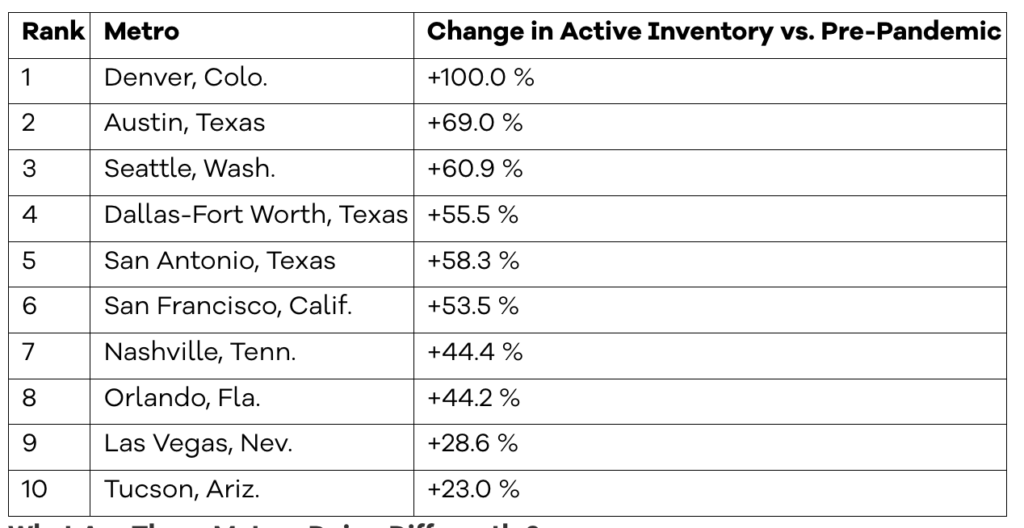
Robust new construction activity and subdued homebuyer demand has led to an inventory boom in 22 of the 50 largest markets, with metros in the South and on the West Coast seeing active inventory double compared to 2019.
Real estate is changing fast, and so must you. Inman Connect San Diego is where you turn uncertainty into strategy — with real talk, real tools and the connections that matter. If you’re serious about staying ahead of the game, this is where you need to be. Register now!
Nearly half of the nation’s largest 50 metros are in the midst of an inventory boom, with the South and West Coast leading the way in markets where inventory levels are up to 100 percent higher than pre-pandemic trends, according to Realtor.com’s latest market report.
TAKE THE INMAN INTEL SURVEY FOR JUNE

Danielle Hale | Credit: Realtor.com
Denver (+100 percent), Austin (+69 percent), Seattle (+60.9 percent), Dallas-Fort Worth (+ 55.5 percent) and San Antonio (+58.3 percent) logged the greatest gains. Realtor.com attributed these gains to two primary factors — robust building activity during and post-pandemic, and a slowdown in homebuyer activity, which has allowed active inventory levels to reach new heights.
“For-sale housing inventory in Denver has doubled compared with the pre-pandemic norm, providing a clear sign of a housing market realignment,” Realtor.com Chief Economist Danielle Hale said in a written statement. “In some areas, affordability concerns have also slowed buyer demand, giving the market room to breathe and contributing to gains in homes for sale. In general, we’re seeing strong inventory rebounds in metros that have built more in the [past] six years.”
Realtor.com said there’s a strong correlation between a metro’s 2019 to 2025 new construction rates and the growth in active listings. Metros that have built more than the national average of seven housing units per 100 residents over the past six years have experienced stronger inventory recoveries compared to those that have not, the report said.
Pandemic boomtowns like Austin, Nashville, and Denver are the clearest examples of this correlation, Realtor.com said, with their current inventory levels matching or exceeding pre-pandemic trends. Meanwhile, metros like New York, Boston, Baltimore and Buffalo, which have built less than seven housing units per 100 residents over the past six years, are still struggling to see meaningful inventory increases.
Realtor.com said there are a few outliers in the trend. Despite lagging in new construction starts and completions, San Francisco has more active listings than pre-pandemic trends. Meanwhile, Richmond, Virginia, still has a dearth of listings, despite robust building trends. Affordability seems to be the leading factor in these outliers, the report said, with homebuyers flocking to metros with the best deals, even if listing availability is slim.
Although inventory levels are the best they’ve been in years for many markets, Hale said that doesn’t mean we’re in a buyers’ market.
In May, the market had 4.6 months of supply at the current sales pace — two months away from the six-month threshold for a buyers’ market. Still, homebuyers have greater negotiating power this spring and summer, as days on market in many metros have increased by double digits.
“This milestone underscores both the importance of enabling housing construction and the growing divide in housing conditions across regions, where some markets are rapidly normalizing and others remain stuck in low-supply dynamics,” she said.
Email Marian McPherson

by Taylor Anderson | Jul 2, 2025 | Industry, News Feed
“Chairman Powell needs to be investigated by Congress immediately,” the FHFA director said in a statement on Wednesday. Pulte and President Donald Trump have been trying to pressure Powell to resign amid high interest rates.
Real estate is changing fast, and so must you. Inman Connect San Diego is where you turn uncertainty into strategy — with real talk, real tools and the connections that matter. If you’re serious about staying ahead of the game, this is where you need to be. Register now!
The director of the Federal Housing Finance Agency continued his war on Federal Reserve Chairman Jerome Powell on Wednesday when he called on Congress to investigate Powell.
TAKE THE INMAN INTEL SURVEY FOR JUNE
In a statement posted on the social media platform X, Pulte asked Congress to look for political bias and deception from Powell. Pulte appeared to suggest that President Donald Trump would be justified in firing Powell, a move that is legally difficult.
The law that created the Fed says that members of its board of governors can only be removed before the end of their terms “for cause.”
Pulte apparently alluded to a recent report in the New York Post that an ongoing renovation of the Fed’s headquarters in Washington, D.C., was overly costly.
“I am asking Congress to investigate Chairman Jerome Powell, his political bias, and his deceptive Senate testimony, which is enough to be removed ‘for cause,’” Pulte wrote in his statement.
“Jerome Powell’s $2.5B in capitalizations of Building Renovation Scandal stinks to high heaven, and he lied when asked about the specifics before Congress,” Pulte said in the statement. “This is nothing short of malfeasance and is worthy of ‘for cause.’”
A spokesperson for the Federal Reserve Board declined to comment on Pulte’s allegations.
Powell, who Trump appointed to lead the Fed in 2017 during his first term as president, has said the central bank’s policies are based solely on economic data and its dual mandate of maximizing employment while keeping inflation in check.
Pulte’s statement wasn’t formally released on the FHFA website.
“As Senator Cynthia Lummis said, ‘He [Chairman Powell] made a number of factually inaccurate statements to the Committee regarding the Fed’s plush private dining room and elevator, skylights, water features, and roof terrace,’ and that ‘this is typical of the mismanagement and ‘don’t bother me’ attitude that Chair Powell has always shown.’”
Pulte and Trump have ratcheted up their campaign to pressure Powell and the governors of the Federal Reserve Board to lower the federal funds rate or resign. The battle ramped up after the board held rates steady at its June 19 meeting.
Powell has said policymakers need more time to assess the impacts of the Trump administration’s policies in areas including tariffs, immigration, taxes and regulation.
Although the Fed has direct control over short-term interest rates, mortgage rates are determined by investor demand for mortgage-backed securities (MBS), which fund most home loans. The last time the Fed cut rates — by a full percentage point in September, November and December — mortgage rates went up.
Editor’s note: This story has been updated to note that the Federal Reserve Board declined to comment on Pulte’s allegations, and with additional context on Fed Chair Jerome Powell’s policy stance.
Email Taylor Anderson

by Ken Baris | Jul 2, 2025 | Industry, News Feed
Real estate is changing fast, and so must you. Inman Connect San Diego is where you turn uncertainty into strategy — with real talk, real tools and the connections that matter. If you’re serious about staying ahead of the game, this is where you need to be. Register now!
When people think of networking, they often picture shaking hands at events, exchanging business cards or connecting with strangers on LinkedIn. That’s important, but here’s a secret many overlook: The most powerful networking happens not with new contacts, but with the ones you already have.
TAKE THE INMAN INTEL SURVEY FOR JUNE
We all have a vast network: childhood friends, neighbors, former classmates, teammates, fellow members of a faith community, hobby partners, colleagues from past jobs and so on. The list is long. Yet we rarely tap into these existing relationships in a meaningful way.
If you want to level up your networking game, start by reconnecting with the people you already know.
Make reaching out a daily habit
You don’t need to call 20 people a day. Just three to five consistent, quality connections each day will have a massive long-term impact. The key is making it a habit — and making it personal.
Prioritize calls and visits over texts
Sure, it’s easy to fire off a quick text or email, but if you want to create real impact, go old school: Pick up the phone, or stop by in person. That human touch is far more memorable and meaningful.
And when you visit or call, be intentional. Avoid saying, “I had a few minutes and figured I would reach out” or “I happened to be in the neighborhood.” That often implies they were an afterthought. Instead, say:
“I made a special trip to connect because I was thinking of you.”
That subtle shift makes a big difference; it shows respect and genuine interest.
Be genuinely interested
These conversations should never feel like a pitch. They should feel like catching up with someone you care about. Ask about their life, listen actively, and be truly present.
Chances are, at some point, they’ll ask what’s new with you. That’s your opportunity to naturally mention your real estate work, not as a sales pitch but simply as part of what’s going on in your world.
Offer to help sincerely
One of my favorite lines when wrapping up a call or visit is:
“I am always available for you. Even though we are not constantly in touch, I frequently think of you — and anytime I can be helpful, just let me know.”
It’s heartfelt and honest — and it often prompts a similar response in return. That’s when you can comfortably say:
“If you ever hear of someone looking to buy or sell a home, I’d be honored if you’d think of me.”
No pressure. No hard sell. Just a natural exchange between two people who trust and appreciate each other.
Build a simple, repeatable system
You likely have well over a thousand contacts — and even if you’re just starting out, you certainly have hundreds. That’s a goldmine of opportunity sitting right in your phone.
Let’s break it down. If you commit to calling just three people a day, five days a week, and take a full month off for vacation, that’s 720 conversations a year. And if you reach out to five people a day to ensure you actually connect with three, you’ll touch over 1,200 contacts annually.
Personally, I make these calls while driving in the morning or winding down at the end of the day. The conversations are typically short — just a few minutes each — and I can easily knock them out in 20 minutes or less.
If I call and get voicemail, I immediately follow up with a quick voice-to-text message:
“Hi, it’s Ken. I just tried to call to catch up — it’s been too long. Please give me a call when you’re free. Looking forward to reconnecting!”
Here’s the key: I don’t stop until I’ve had at least three actual conversations. Not just calls made — conversations had. That discipline is what makes this system work.
Over time, this simple routine has allowed me to stay connected with more than a thousand people each year. It keeps relationships fresh, opens doors to new opportunities, and, best of all, it’s enjoyable.
Use your CRM to stay consistent
To stay on track, I use BoldTrail, which reminds me to reach out to each contact every 11 months. Why 11? Because it rotates the month of contact each year — December this year, November next, October the year after — which keeps your outreach feeling spontaneous and fresh.
And always take notes in your CRM. If someone tells you about a vacation, a child’s graduation or a job change, add that to the contact record. Then, when you reconnect next time, you can follow up with something like:
“Last time we spoke, you mentioned your daughter was applying to college. How did that go?”
That shows you were listening — and that you care.
If the conversation leads to speaking sooner the next time, add the next call in your CRM. It is so simple, yet done by so few.
The payoff
Make the calls. Ring the doorbells. Spark real conversations. You’ll reignite old friendships, strengthen meaningful relationships, and yes, you’ll generate referrals. People want to do business with those they know, like and trust. And trust is built not through mass emails, but through real conversations.
The best networking doesn’t come from collecting more business cards. It comes from genuinely valuing and nurturing the relationships you already have. So open your phone. Scroll through your contacts. Make the call. You’ll be amazed at what happens next.
Ken Baris is CEO of Berkshire Hathaway HomeServices Jordan Baris Realty. Connect with him on Instagram and LinkedIn.

by Angela Yungk | Jul 2, 2025 | Industry, News Feed
Leads follow leaders, Angela Yungk writes. Lead with purpose, clarity and consistency, and you won’t have to chase business — it finds you.
Real estate is changing fast, and so must you. Inman Connect San Diego is where you turn uncertainty into strategy — with real talk, real tools and the connections that matter. If you’re serious about staying ahead of the game, this is where you need to be. Register now!
In today’s crowded real estate market, with over 1.5 million real estate agents in the United States, being visible is important, but is it enough? Let’s face it, every agent has a social media presence, a few email templates and access to the same market reports.
Agents who consistently attract quality leads — and retain long-term relevance — aren’t just present. They’re positioned. They’re trusted. They’re seen as leaders.
TAKE THE INMAN INTEL SURVEY FOR JUNE
This is the power of thought leadership. And in an industry built on trust and connection, it might just be your most underutilized advantage.
Visibility vs. credibility: Why agents need both
Let’s start with a distinction most agents overlook. Visibility is about being seen. Credibility is about being believed. You can show up in feeds all day long, but if what you’re saying doesn’t resonate — or worse, feels generic — you won’t convert attention into trust.
Today, with the automation of social media posts, it’s easy to “show up,” but it doesn’t mean anyone is listening.
If visibility gets you discovered, then credibility gets you chosen. When paired together, these two qualities become the foundation for true influence in your market. And that’s where thought leadership begins.
Why thought leadership builds both pipeline and reputation
The agents who win over time aren’t just chasing transactions — they’re building trust at scale. Thought leadership allows you to do that. Whether it’s through educational content, local market insights or positioning yourself as a voice of calm during uncertain times, you create a magnetic brand that draws people in long before they’re ready to buy or sell.
Great agents don’t just have a CRM full of names. They have a reputation that works even when they’re not in the room. That’s the silent engine of thought leadership — it compounds.
How to become a local authority (without being ‘everywhere’)
You don’t need to be an influencer. You just need to be intentional. Here’s how:
1. Create consistent, value-driven content
Commit to educating your audience. Weekly videos, LinkedIn posts (especially if you don’t want to be on camera) or monthly market updates that humanize data — these build trust over time. Talk to the why behind the numbers. Speak directly to your niche, not the masses.
Now more than ever, you don’t need to worry about how many followers you have.
For example, suppose someone is scrolling on Instagram and likes to watch content about beaches, condos and living on a lake. In that case, chances are that if you are an agent who creates that specific type of content (living on a lake, life in a beach town), that person will start liking and watching your videos without even needing to follow you!
2. Leverage social proof
Client testimonials are more than kind words — they’re credibility in motion. Showcase your process, not just your results. Highlight client wins, behind-the-scenes moments and case studies that show how you think, not just what you close.
3. Get in the room (and on the mic)
Local speaking engagements, podcasts or hosting educational events — even virtually — can instantly elevate your perceived authority. Being seen as the teacher or guide sets you apart in a sea of “salespeople.”
You’re already a brand — time to lead like one
Your voice is your value. And in a trust-based business like real estate, becoming a thought leader isn’t about ego — it’s about impact.
Because in the end, leads follow leaders. And the ones who lead with purpose, clarity and consistency? They don’t have to chase business — it finds them.
Angela Yungk is a managing broker and lead mentor with Arterra Realty Florida. You can connect with Angela on Instagram and LinkedIn.
by Inman | Jul 2, 2025 | Industry, News Feed
Real estate is changing fast, and so must you. Inman Connect San Diego is where you turn uncertainty into strategy — with real talk, real tools and the connections that matter. If you’re serious about staying ahead of the game, this is where you need to be. Register now!
Pulse is a recurring column where we ask for readers’ takes on varying topics in a weekly survey and report back with our findings.
The private listing debate is heating up, with both Compass and Zillow firing shots across the bow as they prepare to take their battle to court. Meanwhile, Mauricio Umansky just rebooted his lawsuit against NAR and its rules’ impact on ThePLS.com, his erstwhile private listing network.

As we continue to follow the drama, we’re most interested in how it impacts you. Tell us: How do you think the private listings battle will play out? Do you think Compass will prevail? Do you side with Zillow? Or are you taking a wait-and-see approach and preparing to adjust your business strategy as needed? Let us know below:
We’ll compile a list of the top responses and post them on Inman next Tuesday.
by Matt Carter | Jul 2, 2025 | Industry, News Feed
Housing trade groups — including NAR, MBA and NAHB — like tax breaks for homebuyers and businesses, and urge lawmakers to put the bill on Trump’s desk
Real estate is changing fast, and so must you. Inman Connect San Diego is where you turn uncertainty into strategy — with real talk, real tools and the connections that matter. If you’re serious about staying ahead of the game, this is where you need to be. Register now!
It might not be a big hit with most Americans, but the “big, beautiful bill” that squeaked through the Senate Tuesday includes a number of perks the real estate industry has lobbied hard for.
The budget reconciliation bill — which would extend tax cuts enacted in 2017 and cut spending on programs like Medicaid, among other things — is headed back to the House for final approval after a 51-50 Senate vote.
With Republicans Susan Collins, Rand Paul and Thom Tillis voting against the bill, it was up to Vice President J.D. Vance to cast the tie-breaking vote in the Senate.
TAKE THE INMAN INTEL INDEX SURVEY FOR JUNE
Key provisions for the real estate industry include protections for the mortgage interest deduction — which makes interest payments on mortgage debt up to $750,000 tax deductible — and a quadrupling of the state and local tax (SALT) deduction cap.
Lobbyists for the National Association of Realtors have been working to persuade lawmakers for months of the value of those and other perks, the trade group said Tuesday, boasting that NAR secured its top five objectives in the Senate bill.

Shannon McGahn
“We were invited to the White House on Friday — just days before the final vote — to continue advocating for our members and consumers as the Senate version took shape,” NAR Chief Advocacy Officer Shannon McGahn said in a statement. “The administration and Congress respect the voice of our members and the roles they play as leaders in their communities. We are an army of advocates living and working in every ZIP code in America with a unique insight into the state of the economy.”
In addition to the mortgage interest deduction and SALT deduction cap, NAR’s top priorities included a permanent extension of lower individual tax rates, an enhanced and permanent qualified business income deduction, and protection for business SALT deductions and 1031 like-kind exchanges.
The Mortgage Bankers Association also had praise for the bill, including a provision that would raise the federal debt ceiling by $5 trillion and avert a government shutdown that could send mortgage rates soaring.

Bob Broeksmit
MBA President and CEO Bob Broeksmit said the bill builds on the version previously passed by the house by allowing continued tax breaks for investment in Opportunity Zones, and improvements to the Low-Income Housing Tax Credit (LIHTC) program that will facilitate more housing production.
“MBA will work with congressional leaders in the coming days to ensure that these beneficial tax policies remain intact in any final package signed into law by President Trump,” Broeksmit said in a statement.

David Dworkin
National Housing Conference President and CEO David Dworkin has called the LIHTC “the most effective tool to build and preserve affordable rental housing,” and estimated that plans to lower the bond financing threshold could produce or preserve more than 1 million affordable rental homes over the next decade.
In more general terms, the National Association of Home Builders (NAHB) urged House passage of the bill, saying it will spur economic growth and allow builders to invest more in multifamily rental construction, land development for single-family homes, and new equipment.

Buddy Hughes
“This will create a better business climate that allows builders to increase the nation’s housing supply, which is crucial to help ease America’s housing affordability crisis,” Lexington-based homebuilder and 2025 NAHB Chairman Buddy Hughes said in a statement.
Outside of real estate industry trade groups, the bill has been polarizing. Many Americans are specifically anxious about the “big, beautiful bill’s” cuts to federal programs including Medicaid, and some Republicans share those concerns, Axios noted. But some fiscally conservative Republicans who are concerned the bill’s tax breaks will add to budget deficits had advocated for even deeper spending cuts.
Get Inman’s Mortgage Brief Newsletter delivered right to your inbox. A weekly roundup of all the biggest news in the world of mortgages and closings delivered every Wednesday. Click here to subscribe.
Email Matt Carter
