
by Micaela Gonzalez | Mar 6, 2026 | News Feed
The 6.1% Strategy: Navigating Current Mortgage Rates in Texas
Mortgage rates have become the deciding factor for many Texas buyers—and right now, the conversation is all about rates hovering around 6% to 6.1%. That range may not sound dramatic day to day, but it can meaningfully change your monthly payment, your buying power, and the type of home that fits your budget in markets from Houston and San Antonio to Dallas–Fort Worth and Austin.
This guide lays out a practical, Texas-specific “6.1% mortgage rate strategy” for staying confident in today’s financing environment. We’ll unpack what a 6.1% rate means for affordability, why Texas housing market interest rates have stabilized near this level, and mortgage payment strategies Texas buyers can use—whether you’re buying your first home in Fort Worth or moving up in the suburbs of Houston.
What does a 6.1% mortgage rate mean for Texas affordability right now?
When buyers talk about affordability, they’re usually reacting to the monthly payment—not just the price tag. With current mortgage rates Texas buyers are seeing around 6%–6.1%, the payment impact is large enough to shape what neighborhoods you shop, how much you put down, and whether you choose a 30-year loan or something shorter.
As a quick rule of thumb, interest rate changes matter most in the early years of a mortgage, when most of your payment is interest. That’s why buying a home with 6 percent mortgage rate can feel like a different world compared with the ultra-low-rate period earlier this decade.
How interest rates affect monthly payments (a simple Texas-friendly example)
Here’s a plain-English way to think about it: the interest rate determines how expensive it is to borrow each dollar. As rates rise, the same home price produces a higher monthly principal-and-interest payment. That often forces one of three adjustments: lower price point, larger down payment, or a different loan structure.
For example, on a 30-year fixed loan, a 6.1% rate versus a 5.1% rate can move the monthly payment by hundreds of dollars depending on the loan size. And that’s before you add Texas property taxes and homeowners insurance, which are major parts of the full housing payment in many counties.
Texas-specific note: even when home prices cool, the “all-in” monthly payment can stay stubbornly high because property taxes and insurance often rise over time. In places like Harris, Fort Bend, Collin, Denton, Williamson, and Bexar counties, many buyers feel the squeeze most in the escrow portion of their payment.
Texas property taxes, insurance, and the real monthly payment
When you hear someone say, “I can afford a $2,800 payment,” they usually mean the full payment: principal, interest, taxes, and insurance (often called PITI). In Texas, taxes and insurance can be a larger slice of PITI than buyers expect, especially first-timers coming from renting.
To keep your budget realistic, ask your lender for scenarios that include:
- Estimated property taxes based on the neighborhood and the new purchase price (not the seller’s old tax bill)
- Insurance quotes that reflect today’s replacement-cost pricing
- Any HOA dues (common in many master-planned Texas communities)
This is where Texas real estate financing tips really matter: two homes with the same price can have very different monthly costs if one sits in a higher-tax area or carries higher insurance costs.
How today compares with the higher-rate reality of recent years
If you’ve watched Texas home loan trends closely, you’ve seen rates move up and down, but many buyers’ memories are anchored to the “cheap money” era. In more recent years, buyers also experienced higher peaks—periods where rates pushed well above 6% and sometimes into the 7% range depending on the week, the loan type, and the borrower profile.
So while 6%–6.1% isn’t “low,” it can feel more manageable than the highest points buyers saw recently. That’s part of why navigating mortgage rates Texas buyers face today is less about waiting for a miracle drop and more about building a plan that works now—with flexibility if rates improve later.
Why have Texas housing market interest rates stabilized around 6%–6.1%?
Mortgage rates don’t move randomly. They respond to a mix of inflation expectations, Federal Reserve policy direction, bond market pricing, and investor demand for mortgage-backed securities. The result is that rates can stabilize for stretches when the market feels it has a clearer read on where inflation and economic growth are headed.
In Texas, the day-to-day shopping experience also contributes to the sense of “stability.” Many lenders are pricing competitively, and borrowers are choosing similar products—especially 30-year fixed-rate loans—so the quoted range often clusters near a tight band like 6%–6.1%.
From a practical standpoint, here’s why many buyers are seeing a plateau-like environment in current mortgage rates Texas shoppers are quoted:
- Inflation has been less volatile than during peak swings, reducing rate whiplash
- Markets have adjusted to “higher for longer” expectations, limiting sudden repricing
- Lenders are competing for purchase loans, sometimes using credits or pricing specials that keep rates near a common range
It’s also worth noting that “Texas mortgage rates 2026” discussions often blend national rate drivers with local market realities. Texas doesn’t set mortgage rates, but Texas buyers do experience the rate environment differently because property taxes, insurance, and the state’s fast-growing metro areas shape affordability decisions.
How to use the “6.1% mortgage rate strategy” to buy confidently in Texas
A smart 6.1% mortgage rate strategy isn’t about pretending rates don’t matter—it’s about controlling what you can. The best approach usually combines three moves: strengthen your borrower profile, structure the loan to match your timeline, and negotiate hard on the purchase (including concessions that reduce your effective cost).
Below are mortgage payment strategies Texas buyers are using right now to make buying a home with 6 percent mortgage rate feel less intimidating—and more predictable.
1) Improve credit and pricing tiers (often the biggest “silent discount”)
Your credit score influences your rate and costs because it affects how lenders price risk. Even a modest score improvement can move you into a better pricing tier, which can lower your payment or reduce fees.
Practical steps buyers can take 30–90 days before applying:
- Pay down credit card balances to lower utilization (often a fast win)
- Avoid opening new accounts right before mortgage underwriting
- Check for errors on your credit report and dispute inaccuracies
- Keep all payments on time—late payments can be costly in pricing
If you’re navigating mortgage rates Texas buyers are dealing with this year, a lender conversation about “rate versus points” can also help. Sometimes paying points makes sense, but only if you expect to keep the loan long enough to break even.
2) Re-think down payment strategy (without draining your safety net)
In Texas, down payment decisions often come down to balancing a lower monthly payment against keeping cash for closing costs, moving expenses, and a healthy emergency fund. More down payment reduces the loan amount, which reduces the principal-and-interest payment at any rate—including 6.1%.
But buyers should be cautious about putting “every dollar” into the down payment. Texas homes can come with real-world first-year costs (fence repairs, HVAC tune-ups, blinds, lawn equipment), and keeping reserves can prevent post-closing stress.
Common, workable approaches include:
- Choose a down payment level that keeps 3–6 months of reserves available
- Compare 5% vs. 10% vs. 20% down with full PITI included
- Ask about lender-paid mortgage insurance options where available, and compare costs carefully
3) Explore loan terms and products that match your timeline
Not every buyer needs a 30-year fixed, and not every buyer should avoid it. The “best” loan is the one that fits how long you expect to stay in the home and how stable you want your payment to be.
Options many Texas buyers consider:
- 30-year fixed: Most popular for payment stability and long-term budgeting
- 15-year fixed: Higher payment, but much less interest over time—best for buyers with strong cash flow
- Adjustable-rate mortgages (ARMs): Can offer a lower initial rate; best for buyers with a shorter ownership horizon or a plan to refinance, but requires clear risk tolerance
Texas home loan trends also show many buyers leaning into “payment certainty,” especially when property taxes and insurance already create year-to-year variability. For that reason, a fixed-rate structure remains a comfort choice, even in a 6%–6.1% environment.
4) Negotiate concessions and consider a temporary buydown
In a more balanced market, negotiations can matter as much as the interest rate. Seller concessions—credits paid at closing—can help cover closing costs or fund a temporary interest rate buydown. This can be especially useful when you want payment relief in the first year or two.
A common approach is a temporary buydown (often structured as a 2-1 buydown), where the rate is lower for the first year and steps up toward the note rate over time. It’s not free money—the cost is usually paid upfront, often by the seller as part of the deal. But it can create breathing room while you settle into the home and adjust your budget.
In many Texas neighborhoods—especially where inventory has improved compared with the frenzied peak—buyers may find more room to negotiate on:
- Seller-paid closing costs
- Rate buydown credits
- Repairs or repair credits after inspection
- Price reductions that directly lower the loan amount
This is one of the most actionable Texas real estate financing tips: negotiate the full package, not just the sticker price.
5) Shop lenders carefully and compare APR, not just the headline rate
Two lenders can quote the same rate but offer very different overall costs. Ask for a formal Loan Estimate and compare the APR, lender fees, and credits. Pay attention to whether you’re being quoted a rate with points, and what the breakeven timeline looks like.
Also consider service quality. In Texas, where contract timelines can be tight and appraisal/insurance details matter, a responsive lender can reduce stress and help avoid closing delays.
Refinancing later: smart option or wishful thinking?
Many buyers feel hesitant to commit at 6%–6.1% because they hope rates will drop. Refinancing can be a smart tool, but it works best as an option—not the foundation of your purchase decision.
Mortgage rate forecasts Texas buyers hear about can change quickly. The healthier mindset is: buy a home that fits your budget today, then refinance later if the math works and your long-term plan still makes sense.
When refinancing can make sense
Refinancing generally becomes compelling when you can reduce your rate enough to offset closing costs within a reasonable timeframe. Another reason is switching from an adjustable rate to a fixed rate for long-term stability, or removing mortgage insurance if your equity position improves.
Green flags that a refinance might work later:
- You expect to keep the home long enough to recoup refinance costs
- Your credit profile may improve after purchase
- You’re buying in an area with steady demand and potential for equity growth over time
Common mistakes Texas buyers should avoid
One mistake is stretching your budget because you assume you’ll refinance quickly. Another is overlooking total housing costs—especially taxes and insurance—when calculating whether a refinance would materially improve affordability.
Also, be cautious about using refinance expectations to justify skipping an inspection or accepting major repair risk. A lower future rate won’t fix a foundation issue, aging roof, or chronic drainage problems—three issues Texas buyers frequently watch for, depending on region and soil conditions.
Texas housing market 2026 outlook: what buyers should watch as rates hover near 6%
No one can promise where rates will land, but buyers can watch the indicators that shape Texas mortgage affordability 2026: inflation trends, job growth in major metros, housing supply, and the pace of new construction—especially in fast-growing corridors like the I-35 stretch (San Antonio to Austin), the DFW suburbs, and parts of the Houston exurbs.
The Texas housing market 2026 outlook is often described as “more normal” than the extreme swings of earlier years: less frantic bidding in many neighborhoods, more listings to choose from in certain price bands, and buyers paying closer attention to the monthly payment than the headline price.
Here are grounded scenarios to keep in mind when thinking about Texas mortgage rates 2026 and mortgage rate forecasts Texas buyers may see:
- If rates stay near 6%: Affordability remains payment-driven; negotiations, credits, and smart loan structuring matter a lot
- If rates ease modestly: More buyers re-enter the market, which can increase competition in popular school zones and close-in neighborhoods
- If rates rise again: Buyers with strong credit, cash reserves, and flexibility on home type or location will have an advantage
Across these scenarios, the most durable strategy is the same: focus on a payment you can comfortably handle, keep reserves, and use the financing tools available. That’s the heart of navigating mortgage rates Texas buyers are facing in this cycle.
If you’re deciding whether to move forward now, remember this: a 6.1% rate environment doesn’t eliminate opportunity—it changes where the wins come from. In today’s Texas real estate financing landscape, buyers often win by preparing thoroughly, negotiating thoughtfully, and choosing a loan structure that fits both the home and the life you plan to live in it.
by Micaela Gonzalez | Mar 3, 2026 | News Feed
The Ultimate Guide to Filling Out the TREC One to Four Family Residential Contract (Resale)
Navigating a real estate transaction in Texas requires familiarity with the TREC One to Four Family Residential Contract (Resale). This nine-page document is the backbone of most residential sales in the Lone Star State. A single unchecked box or an ambiguous sentence in "Special Provisions" can lead to significant legal and financial consequences.
This article provides a detailed, section-by-section walkthrough of the 1-4 Contract. We will explain not only how to fill it out but why each paragraph matters, optimized for agents, buyers, and sellers needing clear, actionable information.
Disclaimer: The following is for educational and informational purposes only and does not constitute legal advice. Real estate laws are complex; always consult with a licensed Texas real estate attorney or broker for guidance specific to your transaction.
1. Defining the Core: Parties and Property (Paragraphs 1 & 2)
The very first paragraphs set the foundation for the entire agreement. If these are incorrect, the contract may be voidable.
Paragraph 1: Parties
This section identifies who is buying and who is selling.
- The Nuance: The names entered here must match the parties’ legal identification. If the seller is a Trust, an LLC, or an Estate, ensure you have the full, correct legal title of that entity. If multiple people own the property, all names must be listed.

Paragraph 2: Property
This defines what is being sold.
- 2A (Land): Do not just rely on the street address. You must include the legal description: Lot, Block, Addition, and City/County. This information is found on the County Appraisal District website or the existing deed.
- 2B & 2C (Improvements and Accessories): This lists what automatically stays with the house (e.g., curtains, garage door openers, pool equipment).
- 2D (Exclusions): This is critical. If the seller wants to take the custom-built bookshelves, the wall-mounted TV brackets, or the heirloom rose bushes, they must be explicitly listed here. If it’s a fixture and it’s not excluded, it stays.

2. The Financial Pillars (Paragraphs 3 & 4)
These paragraphs detail how the purchase will be funded.
Paragraph 3: Sales Price
This is straightforward arithmetic, but errors are common.
- 3A: The cash portion of the Sales Price payable by the Buyer at closing. (This is the down payment plus any cash paid if there is no loan).
- 3B: The sum of all financing described in the attached Third Party Financing Addendum (if applicable).
- 3C: The total Sales Price. (3A + 3B = 3C).

Paragraph 4: Leases
This paragraph addresses situations where the property is subject to an existing lease agreement that will survive the closing. This includes:
- A. Residential Leases: If a tenant is currently living in the home.
- B. Fixture Leases: Often used for solar panels, security systems, or water softeners.
- C. Natural Resource Leases: For oil, gas, or other minerals.
If any of these boxes are checked, a corresponding Lease Addendum is usually required.

3. The Money Moves: Earnest Money and Termination Option (Paragraph 5)
Paragraph 5 is perhaps the most time-sensitive section of the contract, defining the buyer’s financial commitment and their "right to walk away."
Paragraph 5A & 5B: Delivery and Amounts
This section must detail:
- Earnest Money: The amount paid to the Escrow Agent (Title Company) as a sign of good faith (typically 1-3% of the sales price).
- Option Fee: The non-refundable fee paid to the Seller for the unrestricted right to terminate the contract within a specified timeframe (the Option Period).
Crucial Deadline: Both the Earnest Money and the Option Fee must be delivered to the Escrow Agent within three days after the Effective Date of the contract. If the third day falls on a Saturday, Sunday, or legal holiday, the deadline is extended to the next business day.
Paragraph 5D (Failure to Deliver)
If the Buyer fails to deliver the Earnest Money on time, the Seller may terminate the contract. If the Buyer fails to deliver the Option Fee on time, they lose their right to terminate under the Option Period provisions.

4. Title, Survey, and Objections (Paragraph 6)
Paragraph 6 dictates how the property’s legal history (Title) and physical boundaries (Survey) will be verified, and who pays for it.
6A: Title Policy
The "Owner’s Policy of Title Insurance" protects the buyer against future claims to the property. This section determines which title company will issue the policy and, importantly, which party (Buyer or Seller) will pay for it. In many Texas markets, this is a customary Seller expense, but it is always negotiable.
6C: Survey
This is a frequent point of negotiation and potential issues.
- Option 1: The Seller provides an existing survey (along with a T-47 Residential Real Property Affidavit). The Buyer and Title Company review it. If it is rejected, the parties must decide upfront who pays for the new one.
- Option 2: The Buyer orders a new survey at their expense.
- Option 3: The Seller orders a new survey at their expense.
6D: Objections
The Buyer must specify how they intend to use the property (e.g., "single-family residential use and construction of a swimming pool"). If the commitment or survey reveals any issues that would prevent this use (like an easement running right through the pool location), the buyer has a specific number of days to object.

5. Property Condition (Paragraph 7)
Paragraph 7 establishes how the buyer accepts the property and addresses disclosures.
7B: Seller’s Disclosure Notice
This paragraph asks if the Buyer has received the mandatory Seller’s Disclosure Notice.
- If ‘Yes’: The box is checked, confirming receipt.
- If ‘No’: The contract specifies that the Seller has a set number of days to provide it. Crucially, if the notice is received late (or not at all), the Buyer has an automatic right to terminate the contract within a specified timeframe (usually 7 days after receipt).
7D: Acceptance of Property Condition
This is the "As-Is" provision of the TREC contract.
- (1) As-Is: The Buyer accepts the property in its present condition.
- (2) As-Is with Specific Repairs: The Buyer accepts the property "as-is," provided the Seller completes specifically listed repairs before closing (e.g., "repair roof leak over garage"). Do not put generic terms here like "subject to inspection."
Note: Accepting the property "As-Is" under 7D(1) does not prevent the buyer from negotiating repairs later based on the inspection report, provided they still have a valid Option Period (Paragraph 5).

5.5. Broker’s Fees and Disclosures (Paragraph 8)
Paragraph 8 is often overlooked because it’s brief, but it serves two very specific legal purposes: identifying who is getting paid and disclosing potential conflicts of interest.
8A: Broker’s Fees
A common misconception is that this contract sets the commission rate. It does not. Paragraph 8 explicitly states that all obligations regarding broker fees are contained in separate written agreements (such as a Listing Agreement or a Buyer Representation Agreement).
8B: Special Relationship Disclosures
This is the "Transparency" clause. Texas law and TREC rules require a license holder (agent or broker) to disclose in writing if they are a party to the transaction or if they have a close familial or business relationship with one of the parties.
When to fill this out: If the Buyer or Seller is a licensed real estate agent, or if the agent is the spouse, parent, or child of the Buyer/Seller, it must be disclosed here.
Why it matters: Failure to disclose a "licensed interest" in a property can lead to heavy fines or the loss of a real estate license.

6. Closing, Possession, and Special Provisions (Paragraphs 9, 10, & 11)
Paragraph 9: Closing
This defines the closing date. If either party fails to close by this date, they may be in default. This date is often amended as the transaction progresses.

Paragraph 10: Possession
Possession usually transfers upon "closing and funding" (when the title company has the money from the lender and can pay the seller). If the seller needs to stay a few days after closing, or the buyer needs to move in before closing, a corresponding Temporary Residential Lease must be used. Do not attempt to negotiate possession dates using custom language in Paragraph 11.

Paragraph 11: Special Provisions
This is the most misused section of the contract. TREC rules strictly prohibit real estate agents from adding any language that changes the legal effect of the contract (this is considered the unauthorized practice of law). This space should only be used for factual statements or business details for which there is no existing TREC form. When in doubt, leave it blank or consult an attorney.

6.5. Settlement and Other Expenses (Paragraph 12)
While Paragraph 3 lists the Sales Price, Paragraph 12 determines who actually writes the checks for the various administrative fees at the closing table.
12A(1): Seller’s Expenses
This section lists what the Seller is responsible for, such as releasing existing liens, preparing the deed, and paying their share of the escrow fee.
- 12A(1)(b) – The "Broker Credit": This is a critical new area. Following the 2025/2026 rule changes, if the Seller has agreed to pay a specific amount toward the Buyer’s Brokerage fees, that amount is entered here.
- 12A(1)(c) – Seller Concessions: This is where you enter the amount the Seller agrees to pay toward the Buyer’s other closing costs (e.g., $5,000 toward "Buyer’s Expenses"). This is a common negotiation point to help buyers with their out-of-pocket costs.
12A(2): Buyer’s Expenses
This covers the Buyer’s side of the ledger: appraisal fees, loan application fees, credit reports, and the other half of the escrow fee. The contract now explicitly states that the Buyer pays the brokerage fees they agreed to in their separate Buyer Representation Agreement, unless the Seller is covering them via 12A(1)(b).
12B: Expense Exceeding the Cap
If the expenses for either party exceed the amounts listed in the contract, that party can terminate the contract unless the other party agrees to pay the difference. This protects both sides from "fee creep" that might make the deal financially impossible at the last minute.
7. Prorations, Default, and Termination (Paragraphs 13, 15, & 16)
Paragraph 13: Prorations
Taxes, HOA dues, and rent are "prorated" (split) through the day of closing. The Seller pays for their days of ownership, and the Buyer pays for theirs. This section also notes that if taxes are adjusted after closing (which happens often when tax bills come out in October), the parties agree to make the necessary cash adjustments between themselves outside of closing.

Paragraph 15: Default
If a party fails to comply with the contract, they are in default.
- If the Buyer Defaults: The Seller can keep the Earnest Money as "liquidated damages," releasing both parties from further obligation. Alternatively, they can sue for "specific performance" (forcing the buyer to buy) or other monetary damages.
- If the Seller Defaults: The Buyer can receive their earnest money back, and may also sue for specific performance or other damages.

Paragraph 16: Mediation
It is the policy of the state of Texas and this contract to encourage resolution. Both parties agree that if a dispute arises that they cannot resolve themselves, they will attempt to mediate the issue before filing a lawsuit.

8. Finalizing the Agreement: Addenda and Notices (Paragraphs 21 – 24)
Paragraph 21: Notices
Official legal notices (like a notice to terminate) must be delivered to the addresses listed here. Enter valid email addresses and physical addresses for both the Buyer and the Seller.

Paragraph 22: Agreement of Parties
This is the checklist for all Addenda – the attachments that supplement the contract. If you are using a "Third Party Financing Addendum," an "HOA Addendum," or a "Lead-Based Paint Addendum," the corresponding box must be checked for that document to legally be part of the agreement.

Paragraph 23: Consult an Attorney
Real estate agents are not lawyers. This paragraph explicitly advises the parties to consult an attorney before signing if they do not understand the legal effect of the contract.

9. The Effective Date and Signatures
The very end of the contract contains the final essential steps.
- Signatures: All buyers and sellers must sign and date the contract.
- The Effective Date: This is the most crucial date in the transaction. It is filled in by the broker/agent after the final party has signed and communicated that acceptance to the other side. This date is "Day 0" and starts the clock for every deadline in the contract (Option Period, Title commitment delivery, Financing approval, etc.).
10. The Logistics Hub: Broker Information (Page 10)
While the first nine pages focus on the agreement between the Buyer and Seller, Page 10 is for the professionals. In 2025 and 2026, this page saw significant updates to reflect new transparency rules regarding commissions and representation.
The Listing Broker & Selling Broker Sections
This is where the contact information for both firms is housed. You must include:
- License Numbers: Essential for TREC compliance.
- Designated Broker Name: The person legally responsible for the firm.
- Licensed Supervisor: If the agent is being supervised by someone other than the primary broker.
The Disclosure Checkbox (New for 2025/2026)
Following industry-wide shifts in how commissions are handled, Page 10 now features a more robust disclosure regarding Cooperative Compensation.
- If the Listing Broker is offering a fee to the Buyer’s Broker, it is typically noted here.
- SEO Note: This is currently one of the most searched topics in Texas real estate. If you are writing for SEO, ensure you mention that this page discloses the fee, while Paragraph 12 or a separate "Compensation Agreement" obligates the payment.

11. The Paper Trail: The Receipts (Page 11)
Page 11 is arguably the most important page for the Escrow Agent (Title Company). It serves as the official "receipt of record" for the transaction’s lifeblood: the money and the contract itself.
There are four distinct receipt blocks on this page:
1. Option Fee Receipt
When the Buyer pays the fee for the "Unrestricted Right to Terminate" (from Paragraph 5), the Escrow Agent signs here.
- Critical Deadline: Remember, the Option Fee must be delivered within 3 days of the Effective Date. This receipt is your proof that you met that deadline.
2. Earnest Money Receipt
This confirms the Title Company has received the "good faith" deposit. In 2026, it is common to see the Option Fee and Earnest Money delivered as a single wire or check; the Escrow Agent will break those amounts out here.
3. Contract Receipt
The Escrow Agent signs this to acknowledge they have received a fully executed copy of the contract. This is what "opens escrow."

Mastering the TREC One to Four Family Residential Contract empowers you to navigate Texas real estate transactions with confidence and legal clarity.

by Christine Cruz | Mar 2, 2026 | News Feed
New Home Builders in Central Texas With The Best Incentives and Agent Commissions
In Central Texas, new construction is one of the fastest-moving corners of the housing market—and it’s also where buyers can sometimes find the biggest negotiated savings. Between seasonal inventory pushes, interest-rate volatility, and builders trying to hit quarterly sales goals, “best buyer incentives” can change week to week in places like Austin, Georgetown, Leander, Round Rock, Pflugerville, Buda, Kyle, New Braunfels, and San Marcos.
For shoppers, that means two things matter as much as the floorplan: (1) what a builder is offering right now (rate buydowns, closing cost credits, design packages, price reductions), and (2) how clearly those incentives are structured through their preferred mortgage companies and lenders coops. For Realtors, it also raises an important question: which new home builders consistently support buyer representation with competitive, clearly documented best buyer agent commissions?
This guide explains how incentives and commissions typically work in Central Texas, where the best standard features tend to show up, and how to compare builders fairly—without getting distracted by marketing headlines.
What “best buyer incentives” look like in Central Texas right now
In Central Texas, builder incentives are often tied to two local realities: competition between large master-planned communities and a high share of rate-sensitive buyers. When interest rates rise, incentives typically shift toward financing help (like rate buydowns). When demand picks up in spring and early summer, incentives may pivot toward design upgrades or selective price reductions on spec homes.
Here are the most common incentives that show up with new home builders across Central Texas, and how to evaluate them:
- Interest rate buydowns: Temporary (e.g., 2-1) or permanent buydowns that lower the payment. Always ask if it requires using the builder’s preferred lender.
- Closing cost credits: A dollar-for-dollar credit applied to lender fees, title, escrow, and prepaid items. Confirm what it can and can’t cover.
- Price reductions on move-in-ready homes: Often the clearest “real” discount because it reduces loan amount and property taxes tied to purchase price.
- Design center allowances: Credits for flooring, countertops, cabinetry, or structural options. Great value when you plan to stay long enough to enjoy the upgrades.
- Lot premium discounts: Sometimes negotiable on inventory homes, especially late summer or end-of-year.
- Appliance, blinds, or backyard packages: Helpful, but compare the quality and what’s actually included (installation, warranty, specs).
- HOA or financing specials: Less common, but can appear in highly competitive submarkets.
A practical way to compare “best buyer incentives” is to translate them into a 3-year and 7-year cost picture. In Central Texas, many buyers move within that window for job changes, school needs, or lifestyle shifts—so the “best” incentive is usually the one that matters during the years you’ll actually own the home.
Why preferred lenders, mortgage companies, and “lenders coops” matter
Most builders in Central Texas structure their top incentives around preferred mortgage companies and lenders coops—essentially a network of lenders that regularly work with the builder and may offer promotional pricing, streamlined underwriting, or builder-funded credits.
This can be a win for buyers when it’s transparent. The risk is assuming a headline incentive automatically beats what you could get elsewhere. A clean comparison usually includes:
- The interest rate and APR (not just the rate)
- Any discount points or lender fees used to “create” the incentive
- Whether the incentive applies only to specific homes, lots, or closing dates
- Whether you can combine incentives (some builders make you choose one bucket)
In Central Texas, a common strategy is to get a quote from the builder’s lender and one outside lender on the same day, using the same assumptions (credit score range, down payment, loan type, HOA dues). That’s the fastest way to see whether the builder’s incentive is truly the best deal—or simply a different way of packaging costs.
Which Central Texas new home builders tend to offer the best incentives and commissions?
Because incentives and commissions change constantly, it’s hard to name a single “winner” across every neighborhood and month. In practice, the new home builders most likely to provide strong value in Central Texas usually share three traits: they build at scale (so they can fund promotions), they have standing relationships with preferred lenders, and they carry enough inventory to need consistent sales velocity.
Below are builder categories and names commonly active in Central Texas that frequently appear in conversations about strong promotions. Think of these as “builders to watch” for the best buyer incentives, best buyer agent commissions, and the best standard features—then verify current offerings in the specific community and price band you’re shopping.
National volume builders (often aggressive on financing incentives)
In many Central Texas submarkets, large national builders are the most consistent source of rate buydowns and closing cost credits—especially on move-in-ready homes. These builders often lean on preferred mortgage companies and lenders coops to deliver promotions quickly.
- Lennar: Often known for packaged offerings and periodic financing incentives, with communities across the Austin metro and along the I-35 corridor.
- D.R. Horton: Frequently active in entry-level and first move-up segments where payment incentives matter most.
- Pulte: Commonly offers financing and design incentives that vary by community, especially during inventory pushes.
- KB Home: Often emphasizes personalization and may offer rotating incentives tied to financing or design studio credits.
Commission note: Best buyer agent commissions can be strong with high-volume builders at times, but they may require strict registration rules and documentation. The “best” commission is the one that’s clearly published (or confirmed in writing) before contract, without surprises at closing.
Texas-based builders (often strong on standard features and local design)
Texas-rooted builders can shine in the best standard features category—things like masonry exteriors, covered patios, integrated smart-home packages, and finishes that fit Central Texas tastes. Incentives may be competitive, but can be more selective by community or inventory level.
- Perry Homes: Often positioned in master-planned communities with strong base design appeal and recognizable finish packages.
- Highland Homes: Common in Central Texas growth areas; often praised for design choices and build consistency, with incentives that vary widely by neighborhood.
- Taylor Morrison: Active in many Central Texas communities and price points; incentives often tied to financing and specific inventory homes.
- Chesmar Homes: Seen in several Austin-area communities; incentives and included features vary by product line and location.
Green flag: If the builder’s “standard features” list includes meaningful items that other builders treat as upgrades (better window packages, covered patio size, higher ceiling heights, structured wiring), that can beat a one-time incentive over the long run.
Semi-custom and move-up builders (value shows up in features more than flash incentives)
In Central Texas, semi-custom builders and move-up brands may not always advertise the biggest headline credits. Instead, value can come from lot selection, structural flexibility, and higher baseline specifications.
- Coventry Homes: Often in higher-tier communities; incentives can appear on inventory homes, but feature packages are a major part of the pitch.
- David Weekley Homes: Known for design, livability, and customer experience; promotions vary, but standard quality can reduce post-move costs.
- Scott Felder Homes: Common in the Austin region, often offering a mix of design-driven homes and competitive incentives depending on community stage.
Commission note: Best buyer agent commissions can vary significantly in this segment by community maturity (early phase vs. closeout). Agents should confirm commission addenda and registration rules before the first visit whenever possible.
How to compare builder offers: incentives, commissions, and the best standard features
Two homes can look similar on a brochure and still be very different deals. A builder offering a $20,000 closing cost credit might be less competitive than a builder with better base pricing, lower lot premiums, and stronger standard features—especially in high tax-rate areas of Central Texas where monthly cost is sensitive to purchase price.
Here’s a buyer-friendly way to compare new home builders without getting lost in sales language.
Step 1: Separate “price” from “payment”
Builders often market the monthly payment because it’s emotional and immediate. But payment depends on interest rate, taxes, insurance, HOA, and loan structure. Start with purchase price and total cash to close, then work down to the payment.
- Ask for a full loan estimate scenario using the builder’s lender and one outside lender.
- Confirm tax rate and MUD/PID status if applicable in that community, since it can significantly affect the payment.
- Check HOA dues and what they cover (amenities, landscaping, private streets).
Step 2: Put incentives into three buckets
Most best buyer incentives fall into one of these categories. Knowing which bucket you’re getting helps you compare apples to apples.
- Financing incentives: rate buydowns, lender credits, title credits tied to preferred lenders.
- Price incentives: base price reductions, lot premium reductions, inventory markdowns.
- Feature incentives: blinds, appliances, smart-home upgrades, design center credits.
In Central Texas, price incentives are often the most durable value because they reduce taxes and interest paid over time. Financing incentives can be excellent if you plan to refinance later or if the buydown meaningfully improves affordability now.
Step 3: Evaluate “best standard features” like an inspector would
The best standard features aren’t always the flashiest. They’re the items that reduce your future maintenance, improve comfort in Texas heat, and make the home easier to live in.
When you tour model homes, ask what’s standard vs. upgraded in these common Central Texas categories:
- Energy and comfort: insulation levels, window specs, HVAC sizing, thermostat zoning, radiant barrier (if offered).
- Exterior durability: masonry coverage, roof type, gutter inclusion, patio slab size.
- Interior practicality: cabinet construction, countertop material, flooring type in main living areas, lighting package.
- Tech and connectivity: pre-wiring, smart locks, EV outlet or conduit options, structured media panel.
A helpful rule: if you’ll end up paying to add it within the first year (blinds, gutters, garage opener, irrigation additions, ceiling fans), it’s worth real money. In many Central Texas communities, builders differ more on these “day one” livability items than on countertops.
Buyer agent commissions: what to know before you step into the model home
Buyer representation still matters in new construction, especially in Central Texas where contracts can be builder-written, timelines are strict, and incentives shift quickly. The challenge is that best buyer agent commissions are not uniform—and they can be affected by registration rules that kick in the moment you visit a model home or sign in at the front desk.
Here are the key points buyers (and agents) should understand upfront:
- Registration rules can control commission eligibility: Many new home builders require the buyer’s agent to accompany the buyer on the first visit or register the client online beforehand.
- Commission rates can vary by community: The same builder may offer different commissions in Georgetown vs. Buda depending on inventory levels.
- Incentives and commissions are separate: A strong buyer incentive doesn’t automatically mean strong agent compensation, and vice versa.
- Everything should be in writing: Commission addenda, bonus structures, and deadlines need to be documented before contract signing.
From a market dynamics standpoint, commissions tend to be more competitive when builders have standing inventory or are nearing the end of a phase. In spring, when buyer traffic is naturally higher in Central Texas, some builders tighten promotions. In late summer and around year-end, you may see more aggressive offers.
Red flags that can cost buyers and agents time (and sometimes money)
Most issues are avoidable with a little structure. Watch for these common snags:
- “One-day-only” incentives without a written worksheet: If it’s real, it can be documented and dated.
- Unclear lender requirements: If the best buyer incentives require preferred mortgage companies and lenders coops, confirm the exact lender name and whether the credit changes by loan type.
- Model home upgrades presented as standard: Ask for the standard features sheet and the option list for that exact plan.
- Lot premium surprises: A great base price can be offset by a high lot premium for greenbelt, corner, or cul-de-sac lots.
Smart strategies to get the best deal with Central Texas new home builders
In Central Texas, the best deal is usually created by timing, leverage, and clarity—not by negotiating like it’s a resale transaction. Builders have internal goals, construction schedules, and lender partnerships. If you align your offer with what the builder needs (a clean close, flexible move date, using their lender when it truly benefits you), you’ll often see stronger terms.
Focus on inventory homes when you want the biggest incentives
If your timeline is flexible, inventory homes (also called spec homes or move-in-ready homes) are where best buyer incentives tend to concentrate. Builders can discount these more easily because the construction costs are already sunk, and they want to reduce carrying costs and hit closing targets.
In Central Texas, this can be especially true in:
- Late summer (after peak spring/school-move season)
- End of quarter (March, June, September, December)
- Year-end closeouts in mature communities
Use lender comparisons to turn incentives into real savings
Because builder credits are often tied to preferred mortgage companies and lenders coops, the most practical move is to compare at least two loan scenarios. You don’t need five quotes—you need two clean, same-day estimates with matching assumptions.
Ask each lender to show:
- Rate, APR, and whether points are included
- Total closing costs (lender + title + escrow + prepaid items)
- Cash to close and monthly payment (including taxes and HOA)
- Any time-sensitive lock requirements for new construction
If the builder’s lender wins by a meaningful margin after accounting for fees, that’s a true incentive. If it doesn’t, you may still be able to use the outside lender and negotiate for a different incentive bucket (price or features), depending on the builder’s policy.
Negotiate what builders can actually move
Builders typically have more flexibility in some areas than others. In Central Texas, you’re often more likely to win concessions on:
- Closing cost credits (especially on inventory)
- Rate buydowns (through preferred lenders)
- Upgrade packages already installed in the home
- Lot premiums on certain remaining lots in a phase
You’re often less likely to win major changes to structural options after construction has started, or deep discounts on highly desirable lots (true greenbelt, water views, prime cul-de-sacs) in low-inventory communities.
Don’t overlook total cost of ownership in Central Texas
Central Texas ownership costs can vary dramatically by location. Two homes with identical prices can have different monthly costs based on property tax rate, insurance, HOA, and utility efficiency. The “best standard features” sometimes show up as lower electric bills and fewer post-move projects—especially important in Texas summers.
Before you commit, confirm:
- Estimated property tax rate and whether it includes MUD/PID or other district taxes
- Insurance expectations for the area (including hail considerations)
- What’s truly included at closing (landscaping, irrigation zones, gutters, garage opener)
- Builder warranty coverage and service process
For many first-time buyers in Central Texas, the winning combination is a realistic payment, a documented incentive package, and a home that won’t require immediate add-ons. When you weigh best buyer incentives, best buyer agent commissions, and the best standard features together—then validate the financing through mortgage companies and lenders coops—you put yourself in position to buy with confidence.
by Juston Martinez | Feb 27, 2026 | Industry, New Agent, News Feed, newsfeed, Uncategorized
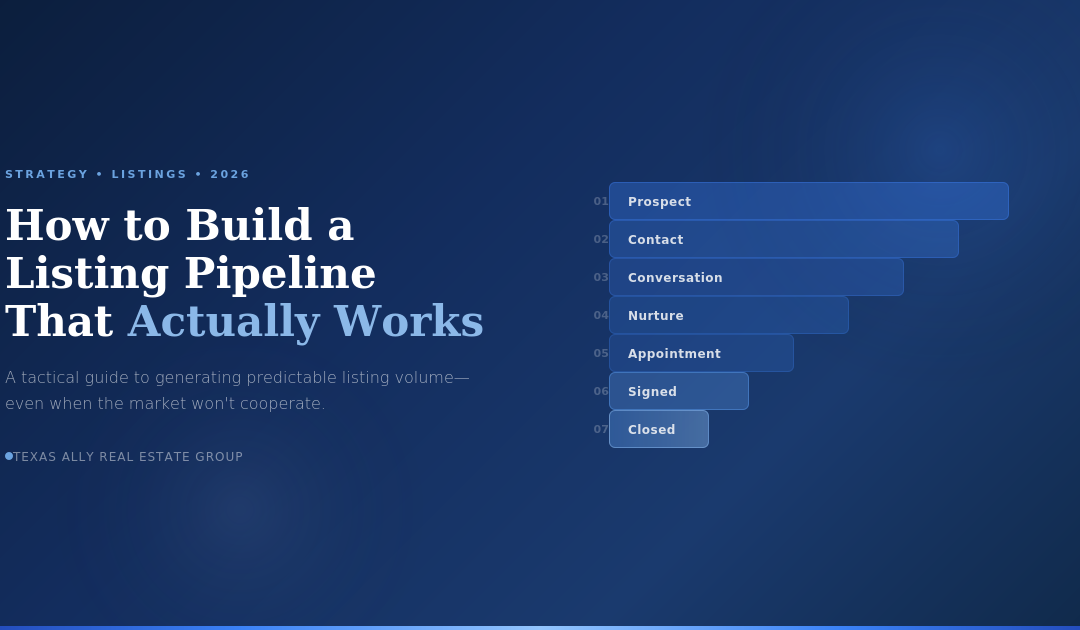
A tactical guide to generating predictable listing volume—even when the market won’t cooperate.
By Texas Ally Real Estate Group
Most agents don’t have a listing problem. They have a pipeline problem.
They know they need listings. They know listings are the highest-leverage activity in real estate. But when you ask them what their system is for generating listings consistently—month after month, regardless of motivation or market conditions—most don’t have a clear answer.
That gap between knowing and doing is where production dies. And in 2026, the margin for error is thinner than ever. Inventory is finally rising (up over 10% year-over-year nationally), which means more sellers are entering the market—but so is more competition for their attention. The NAR settlement has rewritten how buyer-agent compensation is communicated, putting listing agents at the center of new conversations about commissions and value. And home prices have moderated, with national appreciation slowing to roughly 1–2%, meaning sellers are more cautious, more informed, and more likely to interview multiple agents before choosing one.
The agents who win in this environment aren’t the loudest or the flashiest. They’re the ones with a repeatable system that runs whether they feel like prospecting today or not.
This article lays out that system—from the mindset shift you need, to the daily activities that fill your pipeline, to the specific lead sources that produce the best return on effort.
First, Understand Who You’re Talking To
The 2026 seller is not the same person who panic-listed during COVID or casually threw their house on the market in 2021 expecting 15 offers by Friday. Today’s sellers are deliberate. Many have been sitting on historically low mortgage rates for years, waiting for conditions to feel “right.” Life events—job changes, divorces, growing families, retirement—are what’s finally pushing them to move, not fear of missing out.
They’re also doing their homework. According to NAR’s Profile of Home Buyers and Sellers, roughly two-thirds of sellers found their agent through a referral or by using an agent they’d worked with before. That means the vast majority of listing decisions are made before a seller ever Googles “top real estate agent near me.” They’re asking friends. They’re remembering who sent them a market update last month. They’re hiring the person who stayed in touch.
This has a direct implication for your strategy: if you’re not already in a seller’s consideration set before they decide to list, you’re starting from behind. The work you do six months before a listing appointment matters more than your presentation at the table.
Think in Stages, Not Transactions
The most common mistake agents make with listings is thinking about them as events—something that either happens or doesn’t. In reality, every listing is the result of a process that moved through stages, whether you were conscious of it or not.
A useful framework looks like this: Prospect → Contact → Conversation → Nurture → Appointment → Listing Signed → Closed. Each stage has a conversion rate, and those rates are where your real leverage lives.
For example, if you need two new listings per month, you might need to set four listing appointments (assuming a 50% close rate at the table). To get four appointments, you might need 20 meaningful conversations. To have 20 conversations, you might need to make 60–80 contact attempts. And to make those attempts, you need a database of 200+ prospects you’re actively working.
This isn’t theory—it’s math. When agents start tracking their pipeline stages, two things happen almost immediately. First, they stop feeling like listings are random. Second, they can diagnose exactly where their system is breaking down. Not enough appointments? You probably aren’t having enough conversations. Enough conversations but no appointments? Your value proposition needs work. The pipeline tells you what to fix.
Your Sphere Is Still Your Best Asset (If You Actually Work It)
There’s a reason every experienced agent preaches sphere of influence, and the data backs it up year after year. NAR research consistently shows that approximately two-thirds of sellers choose their agent through a referral or a past relationship. Agents earning over $100,000 annually report that roughly a third of their business comes from referrals and another third from repeat clients.
Yet most agents treat their sphere like a storage unit—full of stuff they know is valuable but never actually open. The fix isn’t complicated, but it does require discipline.
Start by building a real database. Not a phone full of contacts, but a CRM-managed list of at least 150–300 people you can contact with intention. Categorize them: A-list contacts are people likely to transact or refer in the next 12 months (past clients, close friends, people who’ve mentioned moving). B-list contacts are people who know you’re in real estate but haven’t signaled intent. C-list contacts are acquaintances and wider network connections.
Then implement a contact cadence. For your A-list, this means a monthly phone call or face-to-face, a monthly market update personalized to their neighborhood, a quarterly in-person touchpoint (coffee, a client event, dropping by), and one to two handwritten notes per year. For your B and C contacts, a monthly email with genuine value—not a generic newsletter, but something useful like a local market snapshot or a piece of advice—keeps you top of mind without being intrusive.
The key word is value. Nobody wants another “Just checking in!” text. Send them something that makes their life better, answers a question they didn’t know they had, or demonstrates that you understand their market.
Pick a Farm and Commit
Geographic farming—choosing a specific neighborhood and becoming the go-to agent there—remains one of the most reliable long-term listing strategies. But it only works if you pick the right area and stay consistent for at least 12–18 months.
Select a neighborhood of 300 to 1,500 homes with a healthy turnover rate (ideally 5–8% annual turnover). Look for areas where no single agent dominates more than 20–25% of the listings—there’s room for you. Avoid areas where one agent has locked down 40%+ market share unless you’re prepared for a multi-year campaign.
Your farming activities should layer on top of each other: monthly direct mail (market reports, just-sold cards, neighborhood-specific content), door knocking when you have a new listing or recent sale to share, hosting open houses in the farm area, and providing hyper-local market data that no national website can replicate.
The goal isn’t to be known as “an agent.” It’s to be known as the agent for that neighborhood—the person who knows the comps cold, who can tell you what the house three doors down sold for and why, and who shows up consistently whether they have a listing there right now or not.
Expired Listings and FSBOs: High Effort, High Reward
These two lead sources get a bad reputation because they’re uncomfortable. Calling someone whose listing just failed, or approaching a homeowner who specifically chose not to hire an agent, requires thick skin. But the upside is significant: these are people who have already decided to sell. You’re not creating demand—you’re redirecting it.
Expired listings are sellers who wanted to sell, hired an agent, and it didn’t work. Something went wrong—pricing, marketing, market conditions, or the agent’s effort. Your job isn’t to pitch. It’s to diagnose. Lead with questions: What do you think went wrong? Were you getting showings but no offers, or was traffic the problem? Did your agent recommend any price adjustments? These questions position you as a problem-solver, not another salesperson. Follow a structured cadence: call on day one, follow up on days 3, 7, 14, and 21. If they haven’t re-listed by week four, move them into a long-term nurture sequence. Many expired sellers re-list 60–90 days later after the sting wears off.
FSBOs represent a shrinking but still valuable opportunity. According to NAR’s 2025 Profile, FSBO transactions have dropped to just 5% of all home sales—the lowest share ever recorded. And FSBO homes sell for a median of $360,000 compared to $425,000 for agent-assisted sales. That’s not a coincidence. Pricing, marketing reach, and negotiation expertise matter, and that price gap is your most compelling talking point.
When approaching a FSBO, don’t lead with “You need an agent.” They’ve already decided they don’t. Instead, offer something useful: a complimentary pricing analysis, insight into what comparable homes have sold for, or help understanding how the new buyer-agent compensation rules might affect their sale. Build trust first. The listing often follows within 4–6 weeks.
Your Online Presence Is Your 24/7 Listing Presentation
Here’s something that surprises a lot of agents: NAR data shows that fewer than one in ten buyers and sellers found their agent through a website. The internet didn’t replace referrals—it became the place where referrals get validated. When someone hears your name from a friend, the first thing they do is Google you. What they find determines whether they call.
This means your online presence doesn’t need to be a lead generation machine. It needs to be a credibility machine. A few fundamentals go a long way.
Start with your Google Business Profile. It’s free, it shows up in local searches, and it’s where your reviews live. Ask every satisfied client for a Google review—this is the single highest-ROI marketing activity most agents ignore. Then focus on producing consistent, educational content. You don’t need to go viral. You need to demonstrate expertise. Topics that resonate with potential sellers include pricing strategy in a shifting market, how to prepare a home for sale without overspending, what the current buyer pool looks like in your area, and how the commission landscape has changed post-settlement.
Publish this content wherever your audience already is—your website, social media, email newsletters, even short video. The format matters less than the consistency. One valuable post per week beats a burst of five posts followed by two months of silence.
The Daily Discipline That Makes Everything Else Work
Strategy without execution is just a wish list. The difference between agents who consistently generate listings and those who don’t almost always comes down to daily habits, not annual goals.
A productive daily rhythm for listing-focused agents looks something like this: spend the first 60–90 minutes of your workday on prospecting—adding new contacts, making calls, sending personalized follow-ups. This is your “money time” and it should be protected from meetings, emails, and admin. Log every interaction in your CRM. If it’s not tracked, it didn’t happen.
Weekly, review your pipeline numbers. How many new prospects did you add? How many contact attempts did you make? How many conversations turned into appointments? Identify where the bottleneck is and focus your energy there.
Monthly, send a market update to your entire database, review your conversion rates across the pipeline, and adjust your approach based on what the numbers are telling you. If your contact-to-conversation rate is dropping, you might need better scripts or a different approach. If your appointment-to-listing rate is low, your presentation might need work.
None of this is glamorous. It’s not a hack or a shortcut. It’s the accumulated result of showing up every day and doing the work that most agents know they should do but consistently avoid.
What the 2026 Market Means for Your Strategy
The current market creates both challenges and opportunities for listing-focused agents. NAR economists project a roughly 14% increase in existing home sales this year, driven by job growth, rising inventory, and gradually improving affordability. Mortgage rates have settled closer to 6%, which is enough to bring sidelined buyers back into the market. Early 2026 data already shows strengthening buyer demand and rising new listings, suggesting the spring selling season could be significantly more active than 2025.
For agents, this means more potential sellers will be entering the market—but many will be nervous. They’ve been watching from the sidelines and they want to know their home will actually sell, at a fair price, without sitting on the market for months. Your ability to communicate market conditions clearly and set realistic expectations will be a differentiator.
The post-settlement compensation landscape also creates a new conversation at the listing table. Sellers now need to understand how buyer-agent compensation works outside the MLS, what offering (or not offering) buyer-agent fees means for their home’s visibility, and how to think about commission as a strategic tool rather than a fixed cost. Agents who can navigate this conversation with confidence—rather than awkwardness—will stand out.
The Bottom Line
Generating listings in 2026 isn’t about finding a magic lead source or mastering a new technology. It’s about building a system that puts you in front of potential sellers consistently, delivers value before you ever ask for their business, and runs on discipline rather than inspiration.
Work your sphere with intention. Pick a farm and commit. Don’t ignore the uncomfortable lead sources like expired listings and FSBOs. Make your online presence a credibility asset. And above all, track your pipeline and do the daily work.
The agents who thrive in this market won’t be the ones waiting for listings to fall into their lap. They’ll be the ones who built the pipeline six months ago—and kept filling it every single day.
Sources & Further Reading
• HousingWire: Rising Inventory Brings Balance to the 2026 U.S. Housing Market
• NAR: 2026 Real Estate Outlook — What Leading Economists Are Watching
• J.P. Morgan: U.S. Housing Market Outlook
• NAR: FSBOs Reach All-Time Low, More Sellers Rely on Agents
• NAR Settlement FAQs
• NAR: Compensation, Commission and Concessions
• HousingWire: 8 Ways to Expand Your Sphere of Influence in Real Estate
• HousingWire: Early 2026 Housing Market Gains Traction

by Micaela Gonzalez | Feb 27, 2026 | News Feed
Home Staging Mistakes to Avoid: How to Prepare Your Texas Home for a Successful Sale
In Texas, the homes that sell fastest in 2026 are often the ones that feel “move-in ready” the moment a buyer walks in—or clicks through photos. With more shoppers comparing listings across multiple neighborhoods and price points, staging has become less about decorating and more about reducing friction: helping buyers picture their life in the home, understand the layout, and feel confident about condition and value.
That’s why learning the most common home staging errors matters right now. The wrong choices can reduce buyer interest, shrink showing traffic, weaken offers, or lead to longer days on market—especially in a market where buyers are value-conscious and quick to move on from anything that looks like extra work.
Below are the biggest home staging mistakes to avoid, along with practical Texas home staging tips you can use immediately. If your goal is how to stage a home to sell fast, think of this as a checklist for preparing your home for sale Texas-style—heat, sun, pets, and all.
Why does staging matter in the Texas housing market in 2026?
Staging matters because buyers don’t just purchase square footage—they purchase confidence. In today’s Texas housing market home preparation is part presentation, part risk management: clean lines, bright rooms, and clearly defined spaces signal that the home has been cared for and is priced with intention.
Texas also has distinct regional and seasonal patterns. In places like Houston and the Gulf Coast, humidity and storms can magnify concerns about odors, flooring, and drainage. In DFW and Austin, buyers often prioritize functional layouts for hybrid work and easy entertaining. In San Antonio and much of Central Texas, strong sun and warm months make shade, window treatments, and curb appeal especially noticeable.
For sellers, staging is also real estate marketing. Your photos, video walkthrough, and first showing are the product launch. The best real estate marketing tips for sellers start with removing distractions, highlighting what’s special, and making the home look easy to live in—because “easy” sells.
- Staging supports your list price by improving perceived condition and reducing “project” vibes.
- Staging improves online performance (more saves, more showings) because photos look brighter and more spacious.
- Staging can reduce negotiation pressure by minimizing visible defects and helping the home show consistently.
What are the most common home staging errors inside the house?
Most common home staging errors happen indoors, where buyers spend the most time evaluating flow, finishes, and maintenance. The goal isn’t to make the house look like a model home—it’s to make it look bigger, cleaner, brighter, and simpler to understand.
1) Skipping decluttering (or “hiding” it in closets and the garage)
Decluttering before selling a home is the foundation of staging, but many sellers stop at countertops and visible shelves. Buyers absolutely open closets, pantry doors, and garage bays—especially in Texas where storage is a major selling point for sports gear, holiday décor, and outdoor equipment.
Why it hurts: Overstuffed closets make the home feel smaller and can raise doubts about storage capacity.
Do this instead: Aim for 30–40% empty space in closets and cabinets. Use matching bins, remove off-season items, and clear garage walls enough that the space reads as usable, not chaotic.
- Pack up excess small appliances, duplicates, and bulky cookware you don’t use weekly.
- Remove extra furniture that blocks pathways—especially in open-concept living areas.
- Keep only a few neutral countertop items (a soap dispenser, a simple tray, a plant).
2) Leaving rooms without a clear purpose
In many Texas homes, you’ll see bonus rooms, lofts, flex spaces, or formal dining rooms that no longer match how people live. When a room feels like a catch-all—half office, half storage, half gym—buyers struggle to understand the floor plan.
Why it hurts: Confusion reduces perceived value. If buyers can’t “place” the room, they mentally discount it.
Do this instead: Stage each space with a single, obvious function. If you’re in Austin, lean into a tidy home office setup. In DFW, a homework station or media room vibe often resonates. In Houston, a flexible guest room can be a strong value signal during relocation season.
3) Ignoring paint, patching, and finish touch-ups
Cosmetic wear shows up more in listing photos than many sellers expect. Scuffed baseboards, chipped door frames, and random paint colors can make a home feel dated, even if the big-ticket items are solid.
Why it hurts: Buyers use visible wear as a shortcut for “what else haven’t they maintained?” That can lead to tougher inspections and more repair requests.
Do this instead: Focus on quick, high-impact fixes that support how to increase home value before selling.
- Patch nail holes and repaint high-traffic walls in a consistent, light neutral.
- Repaint or touch up baseboards and trim where scuffs are obvious.
- Replace mismatched bulbs so color temperature is consistent throughout the home.
4) Bad lighting choices (especially in North-facing rooms)
Texas has plenty of sunlight, but not every room gets it equally—especially in townhomes, older bungalows, or homes with deep porches and mature trees. Dark rooms photograph poorly and feel smaller in person.
Why it hurts: Buyers interpret dim rooms as “gloomy” or “needs work,” even when it’s just lighting.
Do this instead: Use a layered lighting approach: overhead + lamps + natural light. Open blinds, clean windows, and replace heavy curtains with simple panels that frame the window without swallowing it. This is practical real estate staging advice that pays off immediately in photos.
5) Too much personalization (or “themed” décor)
Texas homes often have strong style cues—rustic ranch, hill-country modern, coastal, or ultra-contemporary. Personality is great, but highly specific décor can distract buyers from the bones of the home.
Why it hurts: If buyers focus on your collectibles, bold murals, or loud accent walls, they stop imagining their own life there.
Do this instead: Keep character, but tone it down. A few warm, Texas-appropriate touches (natural textures, a simple bowl, neutral art) reads inviting without feeling like a design decision the buyer must undo.
6) Pet evidence and lingering odors
This is one of the most overlooked home staging mistakes to avoid. In Texas, heat and humidity can intensify odors quickly—especially from litter boxes, dog beds, wet towels, and rugs.
Why it hurts: Odor is emotional. Even buyers who love pets may assume cleaning or flooring replacement is needed, lowering perceived value.
Do this instead: Deep clean soft surfaces, wash pet bedding, and store food bowls out of sight for showings. If you have carpet, consider a professional cleaning and be honest about what it can and can’t fix. Avoid heavy air fresheners; “cover-up” scents can trigger suspicion.
What curb appeal mistakes do Texas sellers make most often?
Buyers start judging before they step inside. Curb appeal mistakes Texas sellers make can quietly reduce showing-to-offer conversion, because buyers arrive with a lower expectation—and then look for flaws to confirm it.
1) Underestimating the Texas yard (or overdoing it)
Lawns can be tricky across the state. In Dallas-Fort Worth, summer heat stresses turf and exposes patchy areas. In Houston, heavy rain can highlight drainage issues. In West Texas, drought-tolerant landscaping often looks best, but only if it’s intentional.
Why it hurts: A struggling yard signals high maintenance, high water bills, or drainage problems.
Do this instead: Keep it simple and tidy. Edge the beds, trim shrubs away from windows, and add fresh mulch for contrast. If grass is thin, focus on neat hardscaping and clean lines rather than trying to force a lush look overnight.
2) A tired front door and entry
The entry is a small area with outsized influence. A scuffed door, dusty light fixture, or cobwebs around the porch read as deferred maintenance.
Do this instead: Clean the door, update hardware if it’s heavily worn, and consider a fresh coat of paint in a classic color that suits the home’s exterior. Keep the porch staged with one or two pieces—too many chairs, pots, and signs can look cluttered.
3) Neglecting rooflines, gutters, and “storm-season” signals
Texas buyers pay attention to weather readiness. Loose downspouts, overflowing gutters, and visible rot can raise concerns about water intrusion—especially in areas with hail, heavy rain, or hurricane season considerations.
Do this instead: Clear gutters, pressure wash where needed, and make sure downspouts direct water away from the foundation. If your area is prone to storms, neat exterior maintenance acts like a trust signal before inspection even begins.
4) Exterior clutter that photographs badly
Trash bins, hoses, toys, and tool piles are easy to ignore in daily life, but they dominate listing photos. This is a frequent issue when staging a house in Texas market conditions, where outdoor living is a key feature and patios get used year-round.
Do this instead: Treat patios like an outdoor room. Store equipment, roll up hoses, and set out a simple seating arrangement so buyers understand the space. Clean the grill and keep pool or hot tub areas spotless and staged minimally.
How do you stage a Texas home to sell fast without overspending?
If you’re wondering how to stage a home to sell fast, start by thinking like a buyer scanning listings at night: bright photos, clean surfaces, and a home that feels easy to maintain. The best Texas home staging tips are often low-cost and focused on presentation, not renovation.
Prioritize the “photo-first” rooms
You don’t need to stage every inch perfectly to get strong results. Put your effort where it matters most for online appeal and first impressions.
- Living room: Create open pathways and a clear focal point (fireplace, large window, or TV wall kept simple).
- Kitchen: Clear counters, clean grout, polish appliances, and minimize magnets/papers.
- Primary bedroom: Neutral bedding, matching lamps if possible, and clear nightstands.
- Bathrooms: Fresh towels, minimal items, spotless mirrors, and bright lighting.
- Entry: A clean mat, a simple console or hook area, and nothing on the floor.
Use “Texas-proof” styling: cool, calm, and low-maintenance
In warm months, buyers are sensitive to stuffiness and glare. Keep the home cool for showings, replace dirty filters, and make sure ceiling fans are clean and wobble-free. If you have plantation shutters or blinds, ensure they’re aligned and dust-free—small details read as overall care.
For homes with lots of tile (common in Texas), make floors shine and use area rugs sparingly to define spaces without hiding condition. For homes with wood floors, avoid heavy waxy products; clean and let the natural finish be the selling point.
Lean on strategic updates that show, not just “tell”
Not all improvements are equal. If your goal is how to increase home value before selling, choose updates that clearly improve how the home looks in photos and feels in person.
- Updated light fixtures in the dining area or entry (simple, modern, proportionate).
- New cabinet pulls if current hardware is dated or mismatched.
- Fresh caulk and re-grouting in showers where discoloration stands out.
- Professional cleaning and window washing before photos and showings.
Be cautious with major renovations right before listing unless you’ve reviewed likely return with a local professional. In many Texas submarkets, speed and cleanliness outperform expensive overhauls—especially when buyers can choose from multiple similar homes.
What should your pre-listing staging checklist look like in 2026?
Think of staging as part of your overall home selling tips 2026 playbook: presentation + pricing + timing. When you’re preparing your home for sale Texas sellers should plan around seasonality, too. Spring and early summer often bring more buyer activity, while late summer heat can make showings less comfortable—another reason to keep the home cool and bright.
Use this practical checklist to avoid common home staging errors and stay organized in the final two weeks before listing.
- Declutter and pack early: Start with closets, pantry, laundry room, and garage (buyers check these).
- Deep clean top to bottom: Focus on kitchens, bathrooms, baseboards, windows, and floors.
- Fix the “small broken things”: Loose handles, sticky doors, missing outlet covers, wobbly fans.
- Unify lighting: Same color temperature bulbs, brighter wattage where appropriate, add lamps in dark corners.
- Neutralize without sterilizing: Remove overly personal photos; keep a warm, welcoming look.
- Refresh curb appeal: Edge, mow, trim, mulch, clean the entry, and clear exterior clutter.
- Prep for showings: Set a quick routine—surfaces clear, beds made, trash out, pet items stored.
- Photo day plan: Open blinds, turn on lights, hide cords, and remove cars from driveway if possible.
Finally, remember that staging and marketing work together. Strong photos, a clean and cohesive look, and a home that shows consistently are core real estate marketing tips for sellers—especially in competitive neighborhoods where buyers can tour several similar homes in one afternoon.
If you want a simple guiding principle: staging is the art of removing reasons to say “no.” Avoid these home staging mistakes to avoid, apply a few high-impact fixes, and you’ll put your listing in a stronger position—whether you’re selling a condo near Houston’s Inner Loop, a family home in Frisco, a bungalow in East Austin, or a Hill Country retreat outside San Antonio.

by Yamila Gagliano | Feb 27, 2026 | News Feed
Why 100% Commission Can Change the Way You Run Your Business
Texas real estate has always rewarded agents who treat their work like a business—especially in a market where deal volume can rise and fall with seasonality, interest rates, and local job growth. From spring listing surges in Dallas-Fort Worth and Austin to summer relocation waves in Houston and San Antonio, the agents who stay consistent are the ones who manage cash flow, reinvest in marketing, and build repeatable systems.
That’s why the conversation around 100% commission real estate models is heating up. When you keep more of each commission check, you’re not just increasing take-home pay—you’re changing your real estate agent income model, your ability to invest, and the level of control you have over your brand. For many producers, joining a 100% commission brokerage is less about a “better split” and more about stepping fully into real estate agent entrepreneurship.
How does a 100% commission real estate model work in Texas?
A 100% commission brokerage typically allows agents to retain 100% of the gross commission income (GCI) on their transactions, while the brokerage earns revenue through a monthly fee, a per-transaction fee, or a combination of both. In Texas, this is often paired with compliance oversight, transaction coordination options, and required errors & omissions (E&O) coverage structures that vary by broker.
It’s important to clarify what “100%” means in real life. In most cases, you keep 100% of the commission after the agreed brokerage fees. That makes it similar to a flat fee brokerage for agents model: predictable costs, higher marginal earnings per deal, and more visibility into profitability.
This approach is gaining attention among agents who see themselves as business owners—especially in high-cost, high-opportunity Texas metros where marketing and lead generation budgets matter. If you’re paying for photography, staging consults, social ads, CRM subscriptions, and client events, your real estate agent commission structure directly impacts what you can sustainably invest each month.
Why timing matters: Texas seasonality and cash flow
Texas markets often move in bursts. Spring can be intense, late summer can be relocation-heavy, and the winter lull can feel very real—especially for newer agents. A structure that improves cash flow during peak months can help you carry consistent marketing through slower seasons without having to “start over” each quarter.
Commission split vs 100 percent: what changes financially?
The simplest way to understand commission split vs 100 percent is to look at what happens to your GCI over time. In a traditional model, you might pay a real estate commission split (for example, 70/30, 80/20, or a tiered system) until you hit a cap. In a 100% structure, you typically pay fixed fees, then keep the rest.
Neither model is automatically “better.” What matters is your production level, your average price point, and what you’re actually receiving in return (leads, admin support, office space, brand power, training, etc.). Still, many agents are surprised by how quickly splits add up—especially once they’re consistently closing transactions.
- Traditional split model: Brokerage earnings scale up as your production grows, unless capped.
- 100% commission brokerage: Your profitability typically scales faster as volume increases, because fees are more fixed and predictable.
- Hybrid/cap model: Often a middle ground, but may include fees even after the cap.
Practical scenario: a Texas agent with steady production
Let’s use a realistic example for a major Texas metro. Assume an agent closes 24 transactions a year with an average gross commission of $10,000 per transaction (that’s $240,000 GCI annually). Compare two simplified structures:
- 80/20 split (no cap for simplicity): Agent keeps 80% = $192,000; brokerage retains $48,000.
- 100% model with fees: $500/month ($6,000/year) + $495/transaction ($11,880/year) = $17,880 total fees; agent keeps $240,000 – $17,880 = $222,120.
In this example, the 100% structure yields about $30,120 more in annual income before your own business expenses. That difference can fund a serious growth plan: better listing media, more consistent online ads, a stronger CRM, and part-time admin help.
Now consider the long-term effect. If you reinvest even half of that margin into lead generation and client experience, you’re not just earning more—you’re compounding growth.
Where high commission real estate brokerage models can shine
A high commission real estate brokerage structure (including 100% options) tends to work best when:
- You have consistent deal flow or a clear plan to build it.
- You’re already paying for your own marketing and tools.
- You want tighter control over branding, systems, and budget decisions.
- You value predictable expenses over variable split-based costs.
Why 100% commission brokerage models can improve agent profitability and cash flow
At its core, the appeal of benefits of 100% commission brokerage options is straightforward: higher retained income per closing can improve real estate agent profitability. But profitability isn’t just about making more—it’s about running a stable business that can weather market shifts and expand when opportunity shows up.
In Texas, “market shifts” aren’t theoretical. When rates move, affordability changes quickly across suburbs like Katy, Round Rock, Frisco, and New Braunfels. A stronger margin helps you keep your marketing consistent when other agents pull back, which can create an advantage when buyers and sellers re-enter the market.
Cash flow also becomes easier to manage. With a fixed-fee model, you generally know your baseline operating costs. In a split model, your “brokerage cost” rises every time you produce more—right when you might want to reinvest most aggressively.
From transaction income to business income
A key mindset shift in the independent real estate agent model is treating each closing like revenue that should be allocated. When you keep more of your GCI, it becomes easier to run your business with intention—pay yourself, fund taxes, invest in growth, and build reserves.
- Owner pay: More consistent, less dependent on the next closing.
- Tax planning: Easier to set aside a reliable percentage each month.
- Reserves: A cushion for slower seasons or unexpected expenses.
- Growth budget: Marketing and systems stop being “optional.”
This is where real estate agent financial growth becomes measurable. When you can reliably reinvest, you can plan quarters ahead instead of operating deal-to-deal.
How higher margins support real estate business growth strategies
The best argument for a 100% commission model isn’t “you get paid more.” It’s that higher margins give you options—and options are what create scalability. If your goal is to move from being a solo agent to building a resilient, referral-driven business (or a small team), your commission structure can either accelerate that path or slow it down.
Here are practical ways agents use increased margins to implement real estate business growth strategies in Texas markets.
Branding that fits your market (and your price point)
Texas is not one monolithic market. Branding that works in The Woodlands may not fit East Austin. What works in Plano may not resonate in Fort Worth’s historic neighborhoods. Higher retained income makes it easier to build a brand that matches your niche, including:
- Professional photography and video on every listing
- Neighborhood-specific content and guides
- Consistent signage, print pieces, and open house materials
Lead generation you can sustain through the slow season
Many agents start and stop ads based on closings, which creates an income roller coaster. With a better margin, you can commit to a consistent spend—especially helpful during slower winter months when competition for attention can actually be cheaper. Whether you focus on Google search, social ads, or local sponsorships, consistency tends to beat intensity.
Technology and systems that reduce chaos
The hidden cost for many agents isn’t money—it’s time lost to repetitive tasks. A stronger real estate agent income model can support systems like:
- A CRM with automation for follow-up and long-term nurture
- Transaction management tools that reduce missed deadlines
- Digital listing presentation and buyer consultation workflows
These aren’t “nice-to-haves” when you’re trying to scale. They’re the operational foundation of the independent real estate agent model.
Support roles that unlock more production
In Texas, where many clients expect quick responses and weekend availability, support is leverage. With more margin, an agent can hire a part-time admin, a transaction coordinator, or a showing assistant sooner—often the difference between capping out at 20 closings and stepping into 35+.
That’s the long game of real estate agent entrepreneurship: using profit to buy back time, then using time to create more profit.
What to evaluate beyond the split: support, compliance, tools, and fees
Choosing among brokerage models for real estate agents is not just a math problem. A 100% commission plan can be excellent, but only if the brokerage provides the right guardrails and value for your stage of business—especially in Texas, where contracts, disclosures, and timelines must be handled correctly to protect the client and the agent.
Before switching, evaluate the full business package: what you’re paying, what you’re receiving, and what you’ll need to replace on your own.
Key questions to ask a 100% commission brokerage
- What fees apply? Monthly fees, per-transaction fees, tech fees, E&O, admin fees, and any “hidden” charges.
- What compliance support is included? Broker access, contract review, required training, and guidance on Texas-specific forms and timelines.
- What tools are provided? CRM, transaction management, templates, marketing assets, and listing support.
- What is the culture and accountability? Coaching, mastermind groups, and performance expectations can matter more than people think.
- What happens when something goes wrong? Disputes, missed deadlines, inspection issues, repair negotiations—how responsive is the broker?
Also consider what type of agent you are today. Newer agents may benefit from hands-on training and mentorship more than a higher split. Established agents with a defined niche and repeatable lead sources often benefit more from keeping margins and controlling the business.
Common red flags and green flags
Red flags can include unclear fee schedules, limited broker availability, weak compliance processes, or pressure to use certain vendors. Green flags include transparent pricing, strong transaction oversight, clear expectations, and optional (not mandatory) add-ons that match your growth stage.
The goal is to find alignment: a model that supports your production without taking a disproportionate share of your upside.
Is a 100% commission real estate model right for your long-term goals?
For many Texas agents, switching to a 100% commission brokerage is a turning point because it reinforces one idea: you are running a business. When you keep more of what you earn, you start thinking differently about hiring, marketing, systems, and the client experience. You stop waiting for the brokerage to “provide” growth and begin building it.
That said, a smart decision considers the full picture—real estate commission split, fees, support, compliance, and tools. A traditional split can be a great fit when mentorship, leads, or infrastructure are truly moving your business forward. A 100% model can be a powerful fit when you want control, predictability, and higher margins to fuel your next stage.
If you’re comparing commission split vs 100 percent, run the numbers based on your last 12 months of production, then look ahead. Ask yourself: does my current real estate agent commission structure help me reinvest, scale, and build a durable brand in my Texas market? If the answer is no, it may be time to explore a model designed for real estate agent profitability, autonomy, and long-term growth.
