
by Marian McPherson | Jun 11, 2025 | Industry, News Feed
New York City’s broker fee bill went into effect on Wednesday, prohibiting property owners from passing broker fees onto renters. REBNY attempted to block the bill’s enforcement but failed.
Bigger. Better. Bolder. Inman Connect is heading to San Diego. Join thousands of real estate pros, connect with the Inman Community, and gain insights from hundreds of leading minds shaping the industry. If you’re ready to grow your business and invest in yourself, this is where you need to be. Go BIG in San Diego!
New York City’s controversial broker fee bill has gone into effect. This means rental property owners — not renters — must pay broker fees when they enlist a broker to help them lease a unit.
The New York City Council passed the bill, formally known as the Fairness in Apartment Rental Expenses (FARE) Act, in November with a vote of 42 to 8. The Real Estate Board of New York (REBNY) sued the City in December to stop FARE’s enforcement and filed an injunction on Tuesday, saying the bill shouldn’t be enforced until the lawsuit ends. However, Southern District of New York judge Ronnie Abrams denied REBNY’s request.
James Whelan | Credit: REBNY
“New Yorkers will soon realize the negative impacts of the FARE Act when listings become scarce, and rents rise,” REBNY President Jim Whelan told The Real Deal.
NYC Councilmember Chi A. Ossé pitched the FARE Act for two years and finally got traction in 2024 amid record rental growth. Ossé and his 33 co-sponsors said broker fees exacerbate high rental costs, with New Yorkers typically paying five figures to rent a unit, which includes the first month’s rent, a security deposit and a broker fee of one month’s rent or 10 to 15 percent of the annual rent.
“A party that purchases or contracts a good or service should be responsible for the cost,” Ossé, who represents Brooklyn, said last year. “This is the case in every other transaction across our vast economy, and should be true for New York City Rentals as well. The FARE Act has the potential to alleviate prohibitive upfront costs for workers and growing families searching for a new home.”
“If you want a broker, great, hire them. And if you don’t want one, my bill says you don’t have to pay,” he added.
Ossé said the bill will improve affordability for New Yorkers, an outcome that Zillow-owned StreetEasy supported through a report that found upfront rental costs had grown 19.28 percent from 2023 to 2024. For renters who leased a unit with broker fees, StreetEasy said they “likely spent 42.9 percent more” in upfront costs than renters who leased a unit without broker fees.
“This is a big win for renters,” StreetEasy Senior Economist Kenny Lee said.
However, early market trends hint that FARE’s supporters might be wrong.
The Wall Street Journal tracked rental listings in the days leading up to the bill’s enforcement, and found that property owners had hiked prices by hundreds of dollars. One unit that The WSJ tracked included a notice that the price would go from $3,300 per month to $3,975 per month if it wasn’t rented before the FARE Act’s enforcement.
REBNY warned that FARE would cause higher monthly rents, as property owners look for a way to offset the cost of brokers’ fees.
“What it really is going to do is complicate the transactions even further to where effectively that cost is going to have to be accrued through higher rent,” former REBNY VP of Government Affairs Ryan Monell told Inman in June 2024. “So while you may save some money on the front end of a transaction, the reality is the cost of the broker fee isn’t actually going to be evaporated into thin air.”
“For those who decide to renew the lease year over year, it’s going to be a problem,” he added. “When you’re looking at a higher base rent for the first year you’re in an apartment, it’s going to be effectively amortized over time because when you go to renew, generally in New York City, they raise your rent, say 5 percent.”
Even as rents experience a post-enforcement pop, New York City renters still seem to see FARE as a win — for now.
The WSJ spoke to 27-year-old NYC renter Rita Liu, who spent half of her savings to get into an apartment during a previous move.
“Landlords are going to jack up the rents no matter what,” she said. “If broker’s fees aren’t a factor now, moving would be a lot more feasible.”
Despite several hiccups in their suit, including Judge Abrams’ criticism of REBNY’s claims that the Act violates First Amendment rights and limits consumer choice, the Association said it won’t give up easily.
“We will continue to litigate this case as well as explore our avenues for appeal,” REBNY President Jim Whelan said.
Email Marian McPherson
by Matt Carter | Jun 11, 2025 | Industry, News Feed
Fort Wayne, Indiana-based Hallmark Home Mortgage is licensed in 18 states. Company founder and CEO Deborah Sturges is joining Fairway as a division manager.
Bigger. Better. Bolder. Inman Connect is heading to San Diego. Join thousands of real estate pros, connect with the Inman Community, and gain insights from hundreds of leading minds shaping the industry. If you’re ready to grow your business and invest in yourself, this is where you need to be. Go BIG in San Diego!
Fairway Independent Mortgage Corp. will expand its presence in the Midwest with a deal to acquire “significant assets” of Indiana-based Hallmark Home Mortgage.
Hallmark will operate as a new division of Fairway, with CEO and founder Deborah Sturges joining Fairway with the title of president, Hallmark Home Mortgage, the companies announced Wednesday.

Deborah Sturges
“This strategic decision brings Fairway’s expanded product portfolio, enhanced technology, and deep support resources into Hallmark’s orbit,” Sturges said in a statement.
Terms of the deal were not disclosed.

Steve Jacobson
“Deborah and I worked together at Waterfield [Financial Corp.] decades ago and have remained industry acquaintances ever since,” Fairway founder and CEO Steve Jacobson said, in a statement. “Our shared values and our trust in each other make this partnership a natural fit. Our shared vision will make us even stronger together.”
Based in Fort Wayne, Indiana, Hallmark Home Mortgage is licensed in 18 states, sponsoring 45 mortgage loan originators who work out of 19 branch locations, according to Nationwide Mortgage Licensing System (NMLS) data.
In 2022, Hallmark hired former Finance of America divisional manager Marc Wadman to spearhead the lender’s expansion into Colorado, Georgia, Kansas, Louisiana, Missouri, South Carolina and Texas.
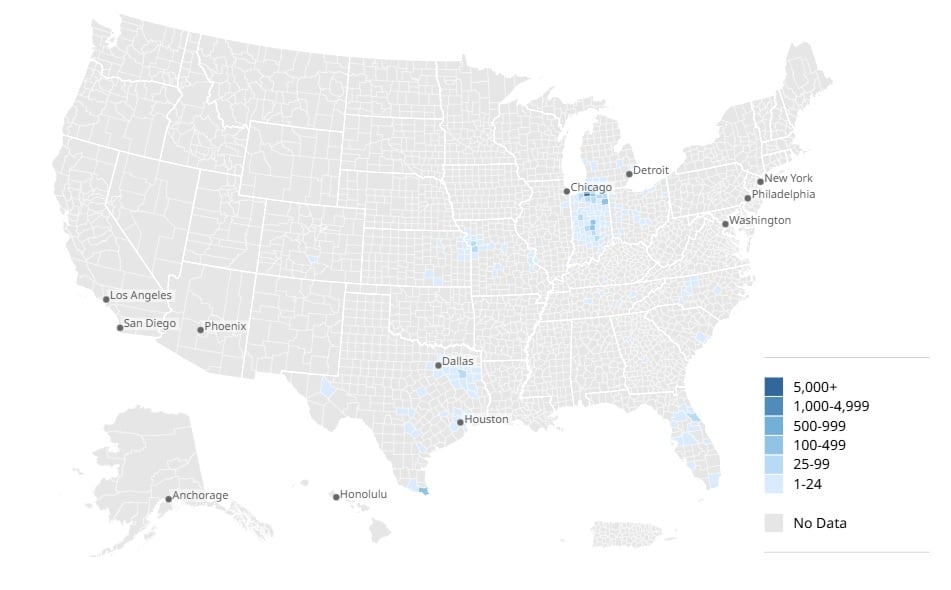
Hallmark mortgage originations by county
Source: iEmergent analysis of Home Mortgage Disclosure Act (HMDA) data.
Hallmark originated $591 million in mortgages last year, with most of that business in Indiana ($399 million), Texas ($88 million) and Missouri ($38 million), according to Home Mortgage Disclosure Act data tracked by iEmergent. Of the 2,640 loans Hallmark originated in 2024, 95 percent were purchase loans taken out by homebuyers
Based in Madison, Wisconsin, Fairway is licensed in all 50 states and sponsors 2,474 mortgage loan originators working out of 604 branch offices, according to NMLS data.
Fairway originated $23.7 billion in loans last year — 91 percent of them purchase loans — making the company the sixth-largest provider of loans to homebuyers, according to iEmergent data.
Fairway’s other trade names include 62PLUSHOMEBUYER.COM, CG HomeLoanPartners, Corporate Lending Group, MortgageBanc, Northpoint Mortgage and The Mortgage Reel. Fairway also owns the domain home.com, which redirects to the company’s homepage.
Last year, Fairway agreed to pay $10 million to settle allegations by federal regulators that the company engaged in redlining in the metro Birmingham, Alabama, market, which it entered in 2009 with the acquisition of MortgageBanc.
Fairway denied wrongdoing, saying regulators “did not identify any evidence of redlining or other discrimination,” and accused the government of acting in “bad faith” by characterizing Fairway’s actions as intentional, willful and reckless.
“Fairway vigorously defended itself against the government agencies’ allegations and continues to deny that the company engaged in any discriminatory behavior,” Fairway said in a statement in October.
Get Inman’s Mortgage Brief Newsletter delivered right to your inbox. A weekly roundup of all the biggest news in the world of mortgages and closings delivered every Wednesday. Click here to subscribe.
Email Matt Carter

by Lillian Dickerson | Jun 11, 2025 | Industry, News Feed
The new allegation of aggravated sexual abuse by force, threat or intoxicant against Oren and Alon brings the total number of counts against the brothers collectively up to 10.
Bigger. Better. Bolder. Inman Connect is heading to San Diego. Join thousands of real estate pros, connect with the Inman Community, and gain insights from hundreds of leading minds shaping the industry. If you’re ready to grow your business and invest in yourself, this is where you need to be. Go BIG in San Diego!
A third indictment was filed against former luxury brokers Tal and Oren Alexander and their brother, private security executive Alon Alexander, in the federal sex-trafficking case against them on Tuesday, which brings the total number of counts against the brothers up to 10.
The brothers now face one count of conspiracy to commit sex-trafficking; five counts of sex-trafficking by force, fraud or coercion; one count of sex-trafficking of a minor by force, fraud or coercion; two counts of inducement to travel to engage in unlawful sexual activity; and the new count of aggravated sexual abuse by force, threat or intoxicant.
The count added to the superseding indictment alleges that Alon and Oren used force to administer a “drug, intoxicant or other substance” to a seventh female victim who was unaware that she was being intoxicated in order to control her and cause her to engage in sexual acts while “on a Bahamian flagged cruise ship which departed from and arrived in the United States.” The previous indictment against them had identified six victims, one of whom was a minor.
The new indictment further states that as a result of the alleged offenses in the new count against them, Oren and Alon are to forfeit any real and personal property that was used or intended for use to commit the offense, “including but not limited to a sum of money in United States currency representing the amount of proceeds traceable to the commission of said offenses.”
The Alexander brothers were arrested on conspiracy to commit sex trafficking and sex trafficking charges in Miami in December 2024. A superseding indictment submitted by prosecutors in May added six new charges against them.
All three brothers have denied the charges against them.
A lawyer representing Alon told Inman in an emailed statement that, “The government continues to move backwards — the latest charge changes absolutely nothing and is merely a reheated version of the same case in an effort to keep the media firestorm going against the brothers.”
Another lawyer for Alon pointed Inman to a polygraph test that he passed in January while denying had ever had sex with a woman he knew had been given drugs.
Lawyers representing Oren and Tal did not immediately respond to Inman’s request for comment for this story, but after the superseding indictment was filed in May, attorneys for Tal said the new indictment “changes nothing,” and that it was “a reheated version of the same case — and still does not include conduct that amounts to federal sex trafficking.”
At that time, a lawyer for Oren told Inman that, “These new accusations, like the previous ones, are meritless, and reflect a failed prosecutorial effort to salvage a factually and legally unfounded case built on readily disprovable claims.”
Oren and Alon, as well as family friend Ohad Fisherman, also face state rape charges in Florida. Oren has been charged with three counts of sexual battery and Alon and Fisherman have been charged each with one count of sexual battery.
Several civil lawsuits submitted by dozens of women are also outstanding against the Alexander brothers in New York State and elsewhere. The majority of the lawsuits were filed in New York under an extension of a city law that allowed alleged victims of gender-motivated violence to sue their supposed perpetrators, no matter how long ago the alleged act of violence occurred. Victims were allowed to file lawsuits through the end of February 2025.
The brothers are currently being held in Brooklyn’s Metropolitan Detention Center.
Update: This story was updated after publishing with a comment from a lawyer representing Alon Alexander.
Get Inman’s Luxury Lens Newsletter delivered right to your inbox. A weekly deep dive into the biggest news in the world of high-end real estate delivered every Friday. Click here to subscribe.
Email Lillian Dickerson

by Summer Goralik | Jun 11, 2025 | Industry, News Feed
Bigger. Better. Bolder. Inman Connect is heading to San Diego. Join thousands of real estate pros, connect with the Inman Community, and gain insights from hundreds of leading minds shaping the industry. If you’re ready to grow your business and invest in yourself, this is where you need to be. Go BIG in San Diego!
Sometimes I need a break from the heavy, the technical, the compliance-laden critique. This piece is exactly that: a written timeout. But just a heads-up: It might also double as a slightly imaginative reenactment of current industry dynamics.
Over the weekend, I stumbled across an old high school yearbook. I don’t know about you, but when that happens, you have to sit down and take a look. Within minutes, there I was, flipping through pages of big hair, loud clothing, awkward smiles and those cringeworthy superlatives like “Most Likely to Succeed” and “Best Looking.” (Also, do schools still single kids out like that?)
Instantly, I was transported. A mix of nostalgia, humor and, if I’m being honest, a little discomfort. High school was full of cliques, competition, drama, ambition and unspoken social norms. It was a place where image often mattered more than substance.
It was also a never-ending reshuffling of alliances, egos and influence. One day, you’re on top: admired, applauded, maybe even envied. The next, you’re sidelined, misunderstood or replaced. Friend groups fracture. Rumors fly. Power shifts. And amidst the chaos that high school could be, someone is always trying to make the system a little better, or at least a little fairer.
Somewhere between the photos and end-of-year messages, something hit me: the coexistence of the school handbook and the unwritten rules. Diverse social factions. Power struggles. Causes people champion or curse. And of course, the swings. The typical ups and downs that high school is known for.
Are the dynamics of residential real estate today … a little like high school?
Some of you are probably thinking, “Oh no, where is she going with this?” Others? You’ve already topped off your coffee and settled in.
Is this an off-base analogy or déjà vu? Either way, let’s have some fun. Hear me out:
Less dazed, more determined
What’s your favorite high school flick? I have many, but Dazed and Confused is at the top of my list. Mostly because I love the ’60s and ’70s: the music, the fashion. And let’s be honest, wearing bell-bottoms in the 2020s just doesn’t hit the same.
“If I ever start referring to these as the best years of my life, remind me to kill myself.” That painfully honest gem, delivered by Pink in Dazed and Confused, used to make me laugh. Now, it makes me think.
Sure, high school had its moments, but I’m far happier in this season of life. I’m more independent, less concerned with approval, and finally free to do the work I believe in.
Maybe the evolution of the real estate industry could reflect that too: less division, more alignment. Fewer power struggles, more shared purpose. A space where doing the right thing, especially for the people licensed professionals serve, matters more than protecting turf or preserving old hierarchies.
Before we dive into the yearbook of Real Estate High, let me just say: If the industry has felt a little like third period with a pop quiz lately, you’re not imagining things. It’s full of bold — and sometimes shocking — headlines, compelling sound bites and swirling rumors, shifting loyalties and silent (and sometimes not-so-quiet) hierarchies. I’d say the only thing missing is a hallway monitor handing out warning slips, but let’s be honest, that’s probably the DOJ.
Let’s head down the hall. Class is officially in session.
The roll call of real estate
Ready for attendance? Just a reminder, this is all in good fun. But if some of it hits close to home, well, that’s kind of the point. On a lighter note, if you’re going to read through this cast of characters, I highly recommend queuing up “Slow Ride” by Foghat. It sets the tone.
As you read, ask yourself: Which of these groups are helping the school thrive, and who’s skipping class? And remember, in this school, the real “assignments” are the deals, disclosures and decisions that shape the industry.
The student body (general agent population)
They’re the heartbeat of the school — showing up, grinding it out and navigating the social swirl of Real Estate High. Some are finding their voice. Others are just trying to make it to graduation without detention (or a DRE citation). They might not all agree on who runs the place, but without them, the halls would be empty.
The cool kids (luxury brokers)
They roll up in Range Rovers, dressed in quiet luxury and loud confidence. Everyone wants to sit with them, even if they pretend not to care. They don’t just sell homes. They sell a lifestyle, preferably with a view and an NDA.
The drama club (reality TV agents + social media stars)
Always “on.” Their open houses are productions, and their Instagram stories are more choreographed than a high school musical. Critics roll their eyes, but hey, they’ve got followers. Sometimes, that’s all it takes to win prom queen.
The geeks (compliance consultants + risk managers)
Uncool? Maybe. Indispensable? Absolutely. They do the homework no one else wants to touch, fix the group project at the last minute, and quietly save everyone’s GPA (and license).
The computer lab crew (proptech + AI innovators)
You’ll find them in the back of campus, building tools the rest of the school hasn’t caught up to yet. They speak in code, pitch big ideas and sometimes get accused of trying to replace teachers with apps. Visionaries to some, disrupters to others. They’re already operating in the future while the rest of us are still fumbling with hall passes.
The principal (state regulators + DRE)
They show up unannounced. They enforce the rules. And when someone breaks them? Expect a trip to the office, and probably a write-up. They’re not here to be liked. They’re here to make sure the place doesn’t burn down.
The teachers (managing brokers + ethics trainers)
Some are inspiring. Some are just counting the days to summer break. They manage behavior, grade performance and try to maintain order in a classroom full of conflicting agendas.
The teachers union (NAR + power brokers)
They’ve long shaped school policies and culture. They say they’re working for the common good — and sometimes, they are. But lately, more teachers are asking: Do they still speak for us?
The PTA (consumer watchdogs)
They don’t go to school here, but they’ve got a seat at the table and an eye on the budget. They show up to meetings, raise tough questions and push for transparency, especially when it comes to fees and access. Some roll their eyes. Others take notes. But one thing’s certain: They’re not staying silent.
The rule-breakers (unethical agents)
They’re vaping behind the gym — it was cigarettes in my day — skipping class and making side deals in the parking lot. Disregarding disclosure and steering buyers? Just part of the routine. They haven’t been caught … yet. But the detention slip is coming.
The overachievers (top producers who follow the rules)
They grind. They lead quietly. They do the work and turn in every form on time. Admired by teachers and peers, they’re the ones actually running the show, just not yelling about it.
The transfer students (new agents and startups)
They’re fresh, a little lost, and someone’s already tried to sell them a coaching program. But they’re curious, scrappy and not bound by legacy friend groups. That makes them unpredictable, but in the best way.
The student council (reformers + advocates)
They show up early. They raise their hands. They fight for transparency, access and equity — even when they get eye rolls in the hallway. But sometimes? They’re the reason the handbook gets rewritten.
The school newspaper (industry media)
They break news, stir the pot and sometimes publish op-eds in your locker. They’re not always unbiased, but people read every word.
The cafeteria (MLS + portals)
Finally, this is where it all goes down. Gossip. Deals. Power plays. You can see exactly who’s sitting where and what’s being served. Some cut the line, others sneak off-campus to eat. What’s visible may not be the whole story. And what gets missed can matter even more.
Fiction or flashback?
Take the cast of characters above and build whatever plot you like. The storyline is yours. But one common reflection when thinking about high school, at least for me, is how I’d do it differently. I’d certainly care less about who was watching and more about who I was becoming. I imagine many of us feel that way when we look back at younger versions of ourselves.
And while this piece is playful, even tongue-in-cheek, I think there are some key takeaways behind the metaphors. Real estate is in flux. Like any institution under pressure, it faces a choice: resist change or rise to meet it.
Right now, in this industry, we have a real-time opportunity to make better decisions. We can treat compliance not as a formality, but as a foundation for trust. It means showing up with intention, without letting the noise or the naysayers slow us down. We can walk forward, learning from the past, but also not looking back.
I should mention that when the coast begins to clear and the headlines quiet down, it becomes easier to see the workforce that has been there all along. It is resilient, ethical and motivated, doing the hard work for the right reasons. That deserves to be seen. And if not celebrated, then certainly acknowledged.
Another way to look at all of this, and as Matthew McConaughey’s character Wooderson memorably put it in Dazed and Confused, is: “You just gotta keep livin’, man. L-I-V-I-N.”
Perhaps that’s the reminder to pull from this crazy analogy: Keep moving, keep growing, and focus on what matters. Integrity. Service. Forward motion. Not image. Not popularity. And definitely not cafeteria politics.
Because high school ends. And thank goodness, right? We grow up. We evolve. We do the adult thing now. Less drama, more direction. Less posing, more purpose.
We should aim to be our authentic selves while continuing to grow, learn and adapt (so few of those walking around on a high school campus). Following the rules, even when no one is watching, has always been the real compliance challenge. And we shouldn’t fall in with the wrong crowd, even if they’re the ones holding the mic.
So sure, maybe this piece is just comic relief. I definitely laughed while writing it. Or maybe, just maybe, it’s a mirror. Either way, I think we can all agree the future is already here. This time, let’s get it right the first time. No regrets.
NOTE: The opinions, suggestions, and recommendations contained in this discussion are based on Summer Goralik’s experience working for the California Department of Real Estate and as a real estate compliance consultant. They should not be considered legal advice or relied upon as such. You should consult with your brokerage and/or appropriate legal counsel in your jurisdiction for further clarification.
Summer Goralik is a real estate compliance consultant and former CA DRE Investigator in Huntington Beach, California. Connect with her on LinkedIn.

by Darryl Davis | Jun 11, 2025 | Industry, News Feed
A price drop is not your only option when the market’s slow or the listing’s stale. Darryl Davis offers strategies to reboot and relaunch that property.
Bigger. Better. Bolder. Inman Connect is heading to San Diego. Join thousands of real estate pros, connect with the Inman Community, and gain insights from hundreds of leading minds shaping the industry. If you’re ready to grow your business and invest in yourself, this is where you need to be. Go BIG in San Diego!
In a market where every listing is fighting for attention, agents are under pressure to produce results fast. But when a home lingers too long without offers, the default reaction is usually: slash the price. After all, what do grocery stores do when a loaf of bread gets stale? Slash the price and put it in the clearance bin.
Here’s the thing: Pricing may be the issue. But before you go reaching for that price reduction button, hit pause. There are seven powerful strategies that can reposition your listing, generate fresh interest and reengage the market, without leaving money on the table.
1. Refresh your first impression
A stale listing usually has a stale first image, and buyers scroll fast. The simple act of changing out your primary photo can reignite interest. Rotate in seasonal shots, twilight photos or lifestyle-focused images.
Are the pictures a little old? Is it July, and your images still show snow on the ground? Refresh your listing with all new in-season photos.
Bonus: Listings with updated images can get reprioritized by some MLSs and portals, helping them look “new” again.
2. Reframe the story
Your description should sell a story, not a list of features. If the home were a person, what kind of personality would it have? Your description should make the buyer feel something.
Think of it this way: If your listing were a dating profile, would it stand out or be ghosted? Has the home been recently staged? Upgraded? Did the sellers add smart home tech? Maybe the home office space is a remote worker’s dream. Highlight what makes the home matter now. If it’s been more than a month, rewrite the narrative.
3. Reintroduce the neighborhood
Buyers don’t just buy homes; they buy lifestyles. Add community photos, nearby hotspots, parks or dog-friendly areas to the listing. Paint the picture of what it feels like to live there. Create a “Love Where You Live” post for your socials or email a lifestyle-focused flyer to your database. Highlight schools, community events, festivals and anything else that will tell potential buyers, “You can have this lifestyle too.” Because nobody remains entirely in their home, it’s often easy access to the surrounding amenities that seal the deal.
4. Reevaluate your marketing mix
When’s the last time you did a marketing audit? Are you relying on auto-blasted email campaigns and hoping for the best? Now’s the time to get intentional. Test a new lead headline. Try a carousel video on Instagram. Post a behind-the-scenes tour to YouTube.
There are plenty of AI tools that can help you analyze your marketing systems and campaigns and can help you improve them with better SEO, more engaging content and better target audience engagement. If you’re not getting fresh eyes on the property, change the channel, not the price.
5. Upgrade to 3D and aerial
Let’s face it: Today’s buyers want more than just photos. They want immersion, and 3D walkthroughs, drone footage and narrated video tours help create a virtual experience buyers can’t ignore. They want to know what it feels like to be in that home before they even pick up the phone.
Try this stat on for size: Homes with video get 400 percent more inquiries. That’s not fluff. That’s fact. And it’s often the difference between “maybe” and “let’s make an offer.”
6. Tap into buyer and agent feedback
Before you drop the price, listen to the market. What are showing agents and buyers saying? Are there repeat concerns like room size, layout or lighting? Maybe you repeatedly hear that the home isn’t as nice as the one down the street. Tackle what you can, and reframe what you can’t.
For example: A small dining room can become a cozy breakfast nook. A dated kitchen becomes a blank canvas. Use feedback to reposition, not reduce.
7. Leverage the power of relaunch
Sometimes, you need to hit the reset button the right way. Consider temporarily withdrawing the listing for a week or two and relaunching it with new visuals, new marketing copy and a virtual open house campaign. This isn’t a stunt; it’s a strategic pause that allows you to come back to market with fresh momentum.
A home that’s sitting without offers isn’t a failure — it’s a message. And before you respond with a price cut, ask yourself: Have I done everything possible to tell this home’s story better, stronger and smarter?
You have tools. You have tactics. You have time to get it right, without rushing to reduce.
Let’s stop normalizing price drops as the only move in a slow market. Real estate is part art, part science — and a whole lot of strategy.