
by Verl Workman | Jun 12, 2025 | Industry, News Feed
Bigger. Better. Bolder. Inman Connect is heading to San Diego. Join thousands of real estate pros, connect with the Inman Community, and gain insights from hundreds of leading minds shaping the industry. If you’re ready to grow your business and invest in yourself, this is where you need to be. Go BIG in San Diego!
Building a real estate team can be a game-changer for your business, but choosing the right size is just as important as having one in the first place. Too big, and you may struggle with inefficiencies and unnecessary overhead. Too small, and you may find yourself overwhelmed, unable to scale or leaving money on the table. It should all start by matching the size of your team with your work style, business goals and the lifestyle you want to create.
Most team leaders don’t start off wanting to grow a specific size or type of team. They feel overwhelmed and stressed with more opportunities than they can handle or the pressure of not being present when they’re with family or friends because they’re focused on work all of the time, which causes them stress or anxiety.
Believe it or not, there is a mathematical process to determine when and who to hire. Let’s lay it out. For every listing you have active, it should generate 1.5 buy-side closings.
Each listing, when marketed correctly, should generate six to eight leads per month. Every 25 leads generated in a 30-day period from all lead sources requires you to hire one additional buyer’s agent. So if you have 10 active listings, you should have three buyer’s agents on the team to hold them open, follow up with buyer leads and convert the opportunities into deals.
If you look at your numbers and see that you are not getting 1.5 buyer sides to each listing, then chances are you don’t have the time or energy to follow up with the B and C leads, so you put them on drip campaigns or auto hot sheets and hope they call and turn themselves in. Hoping is not a strategy.
Understanding the different types of team structures
There is no right or wrong in creating a real estate team. Some are good as lone entrepreneurs, whereas others thrive well with an organizational structure and specific roles with different levels of leadership.
At the most basic level, there are small teams, where the team leader still acts as an active participant with clients. These teams are mostly composed of a team leader, a buyer’s agent and an administrative assistant or transaction coordinator. This arrangement works best for agents who enjoy interacting directly with clients but require support for efficiency.
Mid-sized teams will take delegation further by including listing partners, inside sales agents and dedicated marketing staff. More volume can then be accommodated while maintaining healthy client relationships.
Larger and mega teams operate more like corporations, with a CEO or team leader overseeing multiple departments. A VP of sales might manage a group of buyer’s agents, while a chief operations officer ensures transactions and marketing efforts run smoothly. This structure is ideal for those who prefer leading rather than working directly with clients.
Matching your work style to your team size
Your work approach is the greatest determining factor for the size of your team. If you enjoy immediate client contact and the high-speed environment of closing deals, having a small team may be your best option. But if you are more concerned with leadership, business development and creating a long-term brand, you need a large team with distinct roles and delegation.
One of the key considerations is control. Solo agents and small team leaders maintain full control over every aspect of the business. They decide marketing strategies, client interactions and how deals are handled.
With a larger team, control shifts into leadership and management. The team leader is no longer the primary point of contact for every client, but instead, they are responsible for mentoring agents, tracking performance and ensuring systems are in place.
Lifestyle is another reason. Some agents want to expand their business to the maximum level, while others prefer a well-balanced workload that allows time for personal issues. A lean, high-efficiency team will give you very strong earnings without the need to oversee a huge team. But if you want to step away from production and focus on long-term growth, then a structured team with clear leadership roles will be the perfect fit.
Key considerations when choosing your team size
Regardless of the size of your team, certain elements need to be in place to ensure profitability and smooth operations.
Clearly defined roles are important. Whether you have two people or 20, everyone needs to know what they are responsible for. The job of the team leader, especially in larger teams, is to replace themselves in day-to-day operations by hiring the right people for each position. This means gradually shifting tasks like buyer consultations, listing presentations and lead generation to specialists as the team grows.
Compensation design is essential to profitability and drive. Small teams often have simple commission splits, whereas larger teams need a well-designed pay system that includes salaries, bonuses and production incentives. It’s an art to keep agents and staff motivated without compromising profitability, but a carefully designed commission program will have every team member impacting the bottom line.
In addition, lead generation and conversion efficiency must also be considered. Most agents believe they require more leads, when, in actuality, they require better conversions. A small team can be highly effective with a strong follow-up system, but bigger teams require a dynamic lead distribution strategy so they do not get left out of opportunities.
Technology and systems help streamline operations at any size. A solo agent may only need a CRM and a transaction coordinator, while a large team benefits from automation tools, AI-driven lead scoring and data tracking to maximize performance. The right tools keep your team focused on income-producing activities rather than administrative tasks.
Planning for growth — or staying lean
One of the mistakes that most real estate agents make is growing too fast without thinking whether they actually need a bigger team. Just because you can hire more agents does not mean you should. A well-organized small team can be as profitable, if not more so, than a large team weighed down by inefficiencies.
Conversely, if your intention is to step back from production and create a business that operates independently, you must prepare for leadership succession. Succession planning will keep your team strong even when you step back, and it also provides room for agents in your team to develop into leadership positions.
Whether you want a small, agile team or a full-scale operation, your business should support your lifestyle, not the other way around. Choosing the right-sized team for your work style is about more than just numbers — it’s about creating a business that works for you.
Verl Workman is founder and CEO of Workman Success Systems. Connect with him on LinkedIn or Instagram.

by Debra Trappen | Jun 12, 2025 | Industry, News Feed
Showing up with integrity, clarity and authenticity allows you to build a brand that’s in alignment with your own experience, Debra Trappen writes.
Bigger. Better. Bolder. Inman Connect is heading to San Diego. Join thousands of real estate pros, connect with the Inman Community, and gain insights from hundreds of leading minds shaping the industry. If you’re ready to grow your business and invest in yourself, this is where you need to be. Go BIG in San Diego!
Welcome to Lead with Fire, A Soulful Series for Real Estate Game-Changers. This is more than business advice — “Lead with Fire” is a transformative series created for the soulful, visionary humans in the real estate industry who are done with the old playbook and ready to redefine success on their own terms.
You don’t have to be everywhere. You just have to be seen as you.
There’s a moment in every purpose-led journey when you realize:
It’s not about being visible everywhere.
It’s about being visible in the right way.
To the right people.
For the right reasons.
Recently, a member of the Red Threads Collective contacted me. She’d been working in real estate for over a decade and loved serving her clients. But something was stirring.
“I’m craving more meaning,” she said.
She had walked through several personal transitions — divorces, buying her own home, the early waves of perimenopause — and she’d noticed a pattern: She was meeting more women navigating the same terrain.
They weren’t just looking for a house. They were searching for a home, a new beginning, a space to rewrite their story.
She wanted to speak to them. To hold space for that.
But, of course, fear crept in.
- What if she lost clients who didn’t resonate with this new focus?
- What if her peers didn’t understand the shift?
- What if she was seen as “too much” or “too personal”?
We worked through it. The fears. The old stories. The pull toward external validation.
And then we vision cast a new path. One rooted in purpose. One where her brand, her message and her visibility became an invitation, not a performance.
Since that first call, she has launched and led her first workshop, serving her new niche. Real estate remains a significant part of her world, and now, she’s creating space for deeper connections, aligned storytelling and heart-led visibility.
Because when you and your work evolve, your voice has permission to evolve, too.
Reflective journal prompts
- Where am I showing up out of obligation instead of alignment? What would shift if I gave myself permission to follow the energy instead of the expectations?
- What part of my message, mission, or brand is whispering to be reborn? Is there a truth I’m ready to express even if it scares me?
- Who am I truly here to serve — and am I being radically honest about that? It’s OK to evolve. In fact, it’s sacred.
- What would it look like to lead with my truth, not the industry’s trends? What story would I tell if I weren’t trying to fit in?
Visibility isn’t about the algorithm. It’s about alignment
You don’t need a million followers. You don’t need a perfect grid. You don’t need to show up in ways that don’t feel right.
You need congruence. Clarity. A message that reflects who you truly are.
And when that’s in place, the resonance is magnetic.
Mantra to Lead With Fire:
“I show up in truth, not performance. My presence is powerful — just as I am.”
Next up in the Lead with Fire Series — Own your worth: Say no with confidence and stop undervaluing your work
In our next post, we’ll explore one of the most magnetic qualities of any leader or brand. You’ll learn how to say no with clarity, set prices and boundaries without apology, and rewrite the money stories that no longer serve you. Because when you know your value, the world reflects it back to you.

by Melanie Klein | Jun 12, 2025 | Industry, News Feed
Bigger. Better. Bolder. Inman Connect is heading to San Diego. Join thousands of real estate pros, connect with the Inman Community, and gain insights from hundreds of leading minds shaping the industry. If you’re ready to grow your business and invest in yourself, this is where you need to be. Go BIG in San Diego!
This series highlights inspiring stories of women who have created successful and sustainable careers in real estate and/or invested in real estate to achieve financial independence, gain lifestyle flexibility, and create lives built on their own terms.
Historically, women have faced numerous barriers when it comes to property ownership and wealth accumulation. For much of history, laws in many countries, including the United States, did not allow women to own property in their own right.
Women’s financial autonomy was limited by their legal status as dependents of their fathers or husbands. In the U.S., it wasn’t until the 19th and early 20th centuries that married women were allowed to own property under the law. Even after property ownership became legally accessible, women still faced significant social and financial hurdles.
However, as societal norms evolved and women gained legal rights to property ownership, their role in shaping the real estate landscape grew. Today, women are making tremendous strides in real estate, both as homeowners and investors. According to the National Association of Realtors, women make up 65 percent of the homebuying market and female homeowners are projected to continue outpacing their male counterparts in the coming years. This shift marks an empowering change, as real estate continues to provide women with valuable opportunities to achieve financial independence, wealth and freedom.
Courtney Smith combined her penchant for operations and love for strategy, finance and design and turned it into a successful business. She built a real estate team which sold over 1,500 homes during her tenure before selling the team in 2019. After a year coaching female entrepreneurs across industries she joined Compass, the largest residential real estate brokerage in the U.S. by sales volume, where she serves as a real estate coach and strategic adviser.
Her story illustrates how both investments and careers in real estate can offer women greater opportunities and choices in life — helping them unlock doors to possibilities once considered out of reach.
Smith’s path to real estate was not one she initially set out to pursue. Growing up in a working-class family, she was encouraged to be prudent with money and career choices, but her entrepreneurial spirit emerged early. From babysitting and piano teaching gigs to retail and service jobs, Smith learned the value of hard work, value articulation and negotiation.
Her college years at the University of Southern California were marked by a dual-major workload, multiple jobs and a relentless side hustle mentality. She cultivated a deep interest in learning from each person she encountered and growing her skills with each opportunity that came her way.
Her first career was in the film industry, where she worked her way up from intern to executive roles in development and production. Yet it was the world of real estate that truly captivated her. Smith’s initial entry into real estate came through homeownership. She purchased a small one-bedroom condo in Los Angeles in her early 20s, guided by the timeless adage “location, location, location.”
It was there that she first realized the potential of real estate as a wealth-building tool—her capital gains from the sale of the condo allowed her to reinvest in a more substantial property. Smith’s fascination with real estate deepened during the process of buying and selling properties. What she discovered was that with real estate, she could make more money fixing up a property than she had earned in a year of employment. This revelation set the stage for her eventual transition into full-time real estate.
Building wealth through strategic investment
One of the most powerful takeaways from Smith’s journey is her focus on investing in real estate as a means of achieving wealth and freedom. After her initial renovation successes, she began to shift her mindset. She understood that owning multi-family properties could help cover expenses by renting out units, creating passive income and giving her the ability to reinvest that revenue into additional properties. Smith’s savvy approach to real estate investment led her to acquire residential rentals, commercial buildings and mixed-use properties across five states.
Leverage, she explains, is another critical aspect of building wealth. By using other people’s money — through mortgages and other financing options — she was able to grow her wealth exponentially without risking her own hard-earned savings.
She notes that leverage also requires discipline and patience. The journey to wealth is not instantaneous. It involves delaying gratification and making strategic decisions in the earlier stages of wealth accumulation to ensure long-term rewards.
Advisory plays an essential role in this process, as well. Smith credits much of her success to the coaches, advisors and mentors who have helped her navigate her career and investments. She encourages women to surround oneself with a strong network of experts. This guidance is key to sustaining growth and achieving long-term goals.
Empowering women in real estate
Smith’s success is not just a testament to her strategic mind; it’s also a reflection of her unwavering belief in the power of women supporting women. She shares invaluable advice for women looking to grow their wealth and invest in real estate:
- Stop saying you’re not good at math: Smith emphasizes how often women underestimate their ability to manage money. The truth is, men rarely say this about themselves, so why should women? Financial literacy and confidence are essential for success in real estate.
- Increase your social capital: Building strong relationships is key in any career, and real estate is no different. Networking and getting into the right rooms can help women elevate their careers and investments.
- Celebrate other women’s success: The world needs fewer jealous competitors and more women lifting each other up. When you celebrate the success of others, you pave the way for your own achievements.
- Minimize the gender divide by talking about money: Women often shy away from discussing financial matters, but Smith encourages open conversations about wealth and investment strategies. The more we talk about money, the more we can empower ourselves to take control of our financial futures.
Smith also points to the critical need for companies of all sizes to reduce bias in evaluation and hiring practices, as well as for venture capitalists and funding sources to invest in women entrepreneurs at the same level as their male counterparts. She believes the next generation of women will be the ones to break through these barriers, ushering in a more inclusive and equitable future for all.
Looking to the future
Smith’s vision for the future of women in real estate is bright. She sees the growing number of women homeowners and female leaders in the industry as positive signs of progress. As women continue to break into leadership roles and build wealth through real estate, the industry will become more inclusive, offering financial opportunities to women of all backgrounds.
By embracing real estate as a means of building wealth, women can secure their financial futures, make their own choices and open doors to a world of opportunity. As more women like Smith continue to rise and pave the way, the landscape of real estate — and of wealth itself — will be forever transformed.
In Smith’s own words, “The shift is happening. It’s going to be magic.”
Melanie C. Klein, M.A., is an empowerment and mindset coach.

by Michael Zaransky | Jun 12, 2025 | News Feed
Leave The U.S.: A Village In Italy Is Selling Homes To Americans—For $1
Why This Matters to Texans Watching Housing Costs Rise
In Texas, buyers have spent the past few years navigating higher mortgage rates, elevated insurance premiums, and—especially in fast-growing metros—prices that still feel “sticky” even when the market cools. So it’s no surprise that headlines about $1 homes in Italy catch attention, particularly among would-be retirees, remote workers, and families ready to escape American lifestyle stressors and try something new.
But here’s the key: a Buy a home in Italy for $1 program is not a “free house.” It’s an incentive used by Italian villages selling homes to revive shrinking communities. If you’re considering an international move—whether to Move to Italy from the US permanently or spend part of the year abroad—this guide breaks down how it really works, what it costs, and the smartest way to approach it.
The $1 Home Trend: What’s Really Being Sold?
Across rural parts of Italy, municipalities have offered symbolic-price properties—often old, vacant homes that need significant renovation. These programs are designed to attract new residents, boost local trades, and preserve historic housing stock. That’s why “Cheap homes in Italy” and “Affordable real estate in rural Italy” often go hand-in-hand with strict rules.
While a village on Sardinia has been highlighted in recent coverage, similar programs have appeared across the country over the years. The common thread is that buyers take on a renovation obligation within a set timeline. For Americans, it’s an appealing story—Escape the US by buying a home in Italy and live the Italian dream—but the details determine whether it’s a great opportunity or an expensive detour.
What You Typically Get for $1
- A distressed property in a small town, often vacant for years
- Structural or systems issues (roof, plumbing, electrical, moisture) that require professional work
- Local oversight from the municipality, including deadlines and permit requirements
- A chance at Italian countryside living—but usually not a turnkey home
Why Americans Are Moving to Italy (And What Texans Should Consider)
The reasons behind Why Americans are moving to Italy are practical as much as romantic: a slower pace, walkable towns, food culture, historic architecture, and the possibility of relocating to Italy on a budget compared with high-cost U.S. areas. Many US expats in Italy also say they value community-centered living and the idea of start over in Italy with fewer day-to-day pressures.
From a Texas lens, it’s worth comparing what you’re leaving and what you’re gaining. Texas offers space, newer construction, and (in many counties) relatively lower taxes than coastal states—but costs like insurance and HOA dues can add up. Italy can feel more affordable in some daily expenses, but renovations, bureaucracy, and energy-efficiency requirements can surprise first-time international buyers.
Green Flags vs. Red Flags for Would-Be Buyers
- Green flag: You have a realistic renovation budget and a local professional team lined up.
- Green flag: You can spend time in Italy during planning, permitting, and construction.
- Red flag: You’re counting on a $1 home to be “move-in ready.”
- Red flag: You assume U.S.-style timelines—Italian permitting and contractor schedules can move slower.
How to Buy a $1 Home in Italy as an American (Step by Step)
If you’re serious about How to buy a $1 home in Italy as an American, treat it like any major real estate purchase—just with additional international layers. Here’s a clear process that mirrors the discipline Texas buyers already use for big transactions.
Step 1: Confirm the Program Rules (They Vary by Town)
Each municipality sets its own terms. Many require buyers to submit a renovation plan, start work by a deadline, and complete the project within a fixed window. Some require a refundable deposit or bond to ensure follow-through. Before you commit to Italy real estate for Americans, verify the fine print in writing.
Step 2: Budget Beyond the $1 Price Tag
Think of “$1” as the entry ticket—not the total cost. Your real budget should account for design, permitting, labor, materials, utilities setup, and professional fees. For Texans used to budgeting for inspections, appraisal gaps, and closing costs, apply the same mindset here—only broader.
Step 3: Visit and Inspect Like a Pro
Even if the town doesn’t require a full inspection, you should. Bring a qualified local technician or engineer to evaluate structure, roof, moisture issues, and seismic considerations in older masonry homes. This is your equivalent of a Texas option period—your chance to avoid buying a problem you can’t solve affordably.
Step 4: Line Up Your Team
Successful buyers typically have:
- A local real estate professional (or municipal contact) to coordinate access and paperwork
- A notary (common in Italian transactions)
- A geometra/architect or engineer for plans and permits
- Reliable contractors familiar with historic renovations
Step 5: Understand Residency, Visas, and Remote Work Realities
Buying property does not automatically grant residency. If your plan is move to Italy from the US full-time, talk to an immigration professional about legal pathways. If you plan on remote work from Italy, confirm your employer policies, tax implications, and time zone expectations. Many buyers start with a long-term stay strategy before making a permanent move.
What “Cheap Homes in Italy” Usually Cost After Renovation
Most $1 homes require meaningful investment. While totals vary widely by region, home condition, and finish level, the renovation budget often becomes the true purchase price. In Texas terms, think “major rehab” rather than “cosmetic fixer.” Your cost can rise quickly if you need:
- Roof replacement and structural stabilization
- Full electrical and plumbing updates
- Moisture remediation and insulation upgrades
- New windows/doors that meet local standards
- Interior rebuilds (floors, stairs, kitchens, baths)
This is why many buyers broaden their search beyond $1 programs to other cheap homes in Italy that might cost more upfront but require less work overall.
Are These the Best Italian Villages Offering $1 Homes?
“Best” depends on your goals: access to airports, healthcare, fiber internet for work, year-round livability, and whether you want a true small-town experience. Some buyers want deep rural charm and slow living in Italy; others want a village setting within reach of a larger city.
When evaluating the best Italian villages offering $1 homes, focus on practical livability:
- Distance to a regional airport and major rail routes
- Internet speed and reliability (critical for remote work)
- Local contractor availability and renovation backlogs
- Year-round services (grocery, pharmacy, clinics)
A Texas-Friendly Reality Check: Financing, Timing, and Risk
Texas buyers are used to conventional mortgages, predictable closing timelines, and standardized disclosure norms. Italy can feel different. You may not be using a U.S.-style mortgage for a $1 property, and renovation financing can be more complex. Plan for longer timelines and more hands-on oversight than a typical Texas purchase.
Common Mistakes Americans Make
- Underestimating renovation costs and time
- Not budgeting for professional fees and permitting
- Assuming they can manage construction remotely without local help
- Skipping thorough due diligence on property condition and legal status
What About Patrica, Italy? A Related Option in Lazio
Even when the headline focuses on Sardinia, many Americans also research central Italy for its balance of scenery and accessibility. Interest has grown in places like Patrica Italy homes, where buyers look for value without being too far from larger hubs. If you’re comparing regions, Lazio region real estate can appeal to buyers who want countryside life with the option of reaching Rome for travel, services, and cultural amenities.
If your search includes Homes for sale in Patrica Italy, you may find opportunities that aren’t $1 but still qualify as affordable real estate in rural Italy. Sometimes, paying more upfront for a better-condition home can reduce renovation risk and get you living there sooner.
$1 Program vs. Low-Cost Traditional Listing: Pros and Cons
- $1 home pros: Symbolic purchase price, municipal support, community revitalization energy.
- $1 home cons: Heavy renovation requirements, strict deadlines, higher uncertainty.
- Low-cost listing pros: Often fewer structural surprises, faster move-in potential, clearer budgeting.
- Low-cost listing cons: Higher purchase price, less “program” assistance.
Can You Really “Start Over in Italy” and Make It Work?
For many, the appeal isn’t just price—it’s lifestyle. The idea to escape the US by buying a home in Italy, embrace Italian countryside living, and live the Italian dream is powerful. And yes, it can be done—especially for buyers who approach it with patience, cash reserves, and a realistic plan.
If your goal is to escape American lifestyle pressures and redesign your day-to-day life, the best path is usually a phased approach: rent first, test the town in multiple seasons, and confirm you can access healthcare, groceries, and reliable internet. Then buy—whether that’s a $1 project or another form of cheap homes in Italy that fits your timeline and budget.
Practical Tips for Texans Considering the Leap
- Plan a scouting trip: Visit at least once in the off-season to understand weather, services, and vibe.
- Price the renovation before you buy: Get local contractor input and a written scope of work.
- Build a buffer: Renovations in older homes often uncover surprises—budget accordingly.
- Think long-term: If you may rent it out, confirm local rules and realistic demand.
- Match the town to your life: If you need remote work from Italy, prioritize connectivity over postcard views.
The Bottom Line
The surge of interest in Italy real estate for Americans reflects a real shift: more people are questioning where and how they want to live. For Texans in particular—used to big horizons and big decisions—an Italian $1 home can be a meaningful project and a doorway to slow living in Italy, but only if you treat it like a serious investment, not a gimmick.
If you’re drawn to the idea to buy a home in Italy for $1, start with due diligence, build a strong local team, and budget for the renovation that turns a symbolic purchase into a real home. Done right, it can be a smart way of relocating to Italy on a budget—and, for some, a true chance to start over in Italy.
by Taylor Anderson | Jun 11, 2025 | Industry, News Feed
Bigger. Better. Bolder. Inman Connect is heading to San Diego. Join thousands of real estate pros, connect with the Inman Community and gain insights from hundreds of leading minds shaping the industry. If you’re ready to grow your business and invest in yourself, this is where you need to be. Go BIG in San Diego!
WeWork is finally WeProfitable again.
One year after restructuring its debt after declaring bankruptcy in November 2023, WeWork has regained profitability and is debt-free, the coworking company told Bisnow Tuesday.
The company became notorious for its shared working office spaces across the globe, ballooning to over 800 locations and reaching a market cap of nearly $10 billion in 2022 and a peak valuation of $47 billion.
The company renegotiated with creditors as a way to shed expensive and unprofitable leases and clear up its $4 billion in debt.
In April 2024, real estate tech company Yardi Systems announced that it had become the majority owner of WeWork and said it would guide it through its bankruptcy and into the future.
“We were burdened for many years with our portfolio that everybody knew about and saw,” WeWork Regional President for North America Luke Robinson told Bisnow.
Robinson told the news outlet that the company has now posted six-consecutive months of positive revenue before accounting for interest, taxes, depreciation and amortization, or EBITDA, a figure that indicates strong revenue but which doesn’t mean WeWork is turning a net profit.
It also confirmed to Inman that it now has 170 locations, which puts it among the largest coworking companies in the U.S. despite being far smaller than its 2019 peak.
In its previous heyday, the company gained fame both for its size, flashy office spaces and eccentric CEO Adam Neumann, who was behind the company’s rapid rise and its failure to successfully go public.
Under its new leadership, WeWork has also tweaked its approach at some locations, working directly with landlords to act as a property manager that leases space in buildings and shares revenues with the owners.
That’s alongside its more traditional approach of leasing space and then renting that space to people who need office space.
Several investors and landlords told Bisnow that WeWork’s leadership had shifted and regained trust in the industry, leaving the company an open pathway to rebuild and continue growing.
“When you have a firm where the pendulum has swung back and forth many times, when someone can provide trust and stability, that is a very precious commodity,” Cushman & Wakefield Chairman of Global Brokerage Bruce Mosler told Bisnow.
Email Taylor Anderson
by Matt Carter | Jun 11, 2025 | Industry, News Feed
Purchase loan applications soared 10 percent last week to the highest level since April, even though rates have been stuck in the high sixes, the Mortgage Bankers Association reported Wednesday.
Bigger. Better. Bolder. Inman Connect is heading to San Diego. Join thousands of real estate pros, connect with the Inman Community, and gain insights from hundreds of leading minds shaping the industry. If you’re ready to grow your business and invest in yourself, this is where you need to be. Go BIG in San Diego!
Mortgage rates aren’t coming down, but improving inventory in many markets helped drive up homebuyer demand for purchase loans to the second highest level of the year last week, the Mortgage Bankers Association reported Wednesday.
Demand for purchase mortgages was up by a seasonally adjusted 10 percent last week when compared to the week before, and 20 percent from a year ago. Requests to refinance were also up 16 percent week over week and 28 percent from a year ago, the MBA’s latest Weekly Mortgage Applications Survey found.
“Coming out of the Memorial Day holiday, mortgage applications increased to the highest level in over a month, driven by growth in both purchase and refinance applications,” MBA Deputy Chief Economist Joel Kan said in a statement.

Joel Kan
“Despite ongoing uncertainty surrounding the economy, homebuyers seem to be taking advantage of loosening housing inventory in certain markets,” Kan said.
Consumer sentiment about the housing market improved in May to the highest level since November, according to Fannie Mae’s monthly National Housing Survey.
While just 26 percent of Americans said May was a good time to buy, that’s up from 23 percent in April and 14 percent from a year ago, a survey low.
Mortgage rates stabilize
Rates for 30-year fixed-rate mortgages hit a 2025 low of 6.48 percent on April 4, according to lender data tracked by Optimal Blue.
Since climbing in early April over fears about the potential for tariffs to reignite inflation, rates for 30-year fixed-rate loans have been rangebound in the high sixes for the last 2 months.
Although inflation is nearing the Fed’s 2 percent goal, Fed policymakers are in a wait-and-see mode, while they assess the impacts of the Trump administration’s policies on tariffs, immigration, taxes and regulation. The job market is cooling off, but not quickly enough to alarm Fed policymakers.
The CME FedWatch tool, which tracks futures markets to predict the probability of future Fed moves, shows investors see no chance that the U.S. central bank will cut rates when policymakers meet next week.
But after an encouraging inflation report from the Bureau of Labor Statistics on Wednesday, futures markets tracked by the CME FedWatch tool priced in a 70 percent chance of a Sept. 17 rate cut, up from 62 percent on Tuesday.
Inflation moving in the right direction
The Consumer Price Index (CPI) showed the price of goods and services rose 2.35 percent from a year ago in May. While that’s up slightly from 2.31 percent in April, forecasters were expecting a bigger jump.
So far, tariffs are only having a “microscopic” impact on consumer prices, Pantheon Macroeconomics Chief U.S. Economist Samuel Tombs said in a note to clients. But he noted that it usually takes at least 3 months for retailers to pass cost increases on to consumers.
“Looking ahead, we continue to expect increases in prices for CPI core goods to gather momentum in June, then peak in July and remain above-trend for the rest of the year, assuming the current set of tariffs remain in place,” Tombs said.
The Federal Reserve’s preferred gauge of inflation, the personal consumption expenditures (PCE) index, showed the price of goods and services rose 2.1 percent in April from a year ago, the Bureau of Economic Analysis reported May 30.
The PCE index for May will be released on June 27.
Tombs said Pantheon Macroeconomics forecasters expect core PCE inflation, which excludes volatile food and energy prices, will climb to a peak of 3.25 percent around the end of the year.
Purchase loan demand rebounds
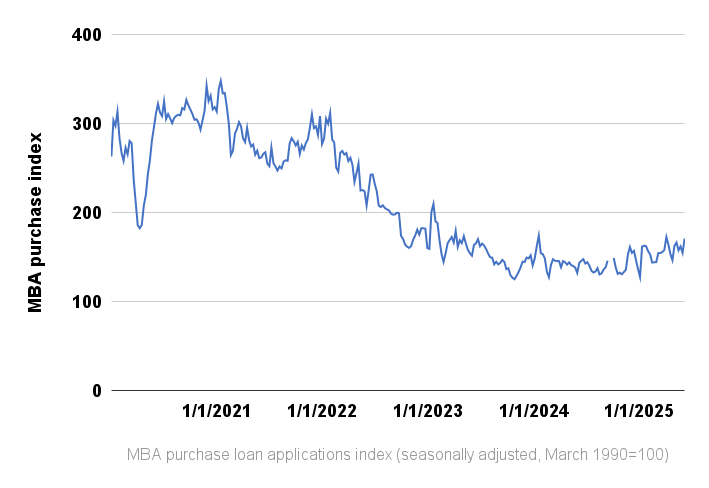
The MBA’s seasonally adjusted purchase loan index, which is benchmarked to March 1990, soared above 300 when mortgage rates plummeted to historic lows during the pandemic. But as inflation and mortgage rates surged in 2022, the index dropped below 200.
At 170.9 during the week ending June 6, the index is up 34 percent this year and approaching a 2025 high of 172.7 registered during the week ending April 4.
In addition to adjusting for seasonal factors — demand for homes usually peaks in the spring — last week’s index results included an adjustment for the Memorial Day holiday.
Get Inman’s Mortgage Brief Newsletter delivered right to your inbox. A weekly roundup of all the biggest news in the world of mortgages and closings delivered every Wednesday. Click here to subscribe.
Email Matt Carter
