by Craig C. Rowe | Apr 23, 2025 | Industry, News Feed
Miami Association of Realtors has hired Infinityy, a software company that builds out graphically enriched and interactive browser-based AI “Rooms” for presenting properties in either the residential, multifamily or commercial real estate environments.
Bigger. Better. Bolder. Inman Connect is heading to San Diego. Join thousands of real estate pros, connect with the power of the Inman Community, and gain insights from hundreds of leading minds shaping the industry. If you’re ready to grow your business and invest in yourself, this is where you need to be. Go BIG in San Diego!
The Miami Association of Realtors has hired a software company that specializes in artificial intelligence-based marketing to assist its members in gaining exposure and capturing leads for their sellers’ homes, Inman has learned.
The company, Infinityy, uses existing listing assets to build out graphically enriched and interactive browser-based “Rooms” for presenting properties in either the residential, multifamily or commercial real estate environments.
The onboard AI is designed to converse with website visitors, earn their interest and turn over their information to the appropriate agent.
Infinityy can build out its presentations using 3D tours, video walk-throughs, imagery, and floor plans and be active 24/7 to answer questions in the hope of capturing new business.
“Every Miami Realtor now has access to a free, AI-powered Infinityy tour — unlocking the ability to reach buyers earlier, faster and more effectively than ever before,” said Teresa King Kinney, the association’s CEO. “Infinityy’s award-winning technology isn’t just saving our members time — it can elevate their service, driving more sales, and giving them a powerful edge in today’s competitive market.”
The company’s website explains an Infinityy Room as an interactive virtual environment for an individual property, which could be a freestanding home, vacant apartment or office space.
“Your Infinityy Room is uniquely your own, allowing all parties to communicate together in real-time, all while sharing the same experience in the same space, even while miles apart. Invite anyone you choose to share your Infinityy Room experience with and simplify the decision-making process, together,” the company states.
Infinityy Rooms can be shared on their own or embedded into websites and landing pages. It supports video conferencing so an agent and prospect can jointly tour and discuss the assets and content within the experience. Agents can be alerted when a Room is being toured to interject or request a call, and, when not available, the AI agent can assume the role.
The software also provides visitor and engagement statistics, nice tools to have when discussing marketing updates with sellers and stakeholders.
Miami Association of Realtors is one of three organizations attempting to untangle from the web of Remine, a long-troubled software company that was swallowed by a group of MLSs in an attempt to turn around its technology on behalf of their collective memberships. Joining Miami was Austin Board of Realtors’ Unlock MLS, First MLS and Heartland MLS. The groups were incorporated under MLS Technology Holdings in 2021.
Miami will make a formal announcement of its latest technology partnership and presentation on Friday, April 25 at the South Florida Real Estate Summit.
Email Craig Rowe
This post was originally published on this site
by Matt Carter | Apr 23, 2025 | Industry, News Feed
Nation’s largest loan servicer turned an $88 million Q1 profit and remains on track to be acquired by Rocket in Q4, a deal that’s prompted UWM to cut ties to Mr. Cooper.

In April, we’ll go deep on money and finance for a special theme month, by talking to leaders about where the mortgage market is heading and how technology and business strategies are evolving to suit the needs of buyers now. Inman’s Best of Finance returns for 2025, celebrating the leaders in this space. And subscribe to Mortgage Brief for weekly updates all year long.
Loan servicing giant Mr. Cooper saw the pool of loans it collects payments on shrink for the first time in two years during the first quarter — a trend that could continue into Q2 following a decision by the nation’s largest lender to pull its business.
While net income was down 57 percent from Q4, to $88 million, Mr. Cooper executives said first quarter results released Wednesday demonstrate the company’s ability to deliver “consistent, recurring and predictable results.”
Mr. Cooper remains on track to be acquired by Rocket Companies during the fourth quarter, a deal that the companies claim will create the industry’s leading integrated homeownership platform, Mr. Cooper Chairman and CEO Jay Bray said.

Jay Bray
“By pooling our talent, data and technology, we are going to totally reimagine the homeownership journey from start to finish, and harness the transformative power of AI to bring our customers a truly amazing experience for our investors,” Bray said on a call with investment analysts.
TAKE THE INMAN INTEL INDEX SURVEY FOR APRIL
Mr. Cooper is the nation’s largest mortgage loan servicer, collecting monthly payments from 6.5 million homeowners on behalf of lenders and investors in mortgage-backed securities, a business that generated $214 million in pre-tax income in Q1.
But Mr. Cooper’s pending $9.4 billion acquisition by Rocket Companies has ruffled the feathers of United Wholesale Mortgage, which famously won’t do business with mortgage brokers who work with rival Rocket Mortgage.
Bray is slated to become president and CEO of Rocket Mortgage when the deal closes, reporting to Rocket Companies CEO Varun Krishna. Rocket also has its sights set on acquiring real estate brokerage Redfin for $1.75 billion, a deal it says could save consumers $20,000 per transaction by unifying home search, buying, selling, mortgage, title and loan servicing.
UWM — which surpassed Rocket Mortgage as the nation’s largest mortgage lender in 2022 — pulled its subservicing contract with Mr. Cooper this month, and will no longer sell mortgage servicing rights to the Dallas-based loan servicer, UWM confirmed to Inman.
At the end of last year, UWM owned the servicing rights on 692,908 mortgages totalling $225.8 billion, a business that generated $636.7 million in income last year. It’s not clear how many of those borrowers were subserviced by Mr. Cooper.
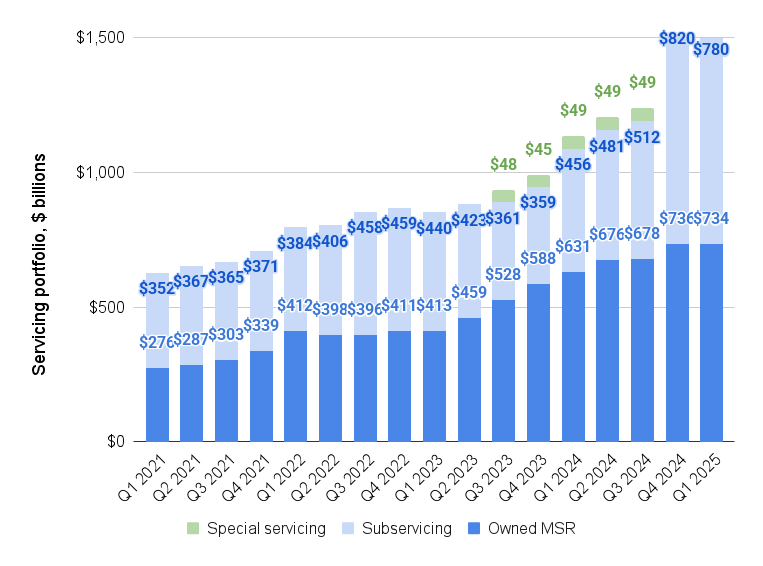
Aided by the $1.3 billion acquisition of Flagstar Bank’s servicing business last fall, Mr. Cooper ended the year with a $1.556 trillion mortgage servicing rights portfolio, up 57 percent from a year ago. That included $736 billion in owned mortgage servicing rights (owned MSRs) and $820 billion in subservicing Mr. Cooper performs for others.
Mr. Cooper’s $1.5T mortgage servicing portfolio
Even before UWM cut ties with Mr. Cooper, the loan servicer saw its subservicing portfolio shrink by $40 billion during the first quarter of 2024, to $780 billion.
Mr. Cooper President Mike Weinbach said the shrinkage was due to expected transfers of $60 billion in subservicing business that Mr. Cooper acquired from Flagstar to other servicers.

Mike Weinbach
“Outside of these de-boardings, our subservicing portfolio grew organically by 2 percent quarter over quarter,” Weinbach said on Wednesday’s earnings call. “We’re growing with our clients, which includes some of the strongest originators and investors in the industry.”
He said Mr. Cooper is in “advanced discussions with potential new clients and optimistic about winning new books of business.”
Mr. Cooper’s owned MSR portfolio also shrank by $2 billion during Q1, to $734 billion.
All told, Mr. Cooper was collecting payments on $1.514 trillion in loans as of March 31, down 3 percent from Q4 but up 33 percent from a year ago.
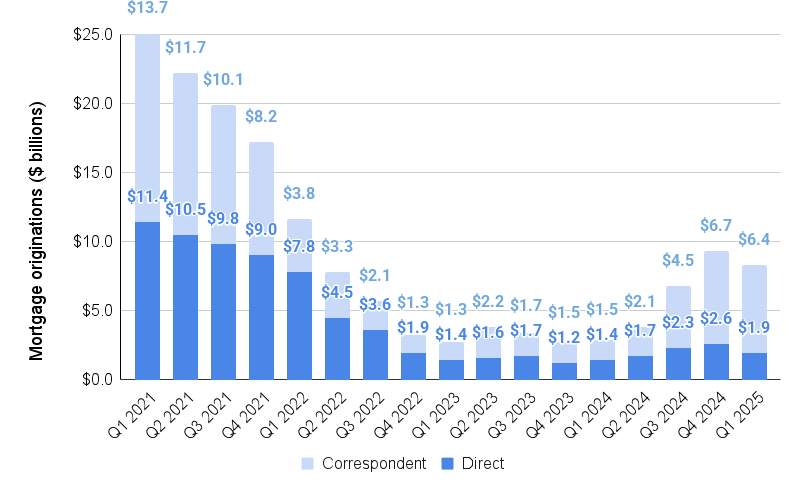
Mortgage originations down 10% from Q4 2024
Mortgage servicers are also in a good position to offer refinancing to borrowers, and Mr. Cooper funded 32,296 loans in the first quarter totaling $8.3 billion, down 10 percent from Q4 but up 186 percent from a year ago.
Most of the company’s mortgage originations ($6.4 billion) came through Mr. Cooper’s correspondent channel, which Weinbach said has benefited from “a number of investments and operational enhancements over the last 18 months.”
In the direct-to-consumer channel, Weinbach said Mr. Cooper enjoyed “very strong momentum” with cash-out refinancing, which made up 46 percent of the $1.9 billion in volume, and second liens, which accounted for another 21 percent of direct loans.
“During the quarter, we helped over 9,000 customers access equity in their homes, and helped nearly 2,000 customers reduce their monthly payments or purchase a new home,” Weinbach said.
Mr. Cooper sold its wholesale and non-delegated correspondent mortgage business to Ft. Lauderdale, Florida-based A&D Mortgage LLC, on April 1.
Get Inman’s Mortgage Brief Newsletter delivered right to your inbox. A weekly roundup of all the biggest news in the world of mortgages and closings delivered every Wednesday. Click here to subscribe.
Email Matt Carter
This post was originally published on this site
by Craig C. Rowe | Apr 23, 2025 | Industry, News Feed
Marketing software company Rechat has rolled out a significant update to its list of product features, a solution to the complicated process of running online display ads.
Bigger. Better. Bolder. Inman Connect is heading to San Diego. Join thousands of real estate pros, connect with the power of the Inman Community, and gain insights from hundreds of leading minds shaping the industry. If you’re ready to grow your business and invest in yourself, this is where you need to be. Go BIG in San Diego!
Marketing software company Rechat has rolled out a significant update to its list of product features, a solution to the complicated process of running online display ads, according to an April 23 statement sent to Inman.
Rechat Digital Ads will give users the ability to create and manage sophisticated retargeting campaigns for lead capture, nurture and conversion. It adds value to email campaigns, landing pages and other digital marketing efforts. Meta platforms are built especially to capitalize on such technology, a long-proven system for real estate agents given the browsing habits of buyers and sellers.
“Rechat Digital Ads represents a major leap forward in real estate marketing,” said Shayan Hamidi, CEO of Rechat, in the press release. “By integrating ad campaigns directly within our platform, we’re enabling agents to effortlessly promote their listings, strengthen their brand, and generate high-quality leads — all in one place.”
While retargeting is hardly new to the industry, there is additional benefit to having it integrated with an existing software package, allowing for better data collection, performance valuation and creative control. It also prevents agents from having to hire and manage third-party vendors in the digital ad space.
Inman reviewed Rechat in 2023, citing as a highlight its ability to intuitively consolidate tools and tactics that typically require multiple partnerships working together to achieve marketing success.
“Rechat does a lot of what a lot of other apps do separately. It can consolidate a tech stack for tech-savvy brokers wanting to provide a single-point solution for lead nurture, brand-building, sales support and lightweight deal management,” the review stated.
Rechat flattens the ad creation process for marketing staff, as well as agents, by repurposing existing marketing assets for campaign use. The process is largely automated and can be strategized in minutes, according to the company. Budgets and geographic targets are made easy to manage.
“Agents can connect and manage their Facebook and Instagram ad campaigns without leaving the platform. Campaigns are fully customizable, with adjustable duration, budget, audience radius, and messaging to align with marketing goals,” the press release stated.
Rechat is part of Leading Real Estate Companies of the World’spreferred partner program. The application is also fully mobile to give agents and their teams the ability to adjust marketing efforts as soon as response data and creative feedback determines a better direction, among other benefits.
Rechat Digital Ads compliments a range of other digital marketing systems and business tools, such as a personal CRM, a CMA builder, website creation and management, social media and video content creation, and a robust email marketing campaign platform.
Email Craig Rowe
This post was originally published on this site
by Lillian Dickerson | Apr 23, 2025 | Industry, News Feed
The surge in sales was a welcome positive sign during a tenuous period for the U.S. economy. However, high prices and high mortgage rates continue to curb homebuyers, new HUD data shows.
Bigger. Better. Bolder. Inman Connect is heading to San Diego. Join thousands of real estate pros, connect with the Inman Community and gain insights from hundreds of leading minds shaping the industry. If you’re ready to grow your business and invest in yourself, this is where you need to be. Go BIG in San Diego!
Sales of newly built single-family homes continued their upwards trajectory in March, as buyers got their first taste of the spring market, the U.S. Census Bureau and Department of Housing and Urban Development announced in a report released Wednesday.
The report findings were a welcome positive sign for the U.S. economy, which has been on shaky ground since the Trump administration unleashed a global trade war in recent weeks, but also a reminder that next month’s report may reflect less positively as the country continues to respond to new tariffs.
TAKE THE INMAN INTEL SURVEY FOR APRIL
New-home sales rose 6 percent on an annual basis in March 2025 for a seasonally adjusted annual rate of 724,000, well-exceeding analysts expectations of a rate of about 680,000. They were also up 7.4 percent month over month from the February 2025 rate of 674,000.
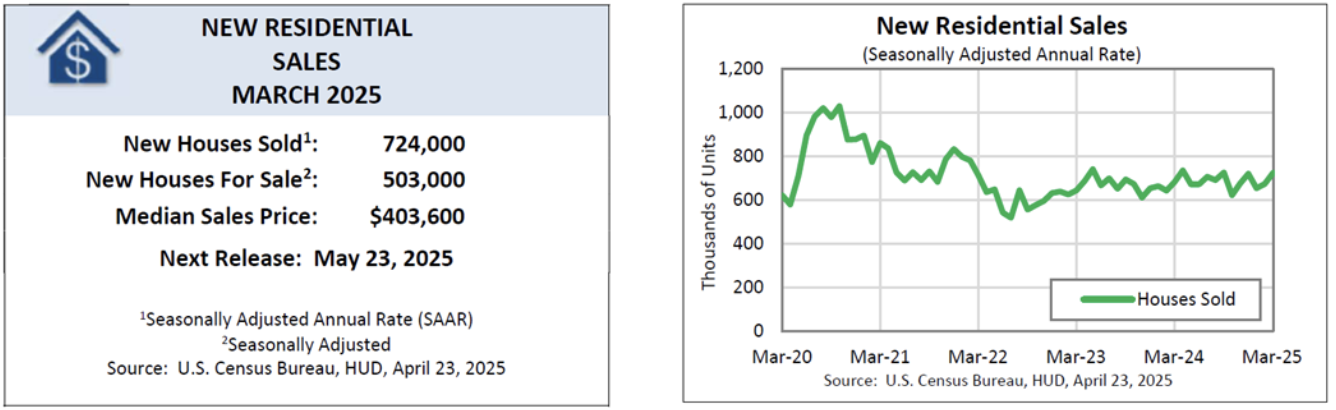
The median sales price of new homes sold during March 2025 was $403,600, down 7.5 percent year over year. The average sales price of new homes sold was $497,700, down 4.7 percent year over year.
By the end of March 2025, the seasonally adjusted estimate of new homes for sale was 503,000, up 0.6 percent from February 2025 and up 7.9 percent from March 2024. That figure represents 8.3 months supply at the current sales rate.
The South drove the growth of new-home sales between February 2025 and March 2025, increasing by 13.6 percent. Meanwhile, the Northeast took the greatest hit in sales of newly built homes, declining by 22.2 percent month over month.
Despite beating expectations, new-home sales are still being curbed by high home prices and mortgage rates, Robert Frick, corporate economist with Navy Federal Credit Union said in a statement sent to Inman.
“March sales were a nice recovery from the dip in January and February, probably due to the frigid weather across much of the country,” Frick said. “But sales remain stuck in a post-COVID range of about 630 to 730, a level that reflects high prices and high mortgage rates.”
Email Lillian Dickerson
This post was originally published on this site
by Doreen Spagnuolo | Apr 23, 2025 | Industry, News Feed
Bigger. Better. Bolder. Inman Connect is heading to San Diego. Join thousands of real estate pros, connect with the power of the Inman Community, and gain insights from hundreds of leading minds shaping the industry. If you’re ready to grow your business and invest in yourself, this is where you need to be. Go BIG in San Diego!
Fair housing is more than a legal obligation — it’s a reflection of who we are, both personally and professionally. It represents dignity, equality, and the fundamental right of every individual to live, grow, and thrive in the community of their choice.
Housing is not just about transactions — it’s about people, futures and the freedom to belong.
TAKE THE INMAN INTEL SURVEY FOR APRIL
Professionally, fair housing means conducting business with integrity and transparency. It requires real estate professionals to treat all clients equitably, regardless of their race, color, national origin, religion, sex (including gender identity and sexual orientation), familial status, disability, and all other protected characteristics.
Upholding fair housing laws isn’t optional; it protects our industry’s credibility, strengthens consumer trust and ensures the sustainability of the communities we serve.
At LIBOR, fair housing is a core value woven into everything we do. Our mission is rooted in ethical conduct, inclusive communities and consumer protection. We equip members with the tools and training to uphold fair housing every day — from mandatory continuing education and immersive bias awareness courses to real-time legal guidance and advocacy at every level of government.
As real estate professionals, we also must work to shift the culture. That means going beyond compliance. We lead by example, encouraging open conversations, supporting diversity in leadership, and promoting member participation in programs like NAR’s “Fairhaven” simulation program and “At Home With Diversity” certification.
Through our “Home for All of Us” campaign, we educate the public about housing discrimination and help consumers understand their rights.
Fair housing isn’t about checking a box. It’s about building communities rooted in fairness and a sense of belonging.
Why fair housing still matters
Some may wonder: Haven’t we already solved this? But fair housing is not a finished chapter — it’s a living issue that continues to demand attention and action. Disparities in homeownership rates persist, and new technologies, such as AI-driven marketing and digital screening tools, raise new concerns about unintentional bias.
The neighborhoods we live in significantly impact everything — access to education, healthcare, jobs and generational wealth. Fair housing laws protect a consumer’s right to pursue homeownership or rental opportunities without facing discrimination based on race, religion, disability, sexual orientation, family status or any other protected class.
These laws help ensure real estate professionals act in the best interests of all clients, with fairness and professionalism.
The ripple effect of inclusion
There is a story that perfectly illustrates the lasting impact of fair housing. In the 1930s, a Black couple in California, the Thompsons, purchased a home despite widespread discrimination. Years later, they sold it to a Chinese family, reportedly choosing them not because they offered the highest price but because they wanted to extend the same opportunity they had been given.
Decades later, the home sold for a multimillion-dollar figure. In gratitude, the Chinese family donated $5 million to a Black student resource center, honoring the original act of fairness that gave them their start. That’s what fair housing can do: Create a legacy of opportunity, bridge communities and empower families across generations.
Why this matters to professionals and consumers alike
For real estate professionals, fair housing is about more than ethics — it’s good business. It protects your license, your reputation and the integrity of your service. Leading with fairness and empathy builds credibility and trust in a diverse marketplace.
Consumers should care because fair housing shapes their ability to access opportunities that lead to stability and upward mobility. Behind the scenes, organizations like LIBOR are fighting every day to protect these rights, advocating for fair lending practices, zoning reforms and first-time homebuyer programs.
You focus on finding the right home. We focus on ensuring you have the right to do it — fairly, safely and confidently.
Progress and the path forward
There’s reason for hope. More professionals now view fair housing education as essential, not just a requirement. Many brokerages are investing in meaningful training that addresses real-world challenges, not just hypothetical scenarios. States are strengthening enforcement, adding protected classes and increasing resources for fair housing agencies.
We’re proud to be building intentional systems that make equity part of the industry standard. We advocate for legislation like the Transparency of Co-op bill, support local housing nonprofits, and provide monthly legal updates to our members.
But challenges remain. Discrimination still happens — sometimes subtly, sometimes systemically. Too often, conversations about race and equity are avoided. Leadership doesn’t always reflect the communities we serve. Compliance varies from region to region.
True accountability requires not only internal policies but also external oversight, more vigorous enforcement and a commitment at every level.
What every professional can do
Change happens one conversation, one showing, one decision at a time. Every real estate professional can practice intentional awareness by avoiding assumptions, checking personal biases, and ensuring that every client is treated with respect and fairness.
Education and training are essential. They help professionals recognize the impact of historical housing discrimination, avoid exclusionary language, and make more informed, better decisions. At LIBOR, we ensure that fair housing is an integral part of our onboarding process, continuing education and everyday conversations.
We must also normalize this conversation. That means making fair housing a consistent part of events, programming and public outreach, not just once a year in April. We can collaborate with community partners, amplify diverse voices and ensure that fair housing is viewed not as a political issue but as a professional excellence.
What gives me hope is that the conversation has moved from the margins to the mainstream. We’re not just reacting to injustice anymore — we’re proactively building a better future. With stronger training, more innovative policies and deeper partnerships, we can ensure that every person has the chance to find a place they can truly call home, without fear, without discrimination and with full dignity.
Doreen Spagnuolo is the CEO of Long Island Board of Realtors. You can connect with Doreen on Instagram and LinkedIn.
This post was originally published on this site
by Sean Frank | Apr 23, 2025 | Industry, News Feed
Bigger. Better. Bolder. Inman Connect is heading to San Diego. Join thousands of real estate pros, connect with the power of the Inman Community, and gain insights from hundreds of leading minds shaping the industry. If you’re ready to grow your business and invest in yourself, this is where you need to be. Go BIG in San Diego!
In modern times, many people don’t consider how real estate began in America. History tells us that land was taken from Native Americans by force and war. Many buildings, including some of the most iconic in the U.S., were built with slave labor.
America was founded on the principles of freedom, but also the suppression of minorities. This profound contradiction remains unresolved centuries later in a country that is deeply divided over the topic of diversity and equality.
TAKE THE INMAN INTEL SURVEY FOR APRIL
Science tells us we are all one human race despite skin-deep differences in appearance. Genetically, all humans are nearly identical, with equal intellectual and emotional capacities. Our lives should be valued equally. Yet, opportunities in life are unequal.
The bigotry and apathy in our country’s founding persist as systemic racism today. The need for fair housing and equality remains as strong as ever.
Historical racism in real estate
United is our country’s namesake, but we are incredibly divided. Racism nearly destroyed America during the Civil War, and many would argue it is still eroding our country today.
Even after slavery was abolished in 1865 through a constitutional amendment, Black Americans were systematically oppressed. In 1926, the U.S. Supreme Court upheld racially restrictive covenants in property deeds, prohibiting sales or occupancy based on race, ethnicity or religion.
The court justified this as protecting “residential districts against deterioration of character.” This ruling stood until the Fair Housing Act of 1968.
Established in 1934, the Federal Housing Administration (FHA) institutionalized redlining, a practice that designated minority neighborhoods as high risk for mortgage lending. The FHA’s Underwriting Manual explicitly recommended the “prohibition of the occupancy of properties except by the race for which they are intended.”
This led to the systematic denial of mortgages to Black Americans and other minorities, severely restricting their ability to purchase homes and build wealth. It also ensured neighborhood segregation for generations.
Even the National Association of Realtors (NAR) played a significant role in enforcing discriminatory housing practices. In 1924, NAR’s Code of Ethics stated that Realtors “should never be instrumental in introducing into a neighborhood … members of any race or nationality, or any individuals whose presence will clearly be detrimental to property values.” This clause remained until 1974.
Furthermore, NAR actively opposed the Fair Housing Act in 1968. NAR formally apologized less than five years ago, in November 2020. The apology came decades late and in the wrong century, evidence of how slowly progress is being made toward equality.
Current bigotry in real estate
The Fair Housing Act of 1968 was a landmark federal law prohibiting discrimination in housing based on race, color, religion, sex, national origin, disability and familial status. The laws changed, but it did not change people’s hearts.
The baby boomers who control U.S. politics today grew up in a segregated world and were taught discrimination by their parents and society. Fair housing matters, but it only works when people embrace it.
Minorities experience more housing discrimination and lower homeownership rates. It’s evidence that the legal protections aren’t working as intended — because many people are still racist and the United States was built for white men.
Today, politicians avoid openly discriminating against protected classes like race, as doing so would be political suicide. Instead, they target other groups with fewer legal protections.
The LGBTQ+ community, for example, is a frequent target. The hatred directed at LGBTQ+ individuals in politics today mirrors the historical hatred toward racial minorities. Currently, there are no federal laws protecting against discrimination based on sexual orientation or gender identity, and only 23 states have passed legal protections for both.
Hateful politicians are strategic about whom they hate publicly versus privately. Beware of any hateful politician if you aren’t in the majority — they might secretly hate you, too.
Politicians also use coded language to alienate minority groups. Diversity, Equity and Inclusion (DEI) programs have been a cornerstone of housing initiatives to help minorities overcome generational disadvantages caused by systemic racism. These programs are crucial to correcting the injustices baked into past and present legislation.
Anti-DEI ideology presumes that the system is not rigged for the majority and that minorities should not have any advantages — which is completely untrue. Even with DEI programs, minorities are still underserved and disadvantaged. Anti-DEI rhetoric is outright racism and an attempt to maintain power over minorities.
Government agencies have focused heavily on DEI programs for years. Department of Housing and Urban Development (HUD), Fannie Mae, Freddie Mac and the Federal Housing Administration (FHA) have all allocated significant budgets toward eliminating housing discrimination and promoting minority homeownership.
Under the Biden-Harris Administration, Black and Latino homeownership rates increased by 13 percent and 7.5 percent, respectively, from 2019 to 2023, narrowing the homeownership gap. Now, HUD faces the challenge of cutting essential staff members and eliminating their positions because of the Department of Government Efficiency, aka DOGE. The Trump administration proposed significant staffing cuts to HUD, targeting employees involved in disaster recovery, rental subsidies, discrimination investigations and support for first-time homebuyers.
This proposal aimed to halve HUD’s workforce, eliminating 4,000 jobs and affecting more than a dozen programs, raising concerns among housing advocates about disruptions to HUD’s critical functions. It’s estimated that 77 percent of staff will be laid off at the Office of Fair Housing and Equal Opportunity, which enforces the Fair Housing Act at the federal level.
Housing is only one component in the fight for equality. There are many other frontlines where minorities are being actively disadvantaged. Systemic discrimination persists in various forms, including school districting, gentrification, political gerrymandering, harsher criminal sentences and employment discrimination.
This doesn’t account for the fact that some people vocally harass minorities for no reason. While Black Americans often bear the brunt of bigotry, other groups also face targeted discrimination based on current events.
Today, transgender people are villainized; during the COVID-19 pandemic, it was Asians; after the Sept. 11 attacks, it was anyone of Middle Eastern descent. Hateful people will always find someone to hate. If you turn on the news, it’s apparent how much hate exists in America.
The harsh reality
From its origins to modern times, bigotry has been ingrained in political discourse and American culture. If you don’t see the problem, it may be because you benefit from privilege, most likely as a white, heterosexual individual.
As we move into the future, it would be assumed that civic rights would prosper. Unfortunately, they are deteriorating.
The United States was recently put on a watchlist for declining civil liberties, alongside countries like the Democratic Republic of Congo, Pakistan and Serbia.
The problem of systemic racism in America is more significant than any of us individually, but with education and personal action, we can still take a personal stance against it.
- We can wholeheartedly embrace minorities on their real estate journey.
- We can vote to protect their interests.
- We can promise not to judge anyone for being different from us.
- We can embrace diversity because it offers more in life than if everyone were the same.
Let’s face the facts: Love feels better than hate. It’s time to embrace compassion because it’s better for us and others.
America would not exist without the theft of land and the exploitation of minorities. The least we can do is show empathy toward those who have been disadvantaged for generations.
The last thing we should allow is to stand by and watch our government suppress, deny and oppress minority groups further.
This is not a political opinion but a call for love and justice. If Americans genuinely believe that “all men people are created equal,” we must actively accept and support each other to make it a reality.
Sean Frank is the founder and CEO of Mainframe Real Estate in Florida. Connect with him on Instagram and LinkedIn.
This post was originally published on this site