
by Doreen Spagnuolo | Jul 9, 2025 | Industry, News Feed
Real estate is changing fast, and so must you. Inman Connect San Diego is where you turn uncertainty into strategy — with real talk, real tools and the connections that matter. If you’re serious about staying ahead of the game, this is where you need to be. Register now!
In the realm of real estate, the terms “real estate agent” and “Realtor” are often used interchangeably, but they are not the same. And while the distinction may seem minor, it makes a significant difference in training, ethics, accountability and service, especially in today’s evolving marketplace.
The basics: license vs. membership
Let’s start with the basics. A real estate agent is an individual who holds a state-issued license to assist clients in buying, selling or renting property. A Realtor, on the other hand, is a licensed real estate professional who is also a member of the National Association of Realtors (NAR). This membership is offered through a local Realtor association and includes automatic membership in both the state and national associations.
All Realtors are real estate agents, but not all real estate agents are Realtors.
A higher standard: The Code of Ethics
What truly sets Realtors apart is their commitment to a strict Code of Ethics — one that exceeds the requirements of state law. Established by NAR, the Code promotes honesty, integrity, fairness and putting the client’s interests above all else. It’s not just lip service — local associations enforce this code and include consequences such as mandatory education, suspension or fines of up to $15,000.
This ethical foundation is more than just paperwork. Article 10-5 of the Code, for example, prohibits hate speech and discriminatory language based on race, religion, gender identity or other protected characteristics — an obligation that exceeds state law in many markets. Recently, NAR approved changes to Article 10-5 of the Code, intending to strengthen the Code’s anti-discrimination focus.
These changes clarify how the Code applies specifically to real estate-related activities and define “harassment” more clearly in a business context. While the core principle — prohibiting hate speech and discrimination based on race, religion, gender identity and other protected characteristics — remains unchanged, these refinements ensure fair, consistent enforcement tied directly to a Realtor’s professional conduct. NAR asserts that the updates help protect against ambiguity while reinforcing the industry’s commitment to equity and inclusion.
When you work with a Realtor, you’re choosing someone who upholds the highest professional standards — on paper and in practice.
Training that goes the extra mile
Realtors are also committed to continual growth. They must complete ethics training every three years, and many go further by earning specialized designations, such as ABR (Accredited Buyer Representative), SRES (Senior Real Estate Specialist), CRS (Certified Residential Specialist) and C2EX (Commitment to Excellence). These aren’t just initials — they represent hours of study, testing and real-world application.
Local Realtor associations offer added support. At LIBOR, for example, members also benefit from monthly legal updates, risk management training, live and on-demand continuing education, and tools to navigate today’s fast-changing real estate landscape. Our Legal Support Center, for instance, gives members direct access to attorneys who help them protect their businesses and clients.
More than sales: Advocacy and community impact
Realtors do more than open doors — they open opportunities. Through the Realtor Political Action Committee (RPAC), members support policies that protect homeownership, preserve property rights and promote access to housing. Whether it’s fighting excessive transfer taxes or lobbying for down payment assistance programs, Realtor is the voice of both the profession and the consumer.
Realtors are also deeply involved in their communities. They support Habitat for Humanity builds, food drives, literacy programs and housing fairs. At LIBOR, we take this commitment further with our “Home for All of Us” campaign — a public-facing initiative that promotes fair housing awareness across our region and reinforces the belief that housing should be inclusive, equitable and safe for everyone.
In 2019, Newsday’s “Long Island Divided” investigative series brought painful truths to light about unequal treatment in real estate. It was challenging and deeply disappointing to read — but it also became a turning point. LIBOR responded swiftly and decisively, recognizing that change starts with accountability.
In the months that followed, among many other initiatives, LIBOR launched “Home for All of Us” to educate both Realtors and consumers about fair housing, implicit bias and equitable service. This transformative initiative continues today, raising awareness and reinforcing the profession’s responsibility to ensure every person receives fair and respectful treatment, regardless of who they are or where they come from.
The value to consumers
For buyers and sellers, choosing a Realtor over a non-member agent means selecting someone who is held to higher ethical standards, has access to more effective tools and training and is part of a robust professional network. Real estate agents are trained not just in contracts and pricing strategy but also in managing risk, avoiding bias, negotiating deals and complying with evolving laws and regulations.
In an era of shifting commission structures, iBuyer platforms and AI-generated home valuations, the human side of real estate matters more than ever. A Realtor provides local insight, conflict resolution, nuanced communication and trusted relationships that no algorithm can replicate.
Why join as a Realtor?
If you’re a licensed agent who isn’t yet a Realtor, there’s never been a more critical time to consider taking that next step. Being a Realtor isn’t just a title — it’s a professional edge. Take a look at your local real estate association and see what tools and solutions are offered. Consider some of these benefits provided by LIBOR, for example: ethical credibility, legal protection, advocacy power, exclusive training, broker and business support, and local service with national strength.
Why work with a Realtor?
Real estate is more than a transaction — it’s a life decision. Whether you’re a consumer navigating a home sale or a professional building a career, it’s essential to understand who’s representing your interests. Ask the question: Are you a Realtor?
The answer can make all the difference.
Doreen Spagnuolo is the CEO of Long Island Board of Realtors. You can connect with Doreen on Instagram and LinkedIn.
by Doreen Spagnuolo | Apr 23, 2025 | Industry, News Feed
Bigger. Better. Bolder. Inman Connect is heading to San Diego. Join thousands of real estate pros, connect with the power of the Inman Community, and gain insights from hundreds of leading minds shaping the industry. If you’re ready to grow your business and invest in yourself, this is where you need to be. Go BIG in San Diego!
Fair housing is more than a legal obligation — it’s a reflection of who we are, both personally and professionally. It represents dignity, equality, and the fundamental right of every individual to live, grow, and thrive in the community of their choice.
Housing is not just about transactions — it’s about people, futures and the freedom to belong.
TAKE THE INMAN INTEL SURVEY FOR APRIL
Professionally, fair housing means conducting business with integrity and transparency. It requires real estate professionals to treat all clients equitably, regardless of their race, color, national origin, religion, sex (including gender identity and sexual orientation), familial status, disability, and all other protected characteristics.
Upholding fair housing laws isn’t optional; it protects our industry’s credibility, strengthens consumer trust and ensures the sustainability of the communities we serve.
At LIBOR, fair housing is a core value woven into everything we do. Our mission is rooted in ethical conduct, inclusive communities and consumer protection. We equip members with the tools and training to uphold fair housing every day — from mandatory continuing education and immersive bias awareness courses to real-time legal guidance and advocacy at every level of government.
As real estate professionals, we also must work to shift the culture. That means going beyond compliance. We lead by example, encouraging open conversations, supporting diversity in leadership, and promoting member participation in programs like NAR’s “Fairhaven” simulation program and “At Home With Diversity” certification.
Through our “Home for All of Us” campaign, we educate the public about housing discrimination and help consumers understand their rights.
Fair housing isn’t about checking a box. It’s about building communities rooted in fairness and a sense of belonging.
Why fair housing still matters
Some may wonder: Haven’t we already solved this? But fair housing is not a finished chapter — it’s a living issue that continues to demand attention and action. Disparities in homeownership rates persist, and new technologies, such as AI-driven marketing and digital screening tools, raise new concerns about unintentional bias.
The neighborhoods we live in significantly impact everything — access to education, healthcare, jobs and generational wealth. Fair housing laws protect a consumer’s right to pursue homeownership or rental opportunities without facing discrimination based on race, religion, disability, sexual orientation, family status or any other protected class.
These laws help ensure real estate professionals act in the best interests of all clients, with fairness and professionalism.
The ripple effect of inclusion
There is a story that perfectly illustrates the lasting impact of fair housing. In the 1930s, a Black couple in California, the Thompsons, purchased a home despite widespread discrimination. Years later, they sold it to a Chinese family, reportedly choosing them not because they offered the highest price but because they wanted to extend the same opportunity they had been given.
Decades later, the home sold for a multimillion-dollar figure. In gratitude, the Chinese family donated $5 million to a Black student resource center, honoring the original act of fairness that gave them their start. That’s what fair housing can do: Create a legacy of opportunity, bridge communities and empower families across generations.
Why this matters to professionals and consumers alike
For real estate professionals, fair housing is about more than ethics — it’s good business. It protects your license, your reputation and the integrity of your service. Leading with fairness and empathy builds credibility and trust in a diverse marketplace.
Consumers should care because fair housing shapes their ability to access opportunities that lead to stability and upward mobility. Behind the scenes, organizations like LIBOR are fighting every day to protect these rights, advocating for fair lending practices, zoning reforms and first-time homebuyer programs.
You focus on finding the right home. We focus on ensuring you have the right to do it — fairly, safely and confidently.
Progress and the path forward
There’s reason for hope. More professionals now view fair housing education as essential, not just a requirement. Many brokerages are investing in meaningful training that addresses real-world challenges, not just hypothetical scenarios. States are strengthening enforcement, adding protected classes and increasing resources for fair housing agencies.
We’re proud to be building intentional systems that make equity part of the industry standard. We advocate for legislation like the Transparency of Co-op bill, support local housing nonprofits, and provide monthly legal updates to our members.
But challenges remain. Discrimination still happens — sometimes subtly, sometimes systemically. Too often, conversations about race and equity are avoided. Leadership doesn’t always reflect the communities we serve. Compliance varies from region to region.
True accountability requires not only internal policies but also external oversight, more vigorous enforcement and a commitment at every level.
What every professional can do
Change happens one conversation, one showing, one decision at a time. Every real estate professional can practice intentional awareness by avoiding assumptions, checking personal biases, and ensuring that every client is treated with respect and fairness.
Education and training are essential. They help professionals recognize the impact of historical housing discrimination, avoid exclusionary language, and make more informed, better decisions. At LIBOR, we ensure that fair housing is an integral part of our onboarding process, continuing education and everyday conversations.
We must also normalize this conversation. That means making fair housing a consistent part of events, programming and public outreach, not just once a year in April. We can collaborate with community partners, amplify diverse voices and ensure that fair housing is viewed not as a political issue but as a professional excellence.
What gives me hope is that the conversation has moved from the margins to the mainstream. We’re not just reacting to injustice anymore — we’re proactively building a better future. With stronger training, more innovative policies and deeper partnerships, we can ensure that every person has the chance to find a place they can truly call home, without fear, without discrimination and with full dignity.
Doreen Spagnuolo is the CEO of Long Island Board of Realtors. You can connect with Doreen on Instagram and LinkedIn.
This post was originally published on this site
by Doreen Spagnuolo | Aug 15, 2024 | Industry, News Feed
The team that founded EasyKnock-acquired power buyer Ribbon has launched Indigo, an artificial intelligence-powered transaction management and home search platform. The platform is only available in Charlotte and is free to use until Oct. 1.
Whether it’s refining your business model, mastering new technologies, or discovering strategies to capitalize on the next market surge, Inman Connect New York will prepare you to take bold steps forward. The Next Chapter is about to begin. Be part of it. Join us and thousands of real estate leaders Jan. 22-24, 2025.
The team that founded EasyKnock-acquired power buyer Ribbon is back with a new artificial intelligence-powered home transaction platform, Indigo, executives revealed to Inman exclusively on Thursday.
The platform centralizes agent-to-agent communications, contract and disclosure signings, buyer offers and negotiations for a more transparent buying and selling experience, said Indigo CEO and co-founder Shaival Shah.

Shaival Shah
“As an independent platform, we help all market participants – real estate agents, buyers, and sellers – by facilitating an open, transparent home transaction,” Shah said in a statement. “We believe this will be the new industry model. As the industry shifts from a search-centric to transaction-centric model, consumers and agents will demand a more accessible and intuitive experience.”
On the sell side, listing agents can create Storefronts for their listings. The storefronts pull listing information from multiple listing services and allow agents to add additional announcements, comparables and seller preferences on earnest money deposits, due diligence fees, due diligence end dates and preferred closing timelines. Storefronts take less than 10 minutes to set up.
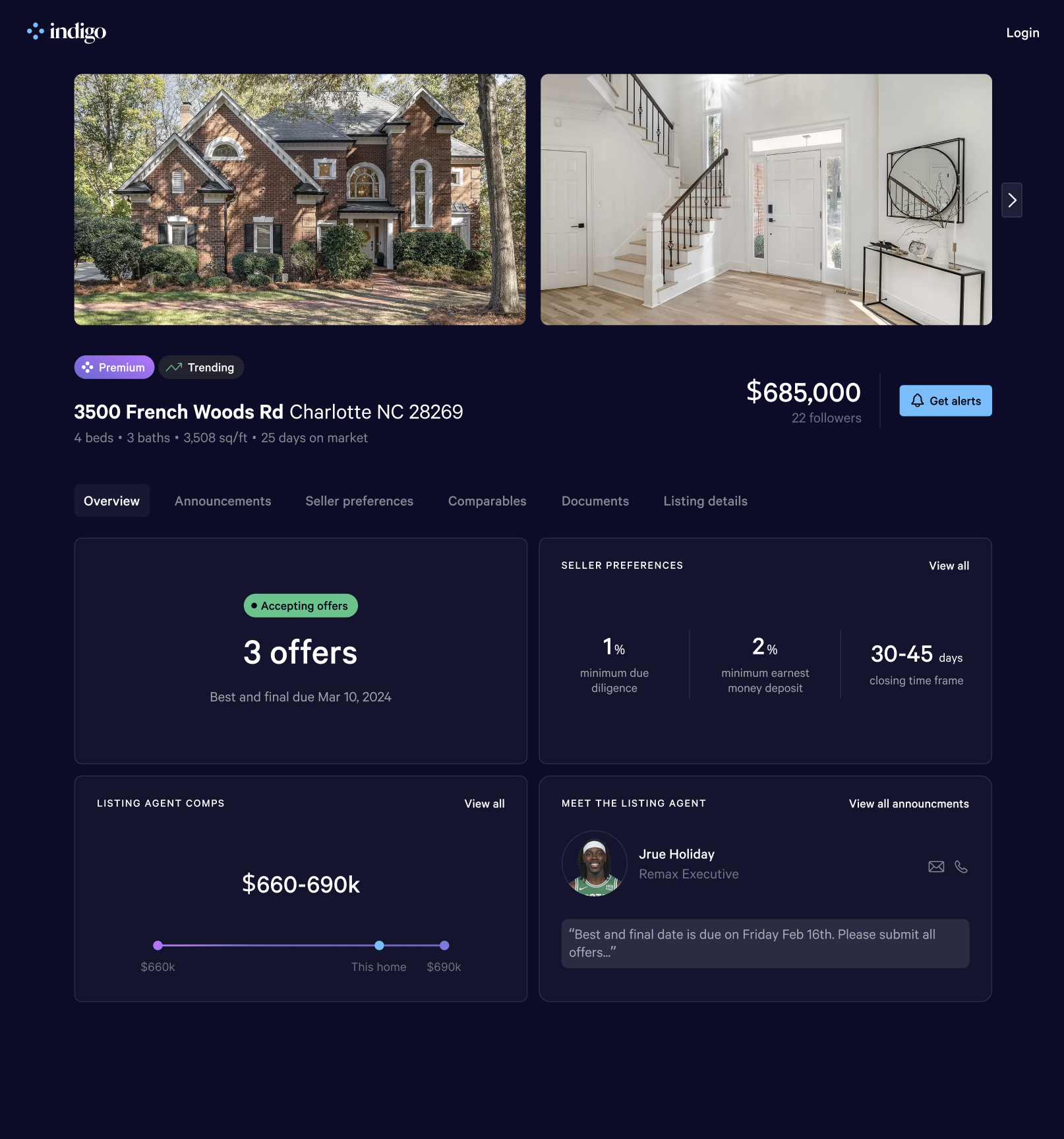
Indigo Storefront
On the buy side, agents can use the platform to generate exclusive or non-exclusive written buyer agreements and craft offers that are automatically sent to the listing agent. As buyers’ agents make offers, Indigo organizes them into a streamlined dashboard so listing agents and clients can easily compare offers.
Indigo’s proprietary artificial intelligence model cuts the chaos associated with paperwork by generating contracts, disclosure forms, and addendums and organizing them into a workflow for listing and buyer agents. Indigo AI also auto-fills paperwork throughout each stage of the transaction, enabling agents to focus on other tasks for their clients.
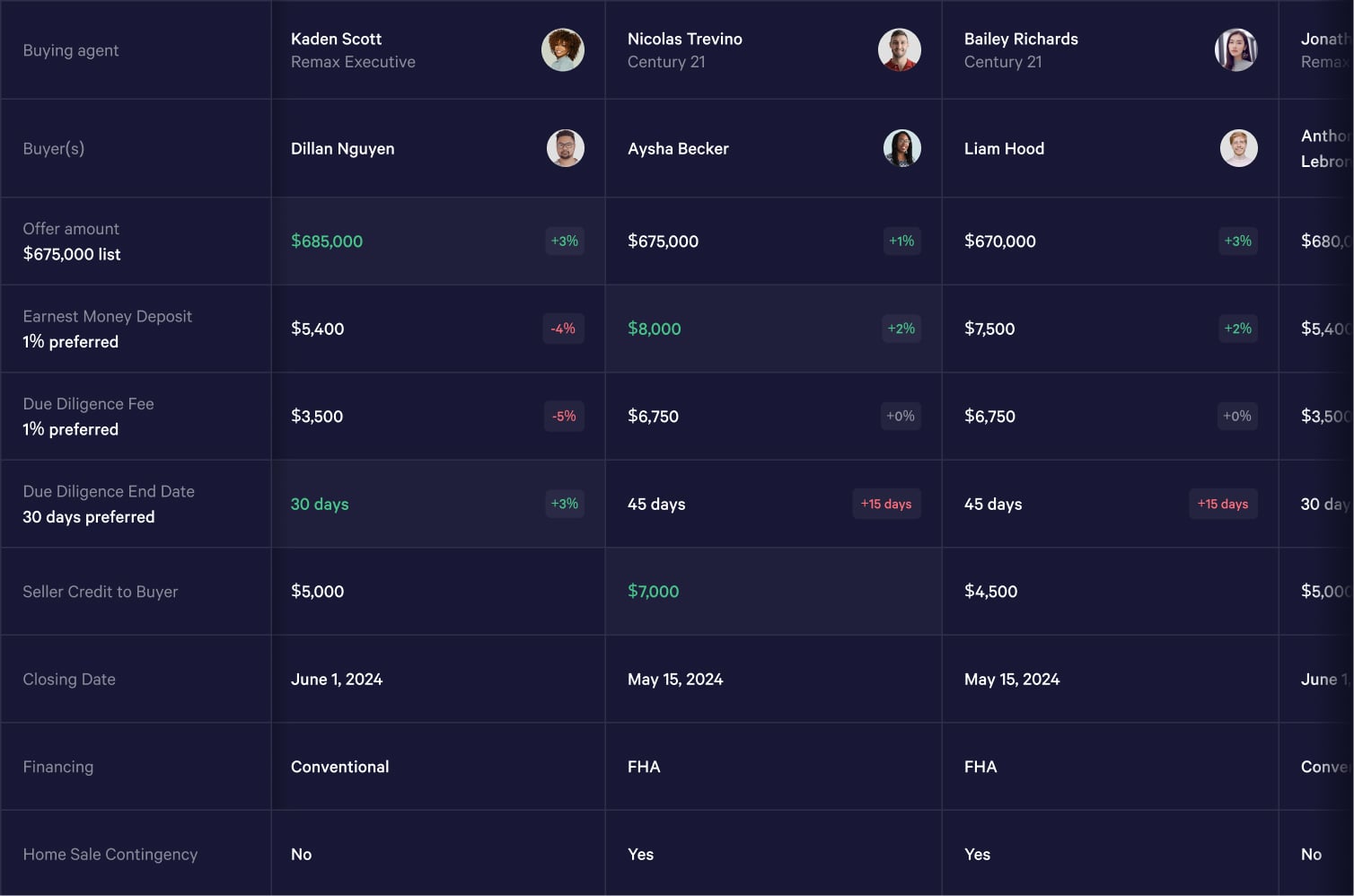
Indigo Offer Dashboard
“To bring the new industry model to market, the information, real-time intelligence and decision-making capabilities must improve to facilitate the transparency the market deserves,” Shah said. “It requires great technical firepower to reimagine the new experience and workflow infrastructure.”
“Indigo’s proprietary AI models do just that – solving new and existing problems that were previously impossible,” he added. “In service of a more modern, transparent experience, we’re confident this is where we should be doubling down.”
In an interview with Inman, Shah said Indigo’s launch is perfect timing as the industry draws closer to the deadline for enforcing cooperative compensation policy changes per the National Association of Realtors’ buyer-broker commission settlement. The changes, he said, heighten the need for platforms that reduce friction and increase transparency while ensuring agents stay in compliance with the new rules.
“You know, we’ve spent a good five or six years operating and building products for agents and for buyers and for sellers in the past,” Shah said in reference to Ribbon. “We learned a lot of things from that. One of the things that we learned was just how complex the transaction process is. At one point, we were processing almost 5,000 offers a month.”
“Over the past year, we’ve been really focused on trying to address fundamental problems with the transaction process and how we could use really advanced technology to fix those problems,” he added. “When the lawsuit information started coming out, and we started to see the changes [happening], the platform and the technology that we were looking to build was very much aligned to the changes.”
Although Indigo is primarily a transaction management platform, he also sees the company as a portal since consumers can use Indigo as a home search platform. He said Indigo’s Storefront enables listing agents to “have a lot more control” than they would have with other portal incumbents, and curate a home search experience for consumers.
“It allows the listing agent to have a lot more control over that portal dynamic, right versus being run by a third party,” he said. “And so that way, the listing agent is able to present information that they think is appropriate that has been verified by their seller, versus a business automatically pulled in by third parties, and allows the listing agent and have more direct communication with anyone that’s interested. That’s how it’s different than a traditional search portal.”
Shah said a handful of leading real estate agents and teams from Compass, Keller Williams, eXp Realty, and RE/MAX have joined the platform, which launched in Charlotte, N.C. on Thursday. Indigo will be free to use until Oct. 1 and then introduce a “nominal fee” for listing and buyer agents who use the site.
Indigo will expand to several more markets by year’s end.
Email Marian McPherson
by Doreen Spagnuolo | Jul 23, 2024 | Industry, News Feed
At Inman Connect Las Vegas, July 30-Aug. 1, 2024, the noise and misinformation will be banished, all your big questions will be answered, and new business opportunities will be revealed. Join us.
Pulse is a recurring column where we ask for readers’ takes on varying topics in a weekly survey and report back with our findings.
Do you need a buyer agreement for open house attendees? Do we have finalized forms yet? Can we post offers of compensation on our websites or through a workaround app? There are plenty of questions floating around out there as we draw closer to the Aug. 17 implementation deadline for the terms of the NAR settlement.
via GIPHY
So we want to know: What looming NAR settlement questions do you still have? Do you have a plan in place for working with buyers, sellers and cooperating colleagues? Has your brokerage provided enough training, or have you gotten your information straight from the local association? Do you feel confident that you have a handle on the day-to-day post-Aug. 17, or are you still struggling to catch up? Let us know below:
We’ll compile a list of the top responses and post them on Inman next Tuesday.