by Lillian Dickerson | Apr 29, 2025 | Industry, News Feed
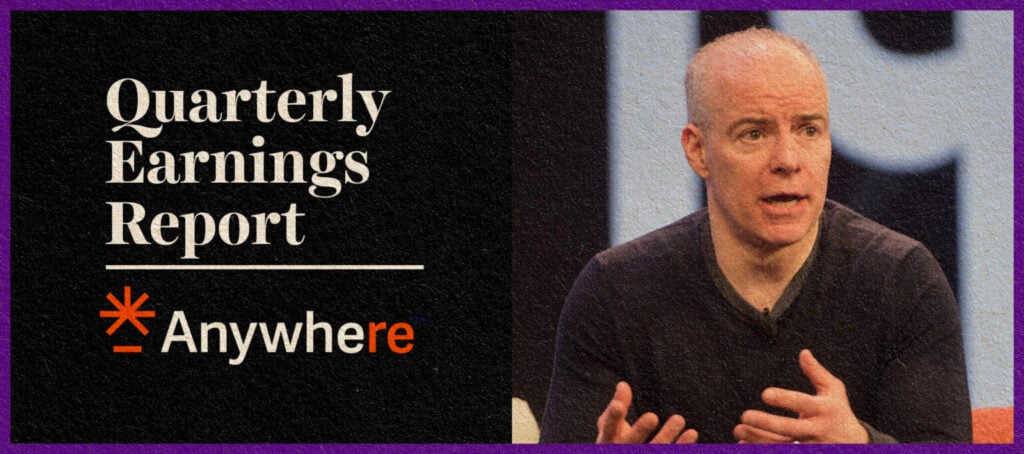
The franchisor’s performance was driven by its luxury brands during the first quarter. President and CEO Ryan Schneider also reaffirmed during an investors’ call the company’s stance on recent moves by NAR, Zillow and Redfin in regards to Clear Cooperation.
Bigger. Better. Bolder. Inman Connect is heading to San Diego. Join thousands of real estate pros, connect with the Inman Community and gain insights from hundreds of leading minds shaping the industry. If you’re ready to grow your business and invest in yourself, this is where you need to be. Go BIG in San Diego!
Real estate franchisor Anywhere grew revenue by 7 percent year over year during the first quarter of 2025, hitting $1.2 billion in a solid start to the year as luxury continued to drive the company’s performance.
Quarterly revenue was down slightly from fourth-quarter 2024 revenue of $1.4 billion. The company’s net loss was $78 million during the first quarter of 2025, an improvement of $23 million on an annual basis. Adjusted net loss was $64 million, improved by $21 million from the previous year.
TAKE THE INMAN INTEL SURVEY FOR APRIL
Transaction volume also increased 6 percent annually, with units down about 4 percent and price up about 11 percent. This figure bested the National Association of Realtors’ 3 percent annual market volume growth, Anywhere noted. Transaction volume was boosted largely by the success of the franchisor’s luxury brands and growth in California and New York City.
“Anywhere continues to prove the advantage of our unique assets, including our unmatched scale, high-margin franchise network, luxury leadership, and integrated end-to-end transaction experience,” Anywhere President and CEO Ryan Schneider said in a statement. “Those assets are driving differentiated success today and help fuel our growth and transformation as we look to the future.”
The previous quarter, Anywhere announced that it had grown revenue, improved quarterly net losses on an annual basis and increased closed transaction volume by 13 percent year over year. During the fourth quarter of 2024, Anywhere increased revenue by $112 million year over year to $1.4 billion.
“Anywhere is on offense, seizing opportunities to fortify our market-leading position today while making smart moves to transform our operations, accelerate our strategic momentum, and build on our financial progress,” added Anywhere Executive Vice President, Chief Financial Officer and Treasurer Charlotte Simonelli.
Coldwell Banker Global Luxury, Corcoran and Sotheby’s International Realty outperformed the market during the first quarter, with closed transaction volume up about 16 percent on an annual basis.
Anywhere added 11 new U.S.-based franchisees during the first quarter and two new international franchisees.
Agent commission splits rose 39 basis points year over year to 80.4 percent.
The company realized $14 million in cost savings during Q1 2025 and said it is on track to realize cost savings of $100 million for the full year.
Anywhere added that it would be making three one-time payments during 2025 that will add up to about $115 million, the first $54 million of which will be the final payment toward its antitrust litigation settlement.
Anywhere, which was one of the first major real estate companies to settle its part in the commission lawsuits, paid $10 million toward the settlement in Q4 2023 and another $20 million in Q2 2024.
The franchisor’s second payment of $41 million will go toward addressing a 1999 Cendant legacy tax issue and the third payment will be a roughly $20 million payment for the January 2025 settlement of the Company’s Telephone Consumer Protection Act (TCPA) litigation, which is still subject to final court approval.
Schneider also addressed recent industry changes, including NAR’s new Delayed Marketing Exempt Listings option and Zillow and Redfin’s choices not to display listings on their portals that have previously been marketed privately.
“Anywhere Real Estate is aggressively advocating for transparency and the broad public distribution of all listings,” Schneider said during an investors call on Tuesday, adding that starting listings as private was not a winning strategy.
“We remain committed to doing what’s right for buyers and sellers which … starts with advocacy, consumer choice and the broad distribution of public listings.”
He added that Anywhere will continue to build out private listing networks within its brands because of industry trends in this direction, but believes that private listings, ultimately, disadvantage both buyers and sellers, even though they respect the wishes of those sellers who choose to list privately. Simonelli likewise added that from a financial standpoint, marketing listings publicly to the widest possible audience made the most sense for the business.
When asked about recent economic volatility and its impact on Anywhere’s performance, Schneider said that, thus far in April, there had not been a significant change to Days on Market or contract cancellation rates. Low inventory and high home prices are continuing trends, however. “But it is pretty volatile out there, so we’re watching it closely and not extrapolating too far,” Schneider said.
Schneider added that Anywhere had proven its ability to deliver results during a tough housing market and said the franchisor is “ready to charge ahead” moving further into 2025.
Email Lillian Dickerson
This post was originally published on this site
by Jim Dalrymple II | Apr 29, 2025 | Industry, News Feed
The brokerage’s federal court complaint acknowledges that clients have canceled listings and that agents have departed amid a battle with Northwest MLS over how they’re marketed.
Bigger. Better. Bolder. Inman Connect is heading to San Diego. Join thousands of real estate pros, connect with the Inman Community and gain insights from hundreds of leading minds shaping the industry. If you’re ready to grow your business and invest in yourself, this is where you need to be. Go BIG in San Diego!
Compass escalated its battle over private listings in Washington state last week via a new lawsuit but, in doing so, revealed that waging war has come at a cost: The brokerage has lost both agents and listings in the course of the fight.
That information comes from Compass’ complaint, which the company filed Friday and which accuses Northwest MLS (NWMLS) of limiting competition. Among other things, the complaint recalls an episode earlier this month during which NWMLS cut off Compass’ IDX feed. An IDX feed takes data — such as listings — from an MLS and sends it to MLS members; in the complaint, Compass describes the move as a “group boycott” meant to “undermine” its business.
Eventually, Compass claims, that is exactly what happened.
“Brokers have reported clients fully canceling listing agreements because Compass can no longer offer them Compass Private Exclusive listings as an option,” the complaint states. “Brokers have likewise lost business opportunities because potential clients no longer wish to list their homes for sale at all as a result of the brokers’ inability to offer Compass Private Exclusive listings.”
TAKE THE INMAN INTEL INDEX SURVEY FOR MARCH
“Compass Private Exclusives” are properties the company markets exclusively through its own platform. Such listings are the first part of the brokerage’s “3-Phase Marketing Strategy” that sees homes put into the MLS only after they’re first marketed privately, then as “Coming Soon.”
The new complaint also indicates that multiple brokers left Compass after NWMLS shut off the IDX feed, and that three of those brokers “specifically cited NWMLS’s actions as the reason for their departure.” Moreover, according to the complaint, a managing broker at another company tried to recruit Compass agents during the IDX shutdown. The broker allegedly claimed in an email that “we’re fully in compliance with NWMLS rules. Our IDX [listings data] feed is live, accurate, and working exactly as it should.”
“No dramas, no disruption — just a stable, trusted platform to run your business on,” the broker’s pitch continued, according to the complaint.
Compass ultimately concludes in the complaint that “NWMLS’s actions against Compass were intended to, and did, have a chilling effect on Compass’s business — both with consumers and with its own brokers.”
That claim is key to Compass’ case, which rests on the idea that the brokerage is suffering thanks to alleged anticompetitive behavior on the part of NWMLS and various Washington brokerages.
For its part, however, NWMLS has previously defended its actions, saying that it shut off Compass’ IDX feed after the company broke the rules.
Inman has reached out to NWMLS this week and will update this story with any information the multiple listing service provides.
The new complaint also offers a detailed glimpse into how both parties ended up in conflict in the first place. The situation began, the complaint notes, when Compass first asked NWMLS to make a rules change in July 2024. The change would have allowed Compass to market private listings in Washington the way it does in other states, but in February of this year, NWMLS declined to make the change, according to the complaint.
In response, Compass pivoted to looking at NWMLS rules that it could interpret in ways that would allow it to market listings privately. NWMLS responded to Compass’ strategy by changing one rule, then telling the brokerage it was out of compliance when it pivoted to a different rule, the complaint states.
The complaint describes Compass’ Exclusives-friendly rules interpretations as a “competitive threat to” NWMLS’s “monopoly.”
Though the conflict is taking place in a single state, it is a case study in tensions over private listings. Compass began publicly leaning into the concept last year and has been open about its desire to build its own private listing network — an idea that has strongly polarized the real estate industry. Tensions over the concept flared just over a week ago when CEOs of multiple companies — including Compass, eXp Realty and others — began arguing about the issue in the comments section of a LinkedIn post.
In the case of Washington state, Compass CEO Robert Reffkin began criticizing NWMLS — as well as Washington-based franchisor Windermere — last month on Instagram. That prompted a war of words, with Windermere Co-President OB Jacobi firing back on several occasions. Friday’s lawsuit was just the latest salvo in the battle.
It remains to be seen who will prevail, but for now, Compass’ new legal complaint offers insights into the degree to which Compass is leaning into private listings.
“Outside of Washington,” the complaint reveals, “in the first quarter of 2025, approximately 48.2 percent of homeowners who listed their home with Compass started their listing using the Compass 3-Phased Price Discovery and Marketing Strategy; this equates to approximately 19,393 new listings in the first quarter of 2025.”
Read the full complaint here:
Email Jim Dalrymple II
This post was originally published on this site
by Melanie Klein | Apr 29, 2025 | Industry, News Feed
Bigger. Better. Bolder. Inman Connect is heading to San Diego. Join thousands of real estate pros, connect with the power of the Inman Community, and gain insights from hundreds of leading minds shaping the industry. If you’re ready to grow your business and invest in yourself, this is where you need to be. Go BIG in San Diego!
The world of permitting and pre-construction is notorious for being complex, oftentimes sluggish and fragmented. For many, navigating the bureaucracy of approvals, zoning and planning is an overwhelming burden. But in Santa Barbara, California, two inspiring young entrepreneurs in their early twenties, Corban Pampel and Tristan Cravens, are changing that narrative.
TAKE THE INMAN INTEL SURVEY FOR APRIL
Through their company, SB Permitting, they have taken an industry riddled with inefficiencies and built a streamlined, innovative and highly effective system that makes the permitting process as frictionless as possible. While their business has filled an industry gap, the larger story is one about innovation, conscious leadership and a prime example of collaborative partnership — cornerstones of their rapid success.
From opportunity to innovation
For Corban Pampel and Tristan Cravens, SB Permitting wasn’t born out of a long-term strategic vision. Instead, it was a response to an immediate and pressing need in their community.
“It was really just an opportunity that the two of us identified and capitalized on,” Pampel recalls. “At the time, we were both enrolled at Santa Barbara Community College. Tristan had his own business hosting events on and off while I was working for my parents’ design studio.
“My parents had a project that needed a permit in the historic district of Santa Barbara, so I went by the city to see exactly what the process looked like. Upon a brief examination, I came to the same conclusion many do — I didn’t want to touch it with a six-foot pole.”
Faced with a convoluted process and no clear solutions, Pampel approached Cravens with an idea. Together, they realized they had discovered a niche market that was completely unserved. Their initial concept was simple: Provide consultation services to individuals and businesses trying to navigate the permitting process.
“Starting Santa Barbara Permitting was really just acting on a problem we saw,” Cravens explains. “There was no grand vision, no five-page business plan, no ‘marketing analysis.’ The only thing there was were people who said they needed help, and so we did something about it.”
Expanding the vision
What started as a small consulting endeavor quickly grew into something far more ambitious. Pampel and Cravens’ perspective shifted dramatically after a business competition at their community college.
“One of the judges told us that he thought there was so much potential that we were leaving off the table,” Pampel says. “That really changed our perspective because we started wondering just what we could accomplish. The outcome of this was we shifted our question from what we tell people to do, to what we ourselves can do to get a client from ‘I want to do ____’ to a builder breaking ground.”
This mindset shift led to a complete transformation of SB Permitting’s offerings. Instead of just providing advice, they built a full-service operation that managed every aspect of the permitting process. They would not only consult but also manage plans, oversee permits, coordinate with regulatory agencies and ensure a seamless pre-construction process.
“We would no longer be a company you asked how to pull a permit,” Pampel explains. “We would become a company where you could say, ‘I want a house,’ and you wouldn’t have to lift a finger to make it happen. We would manage the plans. We would manage the permit. We would manage the auxiliary bodies such as Edison and Environmental Health and Safety.”
The secret to exponential growth
The rapid expansion of SB Permitting has been nothing short of extraordinary. In a notoriously slow-moving industry, the company has grown at an exponential rate, securing over 50 clients in just 18 months. But what’s at the heart of their success?
“I think the heart of our exponential growth is a desire to innovate and have an impact on the communities we are a part of,” Pampel says. “A big part of what defines us is a client base that feels like they are out of options and out of luck when it comes to creating their dream space.”
For Cravens, the key to their success lies in their deep understanding of what the client truly needs.
“We’re exponential because we have such a thorough understanding of what the client needs,” he explains. “We know where we’re most helpful, and we fill in the gaps. We spot what needs to be done and we do it. We encounter a new problem, and we come up with a unique way to deal with it.”
A leadership style that sets them apart
Both Pampel and Cravens embody leadership styles that complement each other and drive SB Permitting forward. Pampel emphasizes adaptability and flexibility.
“I’d say one of the first words that comes to mind when I think about my leadership style is that I’m flexible,” he says. “I’ve always believed that it’s impossible to account for everything in any given environment or situation, but as long as you are capable of pivoting quickly, you can accomplish anything.”
Cravens, on the other hand, focuses on being a visionary and keeping both their team and clients aligned with a compelling future.
“I would describe myself as someone who really understands the value of being a good visionary,” he says. “It’s important that not only our team members but our clients remember why they’re doing what they’re doing.”
Collaboration with Realtors and industry professionals
SB Permitting plays a crucial role in the real estate industry by bridging the gap between property transactions and the reality of construction and permitting.
“For most of the Realtors we work with, we are that next step in the process for their clients,” Pampel explains. “We can generate plans for a general contractor to bid on, give insight into local regulations, and establish project feasibility and timelines before a client has even closed on a home.”
Cravens adds, “Realtors aren’t really supposed to know a lot about permitting and the details of design and construction — they aren’t walking ‘code books.’ So, we go onsite with Realtors to help provide that certainty and knowledge around home improvements, additions, ADUs and whatever else homebuyers envision.”
An inspiring partnership
Beyond their individual strengths, Pampel and Cravens’ partnership is a key factor in their company’s success.
“We’re very young people,” Cravens acknowledges, “and going into business together allowed us to build up each other’s strengths and shun each other’s bad habits, and really that’s the most valuable part of it. It’s made us not just better leaders but better people.”
For Pampel, their impact on Santa Barbara is deeply fulfilling.
“Santa Barbara is known to be one of the hardest places in the nation to get a building permit,” he says. “For us to be able to make it look easy at times is something that really validates the work and the care we have put into what we have done here.”
A call to action for industry professionals
For real estate agents, developers and professionals in the construction space, the question is simple: How can we rethink how we approach these processes to create a better experience for our clients? The answer may just lie in the kind of forward-thinking, problem-solving mindset that has propelled SB Permitting to the forefront of their industry.
As SB Permitting grows and redefines industry standards, Pampel and Cravens offer a compelling vision of what’s possible when innovation meets action. Their story serves as a reminder that opportunities for transformation exist in even the most bureaucratic and cumbersome industries.
Melanie C. Klein, M.A., is an empowerment and mindset coach.
This post was originally published on this site
by Kevin Van Eck | Apr 29, 2025 | Industry, News Feed
Bigger. Better. Bolder. Inman Connect is heading to San Diego. Join thousands of real estate pros, connect with the power of the Inman Community, and gain insights from hundreds of leading minds shaping the industry. If you’re ready to grow your business and invest in yourself, this is where you need to be. Go BIG in San Diego!
Recruiting pressure is at an all-time high, as shown in the latest Inman Intel Index, and how you handle it says everything about your company. When your first touchpoint is lazy, impersonal or misleading, agents don’t chalk it up to a bad day. They assume that’s your culture and your leadership and what working with you would feel like.
TAKE THE INMAN INTEL SURVEY FOR APRIL
Here are five tactics that need to go and what to replace them with.
1. Mass emailing and blind outreach
Agents know when they’re part of a list, and they talk.
Years ago, I received a recruiting email from a brokerage leader praising my “recent production” and “impressive sales.” The only problem? I hadn’t sold anything that year as I was a non-selling managing broker. They were clearly blasting a roster without doing their homework. It reminded me of the third-party award programs I still get invited to … despite still having no production.
In talking with Sean Soderstrom, co-founder and CEO of Courted.io, he put it plainly: “Just like you’d never walk into a listing presentation without knowing the comps, you shouldn’t reach out to an agent without doing your homework. The difference now is that modern tech can do that homework for you instantly.”
He’s right. Research shows that personalized communication significantly increases response rates and improves the perception of your organization. A recent McKinsey research study shows that 76 percent of people are frustrated by impersonal interactions. If you’re still mass-blasting and calling it a strategy, you’re sending the wrong message and alienating your audience.
What to do instead: Take the time to research, or use smart tools like Courted, to personalize your outreach. The time and effort will be validated in the responses and results. Lead with relevance, not desperation.
2. Copy-and-paste messaging (via text, social and anywhere else)
Yes, it’s easier. It’s also the way to be dismissed, or worse.
A brokerage executive once sent the same generic message to thousands of agents. Another firm turned it into a contest: If you received the message and sent a screenshot, your office got a raffle entry to win a happy hour.
What was meant to be outreach became a punchline. The happy hour contest sounds cutthroat, but it was effective in erasing any sense of exclusivity, and it devalued the message entirely.
“Agents are savvy,” Soderstrom said. “They’ve seen it all before. If you can copy and paste it, it’s probably not worth sending.”
What to do instead: Mention a standout transaction they handled. Reference feedback from one of your agents who enjoyed working with them. Point to a marketing campaign or listing that caught your attention. The best outreach feels like it was written for one person, the person you’re messaging.
3. ‘Let’s grab coffee. No recruiting; I promise’
This one has to go.
A top-producing agent recently told me she agreed to a “casual, no-pressure coffee,” the first meeting she’d taken in years. Within five minutes, the broker launched into a full-on filibuster about tools, culture and their entire brokerage offering. She left the meeting and said she had no interest in working with that brokerage, now or in the future.
There’s a trust gap in recruiting, and tactics like this bait-and-switch widen it.
What to do instead: Be upfront. Say, “I’d love to talk about the possibility of working together. Here’s why I think it could be a good fit.” Honesty like that is rare enough to stand out.
4. ‘We’re like a family’ (and other clichés)
Agents aren’t looking for a new family. They’re looking for a place to grow their business and professional sphere.
I’ve lost count of how many brokers and recruiters still lead with “We’re like a family.” In most industries, that phrase has become a meme, usually signaling blurred boundaries, unrealistic expectations or a lack of professionalism. It doesn’t resonate, and it doesn’t work.
The Inman Intel Index backs this up: Nearly a third of agents responding ranked cultural fit as their top priority, but not in a vague or sentimental way. They want mentorship, strong leadership and a collaborative environment that pushes them forward.
What to do instead: Highlight real stories and case studies of mentorship, collaboration and growth. If your culture is what you say it is, agents will feel it without you needing to lure them with your “family.”
5. Overpromising support, tools and resources
This may be the most damaging tactic of all, especially when word gets out.
I’ve spoken with agents who were interested in and joined a brokerage based on promises of robust support, marketing tools and coaching, starting with their first interaction.
One told me she was promised full marketing support with a shared designer and marketing coordinator. When she reached out to utilize that support, multiple staff members ghosted her. She left after four weeks, and her entire peer group heard about it.
Soderstrom was direct, “Saying you offer ‘the best tools’ means nothing if you can’t show how those tools actually grow an agent’s business. Results speak for themselves — especially when your agents can share their own success stories.”
What to do instead: Use data. Share case studies. Show how your value proposition solves the problem that the agent is experiencing without inflating. Enlist your top agents and brand advocates to speak directly to recruits, sharing your company’s value proposition as they live it. Peer proof beats your polished pitch, every time.
It’s not a numbers game
Recruiting isn’t about sending more messages, duping someone into meeting you or exaggerating your offering. It’s about sending the right message in the right way.
Agents are looking for leadership, systems and culture that align with and support their goals. Your message and the delivery set the tone. It either builds trust or breaks it. A miss now may result in a lost opportunity for years to come.
When recruiting is your biggest challenge, refining your approach, investing in the right tools and committing to personalization can turn it into a strength. Don’t just reach out. Reach out in a way that reflects who you are and why you’re worth joining.
Kevin Van Eck is the EVP of innovation and education at @properties in Chicago, Illinois. Connect with him on Instagram or Facebook.
This post was originally published on this site
by Ryan Barone | Apr 29, 2025 | Industry, News Feed
Bigger. Better. Bolder. Inman Connect is heading to San Diego. Join thousands of real estate pros, connect with the power of the Inman Community, and gain insights from hundreds of leading minds shaping the industry. If you’re ready to grow your business and invest in yourself, this is where you need to be. Go BIG in San Diego!
Tenant screening is one of the most critical responsibilities for do-it-yourself landlords, and mistakes can be costly. Missed red flags often lead to unpaid rent, property damage, high turnover, more vacancies, legal disputes or even eviction proceedings. That’s why a surface-level review won’t cut it.
TAKE THE INMAN INTEL SURVEY FOR APRIL
Implementing a five-pronged tenant screening approach that includes background checks, credit reports, criminal reports, eviction reports, and income and asset verification significantly improves the likelihood of selecting the highest-quality tenants.
These tools offer a well-rounded picture of a prospective tenant’s reliability, responsibility and financial stability. Here’s how to put each piece into practice.
Conduct thorough background checks
A background check is your first line of defense in confirming a tenant’s identity and rental history. This includes basic information like full legal name, date of birth, and Social Security number, and details about past addresses, employment records, and landlord references.
When reviewing this information:
- Confirm the tenant has lived where they say they have. Cross-check with public records or a tenant screening report.
- Review employment history to look for long-term stability or unexplained gaps.
- Contact former landlords to ask whether the tenant paid on time, maintained the property and left on good terms.
A complete background check will also flag inconsistencies between what a tenant claims and what the data reveals — such as false employment or fictitious landlords.
Pro tip: Always require a government-issued ID and request the last two years of rental history. Verifying these details helps prevent fraud.
Evaluate credit reports for financial responsibility
Credit history is one of the best indicators of whether a tenant will pay rent on time. But don’t stop at the score — dig into the details.
When reviewing a credit report:
- Look for a history of on-time payments, especially for housing-related bills (like utility accounts).
- Check for high credit card balances, which may signal financial overextension.
- Take note of any bankruptcies, charge-offs or accounts in collections — especially if they are recent.
- Review the number of open lines of credit and the total debt load.
Many landlords use a benchmark — such as a credit score over 600 or 650 — as an initial screen, but it’s essential to interpret scores in context. For example, a young renter with limited credit history might still be financially stable if they have a steady income and no delinquencies.
Pro tip: If you’re unsure about borderline applicants, request a co-signer or additional deposit to offset potential risk.
Review criminal records thoughtfully and compliantly
A criminal background check helps protect your property and neighborhood. But it’s also an area where landlords must tread carefully, ensuring they comply with federal fair housing laws and avoid blanket policies that discriminate.
When conducting a criminal check:
- Use a report that searches national, state and local criminal databases.
- Include searches of sex offender registries and watch lists.
- Evaluate offenses based on recency, severity and relevance to housing. A decades-old nonviolent offense may not be relevant, while a recent conviction for property damage or violence might be disqualifying.
It’s important to apply consistent screening criteria to every applicant. The Department of Housing and Urban Development (HUD) advises landlords to assess whether a criminal record truly poses a risk to people or property.
Pro tip: Document your screening criteria in writing and apply them equally to all applicants to remain compliant and avoid legal trouble.
Examine eviction history in detail
Eviction history is one of the most predictive indicators of future rental issues. A past eviction — especially for nonpayment or lease violations — should trigger further investigation.
When reviewing eviction reports:
- Look at how many evictions appear and over what time span. One older eviction may be forgivable, but multiple recent ones are cause for concern.
- Read the court records when available. Sometimes, an eviction filing never leads to a full eviction judgment.
- Compare reported evictions to references from previous landlords. If there’s a mismatch, that could signal dishonesty.
Eviction databases vary in coverage, so using a nationwide provider gives you the best chance of uncovering records across state lines.
Pro tip: Consider combining eviction checks with reference calls. Ask landlords directly if they ever initiated legal action — even if it didn’t result in formal eviction.
Verify income and asset stability
Even the most responsible tenant can become a late payer if they don’t earn enough to afford the rent. That’s why income and asset verification is essential — not optional.
Standard practices include:
- Requesting recent pay stubs (typically the last two) and a W-2 from the previous tax year.
- Ask for bank statements to assess account balances and spending patterns.
- Ensuring the applicant earns at least 3x the monthly rent — though this can vary by market.
For self-employed or gig economy workers, ask for tax returns (1040s) or 1099 forms and bank statements from a business account. You want to see consistent income, not just one or two high-paying months.
Some platforms offer automated income verification, which links to the applicant’s bank and employment accounts to generate a real-time financial overview. This minimizes the risk of falsified documents and speeds up the process.
Pro tip: Review both income and liquidity. A tenant with a modest income but a large savings balance might be just as qualified as someone with a higher paycheck.
Software can make this process smarter — and easier
DIY landlords often operate without a team, which means time is a precious resource. Managing all five elements of the screening process manually — across email, spreadsheets and PDFs — can be slow, inconsistent and prone to mistakes.
Property management software that centralizes screening reports, automates income verification and provides clear side-by-side applicant comparisons can make the process significantly more efficient. These tools often integrate with national databases and deliver reports directly to your dashboard, allowing you to evaluate tenants faster and more confidently.
You also benefit from built-in workflows that help maintain consistency, reduce errors and ensure compliance with fair housing guidelines — all while keeping costs low by passing report fees to applicants.
Bottom line: The more streamlined your tenant screening process, the more time you save, the fewer mistakes you make and the better tenants you place.
As a landlord, your goal isn’t just to fill a vacancy — it’s to place the right tenant. Applying a five-pronged screening strategy reduces risk, increases stability and protects your rental income.
Whether you manage one property or 10, implementing an innovative, structured screening process is one of the best investments you can make in your real estate business.
Ryan Barone is the co-founder and CEO of RentRedi, an award-winning rental management software that transforms the way landlords and tenants manage their renting experience.
This post was originally published on this site
by Amy Stockberger | Apr 29, 2025 | Industry, News Feed
Bigger. Better. Bolder. Inman Connect is heading to San Diego. Join thousands of real estate pros, connect with the power of the Inman Community, and gain insights from hundreds of leading minds shaping the industry. If you’re ready to grow your business and invest in yourself, this is where you need to be. Go BIG in San Diego!
The spring market doesn’t just bring momentum. It brings opportunity, and the agents who show up with systems will be the ones who capture the most market share.
TAKE THE INMAN INTEL SURVEY FOR APRIL
This isn’t about doing more. It’s about doing what works — consistently, intentionally and with structure.
Here are 10 scalable, relationship-first strategies that will help you not only stand out this spring but also stay top-of-mind for life.
1. Systematize. Automate. Delegate — or delete
Every task in your business either needs to be systematized, automated, delegated or deleted.
Entrepreneurs love to add, but deletion is often the best course of action. Elon Musk famously trains his teams first to ask, “Can this be deleted?” before optimizing anything.
Start there. Clean house. Delete the busywork that doesn’t create client loyalty or revenue.
Then take what’s left, and run it through the SAD filter:
- Systematize repeatable processes
- Automate what doesn’t need your touch
- Delegate what someone else can do at 80 percent of your ability
More isn’t better. Better is better. And spring is the perfect time to trim the fat and install what’s scalable.
2. Build real vendor partnerships — and communicate the value
If you have vendors you trust, they should be showcased, not just recommended in passing.
Create a section on your website that showcases your preferred partners and links to their respective websites. But don’t just do it — tell them you’re doing it. Explain how that backlink helps their SEO and makes it easier for people to find their business online. Most vendors have no idea what that means, so help them connect the dots.
Then go deeper. Have intentional conversations with your vendor partners so they understand exactly who you help, how you help and what problems you solve. Most importantly, teach them what a good lead looks like for you. Because they’re surrounded by people going through significant life changes — clients, customers, employees — and unless you spell it out for them, they’re not going to think of you in those moments.
When you make it easy for people to refer you, they will.
3. Systematize your referral response the moment it comes in
The minute you get a referral — no hesitation, no delay — send a thank-you text or video. Make it personal. Make it fast.
One of the easiest hacks? Set up text replacements in your phone. Type a shortcut, such as “tyref,” and your pre-written, heartfelt message appears instantly. No thinking, no delay, just consistent gratitude.
Then, take it a step further. Build a process to send a thank-you gift — ideally to their place of business. You want as many people as possible to hear your name in the best way possible, as often as possible. A branded thank-you in a public setting? That’s strategic word-of-mouth.
Build your referral playbook. Follow it religiously. You’re not just thanking someone — you’re reinforcing behavior you want repeated.
4. Rewire referral behavior by retraining your sphere
We train people how to treat us. The same goes for your sphere.
If your people aren’t regularly sending you business, it’s probably not because they don’t love you — it’s because they don’t know how.
You have to teach them that the moment someone they know goes through a life change — divorce, new baby, empty nest, job relocation, aging parent — there’s usually a housing need right behind it. That’s your window, and that’s when they should be saying your name.
Bring this message into everything you do: your conversations, newsletters, social media and events. “Know someone with a big life change coming up? Let me know. I’ve got them.”
You’re not asking for business — you’re showing people how to be helpful. That’s the difference.
5. Run a weekend-long dumpster event that deepens loyalty and visibility
We’ve hosted our Dumpster Day event for six years now, and it remains one of the most loved, shared and talked-about events we do.
It’s simple. We make dumpsters available to our clients and the community throughout the weekend. They clean out their garages, prep for spring and walk away grateful — not just for the convenience, but for the experience.
Here’s what it does:
- It positions us as a helpful, reliable resource
- It helps potential sellers prepare their homes without feeling pressured
- It creates easy, organic brand exposure
Then, on Monday, we send a text to every participant thanking them, inviting them to leave a Google review and reminding them that we’d love to help anyone they know who is facing a significant life change.
One weekend. Massive goodwill. And a ripple effect that keeps going.
6. Turn your open houses into exposure engines
Open houses still work when you do them right.
This spring, invite your vendor partners to co-host the event. Have them set up a table, offer a giveaway or bring snacks to share. Ask them to promote the event on their social media channels and tag you when they do. Then you return the favor.
This isn’t just about buyers. It’s about buzz. You’re giving value to your vendors, visibility to the home and elevating your brand as the go-to connector in your market.
People will start showing up to see what you’re doing — and that’s when the real conversations begin.
7. Join a leads club that trains you for lifetime referrals
If you’re not in a relationship-based leads group like Business Network International (BNI), you’re missing one of the lowest-cost, highest-return lead sources in the industry.
It’s one hour a week. You’re the only agent in the room. And when you show up consistently, serve first and teach your group how to refer you, you’ll start to see real, lasting results — not just one-off leads.
Most of these groups meet approximately 48 times a year, excluding holidays. And one well-nurtured group can easily add five to 10 transactions to your business annually.
You’re not cold calling. You’re not chasing clicks. You’re building a local, loyalty-based network that works for you, and that’s how you scale.
8. Stop wasting time you don’t have. Start using AI
Let’s be real: If you’re still trying to do everything manually in your business, you’re not just falling behind — you’re doing your clients a disservice.
We live in a world that moves at a rapid pace. Your clients expect prompt responses, intelligent solutions and a high level of care. That doesn’t happen when you’re stuck rewriting listing descriptions from scratch or bouncing between platforms to launch a property.
I tell my team this often: If you’re not using tools that help you serve faster and better, you’re choosing unnecessary stress. AI isn’t here to replace the human side of what we do — it’s here to give us more space to do what matters.
Use it to streamline your listing process. Use it to prep your marketing content. Use it to enhance client communication and develop effective plans.
AI won’t make you a better agent. But it will give you back time — and in this business, time is the one thing none of us can afford to waste.
9. Turn your CRM into a command center — not a messy drawer
Most agents are sitting on a goldmine and treating it like a junk drawer. If your CRM is merely a contact list with no strategic approach, you’re missing opportunities.
Your CRM should inform you who to follow up with today, who referred you last month, which clients are approaching a home anniversary and who might be experiencing a life event that creates a housing need.
It should track your leads, your past clients, your vendor partners and your entire pipeline — not just store names and numbers.
This spring is the perfect time to clean house. Clear out the duplicates. Fix your categories. Build real tags and workflows. And most importantly, put a follow-up system in place that happens whether you remember or not.
Because the agent with the best memory doesn’t win, the agent with the best follow-up system does.
10. Catch the business other agents are quietly dropping
Not every agent announces when they’re stepping away. Some stop showing up to meetings, to social media, to their clients.
But their clients are still out there. They still need help.
Be the visible one. Be the one who follows up. Be the one with systems, clarity and a heart for service. Because the quiet exits happening all around you. They’re creating wide-open space for ready agents.
You don’t need to chase every cold lead. You need to position yourself as the agent people can rely on when the agent they used to know is no longer available.
That’s how you win — not just in spring, but all year long.
You don’t need to hustle harder this spring. You need to systematize smarter. Referrals, retention, reputation — they all come from structure, intention and follow-through. Roar into spring like a pro. Your market share is waiting.
Amy Stockberger is the founder of Amy Stockberger Real Estate. Connect with Amy on Instagram.
This post was originally published on this site