
by Weichert Real Estate Affiliates Inc. | May 1, 2025 | News Feed
Home staging tips for Austin sellers
Why staging matters in Austin right now
Austin buyers move fast, but they’re also picky. With more inventory than the frenzied peak years and many shoppers comparing multiple homes in the same weekend, presentation can be the difference between “let’s write” and “let’s wait.” Thoughtful home staging Austin helps your listing feel turnkey, photograph better, and stand out online—where most buyers decide whether to tour in the first place.
Staging isn’t about masking problems. It’s about removing distractions, highlighting what makes your home livable, and making rooms look appropriately sized and bright. In a market where price reductions are common when a home misses the early rush, staging can support your plan to sell fast Austin—or at least sell with fewer concessions.
What Austin buyers respond to: styles that sell
Austin is not one-style-fits-all. What works in Central Austin can feel out of place in Round Rock or Dripping Springs. Still, there are consistent themes that show well across the metro:
Warm modern (Austin’s current favorite)
Think clean lines, light neutrals, and natural textures. White or soft greige walls, light oak tones, linen-like fabrics, and matte black accents photograph well and complement many of Austin’s newer builds and remodels. This approach is especially effective when your goal is to boost home value TX through perception: buyers feel the home is updated even when the changes are mostly styling.
Hill Country comfort
In West Austin, Lake Travis, and the Hill Country edges, buyers often respond to a relaxed upscale feel: layered neutrals, leather accents, and a few rustic touches (wood, stone, woven textures). Keep it refined—too much “farmhouse” can read dated if the finishes don’t match.
Urban minimal for condos and small footprints
Downtown, South Lamar, and East Austin condos tend to show best with fewer pieces and bolder, intentional art. Minimal staging helps rooms feel larger and keeps attention on views, balconies, and walkability.
What to avoid in Austin staging
- Overly trendy colors (strong teal, bright red, heavy accent walls) that don’t translate in real estate photography.
- Theme staging (too “Texas,” too “boho,” too “industrial”) that competes with the architecture.
- Dark rooms created by heavy drapes or too-small lamps—Austin buyers expect light and airy spaces.
Staging ROI in Austin: what sellers can realistically expect
Most sellers want to know the payoff. Staging ROI Austin varies by price point, condition, and neighborhood demand, but the most consistent return comes from reducing days on market and protecting your asking price. When a home looks great online and in person, it’s more likely to earn strong early interest—important because many listings see their best traffic in the first 7–14 days.
In practice, staging tends to deliver ROI through:
- Fewer price reductions (a big “hidden cost” when a home starts high and chases the market down).
- Better offer terms (less pressure to cover buyer closing costs or make multiple repair credits).
- Stronger perceived condition, especially when paired with sharp real estate photography.
Local stagers often tell sellers to treat staging like marketing, not remodeling. As one Central Austin stager puts it: “Your goal isn’t to show how you live—it’s to show how the next buyer could live here. That means cleaner lines, fewer personal items, and rooms that clearly communicate purpose.”
When to stage: timing it for Austin’s seasonal market
Austin has predictable seasonality, and staging should match your listing plan.
Spring (March–May): the “best foot forward” season
Spring typically brings more buyers and more competition. Staging is most valuable here because side-by-side comparisons are common. If you can only do partial staging, focus on the rooms that show first online: living room, primary bedroom, kitchen, and backyard/patio.
Summer (June–August): family moves and heat management
Summer showings can be hot—literally. Staging should emphasize cool, bright, breathable spaces. Make sure HVAC is serviced, blinds work smoothly, and outdoor spaces look inviting even in heat. Shade, clean cushions, and a tidy grill area can make a difference.
Fall (September–November): serious buyers, fewer of them
Fall buyers are often more decisive. Staging can support a confident list price when demand is more selective. Keep décor neutral and avoid heavy holiday items that shrink spaces.
Winter (December–February): fewer showings, higher stakes
In winter, each showing matters more. Staging helps create warmth and comfort. Use soft lighting and textiles, but keep it uncluttered. Also plan around shorter daylight hours to support real estate photography and after-work showings.
Step-by-step: how to prepare your home for sale in Austin
If you’re wondering how to prepare home for sale without getting overwhelmed, use this simple sequence. It’s the same approach many best home stagers Austin recommend because it builds on itself.
Step 1: Start with repairs and “quiet upgrades”
Staging doesn’t fix broken. Address items that buyers flag during tours and inspections:
- Sticky doors, loose handles, cracked switch plates
- Leaky faucets, running toilets, missing grout/caulk
- Burnt-out bulbs (match color temperature for consistent lighting)
- Touch-up paint on baseboards and door frames
Tip from a North Austin listing agent: “If a buyer sees three small maintenance issues in the first five minutes, they assume there are thirty more. Fix the easy stuff so the home feels cared for.”
Step 2: Declutter like you’re moving (because you are)
Decluttering is the highest-impact, lowest-cost staging move. Remove at least 30–50% from shelves, counters, and closets. Austin buyers open closets and pantry doors—storage matters.
- Clear kitchen counters except one or two attractive items
- Reduce closet contents so it looks like there’s room to spare
- Pack personal collections, family photos, and oversized furniture
Step 3: Deep clean and reset odors
Clean sells. Pay special attention to baseboards, ceiling fans, shower doors, and pet areas. Avoid heavy plug-in scents; many buyers read them as “cover-ups.” A local stager’s rule: “If you can smell it when you walk in—good or bad—it’s too much.”
Step 4: Create a neutral, consistent palette
Neutral doesn’t mean bland. It means cohesive. Choose whites and light neutrals that complement Austin’s bright natural light. If repainting isn’t in the budget, at least unify mismatched accent walls and touch up high-traffic areas.
Step 5: Define every space (especially flex rooms)
Austin homes often have bonus rooms, lofts, or “office nooks.” Make the purpose obvious:
- Loft becomes a second living area with a rug and compact seating
- Extra bedroom becomes a guest room, not a storage room
- Dining area gets a properly sized table (even small) to anchor the space
Room-by-room staging tips for sellers (Austin edition)
These staging tips for sellers focus on the rooms that drive buyer decisions and appraisals indirectly through stronger offers.
Entry and first impression
- Replace or clean the doormat; keep the entry bright
- Add a simple console or bench if space allows
- Keep keys, bags, and shoes out of sight during showings
Living room: scale and flow
- Float furniture to create clear walkways (no obstacle course)
- Use a rug large enough to anchor the seating area
- Limit pillows and throws; choose textures that photograph well
Home styling ideas that work in Austin: a warm neutral rug, one statement plant, and art that nods to local color without overwhelming the room.
Kitchen: the Austin buyer “deal room”
- Clear counters and remove fridge magnets/papers
- Stage with one board, one bowl of citrus, and a clean sink
- Showcase pantry organization (buyers notice)
If your kitchen has dated hardware, swapping pulls and knobs can be an affordable way to boost home value TX by modernizing the look without a remodel.
Primary bedroom: calm and hotel-like
- Use crisp bedding and a simple color palette
- Nightstands should match in height and feel balanced
- Remove extra furniture that shrinks the room
Bathrooms: bright, clean, spa-light
- Fresh white towels and a single decorative item (plant or tray)
- Re-caulk if needed and replace worn shower curtains
- Close toilet lids; store personal items completely away
Outdoor spaces: don’t leave money on the patio
Outdoor living is a major Austin lifestyle selling point. Even small spaces deserve attention.
- Sweep patios, clean outdoor lighting, and stage seating for two or four
- Trim trees and shrubs to open sightlines and reduce “crowded” feel
- In summer, set out a clean umbrella or shade sail if you have one
Staging and real estate photography: a package deal
In Austin, most buyers first meet your home on their phone. That’s why staging should be planned with real estate photography in mind. Bright, balanced, and simplified rooms photograph larger and more inviting.
Photography-ready checklist
- All lights on, all bulbs matched (same color temperature)
- Window coverings open (unless glare is an issue)
- Cars out of driveway, trash bins hidden
- Ceiling fans off (they blur in photos)
- Countertops cleared, cords tucked away
Tip from an Austin real estate photographer: “The camera sees clutter you’ve learned to ignore—paper stacks, pet bowls, cords, and too many small décor items. If you want magazine-style photos, simplify and let the architecture do the talking.”
Should you hire a stager in Austin, or DIY?
Many sellers can DIY the basics, but professional staging is often worth considering when competition is tight or your home is vacant. Here’s a practical way to decide between DIY and hiring one of the best home stagers Austin homeowners regularly use.
DIY staging: pros and cons
- Pros: lower cost, quick decisions, uses what you already own
- Cons: harder to see your home objectively, risk of mismatched style, may not photograph as well
Professional staging: pros and cons
- Pros: design expertise, access to inventory, stronger flow and scale, often better for vacant homes
- Cons: added upfront cost, scheduling, requires cooperation to maintain staged look
A common hybrid approach in Austin is a staging consultation: a stager walks the home, gives a prioritized punch list, and recommends what to keep, remove, or add. This can be a sweet spot for sellers who want strong results without full-service staging costs.
Austin open house tips: staging for maximum weekend traffic
Open houses can still be a useful part of the marketing mix, especially in neighborhoods where buyers like to “tour first, decide later.” These Austin open house tips focus on creating an easy, comfortable experience.
Before the open house (day-of essentials)
- Set thermostat to a comfortable temp (cooler in summer)
- Open blinds, turn on lamps, and brighten darker corners
- Put away valuables, prescriptions, and personal paperwork
- Hide pet items and arrange for pets to be off-site if possible
During the open house
- Keep music low or skip it—many buyers prefer quiet
- Light scent only (clean air beats strong candles)
- Leave out a simple feature sheet that highlights upgrades, roof/HVAC age, and neighborhood perks
After the open house
- Reset quickly for private showings; in Austin, follow-up tours can happen the same day
- Review feedback for patterns (lighting, smell, layout confusion) and adjust staging accordingly
Common staging mistakes Austin sellers make (and how to fix them)
- Ignoring curb appeal: Buyers form opinions before they walk in. Fresh mulch, trimmed landscaping, and a clean front door go a long way.
- Leaving rooms empty without a plan: Vacant rooms often look smaller and feel cold. Even minimal furniture helps define scale.
- Overfurnishing to “show value”: Too much furniture makes square footage feel tight. Aim for flow.
- Trying to hide condition issues with décor: Buyers notice. Handle repairs first, then stage.
- Forgetting the garage and laundry room: In Austin, storage is a selling point. Clean, organized utility spaces are a quiet win.
Quick checklist: staging plan to sell fast in Austin
If your main goal is to sell fast Austin, focus on the highest-impact actions first:
- Repair small maintenance issues and touch up paint
- Declutter aggressively (counters, closets, shelves)
- Deep clean and neutralize odors
- Stage key rooms: living, kitchen, primary bedroom, patio
- Prep for real estate photography with bright, simplified spaces
- Use a consultation or hire a pro if the home is vacant or highly competitive
Final thoughts: staging as smart Austin marketing
Staging works best when it’s strategic, not expensive. The right home staging Austin plan helps you prepare home for sale with clarity: fix what’s broken, remove what distracts, and style what sells. In many Austin neighborhoods, buyers are making careful comparisons—and a well-staged home often earns stronger first impressions, better photos, and smoother negotiations.
If you’re unsure where to start, ask your listing agent what’s typical for your price point and area, and consider a staging consult. The goal is simple: present a home that feels bright, cared for, and easy to move into—so buyers can say yes with confidence.

by Verl Workman | May 1, 2025 | News Feed
Best neighborhoods in Austin
Why choosing the right Austin neighborhood matters
Austin is a city of distinct “mini-communities,” and the right fit can shape everything from your commute and social life to your school options and long-term resale value. Whether you’re prioritizing downtown Austin living, top-rated schools in Austin TX, a quieter pace for retirement in Austin, or the most walkable neighborhoods Austin has to offer, there’s a pocket of the metro designed for your lifestyle.
Texas market dynamics matter here: inventory and pricing can move quickly in spring and early summer, while late summer and winter often bring a bit more negotiating room. Also, Austin’s neighborhood feel can change drastically from one side of MoPac to the other, so it helps to match your needs to the right area before you fall in love with a house.
Quick guide: how to compare Austin neighborhoods
Step-by-step neighborhood check
- Define your non-negotiables: commute time, budget, school priorities, walkability, yard size, HOA preferences, and access to medical care.
- Map daily life: grocery stores, parks, gyms, childcare, and “third places” like coffee shops and libraries.
- Review school fit: confirm campus boundaries and program options (magnet, dual language, IB, CTE). Treat “ratings” as a starting point, not the whole story.
- Check safety patterns: compare recent incident trends by area, look for street lighting and sidewalks, and talk with locals. (No neighborhood is risk-free, but some areas have consistently stronger safety indicators.)
- Test the commute: drive it during rush hour and after dark, and consider toll routes if you’ll use them regularly.
- Plan for resale: proximity to major employers, school demand, and lot size typically support long-term value.
Green flags and red flags when shopping by neighborhood
- Green flags: consistent neighborhood upkeep, mature trees and drainage planning, stable school enrollment, active neighborhood associations, and nearby everyday amenities.
- Red flags: frequent flooding history on specific streets, heavy cut-through traffic, chronic parking issues near entertainment zones, and homes with repeated foundation repairs without clear engineering documentation.
Best areas to live Austin: neighborhoods by lifestyle
Below are top places to live Austin buyers often consider, grouped by lifestyle. Each section includes what it’s like to live there, who it fits best, and practical notes on schools, amenities, and safety.
For downtown lovers: high-energy, low-commute living
Downtown Austin
Best for: professionals who want a walkable commute, nightlife, events, and a condo-forward lifestyle.
Why people love it: Downtown Austin living offers quick access to offices, restaurants, Lady Bird Lake trails, and major venues. If you value time over space, it’s hard to beat.
- Amenities: Lady Bird Lake hike-and-bike trail, restaurants, museums, coworking, transit connections, and an active calendar of festivals.
- Walkability: One of the most walkable neighborhoods Austin has, especially near the core and Seaholm area.
- Schools: Families can find options, but downtown is typically chosen for adult lifestyle. Always confirm attendance zones and campus options.
- Safety: High foot traffic and strong activity, but like most downtowns, expect more nightlife-related incidents and property crime risk. Parking security and building access controls matter.
South Congress (SoCo) and Bouldin Creek
Best for: buyers who want central access with more neighborhood texture than the high-rise core.
Why people love it: These areas blend iconic Austin character with close-in convenience. You’ll find coffee shops, boutiques, food trucks, and quick access to downtown.
- Amenities: local retail, dining, nearby parks, and easy access to the lake and downtown.
- Walkability: Strong for errands and dining; some streets are more pedestrian-friendly than others.
- Schools: Varies block to block; verify boundaries carefully when shopping.
- Safety: Generally well-trafficked, but busier corridors can see vehicle break-ins. Off-street parking and lighting are helpful.
For “hip” culture seekers: character, food, and creative energy
East Austin (including Holly and Mueller-adjacent areas)
Best for: buyers and renters who want hip neighborhoods Austin is known for—art, dining, music, and a close-in vibe.
Why people love it: East Austin offers a mix of classic bungalows, new builds, and modern infill near some of the city’s most talked-about restaurants and breweries.
- Amenities: restaurant clusters, coffee shops, local galleries, and quick access to downtown.
- Walkability: Pockets can be very walkable, but sidewalk coverage varies by street.
- Schools: Options range widely; confirm programs and commute times. This is a common area where buyers weigh charter, magnet, or transfer options.
- Safety: East Austin is diverse and neighborhood-by-neighborhood; look at micro-location factors like lighting, traffic speed, and proximity to nightlife corridors.
Zilker and Barton Hills (near Barton Springs and the Greenbelt)
Best for: active households that want trails, iconic parks, and a central location.
Why people love it: You’re close to Barton Springs Pool, Zilker Park, and trailheads—perfect for weekend routines that feel like vacation.
- Amenities: Zilker Park, Barton Springs, access to Barton Creek Greenbelt, and nearby dining.
- Walkability: Good access to recreation and select commercial nodes; still very car-friendly for errands.
- Schools: Buyers often prioritize this area for location and lifestyle; confirm specific campuses and program offerings.
- Safety: Generally strong demand and community presence; consider event-day traffic and parking impacts.
For families: space, parks, and school priorities
If you’re searching specifically for family neighborhoods Austin buyers love, it helps to focus on school fit, park access, and a street layout that supports walking and biking. While “school ratings” can be helpful, touring campuses and reviewing programs often gives a more complete picture than a single score.
Circle C Ranch (Southwest Austin)
Best for: families who want a planned-community feel, trails, and access to Southwest Austin employers.
- Amenities: community pools, parks, greenbelt access, and nearby shopping.
- Schools: This area is frequently sought after by buyers prioritizing schools in Austin TX. Confirm current boundaries and program availability because they can change over time.
- Safety: Often considered among the more safe neighborhoods Austin shoppers compare, with family-oriented streets and community activity.
Steiner Ranch (Northwest Austin)
Best for: households who want hill country views, neighborhood amenities, and access toward Lake Travis and major north tech corridors.
- Amenities: trails, pools, parks, and proximity to Lake Austin/Lake Travis recreation.
- Schools: Commonly a focus for families; confirm schools and commute patterns to campuses.
- Safety: Many buyers shortlist it when asking about safe neighborhoods Austin, but always evaluate by section and street.
Mueller (Central Austin master-planned community)
Best for: families and professionals who want central access with sidewalks, parks, and a community layout designed for daily convenience.
- Amenities: parks, trails, playgrounds, retail, farmers market, and community events.
- Walkability: Often ranks among the most walkable neighborhoods Austin offers outside the downtown core.
- Schools: Consider campus options and programs; many families like the ability to bike or walk to nearby amenities.
- Safety: Strong community presence and lighting, with typical urban considerations near busier streets.
For professionals: commute-friendly and “lock-and-leave” options
The Domain / North Burnet (North Austin)
Best for: professionals who want a live-work-play environment near major employers and north Austin offices.
- Amenities: shopping, restaurants, entertainment, fitness studios, and proximity to large employment hubs.
- Housing: lots of condos and newer apartments, plus nearby single-family pockets.
- Walkability: Walkable within the district; driving is still common for broader errands.
- Safety: Busy retail environment; prioritize secure parking and well-managed buildings.
Clarksville and Tarrytown (Central West Austin)
Best for: professionals who want charm, proximity to downtown, and established neighborhood feel.
- Amenities: local cafes, small shops, parks, and easy access to downtown and Mopac.
- Schools: Often part of the conversation for central buyers looking at schools in Austin TX, but confirm per address.
- Safety: Typically perceived as strong, with active neighborhood presence. As always, evaluate street-by-street.
For retirees: comfort, healthcare access, and a lower-maintenance lifestyle
Retirement in Austin can mean different things: some retirees want a condo near culture and healthcare, while others prefer a quiet suburb with golf, trails, and a single-story home. The key is matching mobility needs and long-term maintenance to your housing choice.
Westlake area (near West Lake Hills)
Best for: retirees and move-up buyers seeking a calmer, upscale feel with quick access to central Austin.
- Amenities: shopping and dining nearby, scenic drives, and access to medical offices and downtown.
- Housing: established homes, some with larger lots; consider future maintenance and potential stairs.
- Safety: Often mentioned when discussing safe neighborhoods Austin, though costs can be higher.
Lakeway (West of Austin near Lake Travis)
Best for: retirees who want lake access, a resort-like pace, and community clubs.
- Amenities: golf, boating, trails, and a strong community calendar.
- Housing: a range from condos to single-family homes; single-story options can be easier long-term.
- Considerations: farther from downtown; plan for medical appointments and peak traffic times.
Austin suburbs: more space, newer homes, and value plays
When buyers expand their search to Austin suburbs, they’re often trading a shorter commute for larger homes, newer construction, and more predictable neighborhood layouts. These can be some of the best areas to live Austin families consider, especially when school and budget are top priorities.
Cedar Park (Northwest suburb)
Best for: families and professionals who want suburban convenience with access to north Austin jobs.
- Amenities: parks, youth sports, retail hubs, and commuter routes into Austin.
- Schools: A major reason buyers look here when comparing schools in Austin TX options in the metro area (confirm campuses by address).
- Safety: Often perceived as strong; still wise to compare neighborhood sections and traffic patterns.
Leander (North suburb)
Best for: buyers seeking newer housing stock, master-planned communities, and room to grow.
- Amenities: growing retail and dining, parks, and expanding infrastructure.
- Commute: can be longer; consider work-from-home flexibility or proximity to transit options.
- Value: frequently competitive for buyers priced out of central Austin.
Round Rock (North suburb)
Best for: households looking for established suburb amenities and access to major employers.
- Amenities: sports facilities, parks, retail, and a strong suburban service network.
- Housing: broad mix of established neighborhoods and newer communities.
- Schools: another area many shoppers review when comparing schools in Austin TX across the metro.
Dripping Springs (West suburb / Hill Country)
Best for: buyers wanting Hill Country views, larger lots, and a small-town feel within reach of Austin.
- Amenities: local restaurants, breweries, outdoor recreation, and scenic drives.
- Considerations: commuting can be longer; also confirm water sources (municipal vs. well) and septic systems in some properties.
- Safety: generally quieter, but always evaluate road conditions, lighting, and emergency response distance for rural edges.
Walkable neighborhoods Austin buyers often shortlist
If your goal is fewer car trips, prioritize areas with continuous sidewalks, nearby grocery options, and a comfortable “errand radius.” In Austin, walkability can be very specific to a few blocks rather than an entire zip code.
- Downtown: the classic choice for true car-light living.
- Mueller: a walkable master-planned option with parks and retail nearby.
- South Congress/Bouldin: great for dining and entertainment walks, with a central location.
- Clarksville: neighborhood charm with quick access to central destinations.
Safe neighborhoods Austin: how to think about safety without oversimplifying
Many buyers search for “the safest” area, but safety is best evaluated as a set of patterns: lighting, traffic speed, property security, and how the neighborhood is used at different times of day. Some communities are frequently considered among safe neighborhoods Austin shoppers compare—like parts of Northwest and Southwest Austin and certain suburbs—but the smartest approach is to compare micro-areas and property features.
- Practical tips: visit at night, check parking and entry security (especially for condos), and look for clear sightlines and well-maintained streets.
- Common mistake: relying on a single map or anecdote. Combine multiple indicators and your own on-the-ground observations.
Schools in Austin TX: what buyers should know
Schools in Austin TX can be excellent, but they’re not one-size-fits-all. Campus boundaries can change, and programs vary widely even within the same district. Use school “ratings” as a quick filter, then go deeper.
Step-by-step school due diligence
- Confirm the assigned campus: verify with the district using the property address (not just the neighborhood name).
- Review program fit: dual language, fine arts, STEM tracks, and special education services can be deciding factors.
- Consider logistics: drop-off lines, after-school care, and realistic commute time.
- Ask about future plans: boundary reviews, expansions, or planned campuses can affect long-term convenience.
Choosing among the top places to live Austin: a practical wrap-up
The “best” neighborhood depends on how you live day to day. If you want nightlife, a short commute, and true walkability, focus on downtown Austin living and close-in areas like SoCo, Bouldin, or select parts of East Austin. If your priority is space and schools, compare family neighborhoods Austin buyers consistently shortlist, plus Austin suburbs like Cedar Park, Round Rock, and Leander. For retirement in Austin, think about healthcare access, maintenance level, and whether a condo or single-story home fits your long-term plan.
Ultimately, the best areas to live Austin are the ones that match your budget, commute, and lifestyle—while keeping an eye on school fit, safety patterns, and resale fundamentals. Tour a few neighborhoods at different times of day, and you’ll quickly feel which ones belong on your shortlist of top places to live Austin.
by Matt Carter | Apr 30, 2025 | Industry, News Feed
Advance GDP reading suggests the economy shrank by 0.3 percent during Q1, as a rush by businesses to import goods before tariffs took hold and government spending cuts dented growth.

In April, we’ll go deep on money and finance for a special theme month, by talking to leaders about where the mortgage market is heading and how technology and business strategies are evolving to suit the needs of buyers now. Inman’s Best of Finance returns for 2025, celebrating the leaders in this space. And subscribe to Mortgage Brief for weekly updates all year long.
Mortgage rates got more room to come down Wednesday after two data releases suggested inflation eased in March and the economy shrank during the first quarter, boosting the odds that the Federal Reserve will cut rates in June.
The Federal Reserve’s preferred measure of inflation, the personal consumption expenditures (PCE) price index, showed prices rose 2.3 percent in March from a year ago, the Bureau of Economic Analysis reported. That’s closer to the Fed’s 2 percent goal than February’s PCE price index reading of 2.7 percent.
In a separate release, the bureau’s advance estimate of real gross domestic product (GDP) suggested that the economy shrank by 0.3 percent during Q1, thanks to a tariff-driven surge in imports and a decrease in government spending.
If that estimate holds, it would represent an abrupt turnaround from the 2.4 percent annual growth in real GDP during Q4 2024 and the first economic contraction since 2022.
A rush by businesses to import goods before tariffs took hold was a “huge drag” on net trade, economists at Pantheon Macroeconomics said in their latest U.S. Economic Monitor.
But the advance GDP report “probably greatly overstates the loss of momentum at the start of this year,” Pantheon economists Samuel Tombs and Oliver Allen wrote.
“That said, the April tariff shock has since worsened the picture dramatically,” Tombs and Allen said. “We think stagnation is the most likely outcome over the rest of this year, but a recession would become likely if the threatened additional reciprocal tariffs are imposed in full in July.”
Economy may have shrunk in Q1
The surge in imported goods, which were up more than 50 percent, dented growth by five percentage points, Mortgage Bankers Association Chief Economist Mike Fratantoni said in a statement.
“Clearly, businesses were rushing to get goods into the country and were willing to store them until they were needed for production,” Fratantoni said.
The U.S. trade deficit hit an all time high in March and job postings shrank more than forecasters were expecting, with a federal hiring freeze in place and uncertainty over the economy putting a chill on private sector hiring, according to reports released Tuesday.

Joel Kan
“Mortgage application activity, particularly for home purchases, continues to be subdued by broader economic uncertainty and signs of labor market weakness, dropping to the slowest pace since February,” MBA Deputy Chief Economist Joel Kan said of a drop in mortgage demand last week.
The MBA’s weekly survey of lenders showed applications for purchase mortgages were down by a seasonally adjusted 3 percent last week when compared to the week before, but still up 3 percent from a year ago. Requests to refinance were down 4 percent week over week but up 42 percent from a year ago.
At 6.70 percent on Tuesday, rates on 30-year fixed-rate mortgages were down 19 basis points from their April high of 6.89 percent and 35 basis points from a 2025 high of 7.05 percent registered on Jan. 14, according to rate lock data tracked by Optimal Blue.
Inflation trending down again
While the PCE price index is inching toward the Fed’s inflation goal of 2 percent, core inflation excluding food and energy costs also dropped to 2.6 percent, down from 3 percent in February.

Samuel Tombs
Real consumption rose more sharply from February to March than forecasters had expected, showing “households aren’t allowing their fears about the damage that tariffs will eventually bring weigh on their overall level of expenditure today,” Tombs said in a note to clients.
Surveys show consumer sentiment “became much gloomier in April,” Tombs said, but spending is unlikely to slow down until consumers have to pay higher prices for imported goods.
Pantheon economists are sticking with their forecast that the Fed will cut short-term interest rates three times this year, by a total of 75 basis points, beginning in June.
The CME FedWatch tool, which tracks futures markets to predict the likelihood of future Fed moves, on Wednesday put the odds of a June Fed rate cut at 67 percent, up from 65 percent on Tuesday and 59 percent on April 23.

Mike Fratantoni
“The quandary facing the Federal Reserve is that while the trend in the data is clearly showing a slowing economy, it also renewed upward pressure on inflation,” Fratantoni said. “We expect that the Fed will hold rates steady at its meeting next week and will indicate that it will continue to hold at this level until it becomes clear whether a recession or inflation is the bigger risk.”
In their latest forecast, Fannie Mae economists said they expect economic growth to slow to 0.5 percent this year, and that annual inflation will rise to 3.5 percent by the fourth quarter.
Get Inman’s Mortgage Brief Newsletter delivered right to your inbox. A weekly roundup of all the biggest news in the world of mortgages and closings delivered every Wednesday. Click here to subscribe.
Email Matt Carter
This post was originally published on this site
by Matt Carter | Apr 30, 2025 | Industry, News Feed
In April, we’ll go deep on money and finance for a special theme month, by talking to leaders about where the mortgage market is heading and how technology and business strategies are evolving to suit the needs of buyers now. Inman’s Best of Finance returns for 2025, celebrating the leaders in this space. And subscribe to Mortgage Brief for weekly updates all year long.
The nation’s largest mortgage lender is expanding its rivalry with Rocket Companies into the arena of loan servicing, but will have a lot of catching up to do with Rocket set to acquire the biggest servicer in the business, Mr. Cooper.
United Wholesale Mortgage (UWM) announced Wednesday that it’s signed a long-term agreement with ICE Mortgage Technology and will bring its loan servicing — the collection of monthly payments from borrowers — in-house.

Mat Ishbia
“This will mean a better experience for borrowers and a stronger, stickier relationship with their brokers, which we believe could result in more repeat business and referrals — the foundation for long-term growth and success,” UWM CEO Mat Ishbia said in a statement.
Rocket’s pending $9.4 billion acquisition of Mr. Cooper prompted UWM — which surpassed Rocket Mortgage as the nation’s largest mortgage lender in 2022 — to pull its mortgage subservicing contract with Mr. Cooper this month.
UWM, which famously won’t work with mortgage brokers who do business with Rocket, owned the servicing rights to 729,781 mortgages with a total outstanding balance of $242.4 billion at the end of the year — a business that generated $637 million in fee income in 2024.
UWM’s shrinking mortgage servicing portfolio
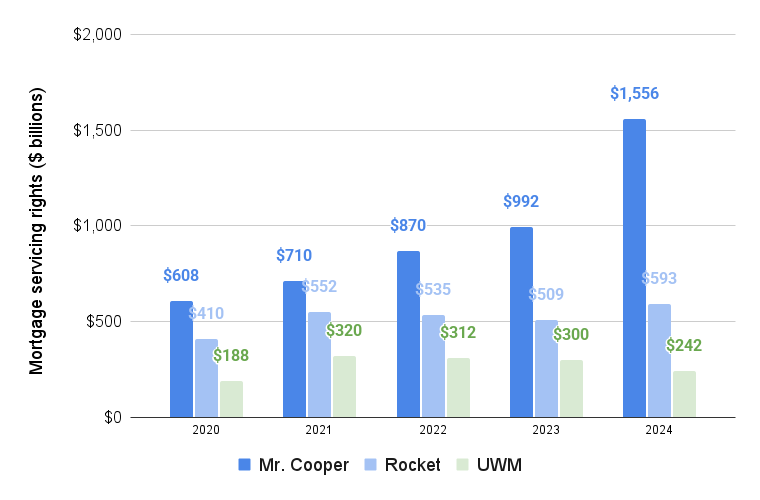
Mr. Cooper, Rocket Mortgage and UWM mortgage servicing rights (MSR) portfolios, including subservicing. Source: Company earnings reports.
Rocket and Mr. Cooper, by comparison, were together servicing (or subservicing) more than $2.15 trillion in mortgages at the end of the year — a combined portfolio nearly nine times larger than UWM’s.
Loan servicers collect monthly mortgage payments from borrowers on behalf of lenders or investors in mortgage-backed securities who own the loans. It’s an attractive business for many mortgage lenders, because the fees they can earn from loan servicing are a steady source of income that can even out ups and downs in home sales.
By maintaining close contact with borrowers, lenders who service their own loans are also in a better position to do repeat business with them when they’re ready to refinance or buy their next home.
Rocket claims that it “recaptures” 83 percent of its servicing clients when they’re ready to take out another loan. The Detroit-based lender’s client base is about to get a lot bigger, with Rocket setting its sights on acquiring not only Mr. Cooper but real estate brokerage Redfin for $1.75 billion.
Together, Rocket and Redfin attract 62 million visitors to their websites every month, while Rocket and Mr. Cooper’s combined client base of 9.5 million servicing customers represents opportunities for repeat business.
“Integrating Rocket’s originations-servicing recapture flywheel with Mr. Cooper’s servicing platform will drive down costs and improve the experience for the companies’ nearly 10 million combined clients,” company executives said in outlining the rationale for the deal.
Lenders who want to be in the loan servicing business can retain the mortgage servicing rights (MSRs) on the loans that they originate when they are bundled up into mortgage-backed securities (MBS) and sold to investors.
They can also acquire MSRs from other lenders who need the cash — or don’t want to be in the servicing business. Lenders who want to keep their MSRs but don’t want to service the loans can also contract with subservicers, as UWM has done in the past.
UWM’s MSR portfolio has been shrinking since 2021, as the Pontiac, Michigan-based lender sold servicing rights to raise money. As an example of one such deal, at the beginning of last year, UWM sold the MSRs on $70 billion in mortgages for $941.2 million.
Using tech to leverage economies of scale
Loan servicers benefit from economies of scale, as executives at Mr. Cooper have said of the company’s investment in AI and other technology to slash expenses. Two years ago, Mr. Cooper executives revealed the company was spending “several hundred million dollars a year” on call center operations, and expected to achieve $50 million in annual savings at the outset of a “multiyear” artificial intelligence project.
By partnering with ICE Mortgage Technology, UWM gets immediate access to what the companies claim is ICE’s “industry-leading MSP loan servicing system.”
UWM said it selected MSP “for the system’s powerful features, scalability and capacity to support outstanding customer service that fosters borrower retention, and the fact that ICE is an independent, neutral and proven technology provider.”
UWM will also employ ICE Servicing Digital, a homeowner portal with “retention and recapture features,” aimed at winning repeat business, and ICE Loss Mitigation, which helps homeowners facing hardship connect with assistance.
“While we are excited about the cost savings for UWM, we’re even more excited about the opportunity to help brokers deepen their relationships with borrowers by leveraging MSP,” Ishbia said.

Ben Jackson
ICE President Ben Jackson said in a statement that the company is “honored that UWM has entrusted us to supply the technology underpinning its new servicing strategy.”
It’s the second big tech partnership for UWM this month, following the announcement of a “strategic, industry-transformative agreement” to integrate Google Cloud AI and machine learning tools into UWM’s lending platform.
Interest rate risk
While mortgage servicing has been a profitable business for Mr. Cooper, it’s not without risks. Loan servicers are expected to help homeowners avoid foreclosure, a task that can prove demanding during economic downturns.
MSR portfolios are also sensitive to fluctuations in mortgage rates.
When interest rates go up, demand for purchase mortgages and refinancing often wanes. But MSRs become more valuable because borrowers are less likely to refinance and end up with another loan servicer.
When mortgage rates go down, loan servicers must often make adjustments to the fair value of their MSR portfolios, as borrowers are more likely to refinance and exit the portfolio.
Servicers who purchased MSRs during the pandemic era “have found themselves in the sweet spot, as mortgage holders remain reluctant to trade in low-priced loans,” outsourcing and advisory firm SitusAMC said in an analysis released Wednesday, “Mortgage Servicing Rights in 2025: Navigating Market Volatility.”

Mark Garland
The “million-dollar question” is where interest rates and mortgage origination volume will land over the next 12 to 18 months, SitusAMC executive Mark Garland said in a statement.
“Volume is everything,” Garland said. “Volume is going to be the issue that will keep people in the [loan servicing] business or drive them out.”
Get Inman’s Mortgage Brief Newsletter delivered right to your inbox. A weekly roundup of all the biggest news in the world of mortgages and closings delivered every Wednesday. Click here to subscribe.
Email Matt Carter
This post was originally published on this site
by Craig C. Rowe | Apr 30, 2025 | Industry, News Feed
A new software application called “Anyone” that promises to fully digitize the residential home sale has announced its rollout in the United States.
Bigger. Better. Bolder. Inman Connect is heading to San Diego. Join thousands of real estate pros, connect with the power of the Inman Community, and gain insights from hundreds of leading minds shaping the industry. If you’re ready to grow your business and invest in yourself, this is where you need to be. Go BIG in San Diego!
A new software application that promises to fully digitize the residential home sale has announced its rollout in the United States, Inman has learned.
The product is called “Anyone,” and it’s also being made available in the United Kingdom and the Netherlands, according to an April 29 statement.
“While traditional platforms focus only on listings, Anyone.com connects the full transaction journey: buyers, sellers, agents, home inspectors, mortgage advisors and notaries can now collaborate digitally in a single, integrated space,” the release stated.
Anyone has access to more than 31 million For Sale properties and 300 million property data points, according to the release, as well as profile data on 4.6 million agents.
Standout features of the product include the ability to drive deals from tour scheduling to offer submission and escrow management, an agent matching feature that uses artificial intelligence and 12+ billion data points to connect consumers with the best-suited sales professional.
It also boasts a centralized communication hub that keeps all individuals, documents and deal steps on track across an international buying and selling environment that can support overseas transactions.
“We’ve basically built the Uber of real estate,” Reza Sardeha, founder of Anyone.com, said in the statement. “The entire transaction — from finding the right home and agent to submitting offers and signing — is now handled in one digital workflow.”
The company states it has use cases in a wide range of nations, including Germany, France, Canada, Australia, India, Sweden, the United Arab Emirates, Netherlands, Italy, Belgium, Spain, Finland, Switzerland, Poland, Portugal, Ireland and Austria.
Anyone is expanding its listing coverage in those markets, which stands at 84 percent. The goal is “near-complete coverage, 99.99 percent, of all active listings.”
A mortgage arm is in development, too, slated to launch in 2026 and focus on first-time buyers and underserved segments, “helping lower the financial barrier to entry by 50 percent,” Anyone said.
The team behind Anyone founded a web domain platform called Dan.com, which was sold to GoDaddy in 2022.
Email Craig Rowe
This post was originally published on this site
by Taylor Anderson | Apr 30, 2025 | Industry, News Feed
Inventory is up and rates are down as fewer buyers face stiff competition and successfully find homes in less than a month, according to new data shared by BrightMLS.
Bigger. Better. Bolder. Inman Connect is heading to San Diego. Join thousands of real estate pros, connect with the Inman Community and gain insights from hundreds of leading minds shaping the industry. If you’re ready to grow your business and invest in yourself, this is where you need to be. Go BIG in San Diego!
Inventory is up. Rates are down. Fewer buyers face multiple offer situations.
By several key metrics, the mid-Atlantic region is still a seller’s market. But signs suggest conditions are gradually changing in favor of homebuyers, according to a survey of thousands of Bright MLS members released Wednesday.
TAKE THE INMAN INTEL SURVEY FOR APRIL
“While it’s not officially a buyer’s market yet, the pendulum is clearly swinging away from the intensely competitive conditions of recent years,” said Bright MLS Chief Economist Lisa Sturtevant in a statement. “Buyers are seeing more options and facing fewer obstacles compared to this time last year.”
Homebuyers are starting to gain the upper hand in the region, comprised of Delaware, Virginia, West Virginia, Washington DC, Pennsylvania and New Jersey.
For the week ending April 27, new listings were up 12.2 percent in Bright’s 6-state market compared to a year ago. The number of active listings rose 31.8 percent compared to a year earlier, the highest level in more than three years, according to responses from approximately 3,000 BrightMLS members in the first quarter.
Nine percent of active listings had a price decrease, which was up a percentage point from a year before, according to BrightMLS data.
The number of buyers in the first quarter who spent less than a month searching for a home was twice as high as it was a year ago, with 40 percent of homebuyers landing a home in less than 30 days.
Half of all buyers made just one offer, with odds slightly favoring repeat buyers over first-timers.
“The housing market in 2025 feels different — less frenzied and more balanced,” Sturtevant said. “If these trends continue, we could see the most buyer-friendly conditions in years this spring.”
BrightMLS members reported fewer buyers halting their searches as a result of high mortgage rates, the latest indication that consumers have grown accustomed to rates above 6 percent.
BrightMLS agents indicated they were still optimistic that buyer activity would pick up in the months ahead. The Buyer Index Activity was 60.1 in the first quarter, indicating high optimism. That was down slightly from April 2024, when the index was near a record high of 68.1, Bright said.
Meanwhile, the Seller Activity Index was at 47.2 in April, up from 35.4 a year ago.
“Sellers aren’t as aggressive as last year, but they’re also not giving away major concessions,” Sturtevant said. “Closing cost help and repair credits are still less common than buyers might hope for.”
Email Taylor Anderson
This post was originally published on this site