by Inman | Apr 30, 2025 | Industry, News Feed
Bigger. Better. Bolder. Inman Connect is heading to San Diego. Join thousands of real estate pros, connect with the power of the Inman Community, and gain insights from hundreds of leading minds shaping the industry. If you’re ready to grow your business and invest in yourself, this is where you need to be. Go BIG in San Diego!
Luxury real estate agents stand out by being exceptional.
The Inman Golden I Club sets the gold standard for recognition in the luxury real estate market, celebrating those professionals who have shown distinction in pushing the boundaries of what’s possible in the industry and whose achievements are synonymous with the highest echelons of luxury real estate.
Nominations close soon for exceptional individuals, teams, campaigns, and companies who are achieving record-breaking sales and delivering stellar service to their clients, all while fostering a culture of excellence and creativity that inspires the entire community with their dedication to greatness in a competitive market.
Simply send in your nominations by May 1 in the following categories:
- Top Luxury Agent
- Top Luxury Brokerage
- Top Luxury Team
- Top Luxury Technology or Tool
- Best City Sale
- Best Beach Sale
- Best Mountain Sale
- Best Sales and Marketing Campaign for a Luxury Home/Property
- Best Sales and Marketing Campaign for a Luxury Development
Finalists will be announced in June, and the winner will be celebrated at Luxury Connect in San Diego in July.
Nominate today: Celebrate success!
Deadline: May 1.
This post was originally published on this site
by Matt Carter | Apr 30, 2025 | Industry, News Feed
Slowing economy could also help bring mortgage rates down to Earth more rapidly, with the latest forecast predicting rates will drop to 6.2 percent by the end of this year and to 6 percent next year.

In April, we’ll go deep on money and finance for a special theme month, by talking to leaders about where the mortgage market is heading and how technology and business strategies are evolving to suit the needs of buyers now. Inman’s Best of Finance returns for 2025, celebrating the leaders in this space. And subscribe to Mortgage Brief for weekly updates all year long.
Incoming economic data has Fannie Mae economists expecting higher inflation and slower growth this year than they’d previously forecast in March.
The latest forecast envisions economic growth slowing to 0.5 percent this year, down from March’s forecast for 1.7 percent growth, and that annual inflation will rise to 3.5 percent by the fourth quarter.
TAKE THE INMAN INTEL INDEX SURVEY FOR APRIL
The commentary accompanying April’s forecast lacked the in-depth analysis Fannie Mae’s Economic and Strategic Research (ESR) Group provided in March and previous months.
But other economists and many consumers expect tariffs imposed or threatened by the Trump administration will push prices up and slow the economy down this year, heightening the probability of a recession.
Signs of a slowing economy could also help bring mortgage rates down to Earth more rapidly. Fannie Mae forecasters now expect mortgage rates to come down to 6.2 percent by the end of this year and 6.0 percent next year.
Mortgage rates expected to ease
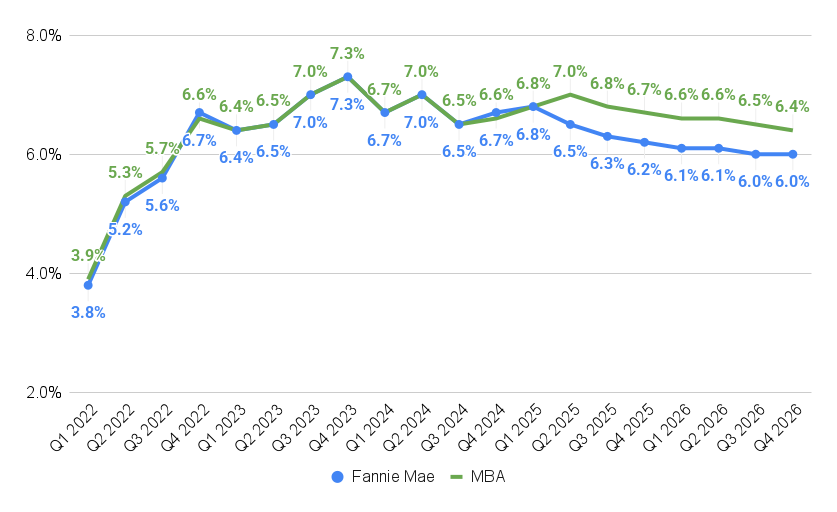
Source: Fannie Mae and Mortgage Bankers Association forecasts, April 2025.
In March, forecasters at the mortgage giant weren’t expecting mortgage rates to hit 6.2 percent until the end of next year.
Economists at the Mortgage Bankers Association in an April 11 forecast projected mortgage rates will still be averaging 6.7 percent in Q4 2025 and 6.4 percent during Q4 2026.
Home sales forecast revised down
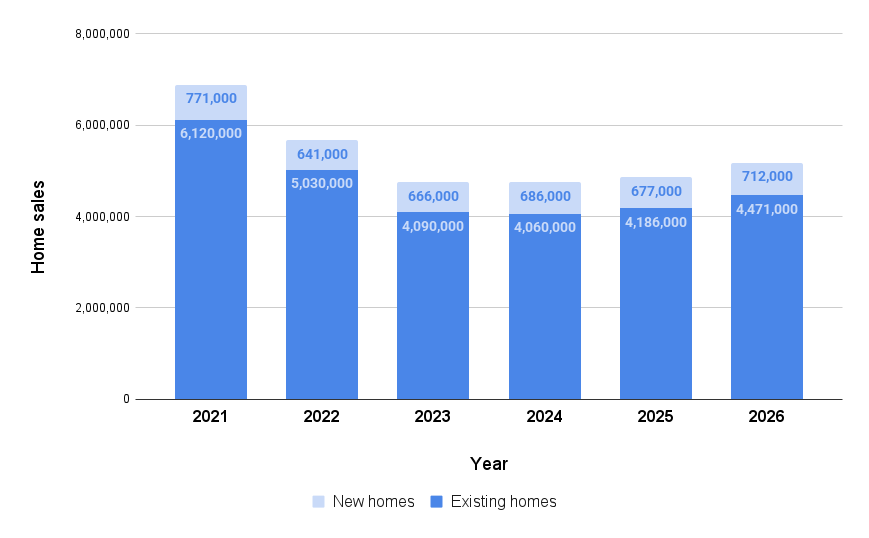
Source: Fannie Mae housing forecast, April 2025.
Despite stronger than expected first quarter home sales, Fannie Mae economists revised their forecast for 2025 home sales to 4.86 million, down from 4.95 million in March.
While sales of existing homes are still expected to grow by 3 percent this year, to 4.186 million, Fannie Mae economists now expect sales of new homes will decline by 1 percent, to 677,0000.
A stronger rebound is still expected in 2026, with sales of new and existing homes expected to grow by 7 percent to 5.18 million and surpassing the 5 million mark for the first time since 2022.
Hotter home price appreciation
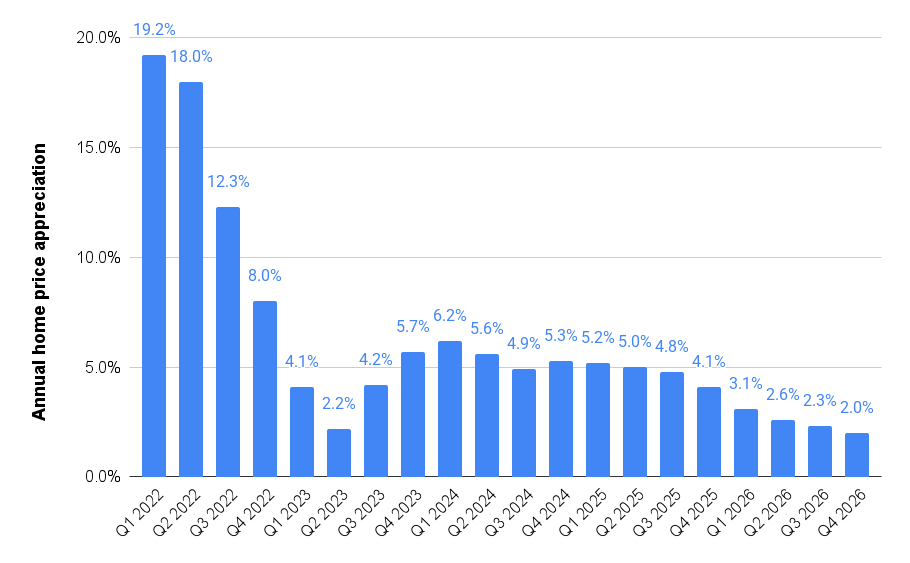
Fannie Mae economists are also expecting hotter home price appreciation than in January, the last update of the quarterly forecast for that metric.
In January, Fannie Mae economists were expecting annual home price appreciation to cool to 3.5 percent by Q4 2025. The latest forecast is that home prices will be up 4.1 percent from a year ago in Q4 2025, before appreciation cools to 2 percent by Q4 2025.
Higher prices spur mortgage originations
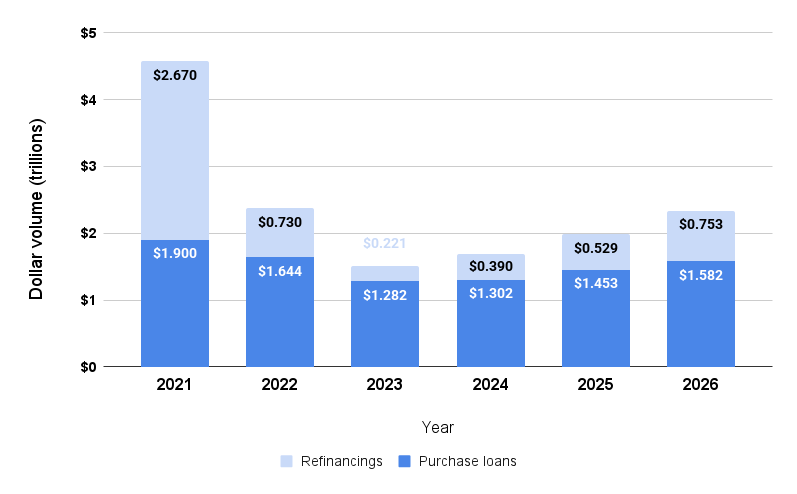
Higher home prices mean mortgage lenders could see 17 percent growth in 2025 lending by dollar volume, with refinancing expected to surge 36 percent to $529 billion, and purchase loans projected to hit $1.453 trillion, up 12 percent from 2024.
If mortgage rates keep trending down next year as projected, Fannie Mae economists expect refinancing to surge by 42 percent next year, to $753 billion, and purchase loan fundings to grow by 9 percent, to $1.582 trillion.
Get Inman’s Mortgage Brief Newsletter delivered right to your inbox. A weekly roundup of all the biggest news in the world of mortgages and closings delivered every Wednesday. Click here to subscribe.
Email Matt Carter
This post was originally published on this site
by Amy Stockberger | Apr 30, 2025 | Industry, News Feed
Bigger. Better. Bolder. Inman Connect is heading to San Diego. Join thousands of real estate pros, connect with the power of the Inman Community, and gain insights from hundreds of leading minds shaping the industry. If you’re ready to grow your business and invest in yourself, this is where you need to be. Go BIG in San Diego!
Spring isn’t just a season of growth; it’s a wake-up call for real estate pros to sharpen their edge.
And let’s be honest: You can’t stand out from your competition if you don’t know what they are offering — including the strengths, weaknesses and gaps that exist in your market among your competition.
It’s not just about what they’re posting online but what they’re actually delivering, where they’re visible, and where they’re leaving space for someone like you to rise.
TAKE THE INMAN INTEL SURVEY FOR APRIL
1. Study your top 5 competitors like a pro
If you haven’t done a real competitive analysis, now’s the time.
Identify the top five agents, teams or brokerages in your market. Already leading? Perfect. Choose five from another market that mirrors yours in price point or demographic, and dig in.
Break it down:
- Who are they?
- Where are they showing up?
- What are they offering?
- What are their follow-up systems and client touchpoints?
- What are their strengths, weaknesses and gaps?
This isn’t just about monitoring the competition. This is about spotting market opportunities, identifying underserved clients, refining your unique value proposition and building strategies that reflect what people actually want. When you track what others are doing — and what they’re not — you stay competitive, relevant and ahead of the curve.
Use this ChatGPT prompt to help you pull the data:
“Act as a Market Analyst and Competitive Intelligence Consultant. Help me identify the top 5 real estate agents in [insert market], their names, websites and programs, including UVPs such as guaranteed sales, instant offers, relocation assistance and VIP client services.”
2. Do the same deep dive on yourself
After analyzing the competition, it’s time to hold up the mirror.
Evaluate your business with intention:
- What are your actual strengths?
- Where are the breakdowns?
- What’s missing from your service model that clients are craving?
This isn’t just a feel-good exercise. It’s how you make sure your business evolves with your clients — and serves them in the ways that matter most.
Here’s how to guide your self-analysis with the help of ChatGPT:
Strengths
“Act as a Personal Business Analyst. Based on my description of my real estate services, help me identify my key strengths. What do I do better than my competitors?”
“Act as a Feedback Analyst. Here are reviews from my past clients on [Google/Zillow/Facebook/etc.]: [paste reviews]. Summarize recurring themes. What do clients consistently praise?”
Weaknesses
“Act as a Business Consultant. Based on my description of my real estate business, help me identify my weaknesses. What areas could I improve on to better serve clients or grow my business?”
“Act as a Feedback Analyst. Here are reviews from past clients: [paste reviews]. What are common complaints or suggestions for improvement?”
Gaps
“Act as a Market Analyst. Based on the competitive landscape and my description of my services, help me identify gaps in my offerings. What new programs or skills should I develop to stand out in my market?”
3. Let your values lead the way
You can’t build a standout business if your clients don’t know what you stand for.
Your values should be more than a page on your website — they should show up in every part of your business, from your first meeting to the final walkthrough and long after the keys are handed off.
Ask yourself:
- What do I believe in when it comes to service?
- How do I want my clients to describe me when I’m not in the room?
- What’s the bigger purpose behind what I do?
Start here:
“Acting as a Core Value Consultant and based on my competitive analysis, self-analysis and client reviews, help me define core values that highlight my strengths, address client pain points and differentiate me from competitors.”
Once you’ve got your core values dialed in, craft your direction:
“Using my self-analysis and core values, help me craft a Vision Statement that reflects where I want my real estate business to go, my Unique Value Propositions and the problems I solve for my clients.”
When those values and vision are clear, they stop being ideas — they become your filter for every client touchpoint, decision and strategy. They become your culture and dictate how you scale your business. And remember, being the local expert in connecting buyers and sellers is not a Unique Value Proposition; rather, it’s the actual definition of your job.
4. Don’t just offer value. Create impact
Everyone says they provide value. But value doesn’t make you memorable. Impact does.
What are you doing that truly changes your clients’ experience — not just in the transaction, but in their life?
This is about becoming known for delivering outcomes, not just services. And it starts by identifying the needs your competitors are missing.
Use these prompts to guide the next layer of your differentiation:
“Based on competitors’ programs, what gaps exist in [insert market]? How can I design unique programs to address these gaps?”
Maybe your market is ignoring first-time buyers, seniors or remote relocations. Maybe no one is offering a stress-free post-close experience. Whatever it is — step into that space. Make it yours.
This is where you shift from agent to trusted guide.
5. Create a system for consistent growth
It’s one thing to stand out for a season. It’s another to stand out consistently.
That happens when you build a repeatable system that keeps you sharp, reflective and ahead of the curve. The good news? You don’t have to manually remember any of it.
Use ChatGPT Task Scheduler to make this a seamless, automated process that runs behind the scenes — keeping you on track while you stay focused on serving.
Every 90 days, have ChatGPT:
- Re-run your competitive scan
- Review and summarize your client feedback
- Reevaluate your strengths, weaknesses and gaps
- Identify where your messaging, service or follow-up needs a refresh
- Serve before you sell — find authentic ways to reconnect and provide support
Copy-paste this to plug into your ChatGPT Task Scheduler:
“Every 90 days, remind me to: 1. Run my competitor scan. 2. Reanalyze my reviews and testimonials. 3. Identify new gaps or service opportunities. 4. Reconnect with five contacts through authentic serve-first messages.”
This turns one-time insight into long-term momentum.
Consistency isn’t just a marketing strategy — it’s your competitive advantage.
Standing out doesn’t come from being louder — it comes from being clearer.
Know your competition. Know yourself. Lead with values. Serve with purpose. Build systems that repeat success, not just chase it.
Strengths. Weaknesses. Gaps. When you know all three — yours and theirs — you don’t chase growth. You attract it.
Amy Stockberger is the founder of Amy Stockberger Real Estate. Connect with Amy on Instagram.
This post was originally published on this site
by Angela Yungk | Apr 30, 2025 | Industry, News Feed
By embracing branding principles, storytelling techniques, PR strategies and leveraging AI, Angela Yungk writes, real estate agents can establish a competitive edge that extends far beyond transactions.
Bigger. Better. Bolder. Inman Connect is heading to San Diego. Join thousands of real estate pros, connect with the power of the Inman Community, and gain insights from hundreds of leading minds shaping the industry. If you’re ready to grow your business and invest in yourself, this is where you need to be. Go BIG in San Diego!
Standing out as an agent is more complex than ever before, and there’s competition to be seen and heard. In a competitive field like real estate, it isn’t just about having the most listings or sales — it’s about having the most exposure.
TAKE THE INMAN INTEL SURVEY FOR APRIL
As a former magazine publisher and TV host turned real estate broker, I’ve seen firsthand how the use of media can provide you with a competitive edge. In an industry where trust, visibility and reputation drive business, those who use media can establish themselves as market leaders. If you want to set yourself apart, here’s how applying media-driven techniques can help.
Branding like a media mogul
The most successful media brands — from magazines to digital influencers — thrive by focusing on three main components: consistency, clarity and connection. Here’s how you can apply these principles to help build your brand.
- Define your niche: Consider diving into a niche that reflects either your expertise or your personality. Whether you’re the go-to condo expert, a first-time homebuyer advocate, or the local neighborhood specialist, a strong identity builds trust and helps potential new clients see you as an authority figure.
- The way you show up online matters: Consider how you perceive most brands today. Their colors, fonts and logos are pretty consistent across all platforms. These attributes help you spot and recognize them immediately. To establish a professional presence, agents should also ensure consistency in their headshots, logos, marketing materials and social media graphics.
- Omnipresence is key: We don’t own social media. Therefore, you should leverage as many different platforms as possible. Utilize email marketing, video content and even print materials to stay visible to your audience. When using social media, consider where your audience is located and how they present themselves on each platform. You may want to tailor content that goes on LinkedIn differently from how you post it on TikTok.
Storytelling is how you sell
One of the most impactful things I learned while in the TV and magazine production business was the power of storytelling. When you are working as an agent, think about your client’s needs above all else. They aren’t just buying homes; they are buying into a lifestyle or a vision they see for themselves. By utilizing storytelling, agents can elevate marketing and create connections with their audience.
- Create a story around a listing: Instead of listing the facts around a home, tell its story. Is the home located near an iconic landmark? What’s the history behind the property? What new restaurants are popping up across the street? A well-crafted story sets you apart from all the agents saying “Just Listed.”
- Leverage your past clients’ experiences: Just like a magazine shares human-interest stories, showcase your past clients’ stories and how you made the deal work. A story about how you helped a first-time home buyer by getting them closing cost assistance from a seller, allowing them to see their dreams come to fruition, is a story that resonates with just about anyone.
The power of PR
Becoming a recognized authority in real estate doesn’t happen overnight. This is where putting your “PR hat” on can help you out. Public relations (PR) is one of the most underutilized tools among agents, as many don’t realize it is attainable. Here are some simple PR hacks you can use to gain media exposure:
- Position yourself as a local expert: Reporters are constantly seeking real estate professionals to share their thoughts on the market. By proactively reaching out to local reporters and online publications with data-driven insights and expert commentary, agents can establish themselves as go-to sources for media content.
- Write thought leadership articles: Agents with expertise in a niche market can write opinion pieces for real estate blogs, lifestyle magazines and business outlets. A great example of this is using LinkedIn to write articles. LinkedIn hosts content, such as articles, similar to a blog, which you can share with your audience and repurpose for email marketing.
- Leverage social media for press: Journalists are scouring the internet for everyday experts. A good practice is to engage your audience with trending topics. Create valuable insights and tag or share them with journalists.
In this day and age, thinking like a journalist is easier than ever before. By embracing branding principles, storytelling techniques, PR strategies and leveraging AI, real estate agents can establish a competitive edge that extends far beyond transactions. In today’s market, being seen as a trusted expert is just as crucial as selling homes, and media expertise is the key to achieving that.
Angela Yungk is a managing broker and lead mentor with Arterra Realty Florida. You can connect with Angela on Instagram and LinkedIn.
This post was originally published on this site
by Matt Carter | Apr 29, 2025 | Industry, News Feed
Consumer confidence sank to a five-year low in April over concerns about tariffs, while trade deficit surged to an all-time high in March, and job postings shrank more than expected
In April, we’ll go deep on money and finance for a special theme month, by talking to leaders about where the mortgage market is heading and how technology and business strategies are evolving to suit the needs of buyers now. Inman’s Best of Finance returns for 2025, celebrating the leaders in this space. And subscribe to Mortgage Brief for weekly updates all year long.
Mortgage rates are on the retreat this week as the latest data on the economy has investors who fund most home loans worried that tariffs will not only fuel inflation but lead to a recession.
The Conference Board reported Tuesday that its Consumer Confidence Index dipped for the fifth consecutive month in April, to 86 — the lowest level since May 2020, the onset of the COVID pandemic.

Mark Zandi
TAKE THE INMAN INTEL INDEX SURVEY FOR APRIL
The U.S. trade deficit hit an all time high in March and job postings shrank more than forecasters were expecting, with a federal hiring freeze in place and uncertainty over the economy putting a chill on private sector hiring.
The 19-point drop in the Consumer Confidence Index over the past three months is “just shy of the recession threshold of 20,” Moody’s Analytics Chief Economist Mark Zandi posted on X. “Unless the trade war cools off very (very) soon, recession appears dead-ahead.”
Consumer confidence falters
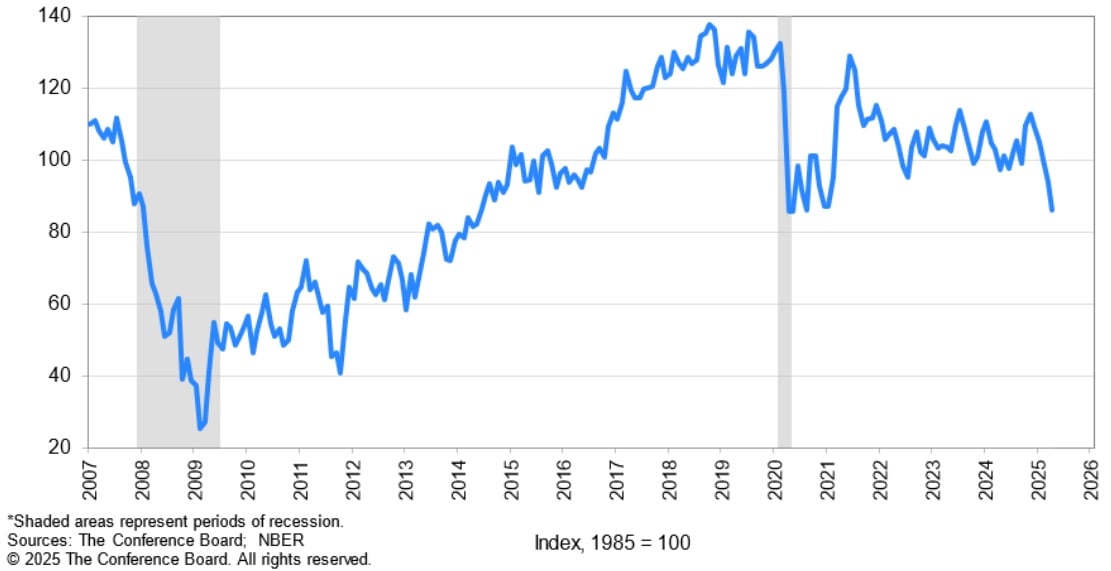
“One positive note is that the slide in confidence was mostly due to weaker consumer expectations,” Zandi added. “Present assessments are holding up better. This suggests confidence could recover quickly with good news on the trade war, heading off a recession.”
In the latest back and forth on tariffs, President Trump signed an executive order Tuesday aimed at providing U.S. automakers some relief by “de-stacking” tariffs to avoid the cumulative effect of overlapping tariffs on other items like steel and aluminum.
The Conference Board reported that its Expectations Index, which tracks consumers’ short-term outlook for income, business and labor market conditions, fell 12.5 points to 54.4 — the lowest level since October 2011, and below a threshold of 80 that usually signals a recession ahead.

Stephanie Guichard
Consumers surveyed by the Conference Board through April 21 said they expect inflation will hit 7 percent in the next year, the most pessimistic reading since November 2022, when the U.S. was experiencing “extremely high inflation,” Conference Board economist Stephanie Guichard said, in a statement.
The decline in consumer confidence was shared across all political affiliations, and consumers “explicitly mentioned concerns about tariffs increasing prices and having negative impacts on the economy” in write-in responses, the Conference Board said.
Job openings trend down again
Employers were looking to fill 7.192 million job openings in March — a drop of 288,000 from February and 901,000 from a year ago, the Bureau of Labor Statistics reported Tuesday. Economists had expected job openings to hold steady at 7.5 million.
Federal government job openings fell by 36,000 in March, while “the surge in economic policy uncertainty in March, mostly relating to tariff policy,” was the primary driver of the 229,000 decline in private sector job openings, Pantheon Macroeconomics Chief U.S. Economist Samuel Tombs said in a note to clients.

Samuel Tombs
“In particular, openings in the transportation, warehousing and utilities sector dropped by a relatively large 59,000, as businesses geared up for lower levels of demand for goods,” Tombs said. “Meanwhile, healthcare job postings fell by 45,000 and now are back in line with their long-run level, relative to the number of jobs.”
Tariffs on some goods from China have been increased by as much as 170 percent this year, with most of that hike taking effect April 9.
The Trump administration’s threats to raise tariffs on China and other U.S. trading partners prompted a rush of imports in March that pushed the U.S. trade deficit to a record high of $162 billion, according to an advance reading published by the Census Bureau Tuesday.
Trade deficit widens
U.S. companies imported an all-time high of $342.7 billion in goods last month, up $16.3 billion from February.
Economists have forecast that economic growth slowed to an annual rate of 0.4 percent during the first quarter, down from 2.4 percent in the final three months of 2024. The Bureau of Economic Analysis is scheduled to release an estimate of Q1 gross domestic product (GDP) growth on Wednesday.
The latest advance economic indicators pushed the Atlanta Fed’s GDPNow forecasting model’s estimate of Q1 annual GDP growth down to -2.7 percent Tuesday, from -2.4 percent on April 24.
Mortgage rates retreat from 2025 high
At 6.76 percent on Monday, rates on 30-year fixed-rate mortgages were down four basis points from Friday and 29 basis points from a 2025 high of 7.05 percent registered Jan. 14, according to rate lock data tracked by Optimal Blue.
Yields on 10-year Treasury notes, a barometer for mortgage rates, fell five basis points Monday and another four basis points Tuesday.
Get Inman’s Mortgage Brief Newsletter delivered right to your inbox. A weekly roundup of all the biggest news in the world of mortgages and closings delivered every Wednesday. Click here to subscribe.
Email Matt Carter
This post was originally published on this site
by Richelle Hammiel | Apr 29, 2025 | Industry, News Feed
Mexican sculptor Enrique Cabrera purchased the property known as the “Darth Vader House” for $3.4 million and plans to transform it into an artistic landmark of its own creation.
Bigger. Better. Bolder. Inman Connect is heading to San Diego. Join thousands of real estate pros, connect with the Inman Community and gain insights from hundreds of leading minds shaping the industry. If you’re ready to grow your business and invest in yourself, this is where you need to be. Go BIG in San Diego!
The Houston home dubbed the “Darth Vader House” has a new owner — and a new identity in the works.
Mexican sculptor Enrique Cabrera purchased the property for $3.4 million and plans to transform it into an artistic landmark of his own creation, the Houston Chronicle recently reported.
TAKE THE INMAN INTEL SURVEY FOR APRIL
Designed by Houston architect Brett Zamora, the home earned its name thanks to its dark facade and angular, helmet-like design, evoking the Star Wars villain, Nan & Co. Properties shared in an article announcing the sale.
Nancy Almodovar of Nan & Co. Properties represented Cabrera in the transaction.

Wikimedia Commons: Darth Vader/Berniethomas68
Over the years, the property has changed hands multiple times and cycled on and off the market.
Most recently, it was listed by local real estate broker and House of Ho star Washington Ho.
When the home didn’t sell, it returned to the hands of listing agent and owner Jason Junkin of Nitya Realty, who held onto it for around three years.
Just six days after the property was listed for $3.3 million this time around, Cabrera snapped it up with plans for a bold rebranding.
“The former Darth Vader house now is officially ‘The Black Bull House’ by Enrique Cabrera,” he told the Chronicle.
The name isn’t just symbolic — Cabrera plans to install a $2.4 million black bull statue of his own design at the home’s entrance.

Enrique Cabrera (Photo by Johnny Nunez/WireImage courtesy Getty)
Cabrera told The Real Deal that he intends to give the property a complete artistic transformation, turning it into a hub of creative energy.
At 7,000 square feet, the home sits on an enormous 18,000-square foot lot in Houston’s prestigious West University enclave. According to the property’s listing description, the house sits “mysteriously lurking in its striking dark slate and aluminum clad armor.”
Inside, the home’s design could be considered just as dramatic, featuring two floating glass staircases, floor-to-ceiling windows, a wine wall, a pool and hot tub. The home also includes four bedrooms and five bathrooms.
Originally built in 1992 by Houston plastic surgeon Dr. Jean Cuckier — a devoted fan of Star Wars — the home has long captured the imagination of locals and architecture lovers and is considered a local landmark.
Email Richelle Hammiel
This post was originally published on this site