by Rick Guerrero | Aug 22, 2024 | Industry, News Feed
Whether it’s refining your business model, mastering new technologies, or discovering strategies to capitalize on the next market surge, Inman Connect New York will prepare you to take bold steps forward. The Next Chapter is about to begin. Be part of it. Join us and thousands of real estate leaders Jan. 22-24, 2025.
Although many of the Blankenship Group’s team members are not originally from 30A, they nonetheless have deep roots in the area. Many, according to team leader Beau Blankenship, “grew up visiting the area and fell in love with its unique charm. This deep connection to 30A drives their passion for helping others achieve their dream of living here.”
Several of the team members started out as interns and have since grown into successful real estate pros in their own right. That’s because Blankenship seeks to foster a supportive and collaborative environment that “treats each team member like family.”
TAKE THE INMAN INTEL INDEX SURVEY FOR AUGUST
With more than $1.7 billion in closed sales since the end of 2021 and a client-centric approach, Blankenship and his team are building a reputation for excellence and a loyal client base. Learn how he made the switch from the NFL and how he’s working to enhance his team’s reputation and connections to the benefit of both clients and the community.
Name: Beau Blankenship
Title: Owner and real estate advisor
Location: Santa Rosa Beach, Florida
Team Name: Blankenship Group
Rankings: No. 1 team on 30A for three consecutive years, No. 1 team in the Engel and Völkers company, the No. 2 large team in Florida and the No. 12 large team in the nation
Team size: Team lead of 15
Transaction sides: 256 (2023)
Sales volume: $1.6 billion (since 2019)
Awards: No. 1 Team by GCI in the Engel and Völkers company (2020, 2021, 2022, 2023)
How did you get your start in real estate?
My journey into real estate began with a foundation in football, where the discipline and determination I developed as an athlete seamlessly translated into my client-centric service.
Growing up vacationing with my family year after year on 30A, I was led to begin my real estate journey in this charming destination. Starting from the bottom, I refined my sales and team-building skills, culminating in the bold launch of my first brokerage, Engel & Völkers 30A Beaches, in 2018 at the age of 27.
In 2019, I formed the Blankenship Group with just a few agents, and through networking and years of relentless work, grew it into the successful, record-breaking team it is today.
What’s something you know now that you wish you knew when you started?
One thing I know now that I wish I knew when I started is the importance of building and maintaining strong relationships. In the luxury market, trust and personal connections are paramount. It’s not just about closing deals but about cultivating long-term relationships with clients, understanding their unique needs and preferences, and providing unparalleled service.
I also learned that investing in a robust network, including other industry professionals and local influencers, can significantly enhance your business.
Lastly, understanding the value of patience and persistence is crucial — luxury transactions often take longer and require a high level of dedication and attention to detail.
What’s your top tip for newly formed teams?
My top tip for newly formed real estate teams is to foster a culture of open communication and collaboration. From Day 1, establish an environment where team members feel comfortable sharing ideas, discussing challenges and offering support.
Encourage regular team meetings to align goals, celebrate successes and address any issues. Emphasize the importance of working together rather than competing against each other. A strong, united team can achieve far more than individuals working in isolation.
Building trust and maintaining transparency within the team will not only enhance your internal relationships but also improve your client interactions and drive long-term success.
Tell us about a high point in your career
One of the high points in my career was reaching the No. 1 spot in our market, but the most fulfilling part of this achievement was witnessing the growth and success of my team members. This milestone was the result of years of hard work, strategic planning and dedication to excellence. I focused on investing in my team by hiring talented individuals and providing them with the training, resources and support they needed to excel.
By setting clear goals, building strong relationships with clients and partners, and embracing innovative strategies, we were able to achieve this success. However, seeing my team members grow into successful real estate professionals and knowing that their achievements were part of our collective success made this accomplishment truly meaningful.
It reaffirmed that real estate success is not just about individual accolades but also about creating opportunities for others to thrive.
What makes a good leader?
A good leader on a real estate team is someone who inspires and motivates their team through a combination of vision, empathy and accountability. Effective leaders lead by example, demonstrating a strong work ethic, integrity and a commitment to excellence that sets the standard for their team. They create a supportive and collaborative environment where team members feel valued and encouraged to reach their full potential.
A great leader also listens actively, providing constructive feedback and fostering open communication to address challenges and celebrate successes. They focus on developing their team’s skills through ongoing training and mentorship, while also setting clear, achievable goals and providing the resources needed to meet them.
Ultimately, a successful leader balances the pursuit of team objectives with the personal and professional growth of each individual, building a cohesive unit that strives for excellence together.
Email Christy Murdock
by Shelby Dunstan | Aug 22, 2024 | Industry, News Feed
It’s all about shifting your mindset, coaches Emily Bossert and Melanie Klein write. To create consistency, you need a plan for your business that defines who you are.
Whether it’s refining your business model, mastering new technologies, or discovering strategies to capitalize on the next market surge, Inman Connect New York will prepare you to take bold steps forward. The Next Chapter is about to begin. Be part of it. Join us and thousands of real estate leaders Jan. 22-24, 2025.
How can real estate agents create steadiness and consistency in their business and personal lives amid constant change and unpredictability? We want to share one of the most important (if not the most important) components of experiencing consistency in real estate.
Consistency in business is not just about mastering the market. It includes mastering yourself, honing your skills, fortifying your work ethic and delivering exceptional value to others.
TAKE THE INMAN INTEL INDEX SURVEY FOR AUGUST
Case study: Sarah
Let’s take Sarah as an example. Sarah is a real estate agent who struggled with the ups and downs of the market. She often found herself overwhelmed and feeling unsteady, which impacted both her business and personal life.
Can you relate? Because this story is all too common in real estate.
However, one day, Sarah chose a few key changes to implement. She decided to focus on her mindset, skillset, work ethic and the value she provided to her clients. These four simple and actionable steps, done consistently over time, allowed her to see a remarkable transformation, not only in her career but also in her overall well-being.
Step 1: Embrace change
Where to start? To create consistency in your business and life, start by checking and fine-tuning your mindset. Think of mindset as the foundation. A positive and resilient mindset is essential for navigating the challenges of the real estate industry and our lives. Research shows that a growth mindset leads to greater success and overall satisfaction.
Choose (yes, it’s a choice) to see challenges as opportunities for growth, and view setbacks as lessons instead of failures. The presence of our mindset, also known as mindfulness, helps us manage our stress and keeps us calm and focused.
A growth mindset encourages continuous learning and adaptability, all while laying the solid foundation for personal and professional success. Get your mindset right, and everything else will follow.
Step 2: Fortify your work ethic
The value of a strong work ethic cannot be overstated. Developing solid daily habits and avoiding procrastination is key. A consistent work ethic in the right areas will create increased success, building on the foundation of a healthy mindset and leading to even greater achievements in both your professional and personal life.
Plant and tend to the seeds consistently — whatever systems you follow, be consistent with them. Plant the seeds, don’t miss a beat, and build a strong foundation. By consistently following your tried-and-true systems and avoiding procrastination, these actions will compound over time, leading to significant business growth.
Step 3: Sharpen your knowledge
Continuous improvement is vital in this fast-paced and ever-changing market. Stay updated with industry trends, learn new techniques, and enhance existing skills.
Here’s how you can do this:
- Understand the form changes: Always stay informed about the latest changes in forms and regulations locally, regionally and nationally. Learn and internalize these updates to ensure accuracy and compliance.
- Role-play conversations to gain confidence: Practice your conversations about all things real estate. This helps you become clear, prepared, competent and confident in your interactions with clients.
- Get comfortable explaining all aspects of the contracts to your clients: Mastering your craft means being able to clearly educate and explain contracts. Being able to read legal documents and break down the language for buyers and sellers is a crucial skill.
- Emphasize the energy and attitude you bring to conversations: Approach conversations with calm and reassuring energy, avoiding dramatics. Remember, your energy can significantly influence the situation and the client’s perception. If you make something out to be a major deal, it will become exactly that.
Step 4: Deliver exceptional value
Providing exceptional value sets you apart in a competitive market. Inspired by Will Guidara’s book Unreasonable Hospitality: The Remarkable Power of Giving People More Than They Expect, we can see that delivering value is crucial in any industry.
Here’s how you can achieve this:
- Provide value without expectation: Offer valuable insights and services without expecting immediate returns. Listen intently, and be genuine when you are helping clients. This is how we build that connection of trustworthiness and commitment.
- Think quality service and take exceptional care of clients: Go above and beyond to meet your client’s needs. Just like we see examples of this in the book Unreasonable Hospitality, outstanding care and attention will turn one-time clients into lifelong advocates.
- Be a forward thinker and bold innovator: Think outside the box, and innovate in your approach. Stand out from the competition by continuously seeking new ways to add value and exceed expectations. This quality is truly special, and it allows your authentic self to get creative.
What’s next for you?
Start with the foundation. Assess your current mindset, and make any necessary adjustments. Embrace change and see it as an opportunity for growth. Remember, consistency and steadiness in your actions will lead to long-term success.
Invest in skill-building activities, and commit to daily consistent actions. Focus on providing exceptional value to your clients. By living your life this way, you will create a more meaningful and fulfilling career and personal life.
Take these steps seriously, and you’ll build a strong, resilient foundation for consistent success in both your business and your life.
Melanie C. Klein, M.A. and Emily Bossert are highly sought-after coaches known for empowering individuals and teams to achieve their full potential and success.
by Kendall Bonner | Aug 22, 2024 | Industry, News Feed
Encouraging a culture that values balance for agents is an important part of recruiting and retaining top-tier talent, luxury consultant Chris Pollinger writes.
Whether it’s refining your business model, mastering new technologies, or discovering strategies to capitalize on the next market surge, Inman Connect New York will prepare you to take bold steps forward. The Next Chapter is about to begin. Be part of it. Join us and thousands of real estate leaders Jan. 22-24, 2025.
Leadership in real estate isn’t just about guiding a team; it’s about shaping an environment where work-life harmony flourishes, creating a space where both professional excellence and personal fulfillment coexist seamlessly. This balance is crucial for retaining top talent, driving success and ensuring that your team isn’t just surviving but thriving.
TAKE THE INMAN INTEL INDEX SURVEY FOR AUGUST
1. Understanding the power of perception in leadership
In real estate, where the stakes are high, how your team perceives their ability to manage work-life demands can make or break their performance. It’s not the sheer volume of tasks or the intensity of the market that leads to burnout — it’s the perception of being overwhelmed or unsupported. As a leader, your role isn’t to remove challenges but to empower your team to handle them with confidence.
Research backs this up. A study involving nearly 3,000 employees found that work-life satisfaction hinges on three key elements: belief in their ability to manage tasks, the capacity to handle emotions, and the empathy to connect with colleagues. Patricia Voydanoff’s work on work-family dynamics highlights that when your team believes it can manage their responsibilities, team members experience less stress and greater fulfillment.
2. Creating a culture of fulfillment
Great leaders aren’t just focused on closing deals — they’re committed to building a culture where work-life harmony is the norm, not the exception. By providing flexibility, fostering transparency, recognizing achievements without overburdening, and leading by example, you create an environment where your team can excel professionally while enjoying a fulfilling personal life.
3. Being flexible with boundaries
One of the most effective ways to support your team is by offering flexibility — on when, where and how they work. Client demands can be unpredictable; providing options can significantly reduce stress.
However, flexibility should never feel like a trap. It’s vital to allow for changes in these choices, acknowledging that needs evolve, whether it’s a parent adjusting their schedule for summer break or an agent handling a particularly demanding client.
Consider this: An associate decides to work from home on Wednesdays to focus on deep work without office distractions. Then, market conditions shift, and the team needs to demand more in-person meetings. Locking them into their initial choice breeds frustration. Flexibility with an understanding of shifting priorities is vital to maintaining work-life harmony.
4. Being transparency without intrusion
Transparency fosters trust — a cornerstone of any successful team, especially in a high-pressure field like real estate. When your team feels informed and trusted, they are more likely to take initiative and go the extra mile. However, there’s a fine line between transparency and intrusion.
For instance, if an associate is dealing with a personal issue that affects their availability, it’s helpful for the team to be aware so they can offer support. But pushing for details crosses a boundary. Leaders must respect individual privacy while encouraging a culture of openness. This balance strengthens the team’s cohesion without compromising personal boundaries.
5. Recognizing performance without overburdening
Exceptional performance should be recognized and rewarded. But beware of the trap of rewarding competence with more work. It’s all too common to see high achievers loaded with additional responsibilities as a “reward,” which can quickly lead to burnout.
Take a buyer’s agent who consistently outperforms in closings. The instinct might be to hand them more leads, more clients, more everything. But more isn’t always better. Instead, balance recognition with support — celebrate their success but also check in on their workload. Offering additional resources or redistributing tasks can prevent top talent from feeling overwhelmed, ensuring they remain motivated and engaged.
6. Leading by example
The example you set as a leader is perhaps the most potent tool in fostering work-life harmony. In real estate, where long hours and high demands are the norms, it’s easy for leaders to fall into the trap of working around the clock, inadvertently setting the expectation that their team should do the same.
Model the behavior you want to see. If you value work-life balance for your team, demonstrate it in your own actions. Take your vacations, unplug after hours, and prioritize your well-being. This isn’t just about avoiding burnout for yourself; it’s about giving your team permission to do the same.
This approach doesn’t just help your team thrive; it sets a new standard in the industry. In a market where high expectations are the baseline, the leaders who prioritize their team’s well-being will be the ones who not only retain top talent but also redefine what success looks like in real estate.
Chris Pollinger, founder and managing partner of RE Luxe Leaders, is the strategic advisor to the elite in the business of luxury real estate. He is an advisor, national speaker, consultant and leadership coach. Learn more about their consulting, coaching and advisory programs at RELuxeLeaders.com
by Makenzie Green | Aug 21, 2024 | Industry, News Feed
The CEO of Douglas Elliman was elected a director of the company alongside David K. Chene and Patrick J. Bartels during an annual stockholders meeting on Wednesday, much to the dismay of some disgruntled stockholders.
Whether it’s refining your business model, mastering new technologies, or discovering strategies to capitalize on the next market surge, Inman Connect New York will prepare you to take bold steps forward. The Next Chapter is about to begin. Be part of it. Join us and thousands of real estate leaders Jan. 22-24, 2025.
During an annual stockholders meeting on Wednesday morning, Douglas Elliman stockholders did not call for Howard Lorber’s replacement as CEO of the company or for a clawback of his 2023 bonus, as some shareholders had hoped.
The vote came about three weeks after vocal shareholder Bradley Tirpak published a letter to fellow investors urging them to allow Lorber’s contract to expire at the end of the year and instead immediately search for a different full-time CEO to lead the company into more solid financial footing.
Tirpak had also urged shareholders to vote against a proposal regarding the firm’s executive compensation and to vote for a proposal to elect directors every year with the goal of aligning compensation with stockholder returns. He also implored the board to claw back Lorber’s 2023 bonus and hire a new compensation consultant, in light of the firm not meeting its Adjusted EBITDA threshold and falling short of its gross transaction value target and dividend threshold.
Tirpak additionally questioned Lorber receiving the maximum permissible award in his 2023 bonus for Diversity, Equity and Inclusion, in light of recent allegations against two of the firm’s former top brokers, Oren and Tal Alexander, who have now been accused by dozens of women of sexual assault and rape.
Douglas Elliman has maintained that no formal HR complaint was ever made about the Alexanders while they were affiliated with the firm.
About one week ago, advisory firms Glass Lewis and Institutional Shareholder Services (ISS) also made recommendations for Elliman in alignment with some of Tirpak’s suggestions.
During the stockholders meeting, a majority of stockholders voted for Lorber, David K. Chene and Patrick J. Bartels as directors. Chene and Bartels each received about 56.6 million votes, while Lorber received about 44.7 million. More stockholders withheld votes from Lorber than the other directors — Lorber saw about 19.5 million votes withheld from him, while only about 7.5 million were withheld from Chene and Bartels, according to a filing with the Securities and Exchange Commission.
Stockholders also voted to ratify Deloitte & Touche LLP as an independent registered public accounting firm for the remainder of the year.
Contrary to Tirpak’s wishes, stockholders voted to approve the compensation of Douglas Elliman’s executive officers, meaning that compensation policies at the company would not be significantly revised.
Stockholders did, however, vote for a proposal to declassify the Board of Directors, something Tirpak was in favor of, and which will allow stockholders to elect directors annually. Therefore, if stockholders deem the company’s performance poor, they have the power to vote for different directors at the next annual meeting.
Douglas Elliman’s financials improved during the second quarter of 2024 after a rocky spell that left investors like Tirpak disgruntled. Consolidated revenues rose from $275.9 million during Q2 2023 to $285.8 million during Q2 2024, and gross transaction volume increased from $9.9 billion to $10.6 billion year over year. Net loss also improved on an annual basis from $5.2 million during Q2 2023 to $1.7 million in Q2 2024.
Correction: An earlier version of this story incorrectly stated that Howard Lorber was only a part-time CEO of Douglas Elliman; however, his appointment is full-time.
Get Inman’s Luxury Lens Newsletter delivered right to your inbox. A weekly deep dive into the biggest news in the world of high-end real estate delivered every Friday. Click here to subscribe.
Email Lillian Dickerson
by Taylor Anderson | Aug 21, 2024 | Industry, News Feed
Publicly traded real estate software company reAlpha Tech Corp (AIRE) has hired a new chief financial officer. William Brent Miller will start his role immediately, taking the reins from Chief Operating Officer Michael J. Logozzo who’s been reAlpha’s interim CFO since July 12.
Whether it’s refining your business model, mastering new technologies, or discovering strategies to capitalize on the next market surge, Inman Connect New York will prepare you to take bold steps forward. The Next Chapter is about to begin. Be part of it. Join us and thousands of real estate leaders Jan. 22-24, 2025.
Publicly traded real estate software company reAlpha Tech Corp (AIRE) has hired a new chief financial officer. William Brent Miller will start his role immediately, taking the reins from Chief Operating Officer Michael J. Logozzo who’s been reAlpha’s interim CFO since July 12.

Giri Devanur | Credit: reAlpha
“We are thrilled to welcome Brent Miller to the reAlpha team,” CEO Giri Devanur said in a prepared statement on Wednesday. His experience, particularly during his tenure at [Kohlberg, Kravis and Roberts], will be instrumental as we continue to execute our strategic vision and bring the reAlpha platform to market.”
TAKE THE INMAN INTEL INDEX SURVEY FOR AUGUST
“Brent’s proven leadership in financial management and his deep understanding of the real estate investment landscape makes him the ideal person to help guide reAlpha’s financial strategy moving forward,” he added.
Miller has two decades of experience in real estate finance, with chief accounting and financial officer roles at KKR Real Estate Finance Trust, Fortress Investment Group and New Residential Investment Corp. Most recently, Miller was the chief accounting officer for Sunlight Financial Holdings Inc., a point-of-sale home improvement financing company.

William Brent Miller | Credit: LinkedIn
“I’m incredibly excited to join the reAlpha team. reAlpha’s innovative approach to overcoming affordability barriers to home ownership and simplifying real estate investment using AI technology is truly inspiring,” Miller said in a written statement. “I look forward to contributing to its continued growth and success.”
In addition to hiring a new CFO, reAlpha launched its “super app” aimed at offering commission-free artificial intelligence-powered onboard title and escrow services. ReAlpha will connect homebuyers with a licensed sales professional if they need more assistance than what Claire, its AI model, can provide. ReAlpha also has a home search portal that covers listings in Palm Beach, Miami-Dade and Broward counties in Florida.
“This launch is timed to coincide with the real estate industry’s shift in light of the National Association of Realtors’ (NAR) recent settlement to eliminate the standard 6 percent sales commission when purchasing a home,” reAlpha said in a release about its super app on Tuesday. “These rule changes went into effect Aug. 17, and reAlpha believes such changes make its commission-free offering to be even more compelling for property buyers.”
Email Marian McPherson
by Julie Brinkman | Aug 21, 2024 | Industry, News Feed
Whether it’s refining your business model, mastering new technologies, or discovering strategies to capitalize on the next market surge, Inman Connect New York will prepare you to take bold steps forward. The Next Chapter is about to begin. Be part of it. Join us and thousands of real estate leaders Jan. 22-24, 2025.
Mortgage rates are likely to keep coming down this year and next, but it will take time for lower rates to translate into more sales, Fannie Mae economists said Wednesday.
Even with the recent pullback in mortgage rates, Fannie Mae forecasters now expect 2024 and 2025 home sales will come in slightly lower than they had forecast in July, as affordability “is unlikely to return to pre-pandemic levels anytime soon.”
Sales of existing homes were down 5.4 percent in June, to a weaker-than-expected annualized pace of 3.89 million, and 82 percent of Americans surveyed by Fannie Mae in July said it was a bad time to buy, economists at the mortgage giant noted in commentary accompanying their latest forecast.
TAKE THE INMAN INTEL INDEX SURVEY FOR AUGUST
“Active inventories of homes for sale have been rising throughout this year, but this increase has not been because of a robust rise in listings of homes added to the market,” Fannie Mae forecasters said. While new listings have risen modestly, “the main driver is the fact that these listings have not been met with any increase in actual home sales, and therefore total inventories are rising and the average time on the market is increasing.”
The recent pullback in mortgage rates has renewed interest in refinancing among some homeowners with high rates, but rates need to come down even more to motivate many would-be homebuyers.

Mark Palim
“On its face, the lower rate environment should be good for home sales by helping loosen the grip of the so-called ‘lock-in effect,’ in addition to aiding affordability more generally,” Fannie Mae Deputy Chief Economist Mark Palim said, in a statement. “However, high-frequency data, such as mortgage applications, home showing requests, and listings views, suggest that many potential homebuyers remain reluctant to make the jump.”
Economists with Fannie Mae’s Economic and Strategic Research (ESR) Group don’t see homebuying picking up “meaningfully until income growth begins to outpace home price growth and mortgage rates move closer to 6.0 percent.”
Home sales expected to grow by 8.5% in 2025
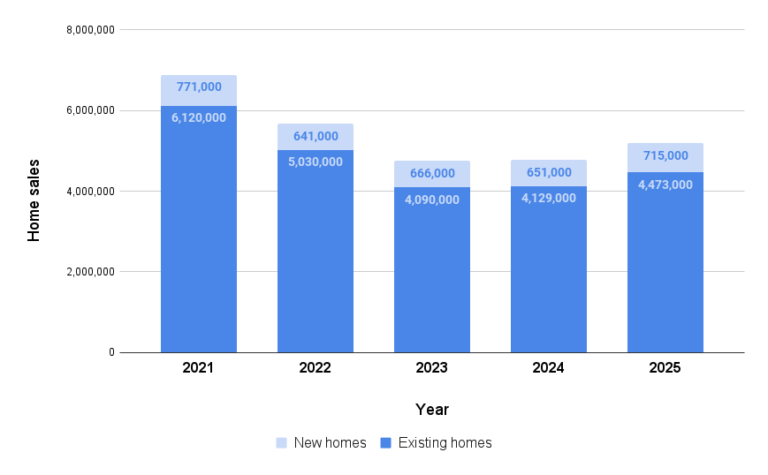
Source: Fannie Mae forecast, August 2024.
Fannie Mae economists now expect sales of new and existing homes will grow by just 0.5 percent this year, to 4.78 million, before surging by 8.5 percent in 2025 to 5.19 million.
That’s 27,000 fewer 2024 home sales than Fannie Mae had forecast in July, and 67,000 fewer 2025 home sales.
The pace of home sales — currently estimated at around 4.7 million a year, after adjusting for seasonal factors — is expected to rebound to 5.11 million next spring, and continue growing to 5.27 million in Q3 2025 and 5.43 million in Q4 2025.
Not only are mortgage rates expected to be lower by then, but national home price appreciation is slowing.
In July, Fannie Mae economists predicted national home price appreciation would cool to 6.1 percent by the end of this year and to 3 percent by Q4 2024. Prices could start to come down in Sunbelt markets where supply exceeds demand.
The Sunbelt had a “disproportionate in-migration wave following the pandemic” and saw a stronger construction boom in recent years, Fannie Mae economists noted in their latest forecast.
While the Sunbelt still has “comparatively less expensive homes than many Northeast and West Coast metros, the relative shift in affordability has been much more severe in recent years, so the normal pool of buyers are likely more stretched,” Fannie Mae economists said.
While inventories of for-sale listings are on the rise in Southern and Mountain West states, they’ve “hardly budged on average for the rest of the country,” Fannie Mae economists said.
Purchase lending forecast to grow by 15% in 2025
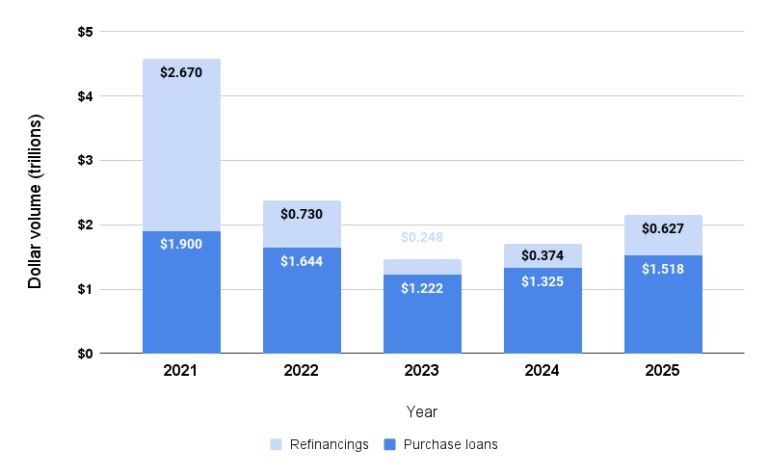
Source: Fannie Mae forecast, August 2024.
Elevated home prices are one reason Fannie Mae economists expect purchase loan volume to grow by 8 percent this year, to $1.325 trillion. But that’s $31 billion less than July’s forecast, “given the somewhat weaker projected path for home sales.”
Purchase lending is expected to grow by another 15 percent next year, to $1.518 trillion, if the pace of sales ticks up in the second half of the year.
While mortgage lenders are expected to see even stronger growth in refinancing, it would be from a comparatively low baseline of $248 billion established in 2023.
Fannie Mae economists expect refinancing volume to grow by 51 percent this year, to $374 billion, and by another 68 percent in 2025, to $627 billion.
Mortgage rates expected to drop below 6%
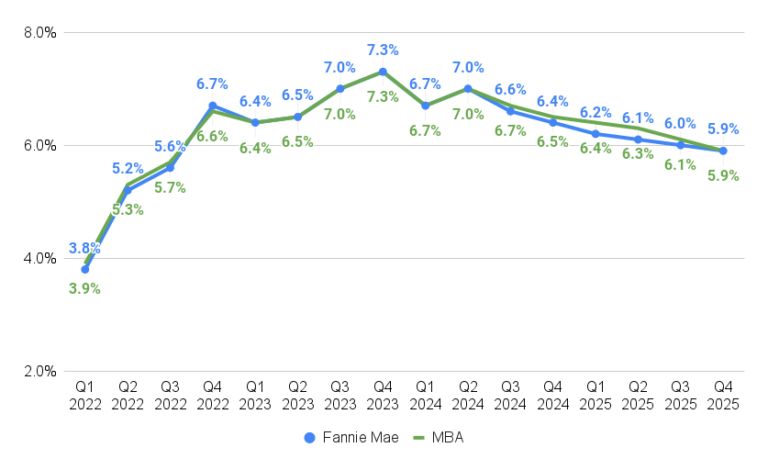
Source: Fannie Mae and Mortgage Bankers Association forecasts, August 2024.
Economists at Fannie Mae and the Mortgage Bankers Association are aligned in their view that the Federal Reserve is on the verge of launching a rate-cutting campaign that will help bring rates on 30-year fixed-rate mortgages below 6 percent by Q4 2025.
With “inflation continuing to decelerate and labor markets softening to at least some extent, a period of rate cuts going forward is expected, but the magnitude and speed of such cuts is highly conditional on incoming data,” Fannie Mae economists said.
Last month, Fannie Mae predicted rates on 30-year fixed-rate mortgages would average 6.7 percent in Q4 2024 and 6.2 percent during Q4 2025. The latest forecast sees mortgage rates averaging 6.4 percent in Q4 2024 and 5.9 percent in Q4 2025.
Economists at the mortgage giant noted that while they continue to expect a soft landing as inflation cools, interest rates remain volatile. If bond market investors who fund most mortgages conclude that the Fed has waited too long to cut rates and the economy is headed for a recession, mortgage rates could come down further and faster.
“The recent jump in the unemployment rate to 4.3 percent helped drive a growth scare and related volatility in equity markets,” Fannie Mae economists said. “More recent data appear to have soothed many market fears of quickly deteriorating economic activity, though long-term interest rates remain significantly lower than a month ago as of this writing.”
Get Inman’s Mortgage Brief Newsletter delivered right to your inbox. A weekly roundup of all the biggest news in the world of mortgages and closings delivered every Wednesday. Click here to subscribe.
Email Matt Carter


