by Mary Mancera | Aug 21, 2024 | Industry, News Feed
Title tech provider expects $85 million merger with Dallas, Texas-based title insurance underwriter Title Resources Group to close later this year.
Whether it’s refining your business model, mastering new technologies, or discovering strategies to capitalize on the next market surge, Inman Connect New York will prepare you to take bold steps forward. The Next Chapter is about to begin. Be part of it. Join us and thousands of real estate leaders Jan. 22-24, 2025.
In what could be the company’s final earnings report as a publicly traded company, title tech provider Doma said double-digit revenue growth helped it cut its adjusted loss in half during the second quarter.
With revenue up 18 percent from Q1 to $78 million and expenses rising 12 percent to $88.7 million, Doma’s operating loss from continuing operations dropped 16 percent, to $11 million.
TAKE THE INMAN INTEL INDEX SURVEY FOR AUGUST
Doma’s adjusted loss on the basis of earnings before interest, taxes, depreciation and amortization (EBITDA) totaled $3 million, down 50 percent from $6 million in Q1.

Max Simkoff
“We are pleased with the continued progress our team is making toward achieving our strategic goals,” Doma CEO Max Simkoff said in a statement.
Doma announced an agreement in March to go private through an $83 million merger with Dallas, Texas-based title insurance underwriter Title Resources Group (TRG). With the TRG deal expected to close this year, Doma did not hold an earnings call or provide forward guidance.
Founded in 2016, Doma set out to revolutionize the title insurance industry using a machine learning platform, Doma, to automate the title and escrow processes.
Initially focused on supporting mortgage refinancing, Doma saw much of that business evaporate as mortgage rates began climbing in 2022.
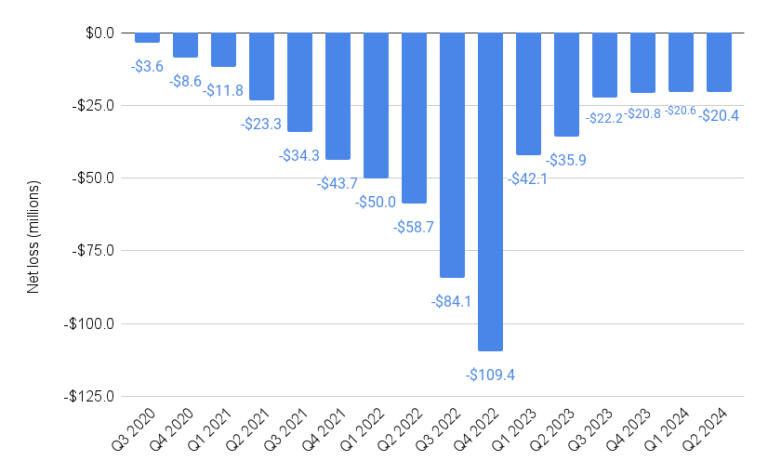
Doma raised less than anticipated when it went public in a 2021 merger with a special purpose acquisition company (SPAC) and has racked up $660 million in cumulative losses through June 30 as it pivoted to adapt its technology to enable “instant underwriting” of title insurance for purchase loans.
Doma finished the quarter with $73.1 million in cash and cash equivalents and restricted cash; $7.4 million in held-to-maturity debt securities; and $41.7 million in available-for-sale debt securities.
Using generally accepted accounting principles (GAAP), which includes interest on the company’s debt, Doma’s Q2 2024 net loss was $20.4 million, down from $20.6 million in Q1 and $35.9 million in Q2 2023.
Doma laid off more than 1,000 workers in 2022, and, after selling its retail title agency and operations centers and getting out of that business, employed 239 workers at the end of last year, or about 12 percent of its previous workforce.
Get Inman’s Mortgage Brief Newsletter delivered right to your inbox. A weekly roundup of all the biggest news in the world of mortgages and closings delivered every Wednesday. Click here to subscribe.
Email Matt Carter
by Jill Butler | Aug 21, 2024 | Industry, News Feed
Thumbtack for Real Estate is an agent-facing co-branded experience that lets licensed professionals deliver an intuitive workflow for task management, from moving company provisioning to room renovation.
Whether it’s refining your business model, mastering new technologies, or discovering strategies to capitalize on the next market surge, Inman Connect New York will prepare you to take bold steps forward. The Next Chapter is about to begin. Be part of it. Join us and thousands of real estate leaders Jan. 22-24, 2025.
Thumbtack, the company known for making homeownership easier, has launched a real estate-specific product to help consumers, through their agent, stay on top of the ever-increasing myriad of tasks required to buy and sell a home.
Available as of Aug. 20, Thumbtack for Real Estate is an agent-facing, co-branded experience that lets licensed professionals deliver an intuitive workflow for task management, from moving company provisioning to room renovation.
TAKE THE INMAN INTEL INDEX SURVEY FOR AUGUST
A service category already common in real estate and the proptech space, it can be argued that Thumbtack’s tenure in the house- and service-provider-management ecosystem lends particular credibility to what it can provide in the category. Many agents, for example, will use blogs, email campaigns or marketing materials as logistical resources for clients, forms of content that lack customization and connectivity, and especially personalization.
Thumbtack for Real Estate is delivered as a closing gift to the buyer, in one use case, along with a financial credit of the agent’s discretion.
“By delivering high-touch service at a moment when buyers and sellers need all the help they can get, real estate agents can close deals more efficiently, secure referrals and provide clients with peace of mind as they begin this new stage of their life,” the press release stated.
LiveEasy, CORE Home and Milestones are additional examples of home sale and property oversight solutions, each with its own set of tools and approaches to safeguarding the consumer against the hassles and hurdles of settling into a new home.
Thumbtack used the release to argue that agents need to do as much as possible to prove their value to clients, and the tools and tech with which they partner are part of that, to the extent that those tools can soften or shrink the process.
The mature mobile experience, heavily consumer-forward, is a compelling argument for Thumbtack. It quickly builds the user’s profile based on location, home type and transaction side, and from there curates a list covering the countless things needing to be done by the buyer or seller.
Nekst is another application that offers a similar, automated list-driven workflow system for agents and transaction coordinators, who can then deploy a client portal for ongoing transaction management and relocation insights.
Email Craig Rowe
by Jen Dillard | Aug 21, 2024 | Industry, News Feed
The average loan balance for first mortgages rose from $345,761 in the first quarter to $356,993 in the second, the Mortgage Bankers Association reported.
Whether it’s refining your business model, mastering new technologies, or discovering strategies to capitalize on the next market surge, Inman Connect New York will prepare you to take bold steps forward. The Next Chapter is about to begin. Be part of it. Join us and thousands of real estate leaders Jan. 22-24, 2025.
Independent mortgage banks notched a profit on loan originations in the second quarter for the first time in two years, the Mortgage Bankers Association reported this week.
After eight straight quarters of net losses on loans, IMBs reported earning a pre-tax profit of $693 per loan origination in the three months that ended June 30. That was up from a net loss of $645 per loan in the first quarter of the year.
TAKE THE INMAN INTEL INDEX SURVEY FOR AUGUST
“With a pickup in quarterly volume, productivity, and closings-to-applications pull-through, production costs dropped by about $1,800 per loan,” Marina Walsh, MBA’s vice president of industry analysis, said in a statement. “These developments contributed to better net results, even as production revenues decreased from the previous quarter.”
“Almost 80 percent of mortgage companies in the sample posted overall profits, including both production and servicing business lines,” Walsh said. “After two of the most challenging years in the mortgage business, many companies are seeing light at the end of the tunnel.”
Seventy-eight percent of the firms that reported production data in the quarter reported earning a pre-tax profit for both production and servicing, up from 59 percent in the first quarter.
Companies reported earning an average of $492 million in production volume on 1,503 loans in the quarter, up from $384 million on 1,193 loans to start the year.
The average loan balance for first mortgages rose from $345,761 in the first quarter to $356,993 in the second, the MBA reported.
Email Taylor Anderson
by Rachael Hite | Aug 21, 2024 | Industry, News Feed
Whether it’s refining your business model, mastering new technologies, or discovering strategies to capitalize on the next market surge, Inman Connect New York will prepare you to take bold steps forward. The Next Chapter is about to begin. Be part of it. Join us and thousands of real estate leaders Jan. 22-24, 2025.
Cardone Capital CEO Grant Cardone slammed Vice President Kamala Harris’ housing policies in two Fox Business interviews over the past week, calling the Democratic presidential nominee “financially illiterate” for proposing $25,000 in down payment assistance for first-generation homebuyers and a $10,000 tax credit for first-time homebuyers.
“[Vice President] Kamala Harris is either financially illiterate, or she believes her audience is,” Cardone said during an interview on Monday, the first day of the Democratic National Convention. “This is called come-on marketing. The $25,000 credit is a come-on; it will not happen. The $6,000 child credit requires you to have two kids in the same year, that’s a come-on.”
TAKE THE INMAN INTEL INDEX SURVEY FOR AUGUST
[Editor’s note: Harris’ proposed change to the Child Tax Credit does not require households to have two children in the same year; parents will get the $6,000 credit for the year their child is born. The current CTC is $2,000 per child.]
“It’s typically used as a bait-and-switch, some kind of offer that exaggerates, that has hidden costs, exaggerated claims,” he added. “And she is, Kamala Harris is the come-on queen now, that should be her new title. What’s required for a first-time homeowner? I know you told our producers earlier that it takes a lot more than $25,000.”
Cardone said the typical homebuyer’s down payment is $35,000 — $10,000 short of what Harris is proposing. Once rising home insurance, homeowners association and property tax costs are figured in, he said, Harris’ down payment assistance program will barely make a dent in the pockets of homebuyers. He also noted homebuilders are already giving sizeable credits to homebuyers, making government assistance unnecessary.
“Yeah, look, $25,000 credits are already being delivered by builders, by the way,” he said. “So the government doesn’t need to do this; the builder is willing to do it today.”
In another interview with Fox reporter Maria Bartiromo on “Mornings with Maria,” Cardone criticized Harris’ housing and economic policies, saying that her plan to increase corporate taxes and taxes for high-wealth Americans will tank the markets in Democratic-led states.
“Well, all we know is that she will continue to do what she’s done her entire career, which is more regulations, higher taxes, and allow property owners to be coalesced with a new property, and those that use the property continue to have more and more flexibility with whether they pay their rent or not,” he said.
Cardone predicted corporations and high-wealth Americans would run to Texas, Florida and other tax-friendly, Republican-led states if Harris is elected.
“If you go to Florida or Texas, those are going to be beneficiaries of a Harris win. If she wins, they will be massive beneficiaries,” he said. “Arizona, Florida, for sure Texas [and] the Carolinas will be beneficiaries because they protect the property owner.”
“If Donald Trump wins, it will be a beneficiary,” he added. “Everybody that owns property around the country will benefit because he’ll loosen the regulations, lower the taxes, and put some predictability in there for property owners.”
Housing policies have taken center stage at Harris and Trump’s latest round of campaign and rally appearances. In a recent National Association of Home Builders survey, 77 percent of respondents said the U.S. is in the midst of a worsening affordability crisis. Eighty percent of respondents said their local officials need to do more to fix the issue, while 51 percent said the federal government needs to enact more national-level housing affordability measures.
TAKE THE INMAN INTEL INDEX SURVEY FOR AUGUST
Inman published an explainer on Harris, Trump and Robert F. Kennedy Jr.’s housing policies, which includes information on Harris’ $25,000 down payment assistance plan and $40 billion innovation fund, Trump’s vision of building freedom cities and relocating unhoused Americans into tent cities, and RFK Jr.’s plan to restrict institutional homebuyers and offer 3 percent mortgage rates through government-backed bonds.
Election years often yield increased conversations from voters about moving to another country or a state that aligns with their political leanings, and Redfin’s latest election-focused research shows 2024 will be no different.
California lost a net 341,866 residents to other states in 2022, with a sizeable chunk deciding to relocate to Nevada (48,836) and Arizona (74,157). Since that migration wave, Nevada and Arizona, have seen the number of registered Independents and Republicans rise. On the other hand, increased migration from Washington, D.C., and New York likely flipped Georgia blue in 2020.
“Four years ago, the pandemic supercharged a trend that has reshaped the national housing market: People have been leaving expensive, coastal, liberal places like New York and California for affordable, inland, politically moderate places like Arizona and Nevada,” Redfin Senior Economist Elijah de la Campa said.
“While a lot of people were simply moving to where they could afford a home, some sought a place where they fit in better politically. While this self-sorting can help explain the voter registration trends, it’s more likely that a lot of Arizonans and Nevadans have been feeling very disillusioned by their political choices.”
Email Marian McPherson
by Josh Ries | Aug 21, 2024 | Industry, News Feed
Whether it’s refining your business model, mastering new technologies, or discovering strategies to capitalize on the next market surge, Inman Connect New York will prepare you to take bold steps forward. The Next Chapter is about to begin. Be part of it. Join us and thousands of real estate leaders Jan. 22-24, 2025.
Law firms for homeseller plaintiffs who sued real estate industry companies and the National Association of Realtors spent 105,000 hours over five years battling high-profile defense attorneys and are now entitled to recoup payments, according to a new filing in a case known as Gibson.
Lawyers representing homeseller plaintiffs seek one-third of the $110.6 million raised from the proposed settlements of nine of the biggest real estate firms in the country — or $36.87 million, plus about $200,000 in remaining expenses that haven’t already been recovered, according to paperwork filed Tuesday.
TAKE THE INMAN INTEL INDEX SURVEY FOR AUGUST
The plaintiffs had previously said they agreed to the amount, and trial lawyers have signaled they will seek it from $987.1 million recovered so far in real estate antitrust cases. The filing provided an in-depth look at the potential payday for the trial attorneys who spent half a decade challenging the real estate industry over business practices that plaintiffs said amounted to an illegal conspiracy to inflate broker commission rates paid by homesellers.
“Class Counsel are a diverse group of well-respected antitrust, complex litigation, and trial lawyers who spearheaded the litigation,” the attorneys wrote in the filing. “In doing so, Class Counsel were not able to rely on any governmental prosecutions or on preexisting litigation by other private attorneys.”
“These Settlements are the independent product of their wholly contingent, risky, costly, and time-intensive work seeking a recovery against Defendants, not the work of anyone else,” they wrote.
The payment is only for the court case known as Gibson, which was combined in April with another case called Umpa. It is separate from the total amount recovered through other litigation, including cases known as Sitzer | Burnett and Moehrl. Gibson was filed in a court in Missouri just minutes after the jury in Sitzer | Burnett, issued its verdict against the real estate defendants, including the National Association of Realtors.
In total, real estate defendants have proposed at least $987.1 million in monetary relief to settle the litigation. The trial attorneys will seek to recover one-third of the entire settlement amount, or about $329 million, plus expenses, according to the filing.
The filing claims attorneys spent more than 105,000 hours and paid over $13 million in out-of-pocket costs “without any guarantee of success” while arguing the handful of lawsuits.
“Class Counsel faced substantial risk representing the Settlement Class,” the filing says, later adding that attorneys “faced off against well-funded and entrenched opponents represented by at least thirty of the most high-profile defense firms in the country.”
The defendants who have settled in Gibson are:
- Compass: $57.5 million
- The Real Brokerage: $9.25 million
- Realty ONE Group: $5 million
- At World Properties: $6.5 million
- Douglas Elliman: $7.75 million
- Redfin: $9.25 million
- Engel & Volkers: $6.9 million
- HomeSmart Holdings: $4.7 million
- United Real Estate: $3.75 million
To prevail in the lawsuit, plaintiff attorneys reviewed millions of pages of documents, retained 20 experts and consultants and conducted about 180 depositions in the lawsuits, they said.There were more than 2,400 docket entries in the four cases related to Gibson.
“Prior to filing these actions, class counsel undertook significant research into the Settling Defendants, their participation in NAR, their enforcement of the Mandatory Offer of Compensation Rule, and their market share and presence,” the attorneys wrote.
The attorneys said in their filing that the Eighth Circuit has previously found that attorneys fees between 25 percent and 36 percent are appropriate for class action lawsuits.
The attorneys said that the amount of work they put into the cases was worth even more than the amount they’re looking to recoup, saying their “lodestar” was closer to $90.8 million. They said they also passed up work that was less risky while prosecuting the cases.
They’re also asking for $13.1 million in expenses they said they incurred for all of the settlements, of which $12.9 million has already been awarded by the court in the Sitzer | Burnett case. Approximately $200,000 in remaining expenses will be recouped by the law firms below:
- Ketchmark and McCreight
- Williams Dirks Dameron
- Cohen Milstein Sellers & Toll
- Hagens Berman Sobol Shapiro
- Susman Godfrey
“The Settlements are more than a large financial recovery for the class,” attorney Eric Dirks wrote. “The practice change relief set out in the Settlements is a substantial victory for class members and, in my opinion, will ultimately result in cost savings for future home sellers.”
The practice changes included a requirement that buyer agents obtain a signed contract before touring homes with clients. The contract must spell out the compensation the buyer broker intends to charge for their services. Offers of compensation were also removed from multiple listing services as part of the changes. Sellers can still choose to pay buyer broker fees.
Partners at Dirks’ law firm earn an hourly rate of $1,250. Paralegals earn $300 per hour. Associates, one of whom spent over 2,000 hours working on the cases, earn $600 per hour, according to the filing.
Lead plaintiffs’ attorney Michael Ketchmark’s rate is higher. In a filing outlining his firm’s costs and expenses, Ketchmark wrote that he spent just under 7,000 hours on all of the cases. At a rate of $1,450 per hour, his total time spent is valued at $10.1 million.
Ketchmark’s rate isn’t the highest among the attorneys involved in the case. That title belongs to Marc Seltzer of Susman Godfrey, whose hourly rate is $2,200.
The court has yet to approve the proposed settlements involved in the Gibson case. The final approval hearing for the Gibson settlements is Oct. 31.
Email Taylor Anderson
by Darryl Davis | Aug 21, 2024 | Industry, News Feed
The numbers suggest that the labor market cooled off much faster than was previously thought and is not in as strong a position as believed. The Federal Reserve now also has a case to make a bigger cut in interest rates than initially anticipated come September.
Whether it’s refining your business model, mastering new technologies, or discovering strategies to capitalize on the next market surge, Inman Connect New York will prepare you to take bold steps forward. The Next Chapter is about to begin. Be part of it. Join us and thousands of real estate leaders Jan. 22-24, 2025.
As predicted by Wall Street analysts, the U.S. Bureau of Labor Statistics (BLS) significantly revised job growth figures downward on Wednesday in its preliminary benchmark revisions, which showed that from Spring 2023 to Spring 2024, 818,000 fewer jobs were created than initially estimated.
The numbers suggest that the labor market cooled off much faster than was previously believed, and is not in as strong a current position. The Federal Reserve now also has a case for making a bigger cut in interest rates than initially anticipated come September.
TAKE THE INMAN INTEL INDEX SURVEY FOR AUGUST
Previously, the U.S. reported the creation of 2.9 million jobs from Spring 2023 to Spring 2024. That figure was revised downward by about 30 percent to about 2.08 million, or roughly 173,500 jobs per month.
The -0.5 percent revision of total payrolls is the largest seen since 2009.
Still, the revision is not as severe as some analysts had anticipated — economists on Wall Street estimated a reduction of anywhere from 360,000 to 1 million jobs.
The largest downward revision was in professional and business services, where job growth was 358,000 less than previously reported. Leisure and hospitality saw a decline of 150,000, manufacturing a decline of 115,000, and trade, transportation and utilities a decline of 104,000.
Some sectors actually saw upward revisions, including private education and health services (87,000), transportation and warehousing (56,400) and other services (21,000).
In some years, the BLS’s revisions have shown movement in the opposite direction of what economists predicted.
The revisions are calculated from a survey conducted four times per year that polls all U.S. companies that participate in the state-federal system for providing unemployment benefits to those workers who lose their jobs. Those companies must provide staff numbers for tax purposes, which also helps the Bureau of Labor Statistics more accurately measure how many jobs are being created.
Results of the first three quarters of the survey suggested that job growth was overestimated by about 735,000, or roughly 82,000 jobs per month during the 12 months that ended March 2024.
In addition to its quarterly survey of businesses, the government takes into account additional factors that can sometimes throw off Wall Street estimates.
One such factor includes the number of new businesses that are created each year versus those that shut down.
“If new firms are being created faster or slower or if existing firms are closing faster or slower than the BLS assumes, then the true employment picture can differ from the monthly estimates,” Stephen Stanley, chief economist of Santander Capital Markets, told Market Watch.
Immigration is another factor that can impact job growth figures. The surge in immigrants coming into the U.S. in recent years has been huge, but that labor force is often difficult for the government to precisely measure.
Therefore, predicting which way revisions will go isn’t always as clear as it may seem. During the 12 months that ended in March 2021, for instance, economists predicted that employment gains would be lowered by 270,000 during the government’s benchmarking process. However, job gains were actually raised by 374,000 during that period.
The revisions announced on Wednesday will not be made official until early 2025.
Email Lillian Dickerson