by Craig C. Rowe | Apr 14, 2025 | Industry, News Feed
Ben Bacal and Harry Dheedene have launched Rila Auctions, an off-shoot of social media app Rila, designed to help agents market homes in an Instagram-like video-search environment.
Bigger. Better. Bolder. Inman Connect is heading to San Diego. Join thousands of real estate pros, connect with the power of the Inman Community, and gain insights from hundreds of leading minds shaping the industry. If you’re ready to grow your business and invest in yourself, this is where you need to be. Go BIG in San Diego!
A new auction brokerage called Rila Auctions has launched in southern California, promising to create “urgency and competition through transparent bidding, ensuring homes reach peak market value while giving buyers of all budgets equal access to compete,” Inman learned exclusively in an April 14 statement.
The company was founded by Ben Bacal of Revel Real Estate and broker of record Harry Dheedene.
Rila states its goal is to change the way the industry works in the auction environment by focusing on transparency and technology. It can close in under six weeks, according to the statement, and is designed to be agent-friendly, offer competitive fees and remove uncertainty in an opaque market.
“After working with several auction platforms, I realized there was an opportunity to create a smarter, more transparent solution that puts agents and sellers first,” said Bacal in the release. “Rila Auctions offers the efficiency, clarity, and competitive edge the modern market demands — with a flat-fee structure and full-service support that agents can trust.”
Bacal and Dheedene also founded the social media app Rila to help agents market homes in an Instagram-like video-search environment. A Bel Air home will be the first property marketed on Rila Auctions, a four-bedroom, four-bathroom house launching at $4.6 million. It is being brought to the platform by Enzo Fiore of Revel Real Estate, who is co-listing with Dheedene.
Bacal said his platform will pay buyer agents and is “the future of real estate” in a video announcement shared with Inman. “Buyers know exactly where they stand with an auction and sellers know that their properties are attracting maximum interest,” he said. “I firmly believe this avenue of selling real estate is going to revolutionize the way we sell properties.”
Rila Auctions isn’t alone in the space. Final Offer is a technology-forward competitor while Concierge Auctions, backed by Sotheby’s and Anywhere Real Estate, is more traditional in its service delivery.
“Final Offer gives buyers an elegant search experience, a UI that lists all activity on a home, alerts agents and even interested buyers to changes and new offers, and plainly lists what it’ll take to meet the seller’s terms, as well as offering calendar views of all activity and a history of homes sold on the platform,” Inman’s review stated.
The intent of auction-based sales is to surface competitive offers instead of hiding them behind traditional practices. For example, listing agents are often reticent about sharing exact terms of each offer when there is competition over a listing, a practice that is generally explained with “It’s always been done that way.”
In a transparent auction experience, buyers are often encouraged to increase an offer when able to clearly see what other buyers are submitting, such as price, earnest money, financing and other contingencies.
If a listing agent’s most important job is to get as much value as possible out of a property for its seller, then there is little argument against an auction format. However, the model hasn’t gained any notable traction, despite a number of opportunities for greater adoption over the years. It seems to be often sold as an either-or instead of as a marketing supplement to a standard listing. One hangup is the need to obtain an auction license per each state’s regulations, which takes time and money.
Rila Auctions, in conjunction with others, could provide the spark the format needs to catch the attention of sellers. Its founders’ collective experience and industry presence could help.
Email Craig Rowe
This post was originally published on this site
by Marian McPherson | Apr 14, 2025 | Industry, News Feed
Bigger. Better. Bolder. Inman Connect is heading to San Diego. Join thousands of real estate pros, connect with the Inman Community and gain insights from hundreds of leading minds shaping the industry. If you’re ready to grow your business and invest in yourself, this is where you need to be. Go BIG in San Diego!
As the debate over the National Association of Realtors’ Clear Cooperation Policy takes a new turn, an industry watchdog has now called on the U.S. Department of Justice to investigate private listing networks.
Stephen Brobeck, a senior fellow at the Consumer Policy Center, penned a blog post on Monday lauding Zillow for refusing to display listings that aren’t added to the multiple listing service (MLS) within 24 hours of being publicly marketed. Zillow said public marketing includes yard signs, social media posts and brokerage private listing networks.
The ban, which goes into effect in May on Zillow and Trulia, does not apply to delayed marketing exempt listings as long as they’re submitted to a Multiple Listing Service (MLS) within one day and published on Zillow and other sites that receive listing feeds.
Hours after the blog post went live, Redfin joined Zillow in banning listings that have been publicly marketed before “being shared with all real estate websites via the MLS.” Redfin CEO Glenn Kelman also called on MLS leaders to adopt a “coming-soon” designation that would conceal Days on Market and historical price points data to alleviate homesellers’ concerns about placing their homes on the MLS.

Steve Brobeck
“We encourage all brokers to support Zillow’s efforts to maintain the transparency of real estate markets and prevent their balkanization,” he said. “The efforts of some big brokers are likely to not only disadvantage buyers and sellers but also reduce competition. The U.S. Department of Justice should take a close look at potential antitrust violations by those brokers who use deceptive practices to try to dominate markets.”
Brobeck, alongside CPC fellow Wendy Gilch, argued that private listing networks are anti-competitive and disadvantage most homesellers, homebuyers and small brokerages without connections to larger brokerages with these networks. Brobeck and Glich said private listing networks prevent homesellers from getting the maximum offer for their home and minimize homebuyers’ choices as they’re unable to access all available listings in the market.
The lack of transparency, the duo said, will enable brokers with private listing networks to boost commissions by “double-ending” a greater share of sales, have an unfair recruiting advantage in attracting the best agents, and have more influence over the market, industry associations, and state regulators. Brobeck and Glich said Compass is the perfect example of what they fear the market will look like if the DOJ doesn’t step in.
Compass co-founder and CEO Robert Reffkin has been one of the CCP’s biggest opponents, arguing that the policy prevents listing agents from meeting their fiduciary duty to clients who don’t want their homes on the MLS. Reffkin lobbied to have the rule fully repealed; however, he was pleased with NAR’s decision to add the delayed marketing exemption alongside a longstanding office exclusive exemption.
Reffkin said the new exemption, which allows MLSs to determine how long listings can be seen by other MLS participants without being publicly listed, was “a small step in the right direction” to “expand consumer choice.”
In the weeks since the exemption announcement, Compass has doubled down on advertising its private listing network, which includes nearly 10,000 private exclusive and coming-soon listings. Luxury stalwarts Douglas Elliman and Corcoran rolled out private listing networks on April 8, and Redfin, despite disagreeing with the practice, said it will become more “aggressive about pocketing listings” if the industry continues its push toward off-market options.

Wendy Gilch
“It will be both predictable and telling to watch brokerage CEOs who denounce private exclusives today quietly adopt them tomorrow,” Reffkin said on LinkedIn several weeks ago. “The same leaders insisting these strategies are harmful to sellers will, within a year, be packaging and promoting their own ‘exclusive off-market solutions.’ It’s not a question of if — it’s a question of when. Consumer demand drives industry evolution…”
While Gilch and Brobeck said off-market sales are necessary in limited circumstances, the duo said they offer little value to the typical homseller. That’s why, Gilch said, homesellers should “think twice” before selling their home through a private listing network.
“Sellers will attract the most buyer interest when their home is visible across as many major real estate websites as possible — some, like Zillow, draw over a billion visits a year, far surpassing any other platform in reach,” she said. “And buyers should be skeptical of private listers who try to sign buyers to contracts by claiming to have access to off-market properties.”
While Brobeck and Gilch call on the DOJ to quash private listing networks, CoStar founder and CEO Andy Florance is hoping the DOJ will force Zillow to drop its ban.
Florance said Zillow’s ban is “anti-competitive” and “a pure power play of epic proportion.” The ban, he surmised, is a reflection of the behemoth’s fears that agents will lean into private listing networks and abandon Zillow’s platform. He urged agents to report Zillow to the DOJ’s antitrust division while reminding agents they “deserve control” over how to market clients’ listings.
“Zillow has overplayed its hand. I believe they panicked at the thought that agents might have real choice in how they market their listings.
And when agents have a choice, many won’t rush to publish listings
on a site that siphons off their leads,” he said in an op-ed on Monday. “Even if just a few agents hold back from listing on Zillow, buyers will quickly follow suit — and stop searching there. Zillow’s lead diversion business model is coming under threat.”
Reffkin sided with Florance on social media, saying, “Andy and Homes.com support agents. So, I support Andy and Homes.com.”
It’s unclear whether the DOJ will answer either side’s clarion call, as the department hinted that it’s less interested in CCP now that NAR has scrapped the Participation Rule.
In a Supplemental Statement of Interest filed in the class-action commission lawsuit Nosalek v. MLS PIN on March 18, the DOJ signaled that Clear Cooperation — on its own — is not anticompetitive. However, in situations where non-NAR governed MLSs, like MLS PIN, enforce CCP while still allowing cooperative compensation, the DOJ might look at CCP with more scrutiny.
“Of note, industry participants have made public statements about the Division’s purported position on Clear Cooperation policies that are misleading and out of context,” the DOJ filing said, according to a previous Inman article. “The Division has not taken a position that such policies standing alone (i.e., without mandated MLS publication of offers of compensation or exceptions benefitting primarily large brokerages) are anticompetitive.”

Ed Zorn
California Regional MLS VP and General Counsel Ed Zorn told Inman on Friday that Zillow’s policy was likely safe from DOJ scrutiny.
“Zillow is an independent company with their own board of directors, right? Their board of directors is not made up entirely of horizontal competitors like an MLS or an association board,” he said.
“So, they don’t have that automatic challenge that any action taken by an association or an MLS instantaneously is a decision of horizontal competitors, right? It’s [the] chairs on our board of directors that make decisions. I don’t see how that’s relevant to an independent company like Zillow deciding what they want to do for the benefit of their business. I don’t see any kind of anti-trust or DOJ type of issue.”
As for private listing networks, the outcome might not be as favorable. Despite the DOJ’s comments in the Nosalek lawsuit, Brobeck said he believes the addition of the delayed marketing exemption will attract the department’s ire.
“I think that DOJ will be particularly concerned about the anti-competitive implications of extensive private listings by some of the big national brokerages,” Brobeck told Inman on a phone call. “Those listings would deprive small and local firms of important information about available properties, and would lead, over time, to increasing dominance by the large firms. I think that the DOJ will be particularly concerned about that.”
“I don’t have evidence they’re looking at it, but I’m sure they are,” he added. “We sent them our news release, and they thanked us. But, you know, the DOJ doesn’t tell anybody what they’re thinking or what they’re going to do until they actually do it.”
Email Marian McPherson
This post was originally published on this site
by Matt Carter | Apr 14, 2025 | Industry, News Feed
Investors bid up mortgage lender’s share price by 21 percent as company says deal with investor investor SB Northstar LP will improve its balance sheet and better position it for growth and a return to profitability.
Bigger. Better. Bolder. Inman Connect is heading to San Diego. Join thousands of real estate pros, connect with the Inman Community and gain insights from hundreds of leading minds shaping the industry. If you’re ready to grow your business and invest in yourself, this is where you need to be. Go BIG in San Diego!
Investors in tech-driven mortgage lender Better Home & Finance are cheering its plans to restructure more than half a billion dollars in debt, which the company said Monday will improve its balance sheet and position the company to grow and return to profitability.
Better will retire $534 million in convertible notes held by investor SB Northstar LP in exchange for $110 million in cash and $155 million in new notes at a 6 percent interest rate due in 2028. The notes that are being retired carried a 1 percent rate and were due in 2028.

Vishal Garg
“This transaction will create approximately $265 million of positive pre-tax equity value for the company and its shareholders, as well as create a path to long-term value creation for our equity holders,” Better CEO Vishal Garg said in a statement. “We continue to invest in building the leading AI platform in the mortgage industry, and fulfilling our mission of making homeownership cheaper, faster and easier, and just plain better for all Americans.”
Shares in Better, which in the last 12 months have changed hands for as much as $30 and as little as $7.71, initially jumped 27 percent Monday on news of the debt restructuring, which is expected to close by April 28. After briefly climbing above $13 from Friday’s close of $10.28, shares in Better gave up some of those gains but closed up 21 percent at $12.40.
Better’s board of directors in January approved a $25 million share repurchase program, a strategy that often signals company executives think their shares are undervalued.
Better, which did a booming business in refinancing during the pandemic when mortgage rates hit historic lows, struggled when interest rates rebounded and has racked up $1.9 billion in losses since its inception.
The New York-based lender inched toward profitability in 2024 as growth in home equity and refinancing helped the company grow funded loan volume for the first time in three years even as it slashed expenses.
Better finished 2024 with 1,250 employees — down 88 percent team from a Q4 2021 peak of 10,400 — but claimed its adoption of AI will fuel more profitable growth, with loan fulfillment costs that are 35 percent lower than the industry average of $9,000 per loan.
Revenue, expenses, earnings moving in right direction
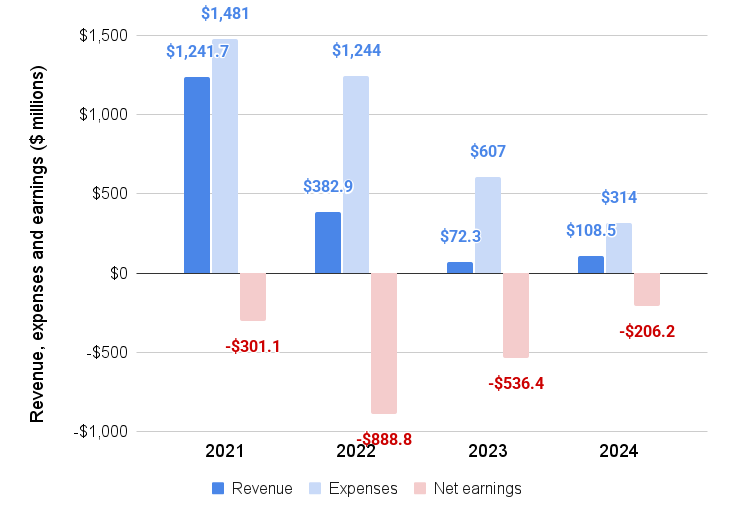
Source: Better Home & Finance Holding Company earnings reports.
Better’s automated “One Day Mortgage” product represented 73 percent of all direct-to-consumer lending in Q4, helping the company achieve loan fulfillment costs it says are 35 percent lower than the industry average of $9,000 per loan.
While Better racked up a $206 million 2024 net loss, that was an improvement from $536 million in 2023 and $888.8 million in 2022.
Purchase mortgage lending accounted for nearly 74 percent of Better’s business last year, even though business from homebuyers was down 3 percent year from 2023, to $2.65 billion.
At $479 million, 2024 home equity funding volume was up 86 percent from a year ago, while refinancing volume grew by 56 percent, to $463 million.
But Better is losing one of its biggest partners this year, Detroit-based Ally Financial Inc., which announced in January that it was laying off hundreds of employees and getting out of the mortgage business.
Ally originated $1 billion in mortgages in 2023 through its partnership with Better and is also an investor in the company, which went public in a 2023 special purpose acquisition company (SPAC) merger.
While Better once relied on its business-to-business (B2B) partnerships for nearly half of its business, the partner channel accounted for only 19 percent of Q4 2024 loan volume.
Better executives have said they plan to grow the company’s partner channel by offering its technology through co-branded or white-label solutions.
In November, Better announced a partnership with NEO Home Loans to use Better’s Tinman technology stack to power local loan officers.
Better hired NEO Home Loans executives Ryan Grant and Danny Horanyi to lead the “NEO Powered by Better” partnership and build out a distributed retail channel.
Get Inman’s Mortgage Brief Newsletter delivered right to your inbox. A weekly roundup of all the biggest news in the world of mortgages and closings delivered every Wednesday. Click here to subscribe.
Email Matt Carter
This post was originally published on this site
by Taylor Anderson | Apr 14, 2025 | Industry, News Feed
CEO Glenn Kelman on Monday also called on MLSs to create a “coming-soon” designation for listings that would conceal Days on Market and historical pricing data from consumers.
Bigger. Better. Bolder. Inman Connect is heading to San Diego. Join thousands of real estate pros, connect with the Inman Community and gain insights from hundreds of leading minds shaping the industry. If you’re ready to grow your business and invest in yourself, this is where you need to be. Go BIG in San Diego.
Days after Zillow rocked the real estate industry with changes to its rules on private listings, Redfin followed suit with a ban on listings that don’t begin on a multiple listing service, CEO Glenn Kelman said in a statement Monday.
The two-paragraph announcement, which also calls on multiple listing services to create a “coming-soon” designation for listings that would conceal Days on Market and historical pricing data from consumers, is the latest twist to come as a result of an adjustment to NAR’s Clear Cooperation Policy last month.
“Because we believe that all buyers should be able to see all listings, Redfin.com will not publish any listings that have been publicly marketed before being shared with all real estate websites via the MLS,” Kelman said in the statement. “To encourage home-sellers to market their listings via the MLS, Redfin is also asking MLSs to create a coming-soon designation for listings that precludes search sites from showing how long a home has been for sale and at what prices.”
Last month, NAR announced it would keep in place its Clear Cooperation Policy, which requires agents to put a listing onto an MLS within one business day of publicly marketing the property.
But it also created an exemption and new category of listings called “delayed marketing exempt listings,” which would allow sellers to have their listing agent delay putting a listing on the Internet Data Exchange (IDX) for a set period of time that would be determined by each multiple listing service.
In response, Zillow announced last week it would prohibit listings that are marketed privately for longer than a day. Listings that aren’t shared with an MLS within 24 hours of being marketed would be banned “for the life of the listing,” according to Zillow’s policy.
The change came in response to an ongoing push by major brokerages to create their own private listing networks.
Redfin said that it was fair to say its policy update, which it would implement after working through technical details over the coming months, was similar to Zillow’s and would apply to the life of the listing.
Other brokerages moved to align themselves in favor or against Zillow’s new policy. EXp and NextHome announced they supported the decision. Compass, @properties and others said they were opposed. Some opponents suggested Zillow was attempting to preserve its pipeline of leads that it generates through its platforms and sells to agents.
Kelman said Redfin, which is set to be acquired by Rocket Holdings, would advocate MLSs to create a new designation indicating a home is coming soon to the market.
“Other brokers have supported the idea of coming-soon listings, but with access limited to agents, and potentially only to their own agents,” Kelman said in a continuation of his statement. “This violates the principle established in the last great real-estate anti-trust battle, settled in 2008, that all brokerage customers should be able to see all MLS listings, online or via an agent. And that principle exists for a reason: once brokers give our clients control over how their listing appears online, every client will want that listing to appear everywhere.”
Homes.com so far has sought to distinguish itself from Zillow and Redfin’s policies, with CoStar CEO Andy Florance saying in a post over the weekend that Zillow’s policy update was “incredible move of audacity and a pure power play of epic proportion.”
“Rest assured, if Zillow does block your listing, it will still be seen on Homes.com and the other sites,” Florance wrote.
Email Taylor Anderson
This post was originally published on this site
by Jonathan Pressman | Apr 14, 2025 | Industry, News Feed
Jonathan Pressman offers real-world examples of the way buyer love letters can violate fair housing, along with fixes to help your clients write right.
Bigger. Better. Bolder. Inman Connect is heading to San Diego. Join thousands of real estate pros, connect with the power of the Inman Community, and gain insights from hundreds of leading minds shaping the industry. If you’re ready to grow your business and invest in yourself, this is where you need to be. Go BIG in San Diego!
Love ‘em or hate ‘em, buyer love letters are still a thing, especially in competitive housing markets. While many people believe love letters give buyers an edge, they could put you at risk of inadvertently violating the Fair Housing Act.
The Fair Housing Act prohibits discrimination against seven protected classes: race, color, religion, sex, national origin, familial status, and disability. So how might a buyer love letter violate the Fair Housing Act? Here are three everyday examples:
Violation No. 1: Familial status
Writing something like, “This is the perfect place to raise our family,” or worse, a buyer including a photo of their family in a love letter, could result in potential discrimination that violates the Fair Housing Act. Sellers should evaluate offers based on terms, and are prohibited from choosing a buyer because they’re married, single, have children or are expecting a child.
If a seller decides to research potential buyers and make a decision that’s influenced by the buyer’s familial status, that’s on the seller and their agent. But as the buyer’s agent, you can make sure your clients don’t make the mistake of revealing any details about their familial status before closing.
Violation No. 2: Religion
For many buyers, proximity to houses of worship is a key consideration. A buyer might think it’s OK to share that they love the house because it’s close to their church, mosque or synagogue; however, divulging their religion might cause the seller to accept or decline their offer on the basis of that affiliation, which would constitute a violation of the Fair Housing Act.
Violation No. 3: National origin
A buyer might share how much they appreciate the local cuisine or cultural offerings in a certain area, but if they mention their own national origin along the way, it could lead to discrimination on the basis of national origin.
For example, let’s say a buyer writes a letter to the seller that highlights how much they want to be near Chinatown, since it reminds them of their hometown. They talk about how they’d like to enjoy the Chinese restaurants and speak their native language with neighbors and local business owners.
If the seller uses that information to determine which offer to choose — whether it benefits the buyer or not — they’d violate the Fair Housing Act in the process.
The fix: What to do instead
Fix No. 1: Avoid buyer love letters altogether
For some buyer agents, the easiest way to avoid liabilities from buyer love letters is to advise clients not to write them at all. Though they might offer some benefits, the risks could outweigh any potential reward, which has led many Realtor associations to discourage buyer love letters altogether.
The State of Oregon took an even stronger position against love letters in July 2021 when it passed a law banning them to prevent seller discrimination. (The law was later blocked by a federal judge, who deemed it unconstitutional.)
Fix No. 2: Educate buyers and encourage them to focus on objective facts
If your buyers are determined to write a love letter, you can help by educating them about fair housing laws and encouraging them to stick to objective facts about the home and the neighborhood.
If a buyer is excited about raising their children somewhere, they can talk about how much they love the spacious yard, local parks and highly rated school district (without ever mentioning kids).
Suppose a buyer with a physical disability is interested in a ranch house with accessible bathrooms. In that case, they don’t have to mention their disability and can instead share how much they like the home’s layout.
Jonathan Pressman is a Realtor who writes on a wide range of financial topics. Connect with him on LinkedIn and Instagram.
This post was originally published on this site
by Christy Murdock | Apr 14, 2025 | Industry, News Feed
Learn how New York City agent Jennifer Roberts navigates the ups, downs and indecisions of real estate clients while keeping her cool.
Bigger. Better. Bolder. Inman Connect is heading to San Diego. Join thousands of real estate pros, connect with the power of the Inman Community, and gain insights from hundreds of leading minds shaping the industry. If you’re ready to grow your business and invest in yourself, this is where you need to be. Go BIG in San Diego!
With nearly 40 years of experience in New York City’s residential real estate market, Jennifer Roberts knows a thing or two about navigating the unexpected and keeping pace with “the city that never sleeps.”
“I am a daily listmaker,” Roberts said, “which serves me well in not wasting time and accelerates accomplishing what I need to do.”
An avid reader and architecture aficionado who has taken many walking tours of NYC, Roberts leaves no stone unturned in serving her clients. Find out how she fell in love with real estate and what she’s learned from the ups and downs of her market.
Name: Jennifer Roberts
Title: Licensed associate real estate broker
Experience: 39 years in the industry
Location: New York City
Brokerage name: Coldwell Banker Warburg
Sales volume: Over $550 million
1. What’s one big lesson you’ve learned in real estate?
I’ve been a real estate agent now for almost four decades, and I learned a big lesson in the very first week of my real estate career. I started in my first real estate firm on a Monday and took out a buyer two days later who gave me a bid on the first home I showed him.
I was so excited and ran to the home of my manager, who helped me negotiate my first real estate transaction. The offer was accepted, and I recall saying to myself that this was an easy business. How wrong I was!
The deal fell through a few days later. I don’t remember the reason the buyer backed out, but I was crushed.
The important lesson I learned, and it has remained with me, is that things happen in this business, and you must go with the flow. You’ll have your ups and downs, but it is a people business, meaning people change their minds about things.
The lesson is you need to remain levelheaded and unflappable under all circumstances. That will serve you well.
2. What TV show has taught you the most?
My go-to TV station is CNBC, which offers business and financial news and analysis. I have gained vast knowledge from their many programs. The varied segments offer in-depth comments on real estate trends, such as the use of AI in real estate and how the economic and political climate affects the housing market and mortgage rates.
This assists me in being a smarter agent, and I can use what I have learned to intelligently guide my clients to make better decisions in the current buying and selling environment.
3. As a child, what did you want to be when you grew up? How does real estate relate to that childhood goal?
My father was a dentist, but he had a side business as a developer. With a partner, he built residential apartment buildings in Northern New Jersey and some strip malls. When I was little, I loved to hear his stories about real estate ventures, and I accompanied him to various sites occasionally.
I wasn’t sure what I wanted to be, but I knew I liked business and wanted to work for myself rather than have a “boss.” After getting my MBA and working for various corporations — American Express, Dun & Bradstreet and Bloomingdale’s — I decided to become a residential real estate agent in Manhattan, where I lived.
Almost 40 years later, I am still going strong. My dad’s love of real estate, which he passed on to me, was passed on to my son, who is a partner in the real estate department of a law firm.
4. What would you tell a new agent before they start in the business?
I would tell new agents that this is not a part-time business, and they must be prepared to put in long hours and work smart. By that, I mean they should develop a business plan on how they intend to grow their business and how they will master the neighborhoods they are covering as agents. To educate themselves on pricing and layouts, they should go to as many open houses as possible.
Another thing I would tell them is that real estate is an up-and-down business, and anything could happen between an accepted offer and the closing table, where even then complications could arise. If an issue comes up at any time during the process, you are the one who must remain calm, even if the parties involved are being high-strung. There is always a solution.
5. If you could do anything other than real estate, what would it be?
If I could do anything other than real estate, I would want to be a clothing designer, particularly a woman’s dress designer. While I can’t really sew, I do like to sketch design ideas now and then.
Plus, when I see certain dresses, I imagine how I could improve the look and fit. Designing dresses would be a way to express my creative side and craft a unique vision.
It would make me happy to give people confidence by wearing my designs. As with real estate, designers need to develop networking skills to build relationships.
Email Christy Murdock
This post was originally published on this site