10 spring real estate content ideas for instant engagement, lead gen

New Inman contributor and marketing strategist Alyssa Stalker offers great ideas for stepping up your spring content marketing and drawing in buyers and sellers.

Bigger. Better. Bolder. Inman Connect is heading to San Diego. Join thousands of real estate pros, connect with the power of the Inman Community, and gain insights from hundreds of leading minds shaping the industry. If you’re ready to grow your business and invest in yourself, this is where you need to be. Go BIG in San Diego!

Spring is historically one of real estate’s busiest and most opportunity-filled seasons. As buyers reenter the market and sellers prepare to list, content becomes critical for staying top of mind.

But to stand out today, agents must move beyond templated graphics and generic listing promos. The most effective real estate professionals use content to tell stories, showcase expertise and build brand trust.

These 10 content ideas combine current trends with strategic messaging to help you connect with modern buyers and sellers without sacrificing your professional edge.

1. Spring reset: How to prepare a home for market in under 30 minutes

Take advantage of the spring cleaning conversation by sharing quick, impactful tips sellers can implement right away, like decluttering entryways, updating light fixtures or refreshing curb appeal. Keep it bite-sized and visual to make it scroll-friendly and shareable.

2. Seasonal trends: The butter yellow effect

This trending hue is popping up in design and fashion, and agents can use it to showcase homes with natural light, warm tones or fresh seasonal styling. A content series that leans into color psychology can demonstrate your understanding of what visually resonates with buyers in today’s market.

3. Patio season: How outdoor spaces can influence a sale

As buyers begin to picture their summer, outdoor living becomes a strong selling point. Use content to highlight features like decks, fire pits or flexible entertaining areas. Share tips for staging these spaces, or feature local contractors or landscapers for added community value.

4. Hosting ready homes: Positioning listings through lifestyle

Create content that reframes listing features through a lifestyle lens. Open concept kitchens, spacious dining rooms or seamless indoor-outdoor flow can be positioned as ideal for entertaining. This helps buyers emotionally connect with the space and shows sellers how you market homes beyond the basics.

5. What buyers actually want this spring: Tap into design and lifestyle trends

Instead of relying on outdated preferences, share what’s trending right now in design and lifestyle and how buyers are responding. Think warm minimalism, statement lighting, earthy neutrals, curved furniture or biophilic design elements that bring the outdoors in.

Create content that shows how these trends appear in real homes, and explain why they matter. You’re not just selling properties; you’re helping buyers envision a lifestyle.

6. Fresh start stories: Real client wins from the spring market

Whether it’s a first-time buyer or a seller relocating for a dream job, spring is the perfect time to share feel-good client stories. Keep the focus on transformation, new beginnings or lessons learned, adding warmth and credibility to your content.

7. Local spring roundup: Your community guide

Establish local authority by sharing seasonal guides for your area, highlighting parks, farmers markets, events or the best patios in town. Position it as a “live like a local” moment for buyers exploring the area and a feel-good lifestyle piece for your wider audience.

8. Visual refresh: Before and after listing content

Spring is about transformation. Show how thoughtful staging, lighting or landscaping can change a listing’s entire presentation. Use a before-and-after format to demonstrate your strategic eye, and position yourself as a professional who adds measurable value.

9. Think outside the box: Listing prep content that doesn’t feel overdone

Everyone shares a “how to prep your home for spring” checklist, but forward-thinking agents take it further. Offer a strategic breakdown of what actually impacts perception online.

For example, what types of listing photos perform best, which small upgrades boost visual appeal or how to prep a home specifically for short-form video. Or do a mini case study on how a seller followed your advice and increased perceived value. This builds your authority while subtly showing how your marketing process is different.

10. Make it yours: Brand yourself with a signature spring strategy

Use this season to create a branded content angle that only you’re known for. Maybe it’s “The Spring Edit” where you share your top picks weekly or a “Freshly Listed Fridays” series. Or a personal mini series showing what you’re doing differently this season to elevate your service.

It’s not only following trends; it’s about establishing consistency and creating an experience around your brand. When done well, people start to associate you with the feeling of spring and action.

The most effective real estate professionals don’t just sell homes; they communicate value. By tapping into seasonal trends, offering expert guidance and creating relatable content, you can position yourself as a trusted advisor in a competitive market that an audience wants to pay attention to.

Whether you use these content ideas to connect with new leads or deepen relationships with your existing audience, spring is your chance to show up with relevance, clarity and confidence.

Alyssa Stalker is a real estate branding strategist and host of the Above Asking podcast. Connect with her on LinkedIn or Instagram.

This post was originally published on this site

Home price appreciation seen as cooling as inventories grow

Experts surveyed by Fannie Mae expect national home prices to grow by 3.4 percent in 2025. Median list prices in 69 markets were down by 10 percent or more from a year ago in March.

In April, we’ll go deep on money and finance for a special theme month, by talking to leaders about where the mortgage market is heading and how technology and business strategies are evolving to suit the needs of buyers now. Inman’s Best of Finance returns for 2025, celebrating the leaders in this space. And subscribe to Mortgage Brief for weekly updates all year long.

Housing experts surveyed by Fannie Mae expect national home price appreciation to cool this year as inventories continue to swell, with dozens of local markets already seeing double-digit annual declines in median list price.

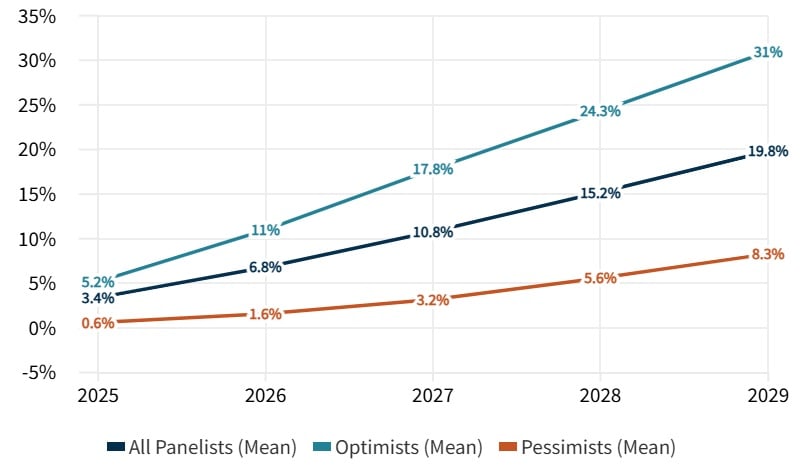
Fannie Mae’s latest Home Price Expectations Survey (HPES), released Tuesday, showed more than 100 housing and mortgage industry experts expect home price growth to slip to 3.4 percent in 2025, down from 5.8 percent last year.

The latest quarterly survey shows experts are less optimistic than they were in January, when they were forecasting 3.8 percent price appreciation in 2025.

The HPES panel expects price appreciation to continue to cool to 3.3 percent next year, down from the 3.6 percent forecast for 2026 issued in January.

Pessimists see home price appreciation flattening

Projected cumulative home price growth from Q4, 2024. Source: Fannie Mae / Pulsenomics LLC.

But the most pessimistic quartile of survey panelists sees national home price appreciation flattening to 0.6 percent this year and remaining weak until 2028.

While prices could go up more sharply in some markets, they’re also expected to fall in some metros where listings come onto the market faster than buyers can snatch them up.

At the national level, there were 1.75 million new and existing homes on the market in February, up 15 percent from a year ago, according to data tracked by the National Association of Realtors and the U.S. Census Bureau.

Inventory of new and existing homes

The inventory of existing homes grew by 17 percent, to 1.24 million, according to NAR data, while the number of new single-family homes on the market grew by 7 percent, to 500,000, the Census Bureau reported.

Realtor.com was tracking 1.3 million listings in March, up 17 percent from a year ago.

The latest readings from the S&P CoreLogic Case-Shiller Indices showed national home prices were up 4.1 percent from a year ago in January, with Tampa the only market in the 20-City index to see prices slip over that period, by 1.5 percent.

Nicholas Godec

But the second half of the year “told a different story,” S&P Down Jones Indices’ Nicholas Godec said in a press release, with only four of 20 cities — New York, Chicago, Phoenix and Boston — managing to “eke out” price increases during that period.

San Francisco posted the largest six-month decline at 3.4 percent, followed by Tampa at 3.2 percent, Godec said.

Selma Hepp, chief economist at Cotality (formerly CoreLogic), said flattening home price changes over the last six months “suggest further price deceleration is ahead.”

Selma Hepp

“While this year’s cold winter and large natural disasters play a role in dampening demand, falling consumer sentiment suggests potential homebuyers are wary of the short-term economic outlook and future inflation,” Hepp said in a March 30 report.

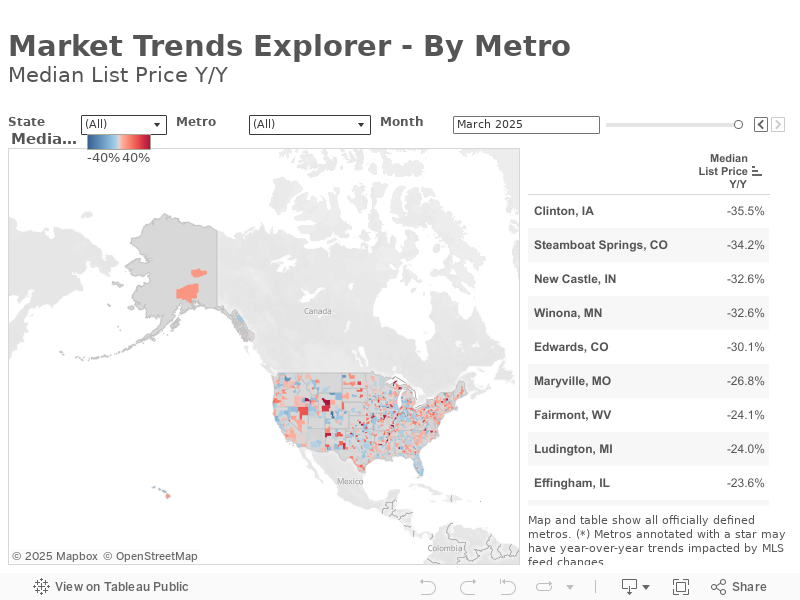
Home prices are driven by local supply and demand, and Realtor.com data shows median list prices in 69 metros were down by 10 percent or more from a year ago in March.

Median list price declines in 69 markets

Markets experiencing double-digit annual declines in median list price included Steamboat Springs, Colorado (-34.2 percent); Winona, Minnesota (-32.6 percent); Wenatchee, Washington (-22.1 percent); Flint, Michigan (-21.1 percent); Marion, Indiana (-19.7 percent); Enid, Oklahoma (-17.6 percent); Santa Fe, New Mexico (-14.5 percent); Ukiah, California (-13.7 percent); Dublin, Georgia (-13.4 percent); Montgomery, Alabama (-11.3 percent); Cedar Rapids, Iowa (-10.9 percent); Wausau, Wisconsin (-10.5 percent); and Boulder, Colorado (-10.2 percent).

“There are many ways to slice and dice housing data,” Realtor.com Chief Economist Danielle Hale said in her most recent weekly housing market update. “Through the lens of geography, our data reveals some commonalities.”

Danielle Hale

Realtor.com’s last Hottest Housing Markets report found that homes are selling more quickly in many markets in the Northeast and Midwest, and that a separate Down Payment Trends report showed buyers were putting more down on homes in the Northeast and Midwest and less in the South and West.

Last month, Fannie Mae economists said a pullback in mortgage rates should provide a “small boost” to home sales this year, in part because tariffs implemented by the Trump administration might inflate prices and slow economic growth. But tariffs announced this month have sent mortgage rates on the rebound, jeopardizing such forecasts.

Get Inman’s Mortgage Brief Newsletter delivered right to your inbox. A weekly roundup of all the biggest news in the world of mortgages and closings delivered every Wednesday. Click here to subscribe.

Email Matt Carter

This post was originally published on this site

Home price appreciation seen as cooling as inventories grow

Experts surveyed by Fannie Mae expect national home prices to grow by 3.4 percent in 2025. Median list prices in 69 markets were down by 10 percent or more from a year ago in March.

In April, we’ll go deep on money and finance for a special theme month, by talking to leaders about where the mortgage market is heading and how technology and business strategies are evolving to suit the needs of buyers now. Inman’s Best of Finance returns for 2025, celebrating the leaders in this space. And subscribe to Mortgage Brief for weekly updates all year long.

Housing experts surveyed by Fannie Mae expect national home price appreciation to cool this year as inventories continue to swell, with dozens of local markets already seeing double-digit annual declines in median list price.

Fannie Mae’s latest Home Price Expectations Survey (HPES), released Tuesday, showed more than 100 housing and mortgage industry experts expect home price growth to slip to 3.4 percent in 2025, down from 5.8 percent last year.

The latest quarterly survey shows experts are less optimistic than they were in January, when they were forecasting 3.8 percent price appreciation in 2025.

The HPES panel expects price appreciation to continue to cool to 3.3 percent next year, down from the 3.6 percent forecast for 2026 issued in January.

Pessimists see home price appreciation flattening

Projected cumulative home price growth from Q4, 2024. Source: Fannie Mae / Pulsenomics LLC.

But the most pessimistic quartile of survey panelists sees national home price appreciation flattening to 0.6 percent this year and remaining weak until 2028.

While prices could go up more sharply in some markets, they’re also expected to fall in some metros where listings come onto the market faster than buyers can snatch them up.

At the national level, there were 1.75 million new and existing homes on the market in February, up 15 percent from a year ago, according to data tracked by the National Association of Realtors and the U.S. Census Bureau.

Inventory of new and existing homes

The inventory of existing homes grew by 17 percent, to 1.24 million, according to NAR data, while the number of new single-family homes on the market grew by 7 percent, to 500,000, the Census Bureau reported.

Realtor.com was tracking 1.3 million listings in March, up 17 percent from a year ago.

The latest readings from the S&P CoreLogic Case-Shiller Indices showed national home prices were up 4.1 percent from a year ago in January, with Tampa the only market in the 20-City index to see prices slip over that period, by 1.5 percent.

Nicholas Godec

But the second half of the year “told a different story,” S&P Down Jones Indices’ Nicholas Godec said in a press release, with only four of 20 cities — New York, Chicago, Phoenix and Boston — managing to “eke out” price increases during that period.

San Francisco posted the largest six-month decline at 3.4 percent, followed by Tampa at 3.2 percent, Godec said.

Selma Hepp, chief economist at Cotality (formerly CoreLogic), said flattening home price changes over the last six months “suggest further price deceleration is ahead.”

Selma Hepp

“While this year’s cold winter and large natural disasters play a role in dampening demand, falling consumer sentiment suggests potential homebuyers are wary of the short-term economic outlook and future inflation,” Hepp said in a March 30 report.

Home prices are driven by local supply and demand, and Realtor.com data shows median list prices in 69 metros were down by 10 percent or more from a year ago in March.

Median list price declines in 69 markets

Markets experiencing double-digit annual declines in median list price included Steamboat Springs, Colorado (-34.2 percent); Winona, Minnesota (-32.6 percent); Wenatchee, Washington (-22.1 percent); Flint, Michigan (-21.1 percent); Marion, Indiana (-19.7 percent); Enid, Oklahoma (-17.6 percent); Santa Fe, New Mexico (-14.5 percent); Ukiah, California (-13.7 percent); Dublin, Georgia (-13.4 percent); Montgomery, Alabama (-11.3 percent); Cedar Rapids, Iowa (-10.9 percent); Wausau, Wisconsin (-10.5 percent); and Boulder, Colorado (-10.2 percent).

“There are many ways to slice and dice housing data,” Realtor.com Chief Economist Danielle Hale said in her most recent weekly housing market update. “Through the lens of geography, our data reveals some commonalities.”

Danielle Hale

Realtor.com’s last Hottest Housing Markets report found that homes are selling more quickly in many markets in the Northeast and Midwest, and that a separate Down Payment Trends report showed buyers were putting more down on homes in the Northeast and Midwest and less in the South and West.

Last month, Fannie Mae economists said a pullback in mortgage rates should provide a “small boost” to home sales this year, in part because tariffs implemented by the Trump administration might inflate prices and slow economic growth. But tariffs announced this month have sent mortgage rates on the rebound, jeopardizing such forecasts.

Get Inman’s Mortgage Brief Newsletter delivered right to your inbox. A weekly roundup of all the biggest news in the world of mortgages and closings delivered every Wednesday. Click here to subscribe.

Email Matt Carter

This post was originally published on this site

Tal Alexander calls himself ‘victim’ in divorce proceedings

Bigger. Better. Bolder. Inman Connect is heading to San Diego. Join thousands of real estate pros, connect with the power of the Inman Community, and gain insights from hundreds of leading minds shaping the industry. If you’re ready to grow your business and invest in yourself, this is where you need to be. Go BIG in San Diego!

Disgraced luxury broker Tal Alexander is reportedly issuing stern warnings to his estranged wife from Brooklyn’s Metropolitan Detention Center as their divorce proceedings continue.

Tal Alexander has been incarcerated for months alongside his brothers, twins Oren and Alon, and is awaiting a federal trial on sex-trafficking charges to take place in January 2026. But being imprisoned hasn’t stopped the former Official Partners broker from telling his wife, Arielle, to “think twice” about moving forward with divorce proceedings, according to a recent filing in the case obtained by The Real Deal.

Arielle filed for divorce in New York in January, just a few weeks after Tal, Oren and Alon were arrested. Tal told his estranged wife that “the divorce will be a ‘war’ unless she agreed to do things his way,” according to a conversation between the two cited in a motion to dismiss a Florida complaint Tal filed against Arielle days after she first filed for divorce.

Arielle and her attorneys are attempting to keep divorce proceedings in New York, where she says that she, Tal and their infant lived before he was arrested, contrary to Tal’s own claims.

“Tal’s efforts to control Arielle, even from behind bars, and to dictate where she and their son live based on falsities and misrepresentations, should not be permitted,” Arielle’s motion states.

According to private messages between the couple obtained by The Real Deal, Tal characterized himself as “the victim” in the cases against him, claiming those making allegations against him are “financially motivated,” and that he had a plan for a turnaround if things go his way.

“I’m the victim, remember that,” Tal wrote. “Once that all comes out and when the facts come out, this whole thing turns around.”

Attorneys for Arielle and Tal did not immediately respond to Inman’s request for comment.

Shortly after Arielle filed for divorce, Tal also communicated to her that the lease on their apartment at 432 Park Ave would expire in March and told her to start looking for another apartment “ASAP.” However, Tal’s assertion contradicted an extension on the lease that was set to expire in March 2026, according to a copy included in the motion.

The filing said Tal “demanded multiple times” that Arielle let agent Marc Riedel, a former Official Partners agent and now-SERHANT. agent, show the apartment to potential new tenants. Riedel also allegedly told Arielle that she would put herself at risk of eviction and a possible lawsuit if she didn’t move out of the apartment.

“Tal orchestrated the early lease termination on the Marital Residence to put Arielle in the position of having — literally — nowhere to go,” the filing says. “Tal, ever the businessman, conducted the apartment circus from his jail cell, communicating constantly with Mr. Riedel and other real estate colleagues, and potential clients.”

Riedel asserted in a statement that he was simply informing Arielle of the risks according to New York law.

“I informed the tenant of what was in the works legally and the risks, as I did not want them to be hurt by this; from there, it was up to the tenant,” Riedel said in a statement. “Almost immediately, the tenant began allowing access.”

Arielle added in the filing that Tal’s threats seemed to be facilitated and abetted by his parents, luxury spec developer Shlomy Alexander and his wife, private security executive Orly Alexander.

After she filed for divorce, Arielle alleged that Tal’s parents “changed on a dime.”

“They began to terrorize, harass and scare me, acting as their son’s agent and proxy from federal prison,” the filing states.

On Dec. 22, Arielle allegedly told Orly that she intended to divorce Tal and on Dec. 25 told her expressly that she did not plan to harm Tal.

“I just want to divorce amicably and quietly,” Arielle said in the filing. “When I told her, she was not understanding, told me I should be standing by my husband, and questioned my morals, among other disrespectful statements she made to me.”

Then in mid-January, Orly and Shlomy allegedly went into the apartment at 432 Park without Arielle’s permission and stole $50,000 in cash, two Rolex watches, three Patek Philippe watches, wine, cigars and other high-end objects, according to a motion for a protective order that Arielle filed.

“None of this was done with my permission, and in fact this was all done over my telling [Orly and Shlomy] not to touch anything,” the filing states. If she did not file a protective order, Arielle said the couple would “continue to do what they want, when they want — even trespass upon my home, and steal whatever is left after their ransacking … not to mention their current efforts to render me and our child homeless, and terrorize, annoy, alarm and intimate [sic] us.”

Two days after the Alexanders entered the apartment, Orly allegedly hired a broker to put 432 Park up for rent and sell all of the furniture contained within at a profit. Arielle vacated the apartment before the lease was allegedly set to expire at the end of March. It went under contract on April 9 and was asking $55,000 per month, according to StreetEasy.

Tal first started renting at the supertall tower, where he represented units, in 2019, and has lived in New York for 12 years, according to the legal filing. Tal, on the other hand, claimed in his own legal filing in Florida that he was a Florida resident.

Earlier this month, Tal, Oren and Official Partners and Side, Inc. said they had reached a tentative settlement in the suit that Side filed against the brothers for allegedly failing to repay a loan. More details in the case are expected to be filed this week.

Get Inman’s Luxury Lens Newsletter delivered right to your inbox. A weekly deep dive into the biggest news in the world of high-end real estate delivered every Friday. Click here to subscribe.

Email Lillian Dickerson

This post was originally published on this site

‘MAGA world’s premier financier’ joins Fannie Mae board of directors

Omeed Malik, founder of investment bank Farvahar Partners and venture capital firm 1789 Capital, is a business partner and “close friend” of Donald Trump Jr.

In April, we’ll go deep on money and finance for a special theme month, by talking to leaders about where the mortgage market is heading and how technology and business strategies are evolving to suit the needs of buyers now. Inman’s Best of Finance returns for 2025, celebrating the leaders in this space. And subscribe to Mortgage Brief for weekly updates all year long.

Banker, investor and lawyer Omeed Malik — recently dubbed “MAGA world’s premier financier” by New York Magazine — is the latest addition to mortgage giant Fannie Mae’s board of directors, Federal Housing Finance Agency Director Bill Pulte announced on social media Monday.

Before founding the investment bank Farvahar Partners and venture capital firm 1789 Capital — where Donald Trump Jr. became a partner in November — Malik was managing director and global head of the hedge fund advisory business at Bank of America Merrill Lynch.

Pulte said Malik “brings great capital markets, legal and investment experience” to Fannie Mae’s board of directors.

As chairman and CEO of Colombier Acquisition Corp., Malik helped take PublicSquare — which touts itself as a marketplace for “patriotic businesses and consumers” — public in a 2023 SPAC merger with Colombier, a special purpose acquisition company.

Malik stepped down from PublicSquare’s board on Dec. 3 — the same day Trump Jr. joined it, along with Willie Langston, a partner at wealth management firm Corient and a former national finance chair for Ted Cruz’s presidential campaign.

Described as a “close friend” of Trump Jr. in a November New York Magazine profile, Malik on March 3 reposted a picture the president’s son published on X the day before — in which Trump Jr. thanked Malik for co-hosting a fundraiser for Vivek Ramaswamy’s bid to become Ohio’s next governor in the 2026 election.

Malik is also an investor in The Daily Caller, the conservative news outlet co-founded by Tucker Carlson. His addition to Fannie Mae’s board follows Pulte’s purge of 14 board members at the mortgage giant and its sister company Freddie Mac, in March.

Pulte — the grandson of homebuilder William J. Pulte, the founder of PulteGroup Inc. — appointed himself the chair of Fannie and Freddie’s boards less than a week after he was confirmed by the Senate as Trump’s choice to lead their federal regulator.

Board Chair Michael Heid was one of eight Fannie Mae board members removed by Pulte, who declared, “DEI is dead at Fannie Mae and Freddie Mac.”

Fannie Mae CEO Priscilla Almodovar was one of five board members who kept their seats. They’ve been joined by Pulte’s other appointments to Fannie Mae’s board: Mike Stucky, a former Pulte Group division president, and FHFA General Counsel Clinton Jones.

Jones, who joined the FHFA in 2019 and was promoted to general counsel in 2021, was also appointed to Freddie Mac’s board.

One of Pulte’s other picks — Christopher Stanley, a staffer from the Department of Government Efficiency (DOGE) — was appointed to Fannie Mae’s board on March 17 but resigned the next day.

Mike Stucky

Stucky, who, according to his LinkedIn profile, is a retired heating, ventilation and air conditioning (HVAC) executive, was appointed vice chair of Fannie Mae’s board on April 10, the company disclosed Monday in a regulatory filing.

The FHFA has determined that Fannie Mae’s board should have at least five and no more than 13 directors. With Malik’s addition, the board will have nine members.

In addition to Chair Lance Drummond, Pulte removed five other directors from Freddie Mac’s board, the company said in a March 17 regulatory filing. In addition to Pulte and Jones, new additions to Freddie Mac’s board included Brandon Hamara and Ralph “Cody” Kittle.

Hamara is the vice president of land acquisition at homebuilder Tri Pointe Homes Inc., a Nevada-based homebuilder that completed 6,460 homes last year. Kittle is a partner at RenWave Kore, a Greenwich, Connecticut-based private equity firm.

On March 24, Freddie Mac board member Grace Huebscher announced her resignation, and Pulte appointed Michael Parrott, CEO and founder of consulting firm 480th Company, as her replacement.

Freddie Mac now has 10 board members, including interim CEO Mike Hutchins, who took on that role after Pulte fired Freddie Mac CEO Diana Reid and Head of Human Resources Dionne Wallace Oakley last month.

Appointed as CEO in September, Reid was the first woman to lead Freddie Mac. With Almodovar having served as Fannie Mae’s CEO since 2022, both mortgage giants were briefly led by women for the first time in history.

Get Inman’s Mortgage Brief Newsletter delivered right to your inbox. A weekly roundup of all the biggest news in the world of mortgages and closings delivered every Wednesday. Click here to subscribe.

Email Matt Carter

This post was originally published on this site

Realtors are fighting for fairness, access and accountability

Bigger. Better. Bolder. Inman Connect is heading to San Diego. Join thousands of real estate pros, connect with the power of the Inman Community, and gain insights from hundreds of leading minds shaping the industry. If you’re ready to grow your business and invest in yourself, this is where you need to be. Go BIG in San Diego!

Compass CEO Robert Reffkin’s recent posts criticizing NAR’s spending, the Clear Cooperation Policy, and the structure of the MLS have sparked lots of conversation in our industry. As someone who has been in this business, works alongside agents every day, and has seen both the challenges and the impact of sound policy, I felt compelled to respond.

Setting the record straight

Trying to rewrite history without understanding it is not only misleading, it’s dangerous. Let’s set the record straight: 2023 was not the worst real estate market since 1995. Those of us who’ve been in this business long enough and understand the full history know that’s simply not true. The real crisis was 2007–2010, when the market imploded due to systemic failures fueled by Wall Street, not by NAR, not by MLSs and not by practitioners.

But what is true is what came next: It was NAR and its partners who showed up to help rebuild, advocate and push for policy that protected homeowners, housing rights and the long-term stability of our industry.

And that’s precisely why we have to remember the full context before throwing stones. Wall Street’s “innovation” led to the 2008 financial collapse — the worst housing market in modern U.S. history — packaging risky subprime loans into complex mortgage-backed securities (MBS), selling them as safe investments and fueling a housing bubble with unsustainable lending practices.

When it all collapsed, millions of homeowners in underserved and first-time buyer communities were left holding the bag, while the financial institutions responsible were bailed out. That wasn’t a failure of organized real estate. That was unchecked greed.

Let’s also call this what it is: The effort to dismantle an entire industry and its trade organization under the banner of “consumer choice” is yet another Wall Street-style “innovation” — one engineered not to empower consumers, but to protect investor returns.

When policies that promote transparency and cooperation are undermined, we should all be asking: Who truly benefits? Because if history tells us anything, these strategies rarely serve the people buying and selling homes.

NAR’s fight for fair housing

Meanwhile, despite its flaws, NAR has consistently been one of the few organizations advocating for homeownership rights at the federal level. They fight for mortgage interest deductions, fair housing, disaster relief and the right for agents to remain independent contractors, a foundational freedom allowing agents to build their businesses on their own terms. That advocacy matters; most agents would feel the impact if it disappeared.

Clear Cooperation isn’t perfect — no policy is — and NAR is not perfect either. But suggesting that the organization and its policies exist purely as a dues-protection racket ignores the real intent: The protection of the profession, a shared Code of Ethics, and a rules-based infrastructure designed to ensure transparency in the marketplace and equal protection for buyers and sellers.

Specifically, the Clear Cooperation Policy was created to prevent off-market manipulation with practices that tend to benefit only a select few while limiting access and opportunity for the broader public. Tearing down a policy that is intended to promote equal opportunity for all buyers, and that requires listings to be entered into the MLS where they are visible and accessible to all, undermines this industry’s stated commitment to fair housing and transparency.

Yes, certain aspects of the policy, including carve-outs for exclusives, deserve further scrutiny. The industry hasn’t always been on the right side of history here, but this is an opportunity — an opportunity for companies and brokerages across the board to come together and acknowledge that cooperation benefits the entire market.

Instead of strategies that protect a company’s bottom line, we should be advocating for policies that serve all sellers and all buyers through transparency, standards, exposure and equal access to data. If we truly believe in a fair and functional marketplace, then it’s time to align our business strategies with the values we say we stand for, not just for what’s profitable, but what’s right.

Examining brokerage motives

What we can’t overlook here is the fact that Compass is a publicly traded company. Their board is accountable to shareholders, and that accountability is also about profit. To criticize NAR while conveniently skipping over the profit-driven motives of your own platform? That’s not transparency. That’s selective outrage.

Yes, it’s fair to question spending and structure. Yes, reform is necessary. However, there are thousands of professionals who deeply care about the real estate industry and its future. Every major organization — nonprofit or corporate — has dealt with bad behavior.

But tearing down an entire institution because of a few bad actors ignores the real, meaningful progress being made. If you want change, you show up. You work toward a common goal: Protecting homeowners, building equity, driving the adoption of data standards and making the system better for everyone.

For further clarification,  when we talk about doing deals outside the MLS, we’re talking about exclusivity and giving access to properties only to those connected to specific agents working with specific brokerages. That hurts communities of color, it hurts first-time buyers, and countless studies have shown it also hurts — you guessed it — sellers. It creates barriers where there should be bridges.

Fair housing isn’t just a slogan, it’s a responsibility. So how can leaders at companies that claim to stand for consumers and equal access not support policies that ensure every agent and every buyer has access to every listing — and every seller receives the full exposure they deserve in the marketplace?

MLSs and greater transparency are not the problem. They are part of a proven infrastructure, built over a century, with model rules and shared data standards that evolve as the market changes. We don’t benefit from a broken system — and this one isn’t broken. It’s imperfect, yes, but it’s functioning and always improving because of the people who keep showing up to make it better.

People who show up to make it better do the work, not just for themselves, but to strengthen this industry for the communities we serve.

Nina Dosanjh is Chief Technology and Strategy Officer at Vanguard Properties. Connect with her at LinkedIn and Instagram.

This post was originally published on this site