Judge whittles down Howard Hanna real estate commission lawsuit

Judge whittles down Howard Hanna real estate commission lawsuit

No evidence of “horizontal agreement” among real estate brokerages to inflate commissions, but judge will hear arguments alleging a “vertical antitrust conspiracy” with NAR.

Bigger. Better. Bolder. Inman Connect is heading to San Diego. Join thousands of real estate pros, connect with the Inman Community, and gain insights from hundreds of leading minds shaping the industry. If you’re ready to grow your business and invest in yourself, this is where you need to be. Go BIG in San Diego!

A federal judge isn’t buying allegations that Howard Hanna Real Estate conspired with other real estate brokerages in a “horizontal agreement” to inflate commissions charged to homebuyers.

But lawyers seeking class action status to represent homebuyers nationwide will have a chance to argue that Howard Hanna engaged in a “vertical antitrust conspiracy” with the National Association of Realtors.

In a June 23 opinion and two related orders, Federal District Judge Wendy Beetlestone further whittled down the scope of a commission-related antitrust lawsuit filed last year against Hanna Holdings by dismissing claims of “unjust enrichment.”

TAKE THE INMAN INTEL INDEX SURVEY FOR JUNE

Beetlestone also dismissed claims tied to antitrust and consumer protection laws in multiple states, outlining procedural issues and perceived legal deficiencies in the Sept. 16 amended complaint against the family-owned brokerage.

A North Carolina homebuyer, Scott Davis, filed the suit in May 2024, and was joined by more than two dozen other plaintiffs.

Attorneys are seeking class action status to represent homebuyers nationwide, claiming that Howard Hanna conspired with other NAR-member brokerages to artificially inflate commission rates for buyer-brokers through rules, policies, and practices imposed on NAR members and MLS users.

That NAR members “are required to obey and enforce NAR rules … only plausibly suggests a vertical agreement between Hanna and NAR, not a horizontal agreement between Hanna and its competitors,” Beetlestone wrote in explaining her order dismissing claims that Howard Hanna conspired with other brokers.

But Beetlestone said the lawsuit presents enough of an argument that a vertical agreement exists between Howard Hanna and NAR to warrant further discovery of evidence and a trial.

“Plaintiffs plausibly allege a vertical agreement between Hanna and the NAR, where the former agrees to enforce the latter’s rules in exchange for the benefits of NAR membership,” Beetlestone wrote. “Those benefits include the ability to participate in NAR-controlled MLSs, where, due to the anticompetitive effects of a handful of NAR rules restraining normal competition among brokers, brokerage fees have allegedly ballooned to supracompetitive rates and non-NAR brokers have been iced out of the market.”

Attorneys for homebuyers allege that they “bear the brunt of these inflated commissions, since sellers pass the inflated rates on to buyers as part of the purchase price of the home,” Beetlestone noted.

Future fact finding “may — or may not” prove those allegations to be true, she said.

Beetlestone dismissed claims tied to state antitrust laws in Arizona, Hawaii, Nevada and Utah, saying those states require plaintiffs to provide notice to states before filing suit. Beetlestone dismissed those claims without prejudice, leaving the door open for plaintiffs to argue that state noticing requirements don’t apply in federal cases.

Attorneys for homebuyers also sought damages under consumer protection laws in 23 states. Beetlestone dismissed claims tied to consumer protection laws in Colorado, Michigan, New York, Oregon, Pennsylvania, Virginia and Wisconsin, saying those laws apply to conduct that involves fraud or deception.

“Nothing about the vertical relationship alleged by Plaintiffs plausibly suggests active concealment or deception,” Beetlestone ruled.

She also dismissed claims tied to Massachusetts’ consumer protection laws, saying plaintiffs failed to fulfill notification requirements.

Finally, Beetlestone dismissed without prejudice claims tied to the doctrine of “unjust enrichment,” saying attorneys for the plaintiffs failed to specify which states’ common laws provided a basis for those claims.

“This slim pleading is simply too vague to clear the bar … because the law of unjust enrichment varies from state to state,” Beetleston ruled.

Barring a settlement, the case will proceed to the discovery stage and trial in the Philadelphia-based U.S. District Court for the Eastern District of Pennsylvania.
Email Matt Carter

Trump looks to South Korea to bring down mortgage rates

Trump looks to South Korea to bring down mortgage rates

Overseas investors hold about $1.36 trillion in U.S. mortgage debt, with Japan, China, Taiwan and Canada accounting for 61 percent of that total.

Bigger. Better. Bolder. Inman Connect is heading to San Diego. Join thousands of real estate pros, connect with the Inman Community, and gain insights from hundreds of leading minds shaping the industry. If you’re ready to grow your business and invest in yourself, this is where you need to be. Go BIG in San Diego!

The Trump administration is looking to bring mortgage rates down by encouraging South Korean investors to step up purchases of mortgage-backed securities (MBS) guaranteed by Fannie Mae, Freddie Mac and Ginnie Mae.

The U.S. Department of Housing and Urban Development (HUD), Ginnie Mae and the Korea Housing Finance Corporation (KHFC) signed a memorandum of understanding this week aimed at strengthening the relationship between the U.S. housing finance system and South Korean institutional investors.

HUD Secretary Scott Turner met with Kyung-Hwan Kim, president and CEO of the KHFC — Korea’s version of Fannie Mae and Freddie Mac — for the June 10 signing.

“Working strategically with our South Korean allies, we are expanding the global understanding of American housing finance, while increasing capital flows in the United States, strengthening our domestic capital markets, and unlocking strategies to benefit American borrowers,” Turner said in a statement. “This agreement signals that, under President Trump’s leadership, our allies are ready and willing to do business in America again.”

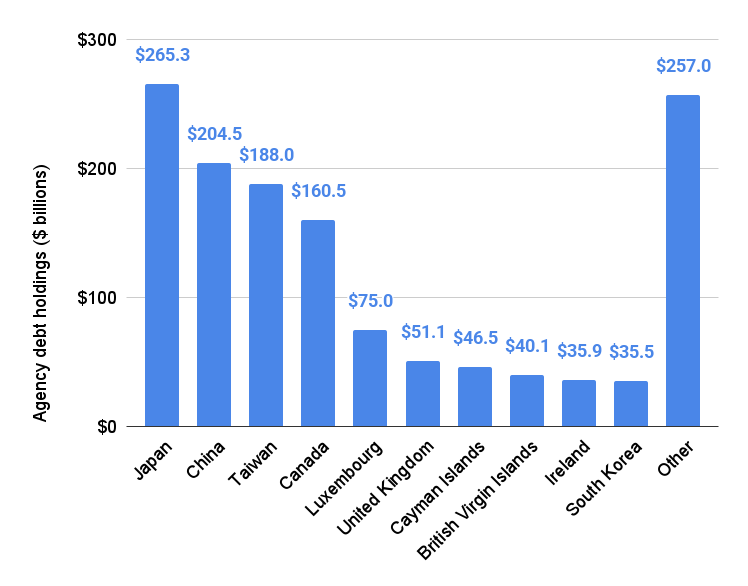
Overseas investors hold about $1.36 trillion in so-called “agency” debt, with Japan, China, Taiwan and Canada accounting for 60 percent of that total.

U.S. agency debt overseas holdings

U.S. agency debt overseas holdings as of March 1, 2025. Source: Ginnie Mae Global Markets Analysis Report, May 2025. 

With $35.5 billion in U.S. agency debt holdings (MBS, notes and bonds), South Korea ranks 10th, behind banking strongholds like Luxembourg, the United Kingdom, the Cayman Islands, the British Virgin Islands and Ireland.

Ginnie Mae President Alanna McCargo led a delegation to Asia in April 2023, meeting with MBS investors, financial institutions, and regulators in Taiwan and South Korea.

On that trip, Ginnie Mae officials “assured investors that the structure of Ginnie MBS will help to protect them from any potential issues tied to a possible U.S. debt default,” Inside Mortgage Finance reported at the time.

“Formalizing our partnership with KHFC through this MOU is a meaningful step in addressing housing challenges that extend across borders,” Ginnie Mae executive Joseph Gormley said in a statement Friday. “Korean institutions continue to play a significant role in our capital markets, and we look forward to working together to advance a shared understanding of global capital markets and to ensure the strength of our mortgage-backed securities.”

Although President Trump has berated Federal Reserve Chair Jerome Powell for not cutting short-term interest rates this year, mortgage rates are largely determined by investor demand for MBS.

MBS are seen as a comparable, if slightly riskier investment, than 10-year Treasury notes. Overseas investors own about 15 percent of the nearly $9 trillion in outstanding Fannie Mae, Freddie Mac and Ginnie Mae MBS.

Fannie Mae and Freddie Mac guarantee payments to MBS investors even if borrowers default on their loans. Ginnie Mae securities are backed by single-family mortgages originated through the Federal Housing Administration (FHA), U.S. Department of Veterans Affairs (VA), U.S. Department of Agriculture’s Rural Development (RD), and Public and Indian Housing (PIH) insurance programs.

Mortgage rates surged in May after Moody’s Ratings became the last credit agency to strip the U.S. of its most favorable debt rating over concerns that Congress and “successive U.S. administrations” have failed to tackle annual budget deficits.

Fears that tax cuts Trump is attempting to push through Congress will lead to even more borrowing have investors demanding higher yields on 10-year Treasurys and MBS.

Trump adviser Peter Navarro has said investors believe the tax cuts aren’t paid for, and “are pricing in a future where the government borrows trillions more with no offsetting revenues.”

But Navarro and other Trump administration officials maintain that tax cuts will help the economy grow and generate more tax revenue than critics expect.

Get Inman’s Mortgage Brief Newsletter delivered right to your inbox. A weekly roundup of all the biggest news in the world of mortgages and closings delivered every Wednesday. Click here to subscribe.

Email Matt Carter

Some markets look vulnerable as home price appreciation cools

Some markets look vulnerable as home price appreciation cools

Experts polled by Fannie Mae expect national home prices to keep climbing, but see Austin, Tampa, Dallas, Denver, Houston, Miami and Phoenix as markets most likely to see price declines.

Bigger. Better. Bolder. Inman Connect is heading to San Diego. Join thousands of real estate pros, connect with the Inman Community, and gain insights from hundreds of leading minds shaping the industry. If you’re ready to grow your business and invest in yourself, this is where you need to be. Go BIG in San Diego!

Housing and mortgage experts polled by Fannie Mae have dialed back their expectations for home price appreciation this year and next, but most don’t expect national home prices to fall. Some markets, however, are looking vulnerable to price declines.

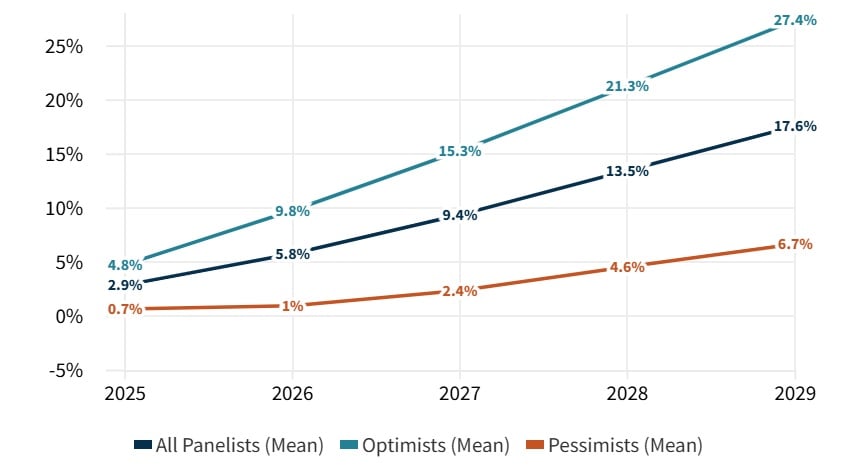
Fannie Mae’s quarterly Home Price Expectations Survey (HPES), released Friday, showed panelists surveyed in May now expect national home prices to rise by an average of 2.9 percent this year, down from their previous forecast of 3.4 percent.

Similarly, the survey’s housing, mortgage industry and academic experts now expect 2.8 percent home price appreciation in 2026, down from the 3.3 percent envisioned in February.

U.S. home price scenarios

Projected cumulative home price appreciation among most optimistic and pessimistic quartile of survey panelists. Source: Fannie Mae Home Price Expectations Survey (HPES) May 2025. 

Pessimists on the panel think national home price appreciation could cool from 5.3 percent in 2024 to less than 1 percent this year and next. A small minority — 15 percent — say the odds are better than even that national home prices will turn negative by the end of next year.

As national home price appreciation cools, some markets could see prices fall. The latest S&P CoreLogic Case-Shiller Indices showed home prices in Tampa were down 2.2 percent from a year ago in March.

While Tampa was the only top 20 metro to post a decline, price appreciation “barely stayed positive” in Dallas at 0.2 percent, S&P Dow Jones Indices analyst Nicholas Godec said in a statement.

Most of the largest housing markets tracked by Case-Shiller — 14 out of 20 — posted seasonally-adjusted price declines from February to March.

Nicholas Godec

“These results underscored how markets that experienced sharp run-ups earlier in the cycle — particularly in the Sun Belt — continued to adjust under the weight of higher mortgage rates and strained affordability,” Godec said.

Mortgage rates aren’t coming down, but improving inventory in many markets helped drive up homebuyer demand for purchase loans to the second highest level of the year last week, the Mortgage Bankers Association reported Wednesday.

Only one in five Americans (21 percent) polled by Fannie Mae in May said they expect home prices to come down over the next 12 months, with 45 percent expecting prices to go up and 34 percent expecting that they’ll stay the same. While only 26 percent said May was a good time to buy, that’s up from an all-time survey low of 14 percent a year ago.

Housing and mortgage experts polled by Fannie Mae in May saw Austin, Tampa, Dallas, Denver, Houston, Miami, Phoenix, Washington, D.C., and Atlanta as markets where home prices are most likely to underperform national home price appreciation over the next 12 months.

Among the 20 largest U.S. housing markets, Boston, New York, Philadelphia, Nashville and San Diego were viewed as places where prices are most likely to go up faster than the national average.

Fannie Mae economists update their home price appreciation forecast four times a year, in the first month of each quarter.

In their April forecast, Fannie Mae economists predicted that home prices will rise 4.1 percent this year before appreciation cools to 2 percent by Q4 2026.

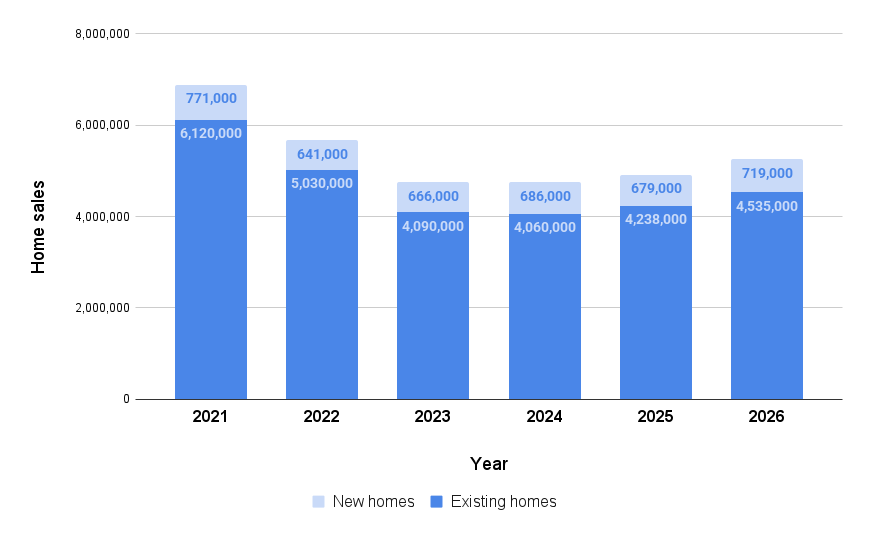
Fannie Mae economists think home sales bottomed at 4.75 million last year and will grow by 3.6 percent this year and 6.8 percent in 2026.

Home sales expected to bounce back

Source: Fannie Mae housing forecast, May 2025.

If Fannie Mae’s forecast of 5.25 million 2026 home sales pans out, it would be the first time since 2022 that sales of new and existing homes surpassed five million.

Get Inman’s Mortgage Brief Newsletter delivered right to your inbox. A weekly roundup of all the biggest news in the world of mortgages and closings delivered every Wednesday. Click here to subscribe.

Email Matt Carter

Court denies CFPB’s request to vacate fair lending settlement

Court denies CFPB’s request to vacate fair lending settlement

Judge declines to reopen case and vacate settlement with Chicago mortgage broker Townstone Financial, calling the request “a Pandora’s box the court refuses to open.”

Bigger. Better. Bolder. Inman Connect is heading to San Diego. Join thousands of real estate pros, connect with the Inman Community, and gain insights from hundreds of leading minds shaping the industry. If you’re ready to grow your business and invest in yourself, this is where you need to be. Go BIG in San Diego!

A federal district judge Thursday rejected the Consumer Financial Protection Bureau’s request to undo a settlement it reached last year in a fair lending case involving Chicago mortgage broker Townstone Financial, which the Trump administration had maintained was targeted because of the owner’s political views.

Townstone was accused in July 2020 of discouraging Black residents from applying for loans on an AM radio show and podcasts. But an internal review of the case determined that the CFPB “abused its power” in pursuing the case in order to “further the goal of mandating DEI in lending,” Office of Management and Budget Director Russell Vought claimed in March.

Fair housing and consumer protection groups opposing the move in court said the CFPB’s request to undo the settlement was “unprecedented” and would establish a “dangerous and destabilizing precedent” if granted.

The groups — including the National Fair Housing Alliance, the American Civil Liberties Union, the Consumer Federation of America and the National Consumer Law Center — were granted standing to file an amicus brief after the CFPB essentially switched sides in the case.

In declining to reopen the case and vacate the CFPB’s $105,000 settlement with Townstone Financial, U.S. District Judge Franklin Valderrama agreed that doing so “would erode public confidence in the finality of judgments.”

Granting the CFPB’s motion “would set a precedent suggesting that a new administration could seek to vacate or otherwise nullify the voluntary resolution of a case between a prior administration (or the same administration, but under different agency leadership) and a private party merely because its leadership thought the original litigation unwise or improperly motivated,” Valderrama wrote in his June 12 order. “That is a Pandora’s box the Court refuses to open.”

Valderrama agreed that “it is impermissible for government agencies to target people or entities because of protected speech,” but noted that the issue was never adjudicated in court.

In pursuing its case against Townstone Financial, the CFPB maintained that the speech in question was not protected by the First Amendment because it was advertising. But neither the trial court or an appeals court weighed in on the First Amendment issues in the case.

Vought and his top deputy at OMB, Dan Bishop, are leading the Trump administration’s efforts to downsize the CFPB, with Vought serving a dual role as the CFPB’s acting director.


At an April 30 cabinet meeting, Vought told President Trump that the CFPB — which brought its case against Townstone and its president and CEO, Barry Sturner, during the first Trump administration — had “ruined [Sturner’s] life.”

The CFPB “had gone after” Sturner “because he complained about crime in Chicago, literally the same thing that the Democrat mayor had talked about,” Vought told Trump.

“We apologized on your behalf to that individual, and we basically, without having to go through notice and comment, we ended the policy that set that [case] in motion,” Vought said, referring to an April 23 executive order prohibiting federal agencies from pursuing cases based on unintentional “disparate impacts” to borrowers.

In a 2020 complaint, the CFPB maintained that statements made by hosts of Townstone’s AM radio call-in show and podcasts discouraged prospective Black mortgage applicants, violating the Equal Credit Opportunity Act (ECOA).

In a 2016 episode, for example, Sturner allegedly said that between Friday and Monday, it’s “hoodlum weekend” on the South Side of Chicago, and that police are “the only ones between that turning into a real war zone and keeping it where it’s kind of at.”

Townstone generated up to 90 percent of its mortgage applications from radio advertising, the CFPB alleged. From 2014 through 2017, Black applicants accounted for only 1.4 percent of the 2,700 mortgage requests fielded by the lender in the Chicago market, compared to 9.8 percent of applications taken by its competitors.

In seeking to overturn the settlement, the Trump administration argued that the CFPB had engaged in a “flagrant misuse of government resources” by employing an audio analytics mining software app, Nexidia, to comb through more than 78 hours of AM radio programs and podcasts published by Townstone on social media.

The CFPB’s attempt to vacate the Townstone settlement and at least four others has prompted other companies to seek similar deals, Bloomberg Law reported Friday.

The acting director of the CFPB’s enforcement division, Cara Petersen, resigned Tuesday, saying in a farewell email that “the bureau’s current leadership has no intention to enforce the law in any meaningful way.”

“Companies lining up to get backroom deals from the CFPB should be embarrassed,” Petersen’s predecessor at the CFPB, Eric Halperin, told Bloomberg Law.

Stephen Hall, legal director at Better Markets — one of the groups opposed to vacating the Townstone settlement — called Valderrama’s order “a thorough, well-reasoned, and decisive rejection of a shameful effort by the Consumer Financial Protection Bureau.”

Get Inman’s Mortgage Brief Newsletter delivered right to your inbox. A weekly roundup of all the biggest news in the world of mortgages and closings delivered every Wednesday. Click here to subscribe.

Email Matt Carter

Chimera boosts non-QM presence with HomeXpress acquisition

Chimera boosts non-QM presence with HomeXpress acquisition

The New York City-based REIT will pay $120 million in cash for national non-Qualified Mortgage lender HomeXpress Mortgage Corp., plus 2.08 million shares in Chimera valued at $27.9 million.

Bigger. Better. Bolder. Inman Connect is heading to San Diego. Join thousands of real estate pros, connect with the Inman Community, and gain insights from hundreds of leading minds shaping the industry. If you’re ready to grow your business and invest in yourself, this is where you need to be. Go BIG in San Diego!

HomeXpress Mortgage Corp., a national provider of non-QM mortgages that are popular with gig workers, is being acquired by a New York City-based Real Estate Investment Trust (REIT), the companies announced Thursday.

Chimera Investment Corporation will pay $120 million in cash for HomeXpress, plus 2.08 million shares in Chimera valued at $27.9 million at Wednesday’s closing price of $13.89.

HomeXpress President and CEO Kyle Walker and key members of his senior management team will continue to lead HomeXpress as a Chimera subsidiary.

Phillip Kardis

HomeXpress’ loan origination platform “is expected to create a powerful combination and enhance our enterprise value,” Chimera President and CEO Phillip Kardis said in a statement. “HomeXpress has an excellent management team with experienced origination professionals that have a long history of serving broker and correspondent partners across the U.S. ”

Chimera is in the business of acquiring, financing and securitizing non-Qualified Mortgages (non-QM) that don’t meet Fannie Mae and Freddie Mac’s strict underwriting and documentation requirements. Because of their more flexible income verification requirements, non-QM loans are popular with self-employed gig workers and others with non-traditional sources of income.

Combining HomeXpress’s origination capabilities with Chimera’s ability to manage, finance and securitize non-QM loans “will create a powerful platform that further anchors our position as a leader in the residential credit sector,” Chimera disclosed to investors in a deal summary.

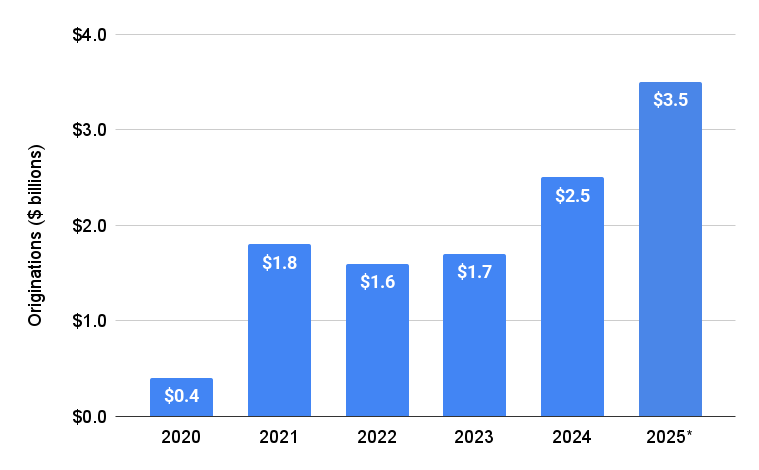
HomeXpress mortgage originations 2020-2024

HomeXpress mortgage originations (* 2025 projected). Source: Chimera Investment Corp. regulatory filing.

HomeXpress has originated $10.7 billion in loans since launching in 2016 and has always been profitable, generating $47 million in 2024 pre-tax earnings, Chimera disclosed.

Acquiring HomeXpress is “the next logical step in the evolution of the company” following last year’s acquisition of alternative asset manager Palisades Group for up to $50 million, the company said.

Santa Ana, California-based HomeXPress is licensed in 41 states and Washington, D.C., sponsoring 13 mortgage loan originators who work out of four branches, according to Nationwide Mortgage Licensing System records.

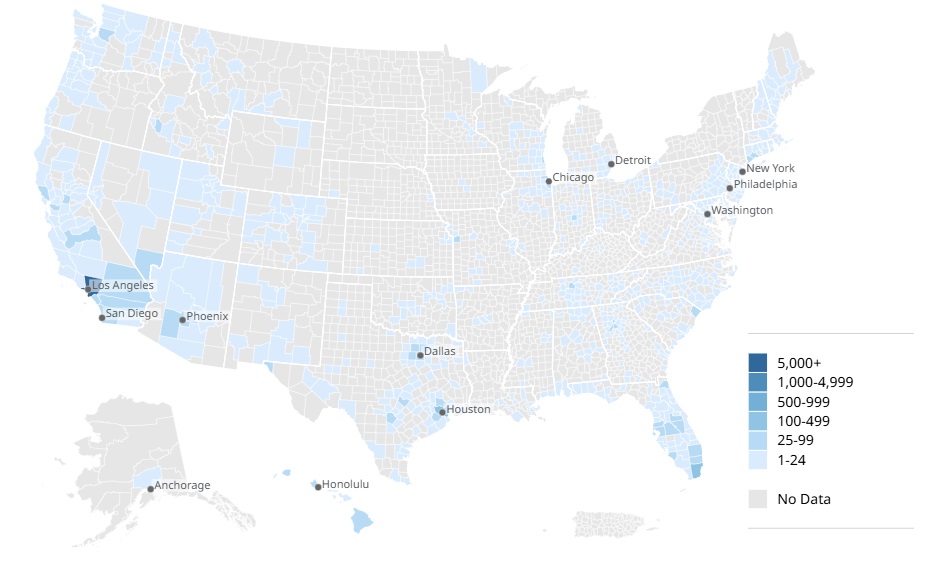
HomeXpress originated 5,982 mortgages last year, most of them (53 percent) refinancings, according to Home Mortgage Disclosure Act (HMDA) records analyzed by iEmergent.

HomeXpress 2024 loan originations by county

HomeXpress 2024 loan originations by county. Source: iEmergent

Most of the company’s business tracked by HMDA was generated in three states — California ($623 million in originations), Florida ($412 million) and Texas ($280 million) — with other contributors including Arizona ($81 million), Washington ($66.6 million) and Nevada ($58.8 million).

As a Chimera subsidiary, HomeXpress will be positioned to expand its product offerings and grow strategically, Walker said.

Kyle Walker

“By combining platforms and assets, Chimera and HomeXpress are poised to deliver enhanced value to HomeXpress’ borrowers and further strengthen its relationships with its many business partners,” Walker said in a statement.

A&D Mortgage — which claims to be the nation’s biggest provider of non-QM mortgages — last month announced it had acquired loan servicer Mr. Cooper’s wholesale and non-delegated correspondent mortgage business.

The integration of Mr. Cooper’s third-party originations team provides A&D Mortgage’s partners with access to a suite of more than 20 mortgage programs, including agency, government, jumbo and non-QM, with enhanced operational efficiency and “industry-best turnaround times,” the company said in announcing the deal.

A&D Mortgage originated 8,369 loans in 2024 totalling $2.93 billion, and two-thirds of those loans were purchase loans taken out by homebuyers, according to iEmergent’s HMDA records.

“Broadly speaking, we like non-QM origination businesses because the returns can be high, and it thematically represents a growth zone of the mortgage market catering to non-traditional situations and self-employed borrowers,” BTIG analyst Eric Hagen said in a note to clients. “The risk is a disruption in credit markets and a widening of securitization spreads which leaves issuers and loan aggregators saddled with warehousing more interest rate and credit risk on their balance sheets.”

Hagen said Chimera’s expectation that HomeXpress could fund $3.5 billion in loans this year implies that the company might need to raise $200 million to $300 million in capital if it were to keep those loans on its balance sheet.

While BTIG is neutral on Chimera, the deal valuation casts other mortgage REITs with non-QM lending businesses in a favorable light, Hagen said. BTIG has a “buy” rating on Chimera competitors Angel Oak Mortgage REIT, Ellington Financial and Rithm Capital Corp.

Editor’s note: This story has been updated with insights from BTIG analyst Eric Hagen.

Get Inman’s Mortgage Brief Newsletter delivered right to your inbox. A weekly roundup of all the biggest news in the world of mortgages and closings delivered every Wednesday. Click here to subscribe.

Email Matt Carter