When you’re buying a home in Texas, the house gets most of the attention—but the land it sits on can cause some of the biggest surprises. Texas property lines, recorded easements, and the type of survey you receive can affect everything from where you can build a fence to whether a neighbor can legally use part of your driveway.
This matters even more in today’s Texas market, where buyers may be moving quickly, relocating from out of state, or purchasing in newer suburbs where lots are tight. A clear understanding of property boundaries Texas and a smart approach to a property survey Texas can help you avoid expensive disputes, delays at closing, and stressful surprises after you move in.
What are Texas property lines, and why don’t they always match fences or landscaping?
Texas property lines are the legal boundaries described in recorded documents—typically a subdivision plat and a metes-and-bounds or lot-and-block legal description. They’re not defined by what “looks like” the yard, where the grass changes, or where a fence happens to sit. In many neighborhoods, fences and landscaping are installed for convenience or aesthetics, not as a precise boundary marker.
This is one of the most common misconceptions first-time buyers have: “The fence is the property line.” In reality, a fence on property line Texas rules depend on what your survey and title documents say. A fence might be close to the boundary, but it can also be several inches—or several feet—off, especially on older properties or where multiple fence replacements happened over decades.
Common reasons the fence doesn’t match the legal boundary
In Texas, it’s normal to see small (and sometimes significant) differences between physical features and the legal boundary. Here are a few frequent causes:
- Fence installed inside the lot: Owners often set fences slightly inward to avoid disputes or to clear utility easements.
- “Follow-the-old-fence” replacements: A new fence gets built where the old one stood—even if the old one was off.
- Sloped lots, creek lines, or irregular shapes: In parts of Central Texas and the Hill Country, topography can lead to creative fence lines that don’t match recorded lines.
- Corner-lot confusion: Side-yard and street-side setbacks can make it unclear where the lot ends and the right-of-way begins.
- Landscaping as a visual boundary: Hedgerows, rock borders, and garden beds are often placed without a survey.
Another Texas homebuyer tip: don’t assume the curb, sidewalk, or a tree line marks your boundary. Street right-of-way can extend farther than you expect, and corner lots often have more complicated setbacks and easements that affect usable space.
What does a property survey in Texas show (and what can it reveal before closing)?
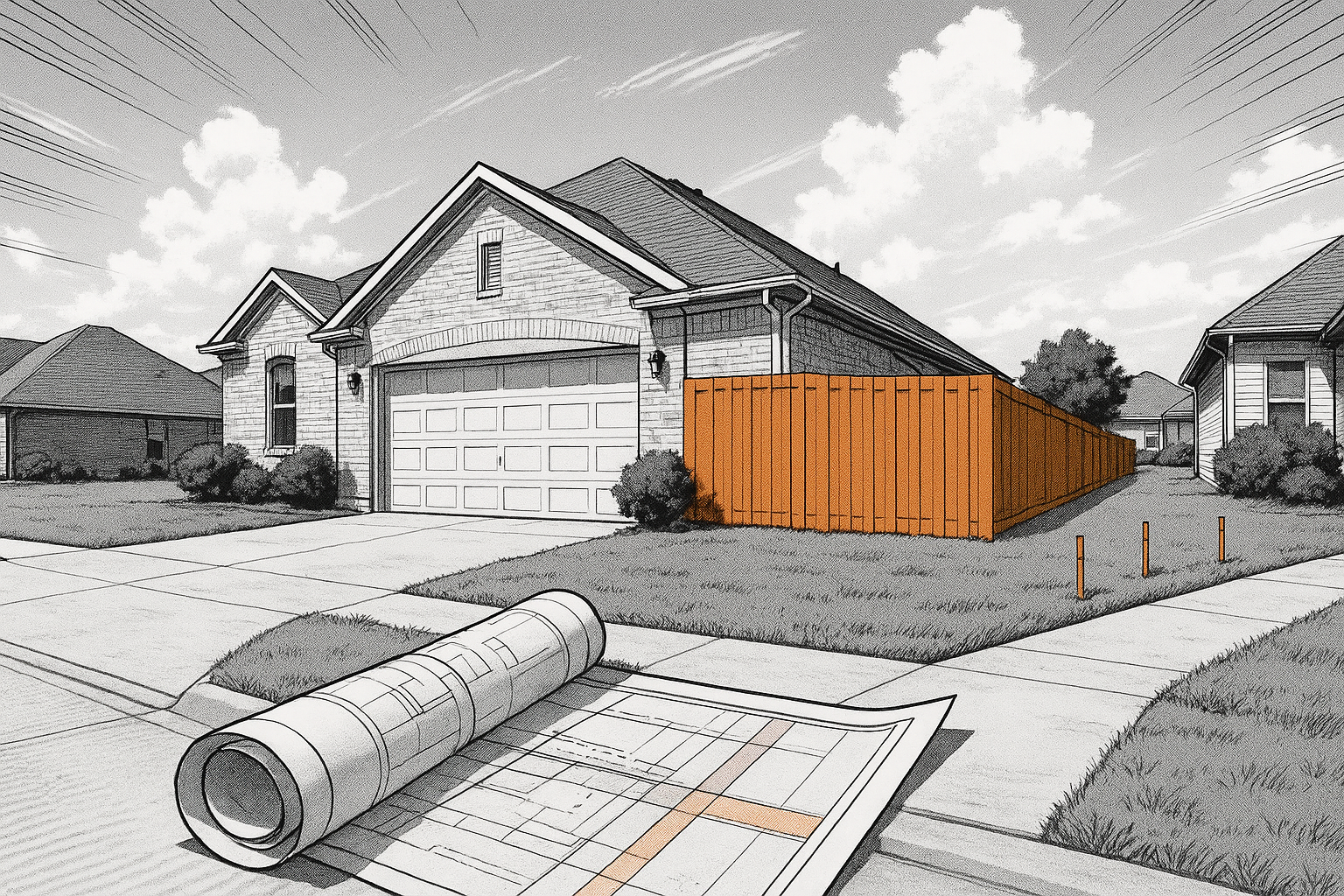
A property survey Texas buyers receive is a drawing prepared by a licensed Texas surveyor that maps boundary lines and key features. Texas real estate surveys can vary by type and detail, but the best surveys for buyers clearly show improvements (like the home, driveway, fences, patios) in relation to the lot lines and easements.
In a land survey when buying a house, you’re typically looking for three big things: whether improvements appear to cross boundary lines, whether there are encroachments from neighbors onto the property (or vice versa), and what recorded easements affect the lot. This is where a survey can save you from surprises, especially in fast-moving metro areas like Dallas-Fort Worth, Austin suburbs, Houston master-planned communities, and San Antonio’s rapidly growing edges.
Issues a Texas real estate survey can uncover
Before you get too far into buying a home in Texas, it helps to know what the survey might flag:
- Encroachments: A neighbor’s fence, shed, driveway, or even roof eave crossing the boundary.
- Setback problems: A patio cover, garage extension, or addition built too close to the lot line.
- Easement conflicts: A pool, fence, or tree planted inside a utility easement Texas property owners must keep accessible.
- Driveway location questions: Shared driveways or drive approaches that cross lot lines can point to an access easement Texas buyers need to review.
- Lot shape surprises: A “pie-shaped” cul-de-sac lot can have a narrower backyard than it looks from the street.
Buyers also ask if they can “use the seller’s old survey.” Sometimes you can, but it depends. If the survey is outdated, missing improvements, or the title company won’t accept it without an affidavit, you may need a new one. In some transactions, the title company survey Texas process involves the seller providing an existing survey plus a T-47 affidavit (a form stating no changes were made). Your agent and title team can guide you, but the key is this: the survey must match the current reality of the property.
Also remember: a survey is not the same thing as an appraisal or a home inspection. An appraisal supports value for the lender. An inspection evaluates condition. A survey focuses on property boundaries Texas and recorded restrictions or rights affecting the land.
How do easements in Texas real estate affect what you can do with a property?
Easements in Texas real estate are legal rights that allow someone else limited use of part of a property. The most common easements relate to utilities, drainage, and access. They typically “run with the land,” meaning they remain in place even when the property changes ownership.
Understanding property easements matters because an easement can limit where you can build, how you can landscape, and what you can fence. A yard that looks wide-open on a showing day may have a sizable easement area that must remain accessible or unobstructed.
Utility easements in Texas: the most common buyer surprise
Utility easements Texas homeowners encounter often run along the rear or side lot lines and allow utility companies access for power lines, cable, gas, water, or sewer. In many Texas subdivisions, rear-lot utility easements are standard—even if you never see workers back there.
Practically speaking, a utility easement doesn’t always mean “you can’t use that space,” but it can mean:
- You may be restricted from building permanent structures (like a garage, detached office, or room addition) within the easement.
- Fences may be allowed, but gates, locks, or certain materials might be discouraged if they block access.
- Landscaping can be risky—large trees planted over utility lines may later be removed or damaged during repairs.
- If the utility company needs access, they may enter the easement area and aren’t responsible for every aesthetic impact.
In areas like Houston (with significant drainage infrastructure) and North Texas (with dense utility corridors in newer developments), easements can be a major factor in backyard usability. A survey and title review help you see these clearly.
Access easements in Texas: driveways, shared roads, and “how do I get there?”
An access easement Texas buyers should pay special attention to is any easement granting the right to cross property to reach another parcel. You’ll see these more often with rural properties, Hill Country tracts, or homes on private roads outside city centers—but they also appear in suburban setups with shared driveways.
Access easements can be perfectly normal, but you want clarity on details like who maintains the driveway, who can use it, whether it’s exclusive or shared, and whether it allows utility installation in the same corridor. If a driveway crosses a boundary without a recorded easement, that can be a red flag worth addressing before closing.
Another often-overlooked category is drainage easements. In parts of Texas where heavy rains and flash flooding are real seasonal concerns, drainage easements may keep water flowing away from homes. Blocking or altering them can create neighbor conflicts—and sometimes city enforcement issues.
What are common property line disputes in Texas, and how can buyers avoid them?
Property line disputes Texas homeowners run into often start small: a fence built a little “over,” a neighbor parking on the edge of a lot, or a driveway that’s been used for years without anyone questioning it. Then a sale happens, a new owner wants to build a pool, or a fence is replaced—and suddenly everyone wants proof of where the line really is.
Texas is a property-rights-focused state, but outcomes still depend on recorded documents, survey evidence, and sometimes legal concepts like boundary agreements or claims based on long-term use. The important takeaway for buyers is simple: don’t wait until after closing to discover you have a boundary problem.
Fence, driveway, and neighbor issues to watch for during showings
As part of your Texas home buying guide mindset, keep an eye out for these situations and ask questions early:
- Fence lines that zig-zag or abruptly change direction: That can signal a past attempt to “split the difference” without a formal boundary agreement.
- A neighbor’s landscaping maintained on “your” side: It may indicate the practical use doesn’t match the legal line.
- Shared driveways without clear separation: Ask whether a recorded easement exists and how maintenance is handled.
- Sheds, garages, or carports close to the lot line: A survey can confirm whether there’s an encroachment.
- Corner lots with fences near sidewalks: The fence may be inside the property line to account for right-of-way or easements.
If the survey reveals an encroachment, it doesn’t always kill the deal—but it does change the conversation. Options might include negotiating repairs, obtaining an encroachment agreement, requesting a boundary agreement, adjusting price, or in some cases requiring the issue to be cured before closing. Your agent and title company can help coordinate next steps, but the earlier you identify the issue, the more options you have.
A practical Texas real estate tip: if you plan to add a pool, outdoor kitchen, or detached structure, pay even closer attention. Setbacks, easements, and boundary lines all affect where you can build. What feels like a “big backyard” can become much smaller once you factor in utility easements and required offsets from fences and the home.
What questions should Texas buyers ask their agent or title company about surveys and easements?
When you’re buying a home in Texas, your real estate agent can help you spot red flags, but your title company and survey documents usually provide the official map of what’s recorded. The goal is to confirm that what you think you’re buying matches what you’re legally buying—and to make sure easements and boundary issues won’t interfere with how you plan to use the property.
Here are practical questions—straightforward, buyer-friendly, and effective for getting clarity before closing.
- Will the seller provide an existing survey, and will the title company accept it? Ask if a T-47 affidavit is required and whether the survey is recent enough.
- If we need a new survey, what type of Texas real estate survey is appropriate? Confirm timing, cost, and how it fits the option period or closing timeline.
- Does the survey show any encroachments or boundary conflicts? Specifically ask about fences, driveways, patios, and roof overhangs.
- What easements are shown on the survey, and what do they allow? Focus on utility easements Texas properties commonly have, drainage easements, and any access easement Texas owners may be subject to.
- Are there restrictions on fences or gates within easement areas? This is especially relevant if you want a fully enclosed yard for pets.
- Is there a shared driveway or shared access, and is it documented? Ask for the recorded easement language and maintenance expectations.
- Does the title commitment list exceptions related to easements or boundary matters? This is where your title company survey Texas review can highlight what is and isn’t covered.
- What would trigger a property line dispute later? Ask your agent what they’ve seen locally in that neighborhood or subdivision—especially with older areas where fences have shifted over time.
One more Texas homebuyer tip: keep your future plans in mind. If you’re dreaming of a workshop, a larger driveway, a pool, or even just moving a fence, ask your agent to help you verify feasibility with the survey, HOA rules (if applicable), and any city setback requirements. Surveys and easements aren’t just paperwork—they shape how you’ll live on the property.
At the end of the day, the simplest way to protect yourself is to treat the survey and title review as essential parts of due diligence, not last-minute closing items. A clear view of Texas property lines, a solid property survey Texas buyers can rely on, and a plain-English understanding of easements in Texas real estate can help you close with confidence—and avoid unpleasant surprises after move-in.