by Craig C. Rowe | May 9, 2025 | Industry, News Feed
Bigger. Better. Bolder. Inman Connect is heading to San Diego. Join thousands of real estate pros, connect with the power of the Inman Community, and gain insights from hundreds of leading minds shaping the industry. If you’re ready to grow your business and invest in yourself, this is where you need to be. Go BIG in San Diego!
As if listing agents don’t have a hard enough time getting sellers to make a few market-friendly improvements to their home, reports from the construction industry suggest the Trump administration’s tariff policy is going to raise the hurdle even higher.
HomeAbroad, a company that provides a range of services for foreign buyers to invest in American real estate, including “fix and flip” mortgages, issued a report stating that “new tariffs will raise house renovation costs by $7,840 on average in 2025, a 15 percent increase, due to the Trump administration’s April 2025 hikes on imported materials.”
Cost to update that kitchen? Nearly 78% more
Kitchens are one of the most common areas buyers hope to see updated when touring a listing. HomeAbroad found that doing so will cost consumers an additional 77.5 percent as a result of tariffs on quartz countertops, refrigerators and stainless steel sinks imported from China.
HomeAbroad’s report on kitchens assumes a 10’ x 10’ space and uses cost of materials findings from HomeGuide.com. It lists tariff-impacted prices for
- cabinets (+10 percent)
- granite (+10 percent) marble (+10 percent) or quartz (+245 percent) countertops
- ceramic tiles (+10 percent)
- refrigerator (+245 percent)
- stainless steel sink (+245 percent)
- vinyl flooring supplied by China (245 percent)
Want a new bathroom? Expect an increase of 41.7 percent, “mainly due to a high 245 percent tariff on Chinese quartz countertops and plumbing parts,” HomeAbroad said.
The most heavily hit items — at the moment — are plumbing and lighting fixtures, vinyl flooring and appliances, which are facing a 245 percent tariff. That rate has been paused for a number of items for 90 days, including things like cement, tile and kitchen cabinets, which sit at 10 percent.
‘Buy American’ can result in shortages and delays
“These high tariffs are shaking up supply chains, with Chinese materials playing a big role,” HomeAbroad stated. “The added costs could push contractors toward domestic options, but with 27 percent of imports from China, shortages and delays loom as the market adjusts. The 90-day pause, ending July 4, 2025, holds non-Chinese tariffs at 10 percent, but if it lifts, rates could jump to 46 percent for Vietnam, 32 percent for Taiwan, 26 percent for India, and 20 percent for Spain, adding $500–$2,300 to a $5,000 order.”
The Trump administration has wavered erratically on tariff timelines and amounts, as well as on which specific materials are subject to what amount and why, making costs exceptionally difficult to forecast.
Tariff impacts on new construction and fix-and-flips
The National Association of Home Builders (NAHB) has weighed in, too, stating on its website that it estimates $14 billion of the $24 billion spent on goods for both new multifamily and single-family housing in 2024 were imported, “meaning approximately 7 percent of all goods used in new residential construction originate from a foreign nation.”
Its Westlake Royal Remodeling Market Index (RMI), which measures national remodeler sentiment, showed drops across the board, except in one metric that stayed the same: small remodeling projects (under $20,000).
Robert Fragoso is a Southern California real estate investor and coach who builds and flips homes. He was a key player in the growth of Anchor Loans, which finances new builds, renovation and flip projects.
He told Inman in an email that he is optimistic about the greater real estate market, and, as a new-home builder, he said he’s taking “the wait-and-see approach.”
As for renovations and fixer-uppers, Fragoso’s models tell him that tariffs “will have a net 5 [percent to] 7 percent increase in the cost of the repairs, notwithstanding opportunistic retailers using tariffs as a way to increase profit,” he said. “On the new construction SFR front, I expect the increase to be more like 6 [percent to] 10 percent overall increase in the cost of building.”
He also told Inman that the fear some have of costs simply being pushed down to the consumer is justified.
“Generally speaking, the ones that will get hurt on the new projects going forward is not us, the builders or the developers, but the sellers of the homes we are either tearing down to rebuild or just remodel because this cost will directly come off of the amount we can pay for the property as we will try and maintain our profit margins,” he said.
Early concerns about rising costs, hesitation from homeowners
HouseAmp is a fintech company that works with homeowners, agents, contractors and lenders to finance and coordinate pre-sale home renovations. In an email to Inman, CEO Rick Hennessey said rumblings are being heard, but that it hasn’t yet experienced any tangible changes.
“While HouseAmp doesn’t directly track tariff data, we work closely with contractors and service providers nationwide, and we’re starting to hear early concerns about rising material costs — particularly for products with international components like cabinetry, flooring and appliances,” he said.
“We haven’t seen a measurable slowdown in project volume yet, but if tariffs continue to tighten supply chains, we do expect more pricing pressure to hit homeowners and renovation timelines later this year. In particular, we anticipate increased demand for financing options as budgets stretch.”
Like HouseAmp, Revive’s tech-forward business model is predicated on agents helping sellers understand that interior updates will net more money upon a sale. It helps brokerages market services and take a hands-on approach with project execution. It also facilitates external improvements when necessary.
Revive CEO Michael Alladawi told Inman the impact of tariffs is tightening the screws on an already stressed environment.
“We’re seeing consistent 10 [percent to] 20 percent increases in costs for core materials like cabinetry, appliances and fixtures. This inflation is leading to hesitation from homeowners and risk buffering from contractors who are adjusting bids to protect against future volatility.”
The company published a report finding that presale renovations are becoming a popular method to make a listing look more inviting to the market. The report found that sellers see an additional profit of $145,000 after a home update, among other benefits.
The paper reports an ROI average of 112 percent and a home value jump 28 percent as a result of a strategic renovation. The company does make clear that individual market metrics impact its service end result and that it’s important for sellers to consider what parts of a home need to be updated. For instance, a primary bathroom re-do may outperform a dining room makeover.
Should tariffs hit as expected, agents will need to run some intricate math to determine if the added cost will result in comparable, pre-tariff ROI. If the sale price rises above comps, the house could face headwinds once on the market.
To that end, Revive is instituting cost-saving measures for clients by stockpiling common items and working as often as possible with local suppliers. If there’s anything shining along the edges of the looming tariff front, it’s that renovations are becoming more deliberate and strategic, albeit smaller in scope.
Alladawi also said that newly renovated homes offer worthy alternatives to new builds.
“The full impact of these cost pressures is still unfolding, but what we’re seeing may be the early signs of a recalibration in the renovation economy,” he said.
To make matters even worse for update-minded sellers, cost-conscious buyers, their agents and anxious contractors, there’s little certainty to any of this. The tariff rate on Chinese imports could change in the blink of a Truth Social post. Like the one this morning, May 9, moments before this article was published:
“80% Tariff on China seems right! Up to Scott B.” President Donald Trump via Truth Social, morning of May 9, 2025.
Email Craig Rowe
This post was originally published on this site
by Lillian Dickerson | May 9, 2025 | Industry, News Feed
The superseding indictment filed in court on Thursday adds one count of sex-trafficking of a minor, among other charges, and brings the total victim count up to six from the two identified in the initial indictment.
Bigger. Better. Bolder. Inman Connect is heading to San Diego. Join thousands of real estate pros, connect with the Inman Community, and gain insights from hundreds of leading minds shaping the industry. If you’re ready to grow your business and invest in yourself, this is where you need to be. Go BIG in San Diego!
A superseding indictment filed by federal prosecutors in Manhattan on Thursday brings six additional charges against former luxury real estate brokers Tal and Oren Alexander and their brother, private security executive Alon Alexander, in advance of their trial scheduled for January 2026.
The initial indictment filed against the brothers in December included three charges: one count of conspiracy to commit sex-trafficking and two counts of sex-trafficking of two separate victims by force, fraud or coercion. The superseding indictment adds three new counts of sex-trafficking by force, fraud or coercion of three additional victims; one count of sex-trafficking of a minor by force, fraud or coercion; and two counts of inducement to travel to engage in unlawful sexual activity. In total, six victims are named.
The brothers were arrested by the feds in Miami in December 2024 and were moved in January of this year to the Metropolitan Detention Center in Brooklyn, where rapper Sean “Diddy” Combs and alleged UnitedHealthcare CEO murderer Luigi Mangione were also being held.
The superseding indictment says the brothers and their associates knowingly conspired to force or coerce six female victims to engage in commercial sex acts between about 2009 and 2021 in the Southern District of New York and beyond.
Milton Williams, Jr. and Deanna Paul of Walden Mach Haran & Williams LLP, who are representing Tal, said the superseding indictment would not materially change things in the case.
“The superseding indictment changes nothing,” the attorneys said in a statement sent to Inman. “It’s a reheated version of the same case — and still does not include conduct that amounts to federal sex trafficking. The government is trying to stretch a statute beyond recognition to fit a narrative, not a crime.”
Richard C. Klugh of Klugh Wilson LLC, who is representing Oren, told Inman in an email, “These new accusations, like the previous ones, are meritless, and reflect a failed prosecutorial effort to salvage a factually and legally unfounded case built on readily disprovable claims. Any new spin offered in these charges does nothing to diminish our client’s innocence as has been shown in passing a rigorous polygraph examination.”
Alon’s lawyer, Jason Goldman, said in an email that he had also passed a lie detector test administered by a former FBI polygraph examiner, “establishing his innocence to the accusations in the earlier version of the indictment.”
“To our knowledge, not a single alleged accuser, including those in the new version of the indictment, has passed an FBI polygraph exam, which the government routinely uses to test the veracity of its own law enforcement agents,” he added.
The charges regarding the sex-trafficking of a minor involve Tal and Alon. Three of the counts in the new indictment name Tal alone as the perpetrator.
The brothers were denied release on house arrest earlier this year by Judge Valerie Caproni because they were deemed a flight risk due to their international connections, and a danger to the community.
Oren and Alon, and family friend Ohad Fisherman, also face state rape charges in Florida. Oren has been charged with three counts of sexual battery and Alon and Fisherman have been charged each with one count of sexual battery.
The Alexanders are expected to be taken back into Manhattan federal court soon to be arraigned on the new charges. It is unclear if the superseding indictment will change the timeline of their federal trial.
On top of the criminal charges against them, the Alexander brothers also face lawsuits against them filed by dozens of women who have alleged the brothers are guilty of sexual assault. The majority of the lawsuits were filed in New York under an extension of a city law that allowed alleged victims of gender-motivated violence to sue their supposed perpetrators, no matter how long ago the alleged act of violence occurred. Victims were allowed to file lawsuits through the end of February 2025.
Update: This story was updated after publishing with a statement from Alon Alexander’s lawyer.
Get Inman’s Luxury Lens Newsletter delivered right to your inbox. A weekly deep dive into the biggest news in the world of high-end real estate delivered every Friday. Click here to subscribe.
Email Lillian Dickerson
This post was originally published on this site
by Dani Vanderboegh | May 9, 2025 | Industry, News Feed
Turn up the volume on your real estate success at Inman On Tour: Nashville! Connect with industry trailblazers and top-tier speakers to gain powerful insights, cutting-edge strategies, and invaluable connections. Elevate your business and achieve your boldest goals — all with Music City magic. Register now.
Every Friday, Inman Service Editor Dani Vanderboegh rounds up the most popular, most read, most critical stories of the week to give you a quick catchup on the big headlines you might have missed in the hustle and bustle of the workweek. Here’s this week’s Top 5 as chosen by our readers.
P.S. Don’t miss The Download, our weekly column that breaks down one of the week’s top stories and equips you with what you’ll need to meet next Monday head-on.

Hanna slammed the National Association of Realtors’ MLS rules in a conversation with Inman prior to the Gibson settlement last week, saying Clear Cooperation and IDX limit broker innovation.

Howard Hanna’s CEO Howard “Hoby” Hanna envisions offering “a deeper level of retail experience” after the NAR rule change, but chafes at the trade group “telling us how to operate our business.”

FHFA Director Bill Pulte tells “crypto influencer” he’s signed more than 80 orders revamping policies and procedures at the mortgage giants, only 12 of which have been made public.

While you’re optimizing your online presence, don’t stop at social media. Jimmy Burgess and Julie Tomlinson help you start up (or rethink) your Google Business Profile.

Credit: Ron and Patty Thomas / Getty Images
Michael Mercurio, the former CEO of the Greater San Diego Association of Realtors and San Diego MLS, alleges wrongful termination as a separate suit against him is set to go to trial in October.
Email Editorial
This post was originally published on this site
by Dani Vanderboegh | May 9, 2025 | Industry, News Feed
Turn up the volume on your real estate success at Inman On Tour: Nashville! Connect with industry trailblazers and top-tier speakers to gain powerful insights, cutting-edge strategies, and invaluable connections. Elevate your business and achieve your boldest goals — all with Music City magic. Register now.
Every Friday, Inman Service Editor Dani Vanderboegh rounds up the most popular, most read, most critical stories of the week to give you a quick catchup on the big headlines you might have missed in the hustle and bustle of the workweek. Here’s this week’s Top 5 as chosen by our readers.
P.S. Don’t miss The Download, our weekly column that breaks down one of the week’s top stories and equips you with what you’ll need to meet next Monday head-on.
Hanna slammed the National Association of Realtors’ MLS rules in a conversation with Inman prior to the Gibson settlement last week, saying Clear Cooperation and IDX limit broker innovation.
Howard Hanna’s CEO Howard “Hoby” Hanna envisions offering “a deeper level of retail experience” after the NAR rule change, but chafes at the trade group “telling us how to operate our business.”
FHFA Director Bill Pulte tells “crypto influencer” he’s signed more than 80 orders revamping policies and procedures at the mortgage giants, only 12 of which have been made public.
While you’re optimizing your online presence, don’t stop at social media. Jimmy Burgess and Julie Tomlinson help you start up (or rethink) your Google Business Profile.
Credit: Ron and Patty Thomas / Getty Images
Michael Mercurio, the former CEO of the Greater San Diego Association of Realtors and San Diego MLS, alleges wrongful termination as a separate suit against him is set to go to trial in October.
Email Editorial
This post was originally published on this site
by Matt Carter | May 9, 2025 | Industry, News Feed
Blend posted a $9.4 million loss in the first quarter as the slow pace of home sales pulled revenue from its mortgage software suite down 22 percent from Q4. Its consumer banking suite brought in $9.6 million.
Bigger. Better. Bolder. Inman Connect is heading to San Diego. Join thousands of real estate pros, connect with the Inman Community and gain insights from hundreds of leading minds shaping the industry. If you’re ready to grow your business and invest in yourself, this is where you need to be. Go BIG in San Diego!
The slow pace of home sales during the first quarter dented mortgage revenue for technology provider Blend Labs Inc., but growth in its consumer banking services helped the company trim its losses from a year ago.
The San Francisco-based banking software and services provider grew Q1 revenue 12 percent from a year ago, to $26.8 million, enabling it to trim its loss for the quarter to $9.4 million, down from $20.7 million a year ago.
While Blend expects Q2 revenue to bounce back to between $30.5 million and $32.5 million, it has entered exclusive negotiations to sell its Title365 business to “a leading title and mortgage services provider” as it pursues a “software-first” business model.
Blend went public in 2021 and acquired a 90 percent stake in national title insurance and settlement services provider Title365 from Mr. Cooper Group for $422 million. But rising mortgage rates curtailed demand for title insurance.
Company executives said Thurseay that they closed almost three times more deals with clients in Q1 than they did a year ago, including a top 25 credit union. With the signing of another loan servicer, Blend now counts 10 of the top 20 U.S. loan servicers as clients.

Nima Ghamsari
“With a pipeline nearly double what it was a year ago—and demand coming from across the industry, from leading banks and mortgage servicers to independent mortgage banks and credit unions—it’s clear the need for effortless, personalized banking and lending is only growing,” Blend co-founder and CEO Nima Ghamsari said in a statement.
Shares in Blend, which in the past year have traded for as little as $2.08 cents and as much as $5.52, were up slightly from Thursday’s close of $3.29 in after hours trading.
Mortgage software revenue down 22% from Q4
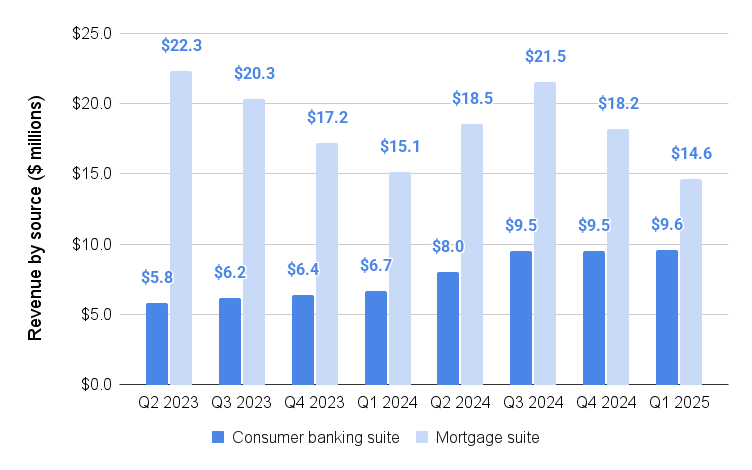
Blend’s mortgage suite brought in $14.6 million in revenue during the first quarter of 2025, down 22 percent from the previous quarter and 3 percent from a year ago.
With revenue from consumer banking up 45 percent from a year ago, to $9.6 million, Blend’s mortgage suite generated 60 percent of software platform revenue, down from 79 percent in Q2 2023.
The company brought in another $2.5 million in professional services revenue.
“In the first quarter of 2025, we saw a decrease in mortgage transactions on our software platform compared to the last quarter of 2024, which can be attributed to seasonal trends, continued high interest rates, decreased housing affordability, and uncertain worldwide political and economic conditions,” the company said in its quarterly earnings report.
“We expect that the aggregate industry mortgage originations will be higher in the second quarter of 2025 relative to the first quarter based on application volume observed to date through our customer base and our analysis of the latest relevant macroeconomic data.”
Every mortgage funded by Blend’s clients represented about $93 in economic value for the company, including $78 from software revenue, $10 from partnerships, and $5 from add-on products, the company said.
Last year, Blend’s clients handled nearly $1.2 trillion in loan applications, with 18 of the top 50 U.S. mortgage originators relying on the company’s services.
Last month Blend announced it was expanding a partnership with CrossCountry Mortgage to drive innovation for independent mortgage banks (IMBs), naming former Compass Mortgage executive Justin Venhousen as appointed general manager of Blend’s newly-formed IMB division.
Get Inman’s Mortgage Brief Newsletter delivered right to your inbox. A weekly roundup of all the biggest news in the world of mortgages and closings delivered every Wednesday. Click here to subscribe.
Email Matt Carter
This post was originally published on this site
by Craig C. Rowe | May 9, 2025 | Industry, News Feed
Anyone is a digital homebuying and selling solution for agents and consumers looking to improve the traditional sales experience.
Bigger. Better. Bolder. Inman Connect is heading to San Diego. Join thousands of real estate pros, connect with the Inman Community, and gain insights from hundreds of leading minds shaping the industry. If you’re ready to grow your business and invest in yourself, this is where you need to be. Go BIG in San Diego!
Anyone is an end-to-end buying and selling solution.
Platforms: Web; mobile-responsive
Ideal for: Homebuyers, sellers and all agents
Top selling points:
• Buyer/seller involvement
• True agent matching
• Agent compensation flexibility
• Multiple forms of listing input
• Offer flow experience
Top concern(s):
I’m going to need to see its full integration of e-notarization and on-board forms completion before giving it my highest review. Also, the company’s messaging needs to be carefully tailored to ensure adoption.
What you should know
Anyone is an end-to-end digital homebuying and selling experience. It starts at agent selection and home search or listing agreement and flows through to closing coordination. It ends for now before deed recording.
The light, fast user experience is based on full transparency for all stakeholders and driven by the idea that the consumer is still not best served by what exists now. Software features reflect current industry trends such as buyer agent commission format and negotiation, eliminating the “dead time” that occurs when a deal crashes before closing and even the Clear Cooperation politics impacting what properties can be viewed.
Few television critics argue about the greatness that was the “Friday Night Lights” series. One particular storyline followed an ex-quarterback turned aspiring artist’s assigned internship with a reclusive local scrapyard sculptor. In a moment of desperate self-doubt, the student asked the reticent artist why he chose him, only to watch his hopeful mentor tear apart a completed work and show a small corner of it, “This, this is why I chose you.” Or something to that effect.

This comparison doesn’t completely fit with what I see in Anyone because there is actually a lot to like, but it’s to demonstrate that what stood out to me in our demo was the little things tucked into its deal workflow that make it one of my favorite business productivity solutions of 2025.
During Anyone’s agent selection workflow, which encourages consumers to find an agent based on regional market performance data, not who their dad knows, it asks individuals to “Choose a Package.” This is where they will select if they need buyer or seller representation, and it lists what the agent provides in a bulleted list, a clean, clear services breakdown that the agent can edit upon onboarding.
This feature challenges the agent to succinctly detail what they’re good at directly for the public to digest. It also helps the agent justify what they provide in exchange for their compensation model.

On that note, Anyone makes compensation agreements very clear. Buyer agents can offer to charge a fixed price or be paid via traditional commission. The content card surfaces as part of the relationship onboarding via agreement in the Communications dashboard.
I really like that this still very controversial industry issue is so smartly made a seamless part of the business process. It normalizes the discussion. Savvy agents can use this to test which payment models resonate with their leads or exclusively offer one depending on deal conditions. The consumer has to view and confirm the agreement, and it’s then made part of the paperwork sent to the listing agent.
Should a deal fall apart during escrow, it takes merely one click of the Return to Market feature to send the listing back to the open market and alert all previously interested parties that it’s in play. There’s no dead time to “reassess marketing” or hide some invisible stigma about a home falling out of escrow.
Anyone surrounds these minor but critical features with a user interface that is nimble, consumer-facing and what I can only assume would be a joy to work with over time. It includes an in-app home search that offers a very similar experience as one would find in any of the major portals, minus the lead sales or controversy over the property’s publishing.
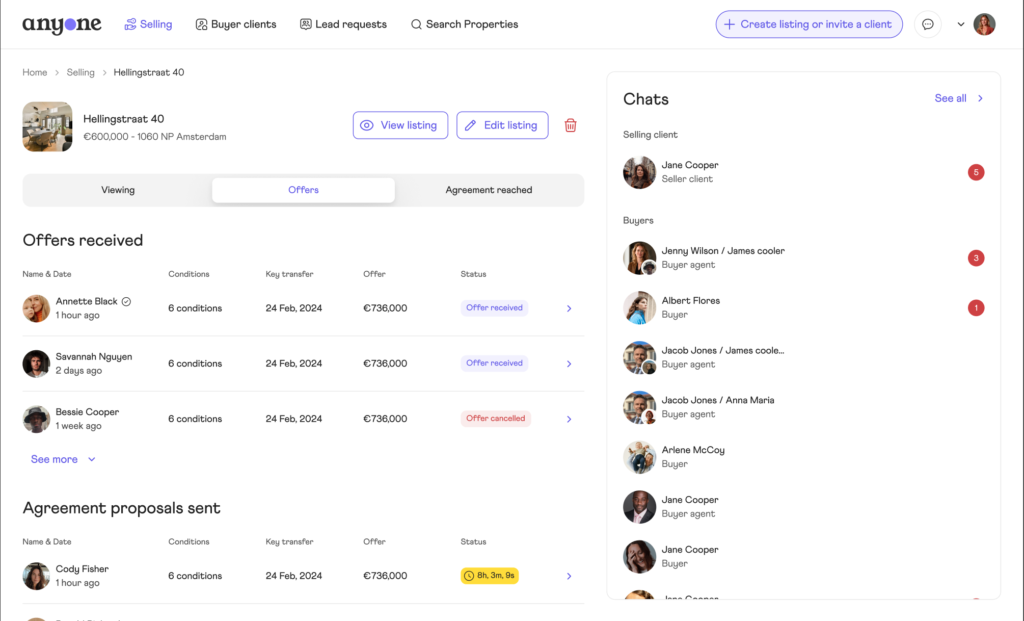
There are calls-to-action for the buyer to schedule a showing on their own — no sending their agent a URL or back-and-forth calendar hassles. When the buyer activates the booking tool, the agent is notified of the details. And so is the seller and their listing agent. Everyone stays in the loop.
The agent or seller can import listings easily via an existing URL or by manual input in a traditional fashion with image uploads and text descriptions. The company is working on a tool for AI-generated listing content. Anyone has 31 million properties published on its site, and database of more than 300 million records it can use to quickly get a home online. However, the seller needs an agent to formally publish and activate their property, one way Anyone ensures the agent remains a part of the solution.
Once in the search, both the agent and the seller can view its ongoing market interest, number of showings, etc., talk about showing results and consider changes. It’s all vertical, all in one place. Anyone helps users eschew multiple third-party communication methods and tools, ensuring all the data generated from the conversation remains part of the transaction, contributing to the ongoing history of the deal.

The offer flow is a smooth back-and-forth between parties with simple terms entry forms, multiple levels of approval before offer submission, opportunities to add documents, view seller disclosures, summarize terms, set deadlines and generate counter offers.
Like many online offer managers, Anyone has its parties finalize formal documents offline and upload them. However, the company is working on digital forms integrations and an e-notarization add-on to push the digital process deeper into the experience.
My discussion with the founders of Anyone, who sold a domain transaction system to GoDaddy, touched on a number of issues they’d like to see addressed in the real estate sales ecosystem. They want to see more consumer involvement, specifically from sellers, more transparency and less information hoarding, agreeable collaboration between all groups and an adoption of the idea that agents should be able to compete on price, and communicate with outcomes.
The latter bit, “communicate with outcomes,” is a precise way of saying there should be more efficiency in the process. Agents should lead with the solution, conversations should end quickly with all parties going away happy, regardless of how consequential the topic. I find those words very insightful.
The more often we communicate with the outcome, the more value we bring to the relationship. And right now, as NAR, Zillow, Compass and the MLS community bicker about who can see what when and how, the consumer is slowly being shown a better way to do it all without them.
Have a technology product you would like to discuss? Email Craig Rowe
Craig C. Rowe started in commercial real estate at the dawn of the dot-com boom, helping an array of commercial real estate companies fortify their online presence and analyze internal software decisions. He now helps agents with technology decisions and marketing through reviewing software and tech for Inman.
Article image credited to Craig C. Rowe; Canva
This post was originally published on this site