by Taylor Anderson | May 13, 2025 | Industry, News Feed
The denial by Judge Stephen Bough is the latest in a string of court losses for the two remaining real estate companies that have yet to reach settlement agreements in homeseller commission cases.
Bigger. Better. Bolder. Inman Connect is heading to San Diego. Join thousands of real estate pros, connect with the Inman Community and gain insights from hundreds of leading minds shaping the industry. If you’re ready to grow your business and invest in yourself, this is where you need to be. Go BIG in San Diego!
The two remaining real estate companies still battling lawsuits filed by homesellers lost their latest bids in court on Monday when the judge overseeing the case denied their requests to transfer the suit to their home states.
Judge Stephen R. Bough issued the order denying the requests by Berkshire Hathaway Energy and Crye-Leike to have a commission lawsuit known as Gibson transferred to Iowa and Tennessee, respectively.
“The Court holds that severing this case into multiple duplicative cases does not serve the interest of justice [or] judicial economy,” Bough wrote in his order.
The denial was the latest in a series of court losses for the firms as the number of real estate companies that weren’t covered by the National Association of Realtors settlement last year and haven’t yet reached their own settlements dwindles toward zero.
Berkshire Hathaway Energy and Crye-Leike are the two remaining real estate companies that have yet to strike their own settlement agreements in lawsuits filed by homesellers who targeted the way agents historically had been paid. Monday’s order threw their attempts to defeat the case further into question.
In December, Bough denied the companies’ requests to dismiss the case.
In March, Hanna Holdings demanded that Bough recuse himself over allegations that donations to the city council campaigns of his wife by plaintiffs’ attorneys amounted to disqualifying conflicts of interest. Berkshire Hathaway and Crye-Leike soon joined that effort, which Bough later denied.
In April, Berkshire Hathaway requested that Bough agree to transfer the case to the Southern District of Iowa, where Berkshire Hathaway Energy resides. BHE is the holding company of Berkshire Hathaway HomeServices. Its attorneys argued in their transfer request that the holding company had nothing to do with real estate and, as such, has no relation whatsoever with the state of Missouri, where the case was filed.
Crye-Leike sought to transfer the case from Missouri to the United States District Court for the Western District of Tennessee.
Earlier this month, Hanna Holdings agreed to settle the Gibson case after losing its attempts for Bough to recuse himself and to have the case transferred to Pennsylvania.
EXp and Weichert Realtors have reached settlement agreements in a separate case known as Hooper. They have yet to receive approval for those settlement agreements, and Gibson plaintiffs have fought to bring them back to the negotiating table with Gibson attorneys, accusing the two companies of cherry-picking their settlements to save money on settlement costs.
Email Taylor Anderson
This post was originally published on this site
by Lillian Dickerson | May 13, 2025 | Industry, News Feed
Corcoran asked $12 million for the Fifth Ave. duplex with sweeping Central Park views and reportedly received multiple bids that pushed the contract price above asking.
Bigger. Better. Bolder. Inman Connect is heading to San Diego. Join thousands of real estate pros, connect with the Inman Community, and gain insights from hundreds of leading minds shaping the industry. If you’re ready to grow your business and invest in yourself, this is where you need to be. Go BIG in San Diego!
Shark Tank star and Corcoran Group founder Barbara Corcoran knows how to make a deal.
The fixture of Manhattan real estate listed her Carnegie Hill penthouse last Thursday for $12 million, and the property was under contract by Friday.
Olshan Realty highlighted the deal in its weekly luxury market report, where it was the seventh priciest apartment contract signed the week of May 5-11.
“Sources say it went over the asking price with multiple bidders,” the report noted.

The converted greenhouse at 1158 Fifth Avenue | Credit: Melanie Greene
Corcoran purchased the home 10 years ago for $10 million, and the $12 million asking price is less than what she spent total on buying the property and renovating it. But, she told The New York Times that she hoped with that list price, she’d receive multiple bids — looks like she got her wish.
The five-bedroom duplex at 1158 Fifth Avenue was represented by Carrie Chiang and Scott Stewart of The Corcoran Group. The feature that first drew Corcoran to the property was stunning views of Central Park from the home’s landscaped terrace. The top floor also features a greenhouse that was converted into an indoor-outdoor dining area.

A sitting room at 1158 Fifth Avenue | Credit: Melanie Greene
During the report period, 36 homes in Manhattan asking $4 million or more went under contract, up from 33 homes the week before.
The priciest contract signed during the week was a penthouse at 15 East 30th Street that was listed for $25 million. That property is a 5,100-square-foot condo that first hit the market in September 2019 when the sponsor initially asked $23.5 million. The building, known as Madison House, includes 30,000 square feet of amenities, like a concierge, fitness center, yoga room, 75-foot lap pool, cold plunge, hot tub, garden, children’s playroom, lounge and bar. The unit itself features a 26-foot terrace and 23-foot ceilings.
Get Inman’s Luxury Lens Newsletter delivered right to your inbox. A weekly deep dive into the biggest news in the world of high-end real estate delivered every Friday. Click here to subscribe.
Email Lillian Dickerson
This post was originally published on this site
by Matt Carter | May 13, 2025 | Industry, News Feed
Bigger. Better. Bolder. Inman Connect is heading to San Diego. Join thousands of real estate pros, connect with the Inman Community, and gain insights from hundreds of leading minds shaping the industry. If you’re ready to grow your business and invest in yourself, this is where you need to be. Go BIG in San Diego!
The Trump administration will withdraw its nomination of attorney Jonathan McKernan to head the Consumer Financial Protection Bureau, as CFPB acting director Russell Vought presses forward with what Democratic lawmakers claim are efforts to dismantle the bureau.
In the latest development, Vought on Monday rescinded dozens of CFPB policy and regulatory guidance documents dating back to 2011 — including some issued during the first Trump administration — on topics including disclosure of consumer complaint data, fair lending, overdraft fees and mortgage loan servicing.
In notice published in the Federal Register on Monday, the CFPB outlined 67 guidance documents to be withdrawn pending further review, including eight policy statements, seven interpretive rules, 13 advisory opinions and 39 circulars and bulletins.
In some cases, the CFPB now claims its guidance relied on interpretations that were inconsistent with lawmakers’ intentions, or imposed compliance burdens without providing opportunities for notice and comment.
But even in cases where the bureau’s guidance is consistent with the law and provided opportunities for the public to weigh in, it’s now the bureau’s policy “to avoid issuing guidance except where necessary and where compliance burdens would be reduced rather than increased.”
While Monday’s recissions are not necessarily final — the bureau “will continue reviewing all guidance documents to determine whether they should ultimately be retained” — they won’t be enforced while the review is ongoing.
“Americans deserve an open and fair regulatory process that imposes new obligations on the public only when consistent with applicable law and after an agency follows appropriate procedures,” the CFPB said in a notice signed by Vought.
The American Bankers Association (ABA) welcomed the move, saying the CFPB has sometimes been too casual about issuing guidance that should have been subject to the more formal rulemaking process.
“While banks welcome guidance that helps them understand and comply with the law, too often in the past the CFPB has characterized something as guidance that is actually a rule Congress requires to go through the notice-and-comment process,” ABA President and CEO Rob Nichols said in a statement. “In the most egregious cases, the guidance announces expectations that exceed the CFPB’s statutory authority.”
As director of the White House Office of Management and Budget (OMB), Vought is leading the Trump administration’s efforts to downsize the CFPB.
With Elon Musk expected to step away from his unofficial role in running the Department of Government Efficiency (DOGE), it will be up to Vought to “lock in” many of DOGE’s cost-cutting efforts throughout the federal government, through avenues including the 2025 budget, eliminating job protections for high-level federal workers, and impounding funds appropriated by Congress, The Wall Street Journal reported Sunday.
Last month, U.S. District Judge Amy Berman Jackson put a temporary hold on the Trump administration’s move to fire all but 200 of the CFPB’s 1,700 employees, saying she has yet to weigh the merits of a lawsuit challenging the legality of dismantling the bureau.
Attorneys representing the CFPB’s union employees claimed that a DOGE employee who managed the bureau’s “reduction in force” (RIF) team failed to properly prepare a particularized assessment of why the employees it intends to fire are not needed to perform duties mandated by Congress.
That employee, a 25-year-old software engineer assigned to the CFPB in March, owns shares in a number of companies that are regulated by the bureau and was warned by ethics lawyers not to participate in any actions that could benefit him personally, ProPublica reported last week. Neither the employee or the CFPB responded to ProPublica’s requests for comment.
With oral arguments on the CFPB’s appeal of Berman’s order scheduled to be heard on May 16, more than 200 House and Senate Democrats signed an amicus brief Friday urging that Berman’s Jackson’s order be upheld.
“Without an act of Congress abolishing the CFPB or authorizing the President to do so, [Vought has] no power to shutter the bureau,” Democratic lawmakers said.
More than two dozen state attorneys general have signed a similar amicus brief.
Three of the lawmakers who signed the amicus brief — Representatives Bonnie Watson Coleman, Rob Menendez and LaMonica McIver — made headlines Friday after inspecting an Immigration and Customs Enforcement (ICE) facility in Newark, New Jersey.
While the lawmakers said they were exercising their right to conduct a congressional oversight visit of the newly-opened, privately operated immigration detention facility, the visit generated controversy when Newark Mayor Ras Baraka was arrested on trespassing charges.
On Friday, Vought’s top deputy at the OMB, Dan Bishop, suggested that those lawmakers and Baraka had “committed an insurrection” and urged law enforcement to “Hunt them down.”
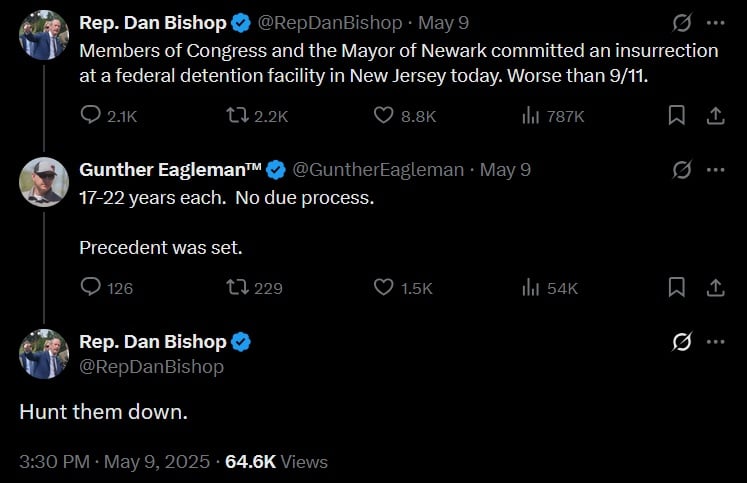
Source: May 9, 2025 post by OMB Deputy Director Dan Bishop on the social media platform X.
Baraka told the New York Times that a security guard allowed him to enter the property through a locked gate, but said he was not allowed inside the facility while the three House Democrats were touring it.
“If I was on that property, I was invited there,” Baraka told the Times.
When the three Democratic lawmakers emerged, Baraka was arrested in what the Times described as “a brief but volatile clash that involved a team of masked federal agents wearing military fatigues and the three lawmakers.”
A spokeswoman for the Department of Homeland Security told CNN that members of Congress who were at the scene could face charges for “assaulting our ICE enforcement officers.”
Watson Coleman rejected the DHS’s claim in a press release that she and Menendez, “stormed the gate and broke into the detention facility.”
“The author of that press release was so unfamiliar with the facts on the ground that they didn’t even correctly count the number of Representatives present,” Watson Coleman told CNN.
With the fate of the CFPB apparently up to be determined in court, the Trump administration’s pick to lead the bureau, Jonathan McKernan, is set to be nominated to serve in a different role — undersecretary of domestic finance at the Treasury Department.
McKernan’s nomination to lead the CFPB was endorsed on March 6 by the Senate Banking Committee in a 13-11 party line vote, but had not yet been voted on by the full Senate.
In the meantime, the former FDIC board member has has been working as an advisor at the Treasury Department, where he has become “an integral part” of Treasury Secretary Scott Bessent’s senior team.
“His continued service at Treasury will ensure that his experience and expertise are best put to advancing the President’s America First agenda,” the Treasury Department said in a press release Friday.
Get Inman’s Mortgage Brief Newsletter delivered right to your inbox. A weekly roundup of all the biggest news in the world of mortgages and closings delivered every Wednesday. Click here to subscribe.
Email Matt Carter
This post was originally published on this site
by Taylor Anderson | May 13, 2025 | Industry, News Feed
Judge called Davis’ demand for arbitration “redundant, immaterial, impertinent, and scandalous,” but ruled the former CEO made reasonable attempts to arbitrate his case against Keller Williams.
Bigger. Better. Bolder. Inman Connect is heading to San Diego. Join thousands of real estate pros, connect with the Inman Community and gain insights from hundreds of leading minds shaping the industry. If you’re ready to grow your business and invest in yourself, this is where you need to be. Go BIG in San Diego!
A 184-page demand for arbitration filed by John Davis is “redundant, immaterial, impertinent, and scandalous” and will be stricken from the record, a magistrate judge ruled Thursday in a long-running fraud case between the former Keller Williams CEO and the Texas-based residential brokerage.
Magistrate Judge Hal R. Ray, Jr. stopped short of holding Davis in contempt, as Keller Williams had requested, in a case that originated after sexual misconduct accusations were leveled against the former chief executive in 2022, several years after he’d left the brokerage.
Those allegations were settled a year ago, only to be followed with a second suit from Davis accusing Keller Williams Executive Chairman Gary Keller and others of inflating key profitability metrics, such as company sales and profits, to convince individuals to purchase Keller Williams Regions and Market Centers, according to legal filings.
“[The] plaintiffs’ Demand for Arbitration is not only redundant, since the Court appointed an arbitrator for this matter, but it also is impertinent and contains immaterial and scandalous allegations,” Ray wrote in his May 8 ruling. “Defendants have repeatedly requested that Plaintiffs withdraw this pleading, and after a failed agreement, the undersigned strikes the Demand sua sponte,” meaning “of one’s own accord.”
The May 8 order was a legal rebuke that struck some of Davis’s allegations from the court record in a case the former CEO filed targeting Keller, former KW President Josh Team and others over alleged fraud.
In his order, Ray ruled that Davis’s “Demand for Arbitration is not only redundant, since the Court appointed an arbitrator for this matter, but it also is impertinent and contains immaterial and scandalous allegations.”
Ray didn’t specify which claims he viewed as scandalous. But the filing that was stricken alleged that a Keller Mortgage employee was fired after reporting sexual misconduct by John Keller, KW’s executive vice chairman and Gary Keller’s son. According to that filing, the allegations were allegedly covered up by general counsel Stacie Herron and Gary Keller paid off the accuser with $1 million of his own money, while he gave Herron a $1 million bonus and a promotion to interim COO for her work in the alleged cover-up.
The updates are part of an ongoing and years-long legal tit-for-tat between Davis, other past Keller Williams executives and the franchisor.
At issue of late has been whether either side in the case has been wrongfully delaying a court-ordered arbitration process.
Andrew Miltenberg, Davis’s attorney, said the order was a win for Davis.
“Perhaps most important is what Judge Hal R. Ray, Jr. did not say — he did not say that the case was false or lacked merit, or was otherwise without basis,” Miltenberg said. “Indeed, the Court’s Order did not dismiss or alter Davis’ claims in any manner. As such, the arbitration will move forward on all of the issues upon which Mr. Davis has sought justice.”
Keller Williams declined to comment on the order.
Keller Williams asked the court to hold Davis in contempt, remove the filing containing the alleged attacks from the public docket and order Davis to pay their attorneys’ fees and expenses.
The request came in response to Davis’s allegations that his former employer was trying to “bully and intimidate” him through the courts.
After the filing was made public, Keller Williams characterized Davis’s allegations as “untrue personal attacks,” “baseless and false claims,” and a continuation of “his public smear campaign against Keller Williams and its leadership.”
Email Taylor Anderson
This post was originally published on this site
by Darryl Davis | May 13, 2025 | Industry, News Feed
From budget to competing buyer’s agents, Darryl Davis looks at the unsaid things that can cloud a client relationship, so you can communicate more clearly.
Bigger. Better. Bolder. Inman Connect is heading to San Diego. Join thousands of real estate pros, connect with the Inman Community, and gain insights from hundreds of leading minds shaping the industry. If you’re ready to grow your business and invest in yourself, this is where you need to be. Go BIG in San Diego!
In real estate, silence speaks volumes. Clients don’t always tell you what they’re thinking — but oh, they’re thinking it.
They’re forming opinions, second-guessing decisions and, sometimes, smiling politely while secretly freaking out. If you want to build trust, stand out and keep things moving along, you’ve got to read between the lines.
Here are five things your clients aren’t saying but absolutely need you to know.
1. They’re totally stalking you
Before they reply to your email or answer your call, they’ve already Googled you, scrolled your Instagram and read every review since 2017. If your digital presence looks like a garage sale — random, outdated and kind of sad — they’ll swipe left without saying a word.
Teachable moment: Your online presence is your first showing. If you wouldn’t take a buyer to a listing that looks like a mess, don’t let your digital brand be one either. Update those bios. Share those wins. Be someone they’d trust with their home — and their hopes.
2. They’re scared you’ll judge them
They’ll smile through the showing, but inside? They’re cringing over the carpet, the clutter or the fact that their credit score is hanging on by a thread. They may not say it — but trust me, they feel it.
Teachable moment: Create a judgment-free zone. Tell them, “Hey, I’ve seen it all. Nothing surprises me. My job is to help, not critique your throw pillows or finances.” When you lead with empathy, they’ll relax and open up.
3. They don’t really know what you do (but they think they do)
Clients think you pop a sign in the yard, post a few pics, then sit back waiting for the offers to roll in. They’re not trying to be rude; they just don’t know better, which is exactly why some flinch at your fee.
Teachable moment: Don’t assume they get your value — show them. Educate as you go. Say things like, “Here’s what I’m doing behind the scenes to protect your price point.” Explain the strategy, the negotiations and the magic you bring to the deal. You’re not a door-opener; you’re a rainmaker.
4. They’re lying about their budget (just a little)
Buyers will say, “We’re capped at $500,000,” then fall in love with a $550,000 stunner. Why? Because they want to test the waters without getting soaked — or judged. Sellers? Same deal. They might “forget” to mention the lien or the weird neighbor with the drum set.
Teachable moment: This is where trust comes in. Ask better questions. Create a safe space. When people feel seen, they get real. And when they get real, you can actually help them.
5. They’re seeing other agents (but it’s not personal)
Yes, even the ones who seem super into you. They’ve got other agents bookmarked, saved and maybe even texting them listings. They’re hedging their bets and hoping you won’t notice.
Teachable moment: Don’t panic. Outperform. Be responsive, prepared and personable. Show up sharp. Make every interaction feel like, “Oh … this is the agent I’ve been looking for.” Let your service speak louder than their silence.
Real estate isn’t just contracts and comps — it’s connection. If you want to win the client, win their trust. And if you want to win their trust? Start by hearing what they don’t say.
Because the agents who listen between the lines? They don’t just close transactions. They build clients for life.
This post was originally published on this site

by Brad Inman | May 13, 2025 | News Feed
5 Things to Know About Living in a MUD (Municipal Utility District)
If you’re house hunting in Texas—especially around Houston, Austin, San Antonio, and the fast-growing suburbs of Dallas–Fort Worth—you’ll likely see homes located in a “MUD.” That stands for municipal utility district, and it can affect everything from your water provider to your annual tax bill. Understanding how a MUD Texas works helps you compare neighborhoods accurately, avoid surprises at closing, and feel confident about your long-term costs.
Below are five practical things to know—explained in plain language—so you can evaluate a MUD community like a pro.
1) A MUD is a local government that provides utilities (and pays for infrastructure)
What a municipal utility district is
A municipal utility district is a type of special-purpose local government authorized by the State of Texas. MUDs are commonly created in areas outside city limits or in newly developing areas where city utility service isn’t available yet. The district’s job is to build and operate essential infrastructure, most often:
- Water (production wells, treatment, distribution lines)
- Wastewater/sewer (collection lines, lift stations, treatment capacity)
- Drainage and stormwater (detention ponds, drainage channels, storm sewers)
- Sometimes roads and parks (varies by district authorization)
Why MUDs are so common in Texas
Texas grows quickly, and new neighborhoods often pop up before a city can extend utilities to serve them—or in areas that prefer not to annex into a city at all. A MUD allows development to move forward by funding infrastructure up front, then paying those costs back over time through taxes and utility fees collected from property owners within the district.
In other words, a MUD can help turn “raw land” into a livable community with reliable water, sewer, and drainage—services that are non-negotiable for most buyers.
2) MUD taxes are part of your total Texas property taxes—so your tax bill may be higher
How MUD taxes fit into Texas property taxes
Texas property taxes are typically made up of several taxing entities. Depending on the address, your bill may include:
- County taxes
- School district taxes (often the largest piece)
- City taxes (if inside city limits)
- Community college or hospital district taxes (in some areas)
- MUD taxes (if the home is in a municipal utility district)
Homes in a MUD frequently have a MUD tax rate added on top of other local rates. This is one of the biggest “budget surprises” for first-time buyers who focus only on the sales price and interest rate.
Why MUD tax rates can be higher in newer communities
When a neighborhood is new, the MUD may still be paying off major infrastructure costs. As more homes are built and the tax base grows, the district can sometimes spread costs across more properties—which may help stabilize or reduce rates over time. That said, tax rates can move up or down based on budgets, debt service, and operational needs, so it’s best to treat any future change as a possibility, not a promise.
How to estimate your real monthly payment
When you’re comparing two homes—one in a MUD and one not—ask your lender to run payment scenarios using the full estimated tax rate. A small difference in tax rate can noticeably change your monthly escrow payment.
- Green flag: Your agent and lender provide a complete tax breakdown early, including MUD taxes.
- Red flag: Tax estimates that ignore the MUD or use an outdated rate.
3) You’ll pay both MUD taxes and utility bills—because they cover different costs
Taxes vs. utility rates: what each one pays for
This is a common point of confusion. In many MUD Texas communities, homeowners pay:
- MUD taxes (collected like property taxes, often used to repay infrastructure debt and support district operations)
- Monthly utility bills (water/sewer usage charges, base fees, and sometimes trash through separate providers)
Think of it like this: your utility bill is generally tied to your consumption and service fees, while MUD taxes are tied to the value of your property and the district’s budget and debt obligations.
Practical questions to ask about services
Before you buy, get clear answers on who provides what. In some neighborhoods, the MUD handles water and sewer, while trash pickup might be private. In others, services are bundled differently.
- Who is the water provider and sewer provider?
- Are there separate fees for drainage or stormwater?
- Is trash and recycling included, through the HOA, or billed separately?
- Are there irrigation restrictions or water conservation rules?
In many Texas markets, summer water usage spikes due to lawn irrigation—so it’s smart to review typical seasonal billing patterns, especially if the home has a large yard or new landscaping that needs frequent watering.
4) MUDs issue bonds to build the neighborhood—so debt and “build-out” matter
What it means when a MUD has debt
MUDs often finance infrastructure by issuing bonds. Bond proceeds can pay for major systems like water lines, sewer lift stations, and drainage improvements. Then the district repays those bonds over time using tax revenue from property owners in the district.
Debt isn’t automatically bad—without it, many Texas master-planned communities wouldn’t exist in their current form. The key is understanding how the district’s debt and growth stage may affect tax rates and future planning.
How to think about build-out stage
A newer MUD in early build-out may have:
- Higher infrastructure spending
- A smaller number of homeowners sharing costs
- More construction activity nearby
A more mature MUD may have:
- A larger tax base
- More predictable budgets
- Fewer active construction impacts
Neither is inherently “better,” but they feel different day-to-day. If you work from home or prefer quiet streets, ongoing development can be a meaningful lifestyle factor to weigh.
Due diligence tips buyers often miss
- Confirm the exact tax rate for the current year and ask whether it includes both debt service and operations.
- Ask for recent district information that explains finances, service areas, and long-term plans (your agent can help request what’s appropriate).
- Compare similar homes across neighborhoods using total monthly payment, not just list price.
5) Governance, disclosures, and closing details can affect your experience
How MUDs are governed (and why it matters)
A municipal utility district is run by an elected board. The board makes decisions about budgets, tax rates, infrastructure projects, and operations. While most day-to-day utility operations are handled by professional managers and contractors, governance still matters because it shapes long-term planning and financial priorities.
For homeowners, the practical takeaway is that a MUD is a real local governmental body—separate from a city and separate from an HOA—with its own responsibilities and public processes.
Disclosures you may see when buying a home in a MUD
In Texas, buyers are often provided a notice that a property is located in a utility district, along with information about taxes and services. Closings may also include details tied to the district’s tax rate or utility setup.
Here’s a simple step-by-step approach for buyers to stay organized:
Step-by-step: how to evaluate a MUD home before you close
- Step 1: Identify the district. Ask your agent for the exact MUD name and confirm the home is within its boundaries.
- Step 2: Verify the total tax rate. Compare last year’s and current year’s rates if available, and make sure your lender uses the right number in payment estimates.
- Step 3: Confirm service providers. Verify who bills water and sewer, and whether there are additional district fees.
- Step 4: Review the seller’s disclosures and any district notices. Pay attention to anything referencing taxes, utility districts, or special assessments.
- Step 5: Budget for real-world usage. Ask the seller (or neighbors, if possible) about typical summer and winter utility bills, especially for irrigation and pool ownership.
Common mistakes (and how to avoid them)
- Mistake: Assuming “no city taxes” means “lower taxes.”
Better approach: Compare the total tax rate, including the MUD and school district.
- Mistake: Underestimating escrow changes after the first year.
Better approach: Plan for potential payment adjustments if the initial escrow estimate was conservative or if taxes/insurance change.
- Mistake: Ignoring drainage and flood resilience.
On that last point: because MUDs often handle drainage infrastructure, it’s still wise to do your own due diligence—review flood history, ask about detention systems, and consider insurance needs. Drainage is a major quality-of-life issue in many Texas regions, particularly in parts of the Gulf Coast and areas prone to heavy seasonal storms.
Pros and cons of living in a MUD community
Pros
- Newer infrastructure and planned utility systems
- Development can happen in desirable areas outside city limits
- Potentially strong neighborhood amenities depending on the community
Cons
- MUD taxes can increase your overall Texas property taxes
- You may pay both MUD taxes and monthly utility bills
- Construction and growth can affect traffic, noise, and local services during build-out
Bottom line: a MUD isn’t “good” or “bad—”it’s a cost-and-services tradeoff
Buying in a MUD Texas community can be a great fit, especially if you want a newer home, planned infrastructure, and access to fast-growing suburban areas. The key is to shop with your eyes open: understand how the municipal utility district impacts services, what it adds to your Texas property taxes, and how it affects your true monthly payment.
If you do that homework early—before you fall in love with a house—you’ll be in a strong position to choose the neighborhood that fits both your lifestyle and your budget.