by Dani Vanderboegh | May 30, 2025 | Industry, News Feed
Turn up the volume on your real estate success at Inman On Tour: Nashville! Connect with industry trailblazers and top-tier speakers to gain powerful insights, cutting-edge strategies, and invaluable connections. Elevate your business and achieve your boldest goals — all with Music City magic. Register now.
Every Friday, Inman Service Editor Dani Vanderboegh rounds up the most popular, most read, most critical stories of the week to give you a quick catchup on the big headlines you might have missed in the hustle and bustle of the workweek. Here’s this week’s Top 5 as chosen by our readers.
P.S. Don’t miss The Download, our weekly column that breaks down one of the week’s top stories and equips you with what you’ll need to meet next Monday head-on.
The changes would offer a specific definition of “harassment” and aim to reduce liability. The prospect of change comes as Texas lawmakers consider a bill that could conflict with current NAR rules.

CEO Hoby Hanna sent a letter to NAR and the more than 70 MLSs the major real estate brokerage belongs to informing them that it will no longer consider itself bound by the policy.

Jimmy Burgess and marketing expert Jason Pantana share perspective on the power of artificial intelligence tools and their place in the modern agent’s toolbox.

Tanya Monestier’s appeal to the commission settlement isn’t just a legal challenge, compliance expert Summer Goralik writes. It’s a reality check the industry didn’t see coming.

Troy Palmquist offers a solution for adding value and staying in front of your sphere by providing a referral directory for local service providers.
Email Editorial
This post was originally published on this site
by Mariya Gordon | May 30, 2025 | Industry, News Feed
The speaker lineup is unveiled for Inman Luxury Connect at the Hilton San Diego Bayfront, July 28 – 29, 2025. Register today before prices rise.
In a market defined by hesitant buyers, shifting policies, and razor-thin margins, maintaining your edge requires more than prestige. It demands insider know-how, tested playbooks, and a network of top-tier peers.
Inman Luxury Connect (July 28 – 29 at the Hilton San Diego Bayfront) is the two-day summit where the most accomplished luxury agents, brokers, and executives gather to share actionable strategies, unlock new referral streams, and forge the connections that power record-breaking deals. You’ll walk away with the clarity and confidence to turn volatility into opportunity and position yourself as the definitive expert in today’s high-end market.
Take a look at the growing speaker roster confirmed for 2025:
- Robert Reffkin | Founder and CEO, Compass: Robert Reffkin grew Compass into America’s No. 1 brokerage with $500 billion+ in sales, and he’ll explain how data-driven leadership, cultural vision and targeted investments fuel resilience through economic swings. Learn more about his approach to marrying tech innovation with human connection for unparalleled client experiences.
- Liz Gehringer | President and CEO, Anywhere Franchise Brands: At the helm of a global network of Coldwell Banker, CENTURY 21, Better Homes & Gardens and ERA franchises, Gehringer drives strategic growth for 60,000+ agents. She’ll share the keys to balancing scale with bespoke service, leveraging franchise-wide resources and championing diversity programs that open new markets.
- Stephanie Anton | President, Corcoran Affiliates: Since launching Corcoran’s affiliate network in 2020, Stephanie Anton has overseen expansion into 60+ markets, fueling one of real estate’s fastest-growing franchise brands. She’ll unpack her formula for vetting, recruiting and empowering affiliates — and how to replicate that success in your own region.
- Rod Watson | Founder and CEO, Distinct Concierge Real Estate: From the NFL to LA luxury, Rod Watson built a referral empire by delivering discreet, white-glove service to pro athletes and high-net-worth clients. He’ll share his negotiation finesse, paparazzi-proof marketing tactics and client-first mindset that turn high-profile contacts into lifelong partnerships.
- A. Bradley Nelson | CMO, Sotheby’s International Realty: As Sotheby’s International Realty’s marketing architect, Nelson oversees global branding, product innovation, and the auction-house partnership that grants clients unmatched market access. He’ll reveal how to deploy luxury-level storytelling and strategic alliances to attract ultra-high-net-worth buyers — and elevate your brand’s prestige.
- Ashley DiPrisco | Associate Broker, Sotheby’s Jackson Hole: Jackson Hole’s digital marketing dynamo, DiPrisco blends award-winning local expertise with multimillion-dollar campaigns and lifestyle storytelling. Learn her secrets for dominating an exclusive market through hypertargeted content, immersive property experiences and a high-touch service model that turns clients into lifelong advocates.
- Erin Krueger | Team Lead, Compass: Transforming Nashville’s luxury landscape, Krueger led her team to over $2 billion in sales and set the city’s record for highest price-per-square-foot. She’ll break down the leadership, branding and negotiation tactics that build powerhouse teams — and how the Luxury Connect audience can replicate that success in your own market.
- Hilary Farnum-Fasth | Owner and Broker, Corcoran Reverie: With 25 years shaping Florida’s Emerald Coast and over $1 billion in annual sales, Farnum-Fasth has defined “The Hamptons of the South.” She’ll discuss crafting aspirational coastal communities, leveraging marquee developments and mentoring teams to deliver architectural beauty and outsized returns for discerning buyers.
- Ivan Sher | Founder and Principal, IS Luxury: Las Vegas luxury maven Ivan Sher has reset every city record — from per-square-foot highs to blockbuster land sales — while building a $2 billion portfolio in three years. Discover his blueprint for scaling boutique brokerages, harnessing off-market strategies, and assembling teams that consistently outpace the competition.
- Jade Mills | Estates Director and International Ambassador, Coldwell Banker Realty: With over $9 billion in career sales and five $100 million-plus transactions, Mills is the consummate global dealmaker. She’ll share how to cultivate international alliances, navigate ultra-high-value negotiations and maintain 24/7 white-glove service that earns the trust of celebrities, C-suite executives and savvy investors.
- Jere Metcalf | Founder and Host, The Jere Metcalf Podcast: A former top-producing agent turned media powerhouse, Jere Metcalf has interviewed 320+ industry icons and luminaries, from Neil Armstrong to Matthew McConaughey. She’ll moderate candid conversations on the Luxury Connect stage that bridge real-world tactics with big-picture trends, giving you the questions and answers you need to lead in today’s fast-paced luxury arena.
- Tomer Fridman | Executive Director, Private Wealth and Luxury Estates, Christie’s SoCal: Tomer Fridman co-leads Christie’s International Real Estate in Southern California and Israel Sotheby’s, closing over $7 billion in career sales. He’ll teach you to craft cross-border partnerships, serve celebrity clientele, and position architecturally significant estates — where art, finance, and lifestyle intersect — for maximum impact.
Join the elite at Inman Luxury Connect 2025, where high-stakes strategies, global perspectives and lifelong connections come together to define the next era of luxury real estate.
This post was originally published on this site
by Craig C. Rowe | May 30, 2025 | Industry, News Feed
Inman Innovator honoree Inspectify unveiled the deal Wednesday, saying it will help the property inspection software provider “streamline what is currently a fragmented and inefficient process.”
Bigger. Better. Bolder. Inman Connect is heading to San Diego. Join thousands of real estate pros, connect with the Inman Community and gain insights from hundreds of leading minds shaping the industry. If you’re ready to grow your business and invest in yourself, this is where you need to be. Go BIG in San Diego!
Property inspection software provider Inspectify has acquired Joule, a firm that uses inspection data to generate energy usage insights, executives announced.
Inspectify announced the deal on its website Wednesday, saying the move will allow it to “streamline what is currently a fragmented and inefficient process.”
TAKE THE INMAN INTEL SURVEY FOR MAY
Joule was founded by CEO Heeral Prakash, and this is Inspectify’s second acquisition of 2025. In February it integrated appraisal company Aloft. Now with the Joule deal in place, Inspectify is aiming to become a digital source of truth for the financial and operational data that define residential property value.
“We’ve been working with Heeral already for about three years, and her vision was always that there is a lot of data in an inspection that can replace a stand-alone energy audit,” Inspectify’s Josh Jensen said in a phone call with Inman. “Her product makes a ton of sense for us, it fit what we want to do, and it’s a good home for the tech she built. Joule was looking at the best path to keep growing and with this, we can automate a bunch of workflow round the purchase.”
Using the Home Energy Score created by the U.S. Department of Energy (DOE), Joule’s software derives solutions for energy conservation from common home inspection data. It identifies home systems subject to inefficiency and provides detailed reports accompanied by upgrade recommendations, purchase rebate programs, green financing options and even local contractors able to implement improvements.
Inspectify was approved earlier this year by the DOE to offer formal Home Energy Scores, and the Joule acquisition will bolster its ability to deliver on that offer to customers. Joule is one of only 13 software companies nationwide with such approval.
With the integration already built, inspectors can push their data to Joule to leverage its reporting tools. The union will also help Inspectify expand its reach into traditional consumer sales, as most of its work — close to 15,000 inspections per month, according to Jensen — are on the enterprise side of the industry.
Inspectify offers a way for home inspectors, buyers and other home sale stakeholders to make the property inspection a powerful digital asset to the deal, removing its traditional role as a hurdle to closing or impetus to renegotiate the sale. It offers standardized item input formats with fast, AI-backed item descriptions, cooperation with common industry software products, mobile convenience and easy scheduling and calendar management.
A June 2024 Inman review highlighted the award winning company’s vision for what an inspection can actually become.
“With this acquisition, we’re able to move faster toward a shared vision,” Prakash wrote Wednesday on LinkedIn. “Where homebuyers receive an inspection, appraisal, and energy audit in a single visit — and where energy scores and upgrade pathways are delivered when they matter most.”
Email Craig Rowe
This post was originally published on this site
by Jim Dalrymple II | May 30, 2025 | Industry, News Feed
Bigger. Better. Bolder. Inman Connect is heading to San Diego. Join thousands of real estate pros, connect with the Inman Community, and gain insights from hundreds of leading minds shaping the industry. If you’re ready to grow your business and invest in yourself, this is where you need to be. Go BIG in San Diego!
It’s hard to recall a more eventful year for the real estate industry than the one that just transpired.
Just over 14 months ago, the National Association of Realtors agreed to settle antitrust commission litigation. That move led to new rules governing agent pay, took place as many large brokerages were settling their own suits and happened as Donald Trump was beginning his eventual march back into the White House.
TAKE THE INMAN INTEL SURVEY FOR MAY
Simultaneously, agents in real estate’s trenches were grappling with the slowest housing market in a generation — conditions fueled by high mortgage rates and low inventory, and which squeezed industry players in a host of unique ways.
Now, it’s against that backdrop that thousands of NAR members will descend on Washington, D.C. on Saturday for the 1.5 million-member trade organization’s annual Realtors Legislative Meetings — a gathering at which real estate leaders craft the organization’s policy, and discuss advocacy and lobbying.
And it’s for all of the above reasons that the gathering may be one of the most consequential of its kind in recent memory.
The event runs from Saturday to Thursday and last year drew about 8,000 attendees. With that scale, a huge number of topics will come up, but keen industry observers are likely to be focused on both political issues such as free speech and fair housing, as well as Realtors’ efforts to stimulate the market.
Read on for the panels and topics that are sure to be discussed long after the conference ends, and be sure to review NAR’s agenda ahead of the event on Saturday. Inman journalist Andrea Brambila will also be on the ground at the event. You can reach her at [email protected].
Speech and harassment
As Inman previously reported, NAR is currently considering Code of Ethics changes related to its policies on speech and harassment.
Matt Difanis, a RE/MAX broker-owner in Illinois and a NAR director, participated in creating the current policy in 2020, and told Inman it was a product of Realtors making hateful comments online and poorly representing the industry.
“In response to a very real proliferation of Realtor hate speech, much of which was in social media outside the context of their real estate transactions, we had state and local leaders begging for better tools,” Difanis recalled.
Now, however, NAR wants to change and clarify the rules that began in 2020. The proposed changes would add a definition of harassment, and stipulate that while Realtors should always follow the Code of Ethics’ principles, they would only be disciplined for harassment that occurs while acting in a professional capacity.
Though the tweaks to NAR’s Code of Ethics will likely only impact a small number of Realtors, the issue is one worth watching closely because it mirrors a larger debate about issues of free speech.
Key sessions:
- Professional standards committee forum, Tuesday, 8:30 a.m.
- Risk Management Issues Committee, Tuesday, 10:30 a.m.
Steering and fair housing
The same agenda also indicates that the Professional Standards Committee will consider steering, which historically was a discriminatory practice that blocked some buyers — most often from minority ethnic groups — from purchasing homes in certain areas. The agenda shows that NAR leaders have continued to receive questions about the issue.
In response, the committee will consider tweaking the language of NAR’s Code of Ethics.
Similar to issues surrounding free speech, steering represents an intersection between real estate and a broader debate about race in the U.S. And within real estate specifically, steering has most recently come up in debates about private listings and who gets to see them.
Key sessions:
- Fair Housing Policy Committee, Monday, 8 a.m.
- Bias Override: Overcoming Barriers to Fair Housing, Sunday, 1 p.m.
- Fair Housing Forward: Networking Reception Featuring NAR’s 2025 Fair Housing Champions, Monday, 3:30 p.m.
Technology and artificial intelligence
Artificial intelligence routinely dominates discussions about the future of real estate, with many leaders arguing that brokers must learn to use new tools or risk being left behind. However, A.I. also raises a host of practical, ethical, and regulatory questions.
The Legislative Meetings will give real estate leaders a chance to consider what role this type of technology has in the industry, as well as what types of regulatory frameworks real estate professionals might support. And these will not be idle meditations; rental software company RealPage is currently locked in multiple lawsuits with government officials over its use of pricing algorithms. Such cases highlight the fact that real estate technology is still something of a new frontier, both for the industry and for regulators.
Key sessions:
- Federal Technology Policy Committee, Monday, 9. a.m.
- iOi Innovation – AI-Powered Advocacy: Elevate Political Impact, Sunday, 11 a.m.
- iOi Innovation – From Leads to Real Conversations: The Tech-Driven Follow-Up Advantage, Tuesday, 3:45 p.m.
Commissions and agent pay
One year ago, commissions were the issue du jour in real estate thanks to antitrust settlements from NAR and various large brokerages. Attention on the issue has ebbed somewhat since, and the latest data suggests commissions have not plummeted as some had feared.
However, a Legislative Meetings agenda shows that NAR’s Professional Standards Committee will still be looking at the issue next week. Among other things, the committee will consider rules that would require Realtors to tell clients that compensation is negotiable and not set by law. The rules additions would also state that Realtors can’t delay or withhold offers while attempting to negotiate compensation.
The attention on agent compensation at the Legislative Meetings highlights the fact that questions about the issue persist, and that the real estate industry is still working to settle on a new status quo.
Key sessions:
- Professional standards committee, Tuesday, 9 a.m.
- Risk Management Issues Committee, Tuesday, 10:30 a.m.
Housing inventory and affordability
Though explicitly political issues such as fair housing and free speech have bled over into the real estate industry, rank and file agents also continue to deal with inventory shortages in their local markets. Difanis said that last year’s Legislative Meetings addressed this issue, with discussions about density, zoning, accessory dwelling units, and other supply-enhancing policies. Those conversations are likely to continue this year, with a focus on how Realtors can advocate for — and lobby lawmakers in favor of — policies that might make building more housing units easier.
Relatedly, Realtors at the event will also discuss federal and state tax policies that impact homeowners and would-be homebuyers, and issues related to insurance.
Real estate coach and educator Dr. Lee Davenport also pointed to inventory as a key issue for the Legislative Meetings. She noted that there are a number of bills currently in congress — the Housing Supply Frameworks Act, the Affordable Housing Credit Improvement Act and others — that members of NAR can weigh in on, including during the visits to lawmakers’ offices that are a regular part of the Legislative meetings.
“I think,” she told Inman, “this should probably be one of the highest priorities.”
Key Sessions:
- Federal Legislative & Political Forum, Sunday, 9:45 a.m.
- Total Cost of Ownership: Sustainability Roundtable, Sunday, 11 a.m.
- The Advocacy Scoop, Sunday, 3 p.m.
- Knocking Down Barriers Though Innovative Homeownership Solutions Provided by Fannie Mae, Monday, 1 p.m.
- Regulatory Issues Forum: The Land of Opportunity: Is Deregulation the Key to Innovation and Expansion in Housing?, Monday, 10 a.m.
- Housing Opportunities Committee, Monday, 10 a.m.
- Federal Financing & Housing Policy Committee, Monday, 2 p.m.
- Realtors Land Institute Leadership & Member Meeting, Wednesday, 9 a.m.
- Land Use, Property Rights and Environment Committee, Wednesday, 10 a.m.
- Federal Taxation Committee, Thursday, 8:30 a.m.
Leadership in trouble times
Aside from specific issues, NAR’s Legislative Meetings will also be an opportunity to hear commentary on issues such as multiple listing service policy, and from top leaders such as President Kevin Sears and CEO Nykia Wright. Here are additional key sessions to be aware of:
- The Leadership Scoop, Sunday 9 a.m.
- Business Issues Policy Committee, Sunday, Sunday, 10 a.m.
- Federal Legislative & Political Forum, Sunday, 9:45 a.m.
- The Advocacy Scoop, Sunday, 3 p.m.
- Regulatory Issues Forum, Monday, Monday, 10 a.m.
- Town Hall for Association Leaders, Monday 2:40 p.m.
- Multiple Listing Service Issues & Policies Committee, Tuesday, 1 p.m.
- Board of Directors, Thursday 8:30 a.m.
Email Jim Dalrymple II
This post was originally published on this site
by Justin Ziegler | May 30, 2025 | Industry, News Feed
The real estate industry prides itself on professionalism and ethical conduct. When it comes to LGBTQ+ clients and colleagues, broker Justin Ziegler writes, it’s time to put words into action.
Bigger. Better. Bolder. Inman Connect is heading to San Diego. Join thousands of real estate pros, connect with the Inman Community, and gain insights from hundreds of leading minds shaping the industry. If you’re ready to grow your business and invest in yourself, this is where you need to be. Go BIG in San Diego!
June should be a time of celebration for the LGBTQ+ community — a month of Pride, solidarity and progress. Yet, as we mark this occasion, our community faces unprecedented challenges: a surge in anti-LGBTQ+ legislation, federal policies rolling back protections and a disturbing rise in housing discrimination perpetuated by those who should know better — real estate professionals.
TAKE THE INMAN INTEL SURVEY FOR MAY
Discrimination is not just an LGBTQ problem. By 2030, the U.S. minority population will account for 44.2 percent of the total population and most homebuyers. At a moment when the public is questioning the value and service of real estate professionals, we must not relax our standards.
The data doesn’t lie: Discrimination is a real problem in real estate
The LGBTQ+ Real Estate Alliance’s 2025 LGBTQ+ Real Estate Report, which we will publicly share next week, reveals a troubling trend: Real estate professionals are now the leading source of anti-LGBTQ+ discrimination in housing, according to Alliance members.
When asked where discrimination most frequently occurs:
- 22.2 percent reported discrimination by real estate agents against prospective homebuyers
- 17.8 percent cited legal forms failing to represent LGBTQ+ life experiences
- 15.7 percent identified discrimination by real estate professionals against prospective tenants
This marks the first time since 2022 that agents have topped the list — a disgraceful distinction that tarnishes our entire profession. Even worse, 33 percent of respondents say anti-LGBTQ+ discrimination has increased over the past three years, the highest level ever recorded by the Alliance.
Unconscious bias is no excuse – professional standards exist for a reason
Some might dismiss these findings as “unconscious bias,” but ignorance is not absolution. The National Association of Realtors (NAR) Code of Ethics is unequivocal:
Realtors shall not deny equal professional services to any person for reasons of race, color, religion, sex, disability, familial status, national origin, sexual orientation, or gender identity.” (Article 10, amended 2023)
Yet, despite this clear mandate:
- 19.2 percent of respondents report increased unconscious bias at the company level
- 22.2 percent see it rising at the industry level
- 15.5 percent report blatant discrimination at the industry level
These numbers are not just statistics — they represent real people denied homes, dignity and equal treatment because some agents refuse to uphold the ethical standards they swore to follow.
Discrimination hurts business – and the industry’s reputation
Real estate is built on trust. When agents discriminate, they don’t just harm individuals — they erode public confidence in the entire profession.
Consider these facts:
- Only 25.8 percent of LGBTQ+ respondents believe real estate is less discriminatory than other industries — down from 38.8 percent in 2022
- The mortgage industry fares even worse, with just 19.2 percent viewing it as inclusive, compared to 27.5 percent in 2022
This decline in trust should alarm every Realtor. In an era where more than 1 in 5 Gen Z adults identify as LGBTQ+, and the U.S. is rapidly approaching a majority-minority population, exclusionary practices aren’t just unethical — they’re bad for business.
The hypocrisy of public discrimination vs. professional conduct
Realtors must be held to the highest ethical standards. We are stewards of the American people’s experience of buying and selling homes.
Some agents may think they can publicly oppose LGBTQ+ rights while still serving LGBTQ+ clients. This is delusional. Real estate is a relationship-driven profession — your public persona is your business persona.
- If you post anti-LGBTQ+ rhetoric online but expect queer clients to trust you, you’re lying to yourself
- If you support politicians pushing anti-LGBTQ+ laws but claim to uphold Fair Housing, you are part of the problem
As the saying goes, “money talks.” LGBTQ+ consumers vote with their dollars and only refer professionals who have treated them well.
In 2023, LGBTQ+ people bought 11 percent of the homes sold in the U.S. that year and pumped $182 billion into the housing economy. That’s green in your pocket, too, and missed transactions if you are perceived as unprofessional. Because referrals work both ways — if your service falls short or is biased, your name will be passed around fast.
The time for change is now
We cannot tolerate discrimination — intentional or not.
The solution is clear:
- Mandate Fair Housing training for all agents, with a focus on LGBTQ+ inclusion
- Hold violators accountable — NAR and brokerages must enforce the Code of Ethics
- Amplify LGBTQ+ voices in real estate to ensure policies reflect real experiences
Actions matter. The real estate industry prides itself on professionalism. It’s time to prove it.
Happy Pride — now let’s do better.
Justin “JZ” Ziegler is a real estate broker and serves as the 2025 national president of the LGBTQ+ Real Estate Alliance. Connect with him on Instagram and LinkedIn.
This post was originally published on this site
by Matt Carter | May 29, 2025 | Industry, News Feed
Since peaking at 246 offices in Q4 2023, RE/MAX’s mortgage franchising business has experienced declines for five consecutive quarters.
Bigger. Better. Bolder. Inman Connect is heading to San Diego. Join thousands of real estate pros, connect with the Inman Community, and gain insights from hundreds of leading minds shaping the industry. If you’re ready to grow your business and invest in yourself, this is where you need to be. Go BIG in San Diego!
New Motto Mortgage offices in Texas, Florida and Missouri could help RE/MAX’s mortgage franchising business get back into growth mode after five consecutive quarters of declining office counts.
Motto Mortgage DreamNest — already serving the metro Houston market and markets throughout Texas — will host a ribbon cutting ceremony Saturday, June 7, at its recently opened Cypress office.
Owner Frank Martin brings over 17 years of real estate construction and development experience to the new Motto Mortgage brokerage, where Christian Sanchez will serve as branch manager.
“We are thrilled to be open for business in Cypress, and we are looking forward to personally introducing ourselves to the community at our grand opening event,” Martin said in a statement Thursday. “Motto Mortgage DreamNest offers an advantageous alternative to the traditional mortgage bankers currently operating in the Greater Houston area.”
Motto Mortgage had previously announced the opening of new offices in Orlando, Florida (Motto Mortgage United), in March and Girardeau, Missouri (Motto Mortgage Home Advisors), in February.
Motto Mortgage doesn’t make loans itself but provides technology, training and marketing tools to franchisors. Each Motto Mortgage franchise is independently owned, operated and licensed by mortgage brokers who work with multiple wholesale lenders to find the best deal for their clients.
After rapid growth during the pandemic — the number of open offices nearly doubled from 118 in Q1 2020 to 235 in Q2 2023 — Motto Mortgage’s open office count peaked at 246 in Q4 2023 and has been shrinking ever since.
Motto Mortgage open office count
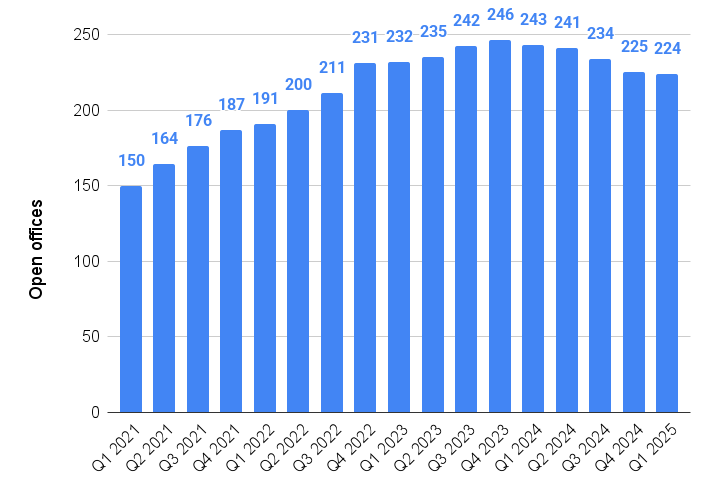
Source: RE/MAX Holdings earnings reports.
Rising mortgage rates slowed the pace at which Motto Mortgage signs new franchise agreements, and some existing franchises have gone out of business or not been renewed. Franchisees sign seven-year agreements directly with Motto Franchising, and 2024 was the first full year Motto has had offices come up for renewal.
In reporting a $2 million net loss for the first quarter, parent company RE/MAX Holdings said there were 224 Motto Mortgage offices open as of March 31, down 8 percent from a year ago.
RE/MAX disclosed in its earnings report that it was providing short-term financial relief to 58 of those offices, which were “temporarily either not being billed and/or having associated revenue recognized.”
TAKE THE INMAN INTEL INDEX SURVEY FOR MAY
RE/MAX also provides third-party loan processing services to mortgage brokers through another subsidiary, wemlo, which it acquired in 2020.

Karri Callahan
“It’s obviously a tough environment for both the legacy Motto business as well as what we’re seeing in terms of the processing business from a wemlo perspective,” RE/MAX Holdings Chief Financial Officer Karri Callahan said on a May 2 call with investment analysts.
Callahan said the shrinking office count is the biggest driver in the decline in revenue generated by Motto Mortgage and wemlo, but “we really have seen some stabilization there on a sequential quarter basis, which is good to see.”
Company executives were also pleased with the engagement at last month’s Motto Mortgage Innovation and Loan Excellence (MILE) Summit in Orlando, which Callahan called “very, very positive.”
Nearly 300 awards were presented at the MILE Summit, including:
In February, Motto Mortgage was named to the 2025 Entrepreneur Franchise 500 List for the sixth consecutive year, ranking 494th.
RE/MAX announced on March 31 that Motto Mortgage President and CEO Ward Morrison — who led the company during its explosive growth phase — is getting married and has decided to retire on June 15, but will continue to work for the company as a consultant for the rest of the year.

Erik Carlson
On the company’s earnings call, RE/MAX CEO Erik Carlson called Morrison “irreplaceable,” but said an active search is underway — internally and externally — for his successor.
“We have a great team in place at Motto and wemlo, and so that team is doing great things right now,” Carlson said. “Obviously, with the mortgage market, there’s a lot of great candidates out there. So we’ll look both within the walls and outside the walls, and we’ll have an announcement on that, I hope, before our next earnings call.”
Get Inman’s Mortgage Brief Newsletter delivered right to your inbox. A weekly roundup of all the biggest news in the world of mortgages and closings delivered every Wednesday. Click here to subscribe.
Email Matt Carter
This post was originally published on this site