by Daniel Houston | Jun 2, 2025 | Industry, News Feed
Real estate agents reported an unexpected hit to their listing pipelines in May as they navigated an uncertain market and weak spring, according to the latest Inman Intel Index survey results.
This report is available exclusively to subscribers of Inman Intel, the data and research arm of Inman offering deep insights and market intelligence on the business of residential real estate and proptech. Subscribe today.
Over the past two years, a slow but steady flow of new real estate listings has crept back into the market, offering a slight boost of new business for brokerages and a welcome expansion of options for their buyer clients.
But as the spring market draws to a close, some agents told Intel that their listing pipelines have suffered an unexpected hiccup.
TAKE THE INMAN INTEL SURVEY FOR MAY
The setback in listing-client interest was offset by newfound hopes that buyers might become easier to find amid a series of pauses in U.S. tariff policy, according to Intel’s Client Pipeline Tracker update for the month of May.
The result? A market that’s essentially still stuck in limbo as it faces broad uncertainty — and few immediate prospects for a quick turnaround.
Client Pipeline Tracker score in May: +1
- Previous score: +1 in April
- Recent high point: +9 in January
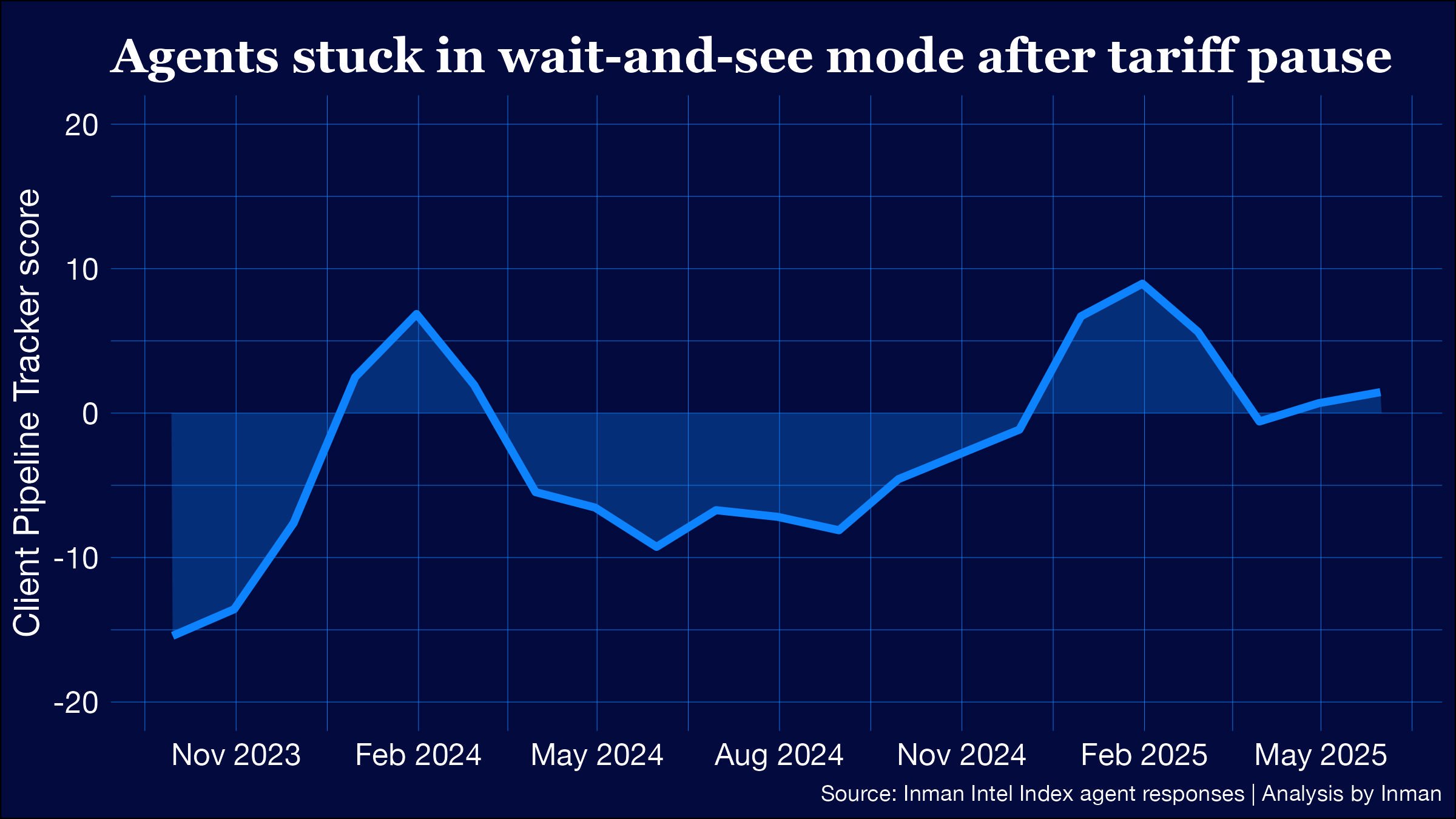
Chart by Daniel Houston
This inventory stumble is just the latest setback for real estate agents, whose hopes for a more robust spring buying season had fallen back to Earth in many parts of the country.
Intel explores these complex dynamics in more detail in its latest Client Pipeline Tracker report.
A spring retrospective
Intel’s Client Pipeline Tracker is a compilation of how agents feel about their buyer and seller pipelines — both over the past year and in the near future.
Intel described the methodology in this post, but here’s a quick refresher on how to interpret the scores.
- A score of 0 represents a neutral period in which client pipelines are neither improving nor worsening.
- A positive score reflects a market in which client pipelines have been improving, or are widely expected to improve in the next 12 months. The higher the rating, the more confident agents are in that conditions are moving in a positive direction.
- A negative score suggests client pipeline conditions are worsening, or are widely expected to get worse in the year to come.
An extremely positive combined score falls somewhere around the +20 mark. This type of score would signify that much of the industry is in agreement with the fact that pipelines are improving and will continue to improve.
An extremely negative combined score, on the other hand, falls closer to -20. That’s a bit lower than where the industry stood in September 2024, the first time Intel surveyed agents about their pipelines.
For each of the four individual components that go into the score, results as high as +50 or as low as -50 are sometimes observed.
Here are the component scores from the most recent survey, and how each sentiment category changed from the previous one.
Tracker component scores
April → May
- Present buyer pipelines: -27 → -26
- Future buyer pipelines: +5 → +10
- Present seller pipelines: -3 → -10
- Future seller pipelines: +13 → +12
As the spring came to a close, the Intel survey found clear signs that agents were disappointed with how their client pipelines developed.
- From late February to late May, the share of agents who responded to the Intel Index reported a year-over-year thinning of their buyer pipelines rose from 45 percent to 51 percent.
- The share of agent respondents who saw a year-over-year decline in listing client conditions crept up from 34 percent to 42 percent over the same span of time — with the most notable leap in negative sentiment occurring from April to May.
Despite this disappointing season, agents remain cautiously optimistic that a slightly better year may be on the way.
- 39 percent of agent respondents told Intel in May that they expected to be working with a bigger buyer client pool a year from now — although only 5 percent of all agent respondents were expecting a big improvement.
These numbers are essentially unchanged from before the spring market kicked into higher gear — a potential sign that despite the relatively slow season, agents are not viewing it as a harbinger of worse conditions ahead.
A rebalancing act
Real estate agents surveyed by Intel the previous month reported widespread concern about the direction of the economy — but not much change in their prospects of attracting clients.
In fact, agents in April did not seem to meaningfully lower their expectations even after the Trump administration announced a slew of new so-called “reciprocal” taxes on imports.
It’s notable then that after many of those tariffs were reduced temporarily, agents did meaningfully increase their expectations for buyer client pipelines in the 12 months ahead.
- Only 17 percent of agent respondents told Intel in May that they expected their buyer pipelines to be lighter a year from now, compared to 23 percent who shared that pessimistic outlook the month before.
This drop in pessimism was a big factor in offsetting the month-to-month weakening in listing pipelines in this month’s Client Pipeline Tracker update.
But beyond those numbers, agents don’t seem to buy that any short-term drop in listing pipelines will hold up amid a market that for years now has experienced persistent momentum behind a gradual replenishment of its supply of available homes.
- The number of new listings that entered the market in April was 9 percent higher than the same month last year and 22 percent higher than the same time the year before that, according to listing data from Realtor.com.
- Still, even after multiple years of upward momentum, this influx of new supply was 15 percent below prepandemic levels from April 2019.
Ultimately, while a rising supply of homes may help nudge brokerage revenues upward in some markets and offer buyers some extra negotiating power, agents are likely waiting for bigger declines in mortgage rates before getting their hopes up.
Methodology notes: This month’s Inman Intel Index survey was being conducted May 20-June 3, 2025, and had received 494 responses as of Friday morning. These results are preliminary and may be revised. The entire Inman reader community was invited to participate, and a rotating, randomized selection of community members was prompted to participate by email. Users responded to a series of questions related to their self-identified corner of the real estate industry — including real estate agents, brokerage leaders, lenders and proptech entrepreneurs. Results reflect the opinions of the engaged Inman community, which may not always match those of the broader real estate industry. This survey is conducted monthly.
Email Daniel Houston
This post was originally published on this site
by Alyssa Stalker | Jun 2, 2025 | Industry, News Feed
From branding basics to social media hacks, marketing expert Alyssa Stalker shares how to create marketing that feels like you and stands out.
Bigger. Better. Bolder. Inman Connect is heading to San Diego. Join thousands of real estate pros, connect with the Inman Community, and gain insights from hundreds of leading minds shaping the industry. If you’re ready to grow your business and invest in yourself, this is where you need to be. Go BIG in San Diego!
Creating great marketing does not have to be complicated or expensive. While high-level agents often invest in professional support for listing videos or long-term campaigns, there are plenty of marketing materials you can create yourself. In fact, for modern agents who want their brand to feel authentic and fresh, doing it yourself can be the best way to keep your message personal and current.
TAKE THE INMAN INTEL SURVEY FOR MAY
5 ways to DIY your content marketing
Here are five pieces of marketing collateral that any agent can DIY, with practical tips to help you do it well.
1. Social media graphics and posts
Social media is often the first place clients see your brand. Your posts should feel like an extension of how you show up in person. Tools like Canva make this easier than ever. One of the best ways to create consistency is by using Canva’s brand kit feature.
Load in your brand colors, fonts and logo to make sure everything you create looks like it belongs to you. A feature many agents overlook is Canva’s “Styles” button. This tool instantly updates any template to match your brand kit with just a few clicks, saving you time and creating a consistent look across your posts.
2. Local guides
Your local knowledge is one of the biggest assets you have. Turning that knowledge into a guide is something you can absolutely handle on your own. Clients want to know the best spots to grab coffee, spend a weekend or explore their new neighborhood. A local guide, whether a simple PDF or a few Instagram slides, can help you build that connection.
The key is to keep it personal and easy to read. Use Canva or another template tool to create something clean that highlights a few local favorites. Share a short note on why you love these spots or how they fit the lifestyle of your ideal buyer.
3. Reels and short-form videos
While you should leave it to the professionals to film a property listing video, creating short-form video content yourself is a major way to stand out online. Reels are meant to be quick, fun, and engaging, and you can easily create them on your phone without a crew.
Good lighting and clean angles still matter, but your personality is what draws people in. Show up with energy, and find ways to connect a property’s features to the lifestyle of the buyer you want to attract. When your video feels real and connected, it will always resonate more than something that feels staged.
To save time and make your videos look polished, consider using editing tools like CapCut or Instagram’s new Edits app. Not only do these tools make editing easier, but platforms like TikTok tend to favor when you use trending CapCut templates, and Instagram is currently boosting videos that use the new Edits app in its algorithm. These tools can give your videos a professional edge without taking away the personal feel that makes them resonate.
4. Brand tone and voice
This is one of the most important parts of your marketing and something you can refine with AI tools if you approach them the right way. Instead of asking AI to create a generic brand for you, use it as a partner to help you clarify what makes your voice unique.
Ask AI like ChatGPT to prompt you with questions about your personality, how you want clients to feel when they read your posts, or what three words describe your style. You can also upload inspiration photos that show the colors and feel you are drawn to, then let AI help you uncover your brand tone and style so it sounds and looks like you.
5. Email newsletters
Newsletters are still one of the most direct ways to stay connected to your network. Tools like Mailchimp, Constant Contact, and Flodesk make it easy to build simple, clean emails that look professional and feel personal. Focus on sharing updates that feel real and relevant. A short note about what you are seeing in the market, a quick story from a recent client experience or a helpful tip is enough to keep people engaged. These days, consistency and content matters more than fancy design. If you keep showing up with valuable insights and a genuine voice, your readers will stay connected.
Bringing it all together
The key is not to aim for perfection but to make sure everything you put out reflects who you are and how you show up for clients. Use the tools that make it easier, like Canva’s brand kit, short-form video on your phone, and AI as a thoughtful partner for finding your voice and boosting creativity.
These five pieces of marketing are places where doing it yourself can actually strengthen your brand. When you create your own materials, you stay close to what makes your voice different. That authenticity is what clients respond to most.
Alyssa Stalker is a real estate branding strategist and host of the Above Asking podcast. Connect with her on LinkedIn or Instagram.
This post was originally published on this site
by Kendall Bonner | Jun 2, 2025 | Industry, News Feed
AI is rapidly transforming the real estate industry. To examine its impact, the Lone Wolf Proptech Advisory Board, a group of 28 industry leaders, convened to discuss AI’s applications, challenges, and future.
The discussion highlighted both excitement for its potential and concerns about implementation, underpinned by a united commitment to learning, collaboration and advancing the industry together.
The tools that are saving time right now
Agents everywhere are using AI to cut down on busywork and boost efficiency. Jackie Soto, eHomes Realty broker and leader, shared how her brokerage has implemented Gamma for creating presentation slide decks.
“To save [agents] time and still get the same results, we’ve been driving them to Gamma, which will create the entire slide deck based on your Google Notes,” she explained. This has reduced what was once a time-consuming task to a matter of minutes.
Elmer Morales, also with eHomes, echoed the impact AI is already having. “We are doing everything AI as much as possible just because we’ve discovered how much time it saves,” he said. His team uses tools like Raya for lead follow-up via text and is starting to explore AI-powered voice tools — some of which, he noted, are “starting to sound less like a robot, more like an actual human.”
These innovations guide companies like Lone Wolf in crafting tools that address real agent and broker needs, such as AI-powered communication solutions for easily personalizing messages at scale — even when working with several clients at once.
Collaboration around industry pain points
Nina Dosanjh of Vanguard Properties emphasized Clavis, a tool that uses AI to scan contracts for missing fields, streamlining compliance. She noted, “From a compliance perspective, I can’t tell you how many of our auditors are having to go through every single form to say there’s a signature missing at the bottom of the page,” highlighting its efficiency.
Amy Powell at Engel & Völkers uses ChatGPT “just about every day” for everything from “math calculations” to “creating marketing material,” but she wants better visual integration. This sparked a discussion on bridging that gap, showcasing the board’s collaborative spirit.
Several members also emphasized AI’s potential for email personalization and contact management — key challenges driving the development of Lone Wolf’s Relationships platform, which is built with real agent input to tackle these needs.
Navigating privacy concerns and ethics
While excitement around AI is high, our Proptech Advisory Board didn’t shy away from the hard questions — especially around privacy. Compass broker Andrea Geller put it simply: “There are still things that when you have one-on-one conversations… that are not public record,” emphasizing the need to protect client confidentiality.
Nikki Beauchamp of Sotheby’s International Realty echoed the concern. “I’m fairly reticent about how I would integrate certain AI tools with client-facing activities if there’s going to be that personally identifiable information,” she said. For her, AI is useful for scheduling — not for full client intake.
These concerns highlight the need for secure, centralized communication tools that work seamlessly with platforms like Google and Outlook — something Lone Wolf Relationships is built to deliver.
Maintaining the human element
Our conversation also touched on the risk of over-reliance on AI. Soto cautioned against agents becoming “a little bit too lazy” and not reviewing AI-generated content before sending it, and specifically mentioned the concerning practice of asking AI to counter offers without human oversight.
“AI isn’t meant to take over all of our processes,” Soto emphasized. “It’s supposed to help us. It’s supposed to create something that we supervise afterwards and can edit with our human touch.” This philosophy — that technology should enhance rather than replace human judgment — guided much of our discussion.
Adoption strategies and education
To encourage adoption, Beauchamp suggested starting small, “making it bite-sized so that people start to really adopt it.” Even agents who resist tech are turning to tools like ChatGPT because “it’s creating efficiencies for them … they’re finding themselves more empowered by using it,” she said.
The board emphasized the need for brokerages to establish clear AI usage guidelines. Leaders should outline best practices to leverage AI efficiently while maintaining boundaries. These guidelines must address privacy, fair housing compliance, and oversight of AI-generated content.
Why Lone Wolf Relationships matters now
The future of real estate isn’t about choosing between technology and relationships. It’s about using AI to support what agents already do best. Impactful tools are ones that streamline workflows, improve communication and reveal business insights.
At Lone Wolf, this philosophy directly drives how they build products like Relationships while listening to feedback from industry professionals. Because when tech reflects your day-to-day reality, it makes you better — not busier.
I invite you to explore Lone Wolf Relationships today — and see how it can help you grow your business without losing the human connection.
This post was originally published on this site
by Weichert Real Estate Affiliates Inc. | Jun 2, 2025 | Industry, News Feed
Today’s real estate professionals are navigating an increasingly complex environment shaped by fluctuating markets and economic uncertainty. While the real estate market isn’t currently where everyone wants it to be, opportunities and success can still be found everywhere — if you have the vision to seek them out.
A legacy of looking ahead
Jim Weichert founded Weichert, Realtors® over 50 years ago, and since then, the company has steadily grown into one of the largest in the country independent providers of real estate-related services — now known as the Weichert Family of Companies. This extraordinary journey is the product of his vision and constant pursuit of opportunity.
In his first days as an agent with no clients, Jim handed out business cards every day at the train station. He pioneered the modern open house concept, recognizing what others in the industry had overlooked — the opportunity to turn open houses into “pop-up stores” and engage with more customers.
He was one of the first to integrate mortgage, title, insurance and home warranty under one roof to simplify the transaction for clients and make Weichert a one-stop shop. His commitment to growing talent led him to establish his own real estate school, helping attract and develop new agents.
Never content to stand still, Jim went on to build one of the world’s top relocation companies to serve clients moving their workforce, and later, launched a franchising company after realizing that many independent brokerages sought guidance and support to run their businesses. This type of vision has become central to the Weichert story, inspiring a culture of thinking big and always looking for the next opportunity as the company continuously seeks to evolve itself.

New time, new opportunity
Enter the latest frontier for Weichert — international expansion. With a strong brand presence established in the United States, the company was confident its systems and strategies would translate successfully to international markets and began exploring new opportunities for growth.
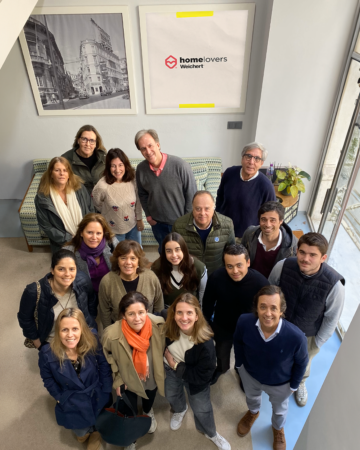
One such opportunity emerged across the water from a top brokerage based in Lisbon, Portugal, named HomeLovers. While international brokerages had reached out before, this time was different. It was the right opportunity, at the right time, with the right people in owner Miguel Tilli and his talented team.
Tilli had a clear vision of what he wanted in a partner: an organization that operates with a people-first philosophy, has a family-like culture, a proven track record of success and an appetite for growth. In the sea of sameness, Tilli saw something different in Weichert. He saw a perfect fit, centered around its strong core values and the opportunity to introduce a fresh brand that wasn’t already established in the Portuguese market.
The resulting partnership marked the first Weichert international licensing agreement and has sparked inquiries from brokerage owners in other countries, leading Weichert to look at further growth in Europe and throughout the world.
The future is bright
When you’ve been in business as long as Weichert, you’ve seen your share of market ups and downs, and this current cycle is no different. The key to resilience isn’t simply staying the course; it’s having the courage to change course when necessary and the vision to seek out the next opportunity.
Whether it’s expanding service offerings, investing in professional development, leveraging productive technology or exploring new partnerships and markets — growth and success come to those with a clear vision who actively pursue new opportunities. The Weichert story proves this.
Looking forward is in our DNA, and the future looks bright and yellow.
Weichert Real Estate Affiliates, Inc. is a top real estate franchisor established in 2001 by Jim Weichert. The company offers a proven business model for operating, managing and marketing a real estate brokerage. Its franchise network includes over 350 offices, serving markets in over 40 states. Each Weichert franchised office is independently owned and operated.
This post was originally published on this site
by Andrea V. Brambila | Jun 1, 2025 | Industry, News Feed
Bigger. Better. Bolder. Inman Connect is heading to San Diego. Join thousands of real estate pros, connect with the Inman Community, and gain insights from hundreds of leading minds shaping the industry. If you’re ready to grow your business and invest in yourself, this is where you need to be. Go BIG in San Diego!
The National Association of Realtors is not considering changes to its hate speech policy due to President Donald Trump’s stance against diversity, equity and inclusion, but rather to mitigate its own legal risk, NAR President Kevin Sears told attendees at NAR’s midyear conference Sunday morning.
Sears and NAR CEO Nykia Wright kicked off a session called “The Leadership Scoop” at the Realtors Legislative Meetings in Washington D.C. Thousands of NAR’s most involved members drop in on the nation’s capital once a year to lobby lawmakers on homeownership issues.
TAKE THE INMAN INTEL SURVEY FOR MAY
But in their leadership update, Sears and Wright focused on internal NAR happenings, including the latest on potential changes to the Realtor Code of Ethics and a $32 million drop in revenue expected from a membership drop to 1.2 million in 2026.
“I want you to know that the [ethics] recommendation has nothing to do with who is sitting in the White House,” Sears told the ballroom of attendees Sunday.
NAR is considering changing its hate speech policy, called Standard of Practice 10-5, which prohibits Realtors from using “harassing speech, hate speech, epithets, or slurs based on race, color, religion, sex, disability, familial status, national origin, sexual orientation or gender identity.”
The policy, which was approved in 2020, applies to all of a Realtor’s activities, not just those related to real estate. A Realtor that violates the policy is charged under Article 10 of the Code of Ethics, which prohibits denying equal professional services to anyone in those protected classes.
One proposed change would include creating a more specific definition for what counts as “harassment” that aligns with the NAR Member Code of Conduct, which contains extensive examples of prohibited behavior.
Another would be to change the policy’s applicability so that Realtors would be encouraged, but not required, to follow the policy “in all of their activities.” Disciplinary action would be reserved for violations that took place while Realtors were acting in a business capacity.
NAR’s Professional Standards Committee will consider the proposed changes at its next meeting on Tues. June 3 and, if approved, the proposals will be considered by NAR’s board of directors at their meeting on Thurs. June 5.
According to Sears, the proposed changes aren’t a reaction to Trump but rather are years in the making. NAR began hearing from some local Realtor associations in 2023 complaining about the ambiguity in some of the wording in the policy, he said.
“We’ve got 1,100 local associations, which means we could have 1,100 different interpretations of the rule,” Sears said.
Sears joked that NAR had “some other stuff going on” in 2023 — likely a reference to the Sitzer | Burnett trial that NAR lost and led to a $418 million antitrust settlement in March 2023. Later that year, Wright hired outside counsel to conduct a legal risk assessment of NAR’s current rules and policies, including its ethics code.
“We were already aware of some issues that were percolating because of Standard of Practice 10-5 and because of that, last summer, we began the conversation about ‘Okay, well, what do we need to do in order to help solve the problem [and] remove some liability, not only for our local associations, but for our volunteer leaders?’” Sears said.
Wright chimed in with a note on DEI.
“For some reason, around the country, there’s a rumor that I have single-handedly dismantled DEI,” Wright said, prompting some chuckles in the audience.
“I don’t know if people see my complexion and recognize me as a woman,” she added, prompting more laughter.
“But that could not be further from the truth. What we are continuing to do internally is make sure that we have the best-in-class staff to get us through today’s transactions and tomorrow’s transactions.” The crowd applauded.
According to Wright, NAR’s advocacy team “over the past several years has really ramped up a significant part of fair housing,” a law that she stressed predates 2020 and the death of George Floyd, which prompted many companies to commit to boosting their DEI efforts.
“[Fair housing] is what all of the alliance groups are coming to us and saying that they want more of, just in a different sort of nomenclature,” Wright said.
She said she wanted to be “very clear about that,” especially in light of NAR’s diminished financial circumstances.
“Yesterday, when NAR had a lot of money, we were a lot of things to a lot of people,” Wright said.
“What we have to do right now is pick our bets. When you look at the fact that we balanced the budget for the first time in the last 10 to 15 years last year, and when you look at what we are trying to do next year, there is a possibility that we have to pull another $32 million out of the budget.
“Kevin has always said that everything has to be affected in terms of an equitable fashion, but we’re not going to cripple anything,” Wright continued.
“Fair housing, DEI, has not been crippled. We are just trying to be more strategic and talk to stakeholders and understanding how we are placing our bets.”
“I feel bad about how people think that we have dismantled DEI,” she added.
She also emphasized that people are asking NAR for more transparency in how the association spends its money.
“So all of our transactions, all of our sponsorships, all of our ability to hand out member money, must have a better form of accountability and transparency in how we are spending those dollars,” Wright said.
Wright pointed out that NAR had hired a consulting firm, Slalom, to survey more than 75,000 members about what they wanted post-settlement and also to help NAR’s Strategic Planning Committee.
“People have been doing strategic planning work over the last few years, and at the committee, they’ve been doing great work, but it has not been tethered to the organization,” Wright said.
“It’s been disjointed. You would see a strategic plan online, but no one internally was marching towards those efforts.
“So right now, we are bringing those together, and they were actually on site yesterday, doing really incredible work, and will be here throughout the rest of the week to help us better understand our purpose.”
She also highlighted the addition of Jarrod Grasso as NAR’s first-ever senior vice president of industry relations as “so significant that it cannot be overstated” and that he and his team are in charge of breaking down “silos” internally at the trade group.
“Yes, you can say that we are strong in advocacy,” Wright said.
“Yes, you can say that we are strong in research. Yes, you can say that we are getting stronger in education and training. But you should also be able to not just cherry-pick specific aspects of the business, but understand how NAR brings the entire house to the transaction to help people go forward.”
Some in the crowd yelled “Yeah! Yeah!” in agreement.
Wright continued. “We are and should be the base camp of the industry. Regardless of what company you work for, at the end of the day, you should always be able to come back to NAR and understand how you can move to your next company, how you can move to the next tier in terms of profitability, how you can start your own brokerage… That is the true North.”
Wright noted that NAR has a new general counsel, Jon Waclawski, who is leading NAR’s effort towards “de-risking the portfolio” and said she wanted NAR to be “the first voice” to talk about what NAR is doing.
“You should be able to come to NAR to understand what the de-risking of the portfolio is, not listening to chatter out there, swapping ignorance on social media, but understanding exactly what we are doing,” Wright said.
Her comments spurred applause and laughter. One woman in the crowd declared, “She’s a badass.”
Regarding 2026’s expected revenue shortfall, Sears noted that for 2025, NAR had budgeted for fewer members — 1.4 million — and had cut nearly $20 million in expenses this year to account for that. For 2026, NAR expects “continued contraction on membership” and is therefore budgeting for 1.2 million members, according to Sears.
Since that means trimming an additional $32 million from the budget, Sears said the leadership team asked NAR’s staff to conduct a similar process to last year where cuts would “hurt us all equally.”
“We need to be able to maintain the products and tools and services and especially the advocacy that we’ve all come to expect, and I believe that in the budget that we’re presenting to the board on Thursday, you will see that,” Sears said.
Sears emphasized that NAR will not be raising dues after hearing from large brokerages who were left out of the antitrust settlement.
“Unfortunately, as part of the settlement, there was a carve-out of approximately 92 or 96 brokerages, and so they’ve had to negotiate their own settlement, and rightfully so, they’re upset now,” Sears said.
“We broke their trust overnight, and now we have slowly trying to rebuild it. One thing we heard loud and clear is: ‘Don’t increase dues. We can’t do it on our end. You shouldn’t do it on your end.’”
Consequently, NAR will instead take about $10 per member from its $45 per member special assessment for its consumer ad campaign to fund its budget and make sure that NAR can make its next, $72 million settlement payment by February 24, 2026, Sears and Wright said.
NAR can do this because at NAR’s annual conference last November, the NAR Executive Committee approved a motion that advocacy and consumer advertising campaign reserves “be used to fund NAR’s settlement obligations … and that the board designation for these funds be suspended for the duration of the settlement period.”
Wright also noted that at least 22 state Realtor associations around the country have their own consumer ad campaign budgets.
“So what we should be doing is leveraging the three-way agreement and working together to make sure … we are managing that at the local level, and that we are able to provide resources where we need them to be,” Wright said.
Inman has asked NAR for its current membership count and will update this story if and when a response is received.
The session ended with a brief presentation from Grasso on rebuilding relationships with local and state associations, the value of the three-way agreement, and the value of the Realtor brand. He displayed graphics NAR had created in the past week to illustrate that value.
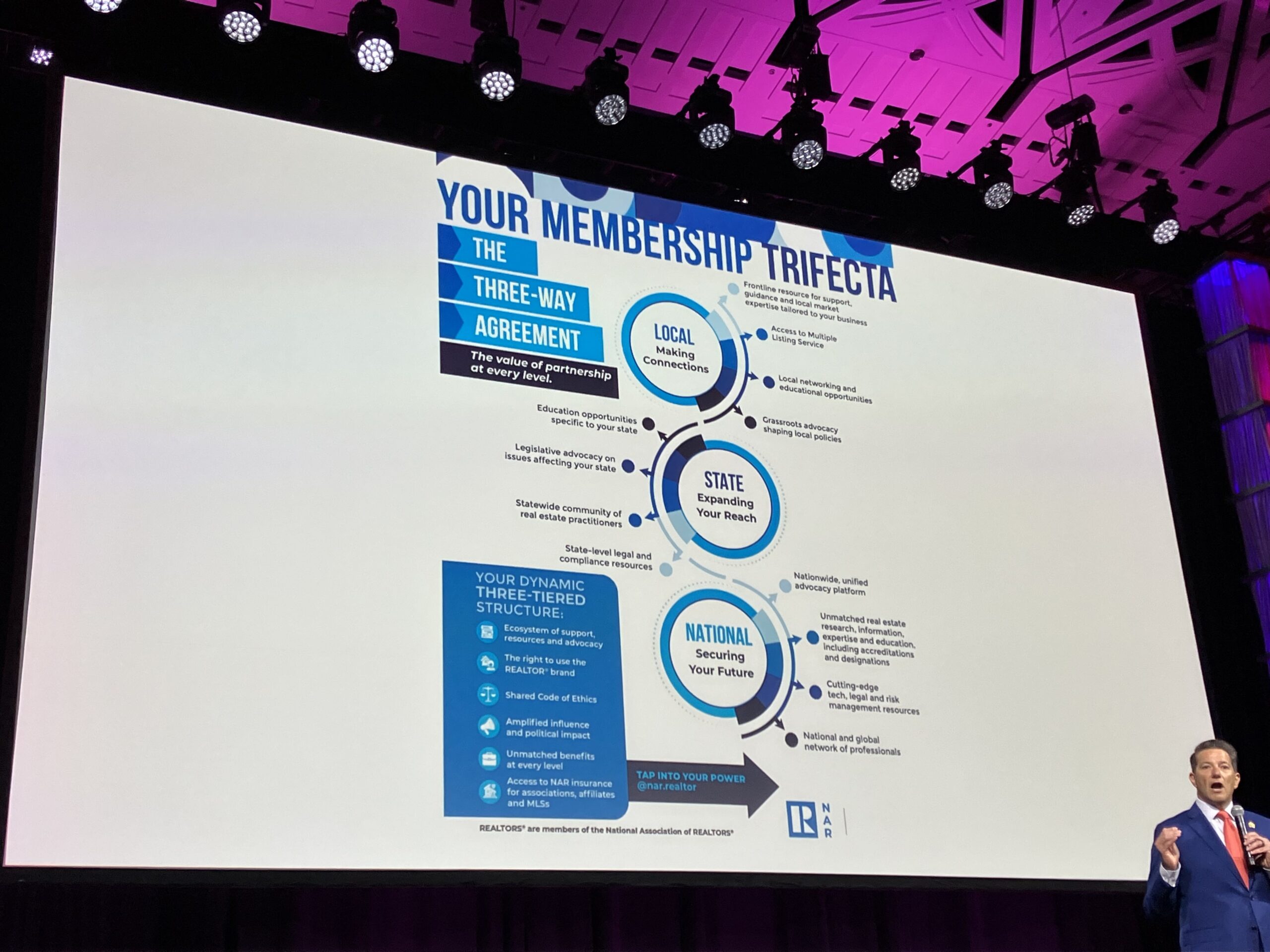
Jarrod Grasso at “The Leadership Scoop” session at the Realtors Legislative Meetings in Washington D.C. on June 1, 2025
“Local associations: They are the boots on the ground. They’re the main point of contact. They are the foundation of our organization, and I wanted to make sure that I emphasize key components of what they do to bring value to the membership,” Grasso said.
“State associations back up those local associations, provide enhanced value, but also have strategic partnerships when it comes to our lobbying efforts on specific state issues.”
“The National Association of Realtors: We bring more value and connect all three levels,” he continued.
“We’ve got [NAR Chief Advocacy Officer] Shannon McGahn and her amazing team and the work that you’re going to do today and this week up on the Hill, making sure that we emphasize the issues that are impacting us.”
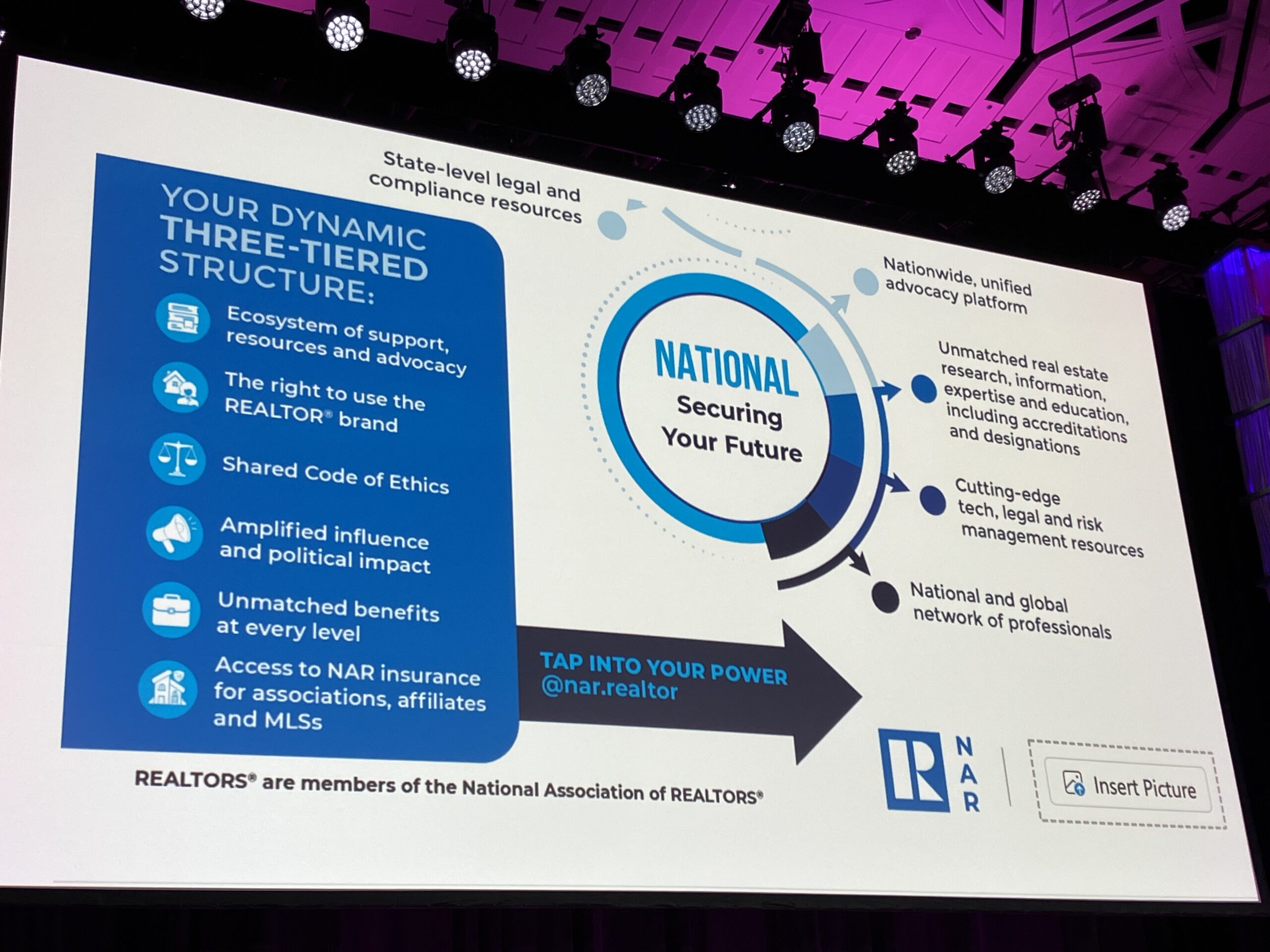
Graphic presented by Jarrod Grasso at “The Leadership Scoop” session at the Realtors Legislative Meetings in Washington D.C. on June 1, 2025
“The three way agreement is a true value,” he added.
“It’s part of the ecosystem. It’s what we bring to the members, and it’s a unique value that no other industry truly has.”
Email Andrea V. Brambila.
Like me on Facebook | Follow me on Twitter
This post was originally published on this site
by Jessi Healey | Jun 1, 2025 | Industry, News Feed
From trending Reels to TikTok link tools and Instagram voice updates, the latest platform changes show a clear shift toward video, voice and human connection.
Bigger. Better. Bolder. Inman Connect is heading to San Diego. Join thousands of real estate pros, connect with the power of the Inman Community, and gain insights from hundreds of leading minds shaping the industry. If you’re ready to grow your business and invest in yourself, this is where you need to be. Go BIG in San Diego!
Each week on Trending, digital marketer Jessi Healey dives into what’s buzzing in social media and why it matters for real estate professionals. From viral trends to platform changes, she’ll break it all down so you know what’s worth your time — and what’s not.
Social platforms are doubling down on visibility — whether that means spotlighting personality-driven content, surfacing job listings more effectively or amplifying what others are saying. This is evident in personality-driven content, job listings and user-generated content. Platforms like Instagram Reels emphasize engaging content, while AI optimizes ad delivery.
For real estate, this means embracing short-form video, cultivating candid moments and prioritizing strategic clarity across all channels to connect with clients authentically. Understanding and adapting to this visibility-first landscape is now crucial for real estate professionals to succeed.
From catchy to candid: Trends that work
Three viral trends are dominating Reels and TikTok — and each one proves that low-effort, relatable content performs best.
“Phrase to the Rhythm” turns short, six-syllable lines into catchy audio hooks, set to the “New Flame” interlude.
Use it to spotlight messages like:
- “This listing won’t last long”
- “Let’s go find your dream home”
- “Move-in ready for you”
Pair it with a listing tour, a text-on-screen Reel or a celebratory moment.
For real estate professionals, it’s a fun way to turn everyday phrases into memorable content.
The Samba “Whisk” Challenge is all about joy and energy — no choreography required.
Use it to:
- Announce a new listing
- Celebrate a closing
- Introduce a team member
It’s light, upbeat and human.
For real estate professionals, it’s an easy way to show your personality without overthinking.
“Calling to Say Goodnight” is a sincere trend focused on connection.
Use it to:
- Check in with a past client
- Film a team moment
- Share a thank-you or personal milestone
It’s short-form content with heart — and heart gets watched.
For real estate professionals, it’s a chance to connect with your audience in a real, human way.
Instagram updates DMs — and Reels keep rising
Instagram is leaning into better communication and immersive video.
Voice messages now have transcriptions — and can be up to five minutes long.
You can read them before, during or after playback.
Meanwhile, Reels account for 51 percent of time spent on Instagram — while engagement with traditional friend posts is slipping.
For real estate professionals, it’s time to prioritize voice and video-first content that’s quick, clear and engaging.
TikTok adds stylized links to Stories
TikTok now supports customizable links in Stories with unique text, color and styling options.
Use them to:
- Highlight a listing
- Link to your contact page
- Push a tour signup or newsletter
For real estate professionals, this creates a seamless path from content to conversion.
YouTube TV ad spend takes the lead
Brands are now spending more on YouTube ads for connected TVs than mobile.
Optimize content to:
- Look good on big screens
- Use bold, readable text
- Showcase video tours clearly and professionally
For real estate professionals, it’s a cue to think beyond the phone — and design with the living room in mind.
LinkedIn sharpens its tools for visibility and hiring
LinkedIn just made promoted job listings searchable — a move that improves discoverability for roles and helps recruiters surface listings to the right candidates. At the same time, the platform is testing a renamed video tab, “Today’s Top Trends,” designed to highlight timely, relevant content.
For real estate professionals, that means two key opportunities: Reach stronger candidates when hiring admins, marketers or agents — and earn more exposure by posting content that responds to local or industry trends.
Bluesky expands profile verification
Bluesky has expanded profile verification to notable users, similar to early Twitter’s blue checks.
A verified account boosts visibility and trustworthiness.
For real estate professionals, it’s a chance to build credibility early on an emerging platform.
TL;DR (Too Long, Didn’t Read)
- Trends that click: Phrase hooks, joyful dances and heartfelt moments are going viral. Authenticity wins over polish.
- Instagram evolves: Voice DMs now transcribe, and Reels dominate user time — short-form video is key.
- TikTok upgrades Stories: Customizable links in Stories make it easier to drive traffic from content.
- YouTube goes big-screen: TV ad spend surpasses mobile — design videos with larger formats in mind.
- LinkedIn improves search and video get a refresh: Promoted jobs are now searchable, helping recruiters and teams hire smarter. New “Top Trends” tab could surface timely content for more reach.
- Bluesky opens up verification: More notable users can get verified, adding early credibility on the platform.
To stand out in a content landscape shaped by algorithms and audiences, a strategic and human approach is key. Whether embracing trends, tailoring messages, or utilizing new tools, the ultimate aim is meaningful connection. These updates are more than just features; they are indicators. For observant agents, they present numerous opportunities to remain visible, relevant and prepared.
Jessi Healey is a freelance writer and social media manager specializing in real estate. Find her on Instagram, LinkedIn, Threads, or Bluesky.
This post was originally published on this site