by Lillian Dickerson | Jun 25, 2025 | Industry, News Feed
A steady course is predicted for luxury real estate throughout the remainder of 2025, the firm’s mid-year luxury report said, creating “compelling opportunities for strategic homebuyers and sellers,” according to CEO Philip White.
Real estate is changing fast, and so must you. Inman Connect San Diego is where you turn uncertainty into strategy — with real talk, real tools and the connections that matter. If you’re serious about staying ahead of the game, this is where you need to be. Register now!
Many Americans may feel shaken right now because of economic uncertainties and stock market volatility, but their confidence in luxury real estate as a safe haven remains firm.

Bradley Nelson | Sotheby’s International Realty
The conclusion comes from Sotheby’s International Realty’s 2025 Mid-Year Luxury Outlook, released on Wednesday, which pulled intel from Sotheby’s International Realty agents across the globe who specialize in transactions priced at US$10 million and above. Those insights are also paired in the report with data from investment bank UBS, J.P. Morgan, Moody’s, McKinsey and Company, Bain and Company, Cotality, the National Association of Realtors (NAR) and the National Association of Home Builders (NAHB).
“The luxury real estate landscape continues to evolve at an unprecedented pace, creating opportunities for homebuyers and sellers with the right market knowledge,” Sotheby’s International Realty Chief Marketing Officer Bradley Nelson said in a statement.
“Our global network of affiliated agents brings unparalleled expertise and market insights that only Sotheby’s International Realty can deliver. This report is designed to empower both homebuyers and sellers with the strategic intelligence needed to make informed real estate decisions throughout the remainder of the year.”
TAKE THE INMAN INTEL SURVEY FOR JUNE
Luxury real estate continued to outperform the market at large during 2024 and the first months of 2025, Sotheby’s Realty noted, with the top half of the wealthiest U.S. households benefiting from the greatest gains in real estate value, according to data from Realtor.com.

Philip White | Sotheby’s International Realty
As some buyers pull away from the market during economic uncertainty, it also creates opportunity for other buyers who are ready to pounce when there’s less competition, the report said. The economic landscape, as well as movement in key markets, rebuilding opportunities in disaster areas and more, will all have an impact on the luxury real estate market this year, Sotheby’s International Realty concluded. But a steady course is predicted as 2025 continues.
“Ultra-high-net-worth individuals continue to view real estate as an essential portfolio component,” Sotheby’s International Realty President and CEO Philip White said in a statement. “Even amid economic uncertainty, the resilience of the luxury housing market provides compelling opportunities for strategic homebuyers and sellers, and this report serves as a roadmap for navigating today’s complex luxury real estate landscape.”
Economic headwinds

Odeta Kushi | First American Deputy Chief Economist
“On one hand, sharp swings in equities can prompt some high-net-worth individuals to delay big purchases due to uncertainty,” Odeta Kushi, deputy chief economist of First American Financial Corp, said in Sotheby’s International Realty’s report. “On the other, real estate — especially in prime markets — might be seen as a safer, more tangible store of value.”
- Construction costs may be exacerbated by Trump administration tariffs, Kushi said, which could drive luxury homebuyers toward turnkey properties to avoid elevated construction costs.
- Real estate represents 18.7 percent of the top 10 percent of wealthiest households’ investment portfolios, according to an April 2025 Realtor.com report, which is down from 19.9 percent a year ago.
- The segment of $1 million homes in the U.S. continues to grow, and represents nearly 13 percent of recent existing-home sales, according to April 2025 data from NAR, suggesting affluent buyers see real estate as a safe harbor for their investments.
- A weaker dollar in response to trade wars could lead to more overseas real estate investor purchases in the U.S., as could President Trump’s proposed “Gold Card” visa program, which creates a path to citizenship for individuals who invest US$5 million in the country.
Key US markets

Kara Warrin | Golden Gate Sotheby’s International Realty
“Our luxury property market isn’t impacted by interest rates because 85 percent of transactions are with cash,” said Kara Warrin, an advisor with Golden Gate Sotheby’s International Realty in Marin County and San Francisco. “Our team sold more than US$65 million between October and December 2024, with an average sale price of US$6 million. The buyers tend to be local people who want something bigger and better and have the cash to pay for it.”
- Buyer confidence seems to be growing in San Francisco, driving momentum at Sotheby’s International Realty – San Francisco, where the firm closed several transactions over $20 million in 2024, breaking old records.
- Momentum picked up in the New York City luxury market after the election as a result of pent-up demand and more liquidity from stock market performance, local Sotheby’s Realty advisors say. Condos are especially in demand because of their fewer restrictions than co-ops.
- Low inventory and restrictions on new development in Aspen have led to sustained elevated prices in the luxury ski town.
Rebuilding after disaster
“The number of such damaging natural disasters is growing,” Sotheby’s International Realty’s report said. “According to data released in January 2025 by the National Centers for Environmental Information, part of the National Oceanic and Atmospheric Administration, in 2024, the U.S. alone suffered 27 natural disasters where the estimated damage exceeded US$1 billion.
This trend is having profound consequences for high-end property markets around the world, reinforcing the increasing importance of considering climate resilience when investing in luxury real estate.”
- 2024 was the fifth year straight in which insured global losses from natural disasters exceeded US$100 billion, marking sustained climatic disruption, according to a January 2025 Moody’s report. One-third of losses were attributed to hurricanes making landfall in the U.S.
- In the last five years, 23 percent of U.S. homeowners saw property damage or loss as a result of severe weather, and 65 percent are prepping homes for future weather events, according to a Bank of America Institute report from May 2025.
- Rebuilding after a disaster can slow the inventory recovery, potentially bumping up prices while inventory is still constrained, the report noted. Relocation to other areas after a disaster can shift demand and create more pressure on nearby markets.
- Low inventory in the Pacific Palisades in the wake of fires in January 2025 has led to the average list price for surviving homes to grow to US$9.7 million, significantly higher than historic norms. Many of those who are rebuilding are now incorporating fire-preservation features in homes to prepare for future wildfires.
Global highlights

Tammy Fahmi | Sotheby’s International Realty
“What’s driving today’s high-end market is the feeling a home delivers as much as its address,” said Tammy Fahmi, senior vice president of global servicing and strategy at Sotheby’s International Realty. “What we’re witnessing in luxury real estate isn’t just a trend — it’s a fundamental redefinition of value. This experiential revolution transcends cultural boundaries, with buyers willing to pay substantial premiums for properties that offer exceptional features that reflect their lifestyles.”
- With the Saudi Vision 2030 economic development initiative, executives and foreign companies coming into Saudi Arabia are driving luxury developments with high-end amenities. The Red Sea Project, just off Saudi Arabia’s west coast, is also expected to drive tourism to the region after it is unveiled around 2030.
- Demand for high-end properties in India has surged in the last two years, and the luxury real estate market is expected to reach a value of US$105 billion by 2030.
- Between 2012 and 2021, the highest-priced transaction in Puerto Rico rose from US$2 million to $30 million. The island has seen growth in the luxury goods market, with revenue from the industry set to reach US$533.44 million in 2025, according to Statista Market Insights.
Get Inman’s Luxury Lens Newsletter delivered right to your inbox. A weekly deep dive into the biggest news in the world of high-end real estate delivered every Friday. Click here to subscribe.
Email Lillian Dickerson

by Carl Medford | Jun 25, 2025 | Industry, News Feed
Real estate is changing fast, and so must you. Inman Connect San Diego is where you turn uncertainty into strategy — with real talk, real tools and the connections that matter. If you’re serious about staying ahead of the game, this is where you need to be. Register now!
It is no secret that real estate agents have had a long-term love-hate relationship with Zillow since its online debut in 2006. Its advent, along with the other web-based portals that began to appear (Trulia, Realtor.com, Homes.com), inaugurated the transition of real estate information from the carefully guarded hands of real estate agents to the masses and fundamentally changed the industry.
TAKE THE INMAN INTEL SURVEY FOR JUNE
Although there has always been significant tension between the online portals and real estate brokerages and their agents, the current war between Zillow and Compass has caused many to take a deeper look at Zillow and, as a result, has raised more than a few questions about some of Zillow’s practices.
A look at the war between Compass and Zillow
To begin, let’s take a quick look at the current issue with Compass. In a nutshell, Zillow takes listings from the various MLSs across the country and posts them on its website. It then captures leads (mostly buyers), which Zillow then turns around and sells to participating agents who pay (at a basic level) a monthly fee for a prescribed number of leads or (for a higher level of better “qualified” leads) a monthly fee and a subsequent referral fee for closed transactions.
The rub here for many real estate agents is that they believe the leads should belong to them because they (as listing agents) do all of the legwork up front to develop a relationship with a seller, pay the costs of marketing and servicing the listing, and so on.
Zillow’s contention has always been that listing agents and their brokers do not do a good enough job of online marketing, thus providing a foothold for companies such as Zillow and Realtor.com, which, by spending significant amounts to market those leads online, should reap the benefits.
Zillow and other online portals rely on MLSs to provide them with data feeds that, in turn, provide the flow of listings they need to continue their business model. Enter Compass, which, by setting up its own independent feed of off-market listings, is cutting off some of the potential flow of listings to Zillow, thus undermining Zillow’s business model.
Compass — and I’ve certainly commented on this in other posts — has been flying in the face of many other brokerages with their blatant opposition to NAR’s Clear Cooperation Policy.
In retaliation, Zillow is refusing to allow any listings that have been previously marketed on off-MLS sites for more than a day to come onto its site. Let me clearly state that I support NAR’s CCP and, as such, do not agree with any attempts to set up private listing portals. With that out of the way, Zillow’s action does raise a number of questions that will now be played out in the courts.
How Zillow’s brokerage status changes the picture
An important distinction to understand is that, unlike web-based portals such as Realtor.com, Homes.com and Trulia, Zillow is actually a broker in all 50 states. This means that Zillow operates by the same rules that govern brokers and their agents, a fact that separates Zillow from information-only portals.
One immediate question that arises from any given broker refusing to post any listing is the question of potential steering.
Although I am not an attorney or capable of dissecting the finer points of the conflict, the overall topic of Zillow brings up some other questions about Zillow’s long-term intent and how real estate agents can continue to navigate with this “elephant” in the room effectively.
At the heart of the issue is whether or not a portal is providing information or advice. If they are providing information, then they are acting as a web-based portal. If they provide advice, however, then they are entering into brokerage territory. There is no doubt that this is a finely nuanced discussion, and, at the end of the day, is fraught with legal implications.
Take, for example, the idea of posting school scores. If you are simply a web-based information portal, then you can link to sites such as Great Schools and display their results for any given property. As such, and with the correct disclaimer, information is being displayed with no advice or interpretation.
As a broker or agent, however, the rules are different. To stay clear of fair housing violations and to avoid any appearance of steering, brokerages and their agents can disclose the existence of sites that provide school scores and even provide their clients with links to those sites, but should not communicate the actual scores themselves.
Brokerages and real estate agents can do the following:
- Provide links or resources where buyers can research school performance themselves.
- Direct buyers to official sources for more detailed and up-to-date information (GreatSchools.org, Niche.com, state Department of Education websites).
Brokerages and their agents should avoid:
- Providing specific scores or data.
- Providing assessments or judgements (“this is a horrible school” or “that is a great school district”) can be considered to be steering and a violation of fair housing laws.
- Excluding or recommending neighborhoods based on school information.
To avoid any fair housing laws, Zillow and other brokerage sites, such as Redfin, follow strict guidelines to maintain a legal safety net:
- They present data from Great Schools “as-is,” not curated in any way.
- They provide disclaimers indicating the source of the data and encourage users to verify the information independently.
- They let users of their website draw their own conclusions.
- They ensure there is no editorializing or interpreting of the scores.
- They maintain a role closer to a search engine or web-based informational portal that provides them with more leeway than a licensed real estate agent offering guidance or advice.
Even though Zillow provides adequate legal disclaimers, there is still risk, and any brokerage displaying school scores opens itself up to potential violations in an indirect manner.
- When it comes to fair housing laws, impact matters. Whereas the intent may have been to simply provide information, if that data is used by a consumer to avoid certain properties or areas, then the heart of fair housing laws has been violated. If the school scores are posted on an information-only web portal, there is no issue. If they are posted on a brokerage site, however, it is different.
- If school scores can be demonstrated to steer certain demographic groups toward or away from any given area — even in a passive manner — this could then be challenged in court, especially if there’s a pattern of disparate impact.
- This is not a new issue: Consumer advocacy groups and HUD have complained about this practice, though, to date, no landmark case has held Zillow liable. Responding to concerns that have been raised about this practice, while Zillow has made changes to the way the information is being displayed, it chosen not to remove the data.
As you can hopefully see by now, the inherent nuances are the issue, which brings up the next potential issue.
Zillow’s ‘suggested offer prices’
I am going to guess that many agents simply do not know about this feature on Zillow’s site. Set approximately 50 percent of the way down the page of an active listing, this feature not only provides Zillow’s trademark Zestimate (along with its accuracy percentage over the past 10 years), but also outlines strategies a buyer can employ potentially to write a winning offer. Maybe it’s just me, but this looks like advice, not information.
As an example, a home listed at $1,098,000 shows a Zestimate of $1,075,400. Under the Explore offer strategies headline are four buttons: Strong, Competitive, Moderate and Weak.
- By pressing the Strong button, Zillow suggests that an offer of $1.09 million-plus has an over 90 percent chance of winning.
- Press the Competitive button, and Zillow suggests that by writing an offer between $1.07 million and $1.09 million, you now have a 70 percent to 90 percent chance of getting your offer accepted.
- Hit the Moderate button, and the numbers $1.07 million to $1.07 million are displayed, along with a 50 percent to 70 percent chance of getting your offer accepted.
- Finally, by using the Weak button, Zillow suggests that an offer between $1.01 million and $1.07 million has less than a 50 percent chance of winning.
While these numbers for the specific property I used are close to the list price, I have seen instances where the recommended numbers are dramatically lower than the list price.
Here are some important things to consider:
- With this feature, even though the numbers provided are automated, Zillow is providing advice, which puts it squarely in the category of a broker or real estate agent.
- It is using its Zestimate to provide the basis for recommendations, which, as has been demonstrated amply over the years, is not accurate enough to provide sound pricing advice.
- By providing advice as to a recommended offer price lower than the list price, it is acting in direct competition with the listing agent and the seller.
All of this poses some serious concerns and questions:
By offering pricing suggestions — even algorithmically — this can be construed as real estate advice, which is inherently a part of a real estate agent’s fiduciary role.
This can interfere with buyer-agent relationships if a buyer’s agent recommends a specific offer price, based on their market knowledge, conversations with the listing agent and condition of the property, and Zillow recommends a lower price. This could potentially:
- Undermine the agent’s ability to represent their client
- Create confusion and mistrust between agent and clients
- Significantly impact negotiation strategies
This can also introduce potential liability:
- By providing “advice,” Zillow could potentially be construed as establishing an agency relationship with a buyer.
- If buyers rely on Zillow’s “suggested pricing” and either lose out on a home by offering too little or, inversely, overpay, there could be potential legal risk and liability, especially if it could be proven that the data was flawed. (Since the data is based on the Zestimate, which does not provide information based on property condition, photos, etc., the chances for error are high.)
While Zillow attempts to mitigate concerns or liability by labeling its suggested prices as “an estimate,” including disclaimers such as “not a guarantee” and avoiding direct “you should offer this” language, they are still, in my opinion, skating on very thin ice.
ChatGPT provides the following assessment:
Zillow is skating a fine line by posting suggested offer prices. It’s not illegal, but it treads dangerously close to giving what amounts to licensed advice — especially since Zillow holds brokerage licenses.
They’re relying on:
-
- Automation, not personal guidance.
- Disclaimers to reduce liability.
- Their platform status, not direct agent representation.
As a result, this practice has drawn criticism from brokerages, real estate agents, legal analysts, consumer advocacy groups and industry watchdogs alike.
The irony here cannot be overstated: While we are in the midst of a battle over Clear Cooperation, with Zillow refusing to show listings on its portal that are not on the MLS, sellers, aware of the fact that Zillow’s Suggested Offer Prices may in fact be competing directly against their chances of a competitive price (to be fair, Zillow sometimes recommends higher than list price offers), may not want their listings (even though they are on the MLS) shown on Zillow.
What a tangled web we weave.
by Lillian Dickerson | Jun 25, 2025 | Industry, News Feed
Homebuyers continued to respond to market headwinds like high mortgage rates and economic uncertainty and failed to be drawn in by builder sales incentives.
Real estate is changing fast, and so must you. Inman Connect San Diego is where you turn uncertainty into strategy — with real talk, real tools and the connections that matter. If you’re serious about staying ahead of the game, this is where you need to be. Register now!
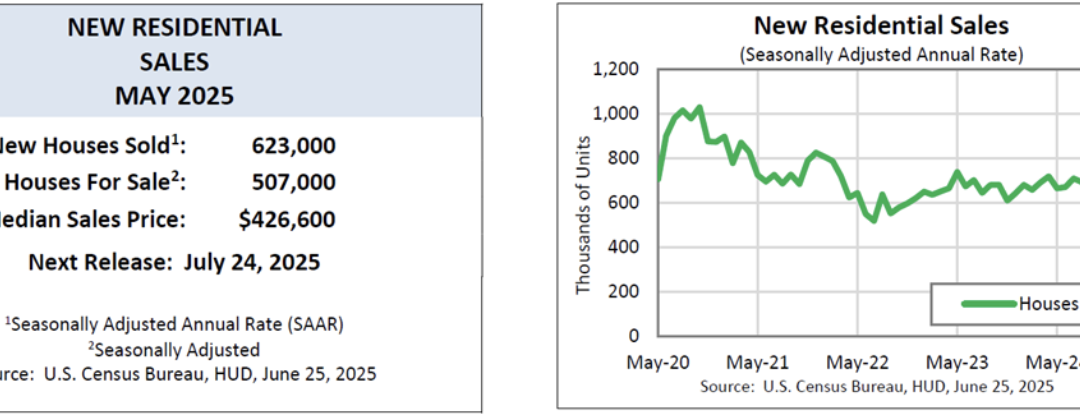
Sales of newly constructed single-family homes dropped 13.7 percent in May 2025 from the previous month, as homebuyers continued to respond to market headwinds like high mortgage rates and economic uncertainty and failed to be drawn in by builder sales incentives.
The seasonally adjusted annual rate of sales hit 623,000 in May, which was 6.3 percent below the May 2024 rate of 665,000, the U.S. Census Bureau and U.S. Department of Housing and Urban Development reported on Wednesday. The figure represented the most severe drop in new-home sales in nearly three years.
TAKE THE INMAN INTEL SURVEY FOR JUNE
The report comes on the heels of the Census Bureau and HUD’s report last week showing that housing starts slid by 10 percent in May to their lowest level since 2020.
“New home sales plunged in May,” Navy Federal Credit Union Chief Economist Heather Long said in a statement sent to Inman. “The spring and summer are shaping up to be very tough for the real estate market. Buyers are staying on the sidelines as they worry about uncertainty and high mortgage rates. New-home inventories edged up in May and remain at elevated levels. Buyers are waiting for deals and there just aren’t many of them right now.”
The seasonally adjusted inventory estimate for new homes was 507,000 at the end of May 2025, 1.4 percent above April 2025’s estimate and 8.1 percent above inventory levels in May 2024.
The figure represents 9.8 months of supply of new homes at the current sales rate, which is 18.1 percent above the April 2025 supply of 8.3 months, and 15.3 percent above May 2024 levels of 8.4 months.
In May 2025, the median sales price of new homes sold was $426,600, 3.7 percent above the median price in April and 3 percent higher than the median sales price in May 2024.
The average sales price for new homes sold in May 2025 was $522,200, 2.2 percent higher than April and 4.6 percent higher than the average in May 2024.
Email Lillian Dickerson
by Lillian Dickerson | Jun 25, 2025 | Industry, News Feed
Real estate is changing fast, and so must you. Inman Connect San Diego is where you turn uncertainty into strategy — with real talk, real tools and the connections that matter. If you’re serious about staying ahead of the game, this is where you need to be. Register now!
Even as markets muddle through uncertain waters today, high-net-worth clientele remain attracted to luxury real estate as an investment.
But this year, luxury buyers have proven to be more selective and ready to take a hard-line approach to their homebuying goals with an eye on cash deals, according to Coldwell Banker Global Luxury’s 2025 Mid-Year Report released on Wednesday.
TAKE THE INMAN INTEL INDEX SURVEY FOR JUNE
The report analyzed market data from 120 markets in the U.S. and surveyed responses from more than 200 Coldwell Banker Luxury Property Specialists to predict luxury trends over the next six, 12 and 24 months.

Michael Altneu | Coldwell Banker Global Luxury
Out of those Coldwell Banker luxury agents surveyed, 68 percent said their clients are at least maintaining, if not increasing, their exposure to real estate. Many are also opting out of financing at a growing rate, with 51 percent of luxury agents reporting an increase in all-cash transactions.
The findings add up to a luxury real estate market in a period of adjustment, said Coldwell Banker Global Luxury Vice President Michael Altneu.
“So far in 2025, we’re seeing a luxury real estate market that isn’t fully bullish or bearish — but rather recalibrating,” Altneu said in a statement. “Affluent homebuyers still see real estate as a safe haven to grow and protect their wealth, but as the market balances and more inventory comes online, they can also be more choosy than in recent years. Practical considerations including home affordability, tax strategy, estate planning and long-term investment potential are taking precedence over aesthetics, flashy amenities or location. This could market the return of what we call ‘smart luxury’ — a mindset shift where discernment and strategic decision-making take priority.”
Different classes of luxury buyers are responding to market fluctuations in contrasting ways, Altneu added in the firm’s report. The “aspirational affluent” are reacting to financial market volatility by pulling back from real estate while the ultra-wealthy are digging their heels into the most high-end real estate assets, Altneu said, “driven in part by a desire to diversify out of equities and into real estate, which is seen as a safer, more stable asset class.”
Looking at the months ahead, luxury real estate agents can expect wealth strategy, “smart luxury,” move-up buyers, the ultra-wealthy and aspirationally wealthy divide, and cash purchases to increasingly impact the market.
Real estate remains a stable wealth strategy
Despite economic headwinds including high home prices and mortgage rates, a volatile stock market, Trump administration tariffs and more, many luxury buyers remain of the opinion that real estate is a stable investment, Coldwell Banker’s report shows.

Jessica Lautz | NAR Deputy Chief Economist
The nearly 7 in 10 luxury agents who said their clients are either upholding or growing their exposure to real estate shows the level of confidence high-net-worth individuals place on real property as an investment. Nearly 60 percent of luxury agents said they feel somewhat or extremely confident about the health of the market today.
At the opposite end of the spectrum, only about 11 percent of luxury agents said their clients are decreasing their real estate assets in favor of other investments.
“Real estate can be a place to park money, and when the world feels uncertain, we often see an interest in home and real estate purchases,” National Association of Realtors Deputy Chief Economist Jessica Lautz said in the report. “With the recent volatility in the stock market, the affluent may be looking to diversify their assets and invest in real estate since they view it as a more secure asset.”
The ‘smart luxury’ movement

Carla Rayman Kidd | Coldwell Banker
Luxury buyers today are much more keen on buying homes that are completely aligned with their ideal property features or condition — and a lot less willing to compromise on those properties that don’t fall into these categories, Coldwell Banker said in the report.
Those high standards might also be contributing to growing inventory, the report noted. Since 2023, inventory of single-family luxury homes is up 40.4 percent and inventory of attached luxury homes is up 42.6 percent. Rising inventory levels are also serving as a feedback loop of sorts, the report said, with buyers becoming more selective as more inventory becomes available.
Those “smart buyers” that Altneu mentioned are also waiting for a perceived deal.
“Many luxury buyers are trying to get a ‘deal’ on a home that may have been sitting on the market for a longer period of time — trying to take advantage of the current economic conditions of the world,” Coldwell Banker luxury agent Carla Rayman Kidd of Sarasota, Florida, said in the report.
Move-up buyers moving on in

Georgie Smigel | Coldwell Banker
With home prices continuing to climb, homeowners are gaining new levels of equity and graduating into luxury buyers, the luxury report found. The number of million-dollar homes is also increasing as a result. In the last year, almost 300,000 homes sold above the $1 million mark, up from 275,000 homes the previous year, according to data from Realtor.com.
“Prices have increased, forcing move-up buyers to now become luxury homebuyers — especially if they want a newer home,” Georgie Smigel of Coldwell Banker Realty in Cranberry Township, Pennsylvania, said in the report.
For every 1 percent increase in home prices, about $350 billion in home equity is generated, according to NAR data cited in Coldwell Banker’s report. “That means a gain of nearly $1.3 trillion in home value appreciation at a time when the stock market is undergoing a correction,” NAR Chief Economist Lawrence Yun said during NAR’s quarterly Real Estate Forecast Summit in March.
The aspirational and ultra-wealthy buyer divide

Winston Chesterfield | Barton Consulting
While many agents with ultra-luxury buyers (those in the top 5 percent of the market) reported an increase in transactions, those with lower-tier luxury buyers reported more hesitancy as financial market remain in an uncertain place.
Ultra-high-net-worth buyers tend to be “more globally minded, with larger investments exposed to geopolitical shifts,” Barton Consulting founder Winston Chesterfield said. “High-net-worth buyers, on the other hand, are often more focused on immediate, practical concerns — like interest rates, inflation, and taxes. They’re thinking in terms of their own financial world, not the global one.”
However, looking at the data, Coldwell Banker Global Luxury found no significant performance gap between the top 5 percent and top 10 percent of the market during the first five months of 2025 compared to the same period the year prior. “When comparing the top-performing tier to the broader luxury market, differences have been marginal — except in a handful of powerhouse markets,” the report stated, pointing to top-tier sales in Los Angeles, New York City, Miami, Palm Beach and Aspen.
Cash is king

Jade Mills | Coldwell Banker
Luxury buyers are known for their use of cash in transactions to avoid those pesky interest rates that have remained elevated in recent years. And according to Coldwell Banker’s report, that isn’t changing this year.
A massive 96 percent of Coldwell Banker luxury agents reported that buyers are either maintaining or increasing their use of cash purchases.
“Ultra-high-net-worth individuals aren’t just buying one property — they’re building real estate portfolios,” Jade Mills, president of Jade Mills Estates and International Ambassador of the Coldwell Banker Global Luxury program, said in the report. “These buyers are paying all-cash specifically because they want hard assets independent of market swings. When you’re dealing with generational wealth, real estate becomes a cornerstone strategy, not just a lifestyle purchase.”
Get Inman’s Luxury Lens Newsletter delivered right to your inbox. A weekly deep dive into the biggest news in the world of high-end real estate delivered every Friday. Click here to subscribe.
Email Lillian Dickerson
by Darryl Davis | Jun 25, 2025 | Industry, News Feed
The next time you’re questioning your effort and your impact, coach Darryl Davis writes, look at the ripple effect of all you do and the lives you touch.
Since the NAR commission suit settlement, buyer agents have faced new rules, new documents and a new normal. This month, Inman drills down on Today’s Buyers Agent with the fresh marketing strategies, skills and tools buyer agents are using to prosper in changing times.
In the hustle of daily life, it’s easy to lose sight of just how powerful and essential you are as a real estate professional. Are you feeling undervalued, overwhelmed or disconnected from the bigger impact of your work? Maybe you wake up, check your emails, return calls, set up listings, negotiate deals and hustle to make things happen for your clients, but it feels like you aren’t making a difference.
Let me remind you of something — what you do is bigger than just you. It’s bigger than just one home sale or one closed transaction. What you do sends ripples through the world, affecting dozens — no, hundreds — of lives with just a single deal.
The chain reaction of a single transaction
Let’s break it down.
When a house goes on the market, the impact begins immediately. The moment you take that listing or help a buyer find their dream home, an entire network of professionals jumps into action. Photographers, videographers and stagers help showcase the property. The MLS system processes the listing, and the people working behind the scenes at the MLS ensure it’s up and running smoothly.
Then comes the appraiser, the home inspector and the contractors making necessary repairs. That’s just the beginning.
Now think about the painters freshening up a home, the landscapers boosting curb appeal, the house cleaners ensuring everything shines. Movers step in to transport families to their next chapter.
Loan officers, underwriters, title companies, attorneys and insurance agents all play their roles, each earning a living from that one transaction. Every single person involved supports their family with the income they earn, thanks to the ripple effect of your work.
The ripple expands further
The marketing teams designing brochures and ads. The sign company crafting the For Sale sign. The surveyor ensuring boundaries are set. If the home was staged with rented furniture, that’s another business benefiting.
Once the home sells, utility companies gain a new customer, local restaurants welcome a new family and storage facilities provide solutions for transitions. The city and county clerk’s office process paperwork, generating revenue for public services. Even the neighbors are affected — new faces in the community mean new relationships, new stories and new beginnings.
And let’s not forget the emotional and social impact.
You’re not just selling a house. You’re helping a family find a home where memories will be made, where children will take their first steps, where celebrations will happen and where lives will be lived.
You’re guiding sellers through a transition, whether it’s upgrading, downsizing or moving forward after a major life change. Every decision, every negotiation and every conversation carry weight beyond the immediate sale. It shapes futures.
Real estate as a force for good
Every real estate transaction you touch is a ripple that spreads outward, changing lives in ways you may never even see. And that’s why what you do matters so much.
I get it — some days are tough. Deals fall through, clients get difficult, the market shifts. It’s easy to get caught up in your own challenges, focusing on the to-do lists, the numbers and the commission checks. But when you remember the bigger picture, when you recognize how many people are impacted by your success, it changes the game.
Your work isn’t just about you — it’s about the hundreds of people who rely on you, directly and indirectly.
So, the next time you’re feeling frustrated, the next time you’re questioning whether all the effort is worth it, take a step back. See the bigger impact. Feel the ripple effect of what you do and let that energy push you forward to your next level.
Darryl Davis is the CEO of Darryl Davis Seminars. Connect with him on Facebook or YouTube.
by Inman | Jun 25, 2025 | Industry, News Feed
Since the NAR commission suit settlement, buyer agents have faced new rules, new documents and a new normal. This month, Inman drills down on Today’s Buyers Agent with the fresh marketing strategies, skills and tools buyer agents are using to prosper in changing times.
Pulse is a recurring column where we ask for readers’ takes on varying topics in a weekly survey and report back with our findings.
With political and economic uncertainty in the air and in the midst of a multi-year down market cycle, finding qualified buyer leads is job one for many agents. Whether they come from your broker, from your sphere of influence or from paid channels, it’s not easy to find buyers who have all their ducks in a row financially and logistically.

So let us know: How are you getting buyer leads in today’s market? Once you get them, how are you converting them? Do you hold buyer consultations or otherwise qualify your buyers before you start showing them homes? Do you create content, focus on past clients and referrals, or are you paying for leads? Share your secrets below:
We’ll compile a list of the top responses and post them on Inman next Tuesday.
