by Andrea V. Brambila | Jun 26, 2025 | Industry, News Feed
The Orlando Regional Realtor Association (ORRA) and the parent company of the lockbox firm informed the court they had agreed to terms.
Real estate is changing fast, and so must you. Inman Connect San Diego is where you turn uncertainty into strategy — with real talk, real tools and the connections that matter. If you’re serious about staying ahead of the game, this is where you need to be. Register now!
A local Realtor association in Florida and the parent company of lockbox firm Supra have reached a settlement over allegations that the latter colluded to “steal” members and entice them to join other, rival associations.
On June 16, attorneys for the Orlando Regional Realtor Association (ORRA) and Honeywell International Inc. informed the U.S. District Court for the Middle District of Florida Orlando Division that the parties had settled.
“A settlement agreement has been agreed to in terms and is in the process of being executed,” the attorneys wrote.
Honeywell acquired Carrier Global Corporation’s Global Access Solutions business, including Supra, in June 2024.
The filing did not provide details on terms of the deal, whether there was any admission of wrongdoing or any payment involved. Inman has reached out to ORRA and Carrier for comment and will update this story if and when responses are received.
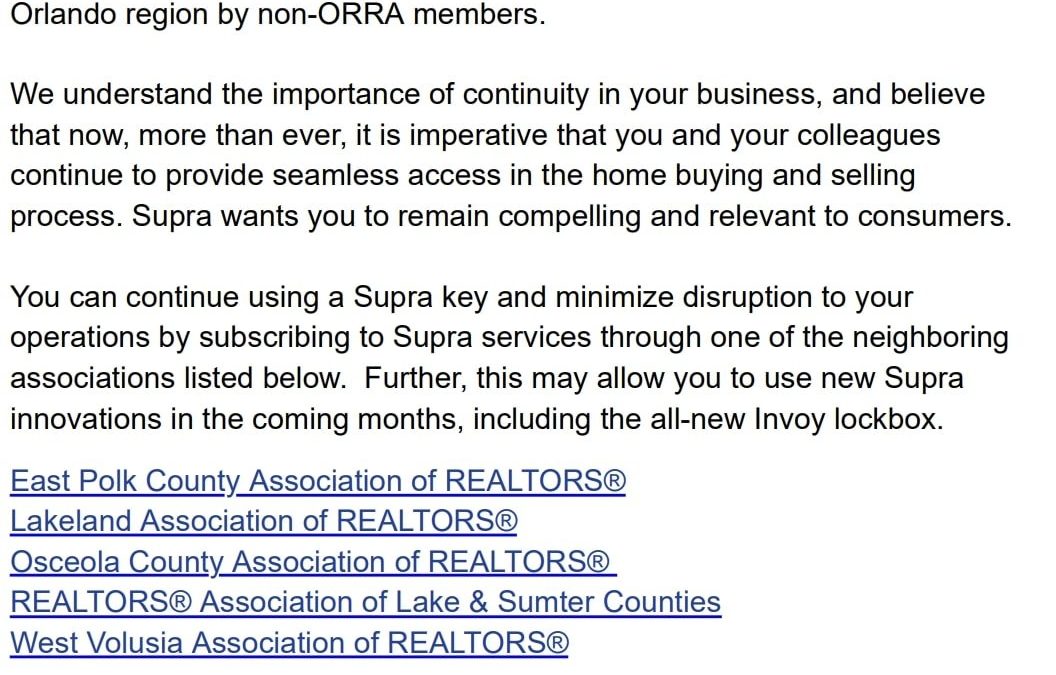
ORRA, which has more than 20,000 members, filed suit last year. The association alleged that, after ORRA declined to renew its lockbox partnership agreement with Supra, Supra sent “a malicious Email intimidating ORRA’s Members into leaving ORRA and associating with other organizations,” causing at least 67 to 100 members to leave the trade group since the email was sent.
Screenshot of email sent to ORRA members from Supra on July 8, 2024
The complaint alleged tortious interference of business relationships, tortious interference with contractual relationships, breach of contract, and breach of good faith and fair dealing. But in its answer to the complaint, Honeywell denied the allegations, including ORRA’s characterization of the email sent by Supra.
Read the notice of resolution (reload page if document is not visible):
Email Andrea V. Brambila.
Like me on Facebook | Follow me on Twitter

by Mary Mancera | Jun 26, 2025 | Industry, News Feed
As we celebrate the 10th anniversary of same-sex marriage, Mary Mancera writes, though society is seemingly supportive of the community, discrimination against LGBTQ+ people remains visible.
Real estate is changing fast, and so must you. Inman Connect San Diego is where you turn uncertainty into strategy — with real talk, real tools and the connections that matter. If you’re serious about staying ahead of the game, this is where you need to be. Register now!
Do you remember where you were on the morning of June 26, 2015? Most LGBTQ+ people do as so many were glued to CNN as it shared breaking news that the Supreme Court had just ruled in favor of legalizing same-sex marriage. As we celebrate the 10th anniversary of Obergefell v. Hodges, we can reminisce about watching former Realtor Jim Obergefell celebrate the landmark decision as he talked to then-President Obama.
TAKE THE INMAN INTEL SURVEY FOR JUNE
The ruling has had a profound positive impact on the LGBTQ+ community and society at large.
The number of same-sex marriages has risen dramatically since then, from 425,357 in 2015 to 774,553 in 2023, according to Pew Research. A recent The Hill report also showed that 72 percent of Americans today support the right of same-sex couples to marry. Pew Research also found that most LGBTQ+ adults believe that society is more accepting of gay, lesbian, transgender and nonbinary people today than a decade ago.
It’s easy to see how the ruling on June 26, 2015, tangibly changed lives.
Discrimination on the rise
As we celebrate today’s 10th anniversary, we understand that while society is seemingly supportive of our community, discrimination against LGBTQ+ people remains visible.
Take a look at where members of the LGBTQ+ community fared in the findings of May 2025’s Pew Research Center report, which showed the percentage of Americans who say there is “a lot” of discrimination against various groups:
- Immigrants who are illegally in the U.S. (57 percent)
- Transgender people (48 percent)
- Gay or lesbian people (37 percent)
- Black people (36 percent)
- Muslims (34 percent)
- Hispanic people (34 percent)
- Jews (30 percent)
- Immigrants who are legally in the U.S. (29 percent)
Discrimination, and the fear of it, is likely why a survey from Monster just reported that 42 percent of LGBTQ+ employees said they feel less comfortable talking about gender identity, expression or sexual orientation at work compared to last year at this time. This matters. It is virtually impossible to improve your career, get promoted or save for a down payment when you are fearful of being yourself at work.
It’s happening in real estate, too
The LGBTQ+ Real Estate Alliance’s most recent report showed that discrimination remains far too rampant in our industry:
- 33 percent of our members report seeing an increase in housing discrimination against LGBTQ+ clients over the past three years — a 46 percent increase since 2022.
- For the first time since the Alliance began tracking the data in 2022, real estate professionals were named as the leading culprit of housing discrimination, ahead of legal forms needing a signature, sellers, landlords and lenders.
This should be a wake-up call for our industry that requires all Realtors to follow the Code of Ethics and, at the same time, practice the “do unto others … ” mantra so many follow every day.
You can imagine why so many of our members were concerned when the National Association of Realtors (NAR) Board of Directors recently altered Article 10.5 of the Code of Ethics. While we applaud NAR leadership for taking questions on an Alliance Town Hall last week, it was another reminder of how much further we have to go in the fight to end discrimination in our society and industry
The Alliance will continue to lead
The real estate profession has been incredibly supportive of the LGBTQ+ Real Estate Alliance and its over 3,500-plus members since our founding in 2020. The industry has worked with us when we disagreed with actions and called them out.
That included us drafting the “Article 10 Rule,” which encourages RPACs to refrain from supporting discriminatory elected officials and candidates. If Realtors are not permitted to discriminate based on gender identity and sexual orientation, according to Article 10 of the Code of Ethics, those same professional standards should apply to those whom RPACs support. It’s been eye-opening and rewarding to see so many local and state Realtor associations adopt such language.
On the rare occasion when Realtors openly discriminate, our members have been quick to file ethics complaints. And you may recall our outrage last year when NAR posted a simple “Happy Pride Month” message that attracted far too many bigoted and homophobic responses.
Our fight to end housing discrimination continues, and the Alliance alone can’t do it. We need you, the allies, to assist. And there are plenty of you out there!
By our estimates, there are about 80,000 Realtors with an LGBTQ+ child. That doesn’t include the hundreds of thousands who know that child and/or work with and support their Realtor parent. If you fit in those groups, take one last action this Pride Month and join the Alliance.
The LGBTQ+ buying boom is coming
Real estate professionals should refrain from discrimination against the LGBTQ+ community for obvious moral reasons. We are people who want and deserve the same dignity and respect that all cherish. There is also a business rationale for proper behavior. You may attract more business as Gen Z and millennials continue to move through their homebuying years.
The annual Gallup report states that 23 percent of all Gen Z adults self-identify as part of the LGBTQ+ community, while 14 percent of millennials do the same. These millions of young people may eventually buy homes, if they haven’t already. Zillow recently shared that 11 percent of all 2024 homebuyers identified as LGBTQ+. That’s up from 7 percent in 2019 and equates to $182 billion in sales volume.
Rather than fight against the LGBTQ+ community, welcome us. Do not fear us; talk to us. Join our next Alliance Certified Ally course on July 10, and learn about us. Improve your lives and careers with us.
Thanks for your support, and happy Pride!
Mary Mancera, Interim CEO, LGBTQ+ Real Estate Alliance

by Taylor Anderson | Jun 26, 2025 | Industry, News Feed
New numbers from the National Association of Realtors show that pending sales rose 1.1 percent year over year in May.
Real estate is changing fast, and so must you. Inman Connect San Diego is where you turn uncertainty into strategy — with real talk, real tools and the connections that matter. If you’re serious about staying ahead of the game, this is where you need to be. Register now!
Mortgage rates may still be higher than anyone wants, but new numbers from the National Association of Realtors show that strong job and wage growth helped push pending home sales higher in May.
The numbers, out Thursday, show that pending sales rose 1.1 percent year over year last month. Compared to April, pending sales rose 1.8 percent. The increases are small, but NAR framed them as a positive sign anyway and attributed them to other positive economic progress.
“Consistent job gains and rising wages are modestly helping the housing market,” NAR Chief Economist Lawrence Yun said in a statement. “Hourly wages are increasing faster than home prices. However, mortgage rate fluctuations are the primary driver of homebuying decisions and impact housing affordability more than wage gains.”
NAR’s pending home sales report is considered a leading indicator for the housing market at large. It tracks pending sales of existing homes. NAR reported that all four regions that it tracks experienced increases in pending home sales in May, according to the new data.
The uptick also coincided with a string of signs that home prices were declining in some regions while booming elsewhere.
The Federal Housing Finance Agency reported this week that home prices fell 0.4 percent from March to April in the U.S., with price declines more pronounced in some regions and gains more pronounced in others.
Pending sales were down 0.5 percent in the Northeast compared to May 2024. Still, they were up 2.1 percent compared to April 2025.
The FHFA report found that home prices in New England were 5.5 percent higher in April 2025 than a year earlier. Home prices were up 7.4 percent this year in the Middle Atlantic, which includes New York, Pennsylvania and Delaware.
“The Northeast’s housing shortage is boosting home prices, with more than a quarter of homes selling above list price,” Yun said. “Conversely, more inventory in the South gives homebuyers greater negotiation power. Price declines in the South should be considered temporary given the region’s strong job creation.”
Pending home sales rose 6 percent in the West compared to a month earlier, NAR said, the strongest growth among the four regions.
NAR’s pending sales report stood in stark contrast to a separate report, also released this week, which found that sales of newly constructed single-family homes dropped 13.7 percent in May 2025 from the previous month.
The seasonally adjusted annual rate of sales hit 623,000 in May, which was 6.3 percent below the May 2024 rate of 665,000, the Census Bureau and Department of Housing and Urban Development reported on Wednesday.
Email Taylor Anderson
by Christy Murdock | Jun 26, 2025 | Industry, News Feed
Find out how this luxury broker and her team continue to set records in some of the country’s most exclusive markets.
Real estate is changing fast, and so must you. Inman Connect San Diego is where you turn uncertainty into strategy — with real talk, real tools and the connections that matter. If you’re serious about staying ahead of the game, this is where you need to be. Register now!
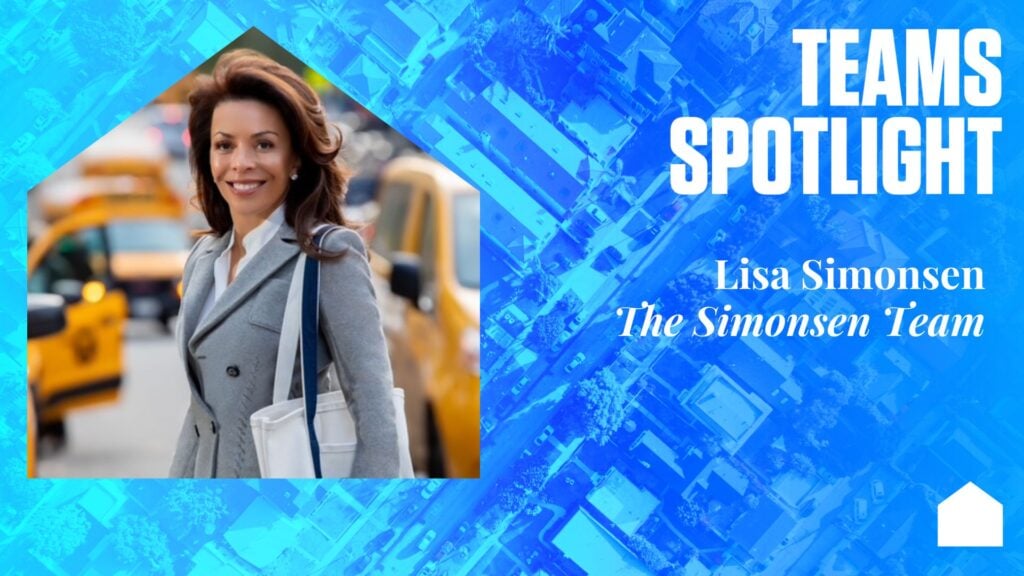
As a featured real estate expert on both local New York City TV and national platforms, including Good Morning America and The Today Show, luxury real estate team lead Lisa Simonsen and her team serve clients in New York, Florida and California. “We joke that we work eight days a week, and we wear many different hats: We are brokers, psychiatrists, designers and friends to our clients,” she said.
TAKE THE INMAN INTEL SURVEY FOR JUNE
She loves social media for keeping in touch with past and present clients as well as other members of her sphere of influence and leverages her networking prowess to get deals done. Simonsen recently closed the off-market sale of a luxury rental building for $150 million, forming a relationship with the buyer through her personal marketing and locating the off-market opportunity through her commercial contacts.
“Our exclusive new development, Abi Chelsea Penthouse, sold for the highest price per square foot for a downtown boutique condominium in the past five years. We continue to break records with residential resales in premier Park and Fifth Avenue Cooperatives and hold sales records in many of the top Fifth Avenue buildings on the Upper East Side,” Simonsen said.
Find out how this luxury broker and her team continue to set records in some of the country’s most exclusive markets.
Name: Lisa Simonsen
Title: Licensed associate real estate broker
Experience: 20+ years
Location: New York, Florida, California
Team Name: The Simonsen Team
Rankings: Top .5 percent of all real estate brokers nationwide
Team size: 3
Sales volume: $206 million sales volume in 2024
Awards:
How did you get your start in real estate?
I started in real estate over 20 years ago, following a career as a celebrity fitness trainer. A client suggested that I consider getting my license. I initially planned to pursue real estate as a side career; however, I quickly landed an $18 million sale during my first week as an agent, and my career took off from there.
How did you choose your brokerage?
Brown Harris Stevens is the No. 1 privately held real estate firm in New York City, with a 150-year legacy of white glove luxury service. BHS agents sell more homes per agent than any other firm, with the highest average sale price achieved per agent nationwide.
The brokerage is renowned for providing innovative tools and resources to its agents, and in turn, the high-net-worth buyers and sellers they represent. My domestic and international clients benefit from this ingenuity and from the firm’s sophisticated brand.
What do you wish more people knew about working in real estate?
This is not a part-time job, and the day-to-day life is far removed from what is portrayed on television shows focused on the brokerage industry.
What’s something you know now that you wish you knew when you started?
The importance of follow-up. I once lost a listing because I did not provide my client with regular, timely follow-ups. I quickly learned this golden rule and will never make that mistake again!
What are 5 things you’d like readers to know about you and your brokerage?
- I am licensed in New York, Florida and California and sell properties in major markets in all three states.
- In 2024, we closed a $150 million deal and a $500,000 deal, both in the same week. The Simonsen Team provides the same level of service to our clients across all price points.
- Brown Harris Stevens has the highest average sale price achieved per agent nationwide.
- Brown Harris Stevens agents sell more homes per agent than any other firm in New York City.
- Over 25 percent of The Simonsen Team’s major sales are of properties that are not actively on the market. It is key for buyers and sellers to align themselves with a proactive broker who can actively identify and secure opportunities that may not be available online.
What’s your top prediction for 2025?
There is a wealth of opportunity for smart buyers (and their brokers) at the moment. Buyers willing to tackle a project should seize the opportunity to purchase value-add properties, as there is currently less competition for properties that need work. (To that point, owners of turnkey properties who may wish to sell should certainly consider listing now, as buyers will pay a premium for turnkey inventory.)
First-time buyers who plan to finance should consider buying now and refinancing as interest rates continue to drop.
What’s your top tip for newly formed teams?
Grow your team (and your career) slowly and with intention. Coaching and mentorship are key, even for team leaders!
What makes a good leader?
A good leader and mentor is generous with their time, provides constructive feedback, and genuinely wants to see those around them grow and flourish.
What’s one thing you wish every agent knew?
There is always an opportunity to expand your skillset, to learn a new skill and to grow your business. Never become complacent!
Email Christy Murdock

by Debra Trappen | Jun 26, 2025 | Industry, News Feed
The people you surround yourself with can fuel or extinguish your fire. Debra Trappen shares strategies for building up and letting go.
Real estate is changing fast, and so must you. Inman Connect San Diego is where you turn uncertainty into strategy — with real talk, real tools and the connections that matter. If you’re serious about staying ahead of the game, this is where you need to be. Register now!
Welcome to Lead with Fire, A Soulful Series for Real Estate Game-Changers. This is more than business advice — “Lead with Fire” is a transformative series created for the soulful, visionary humans in the real estate industry who are done with the old playbook and ready to redefine success on their own terms.
There’s a difference between a group chat and a sacred circle. Between people who “get” you and people who see you. Between acquaintances and soul allies.
TAKE THE INMAN INTEL INDEX SURVEY FOR JUNE
Within the Red Threads Collective, we frequently discuss the importance of the people you surround yourself with because no matter how powerful your strategy or polished your brand, if you’re surrounded by individuals who drain your energy or don’t support your vision, your passion will dim. Slowly. Quietly. Until one day you wonder why everything feels so heavy.
This is your permission slip to reassess who gets a seat at your table.
The role of community in real growth
Real growth isn’t always glamorous. It’s vulnerable. It’s messy. It’s filled with moments that require courage, clarity and a sense of community.
Whether you’re launching a new vision, refining your niche, grieving a former identity or stepping into a next-level version of yourself, you need people who can hold space for your becoming, without judgment, projection or comparison.
You deserve a circle that witnesses your evolution and celebrates it.
Who belongs in your wise council?
Your wise council might include friends, mentors, clients, spiritual guides or even unexpected connections who spark something in you. You’ll know them by how they make you feel:
- Safe to be messy and magnificent
- Seen without having to overexplain
- Celebrated, not just tolerated
- Called forward with loving honesty
These are the ones who fan your flames, not your fears.
And sometimes, to make space for this level of connection, you must lovingly release the relationships that no longer serve your soul’s direction. (I know this sounds like a lot. Remember, we can do hard things.)
When you let go, you make room
Letting go doesn’t mean there wasn’t a connection. It means you are no longer available for relationships built on guilt, obligation or outdated versions of you.
As you rise, your relationships will shift. That’s not a failure; that’s growth.
Choose to surround yourself with people who are doing their healing, holding their vision and walking beside you, not above or behind you.
Reflective journal prompts
- Who are the 3 people in my life who uplift and inspire me — and how can I deepen those connections? Send the text. Schedule the coffee. Open your heart.
- Where am I still seeking connection out of habit rather than alignment? What does that cost me energetically?
- What does a sacred circle look and feel like for me? Visualize the energy. The laughter. The nourishment.
- How can I be a better member of someone else’s wise council? Support goes both ways. Shine your light back.
Mantra to Lead With Fire
“I am held by a circle that sees me, supports me and celebrates my becoming.”
Next up in the Lead with Fire series — Ditch the sensless hustle: How to create a business and life you love
Are you designing your business and life from the inside out or simply following the map someone else handed you? Next, we’ll dive into creating a business and life you actually love, rooted in harmony, not hustle.

by Greg Hague | Jun 26, 2025 | Industry, News Feed
Real estate is changing fast, and so must you. Inman Connect San Diego is where you turn uncertainty into strategy — with real talk, real tools and the connections that matter. If you’re serious about staying ahead of the game, this is where you need to be. Register now!
Zillow’s 24-hour policy ignited the most consequential real estate lawsuit of our generation. It will have a bigger impact than Sitzer on how we do business. And be assured that the tech giants are circling like vultures.
TAKE THE INMAN INTEL SURVEY FOR JUNE
In my five decades as a real estate broker and attorney specializing in real estate, I’ve witnessed shifts that reshaped our industry in various ways. I cut my teeth in the 1970s representing my father and other prominent Cincinnati brokers, forging a settlement in a landmark civil rights case involving buyer steering, a case that fundamentally and positively changed how we approach fair housing. It was a wake-up call that the industry needed at that time.
But I’ve never seen anything quite like what unfolded with Compass filing an antitrust lawsuit against Zillow in a New York federal court. What we’re witnessing isn’t just a corporate dispute; it’s the opening shot in a war that will determine the future of how Americans buy and sell homes. Having analyzed real estate litigation for half a century, I can tell you this: Compass fired a legal missile that could blow Zillow’s monopoly to smithereens.
The shot heard ’round the real estate world
Compass, America’s largest residential brokerage by market share, pulled the trigger on what is legally considered the “nuclear option.” In a 67-page federal complaint filed in the Southern District of New York, Compass alleged that Zillow Group violated federal antitrust laws through “anticompetitive tactics” designed to protect its monopoly over online home listings.
But here’s what makes this case different from every other real estate lawsuit I’ve analyzed: It’s not about commissions, fair housing or traditional brokerage practices. This is about who controls the digital gateway through which nearly every American searches for their next home.
What triggered this legal earthquake? A policy change Zillow quietly implemented in April 2025, a policy positioned to be about equal access to all publicly marketed listings and fairness to buyers.
A 24-hour ultimatum broke the camel’s back
Picture this scenario: You’re working with sellers who want to test the waters before fully committing to putting their home on the market. Maybe they want to see if there’s buyer interest at their dream price, or perhaps they value their privacy and don’t want the entire neighborhood knowing their business immediately. For decades, this was not only possible but was common practice in real estate.
Then, the Clear Cooperation Policy (CCP) was implemented by our trade organization. The Clear Cooperation Policy requires MLS participants to submit listings to their MLS within one business day of marketing a property to the public. Since it was “our” trade organization, we accepted it.
But Zillow is a vendor. When NAR modified CCP to permit agents to delay sending their listings to MLS feeds that go to Zillow and other portals, and Compass’s Private Exclusives program gained attention and traction, Zillow dropped its 24-hour bombshell.
Zillow’s 24-hour policy is deceptively simple yet devastatingly effective: Any home that is publicly marketed for more than 24 hours before being posted to both Zillow and the local multiple listing service (MLS) will be permanently banned from ever appearing on Zillow’s platform. Not temporarily restricted. Not subject to review. Permanently banned.
To understand the magnitude of this move, you need to grasp Zillow’s stranglehold on home search. With an average of 227 million unique monthly users (reported by Zillow in Q1 2025), Zillow isn’t just a place buyers search for homes; it is the place. It has become the Google of real estate, the digital town square for homebuyers and sellers to first meet each other.
Compass CEO Robert Reffkin didn’t mince words: “No one company should have the power to ban agents or listings simply because they don’t follow that company’s business model.” But this lawsuit isn’t just about corporate philosophy; it’s about profits. Serious profits that could reshape how everyone in our industry conducts business.
This case could rewrite real estate law forever
Compass has weaponized the most powerful legal machinery available to take down monopolies. The Sherman Antitrust Act of 1890, the same law that broke up Standard Oil and AT&T, contains two nuclear weapons that Compass is now deploying against Zillow.
Section 1: The conspiracy charge
Section 1 of the Sherman Act outlaws “every contract, combination, or conspiracy in restraint of trade.” This isn’t just legal jargon; it’s the same provision that has toppled corporate giants for over a century. Compass alleges that Zillow’s policy isn’t just a unilateral business decision; it’s part of a coordinated effort with industry players to stifle competition. The lawsuit specifically names Redfin as a co-conspirator, claiming these platforms are working together to eliminate private listing networks.
Section 2: The monopolization bomb
Section 2 prohibits monopolization and attempts at monopolizing any aspect of interstate commerce. Compass argues that Zillow’s 24-hour rule represents textbook “exclusionary conduct,” effectively using market dominance not to compete on merit, but to eliminate competitors entirely.
The evidence appears compelling. Zillow’s policy specifically targets what Compass calls its competitive advantage: the ability to offer sellers “Private Exclusives” and extended “Coming Soon” periods. These services allow sellers to test pricing, gauge interest and maintain privacy.
Treble damages and the nuclear option
Here’s where this case transforms into a potential industry earthquake. Under federal antitrust law, and I’ve seen this play out in countless cases, successful plaintiffs don’t just recover their losses. They receive treble damages, meaning three times their actual harm, plus attorneys’ fees and costs.
So, what could Compass potentially recover? Consider its inability to deliver the three-phase marketing process promised to thousands of current sellers, future loss of listings by having to revamp its core listing program while training thousands of agents on a new presentation, and diminished ability to recruit agents because of a perceived black-eye to its industry image, and you’re likely looking at provable damages reaching $50-75 million.
Apply the treble damages multiplier, and suddenly Zillow faces a $150-$225 million judgment.
Zillow has the resources to defend itself and the money to pay a big judgment if it’s assessed. Courts have historically been generous in antitrust damages calculations, recognizing that monopolistic behavior often causes harm that’s difficult to quantify precisely.
But the damage to Zillow’s reputation could make a monetary damages award look tiny. This lawsuit will receive widespread consumer-focused press coverage. When America’s homebuyers learn that Zillow’s model is to sell them as leads, and homesellers learn that they are used as the bait, I don’t see a positive PR outcome for Zillow. And if this case isn’t settled and goes to trial, a jury will decide who wins. In my view, Compass’s moral positioning to a jury significantly outweighs Zillow’s.
Reading the legal tea leaves: Probability of victory
Compass has assembled a strong case. But the path to victory is fraught with legal landmines that could explode at any moment.
Compass’s winning arguments
- Clear exclusionary conduct: Zillow’s policy explicitly punishes competitors for offering differentiated services
- Undisputed market dominance: With an average of 227 million monthly users, Zillow’s monopoly position is virtually unassailable
- Demonstrable consumer harm: The policy reduces seller choice and limits the growth of innovative marketing options
- Smoking gun timing: The policy’s implementation coincided directly with the growth of Compass’s Private Exclusives program
Zillow’s likely defense strategy
- Pro-competitive justification: Zillow will argue that the policy promotes market transparency and equal access for buyers
- Industry alignment: The policy aligns with the National Association of Realtors’ Clear Cooperation Policy
- No duty to deal: Companies generally aren’t required to provide platforms for competitors
- Legitimate business rationale: Preventing market fragmentation serves broader consumer interests
My settlement prediction
This case will ultimately hinge on one crucial question: Is Zillow’s policy primarily designed to improve market transparency (pro-competitive) or to eliminate competitive threats (anti-competitive)?
I predict Compass has the upper hand and Zillow will settle before trial, paying between $85-$140 million in damages, with Zillow agreeing to discontinue its 24-hour policy. I also see the public attention and scrutiny of industry practices stemming from this lawsuit resulting in the end of NAR’s Clear Cooperation Policy.
3 scenarios that could define our industry
Having watched our industry evolve through multiple disruption cycles, I see three distinct paths forward, each with profound implications for how you’ll practice real estate in the coming decade:
Scenario 1: Compass wins at trial (20% probability)
If Zillow doesn’t settle (it should) and Compass secures a decisive victory with a massive damages award, this will signal open season on dominant platforms. Expect a flood of new entrants offering innovative listing services, private networks and alternative search experiences. The MLS system could fracture into specialized platforms serving different market segments, similar to how the airline industry deregulated in the 1980s.
Scenario 2: Negotiated settlement (70% probability)
A negotiated settlement that eliminates Zillow’s policy will create significant opportunities for new players in the real estate marketing space. These platforms will leverage AI and novel approaches to offer yet unimagined choices. This will enable savvy agents to differentiate themselves and compete by recommending various platforms to their clients. This innovation will be propelled by the elimination of NAR’s Clear Cooperation Policy, which I predict to be a certainty.
Scenario 3: Zillow’s fortress holds (10% probability)
If Zillow successfully defends its policy, it will cement the platform’s dominance but also attract intense regulatory scrutiny. This scenario makes government intervention more likely and could trigger broader antitrust investigations into real estate technology, something I’ve witnessed happen repeatedly when monopolies become too brazen.
The revolution will be digitized
What we’re witnessing isn’t just a lawsuit; it’s the first domino falling in a restructuring of how Americans interact with real estate. The old model of a few dominant platforms controlling access to listings is already cracking under the pressure of innovation, consumer demands, and it will now topple in the wake of this lawsuit.
Having been a broker, real estate trainer and attorney since the 70s, and having advised agents and real estate firms through fair housing lawsuits, commission battles and technology disruptions, I can tell you this: change will be your only constant in the next few years. The question isn’t whether this transformation is coming; it’s whether you’ll capitalize on the wave or be swept away by it.
The Compass vs. Zillow lawsuit may have started as a dispute over a 24-hour policy, but it will end as the catalyst that democratizes real estate technology, empowers innovation, and ultimately puts consumers back in control of how they buy and sell homes.
Choose your side carefully because in my experience, those who resist, or even hesitate, during industry inflection points get left behind.
Greg Hague has been a real estate broker and attorney specializing in real estate law since the 1970s. He has provided advice and commentary on landmark industry cases spanning five decades and is currently CEO of 72SOLD. This analysis represents an informed opinion based on publicly available information and should not be construed as legal advice.
