by Matt Carter | Jul 1, 2025 | Industry, News Feed
With closure of merger, homebuyers get temporary rate buydown or up to $6,000 in lender credits from Rocket Mortgage when the buyer or seller is represented by a Redfin agent.
Real estate is changing fast, and so must you. Inman Connect San Diego is where you turn uncertainty into strategy — with real talk, real tools and the connections that matter. If you’re serious about staying ahead of the game, this is where you need to be. Register now!
Mortgage giant Rocket Companies closed its deal to acquire real estate brokerage Redfin Tuesday, and immediately rolled out “preferred pricing” to borrowers involved in deals in which the buyer or seller is represented by a Redfin agent.
The new program, Rocket Preferred Pricing, provides a 1 percent temporary rate buydown for the first year of a loan, or up to $6,000 in lender credits to homebuyers taking out a conventional, FHA or VA mortgage from Rocket.
The program is available not only to homebuyers represented by a Redfin real estate agent, Redfin partner agent or Rocket Homes Partner Agent, but is also offered on listings represented by Redfin agents.
TAKE THE INMAN INTEL INDEX SURVEY FOR JUNE
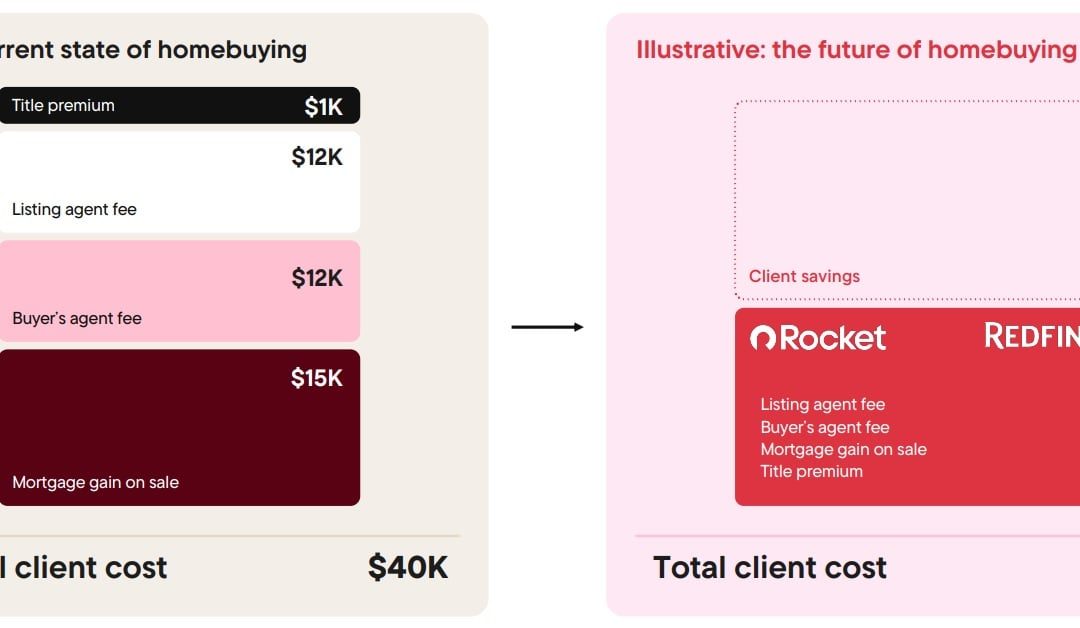
In announcing an agreement to acquire Redfin in March, Rocket executives said the deal could cut consumers’ transaction costs in half by trimming agent fees, mortgage gain-on-sale and title premiums.
By handling every aspect of homebuying and selling — from home search to mortgage financing, and title and closing — Rocket aims to cut transaction costs on the median priced home from $40,000 to $20,000.
Rocket: merger will cut transaction costs by $20K
In a March 10 investor presentation, Rocket broke down transaction costs for a $430,000, median priced home price that included $15,000 in lender profits, $12,000 each to listing and buyer’s agent, and $1,000 in title insurance.
Although the company didn’t break down savings for each category, it says it intends to bring total costs of clients who use both Rocket and Redfin down by 50 percent.

Varun Krishna
“For far too long, the homeownership process has been outdated and disconnected,” Rocket CEO Varun Krishna told investment analysts in March. “Home search, brokerage, mortgage, title, closing, servicing, all exist in separate ecosystems, forcing consumers to piece together a complex and frustrating journey.”
Senate Democrats including Elizabeth Warren, Bernie Sanders and Cory Booker expressed skepticism about claimed benefits to consumers in a June 3 letter to antitrust regulators, claiming the Redfin deal and Rocket’s plans to acquire the nation’s largest loan servicer, Mr. Cooper, creates “the potential for Rocket to steer homebuyers to its own products, hike prices based on private data, and block competition.”
Rocket will retire its home search portal, hosted on Rocket.com and Rocket’s mobile app, on Aug. 4, in favor of Redfin’s site, which it’s rebranded “Redfin powered by Rocket.”
“I’ve used Redfin every day for the last 20 years. It helped me find and fall in love with my first home, completely changing how I thought about real estate,” Krishna said in a statement Tuesday. “The Redfin team is best-in-class in building a product experience focused on simplicity. It was a perfect fit for Rocket’s vision of what the homeownership experience should be.”
Redfin will remain headquartered in Seattle, with CEO Glenn Kelman continuing to lead the business and reporting to Krishna.

Glenn Kelman
“Rocket’s and Redfin’s approaches to lending and brokerage service have always just been two halves of one vision to make the whole homebuying process magical,” Kelman blogged in March.
After leading the nation in mortgage refinancing last year, Rocket hopes acquiring Redfin will help it do more business with homebuyers.
Rocket Mortgage was the nation’s second biggest mortgage lender in 2024, with $97.6 billion in funded loans accounting for 5.4 percent of originations by volume, according to Home Mortgage Disclosure Act (HMDA) data tracked by iEmergent.
Speaking at an investment conference in May, Krishna said Rocket has set a goal of handling 8 percent of purchase mortgages and 20 percent of refinancings.
Last week, Rocket Mortgage introduced a new bridge loan product that lets existing homeowners buy before they sell and make non-contingent offers to compete with cash buyers.
Rocket on Monday announced that it had completed a reorganization of its capital structure — a move that paves the way for the acquisition of its next big acquisition target, Mr. Cooper Group Inc., the nation’s biggest loan servicer, for stock valued at $9.4 billion.
Assuming that deal closes later this year as planned, Rocket will be collecting payments on about one in six U.S. mortgages with $2.1 trillion in outstanding balances — giving the company a leg up on recapturing homeowners’ business when they’re ready to refinance.
Editor’s note: This story has been updated to note that Rocket’s home search site is hosted on Rocket.com and Rocket’s mobile app.
Get Inman’s Mortgage Brief Newsletter delivered right to your inbox. A weekly roundup of all the biggest news in the world of mortgages and closings delivered every Wednesday. Click here to subscribe.
Email Matt Carter

by Terry LeClair | Jul 1, 2025 | Industry, News Feed
Real estate is changing fast, and so must you. Inman Connect San Diego is where you turn uncertainty into strategy — with real talk, real tools and the connections that matter. If you’re serious about staying ahead of the game, this is where you need to be. Register now!
In real estate, skill is only part of the game. The rest? Mindset, clarity and daily habits. That’s why The Success Principles by Jack Canfield continues to be one of the most valuable personal development books I’ve ever read — and one I recommend to every agent I coach or manage.
Canfield breaks success into 64 principles (yes, 64), but the first 20 are foundational. They’ll change how you work, how you lead and how you live. And when you apply them through the lens of real estate — where rejection, risk and rollercoaster commissions are baked into the business — you gain more than inspiration. You get a tactical advantage.
20 foundational Success Principles
Here’s how each principle applies to your real estate journey:
1. Take 100% responsibility for your life
You can’t blame the market, your clients or your broker. If your listing didn’t sell, ask yourself: Did I market it well enough? Did I manage the seller’s expectations? Taking responsibility gives you control — and control is power.
Real estate tip: Own your outcomes. When deals fall apart, use it as fuel to refine your process.
2. Be clear why you’re here
Why did you get into real estate? Money? Freedom? Helping people? Your “why” is your anchor when a transaction falls apart or a client ghosts you.
Real estate tip: Revisit your mission. Align your prospecting, marketing and branding with that core purpose.
3. Decide what you want
Winging it won’t cut it. Want to close 25 deals? Move into luxury? Build a team? Decide — and get specific.
Real estate tip: Don’t just set income goals. Set unit goals, listing appointments and calls per day. Effort creates opportunity.
4. Believe it’s possible
If you don’t believe a $2 million sale is possible for you, you’ll never do the prospecting strategies to land it. Belief precedes behavior.
Real estate tip: Study agents doing what you want to do. If they can, you can. Success leaves clues.
5. Believe in yourself
Confidence shows up in your listing presentations, your pricing recommendations and your negotiations. Self-belief is your competitive edge.
Real estate tip: Revisit your wins often. Keep a “success folder” with past testimonials, photos of closings or thank-you notes. Practice and hone your skills consistently, and that will give you more confidence, which strengthens your belief in yourself.
Your energy is magnetic. If you walk into every open house drained and discouraged, guess what you’ll attract? Disengagement. But if you lead with enthusiasm and value, you’ll start pulling out opportunities.
Real estate tip: Start your day with visualization. Picture the ideal client conversation, showing, signed contract or a well-presented homeseller marketing presentation.
7. Unleash the power of goal setting
Goal setting isn’t wishful thinking — it’s strategic universal command. Agents with written goals earn significantly more. Period.
Real estate tip: Write down monthly transaction goals, then reverse-engineer your daily activities to support them. Knowing how many pipeline leads you need to attain your goals is crucial to the process.
8. Chunk it down
That $500,000 income goal? It’s overwhelming until you break it into daily calls, weekly appointments and monthly closings.
Real estate tip: Use tools like Follow-Up Boss, Bold Trail (kvCore), Trello or a simple Excel tracker to chunk and track your pipeline stages.
9. Success leaves clues
There’s no need to reinvent anything in this business. Follow the top producers, mimic their models, then put your own spin on it.
Real estate tip: Shadow top agents. Read their bios. Analyze their listing photos. Model what works.
10. Release the brakes
Your limiting beliefs are the brakes on your Ferrari. If you don’t believe you’re worthy of big success, you’ll sabotage yourself every time.
Real estate tip: Watch for self-talk like, “I’m not a luxury agent.” Eliminate it. Replace it with, “I’m becoming a top luxury expert.”
11. See what you want, get what you see
Canfield says that your brain doesn’t distinguish between real and vividly imagined experiences. So if you consistently visualize selling oceanfront property in Laguna Beach, you’re training your brain to find the path.
Real estate tip: Create a vision board with your dream clients, commissions, homes and experiences. You attract what you emit.
12. Act as if
Start acting like the agent you want to become. Dress like a $10 million producer. Learn your market, and speak eloquently to it. Lead with that confidence. Remember, perception is reality.
Real estate tip: Show up to every appointment prepared and polished — like your dream self would.
13. Take action
You can work for the best brokerage, have the best CRM, listing presentation or brand — but it’s meaningless without action. Action is the key to lead generation and conversion.
Real estate tip: Prospect daily. One conversation can lead to a deal that changes your year. Persistence pays!
14. Just lean into it
You don’t need a five-year plan. Just take the next best step. Success has many twists, turns and failures — it’s a series of course corrections and being able to pivot.
Real estate tip: Lean into learning and being a better version of yourself. Don’t overanalyze every step. Make the call, show the home, send the mailer. Analysis paralysis is the killer of many a great agents.
15. Feel the fear, and do it anyway
Fear is your green light. That luxury listing pitch that scares you? Do it. That video you’re afraid to post? Post it. Growth lives on the other side of fear.
Real estate tip: Start each week by tackling the one thing you’ve been avoiding.
16. Be willing to pay the price
Real estate isn’t a 40-hour-a-week job. It’s a commitment. Open houses on weekends. Prospecting before 9 a.m. Mastery demands sacrifice.
Real estate tip: Create boundaries, but don’t expect balance 24/7. Hustle now, harvest later.
17. Ask! Ask! Ask!
Ask for referrals. Ask for the listing. Ask for testimonials. Closed mouths don’t get fed.
Real estate tip: End every client conversation with: “Is there anyone else I can help this month?”
18. Reject rejection
No is just one more step toward a yes. It’s critical to understand that the rejection you receive is not a personal rejection; it’s just that they are rejecting your proposition or your timing. Never take it personally, but realize you either need to have a better value proposition or a longer follow-up process.
Real estate tip: Track rejections. Celebrate them. They’re proof you’re doing the work.
19. Use feedback to your advantage
That client who said your listing photos weren’t good enough? Gold. Use it. Upgrade your service. Feedback isn’t failure — it’s fertilizer.
Real estate tip: After every close, ask, “What could I have done better?” Then do it.
20. Commit to constant and never-ending improvement
Real estate evolves. So should you. Mastering contracts, pricing, marketing and technology is a lifelong game.
Real estate tip: Read daily. Attend coaching. Stay curious. Every bit of knowledge sharpens your competitive edge and helps you differentiate yourself from other agents.
Real estate is personal growth in disguise
The truth? Real estate isn’t just about selling homes — it’s about growing into the kind of person who can handle the volume, pressure and income you’re dreaming about.
The Success Principles is a reminder that there’s no secret sauce — just consistent, intentional habits. The agents who rise to the top aren’t necessarily the smartest or most experienced. They’re the ones who believe, act and grow daily.
If you take even five of these 20 principles and implement them with discipline, your business — and your life — will never be the same.
See you at the top.
Terry LeClair is a seasoned real estate professional and trainer with over 30 years of experience. Connect with him on Instagram and LinkedIn.

by Marian McPherson | Jul 1, 2025 | Industry, News Feed
California Governor Gavin Newsom has signed the state’s 2025-2026 budget, which offers environmental review exemptions for critical housing and infrastructure projects. Leaders say the exemptions will improve affordability, while environmentalists say it will ruin the state’s ecosystem.
Real estate is changing fast, and so must you. Inman Connect San Diego is where you turn uncertainty into strategy — with real talk, real tools and the connections that matter. If you’re serious about staying ahead of the game, this is where you need to be. Register now!
Amid a worsening housing affordability and homelessness crisis, California legislators have made a drastic move to bolster inventory levels throughout the state.
On Monday, Governor Gavin Newsom announced that he’d signed Assembly Bill 130 and Senate Bill 131, both of which include sweeping reforms to California’s building permit and new residential building standards systems, alongside greater oversight of city and county homeless shelters and an increase to the Renters Tax Credit.
TAKE THE INMAN INTEL INDEX SURVEY FOR JUNE
However, the most consequential change within AB 130 and SB 131 is the streamlining of the state’s 55-year-old environmental protection law, California Environmental Quality Act (CEQA).
Although originally limited to government projects, CEQA’s strict environmental reviews expanded throughout the decades to include private housing projects. Legislators on both sides of the aisle said the reviews, which are meant to identify and mitigate risks to air, water quality, biodiversity, habitats and ecosystems, had become too cumbersome.
The CEQA reform offers exemptions to high-density projects not on environmentally sensitive or hazardous sites, and critical housing and infrastructure projects, including infill housing, high-speed rail facilities, utilities, broadband, community-serving facilities, like child care centers, and farmworker housing. The reform also opens the door for municipalities to rezone commercial projects, like malls and office buildings, into multifamily housing with more ease.
“This isn’t just a budget. This is a budget that builds. It proves what’s possible when we govern with urgency, with clarity, and with a belief in abundance over scarcity,” Newsom said in a prepared statement on Monday. “In addition to the legislature, I thank the many housing, labor and environmental leaders who heeded my call and came together around a common goal — to build more housing, faster and create strong affordable pathways for every Californian.”
“Today’s bill is a game changer, which will be felt for generations to come,” he added.
Both bills received bipartisan support, with AB 130 receiving a unanimous vote from the Assembly and a 28-5 vote from the Senate. SB 131 received similar support, passing the Assembly 50-3 and the Senate 33-1.
Senator Scott Weiner, who represents Senate District 11 in San Francisco, said the bills’ passage will enable the state to “move the needle on affordability.”
“It isn’t easy to make changes this big, but Californians are demanding an affordable future, and it’s our job to deliver for them no matter what,” he said in a written statement. “I’m incredibly proud of the work Governor Newsom, Assemblymember Wicks, Speaker Rivas, and my friend and partner Pro Tem McGuire did to push this bold package across the finish line and set us on a path to build again in California.”
Although legislators and several housing groups, such as the United Brotherhood of Carpenters, MidPen Housing and California YIMBY, are praising CEQA’s reform, environmentalists are ringing the alarm bell, saying the exemptions could yield potentially deadly consequences.
“It blows a hole in our efforts to protect habitat,” environmental lobbyist Kim Delfino told The New York Times on Monday. “Make no mistake, this will be devastating.”
Political experts said California’s decision could set the stage for more states, especially those with Democratic leaders looking to woo voters with the promise of more affordable housing, to relax environmental reviews and permitting laws.
“This has created a different political environment,” Public Policy Institute of California survey director Mark Baldassare told the Times. “Voters have been telling us in our polling for quite a while that the cost of housing is a big problem, but maybe for the elected officials, the election itself was a wake-up call.”
Email Marian McPherson

by Taylor Anderson | Jul 1, 2025 | Industry, News Feed
Celebrity agent Mauricio Umansky, who has targeted the National Association of Realtors’ dominance over agents and the rules governing real estate, heads back to court.
Real estate is changing fast, and so must you. Inman Connect San Diego is where you turn uncertainty into strategy — with real talk, real tools and the connections that matter. If you’re serious about staying ahead of the game, this is where you need to be. Register now!
Celebrity broker and The Agency founder Mauricio Umansky has revived a simmering lawsuit that takes aim at rules created by the National Association of Realtors, arguing the rules help maintain unfair dominance over the nation’s multiple listing services.
The new lawsuit, filed in the U.S. District Court of Southern California, boils down to a few key arguments:
- Umansky alleges NAR controls competition in the residential real estate industry by controlling a large network of MLSs in the country.
- Namely, the Clear Cooperation Policy that requires listings to be placed on an MLS within one business day limits competition from companies seeking to offer private listings that are marketed outside the MLS.
- The policy stymied efforts by would-be competitors, like Umansky’s ThePLS.com, to give brokerages a new way to discreetly market homes for sale.
“The surge in consumer demand for pocket listings, and the rise of a listing network to market pocket listings effectively, was a competitive threat to the viability of the NAR-affiliated MLS system,” ThePLS.com wrote in its complaint, filed overnight on Tuesday. “These market changes also threatened NAR’s ability to control competition in the residential real estate brokerage industry.”
TAKE THE INMAN INTEL INDEX SURVEY FOR JUNE
The federal antitrust lawsuit keeps pressure on NAR and its affiliated MLSs, and shows that the industry will remain engaged in a fierce debate over the rules — especially those governing private listings — that will guide the next chapter of the real estate industry.
Compass, the No. 1 largest brokerage by sales volume, last week filed a lawsuit against Zillow, the nation’s largest real estate portal by unique visitors. Compass is taking aim at updates to Zillow’s policies that require listings to be filed on the MLS and therefore on Zillow within one business day.
Compass is making the claim that Zillow is a monopoly and that its policy is anticompetitive because it prevents the company from growing its network of Private Exclusive listings, which are homes for sale and only accessible through a Compass agent. The network itself is marketed on Compass’ website, which is a violation of Zillow’s new standards.
The newly filed lawsuit keeps a target squarely on NAR and the Clear Cooperation Policy.
“Through the Clear Cooperation Policy, NAR and the MLS conspirators eliminated the possibility of a more competitive future in the market for residential real estate listing network services,” ThePLS.com wrote in the complaint. “A once-in-a-lifetime opportunity for competition in a monopolized market has been lost. NAR’s conduct has harmed competition and consumers, and is illegal.”
What is NAR saying?
The new filing actually represents the refiling of a case that Umansky and NAR fought over beginning in 2020, shortly after NAR adopted its Clear Cooperation Policy. NAR said that PLS had walked away from the negotiating table before filing its suit overnight, and it defended its Clear Cooperation Policy.
“NAR and PLS were in discussions to extend this agreement until PLS ceased to engage,” an NAR spokesperson said in a statement to Inman. “The Clear Cooperation Policy promotes transparency and competition in the real estate marketplace while still providing home sellers and their agents the option to list their property as an office exclusive.”
More context
After years of debate, NAR opted to keep Clear Cooperation in March, but at the same time rolled out a new policy to allow for the delayed marketing of a listing without violating the rule.
The update was an effort to balance criticisms of the policy, but it received mixed reviews among industry insiders.
ThePLS.com filed it’s first lawsuit against NAR in 2020, shortly after the trade organization first adopted the Clear Cooperation Policy.
NAR and ThePLS.com previously reached an agreement that dismissed the case but kept open the possibility of it being filed again at a later date.
“Where we landed is that we gave them a tolling agreement on the statute of limitations to give us time to figure out whether or not we were amenable to repealing the Clear Cooperation Policy,” former NAR outside legal counsel Ethan Glass said at a hearing in 2024.
Over the years, Umansky has challenged NAR in other ways as well.
Early last year, he was part of a team that launched the American Real Estate Association, a group that intends to compete with NAR.
“Right now I don’t feel like anybody is caring; we’re in a lot of trouble,” Umansky said at the time, arguing at another point, “We need better advocacy, we need better lobbying, we need to make sure we’re taken care of.”
Update: This post was updated after publication to add additional clarity.
Email Taylor Anderson
by Andrea V. Brambila | Jul 1, 2025 | Industry, News Feed
The rollout will be followed by the debut of BPP-powered local MLS sites and then a long-promised national consumer listing site to compete against Zillow, Realtor.com, Homes.com and Redfin.
Real estate is changing fast, and so must you. Inman Connect San Diego is where you turn uncertainty into strategy — with real talk, real tools and the connections that matter. If you’re serious about staying ahead of the game, this is where you need to be. Register now!
The Broker Public Portal, a company formed by a large group of brokers and multiple listing services to launch the nation’s first national public-facing MLS website, has “soft” launched and added its 48th MLS investor.
TAKE THE INMAN INTEL SURVEY FOR JUNE
On June 30, the BPP went live with what CEO Dan Troup called a “soft launch” on BrokerData.com, which will be part of a three-phase launch program.

Dan Troup
“This is allowing us to test and demonstrate our technology in a production environment that anyone can look at,” Troup told Inman via email.
In October 2022, the National Broker Portal LLC, a joint venture owned 50-50 by Homesnap and the Broker Public Portal shut down, following CoStar’s purchase of Homesnap. CoStar subsequently sunset the Homesnap brand. At the time of their divorce, BPP said it would pivot to creating and providing a national listing data “superset” and forming multiple joint ventures with tech vendors that wish to use that data for their tech products.
According to Troup, the second phase of the BPP reboot “will be the launch of local market websites that are powered by our search solution but displayed on local MLS domains” while the third phase will be the debut of BPP’s national consumer-facing portal, which will replace Homesnap.com.
“Timing will be driven by our stakeholders and their value proposition to their members,” Troup said.
“We will launch as soon as our partners review the product and tell us to turn on their data.”
BPP’s investors are made up of 44 brokerages and 48 MLSs, the latter of which serve 1,047,000 agents combined, according to the company. The latest MLS investor to come on board is Cary, North Carolina-based Doorify MLS, which has nearly 15,000 agent and broker subscribers across 16 counties.
“Our investment in Broker Public Portal is a clear signal of Doorify MLS’s commitment to technology sovereignty in real estate,” said Matt Fowler, CEO of Doorify MLS, in a statement.

Matt Fowler
“By taking ownership in this broker- and MLS-controlled platform, we’re ensuring our industry retains vital control over its technology infrastructure and data. Our core mission is to provide consumers with the most comprehensive MLS search experience, directly connecting them with the local experts – their agents and brokers.
“This investment fortifies a platform truly built by the industry, for the industry, fostering genuine engagement between consumers and real estate professionals.”
Like every investor in BPP, Doorify MLS is limited to one share of the company. Each share, or unit, in the company costs $5,000.
“This has never changed,” Troup told Inman. “We are well-funded as a result of the our dissolution from Homesnap.”
“Every shareholder in BPP has the same rights and our governance has not changed – we are only funded by MLSs and Brokers. The investment from Doorify is in accordance with our governance and follows the same rules that previous shareholders are granted.
“The BPP is a crowdfunded effort that supports a national consumer MLS website to provide some competitiveness to the existing national portals.”
Whenever that national MLS website does launch, it will face a crowded field of well-established and well-funded rivals, including Zillow, Realtor.com, Homes.com and Redfin.
Email Andrea V. Brambila.
Like me on Facebook | Follow me on Twitter

by Jessica Souza | Jul 1, 2025 | Industry, News Feed
Your budget is your business plan in action, broker-owner and author Jessica Souza writes. Find out how to crunch the numbers and make them work as hard as you do.
Real estate is changing fast, and so must you. Inman Connect San Diego is where you turn uncertainty into strategy — with real talk, real tools and the connections that matter. If you’re serious about staying ahead of the game, this is where you need to be. Register now!
Let’s be real — when you’re launching your real estate career, creating a business budget might feel a little … intimidating. Between licensing costs, marketing expenses and just trying to get your first deal closed, the idea of budgeting can feel like one more thing on an already overflowing to-do list.
But here’s what I want to tell every new (and honestly, not-so-new) agent: a business budget isn’t a restriction — it’s a roadmap. It’s what helps you make smart, confident decisions. It’s what gives you clarity in slow seasons and control in fast ones. And it’s what separates the agents who hustle paycheck to paycheck from the ones who actually build sustainable, scalable businesses.
I’ve seen both sides; I’ve lived both sides. And now, as a broker-owner coaching new agents every day, I’ve boiled the budgeting process down to five simple, doable steps that anyone can follow.
5 steps for building a business budget
Let’s break it down.
Step 1: Know your numbers (and separate your accounts)
First things first: You can’t manage what you don’t measure. Before you make a single budget decision, you need to know:
- How much is coming in (even if that’s $0 for now — this is about preparation)
- What your fixed and variable expenses are
- What your income goals are
Start by setting up separate business banking accounts. Even if you’re a one-person show, this is key. Having a separate account for your real estate income and expenses helps you stay organized, track your spending, and avoid those messy “Wait, was this dinner a business expense or date night?” moments.
Protip: Open a business checking and a tax savings account. Every time you get paid, transfer 20 percent to 30 percent into your tax account before you even blink. Future you (and your CPA) will be forever grateful.
Step 2: Build your baseline budget
Now that you’ve separated your accounts and tracked your basics, it’s time to build a budget that reflects what you actually need to run your business.
Here’s a list of common new agent startup and recurring costs:
Startup
- Licensing + exam fees
- Local, state, and national association dues
- MLS access
- Business cards, signage, lockboxes
- Headshots and initial marketing
Monthly/Quarterly
- Brokerage fees or splits
- CRM or lead generation platforms
- Social media scheduling tools (think Canva, Later)
- Website hosting or IDX feed
- Fuel, car maintenance, office supplies
- Continuing education
Now, set realistic monthly and quarterly budgets for these categories. Don’t overshoot your tools and tech. You don’t need everything at once. Start lean, then grow intentionally.
Remember: Just because it’s a write-off doesn’t mean it’s free.
Step 3: Plan for slow seasons and the ‘no check’ gap
Real estate is a feast-or-famine business if you’re not careful.
It’s easy to get a big commission check and feel like you’ve got money to burn. But smart agents — ones who last — know to treat every check like it’s part of a bigger puzzle.
Here’s how:
- Plan your personal budget around your lowest average month, not your best one
- Create a reserve fund for business expenses — ideally three to six months
- Remember: there’s often a 30-90 day lag between doing the work and getting paid
Start thinking like a CEO, not just a salesperson. Your business needs cash flow, cushion and clarity. Treat your commission as income to be managed, not a jackpot to be spent.
Step 4: Use tools that help you instead of confusing you
If you’re someone who breaks into a cold sweat at the thought of spreadsheets, you’re not alone. Good news: You don’t need to be a numbers nerd to build a great budget.
Here are a few tools I recommend:
- QuickBooks Online: Great for tracking expenses and mileage
- Wave: A free, beginner-friendly accounting platform
- Google Sheets: Customize your own tracker
But here’s the real key: Use it consistently. Block out 30 minutes once a week to check in on your numbers. Know what’s coming in, what’s going out and what needs adjusting. Budgeting isn’t a one-time setup; it’s a habit.
Step 5: Budget for growth, not just survival
This step is often missed, but it’s what makes the difference between staying stuck and scaling with intention.
Too many agents budget just to get by. But a great budget should include room to grow, even if the numbers are small at first.
Set aside funds for:
- Future marketing campaigns
- Coaching or training opportunities
- Upgrading your systems or software
- Celebrating wins (yes, budget for the celebratory coffee after a hard week)
I like to call this your “vision line” in the budget. It’s not required for survival, but it’s essential for momentum. You’re not just building a business to stay afloat. You’re building a life you’re excited to wake up to.
Your budget is your business plan in action
At the end of the day, a budget isn’t just about dollars. It’s about decisions. It’s about choosing where your energy (and your money) goes, so your business feels more aligned than chaotic.
If you’re a new agent reading this, wondering where to even begin, let me say this clearly:
You don’t have to be perfect. You just have to be willing. Willing to look at your numbers. Willing to learn. Willing to treat your business like it matters — because it does.
So open the spreadsheet. Separate your accounts. Build your baseline. And take the first step toward a business that doesn’t just survive — it soars.
I’m cheering you on. Every click, every dollar, every smart decision at a time.
Jessica Souza is a broker-owner and author. Connect with her on LinkedIn and Instagram.
