As commission conversations change, become a seller specialist

Consumers expect specialization in every area of life, from doctors to hairdressers, coach Verl Workman writes. They should expect no less from their real estate expert when it’s time to sell a home.

At Inman Connect Las Vegas, July 30-Aug. 1, 2024, the noise and misinformation will be banished, all your big questions will be answered, and new business opportunities will be revealed. Join us.

In today’s world, we have specialists for pretty much every aspect of our personal lives: a specialist for cutting our hair, a different specialist for color, then a specialist for nails, then pedicures and then finally someone who does facials. While each requires the same or similar licenses, we choose to go to the person who specializes in the very thing we want to be exceptional.

TAKE THE INMAN INTEL INDEX SURVEY FOR JULY

In visiting our doctor or dentist, we go to specialists for our particular problem. It’s no longer acceptable to see an orthopedist for a knee issue. Instead, you would seek out a knee specialist — or, even more specifically, a knee specialist who works specifically on athletic injuries.

Today’s consumer is trained and has come to expect specialization in almost every aspect of their lives, but when they go to meet with a real estate agent, they are often disappointed with a generalist who handles buyers, sellers, residential, commercial, rentals, land, ranches, luxury and short-term vacation properties. That description says a lot to the consumer. “I also do knees.” Is that who you want helping you?  

As commission lawsuits and subsequent settlements have upended both buy-side and sell-side transactions, it’s more important than ever to hone your expertise and present yourself as the answer to your clients’ goals and challenges. For homeowners who are navigating entirely new questions about compensation, concessions and pricing, the service of a true specialist is a particularly appealing unique value proposition (UVP).

Specialization is not merely a strategic advantage — it’s the cornerstone of providing unparalleled service and customized, specific solutions for your clients. For listing agents, sharpening specialty skills is crucial for standing out in a crowded marketplace. A listing agent’s primary responsibilities revolve around marketing, pricing and negotiating the sale of properties. Let’s delve into these roles and explore how team leaders can cultivate specialization within their teams.

Marketing: The art of selling homes

There are only three things a listing specialist should focus on. First, prospecting for listing appointments; second, going on listing appointments; and third, negotiating contracts. That’s it. The rest of the activities should be done by different specialists on the team, including the marketing of the homes, showings of the homes, holding the open houses, etc. Those activities that are not directly related to the first three should not involve the listing specialist.

Pricing: The science of valuation

Accurate pricing is a delicate balance that can make or break a sale. Listing agents must specialize in pricing strategies that reflect the true value of a property while remaining competitive in the market.

Specializing in pricing

  • Comprehensive market analysis: Provide agents with tools and training to conduct thorough market analyses. Understanding the nuances of the local market is essential for setting the right price.
  • Dynamic pricing strategies: Teach agents to be flexible with pricing strategies, taking into account factors such as seasonality, economic shifts and inventory levels.
  • Communication of value: Train your agents to effectively communicate the rationale behind pricing to sellers, building trust and setting realistic expectations.

Negotiating: The art of the deal

Negotiation is where the listing agent’s expertise is most visible. It’s about advocating for the seller’s interests and securing the best possible terms.

Mastering negotiation as a listing agent

  • Understand the buyer’s perspective: Train agents to understand the buyer’s motivations and constraints, which can provide leverage in negotiations.
  • Finesse and diplomacy: Encourage agents to practice finesse and diplomacy. Negotiation is not just about being firm; it’s also about finding mutually beneficial solutions.
  • Legal acumen: Ensure your agents are well-versed in the legal aspects of real estate transactions to navigate complex negotiation challenges confidently.

Specializing as a listing agent in practice

Creating a team of specialized listing agents means fostering an environment where continuous improvement is the norm. Here’s how team leaders can achieve this:

  • Role specialization: Assign roles based on individual strengths, whether it’s marketing, staging, pricing, or closing deals.
  • Invest in education: Provide ongoing training and professional development opportunities in advanced marketing techniques, market analysis and negotiation skills. 
  • Collaborative culture: When working on a team of specialists, buyer’s agents refer listing leads to the listing team, and listing agents create opportunities for buyer’s agents to show and represent buyers. Specializing means you stay in your lane and provide exceptional client services based on your specialty.
  • Performance metrics: Set clear goals and metrics for each specialization area to measure success and guide improvement efforts. An example would be, if you want to earn $1 million a year in gross closed income, then all you have to do is understand what has to happen from a listing appointment perspective to accomplish that. Here is a hypothetical and I will use numbers for demonstration purposes only. Commissions are negotiable and the average sales price in different markets is just that, different.   

Let’s say the average listing is $500,000.00. You charge a listing or sales commission of 2.75 percent. That means your average commission is $13,750 on each sale. So, if you don’t do anything else but focus on listings, you need 73 listings a year to earn a gross commission of $1 million.  

If you close 50 percent of the appointments you go on, then you will need 146 listing appointments in a 12-month period to accomplish this. That’s just over 12 appointments per month, three appointments per week and less than one listing appointment per day. If you wake up every day broke and hungry and focus on prospecting until you set and go on one appointment per day, you will hit or exceed your income goal.

Let me ask you this: If you go on 146 appointments per year, do you think you will get better at listing homes, at the listing presentation, at pricing and at prospecting? Would you be better than an average agent who is a generalist who does seven transactions per year? The answer is, simply, yes. As you specialize, you become a true expert at the part of the business you focus on.

Specialization within a listing agent team is about more than just improving service — it’s about building a well-oiled machine where efficiency and expertise lead to outstanding results. By focusing on marketing, pricing and negotiating, listing agents can sharpen their skills and deliver unmatched service to sellers.

We know by tracking the performance of hundreds of high-performing teams that the ones who specialize in each area of the business outperform teams or individuals who are generalists and the teams are more profitable because they create compensation that is consistent with the position and the work required at their level of specialization. 

As a team leader, nurturing these specializations can transform your real estate practice into a more profitable, esteemed business. Each listing you generate should create 1.5 buy-side closings, and your buyer specialists will be amazing at converting and closing those opportunities.

Empower your agents to become specialists in their respective roles, and watch as they become invaluable assets to your team and clients. Remember, in the world of real estate, “Most agents create jobs for themselves; very few create a business.” As the market becomes more complex and consumers have more questions than ever, let’s build a business where specialization is the foundation of excellence and success.

Verl Workman is founder and CEO of Workman Success Systems. Connect with him on LinkedIn or Instagram.

Suffering from commission anxiety? Here’s how to heal it

When your pipeline dwindles and your next payday is uncertain, anxious thoughts can consume your day. Rachael Hite offers a financial and self-care prescription.

At Inman Connect Las Vegas, July 30-Aug. 1, 2024, the noise and misinformation will be banished, all your big questions will be answered, and new business opportunities will be revealed. Join us.

The rollercoaster ride of being an independent contractor and working on commission is not for everyone. Even seasoned professionals hit slumps in their pipeline, and they begin to wonder if they can navigate another sales cycle without regular closings to pump up their reserves. 

Managing anxiety around financial irregularities requires patience, planning and persistence. Finding a strategy to overcome and put those negative feelings aside is an act of self-preservation in this high-stakes/ high-intensity market.

TAKE THE INMAN INTEL INDEX SURVEY FOR JULY

Anxiety can sit beside you like an unwanted monster, and it can weigh down your normal solutions of solving problems and prospecting by creating doubt and fear that you are not doing enough. 

Here are four strategies to help you move through the anxiety and stay focused and keep your mind on your money (and not your money on your mind) while working through adjusting commission structures and payouts.

Know what you owe

It’s essential to take time to understand how much income you need to cover your essentials and stash away funds for your reserve. If your first thought when you wake up in the morning is about how you are going to pay your bills, you have a major income problem.  

Working by commission takes careful planning, budgeting, and a knack for self-restraint against blowing big payouts on fancy cars and vacations. If you are a real estate agent, you also need to be an expert on personal finance and investments. It’s the only way to stay in — and move forward in — the game of life. 

Know how much debt you owe, plush up your reserves, and have every dollar that comes in commission allocated. Anxiety thrives on worst-case scenarios and unanswered questions. Map out your finances, and “eat the frog” — or tackle your hardest task first — to start chipping away at commission anxiety.

Lean in on management and mentorship for support

You cannot do this alone. Every agent needs a support system, especially someone to grab a cuppa with to debrief, vent and offer encouragement. Your management team should offer resources to help you not just sell but also build a lifelong career. Your management should be invested in you and your well-being. 

If at this point your management team has been “hands off,” or as I like to call it, “hunger games” (may the odds be ever in your favor), then it’s probably time to find a new place to hang your license. Great leadership and office support systems should remove your anxiety, not encourage it or make it worse. 

A great squad will help level out rising anxiety because there will be expectations and systems in place to help you adapt to upcoming changes smoothly.

Take a digital break

Get off social media. Seriously. One of the biggest drivers in commission or pipeline anxiety is FOMO (fear of missing out) or death by comparison against other agents. 

Why are you stalking other agents? Why do you spend so much time talking about someone who has thousands of dollars to invest in marketing and a full team behind them, when you are a one-person show?

To avoid this mind trap, ask yourself these questions:  

  • Would their success feel like the same success in my life? 
  • Could I handle that overhead? 
  • Do I really want to spend all that time on TikTok?
  • Does my schedule even allow for me to make that much content? 
  • Is their style my style or even my personality?

If you are having anxiety about your own pipeline, but cannot articulate what you are actively doing to fix it — Houston, there is a problem. (It’s an even worse problem if you can explain what six other more successful agents are doing.) 

Take a week off of social media. Unfollow your competition. Get crystal clear about what you want your marketing to look like. Watch your anxiety slowly come down and your brand message build up. 

Take care of yourself

One of the first things I need to ask myself when I am feeling anxious is if I have been taking good care of myself (eating, resting, exercising, keeping my schedule from being overloaded) and usually one or all of those things are off course. 

Admitting you have anxiety about the upcoming commission changes does not mean you are weak, or a terrible agent. It means that you are human, and your career is entering a new season that you need to prepare for. Every season requires new skills, tools, and mindset shifts. Working on being less rigid and more dynamic will help you work through those changes.

This means you probably need to dial back the following:

  • Screentime
  • Drinking
  • Caffeine
  • Junk food
  • Late nights
  • Spending time with toxic people
  • Old systems that no longer serve your career
  • The hard way

And embrace the following:

  • Rest
  • Exercise
  • Whole foods
  • Water
  • Time with friends and family (or pets or people you like)
  • New systems that allow you to work smarter rather than harder
  • The path of least resistance

Your pep talk

Are you doing enough? It depends. Seriously, you may be doing all the right things, and business is just hard to come by in your market. Anxiety will live beside you until you get it under control.

That might mean working on generating other income. That might mean finding a new team. That might even mean working in a different type of position in real estate. (Are you a fantastic admin or creative with marketing?) 

For the seasoned pros, the folks that have been doing this for more than a decade, you know what this is. You have been through this more times than you can count. Look at your anxiety, and tell it that you are the boss — and hand it an official eviction notice. 

Don’t let pipeline anxiety rule your life. Stay vigilant and remember that your personal value has nothing to do with your sales and everything to do with the content of your character.

Rachael Hite is a former agent, a business development specialist, fair housing advocate, copy editor, and is currently perfecting her long game selling forever homes in a retirement continuing care community in Northern Virginia. You can connect with her about life, marketing and business on Instagram. 

3 must-have skills for building rapport with real estate clients

By building rapport, The Agency’s John Antretter writes, agents can not only secure immediate business but also build a network of loyal clients who will return and refer others for years to come.

July is Luxury Month at Inman. Tune in as we survey the evolving luxury market, explore emerging trends, and talk to top producers and influencers in the ultra-luxury space about how they got where they are today and the insights they’ve gained along the way. The month culminates with the announcement of the expanded Golden I Awards live onstage at Luxury Connect (July 29-30) in Las Vegas.

After working for one of Wall Street’s largest investment banks for several years and serving as a top agent in New York for almost nine years, I’ve learned the importance of building rapport in this industry — and I believe it is truly an art form. The ability to connect with clients on a deeper level can be the difference between a one-time transaction and a lifelong business relationship.

Here are my top tips for agents, especially in this time of change and adaptation in our industry.

It starts even before your first meeting

Research your client beforehand. Before meeting a new client, take the time to get to know them. Understanding their background, interests and needs allows you to tailor your approach and make a lasting first impression.

It’s also the ultimate way to build a genuine connection and find common ground. Discovering shared interests or experiences can quickly establish a connection. Whether it’s a mutual love for a particular sport, hobby or travel destination, common ground fosters trust and openness. 

Stay connected

There are numerous ways to stay connected with clients after a closing, and you have to be willing to put in the time and effort to do so. Closing dinners are the perfect start. I find closing dinners to be more intimate and conducive to building long-term relationships.

During these dinners, I learn about my clients’ future plans and needs, organically uncovering opportunities for second homes or future referrals. I also bring closing gifts and invite their children, allowing for deeper connections and enhanced service longevity. Even if they decide to leave the kids at home, it is the thought and effort that shows I am invested in them, even after the transaction.

Another way to do this is through ongoing marketing. For example, share a “Global Listing of the Week” or other e-blasts to clients. Sending a curated listing of the week serves as a regular touchpoint. This keeps you on your clients’ radar and provides them with valuable market insights. Curate a monthly blog and newsletter with content on real estate, trends, luxury news and more, so there is never a shortage of interesting topics and articles to send to your clients.

Additionally, take note of your clients’ vacation plans and preferred destinations. If they mention wanting a winter home in Turks and Caicos, I note this and follow up with listings that match their desires. Leveraging our brokerage’s global network, I have also connected my clients with like-minded agents in top second-home markets to take care of them when the opportunity arises.

Be thoughtful with gifts

Thoughtfulness in client gifting is crucial. I have a strategy in place that avoids consumables like wine or beverages, which are temporary. Instead, I opt for conversation pieces that leave a lasting impression, such as Dior platters or trays or Hermes blankets. These beautifully wrapped, special gifts show clients they are valued and leave a lasting impression.

I also use gifts as a reconnection point. For instance, I send Tiffany piggy banks for baby gifts and always send winter gifts during holidays or New Year’s. The key is to avoid going cheap, as high-quality and thoughtful gifts reflect your appreciation and foster long-term relationships.

Building rapport in real estate is an art that requires dedication, empathy and a personal touch. Sincerity is also important throughout the process. Sincerity also can break the ice and make clients feel valued.

Whether you are meeting to tour their home to list it or you’re in the middle of negotiations during the closing period, acknowledge your client’s achievements, taste, or even the choice of their current or new home. Genuine feedback goes a long way in building rapport.

By following these tips, agents can not only secure immediate business but also build a network of loyal clients who will return and refer others for years to come.

After working for one of Wall Street’s largest investment banks for several years, John Antretter turned his passion for real estate into a career. Connect with John on Instagram and LinkedIn.

Credit reports should be non-negotiable in divorce proceedings

Credit reports offer a wealth of valuable insights and can be especially important in evaluating client needs post-divorce, Lindsey Harn writes.

At Inman Connect Las Vegas, July 30-Aug. 1, 2024, the noise and misinformation will be banished, all your big questions will be answered, and new business opportunities will be revealed. Join us.

Divorce proceedings can be complex and exhausting as every financial move is scrutinized and each asset evaluated. Amid all the details, credit reports can be a powerful and often underutilized tool that can distinguish between a fair conclusion and a financial disaster. They are a fundamental part of financial transparency and fairness and provide information that can alter case decisions.

TAKE THE INMAN INTEL INDEX SURVEY FOR JULY

For real estate agents, understanding the financial situation post-divorce is needed to facilitate better your client’s needs with property sales, new living situations, etc. As an expert, it’s a best practice for agents to recognize that professionals best handle all financial matters, and to point the clients in the right direction in the early stages of discovery in divorce legal proceedings. 

Insights revealed by credit reports

Credit reports offer a wealth of valuable insights. They can reveal hidden debts, distinguish between marital and separate debt, show violations of court-ordered payments and provide assessments of someone’s creditworthiness. Credit reports can also provide an overview of a person’s financial history, including details like revolving credit accounts, installment loans, bankruptcies, unpaid child or spousal support, and collection accounts. This provides a holistic understanding of both party’s finances, ensuring fair asset division and post-divorce financial planning.

Hidden debts, for instance, can often go undetected and are liabilities that can significantly impact the division of assets and finances after a divorce. Uncovering debts early on provides a more accurate assessment of each spouse’s financial obligation and ensures a more fair and transparent negotiation process. 

In many marriages, couples have joint accounts and debts. Credit reports can help unravel these intertwined financial commitments, clarifying each party’s obligations and facilitating fair resolution. This includes determining responsibility for joint debts and ensuring equitable distribution of shared assets.

The distinction between marital and separate debt provided by credit reports is also crucial for a fair split. With this information, clients can be confident they are only assuming responsibility for debts gained during the marriage and are not burdened with pre-existing liabilities. 

Financial disclosure requirements

Many jurisdictions require parties in divorce proceedings to disclose their financial information fully, like many U.S. states, including California, Florida and Texas. Credit reports serve as a vital component of this disclosure process, providing objective data on debts, assets and financial history. By adhering to these disclosure requirements and presenting accurate financial information, clients can uphold their legal obligations and promote transparency.

Prevalence of unauthorized credit activity

One of the main reasons clients need to monitor their credit reports during the divorce process is the prevalence of unauthorized credit activity. It’s not uncommon for someone to receive credit in their spouse’s name without their knowledge. Consistent credit monitoring provides early detection of suspicious or unauthorized transactions. By doing this, clients can prevent financial harm and protect their credit during a divorce.

Monitoring credit reports with National Credit Bureaus

Clients should monitor their credit reports with all three national credit bureaus — Experian, Equifax and TransUnion — as not all creditors report to every bureau. Platforms like AnnualCreditReport.com offer free access to credit reports from each bureau annually. Signing up for credit monitoring services can also provide continuous monitoring and alerts for suspicious activity or changes to a credit report. Setting up fraud alerts with credit bureaus can add an additional layer of protection by notifying clients if there is a request for new credit in their name. 

Following these steps can help clients stay vigilant and proactive in monitoring their credit health and detect any issues early on. 

Safeguarding against unauthorized access

Unfortunately, it’s not uncommon for the opposing party in a divorce case to attempt unauthorized access to their spouse’s credit report, even though this is illegal. This can lead to the misuse of sensitive financial information to open unauthorized accounts, obtain loans or even identity theft.

To safeguard against this, real estate agents can recommend their clients take proactive steps, such as freezing their credit reports. This prevents new creditors from accessing information without explicit permission. 

Empowering clients and ensuring fair outcomes

Credit reports serve as invaluable tools not only during divorce proceedings but also in empowering clients to navigate their financial landscape post-divorce with clarity and confidence. Gaining a holistic understanding of their financial standing enables clients to strategically plan for their future, setting them up to secure loans, effectively manage debts and improve their credit. 

Integrating credit reports into divorce proceedings isn’t just advisable; it’s essential. Shedding light on hidden debts and detecting unauthorized activity ensures fairness and transparency in negotiations. They also empower clients to make informed decisions about their financial future and pave the way for a brighter monetary outlook beyond the conclusion of their marriage. 

Lindsey Harn’s results-driven approach, work ethic, integrity, and honesty have earned her top-producer status. Connect with Lindsey on Instagram and Linkedin.

Eyeing next refi boom, lenders plan to maintain or grow payrolls

Lending industry leaders surveyed by Fannie Mae see the lack of housing supply as the biggest risk factor in 2024, but most expect refinancing to pick up next year if rates continue to fall.

At Inman Connect Las Vegas, July 30-Aug. 1, 2024, the noise and misinformation will be banished, all your big questions will be answered, and new business opportunities will be revealed. Join us.

Nearly two out three mortgage lenders trimmed their workforces in 2023, but most lenders expect to either maintain or grow their payrolls this year, according to a survey of more than 200 senior executives by mortgage giant Fannie Mae.

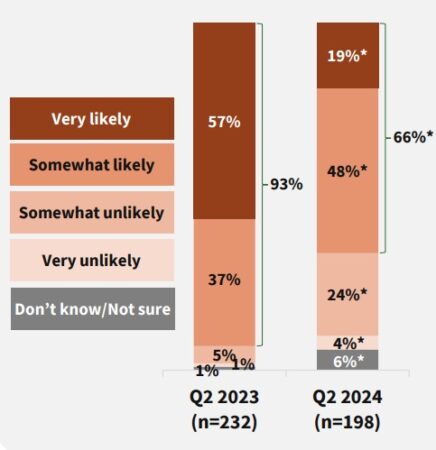
While the survey found two-thirds of mortgage industry executives think it’s likely the U.S. economy will tilt into a recession within the next two years, that’s down from 93 percent a year ago.

Lending industry leaders see the lack of housing supply as the biggest risk factor in 2024, but most (64 percent) expect a new mortgage refinance boom to kick off this year or next if rates continue to fall.

TAKE THE INMAN INTEL INDEX SURVEY FOR JULY

Doug Duncan

“After job cuts in 2023, and with lenders generally less pessimistic about the economy and the direction of the mortgage market, staff sizes appear to be normalizing” at the lowest level since 2014, Fannie Mae Chief Economist Doug Duncan wrote in summarizing the survey’s findings.

“Mortgage activity likely hit a post-pandemic floor following that era’s historically high mortgage purchase and refinance volumes,” Duncan wrote. “As a result, we believe some mortgage lenders are now preparing their workforces to meet potential growth in mortgage originations should the slow recovery of the housing market continue through the rest of this year and into 2025.”

Conducted in early May and released this month, Fannie Mae’s Mortgage Lender Sentiment Survey gathered perspectives from 215 senior executives at 198 lenders, including mortgage banks, depository institutions and credit unions.

Mortgage lenders’ top business priorities

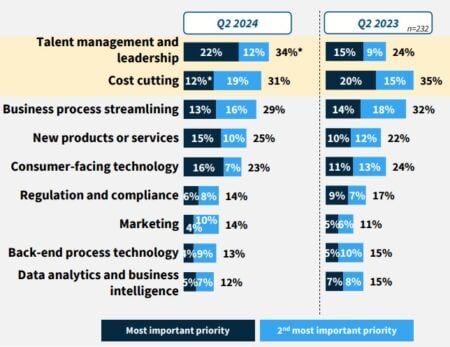
“Talent management and leadership” was the top priority for most executives, followed by cost-cutting and business process streamlining.

“Retention is top of mind,” an executive at one large institution told Fannie Mae. “We want to retain our LO (loan originations) team that is performing as well as continue to scout for new talent to join our organization. We are in growth mode for the foreseeable future.”

Fannie Mae defines large institutions as having more than $245 million in 2023 loan origination volume.

While 62 percent of mortgage executives said they cut their workforce last year, 54 percent said they expect 2024 staffing to stay about where it was last year, while 28 percent expect to staff up this year.

Last year, as mortgage rates were climbing past 7 percent to levels not seen in more than two decades, cost-cutting and business process streamlining were mortgage executives’ top two priorities.

An executive at a mid-sized institution with between $46 million and $245 million in originations said business process streamlining remains a top priority, with the lender migrating to a cloud-based system “to minimize new product introductions and streamline the process for employees and members seeking a loan.”

New products and services were a top priority for one in four executives surveyed, with a leader at a smaller institution (less than $46 million in originations) saying that “Traditional loan origination has decreased so much the last 18 months, we are looking at other types of ways to make money, be it new products or different services.”

Investments in consumer-facing technology — the top priority for lenders in 2019 — failed to crack the top three priorities for the third year in a row.

Lenders less certain of a recession in next 2 years

Mortgage execs think the odds of a recession in the next two years are better than even, but only 19 percent think a recession is “very likely,” down from 57 percent a year ago. Close to half of lending industry leaders (48 percent) still believe a recession is “somewhat likely.”

Scarce housing supply was the risk factor cited most often (64 percent) by mortgage executives, followed by mortgage rate changes (59 percent), household debt level (35 percent) and home prices (31 percent).

Fannie Mae economists, who last year were warning that Fed tightening would likely lead to a recession, backed away from that call in January.

In their June forecast, Fannie Mae’s highly regarded Economic and Strategic Research (ESR) Group forecast that purchase mortgage originations will grow by 14 percent next year, to $1.5 trillion, as 30-year fixed-rate loans will drop to 6.3 percent by the end of next year.

Fannie Mae economists are predicting even more dramatic growth in refinancing next year, with refi volume growing by 46 percent to $544 billion.

Two-thirds of mortgage executives surveyed by Fannie Mae are expecting a refi boom. While only 6 percent see that happening this year, 26 percent expect refinancing to pick up in the first half of next year, while 32 percent are planning on a refi boom kicking off in H2 2025.

Get Inman’s Mortgage Brief Newsletter delivered right to your inbox. A weekly roundup of all the biggest news in the world of mortgages and closings delivered every Wednesday. Click here to subscribe.

Email Matt Carter

Keller Williams hits milestone: $2B in profits shared with agents

The company celebrated during a live “growth call” with leaders from more than 1,000 franchisees in the U.S. and Canada. Nearly 150 KW agents have earned more than $1 million in lifetime profit share.

At Inman Connect Las Vegas, July 30-Aug. 1, 2024, the noise and misinformation will be banished, all your big questions will be answered, and new business opportunities will be revealed. Join us.

Keller Williams logged a milestone Monday: The major real estate franchisor has shared more than $2 billion in profits with its agents since the program’s launch in 1987.

The company, which has 174,000 agents, celebrated at 11 a.m. Central on a live “Growth Call” with top leaders from its more than 1,000 franchisees, also known as market centers, in the U.S. and Canada.

“This achievement is a quantifiable testament to our strong, growth-minded culture,” said Mark Willis, KW CEO and president, in a statement.

TAKE THE INMAN INTEL INDEX SURVEY FOR JULY

Keller Williams also shared on Monday that between Jan. 1, 2023 and June 30, 2024, its franchisees gave more than $148 million in profits to their affiliated agents. In a statement, Gary Keller, KW’s co-founder and executive chairman, said the profit share program allows franchisees to treat their agents as partners and allows agents “to build their businesses inside our franchise model, which is as powerful as if they owned a brokerage themselves.”

“This profit share milestone results from how we think of our relationship with our business partners,” Keller added. “Profit share is an equal opportunity, unequal reward. Those that put in effort will get the lion’s share of the results.”

Keller Williams is a private company, which means it is not obligated to share any financial information publicly. The franchisor is a defendant in several antitrust commission lawsuits and settled the cases earlier this year for $70 million.

Although that settlement has received final approval from a district court, several homesellers are appealing that decision, alleging the payout is far too low and objecting to the deal’s release of franchisees from liability without requiring them to pay anything to the people they allegedly harmed or change anything about their practices.

Keller Williams’ profit share program specifically is also the subject of multiple lawsuits due to a now-scrapped plan to slash profit sharing for defecting agents. The agents behind the suits alleged the plan would have amounted to breach of contract and unjust enrichment on the part of the company. Those suits are ongoing.

According to the company, through June 30, 2024, 137 KW agents have earned more than $1 million in lifetime profit share while 386 agents have earned more than $500,000. Tens of thousands of agents have earned at least five figures in profit share in that time frame:

  • 3,077 KW agents have gotten more than $100,000 in lifetime profit share
  • 6,648 KW agents have gotten more than $50,000 in lifetime profit share
  • 28,827 KW agents have gotten more than $10,000 in lifetime profit share

“Profit share is the engine of our culture,” said Shawn Rawls, an Atlanta-based KW agent, in a statement. “It gives everybody a seat at the table.”

Through Keller Williams’ current profit sharing model, associates who are with the company for more than seven years receive a portion of their former market center’s profit for life. Market centers take slightly more than 50 percent of their profit, then sponsored associates split up the rest.

The model works like a pyramid, with each associate taking 50 percent of that profit, then the rest being split among their sponsoring associate, and that associate’s sponsoring associate and so on, up to seven levels.

“Each of these programs are set in motion when an associate joins a Keller Williams office and names one person as the individual primarily responsible for bringing them to the company,” a white paper from Keller Williams describing the model states. “It may not have been the first person or the last person they talked to about Keller Williams.

“It may be someone from their Market Center, or it could be someone from another region, province, or country,” the paper continues. “It is the person who was most impactful on their decision to join the company.”

According to KW, agents can designate a beneficiary to receive their profit share distributions when they die.

“Profit share is a legacy that you can leave,” said Jessica Starr, a Simsbury, Connecticut-based KW agent, in a statement. “You can leave it to your loved ones, or you can leave it to a trust.”

Email Andrea V. Brambila.

Like me on Facebook | Follow me on Twitter