by Bernice Ross | May 1, 2025 | Industry, News Feed
Bigger. Better. Bolder. Inman Connect is heading to San Diego. Join thousands of real estate pros, connect with the power of the Inman Community, and gain insights from hundreds of leading minds shaping the industry. If you’re ready to grow your business and invest in yourself, this is where you need to be. Go BIG in San Diego!
You have just taken a new listing and plan to market it directly to consumers in print, on the web and on social media. Almost no one, however, has a game plan to market to other agents. If you want to stop leaving money on the table and get your listings sold faster, here’s a five-step plan to reach the agents most likely to bring you an offer.
5 reasons to market your listings to other agents
1. Executive reviews: Bring in the firepower
Long before video walkthroughs or virtual tours became the norm, Jon Douglas Company pioneered a unique idea that led the company to dominate the market in Brentwood, Beverly Hills, Bel Air and Santa Monica, California, in the 1990s: the “executive review.”
The purpose of the executive review was two-fold — to ace out the competitors for the listing and to increase the probability that the seller would set a realistic asking price.
In our office, the listing agent typically invited at least three top-producing agents to the executive review, along with a manager or assistant manager. Each member of the team answered several questions about where the property should be priced, selling points and any issues that needed the seller’s attention.
Especially when we conducted them as part of the pre-listing process, our executive reviews were extremely effective at converting leads into signed listings. Sellers were impressed that a team of agents showed up to help them, and even more so when they were introduced to a member of our management team.
At the listing appointment, the agent would share the pricing and other feedback from the executive review team. The agent would then present their CMA and ask for the sellers’ feedback about where they wanted to price the property. When I was the agent going for the listing, I didn’t recommend a price — I wanted to see how they responded to the team’s pricing first.
If any members of the executive review team had a buyer who was a fit, the listing agent could leverage that by telling the seller that one of the agents was excited about showing the property to their buyer. Also, agents on the executive review team often knew other agents who had buyers for the listing.
Pro tip: Executive reviews help you win more listings, price the property correctly, and get the property sold faster, usually at a better price.
2. Target the right agents, not the whole MLS
When it comes to marketing to other agents, identify which agents consistently list and sell homes in the area where the property is located. Also, look for agents who have buyers searching in the same price range as your listing lead.
The next step is to identify which agents represent the buyers (not just the sellers) for properties located close to your listing. These buyer agents are your priority audience. They’re already dialed into local demand and are likely to have buyers who would be a good fit for your listing.
Pro tip: Create your own VIP emailing list of top buyers’ agents. When the listing agreement is signed and your listing is ready to come on the MLS, invite them for an “exclusive first look” at a specific time where they can drop in and preview the property without an appointment. Be sure to invite the agents from your office who have buyers as well.
3. Leverage listing agents with active buyers
If an agent has a listing in the same neighborhood as yours, they probably have a list of buyers who weren’t a fit for their listing. Review their listing(s) to determine how yours compares. Then, if you have the listing agent’s mobile number, text them using the following script:
“Hi [Agent Name] — Sally Agent here from ABC Realty. I have a new listing that might be a fit for any buyers who contacted you about your current listing but weren’t a fit for that property. Would you like me to send over some info?”
Before sending this message, be sure you have prepared a detailed package about the property that includes top-quality photos, a short video walkthrough (easily shot on your phone) and a polished digital brochure. Your goal is to make it easy for these agents to get back in touch with previous buyers for their listing without spending time pulling data from the MLS.
Pro tip: Most agents appreciate having an edge that gives them easy access with their buyers prior to the first public open house. Best of all, this establishes you as an agent they can trust, and one who is willing to work with them.
4. Contact agents in feeder markets
In addition to contacting agents who have listings where your listing is located, also contact agents who have listings in nearby areas that are less expensive. Agents with active listings in these “feeder” neighborhoods often have sellers or buyers looking to upgrade to your location.
You can use the same preview-and-reach-out approach that you used with listing agents with properties near your listing. It’s a smart way to find additional high-probability buyers for your listing and snag a quick sale.
Pro tip: When reaching out to feeder-area agents, position your listing as a “move-up opportunity” to help them frame it attractively for sellers in their area.
5. If you feed them, they will come
Broker open houses where you serve food have worked for decades to motivate agents to see your listing in person. Despite all the tech advances, nothing beats having agents walk through the door to view the property in person. A well-attended broker open house means more feedback, more buzz and more buyer leads. As a bonus, it also shows your seller you’re pulling out all the stops to market their property aggressively.
Pro tip: Create a theme for your open house, such as “Brunch and Browse” or “Taco Tuesday.” Promote it aggressively through your agent network to maximize attendance.
Marketing to other agents requires time and effort, but the payoff can be huge: more offers, happier sellers and fewer days (and dollars) spent while your listing languishes on the market. While other agents may be competitors when it comes to listings or on multiple offers, they are still your best source for locating the right buyer with the right offer for your new listing. Take advantage of it!
Bernice Ross, president and CEO of BrokerageUP and RealEstateCoach.com, and the founder of RealEstateWealthForWomen.com, is a national speaker, author and trainer with over 1,500 published articles.
This post was originally published on this site
by Erin Krueger | May 1, 2025 | Industry, News Feed
If you don’t define your real estate team’s culture, it will define itself, author and team leader Erin Krueger writes. And that’s a risk you can’t afford to take.
Bigger. Better. Bolder. Inman Connect is heading to San Diego. Join thousands of real estate pros, connect with the power of the Inman Community, and gain insights from hundreds of leading minds shaping the industry. If you’re ready to grow your business and invest in yourself, this is where you need to be. Go BIG in San Diego!
There’s a dangerous myth about real estate teams — the idea that success is simply about strategy and hard work. If you master the market, deliver amazing customer service and work hard, success will automatically follow.
Strategy alone won’t save you. Hard work alone won’t elevate you.
The real secret? Culture.
Because a business without culture is like a house without a foundation — it might look strong on the outside, but the first storm will bring it crashing down. You can have the most talented individuals, but if they don’t work well together, your company will crumble.
I’ve seen it firsthand. I’ve built, refined and protected my team culture with the same intensity that I sell homes. I want to share a blueprint for building a business that doesn’t just survive, but thrives.
Great culture doesn’t happen by chance; it demands ongoing commitment, clear values and authentic leadership. These ideals cultivate an environment where everyone feels valued and empowered to contribute to a shared vision and achieve extraordinary results.
We are in an era when employees and team members no longer just want a paycheck. They want purpose. They want to be part of something bigger. They want to feel valued, challenged and supported.
When a culture is strong, your team moves like a championship-winning sports team — each player knows their role, supports each other and is working toward a common goal. When a culture is weak, it feels like you’re constantly fixing issues — miscommunications, disengagement, high turnover and that underlying feeling that something is “off.”
So, how do you create a culture where people want to work, thrive in their roles and stay long-term? It comes down to three essential pillars: build intentionally, nurture consistently and monitor actively.
1. Build intentionally: Culture doesn’t happen by accident
What is the biggest mistake I see business leaders make? They let culture happen instead of shaping it. Culture is like a house — if you don’t build it intentionally, it will crumble under pressure.
That’s why, from Day 1, I decided that the culture of my team would be built on integrity, trust and a relentless commitment to growth.
What does this look like in practice?
- Hiring for values as much as for skills
- Setting clear expectations and holding people accountable
- Leading by example — because you can’t ask your team to do what you aren’t willing to do
If you don’t define your culture, it will define itself. And that’s a risk you can’t afford to take.
2. Nurture consistently: Culture is like a garden. Neglect it, and it dies
Culture isn’t something you set once and forget. It’s a living, breathing thing that needs constant attention. Think about it: You don’t plant a garden and expect it to thrive without watering, pruning and tending to it. The same applies to your team.
How do you nurture culture consistently?
- Celebrate wins — big and small. Don’t wait for massive milestones to acknowledge hard work
- Check in regularly — not just on results, but on how your team is feeling
- Encourage growth — whether it’s training, mentorship or new challenges
The strongest cultures are not built overnight, but they are built daily.
3. Monitor actively and protect relentlessly: Culture is your competitive advantage
Here’s the hard truth: Not everyone is meant to stay on your team. One of the toughest lessons I’ve learned in leadership is that the wrong person in the right culture can destroy it.
There were times I kept someone on my team because they were producing excellent results, but they weren’t aligned with our values. And every time, it cost me. Negativity can spread faster than positivity, and a disengaged team member can pull down even the strongest players.
So, I started treating culture like a non-negotiable. If someone didn’t align, I had to make a change, no matter how difficult the decision was. Protecting your culture isn’t about being harsh. It’s about being committed to the team you want to build. Because at the end of the day, your business will only be as strong as the culture you protect.
Building a thriving team culture isn’t easy. It takes commitment, clarity and courage.
But when you get it right? Your team becomes your biggest asset. Your business grows effortlessly because people love what they do. You don’t have to chase success — it comes to you.
Remember: The greatest leaders don’t just build businesses. They build cultures that last.
Erin Krueger is the author of Capture the Culture and team lead at The Erin Krueger Team, Compass in Nashville. Connect with Erin on LinkedIn and Instagram.
This post was originally published on this site
by Darryl Davis | May 1, 2025 | Industry, News Feed
Bigger. Better. Bolder. Inman Connect is heading to San Diego. Join thousands of real estate pros, connect with the power of the Inman Community, and gain insights from hundreds of leading minds shaping the industry. If you’re ready to grow your business and invest in yourself, this is where you need to be. Go BIG in San Diego!
Did the title of this article upset you? Good — it should, because that’s the subtle, yet clear, message Zillow has been sending to consumers while our industry has been busy fighting itself.
Over the past several years — and especially the past few months — while we’ve debated policies, filed lawsuits, bickered over the Clear Cooperation Policy (CCP) and splintered into competing business models, Zillow has quietly and methodically positioned itself as the central hub of the real estate transaction.
Let’s be honest: They didn’t outsmart us — they simply outlasted our unity.
Divide and conquer
Zillow’s strategy has been brilliant opportunism. By capitalizing on the lack of cohesion among Realtors, they’ve stepped into the void as the “consumer champion,” filling in the gaps that we left wide open.
While industry leaders argue over Clear Cooperation, exclusives and listing timelines, Zillow shows up with a polished statement about “transparency” and positions itself as the savior for buyers and sellers.
Errol Samuelson, Zillow’s chief industry development officer, recently said:
“We will continue to advocate on behalf of the consumer. It’s the right path for the industry, and we know the companies that will succeed are those that deliver for consumers, not those that put their own interests ahead of the needs of the homebuyers and sellers they purport to represent.”
Let’s pause for a moment. Who is he talking about when he says “those”?
He’s talking about you. He’s talking about real estate professionals
This is a textbook example of Zillow elevating its public image while disempowering the perception of agents. It’s subtle, but make no mistake — it’s strategic.
By framing themselves as “pro-consumer,” they are implying Realtors are “self-serving.” This weakens us in the eyes of the public … and strengthens Zillow’s grip.
Zillow’s latest chess move
As I’m sure you’re aware, NAR recently came out with another new MLS listing option called the “MLS Option with IDX Feed Delay” (a ridiculous and confusing rule from NAR that I recommend agents not even bring up on a listing appointment). In response to NAR’s new policy, Zillow published its own Listing Standards Policy, which only added to the confusion.
The big question many people have is: “Does Zillow’s threat to ban listings apply to NAR’s new IDX Feed Delay policy?”
Every press release and communication from Zillow so far does not make this point clear.
Recently, Errol Samuelson posted on Zillow’s LinkedIn page to supposedly address this confusion, but if you read it, like I have (several times), it still isn’t clear.
So, I asked myself: Why doesn’t Zillow simply say, in print, “NAR’s new MLS Option with IDX Feed Delay is exempt from our banning policy”?
By the way, I’ve received a lot of calls from people I respect in our industry telling me that Zillow has verbally told them that NAR’s new policy is exempt from Zillow’s ban threat … but again, back to my question:
Why don’t they tell the consumer this clearly in their printed policy?
Why do they say one thing privately to the real estate community but leave it vague for the public? Well, I finally figured it out. Here it is: Because vagueness is the strategy.
By being unclear, Zillow gets to say to the consumer: “We’re pro-consumer. NAR isn’t.”
While at the same time having personal conversations with us, they say: “We’re your partner; we got your back.”
You see — if they clearly told consumers that NAR’s new policy is compliant under Zillow’s standards, they’d be showing public support for NAR. But that’s not their strategy.
Their strategy is, while NAR and the Realtor community are bogged down with ridiculous rules and fighting each other, to make Zillow shine as the “pro-consumer advocate.”
They’re using this entire situation as another opportunity to elevate themselves as the consumer’s hero, while subtly implying that Realtors are only out for themselves.
Here’s the worst part: There are industry leaders today who are hailing and applauding Zillow.
Zillow’s not just playing chess — they’re playing us.
Zillow’s real endgame: Total control
While we’ve been distracted by policy fights, lawsuits and finger-pointing, Zillow has been executing a master plan to become the dominant force for all real estate needs — just like Zillow co-founder Rich Barton created Expedia to take over travel.
Zillow isn’t just a listings portal anymore. It’s taken billions in agent-paid ad dollars and used them to build a vertical empire:
- Dotloop: transaction management
- ShowingTime: appointment setting and access control
- Follow Up Boss: CRM and lead nurturing
- Aryeo: listing media management
- VRX Media: photography and visual content
- Spruce: title and escrow services
Piece by piece, Zillow has inserted itself into every stage of the real estate transaction.
As Brian Boero, co-founder of 1000watt, perfectly said: “Zillow is now less portal, more platform. The days of agents simply advertising on it are gone. It’s now a competitor. Full stop.”
And they did it using Realtor money.
How we take back our industry
We don’t need outrage. We need action. Here’s how we start:
1. Stop feeding the beast
If you’re still giving Zillow your ad dollars, stop. Would you pay your competitor to out-market you? That’s exactly what’s happening.
2. Update MLS photo policies
MLSs need to allow the listing agent’s contact info in the final photo. One simple change — and buyers will know exactly who to call. No confusion. No third-party reselling leads. Real leads, going back to the real listing agent.
By the way, to all those real estate companies who would like to increase their bottom line and sell more of your listings, this one change would certainly accomplish that.
3. Get involved in MLS and association committees
Rules aren’t made online — they’re made in meeting rooms. Volunteer. Vote. Speak up. Push for agent-first, consumer-friendly policies.
4. Audit your brokerage tools
Before you hand another dollar to Zillow, use what you already have. Most agents are sitting on incredible marketing tools provided by their brokerages that they aren’t even using.
5. Embrace grassroots marketing
Neighborhood open houses, YouTube listing videos, Instagram ads, Facebook groups, direct mail with lead capture, door knocking and attending garage sales, just to name a few, are all valid ways to get in front of potential clients. You don’t need Zillow to reach buyers. You need creativity, relationships and hustle.
Zillow doesn’t have to be the villain. But they are definitely not our savior. They are a tech company with shareholders — not stakeholders in your career.
This isn’t about banning Zillow. It’s about balancing the power. It’s about remembering that we are the industry, not the platforms that repackage our work.
It’s time to take it back.
This post was originally published on this site
by Verl Workman | May 1, 2025 | Industry, News Feed
Bigger. Better. Bolder. Inman Connect is heading to San Diego. Join thousands of real estate pros, connect with the power of the Inman Community, and gain insights from hundreds of leading minds shaping the industry. If you’re ready to grow your business and invest in yourself, this is where you need to be. Go BIG in San Diego!
When you’re great at your business, you attract more business; often, more than you can handle. This can cause stress in other areas of your life like family, faith, friends, fun and fitness. However, you can have it all — with great life balance — if you learn to delegate and focus your time on the right activities daily. This often requires an agent to step into leadership and build a team.
Launching a real estate team is a significant step that requires careful planning and execution. A structured timeline not only helps you strategically plan and delegate effectively but also ensures that your team has a clear direction from the start. By incorporating time-tested, proven strategies, you can enhance your team’s potential for success. Here’s a detailed guide to setting up a clear and actionable team launch timeline.
Weeks 1-2: Clarify your vision and set foundations
Define your ‘Why’: Clearly articulate why you want to start a team. Consider your professional goals and personal motivations, such as more family time, higher productivity or the desire to mentor others. This will help shape your team’s culture and purpose. I’ve always emphasized the importance of aligning personal and professional goals to create a cohesive team vision.
Your first hire: Begin by assessing your daily activities and identifying tasks that are non-dollar-producing. A simple way to identify what you need to delegate is simply track what you do in 30-minute increments each day for the next two weeks, then at the top of the page write “$250 per hour.”
As you go down the margin, ask this question on every 30-minute task: “Would I be willing to pay $250 an hour for someone else to do this?” If the answer is no, then you should delegate that task.
We know that prospecting for listings generates, on average, $7,000 per hour — if you delegate non-dollar-producing activities. Then, if you focus your time on generating new business, you will never have to worry about paying your assistant. This will help you see the type of assistance you’ll need.
Start drafting a detailed job description for your assistant or virtual assistant. Run ads on Wise Hire, and get your first assistant hired. Take advantage of templates and tools to streamline this process, ensuring you focus on high-impact activities.
Weeks 3-4: Hire and train your assistant
Hiring: Making smart hires is critical to the success of your future team. Use your clearly defined job description to attract and hire an assistant. Whether virtual or in-person, your assistant will handle critical tasks, freeing your time to focus on lead generation and client relationships. Tap into your network to see who might be able to offer guidance on effective recruitment strategies to find the right fit for your team, including leveraging their extensive network and resources.
Training, onboarding and delegation: Begin training your assistant using recorded videos and clearly defined processes. Essential tasks to delegate immediately include:
- Email management and scheduling
- Client care and communication
- Transaction coordination
- Preparing listing and buyer presentations
- Field services and so much more
The key is that for anything you do three times, you need to create an operations manual with a Zoom video on how to do that task. As you teach your admin, record the sessions so they have a quick, easy reference on how to do the tasks without going back to you constantly.
As a leader, you have full responsibility to make sure things are done correctly, so inspect what you expect, especially for the first few months as you learn to trust each other.
Weeks 5-6: Attract and onboard initial team members
Begin agent attraction: Start searching for your first agents and other team roles. Clearly communicate your vision, the team’s culture and expectations for each role.
Buyer’s agents: For every listing you have, you should be gaining six to eight buyer leads per month. Once you have 25 leads, you need to hire a buyer’s agent. This is designed to maintain a high level of service and ensure that each lead is adequately followed up on.
Commission structure: Create a compensation structure that motivates the leader to let go of the buyers. I recommend a tiered commission structure for buyer’s agents to align incentives and promote productivity. This would be 40 percent for the agent on their first two transactions per month. Then the agent receives 45 percent for their third and fourth transactions. Finally, for their fifth transaction and beyond, they receive 50 percent.
Structured onboarding: Develop and execute a structured onboarding process, ensuring all new team members receive consistent training, resources and support from Day 1. I’ve found over the years that the use of onboarding templates and mentorship programs can facilitate this process. I have used a 30-60-90-day onboarding plan so that new agents are up and running and on track to complete two transactions per month.
Weeks 7-8: Team integration and growth
Team integration: Focus on team cohesion through team-building activities, regular check-ins and performance reviews. Reinforce a culture of continuous improvement and open communication. Emphasize the importance of fostering a positive team culture and provide resources for team-building strategies.
Assess and adjust: Regularly assess your team’s performance, client feedback and your own time allocation. Adjust strategies and processes accordingly to maintain growth and balance. Take full advantage of performance tracking tools and coaching to help you make data-driven decisions.
Maximizing your time and productivity
Throughout the entire process, consistently redirect the time saved from delegation into lead generation, client relationships and strategic planning. At least 50 percent of the reclaimed time should be focused on income-generating activities, ensuring continued business growth and personal fulfillment. The feedback I’ve received is that coaching and support helps maximize productivity, allowing you to focus on high-value tasks.
If you are thinking about a team, you already need one. I have always maintained that if you don’t have an assistant, you are one. I can’t take you to a place where you have amazing life balance and a phenomenal business when you spend 70 percent or more of your day doing tasks and activities that you could easily delegate. The time is now; don’t procrastinate any longer.
Following this real estate team launch timeline ensures clarity, focus and efficient progression toward your goals. By following this structured approach and leveraging available resources, you’ll build a sustainable, successful team that enhances your professional effectiveness and quality of life.
Verl Workman is founder and CEO of Workman Success Systems. Connect with him on LinkedIn or Instagram.
This post was originally published on this site
by Matt Carter | Apr 30, 2025 | Industry, News Feed
Advance GDP reading suggests the economy shrank by 0.3 percent during Q1, as a rush by businesses to import goods before tariffs took hold and government spending cuts dented growth.

In April, we’ll go deep on money and finance for a special theme month, by talking to leaders about where the mortgage market is heading and how technology and business strategies are evolving to suit the needs of buyers now. Inman’s Best of Finance returns for 2025, celebrating the leaders in this space. And subscribe to Mortgage Brief for weekly updates all year long.
Mortgage rates got more room to come down Wednesday after two data releases suggested inflation eased in March and the economy shrank during the first quarter, boosting the odds that the Federal Reserve will cut rates in June.
The Federal Reserve’s preferred measure of inflation, the personal consumption expenditures (PCE) price index, showed prices rose 2.3 percent in March from a year ago, the Bureau of Economic Analysis reported. That’s closer to the Fed’s 2 percent goal than February’s PCE price index reading of 2.7 percent.
In a separate release, the bureau’s advance estimate of real gross domestic product (GDP) suggested that the economy shrank by 0.3 percent during Q1, thanks to a tariff-driven surge in imports and a decrease in government spending.
If that estimate holds, it would represent an abrupt turnaround from the 2.4 percent annual growth in real GDP during Q4 2024 and the first economic contraction since 2022.
A rush by businesses to import goods before tariffs took hold was a “huge drag” on net trade, economists at Pantheon Macroeconomics said in their latest U.S. Economic Monitor.
But the advance GDP report “probably greatly overstates the loss of momentum at the start of this year,” Pantheon economists Samuel Tombs and Oliver Allen wrote.
“That said, the April tariff shock has since worsened the picture dramatically,” Tombs and Allen said. “We think stagnation is the most likely outcome over the rest of this year, but a recession would become likely if the threatened additional reciprocal tariffs are imposed in full in July.”
Economy may have shrunk in Q1
The surge in imported goods, which were up more than 50 percent, dented growth by five percentage points, Mortgage Bankers Association Chief Economist Mike Fratantoni said in a statement.
“Clearly, businesses were rushing to get goods into the country and were willing to store them until they were needed for production,” Fratantoni said.
The U.S. trade deficit hit an all time high in March and job postings shrank more than forecasters were expecting, with a federal hiring freeze in place and uncertainty over the economy putting a chill on private sector hiring, according to reports released Tuesday.

Joel Kan
“Mortgage application activity, particularly for home purchases, continues to be subdued by broader economic uncertainty and signs of labor market weakness, dropping to the slowest pace since February,” MBA Deputy Chief Economist Joel Kan said of a drop in mortgage demand last week.
The MBA’s weekly survey of lenders showed applications for purchase mortgages were down by a seasonally adjusted 3 percent last week when compared to the week before, but still up 3 percent from a year ago. Requests to refinance were down 4 percent week over week but up 42 percent from a year ago.
At 6.70 percent on Tuesday, rates on 30-year fixed-rate mortgages were down 19 basis points from their April high of 6.89 percent and 35 basis points from a 2025 high of 7.05 percent registered on Jan. 14, according to rate lock data tracked by Optimal Blue.
Inflation trending down again
While the PCE price index is inching toward the Fed’s inflation goal of 2 percent, core inflation excluding food and energy costs also dropped to 2.6 percent, down from 3 percent in February.

Samuel Tombs
Real consumption rose more sharply from February to March than forecasters had expected, showing “households aren’t allowing their fears about the damage that tariffs will eventually bring weigh on their overall level of expenditure today,” Tombs said in a note to clients.
Surveys show consumer sentiment “became much gloomier in April,” Tombs said, but spending is unlikely to slow down until consumers have to pay higher prices for imported goods.
Pantheon economists are sticking with their forecast that the Fed will cut short-term interest rates three times this year, by a total of 75 basis points, beginning in June.
The CME FedWatch tool, which tracks futures markets to predict the likelihood of future Fed moves, on Wednesday put the odds of a June Fed rate cut at 67 percent, up from 65 percent on Tuesday and 59 percent on April 23.

Mike Fratantoni
“The quandary facing the Federal Reserve is that while the trend in the data is clearly showing a slowing economy, it also renewed upward pressure on inflation,” Fratantoni said. “We expect that the Fed will hold rates steady at its meeting next week and will indicate that it will continue to hold at this level until it becomes clear whether a recession or inflation is the bigger risk.”
In their latest forecast, Fannie Mae economists said they expect economic growth to slow to 0.5 percent this year, and that annual inflation will rise to 3.5 percent by the fourth quarter.
Get Inman’s Mortgage Brief Newsletter delivered right to your inbox. A weekly roundup of all the biggest news in the world of mortgages and closings delivered every Wednesday. Click here to subscribe.
Email Matt Carter
This post was originally published on this site
by Matt Carter | Apr 30, 2025 | Industry, News Feed
In April, we’ll go deep on money and finance for a special theme month, by talking to leaders about where the mortgage market is heading and how technology and business strategies are evolving to suit the needs of buyers now. Inman’s Best of Finance returns for 2025, celebrating the leaders in this space. And subscribe to Mortgage Brief for weekly updates all year long.
The nation’s largest mortgage lender is expanding its rivalry with Rocket Companies into the arena of loan servicing, but will have a lot of catching up to do with Rocket set to acquire the biggest servicer in the business, Mr. Cooper.
United Wholesale Mortgage (UWM) announced Wednesday that it’s signed a long-term agreement with ICE Mortgage Technology and will bring its loan servicing — the collection of monthly payments from borrowers — in-house.

Mat Ishbia
“This will mean a better experience for borrowers and a stronger, stickier relationship with their brokers, which we believe could result in more repeat business and referrals — the foundation for long-term growth and success,” UWM CEO Mat Ishbia said in a statement.
Rocket’s pending $9.4 billion acquisition of Mr. Cooper prompted UWM — which surpassed Rocket Mortgage as the nation’s largest mortgage lender in 2022 — to pull its mortgage subservicing contract with Mr. Cooper this month.
UWM, which famously won’t work with mortgage brokers who do business with Rocket, owned the servicing rights to 729,781 mortgages with a total outstanding balance of $242.4 billion at the end of the year — a business that generated $637 million in fee income in 2024.
UWM’s shrinking mortgage servicing portfolio
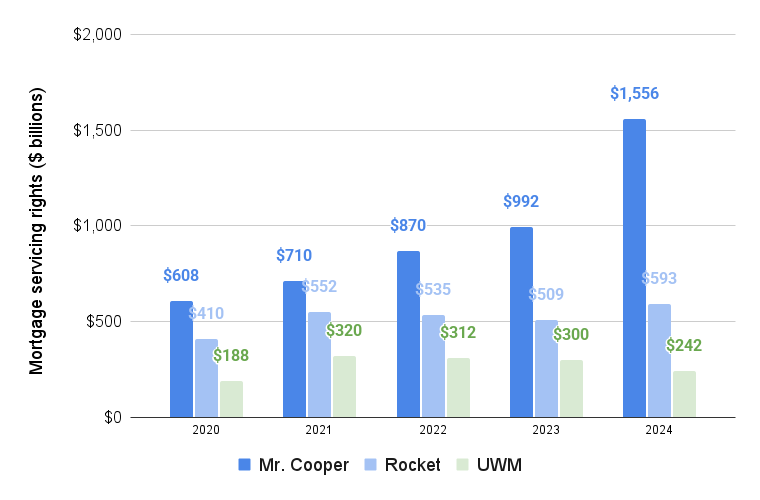
Mr. Cooper, Rocket Mortgage and UWM mortgage servicing rights (MSR) portfolios, including subservicing. Source: Company earnings reports.
Rocket and Mr. Cooper, by comparison, were together servicing (or subservicing) more than $2.15 trillion in mortgages at the end of the year — a combined portfolio nearly nine times larger than UWM’s.
Loan servicers collect monthly mortgage payments from borrowers on behalf of lenders or investors in mortgage-backed securities who own the loans. It’s an attractive business for many mortgage lenders, because the fees they can earn from loan servicing are a steady source of income that can even out ups and downs in home sales.
By maintaining close contact with borrowers, lenders who service their own loans are also in a better position to do repeat business with them when they’re ready to refinance or buy their next home.
Rocket claims that it “recaptures” 83 percent of its servicing clients when they’re ready to take out another loan. The Detroit-based lender’s client base is about to get a lot bigger, with Rocket setting its sights on acquiring not only Mr. Cooper but real estate brokerage Redfin for $1.75 billion.
Together, Rocket and Redfin attract 62 million visitors to their websites every month, while Rocket and Mr. Cooper’s combined client base of 9.5 million servicing customers represents opportunities for repeat business.
“Integrating Rocket’s originations-servicing recapture flywheel with Mr. Cooper’s servicing platform will drive down costs and improve the experience for the companies’ nearly 10 million combined clients,” company executives said in outlining the rationale for the deal.
Lenders who want to be in the loan servicing business can retain the mortgage servicing rights (MSRs) on the loans that they originate when they are bundled up into mortgage-backed securities (MBS) and sold to investors.
They can also acquire MSRs from other lenders who need the cash — or don’t want to be in the servicing business. Lenders who want to keep their MSRs but don’t want to service the loans can also contract with subservicers, as UWM has done in the past.
UWM’s MSR portfolio has been shrinking since 2021, as the Pontiac, Michigan-based lender sold servicing rights to raise money. As an example of one such deal, at the beginning of last year, UWM sold the MSRs on $70 billion in mortgages for $941.2 million.
Using tech to leverage economies of scale
Loan servicers benefit from economies of scale, as executives at Mr. Cooper have said of the company’s investment in AI and other technology to slash expenses. Two years ago, Mr. Cooper executives revealed the company was spending “several hundred million dollars a year” on call center operations, and expected to achieve $50 million in annual savings at the outset of a “multiyear” artificial intelligence project.
By partnering with ICE Mortgage Technology, UWM gets immediate access to what the companies claim is ICE’s “industry-leading MSP loan servicing system.”
UWM said it selected MSP “for the system’s powerful features, scalability and capacity to support outstanding customer service that fosters borrower retention, and the fact that ICE is an independent, neutral and proven technology provider.”
UWM will also employ ICE Servicing Digital, a homeowner portal with “retention and recapture features,” aimed at winning repeat business, and ICE Loss Mitigation, which helps homeowners facing hardship connect with assistance.
“While we are excited about the cost savings for UWM, we’re even more excited about the opportunity to help brokers deepen their relationships with borrowers by leveraging MSP,” Ishbia said.

Ben Jackson
ICE President Ben Jackson said in a statement that the company is “honored that UWM has entrusted us to supply the technology underpinning its new servicing strategy.”
It’s the second big tech partnership for UWM this month, following the announcement of a “strategic, industry-transformative agreement” to integrate Google Cloud AI and machine learning tools into UWM’s lending platform.
Interest rate risk
While mortgage servicing has been a profitable business for Mr. Cooper, it’s not without risks. Loan servicers are expected to help homeowners avoid foreclosure, a task that can prove demanding during economic downturns.
MSR portfolios are also sensitive to fluctuations in mortgage rates.
When interest rates go up, demand for purchase mortgages and refinancing often wanes. But MSRs become more valuable because borrowers are less likely to refinance and end up with another loan servicer.
When mortgage rates go down, loan servicers must often make adjustments to the fair value of their MSR portfolios, as borrowers are more likely to refinance and exit the portfolio.
Servicers who purchased MSRs during the pandemic era “have found themselves in the sweet spot, as mortgage holders remain reluctant to trade in low-priced loans,” outsourcing and advisory firm SitusAMC said in an analysis released Wednesday, “Mortgage Servicing Rights in 2025: Navigating Market Volatility.”

Mark Garland
The “million-dollar question” is where interest rates and mortgage origination volume will land over the next 12 to 18 months, SitusAMC executive Mark Garland said in a statement.
“Volume is everything,” Garland said. “Volume is going to be the issue that will keep people in the [loan servicing] business or drive them out.”
Get Inman’s Mortgage Brief Newsletter delivered right to your inbox. A weekly roundup of all the biggest news in the world of mortgages and closings delivered every Wednesday. Click here to subscribe.
Email Matt Carter
This post was originally published on this site