
by Marian McPherson | Jun 5, 2025 | Industry, News Feed
Workforce cuts, the rescission of Fair Housing initiatives and COVID assistance, and multiple pathways for Fannie Mae and Freddie Mac are all under discussion at the federal housing agencies.
Bigger. Better. Bolder. Inman Connect is heading to San Diego. Join thousands of real estate pros, connect with the Inman Community and gain insights from hundreds of leading minds shaping the industry. If you’re ready to grow your business and invest in yourself, this is where you need to be. Go BIG in San Diego!
After passing the U.S. House of Representatives in a razor-thin vote of 215-214, President Trump’s tax bill, the One Big Beautiful Bill Act, will now face the scrutiny of the U.S. Senate, where Republicans are pushing for an additional $500 billion in cuts.
The $1.5 trillion budget cut passed by the House is to offset the costs of making the 2017 Trump tax cuts permanent, NPR explained, and primarily hinges on slicing funding for Medicare, Medicaid, the Affordable Care Act (ACA), and the Supplemental Nutrition and Assistance Program (SNAP), and reducing student loan repayment options to a 10-year and a 25-year plan.
Although healthcare and student loans have gotten the lion’s share of coverage, the One Big Beautiful Bill Act’s passage in the House relied on proposing key cuts to several Department of Housing and Urban Development programs. If passed, the cuts to HUD would be in addition to the $32.9 billion budget cut outlined in Trump’s FY 2026 budget request.
Eighty-one percent of the cuts in HUD’s FY 2026 budget are aimed at limiting federal rental and homelessness assistance programs and eliminating Fair Housing grants and initiatives.
HUD Secretary Scott Turner has already gotten the ball rolling on some cuts, with plans to lay off 40 percent of the Federal Housing Administration (FHA) staff, rescind several Obama- and Biden-era fair housing rules, and reduce funding to the Fair Housing Assistance Program (FHAP), the Fair Housing Initiatives Program (FHIP) and other assistance programs.
These changes not only impact renters, 5 million of whom get housing assistance through Section 8, but they could also impact homebuyers and homeowners who’ve had their fair housing rights violated, have Federal Housing Administration (FHA)-insured loans or still rely on COVID-era assistance options to avoid foreclosure.
Here’s what you need to know about what’s happening at HUD and the Federal Housing Finance Agency (FHFA), and how you can help your clients navigate what’s ahead:
FHA: No loans for non-permanent residents, the end of COVID-era assistance
The Federal Housing Administration, which is under HUD, is one of the nation’s largest mortgage insurers. The FHA insures loans from HUD-approved lenders who offer lower closing costs, lower down payment requirements and more lenient creditworthiness standards.
- Twenty-five percent of HUD workers accepted the DOGE deferred resignation plan, which allows them to receive pay and benefits through Sept. 30. Inman reported in February that HUD planned to lay off 40 percent of FHA staff; however, HUD has not confirmed the number.
- HUD will no longer allow non-permanent residents to apply for FHA-insured loans. The change, which impacts borrowers with teaching, student and other professional visas, goes into effect on May 25. Those borrowers will still have access to conventional loans.
- HUD also made changes to the Mutual Mortgage Insurance Fund (MMIF) and COVID-19 Recovery Options. The changes limit homeowners to one permanent Loss Mitigation Option every two years versus every 18 months.
- National Housing Conference President and CEO David Dworkin said it’s anyone’s guess on how many HUD workers will face layoffs. The size of those layoffs and whether HUD decides to update its regulatory structure to operate sufficiently with a smaller staff will determine whether the experience for borrowers declines.
Opportunity Zones: Hitting restart in 2027
A holdover from the first Trump term, the 2017 Opportunity Zones (OZ) program offers developers tax breaks when they invest their realized capital gains in projects across 8,700 designated zones. The program has yielded mixed results, with home values in most OZs struggling to match the national average and developers abusing loopholes to receive tax benefits without making actual long-term investments in the zones.
- Trump’s FY 2026 budget request proposes that HUD sunset the program in the first set of 8,700 OZs in 2026. Governors will be able to nominate new zones in 2027.
- The new OZs will favor rural land, with developers getting a 30 percent break, versus a 10 percent break for projects in non-rural zones.
- Experts anticipate that some of the original zones will have their program status renewed; however, for zones that don’t, developers will no longer get tax breaks.
HOME Investment Partnerships (HOME) program: On the chopping block
HOME is HUD’s biggest federal block grant and provides funding to preserve and build affordable housing for renters and homebuyers. HOME grants can be used for down payment, closing costs and mortgage assistance.
- The final rule to update HOME — the first update since 2013 — is expected to offer higher assistance thresholds and streamline homebuyers’ application process.
- Several housing groups lauded the program updates, saying they’ll strengthen tenant protections and help Community Housing Development Organizations (CHDOs) better serve tenants and homebuyers from low- and middle-income communities.
- Trump’s FY 2026 budget request proposes to discontinue the $1.25 billion program; however, Dworkin said Congress will likely deny Trump’s plan to discontinue HOME.
Affirmatively Furthering Fair Housing: A partisan talking point
Affirmatively Furthering Fair Housing requires all local, state and public housing officials to use the Affirmatively Furthering Fair Housing Assessment Tool. The tool uses a 96-part questionnaire to help leaders identify patterns of segregation and concentrated poverty along racial lines.
Former HUD Secretary Ben Carson removed the rule in 2016, and the following HUD secretary, Marcia Fudge, outlined plans to reinstate AFFH and make the tool easier to use. However, HUD, under Fudge, never issued the final rule needed to officially bring the AFFH back.
- Turner has no interest in crafting a new AFFH policy, saying it was “red tape” that prevented jurisdictions from solving housing issues without federal interference.
- Representative Maxine Waters (D-CA) and Senator Elizabeth Warren (D-MA) have introduced the “Restoring Fair Housing Protections Eliminated by Trump Act,” which includes legislation to reinstate AFFH.
- Dworkin said the conversation around AFFH is more of a “rhetorical policy argument than something that’s going to have true, immediate impact” on homebuyers and homesellers from marginalized communities. Proposed cuts to the Fair Housing Assistance Program (FHAP) and the Fair Housing Initiatives Program (FHIP) matter more, he said.
Property Appraisal and Valuation Equity (PAVE) Task Force: A future unknown
The PAVE Task Force was created in 2021 to address appraisal bias among Black homesellers, who’ve reported receiving lowball appraisals compared to their white counterparts who live in the same area. The task force collected appraisal bias data, set federal enforcement actions for appraisers who discriminated against homesellers and created a rule that allowed homesellers to ask for a reconsideration of value if their appraisal came in too low.
- HUD deleted the PAVE Task Force homepage in February and has said nothing else about it since.
- In March, HUD lifted appraisal review procedures enacted last year for FHA lenders to follow to better protect borrowers against discriminatory appraisals.
- In light of lingering questions about PAVE, experts have advised consumers to be vigilant during the appraisal process and flag potential instances of discrimination.
Privatizing Fannie and Freddie: Multiple options on the table
Fannie Mae and Freddie Mac’s regulator, the Federal Housing Finance Agency (FHFA), is weighing plans to restructure the companies. Both government-sponsored enterprises, whose business model relies on purchasing loans from banks and selling them as mortgage-backed securities, were put under conservatorship during the height of the subprime mortgage crisis.
The timeline for restructuring the mortgage giants is still unclear, with FHFA Director Bill Pulte saying he’s waiting for President Trump’s direction.
- In past interviews, Trump floated multiple privatization options, including bypassing Congress using the FHA to free the firms from their conservatorship. However, the president pitched a new plan on May 21 via Truth Social, saying he wanted to take Fannie and Freddie public.
- Pulte later pointed out that Trump “very explicitly says that he wants to take them public. He did not say that he wants to privatize them,” and that the administration is studying whether it could keep the companies in conservatorship.
- Dworkin said there are “a lot of complex questions that still have to be resolved” when it comes to privatization, and it’s anyone’s guess on what method the Administration will choose. However, they must be careful — brashly pulling the GSEs out of conservatorship could lead to mortgage rates rising anywhere from 43 to 97 basis points or almost 1 percent (100 basis points = 1 percent).
- In a move to address fears that mortgage rates might go up if Fannie and Freddie are restructured, Trump posted on Truth Social on May 27 that “the U.S. Government will keep its implicit GUARANTEES, and I will stay strong in my position on overseeing them as President.”
- One theory is that the government could invest its stake in Fannie and Freddie into a sovereign wealth fund and raise cash by issuing preferred shares that pay dividends — an approach Treasury Secretary Scott Bessent says could help put the mortgage giants on sound footing without boosting mortgage rates.
A new credit-scoring system: Double the scores, double the work
The FHFA is seeking a shift from a tri-merge to a bi-merge credit scoring system. The FHFA approved the plan in 2022 with a Q4 2025 implementation deadline, but that timetable has been pushed back. Instead of pulling one score from three credit reporting agencies, Fannie and Freddie will require lenders to pull two scores — FICO 10T and VantageScore 4.0 — from two credit reporting agencies, for a total of four scores.
- Pulte has said he’s “not happy” about price increases levied by the company behind the FICO score algorithm, Fair Isaac, which an industry trade group, Community Home Lenders of America, claims total 700 percent over the last 30 months.
- In addition to introducing competition, backers tout the new VantageScore 4.0 and FICO Score 10 T credit scoring models as more inclusive and accurate. VantageScore – a joint of consumer reporting agencies Equifax, Experian, and TransUnion – claims that implementation of VantageScore 4.0 will boost the eligible pool of mortgage applicants by over 2.5 million borrowers.
- Originators worry that a bi-merge credit scoring system will make it more difficult to assess borrowers’ creditworthiness, as they’ll need to learn the nuances of each system.
- Borrowers with lower credit scores may have fewer options to get approved. FICO 10 T evaluates two years of credit behavior, meaning borrowers can’t pay off a large chunk of debt before applying for a mortgage to improve their score.
Pulling back on equitable housing programs: A hit to minority homeownership rates
Director Pulte issued a directive on March 25 terminating Fannie and Freddie’s Special Purpose Credit Program, saying, “the current level of support for SPCP is inappropriate for regulated entities in conservatorship.”
- Fannie and Freddie had launched SPCPs in select U.S. cities aimed at boosting lending by expanding borrower eligibility criteria, reducing closing costs and providing flexibility in the form of down payment assistance. Lenders can participate in Fannie and Freddie SPCPs or develop their own programs.
- Dworkin is hopeful that lenders will still utilize SPCPs as long as Fannie and Freddie avoid making “unique underwriting changes” that will hinder service to borrowers with lower creditworthiness.
Pulte also did away with a requirement that Fannie and Freddie adopt Equitable Housing Finance Plans every three years and publish annual reports documenting their performance.
- Although a final rule requiring the mortgage giants to adopt Equitable Housing Finance Plans was finalized in May 2024, Fannie and Freddie submitted their first plans in 2021 with the goal of providing long-term, equitable housing solutions for homebuyers from underserved groups. The plan required Fannie and Freddie to identify homeownership barriers and create solutions for those barriers, including leveraging SPCPs.
- “Before the Equitable Housing Finance Plans were created, Fannie Mae and Freddie Mac were doing a horrible job of serving the entirety of the market in an equitable way,” National Fair Housing Alliance (NFHA) Executive Vice President Nikitra Bailey told Inman when Pulte eliminated the requirement.
- Lastly, Pulte withdrew the FHFA’s participation in monitoring unfair, deceptive and abusive acts and practices (UDAAP) in collecting consumer debts, leaving the Consumer Financial Protection Bureau (CFPB) and the Federal Trade Commission (FTC) to handle the task.
Slimming the workforce: Fewer workers, reduced services
In April, Pulte went to X, the platform formerly known as Twitter, to announce that Fannie and Freddie had cut more than 25 percent of their workforce. Fannie and Freddie had 16,000 employees at the beginning of 2025. A 25 percent cut means about 4,000 employees have been fired or left the company since March.
Email Marian McPherson

by Rachael Hite | Jun 5, 2025 | Industry, News Feed
Bigger. Better. Bolder. Inman Connect is heading to San Diego. Join thousands of real estate pros, connect with the Inman Community, and gain insights from hundreds of leading minds shaping the industry. If you’re ready to grow your business and invest in yourself, this is where you need to be. Go BIG in San Diego!
I’m exercising my freedom of speech by writing about the National Association of Realtors’ insistence that their review of potentially changing the Realtor Code of Ethics, which passed intact through committee in preparation for a vote Thursday, is less about Trump’s presidential policy against DEI and more about a drop in revenue, membership and potential future legal battles.
Because let’s be real, that is what’s being pushed back on here. Privileged agents want an exception, a free pass, a Get Out of Jail Free card to do what they want to do, without suffering professional consequences.
NAR wants membership dues to cover its debts, and also wants to ensure that it’s not responsible for the actions of agents under the brand, as it can no longer afford the risk of carrying such a low professional threshold for licensing and poor training, and the results that it produces.
To increase membership numbers, NAR needs to make it more appealing to be a Realtor. And who wants to be a Realtor and pay dues if there are so many rules to follow? Sales is hard enough; let’s remove some barriers and get things cranking like it was 2006 and sell, sell, sell. Who cares about how it’s done? We need to get this train back on track.
The message is that NAR is willing to change its beliefs on DEI because the current state of membership is so chaotic and filled with liability that it’s willing to compromise its Code of Ethics to stay in business.
So, the trade group will continue to offer Code of Ethics training, but perhaps now, it will look the other way and not enforce it. What is the end goal here?
Past is prelude
In 2000, NAR was focused on many of the issues that remain in the spotlight today: fair housing, affordability and affiliated business agreements to ensure consumers had transparency in pricing and who was profiting, laying the groundwork for the founding of the Consumer Financial Protection Bureau.
Essentially, NAR was focused on protecting the interests of the consumers because unfair business practices and happenings were still rampant in the industry.
Since 2000, NAR has failed to address many of the problems it set out to resolve over the past 25 years. Fair housing and fair appraisals remain issues, and transparent commissions continue to be a concern, sparking daily heated arguments. Now, thanks to a series of lawsuits, the public trusts real estate agents less than ever before.
The CFPB is under attack by the current administration, and to make things even more fun, additions to the Code of Ethics that were made during the pandemic to protect consumers, along with DEI and other serious issues, are under the lens because some Realtors feel that their freedom of speech is being violated if they face professional and financial penalties from grievances filed against them under 10-5.
Thoughts and prayers for those against 10-5
I’ve prayed more than I ever have in my whole life recently, and I’ve had a tough road with religion from childhood. My frustration is that this world is a very broken and scary place.
So many people do not have a “fair” or “equal” chance; the playing field is not the same for everyone, and we all don’t have the same tools or skills or even opportunities given to us based on where we grew up, who raised us, physical health, mental health, and modern culture and politics.
I pray for the folks who use their religion as a weapon and an excuse to judge, hurt or oppress marginalized groups and the less fortunate, and that their ignorance or delusion is creating a world that is even less welcoming for current and future children.
I pray for people who are considering suicide because they do not feel welcome in this world, that they find the strength to stay, and someone who helps them understand that their worth has nothing to do with money, status, who they love or what gender they are.
I pray mostly for empathy and compassion, and especially for those in privileged positions who can help others achieve success. I pray for people to worry about their own lives and stop worrying about how others choose to live. I hope that something in the universe teaches them that diversity is what makes our communities stronger.
However, here’s the thing about thoughts and prayers: They don’t accomplish anything without action. I call my reps, I speak out against hate, and I insist on holding people accountable when they are contributing to the problem and not the solution.
That’s what 10-5 is about. It’s a ribbon of protection for consumers, and some guardrails for maintaining the Realtor brand and upholding the pledge of the Golden Rule. When NAR stepped up and created 10-5, it was because it needed to demonstrate to consumers that Realtors care and would not tolerate discrimination. NAR took action.
If the Code of Ethics doesn’t align with your personal beliefs and religious beliefs, then perhaps you should not be working with the public.
If you struggle to explain how you get paid, why you get paid, and what you charge for your work, then you may not be suited for sales with consumers. It’s just that simple. It’s not an if-then scenario when you work with the public.
The public has the right to know if you are engaging in activities on your personal time that would make them feel unsafe, discriminated against or that you don’t have their best interests at heart. They should be able to research you and know not to work with you.
Finally, even if 10-5 is changed or removed, consumers still have the right to file a grievance against you at any time for multiple reasons. If you are behaving in a way that raises questions, you will likely still be called before your governing board to explain what you were doing to warrant the call or grievance.
That’s what democracy is about. You have the total freedom to participate in and say whatever you want, but the public and the Realtor brand do not have to sit next to you while you do it, nor agree with your agenda.
Rachael Hite is a seasoned housing counselor and thought leader in the real estate industry. Connect with her on Instagram and LinkedIn.
by Spencer Krull | Jun 5, 2025 | Industry, News Feed
Since the NAR commission suit settlement, buyer agents have faced new rules, new documents and a new normal. This month, Inman drills down on Today’s Buyers Agent with the fresh marketing strategies, skills and tools buyer agents are using to prosper in changing times.
Imagine if we licensed drivers the same way we license real estate agents; our roads would look like a bumper car track.
I remember my first day as a real estate agent, wearing my jacket and tie, sitting at my desk, ready to get to work and thinking, “I have no idea what I am doing.”
To clarify, I had learned the basics of prospecting; I had worked on my scripts for hitting the phones or knocking on doors, and even sitting open houses if another agent would give me the chance. I knew the basics of getting clients. What I didn’t know anything about, however, was what I was supposed to do in case someone answered a door that I knocked on and said, “I’d like to write an offer on the house across the street.”
Practical training is a must
Though I’m a licensed broker in six states, with over 20 years of experience, I still had that same lost feeling each and every time I received a new license. I place the blame for agents’ lack of readiness squarely on most states’ licensing courses and educational requirements.
As an illustration, let’s compare the steps necessary to get a real estate license with getting a driver’s license (something with which I have white-knuckled familiarity thanks to my 16-year-old).
Driver’s license training is “skills-focused.” The coursework focuses on the useful, practical knowledge that a driver will use every day — things like what to do at a stop sign, how and when to signal, and whether or not one can cross a double yellow line to pull into a driveway or parking lot (something that sparks an argument almost every time I go to Costco).
Real estate license training is much more scattered. For instance, instead of simply teaching that discrimination is illegal and providing a list of protected classes and people, real estate training and testing is equally focused on things like when different civil and housing rights acts were passed.
When a HUD tester shows up asking if the owner will rent to a person of color, I think it’s more important that an agent knows to say, “Of course,” and not “The first civil rights act was passed in 1866, but was undermined by the 1896 Supreme Court decision in Plessy v. Ferguson … ”
History is great, I love history, but when approaching a stop sign, I thank the DMV that my son knows to apply the brakes instead of looking at me and saying, “In 1954, the Federal Manual on Uniform Traffic Control Devices required that all stop signs must be red and octagonal.” (I would hazard a guess my insurance company is thankful, as well.)
We need traditional blackbelts
A karate instructor once told me that traditionally, students didn’t go out and buy darker and darker belt colors as their skills grew; rather, they wore the same belt, which started off white and darkened over time with experience. When it comes to real estate, it seems many agents “buy” a black belt as soon as they get their license, without having or seeking any practical experience.
On the other hand, the aspiring driver gets their white belt when they pass the written test and starts to “darken their belt” with practical experience behind the wheel (with an experienced driver ready to grab the wheel one seat over).
It’s not until the novice driver has attained a degree of road competency that they are allowed to take a practical driving test, and upon passing, get to give their parents mini heart attacks any time they hear anything that vaguely sounds like metal hitting metal.
Which licensee is better prepared?
Who’s picking up the slack on training?
That lack of actual skills-based education in real estate puts the burden of training on brokerages, and not all brokerages are created equal or up to the task. A friend from my licensing class went to a brokerage that provided her a mentor who drilled her on paperwork and procedures through practice listings, offers, counteroffers and repair requests.
My first brokerage paired me with a mentor who hadn’t done a deal in quite a few years and was more concerned with whether the coffee was fresh or from that morning, instead of whether contingencies were removed actively or passively. (Oh, and she got that one wrong on my first deal, and I was nearly sued.)
Inexperienced karate students and drivers can cause serious physical damage; inexperienced agents can cause serious financial and even civil damages that affect their clients, themselves and their brokerages.
Before getting a license, plumbers and electricians are required to undergo vocational training and years of apprenticeship; I am grateful for this system whenever I flush a toilet or turn on a light switch (especially if the light switch is in my bathroom).
With so much at stake for a client buying or selling a home — something which is, more often than not, the largest and most significant financial transaction of their lives — I think the public deserves better than “off-the-shelf blackbelts.”
If departments of real estate across the country were serious about their mission to protect the public, they would align licensing education and certification with actual practice in the industry. There would be tests on skills or mandated apprenticeships, and continuing education for renewal would reinforce these skills.
But for now, I guess we’ll settle for tests that require an agent to know how many square feet are in an acre (43,560), or what year the Americans with Disabilities Act was passed (1990), instead of knowing how to write a counteroffer properly.
Writer’s note: The opinions in this article represent the author’s opinions and do not reflect those of Side.
Spencer Krull is a managing broker with Side, and also works as a real estate expert witness and consultant for attorneys.
by Carl Medford | Jun 5, 2025 | Industry, News Feed
Since the NAR commission suit settlement, buyer agents have faced new rules, new documents and a new normal. This month, Inman drills down on Today’s Buyers Agent with the fresh marketing strategies, skills and tools buyer agents are using to prosper in changing times.
With buyer loyalty down and deals harder to ink, buyer agents need to up the ante if they wish to finish 2025 on a successful note.
It has been a tough year so far for buyer agents: Not only have the rules for buyer engagement morphed and shifted over the past year, but we are still dealing with inventory shortages, high interest rates, potential tariffs, significant shifts in the stock market, declining consumer confidence and more.
All of this has resulted in indecisive buyers who, if not properly nurtured, can turn on a dime and engage in an “out-of-the-blue” real estate transaction that excludes the agent who assumed they would be the “go-to” representative.
Although there is no guaranteed method of ensuring buyer loyalty, there are processes that will help increase the odds. Here are our recommendations:
1. Insist on a mandatory buyer consultation
Regardless of how you connect with a potential buyer — whether at an open house, internet lead, referral and so on — you need to help them understand that a mandatory consultation is critical for getting the homebuying process started.
We ask potential buyers to commit to a consultation that will typically last between 60-90 minutes. Because you only want to work with clients who are actually motivated to buy a home, if they refuse to meet, that is a signal that they are not the type of client you will want to represent. Rather than go into detail about what constitutes an effective buyer consultation, you can click here for a complete outline.
2. Demonstrate your value
Real estate agents, unfortunately, are now viewed as a commodity or even a necessary evil instead of skilled advocates such as attorneys or accountants. This slide in confidence has been dutifully earned, as aptly demonstrated in conversations surrounding the industry’s commission lawsuits. With a substantial percentage of agents doing little or no business, agent professionalism has taken a serious hit.
When something or someone is viewed as a commodity, the goal is to obtain their product or service as cheaply as possible.
If buyer’s agents wish to demonstrate their value and rise above the herd, this can be done in three ways:
- Have a written value proposition that clearly articulates your value.
- Have a number of client testimonials and references you can provide to a prospective client that will validate your value. Ironically, people will believe a third party they have never met more than they will trust a person sitting in front of them.
- Tell stories of past issues you have successfully resolved. While people may appreciate a written value proposition, a story will help connect to their emotions and, at the end of the day, people commit with their emotions more than logic.
3. Complete an exclusive buyer-broker agreement
If you do not have a signed buyer-broker agreement, then you have nothing. Because an agreement is now required in our state to show a single property to a prospective buyer, buyers are beginning to understand the need for formalized representation. Although some are refusing to sign and are utilizing open houses as a way to vet properties, there is growing acceptance among buyers to sign a representation agreement.
How that agreement is filled out, however, is everything. As soon as the realization occurred that buyer-broker agreements were going to become mandatory, we began training with scripts designed to overcome potential buyer objections. Like anything else, conversations concerning representation agreements have to be practiced to ensure success.
Although it’s relatively easy to get a buyer to sign an agreement to view a single property, the goal is to establish a meaningful and exclusive relationship with a buyer that will permit you to work on their behalf for as long as it takes to get them into a home and secure appropriate compensation for yourself.
4. Connect the buyers with a reputable lender
Although we will work with any lender the buyer chooses, not all lenders are created equal. Ideally, connect them with your in-house lender so you can monitor their progress more effectively. The lender will help determine their creditworthiness, verify deposits for down payments, confirm their ability to borrow and establish limits.
Once this is done, they will produce a pre-approval that includes the parameters you will need to know to set up property search parameters effectively. We will not show homes to buyer clients who are not pre-approved, nor will we set up tours for properties that are above their pre-approval limits.
5. Set up buyers on your app
Buyers have a habit of looking at homes in places that may not be helpful to you as their agent. Unless you actively work on setting them up for successful communication, you have no right to be surprised when they go off in a different direction and, depending on how your buyer-broker agreement is written, ink a deal with someone else.
To shift things in the agent’s favor, your clients should be directed to use your app. A robust app will not only be branded to the agent but also will link directly to local MLSs and provide full access to all available listings and notify the agent of the buyer’s activity, favorites and more. This knowledge makes it much easier for the agent to interject themselves into the process and proactively set up showings for homes the buyers have liked.
Further, in the case of robust CRMs, agents can:
- Set up customized property searches and market alerts for their clients based on their preferences (price, size, location, features and more). These apps frequently provide real-time access to MLS data, often more up-to-date than public portals, such as Zillow, Realtor.com or Homes.com.
- Have automated real-time communication and updates when new listings go live or when a listing they are following has a status change (price adjustments, open houses, etc.). Not only does the buyer receive the alerts, but their agent does as well, helping streamline communication and respond immediately to a buyer’s needs.
- Showing coordination. Depending on the app, agents can manage showings directly within the platform, so buyers get timely and efficient viewing opportunities.
- Collaboration and notes. Buyers and their agents can collaborate on favorites, leave notes and rate properties, which makes it easier to narrow down choices and stay organized.
6. Communicate, communicate, communicate
Do not make the mistake of setting your clients up on auto feeds and then waiting for them to communicate. If you have set them up with your app, then you can monitor their activity and reach out continuously to provide additional information, schedule showings and more.
7. Actively look for opportunities
Many agents in the past have been willing to let their buyers do all the work: They would set them up on autofeeds and then wait for them to raise their hand when they found something they liked. Agents that want to succeed in the current market are going to have to raise the bar.
Activities include the following:
- Go with your buyers to open houses they want to visit. Although some agents consider this a waste of time and effort, smart agents will understand that there is no difference between an open house they attend with their client and a private showing; each one is an opportunity to gauge your client’s interest and proactively act. If you are not with them when they see a home they like, you will be left guessing and may miss an opportunity to write an offer. Ironically, if they like a home they visited without you, you will need to go to the property anyway to represent them effectively.
- Take your clients to new builders. Do not wait for them to go on their own — if they drive by a builder’s development and sign anything without you present, your chances of getting a commission will be dramatically diminished. Even if your buyers state upfront that they are not interested in new homes, a quick tour of local builders may be all they need to ink a deal.
- Actively seek off-market opportunities. Many buyers want to live in a specific neighborhood due to access to local schools, commute, proximity to family, neighborhood amenities and so on. If no homes are available, then strap on your walking shoes, hit the streets, and knock on every door in that neighborhood that meets their criteria. You can also send out Golden Letters explaining your client’s need to live in that neighborhood. I am not advocating any brokerage practices or private networks that would violate the intent of the Clear Cooperation Policy: I am talking about buyer agents going out and actively looking for homes that might meet their client’s needs – properties that might otherwise not have gone on the market.
Times have changed, and if any given buyer’s agent wishes to succeed, they need to adapt to meet the new realities. Whereas markets in the past were significantly easier to navigate, actual work is required in the current market, and those who understand this and are willing to roll up their sleeves and dig in will be the ones who will ultimately build a successful business.

by Debra Trappen | Jun 5, 2025 | Industry, News Feed
Debra Trappen’s series continues with inspiration for getting back in touch with the work that lights you up and renews your motivation.
Bigger. Better. Bolder. Inman Connect is heading to San Diego. Join thousands of real estate pros, connect with the Inman Community, and gain insights from hundreds of leading minds shaping the industry. If you’re ready to grow your business and invest in yourself, this is where you need to be. Go BIG in San Diego!
Welcome to Lead with Fire, A Soulful Series for Real Estate Game-Changers. This is more than business advice — “Lead with Fire” is a transformative series created for the soulful, visionary humans in the real estate industry who are done with the old playbook and ready to redefine success on their own terms.
The secret to success isn’t doing more; it’s staying lit up.
There was a moment when I realized the cost of playing it small was slowly killing me from the inside out.
I was doing work I loved. My values, passion and purpose all aligned — check, check, check. The problem? The people I was working with had a different agenda.
They didn’t want all of me. They wanted the “palatable” version. They wanted to dull my voice, shrink my presence, and rework my vision into something … safer. Directionless, yet controlling. Hollow, yet somehow demanding.
I fought it. I kept showing up. Kept trying to make it work. Until one morning, I realized I had slipped from flow into force.
I was exhausted — physically, mentally and spiritually. The drama drained me. The lack of vision, combined with vanilla feedback, drained me. The pressure to contort and conform drained me.
And then — a spark. The moment I made the decision to leave, the light returned. The fire that had dimmed came roaring back. My energy returned because I returned to myself.
Energy is everything
In a world obsessed with productivity, most people are taught to manage their time. When you’re building a life and business rooted in purpose, managing your energy is the real flex.
Your energy is sacred. It’s your fuel, your currency, your lifeforce. When you know what drains it and how to protect it, you unlock a new level of freedom and power.
Let’s get real about energy drains
Sometimes, it’s obvious. Late nights. Back-to-back meetings. Hustle without rest.
Other times, the most significant energy leaks are more subtle:
- Saying yes when your intuition says no
- Silencing your voice to keep the peace
- Over-giving and under-receiving
- Staying in places you’ve outgrown
- Holding back to make others comfortable
Energy management is about alignment, not avoidance. It’s doing what matters most to you.
Reignite your fire: Your energy rituals
Just as drains exist, so do boosters. Protecting your fire means having daily practices that nourish you and bring you back into alignment.
Consider weaving these into your day
- Boundaries that honor your bandwidth
- Quiet time that reconnects you to your inner wisdom
- Movement that energizes instead of depletes
- Creative time that lights you up from the inside
- Soulful conversations that make you feel seen
Reflections journal prompts
Let’s bring this to life. Take a few moments to reflect and journal on the following:
- What (or who) is draining my energy the most lately? Why am I still giving it my time, attention or power?
- What consistently replenishes me, even in a busy season? How can I create more space for that nourishment?
- Where have I been forcing instead of flowing? What would shift if I softened or surrendered?
- What boundaries would protect my energy and creativity right now? What am I available for — and what am I lovingly releasing?
- How do I want to feel at the end of each day — and what needs to change to honor that? Let that feeling guide your choices and your calendar.
It’s not just self-care — it’s self-leadership
When you protect your energy, you protect your vision. You protect your ability to show up, to lead, to create. You shift from surviving to shining. From pushing through to moving in flow.
Your fire-protection invitation
This week, create your own daily energy reset ritual. Something simple. Sacred. Repeatable.
- A few minutes of breathwork
- A morning walk without your tech
- A midday dance break or soaking in the sunshine
- An end-of-day journaling session to release the day
Let it be yours.
Let it be enough.
Let it bring you back to yourself.
Mantra to Lead with Fire:
“My energy is sacred. I choose flow over force and create from alignment, not exhaustion.”
Next up in the Lead with Fire series: How to show up online without selling out
What’s your time, energy and talent really worth? In our next post, we’ll explore the power of saying no, standing in your values and owning your worth — no apologies, no discounts.
Debra Trappen is the founder of the Red Threads Collective, a sacred community for women entrepreneurs. Connect with her on Instagram and LinkedIn.
by Matt Carter | Jun 4, 2025 | Industry, News Feed
While purchase loan demand was still up 18 percent last week from a year ago, some of that demand may not translate into sales, with Redfin reporting an unusual bump in cancelled purchase contracts.
Bigger. Better. Bolder. Inman Connect is heading to San Diego. Join thousands of real estate pros, connect with the Inman Community, and gain insights from hundreds of leading minds shaping the industry. If you’re ready to grow your business and invest in yourself, this is where you need to be. Go BIG in San Diego!
Last week’s dip in mortgage rates didn’t send homebuyers rushing to their lender, with purchase loan applications contracting by a seasonally adjusted 4 percent compared to the week before, according to a weekly survey of lenders by the Mortgage Bankers Association (MBA).
The latest MBA Weekly Mortgage Applications Survey, released Wednesday, found purchase loan demand was still up 18 percent from a year ago. However, some of that demand may not translate into sales, with Redfin reporting an unusual bump in cancelled purchase contracts in April.
The MBA survey showed requests to refinance were down 4 percent during the week ending May 30 when compared to the week before, but up 42 percent from a year ago.

Joel Kan
“Most mortgage rates moved lower last week, with the 30-year fixed rate declining to 6.92 percent and staying in the 6.8 percent to 7 percent range since April,” MBA Deputy Chief Economist Joel Kan said in a statement.
“Refinance activity fell across both conventional and government segments, and the overall average refinance loan size was the smallest since July 2024, as potential borrowers hold out for larger rate drops,” Kan said.
Redfin’s analysis of MLS pending-sales data showed 14 percent of homes that went under contract in April — about 56,000 properties — ended up not selling because their purchase agreements were cancelled.
That’s the second highest share of April cancellations in records dating back to 2017, Redfin said, after April 2020, when the pandemic put the brakes on many closings.
Redfin said purchase agreements are being cancelled at a higher rate than usual during the spring homebuying season due to economic and political uncertainty, a surge of inventory in many markets, and elevated home prices and mortgage rates.
Mortgage rates on the rebound
Since hitting a 2025 low of 6.48 percent on April 4, rates on 30-year fixed-rate conforming mortgages have rebounded above 6.8 percent for most of May, according to lender data tracked by Optimal Blue.
Inflation continued to move closer to the Federal Reserve’s 2 percent target in April, but central bank policymakers have been reluctant to cut short-term interest rates as they continue to assess the impacts of the Trump administration’s policies in areas including tariffs, immigration, taxes and regulation.
Purchase loan demand peaked in April
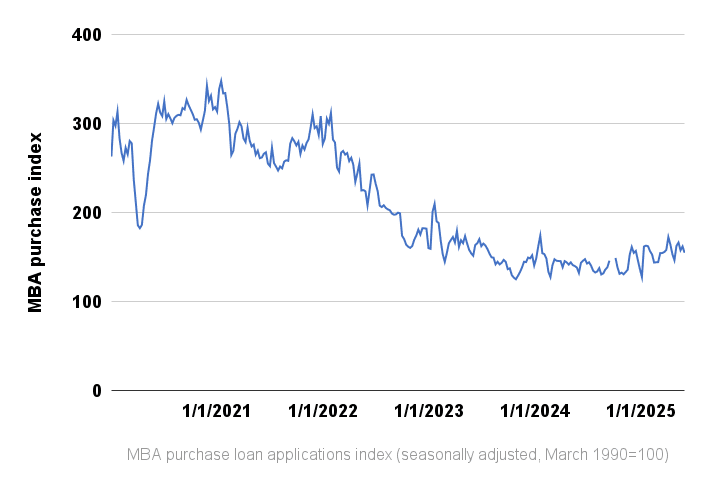
Even after adjusting for heightened demand during the spring homebuying season, purchase loan requests peaked in April, MBA data shows.
At 155 for the week ending May 30, the MBA’s seasonally adjusted purchase index was at its lowest reading since the week ending April 25. The index is now down 18 points from its 2025 high of 172.7 registered during the week ending April 4, but 27 points higher than a low for the year registered in January.
Get Inman’s Mortgage Brief Newsletter delivered right to your inbox. A weekly roundup of all the biggest news in the world of mortgages and closings delivered every Wednesday. Click here to subscribe.
Email Matt Carter
