by Bernice Ross | Jun 10, 2025 | Industry, News Feed
Bigger. Better. Bolder. Inman Connect is heading to San Diego. Join thousands of real estate pros, connect with the Inman Community, and gain insights from hundreds of leading minds shaping the industry. If you’re ready to grow your business and invest in yourself, this is where you need to be. Go BIG in San Diego!
In a market where flipping has started feeling like playing financial roulette, owner-occupying your first investment, otherwise known as house hacking, offers new investors a safer, smarter path to profit from their first real estate investment.
There was a time when flipping homes seemed like one of the fastest ways to build real estate wealth. Buy low, renovate fast and sell high — that was a formula that worked for millions of one- to four-unit investors.
Due to thinning margins, supply chain problems, too few contractors, plus higher interest rates, house flipping has now become challenging even for the most experienced flipper. Couple that with tariffs, inflation and a stagnant or deflating market, and this is an environment where you can easily end up with massive losses rather than profit.
What’s the hot new alternative? House hacking
House hacking is the strategy of living in your investment property and either renting out part of your existing home or creating additional units you can rent out to generate rental income. This approach reduces (and can even eliminate) your personal housing costs, build equity, while also simultaneously lowering your risk.
House hacking is one of the best alternatives for becoming a real estate investor and not getting crushed by what could easily happen if you were doing a flip.
House hacking your primary residence
“House hacking” combines the advantages of single-family homeownership with the income and wealth-building potential of owning a rental property.
Here are a few common house hacking strategies for single-family properties:
Garage conversions
Transform your detached or attached garage into a studio or one-bedroom rental.
Basement apartments
Finish out a lower level with its own entrance, bathroom and kitchenette. My in-laws had a huge unfinished basement that only had a laundry. They added a separate outside entrance, built a full kitchen, created a living area for viewing TV and a single bath for that area. They also added a second master suite for guests, including a steam shower that was accessible from the main house down the stairs.
ADU builds
If you’re in a market with high rents and lenient ADU laws, (Portland, Austin or parts of Southern California), building or converting even a modest ADU can add $1,200 to $2,500 per month to your income stream while also significantly increasing your resale value.
In addition, many cities now allow homeowners to build a small backyard cottage or over-garage apartment with minimal red tape.
Internal reconfiguration
Do you have a split-level house or home with a fourth or fifth bedroom with a private bath away from most of the house? If so, you can section off part of your home to create a rental with a private bath and separate entry, which is great for traveling nurses, students or Airbnb guests.
Practical steps to get started
Assess your property
Identify spaces within your home that can be rented out, such as spare bedrooms, basements or garages.
Understand financing options
Explore loans suitable for owner-occupied properties, like FHA or VA loans.
Check local regulations
Research zoning laws, rental regulations and tax implications in your area. Many areas have strict rules about short-term Airbnb-style rentals. This may vary given that you are living in the property, but it’s important to verify.
Prepare the space
Make sure that the rental area meets safety standards, is up to code if you make any improvements and is clean and appealing to potential tenants.
Market your rental
Use platforms like Airbnb or local rental listings to find tenants.
Owner occupying a 2- to 4-unit property
If you house hack your primary residence, chances are it will mean that you’re living in a nicer property than if you purchase a two- to four-unit building, where you may end up living in an apartment.
In other words, you’re not getting the dream home you see on HGTV, but you are trading those high mortgage payments for rental income that starts you on the path to building true real estate wealth.
Benefits of owning a 2- to 4-unit property where you reside include
- Built-in cash flow from Day 1.
- Simplicity in management (you’re already on-site)
- Favorable financing options as an owner-occupant.
- Better yet, lenders typically allow you to count a portion of the rental income from the other units toward your qualifying income. That means you can afford a larger purchase than you could with a single-family loan alone.
- When you’re purchasing as an owner-occupant, you may qualify for low- or no-down-payment loans (FHA: 3.5 percent; VA: 0 percent), an opportunity that doesn’t exist for investor-only loans, which typically require 15 percent to 25 percent down.
- Best of all, you may even be eligible for down payment assistance. According to DownPaymentResource.com, the average DPA benefit in 2024 was $18,000, money that in many cases can cover most, if not all, of your down payment and closing costs.
Add even more value by building additional units over time
Want to increase income without buying another property? Consider these value-boosting strategies:
- Convert a duplex to a triplex by finishing a basement.
- Add an ADU to the backyard of your two- to four-unit property.
- Upgrade the existing units to command higher rent.
- Split a large unit into two smaller apartments, if zoning allows.
With the national housing shortage and demand for rentals still sky-high, especially in starter markets, these upgrades can yield serious ROI.
10 powerful reasons your first real estate investment should be a property you live in
1. Significantly better financing terms
Owner-occupants qualify for much lower interest rates and better loan terms than traditional investors. FHA and VA loans allow low or even zero-down payments, something that investor loans almost never offer.
2. Buy with less cash upfront
Instead of coughing up 15 percent to 25 percent down on an investment property, you can get started with as little as 3.5 percent down on a duplex, triplex or fourplex if you live in one unit. It’s the easiest path for first-time homeowners to break into real estate investing.
3. Reduce your housing costs
Tenant rent can cover a large chunk (and sometimes all) of your mortgage, taxes and insurance. This drastically lowers your cost of living while you’re simultaneously building wealth through equity and appreciation.
4. Boost your buying power
Lenders often count projected rental income toward your qualifying income, especially on two- to four-unit properties. That means you may qualify for more property that is more expensive than your W-2 income alone would normally allow.
5. Gain built-in property management
When you live onsite, you can handle minor issues immediately, avoid property management fees and stay on top of maintenance. This saves money, time and headaches.
6. Set the standard for tenant behavior
Tenants tend to behave better when their landlord lives on the premises. Properties stay cleaner, lease violations drop and disputes get resolved quickly. Your presence creates built-in accountability.
7. Learn by doing (and earning)
Becoming a landlord will provide you with a real-world masterclass in real estate investing, especially if you’re managing a two- to four-unit building. You’ll learn how to screen tenants, manage maintenance and handle finances, all with less risk than traditional investing.
8. Double-dip on tax benefits
You may be able to deduct mortgage interest and property taxes as an owner-occupant while also claiming depreciation, repair costs and other deductions on the rental portion of your property. (Always check with your CPA for your unique tax situation.)
9. You have multiple exit strategies
Unlike pure rentals, owner-occupied two- to four-units offer flexible resale options. You can rent out all the units, refinance and move into your next investment property, do a straight sale of the property, or a 1031 Tax Deferred Exchange.
10. Build wealth faster
With lower expenses, higher cash flow, forced savings through amortization and real-time experience, living in your first real estate investment lets you scale faster. Whether you’re after financial freedom or long-term rental income, this strategy gets you there more quickly.
The best real estate investment may the one you can live in
In a market that is challenging even to the most experienced house flippers, living in your first real estate investment can provide the foundation for building lasting wealth through real estate investing. Best of all, you don’t need a lot of money to get started, just a mortgage, a plan and the willingness to live in a property where your name is on the mailbox.
by Matt Carter | Jun 9, 2025 | Industry, News Feed
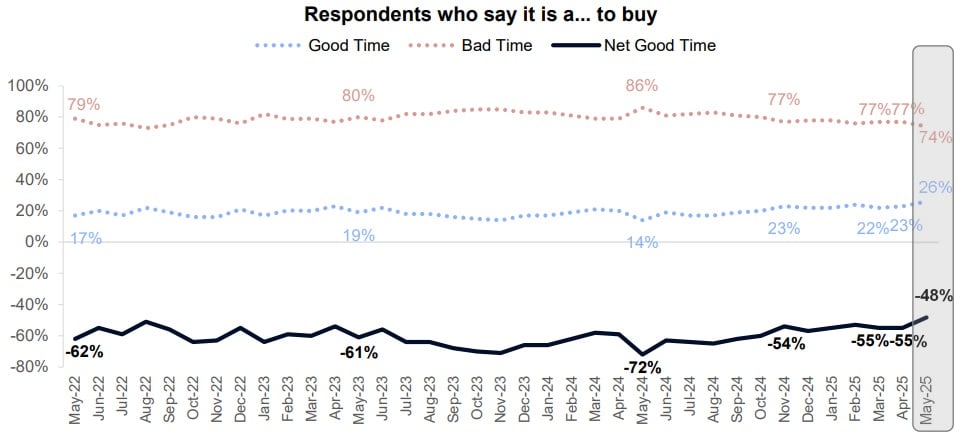
While just 26 percent of Americans said May was a good time to buy, that’s up from 23 percent in April and 14 percent a year ago, an all-time low in Fannie Mae survey.
Bigger. Better. Bolder. Inman Connect is heading to San Diego. Join thousands of real estate pros, connect with the Inman Community, and gain insights from hundreds of leading minds shaping the industry. If you’re ready to grow your business and invest in yourself, this is where you need to be. Go BIG in San Diego!
Consumer sentiment about the housing market improved in May to the highest level since November as Americans became more optimistic about buying and selling conditions and the prospects for mortgage rates to come down in the year ahead.
Fannie Mae’s latest National Housing Survey, released Monday, showed five of six components of the mortgage giant’s Home Purchase Sentiment Index (HPSI) improved in May.
Consumer sentiment has been trending down this year, in part due to fears about the impact of the Trump administration’s tariff policies, but the economy continues to do better than surveys suggest, economists say.
Fannie Mae Home Purchase Sentiment Index
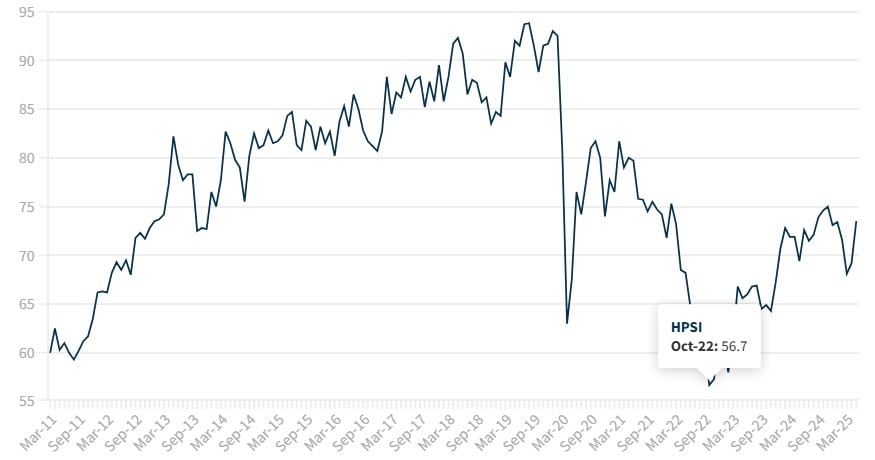
At 73.5, the HPSI was up 4.3 points from April to May, surpassing the previous 2025 high of 73.4 seen in January.
The HPSI — which hit an all-time low of 56.7 in October 2022 in records dating to 2011 — distills six questions from Fannie Mae’s monthly National Housing Survey into a number.
The latest survey, which was fielded from May 1 through May 20 to 1,345 household decision makers, found that while most Americans still think it’s not a good time to buy, sentiment is improving.
With Americans also less worried about losing their jobs in May, the only HPSI component that didn’t improve was household income.
While only 26 percent of household decision-makers said May was a good time to buy, that’s up from 23 percent in April and 14 percent a year ago — an all-time survey low.
With the share who said May was a bad time to buy falling from 77 percent in April to 74 percent in May, the net share of consumers who said it was a good time to buy increased by seven percentage points, to -48 percent.
More than two-thirds of consumers surveyed (68 percent) said they’d buy rather than rent if they were going to move, up from 65 percent in April.
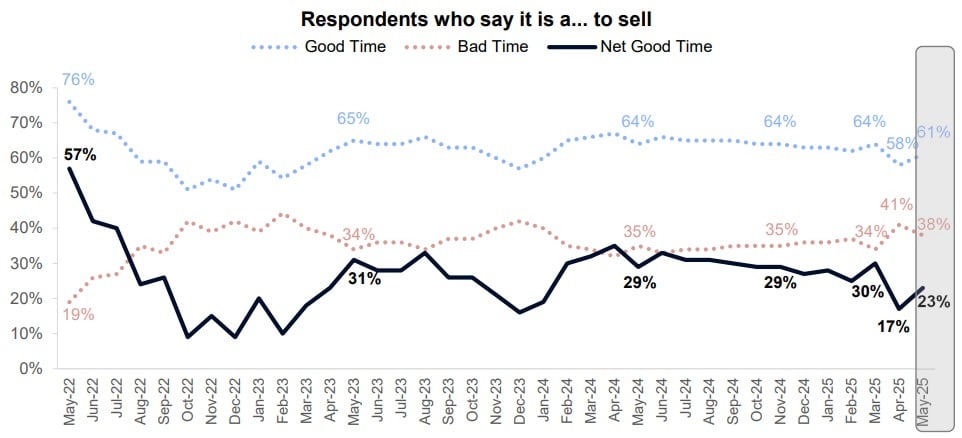
Most consumers (61 percent) said May was a good time to sell, up from 58 percent in April but down from 64 percent a year ago. With the share who said it was a bad time to sell falling from 41 percent in April to 38 percent in May, the net share of consumers who said May was a good time to sell increased by six percentage points, to 23 percent.
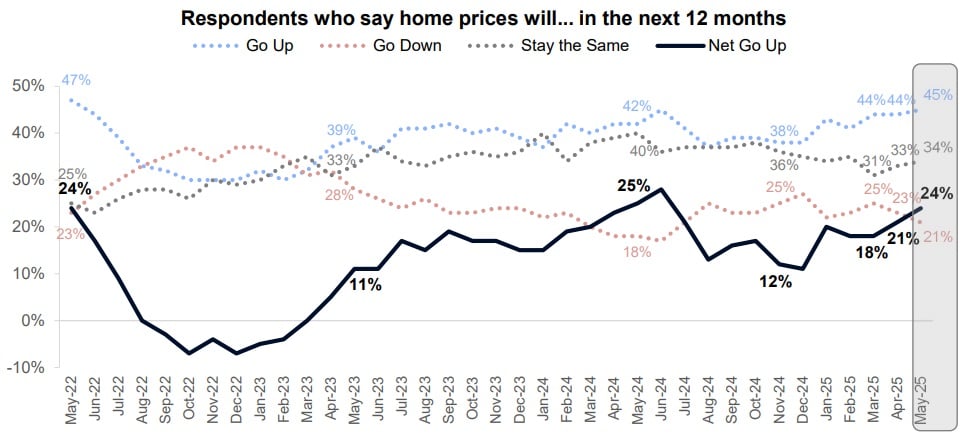
With more consumers convinced that prices are headed up in the next 12 months (45 percent) or that they’ll stay the same (34 percent), the net share of consumers who expect prices to go up rose three percentage points, to 24 percent.
While many would-be homebuyers are hoping prices come down, Fannie Mae’s HPSI treats expectations of price increases as a positive, since it shows consumers aren’t worried about prices crashing.
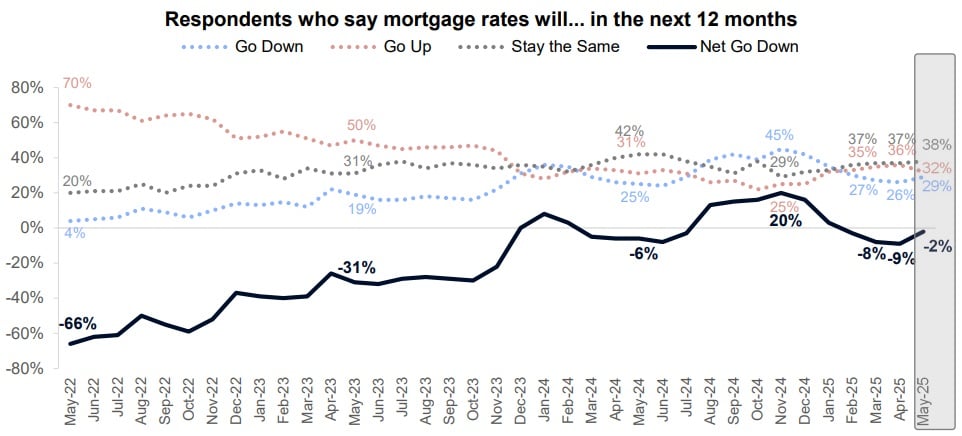
Most consumers surveyed in May said they expect mortgage rates to either stay the same over the next 12 months (38 percent) or go down (29 percent).
With the share who expect rates to go up falling from 36 percent in April to 32 percent in May, the net share expecting rates to go down improved by seven percentage points, to -2 percent.
Last month, Fannie Mae economists said they expect mortgage rates to come down by a full percentage point by the end of next year. Forecasters at the Mortgage Bankers Association have issued a more cautious take.
MBA forecasters predict mortgage rates will still be averaging 6.6 percent during Q4 2025 and 6.3 percent during Q4 2026.
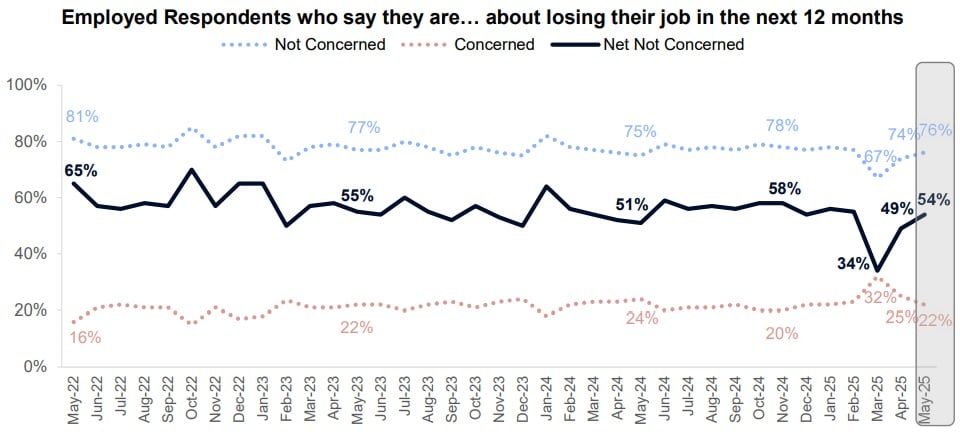
Only one in five employed respondents surveyed in May (22 percent) said they were worried about losing their job in the next 12 months, down from 25 percent in April and a 2025 high of 32 percent in March.
With 76 percent of employed consumers saying they weren’t concerned about losing their job, the net share who said they weren’t concerned about being unemployed increased by five percentage points, to 54 percent.
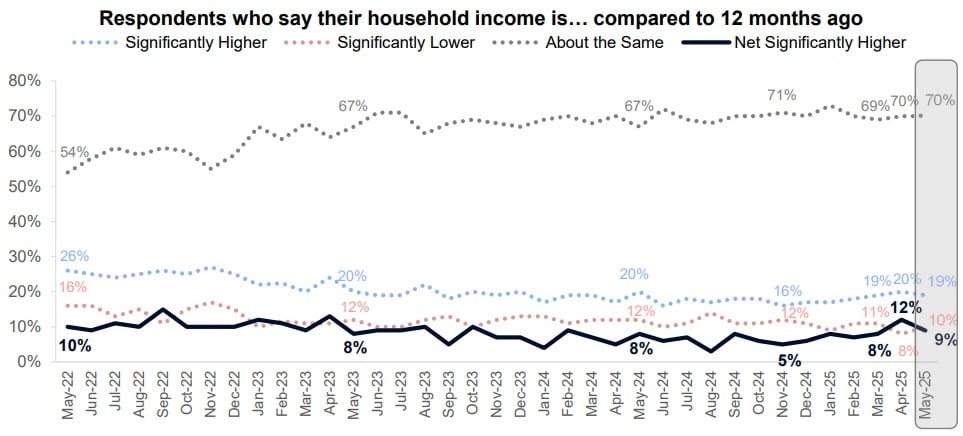
Most consumers surveyed in May (70 percent) said their household income is about the same as it was 12 months ago. But 10 percent said it was significantly lower, up from 8 percent in April, but down from 12 percent a year ago.
The net share of consumers who said their income was higher than 12 months ago fell three percentage points from April to May, to 9 percent.
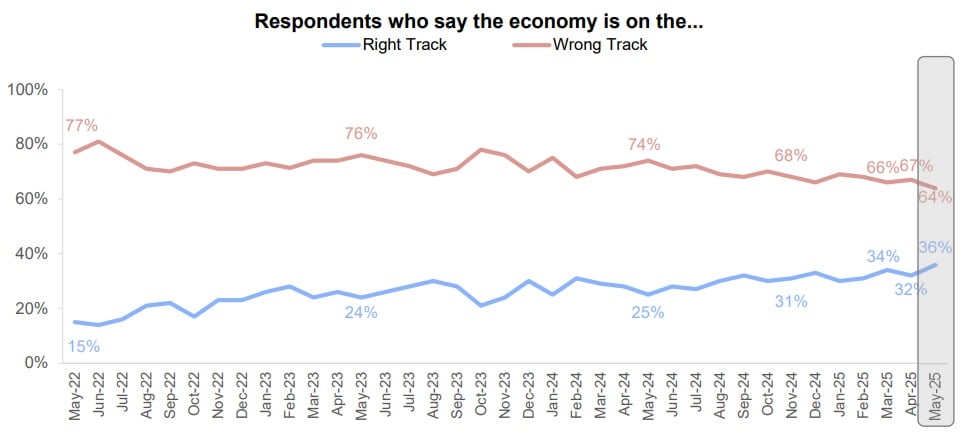
Although not factored into the HPSI, the National Housing Survey asks household decision-makers if they think the economy is on the right or the wrong track.
While most consumers thought the economy was on the wrong track in May (64 percent), that’s down from 67 percent in April and 74 percent a year ago.
Email Matt Carter
by Richelle Hammiel | Jun 9, 2025 | Industry, News Feed
A wave of “Altadena Not for Sale” signs dot the yards of fire-scarred properties as a plea to preserve the communities that have been lost in January’s Eaton fire. Behind the signs, a different reality is unfolding — Altadena is for sale, and developers are lining up to buy in, the “Los Angeles Times” reported Thursday.
Bigger. Better. Bolder. Inman Connect is heading to San Diego. Join thousands of real estate pros, connect with the Inman Community and gain insights from hundreds of leading minds shaping the industry. If you’re ready to grow your business and invest in yourself, this is where you need to be. Go BIG in San Diego!
A wave of “Altadena Not for Sale” signs dot the yards of fire-scarred properties as a plea to preserve the communities that have been lost in January’s Eaton fire. Behind the signs, a different reality is unfolding — Altadena is for sale, and developers are lining up to buy in, the Los Angeles Times reported Thursday.
So far, around 145 properties have been sold, 100 are currently listed and dozens are in escrow. By comparison, the Palisades, another fire-affected area, has seen fewer than 60 sales, with about 180 lots still lingering on the market.
Real estate records show that developers are behind many of the Altadena purchases, with firms Black Lion Properties, Iron Rings Altadena and Sheng Feng acquiring multiple lots. Roughly half of the lots have gone to individual buyers, while the other half were purchased in bulk by these development firms.
Six thousand homes were destroyed in the Eaton fire, leaving a long road to recovery, but sales activity has picked up each month. Homes are selling faster, too.
In the first four months of the year, the median Altadena lot spent just 19 days on the market, compared to 35 days during the same period last year, a report from Redfin shows. Prices range widely, from $330,000 to $1.86 million, with most selling between $500,000 and $700,000. Most buyers are now paying close to asking price.
For many longtime residents, the emotional toll is deep. “In a perfect world, my neighbors and I would all rebuild, and five years from now, Altadena would look the same as it did before the fire,” one resident, who asked to remain anonymous, told the LA Times. “But it’s just not realistic.”
Many families are still tangled in insurance claims or simply lack the time and resources to start over. However, help may soon be on the way.
On June 12, the state will launch the CalAssist Mortgage Fund, which will provide up to $20,000 in grants to homeowners whose homes were destroyed or left uninhabitable by recent disasters, including the wildfires, California Gov. Gavin Newsom announced on Thursday.
“We know that recovery takes time, and the state is here to support,” Newsom said. “California is extending this ongoing support to disaster victims in Los Angeles and beyond, by assisting with mortgage payments to relieve financial pressure and stress as families rebuild and recover.”
Some displaced residents aren’t waiting. According to real estate agent Chelby Crawford, 10 percent of buyers at her open houses are Eaton fire victims looking to relocate.
“Pasadena and La Cañada Flintridge are benefiting the most,” she said. “Fire victims are just excited to find their next home. It’s selling season.”
Still, some are fearful of the rapid pace of redevelopment. Altadena is known for its century-old Craftsmans, Colonial Revivals and English Tudors. Residents fear new builds and gentrification will erase the town’s charm.
Others argue that development may be the only way forward. Brock Harris, a real estate agent who sold several burned lots, said it’s mostly small developers scooping up properties. These developers typically handle five to 10 builds a year.
“If Altadena is going to come back, we need way more developers coming in to help out,” Harris told the LA Times. “Otherwise, a decade from now, it’ll look desolate and unwelcoming with one house for every five lots.”
Email Richelle Hammiel
by Darryl Davis | Jun 9, 2025 | Industry, News Feed
If your buyers seem to be getting cold feet, dig deeper and find their why so you can help them make the right decisions, coach Darryl Davis writes.
Since the NAR commission suit settlement, buyer agents have faced new rules, new documents and a new normal. This month, Inman drills down on Today’s Buyers Agent with the fresh marketing strategies, skills and tools buyer agents are using to prosper in changing times.
Let me ask you a question: Have you ever worked with a buyer who seemed all in — until it was actually time to move forward?
They toured homes, raved about floor plans, nodded along during conversations and maybe even started picking out paint colors in their head. But when it came time to sign? Radio silence. Cold feet. Crickets.
If that’s ever happened to you (and let’s be honest, it has), you’re not alone. One of the biggest frustrations agents share with me is wasting time with buyers who aren’t really ready — and who might not even know it themselves.
So, how do you tell the difference between a buyer who’s truly serious and one who’s just window shopping?
It comes down to this: It’s not about what they want. It’s about what they’re committed to.
Wanting vs. committing: There’s a big difference
Let me give you an example. I want a Rolls-Royce. Beautiful car. Smooth ride. I would love to be seen in one. But I don’t own a Rolls-Royce. Why? Because I’m not committed to the price tag, the maintenance or the reality of owning one. Wanting something and being willing to do what it takes to get it? Two very different things.
Your buyers might want a three-bedroom in a great school district with quartz countertops and a big backyard. Great. But unless they’re committed to navigating the process — financing, inspections, negotiations, paperwork — they’re going to stall.
If you want the truth, ask the right questions
To get past the surface and into their real motivations, don’t just ask, “What are you looking for?”
Instead, go deeper:
- “Why are you buying a home now?”
- “What happens if you don’t move?”
- “How would this new home impact your life in the next five years?”
- “What are you hoping this move will do for you or your family?”
You’re not just collecting data — you’re helping them connect to their why. Because people don’t buy homes based on square footage alone. They buy because of what that square footage represents.
For investors, dig deeper too:
- “What’s your long-term financial plan?”
- “How does this property fit into your portfolio?”
- “If you don’t move forward, what opportunity are you leaving on the table?”
You’re not selling them on the deal — you’re helping them remember their destination.
Buying a home isn’t just a transaction — it’s a vision
Here’s the truth: A house isn’t just a structure. It’s the setting for someone’s next chapter.
That kitchen? It’s where Sunday pancakes and Thanksgiving dinners happen. That backyard? It’s where the dog plays and the kids grow up. That quiet cul-de-sac? It’s peace of mind after a long day.
People don’t buy properties. They buy possibilities.
When a buyer hesitates, help them zoom out. Remind them of the bigger picture. One of the things I coach agents to say when someone’s stuck is:
“I know this decision feels big — and it is. But you’re not just buying walls and windows. You’re buying future memories, future milestones and the life you’ve been dreaming about.”
That shift — from fear to future — can break through paralysis.
Commitment calms fear
When buyers are anchored in their purpose, the fear has less room to grow.
Let’s say an investor is hesitating on a purchase. The numbers work, the property fits their strategy — but they’re stalling.
Ask:
“If this property appreciates 10 percent over the next decade, how much potential equity are you walking away from? Are you OK with that?”
Because at the end of the day, most hesitation isn’t about the home — it’s about uncertainty. When you bring them back to what they’re committed to, you help them replace uncertainty with clarity.
Your role: Less tour guide, more coach
You’re not just showing homes. You’re helping people make one of the biggest decisions of their lives. So don’t be afraid to ask bold questions. To challenge them when they’re stuck. To gently steer them back when fear or doubt creeps in.
Buyers don’t need someone to unlock doors. They need someone who can unlock their commitment to the life they’re trying to build.
The next time a buyer starts hesitating, don’t just tell them how great the property is. Dig deeper. Find their why. Speak to the vision that brought them to you in the first place. Remind them: They’re not just buying a home — they’re stepping into the next level of their life.
And if you’re feeling stuck working with buyers who can’t commit, don’t take it personally. Don’t lose heart. The most powerful agents are the ones who learn to lead with questions, coach with clarity and serve with strength.
You’ve got the tools. You’ve got the heart. You’re in the right profession — and if you’re reading this here on Inman, you’re in the right place.
Keep going. Keep serving. And remember: your job isn’t just to help buyers find a house. It’s to help them find the courage to move forward.

by Bess Freedman | Jun 9, 2025 | Industry, News Feed
As Hall Willkie steps into a consultant role at Brown Harris Stevens, CEO Bess Freedman reflects on the impact of her mentor.
Bigger. Better. Bolder. Inman Connect is heading to San Diego. Join thousands of real estate pros, connect with the Inman Community and gain insights from hundreds of leading minds shaping the industry. If you’re ready to grow your business and invest in yourself, this is where you need to be. Go BIG in San Diego!
When the Michael Jordan of real estate asks you to come and work with him, you can’t say no. That’s why I came to Brown Harris Stevens some 13 years ago.
The opportunity to work with and learn from Hall Willkie was once in a lifetime. And while he is stepping into a new full-time consultancy role at BHS, he is still going to be part of the fabric of this company, working with and mentoring our agents as he has done so successfully for the past 37 years.
Forget the fact that his uncle, Wendell Willkie, ran for President back in 1940, and that Hall lived all over the world. In truth, Hall is a simple guy, a farmer, a perfectionist, a neat freak, an elegant, blue-eyed charmer who loves real estate and putting deals together.
When I first joined BHS, Hall took me on a tour of all the offices in NYC and he would straighten the magazines, window displays, even dust off counters and hide ugly wires from view.
I thought, “How is this the president of the company?!” He really rolls up his sleeves and cares about the details. I never saw this type of focused dedication at my prior company. I was used to corporate ladders with many layers between the executives and the agents. Hall was never like that — he was an open door, full access type of leader.
Back when I first came to BHS, Hall was in remission from cancer, and he shared with me that he had met this young man, aged 13, Eric Martinez, and his family while he was going through chemo treatments. Eric had brain cancer.
Hall knew I spoke Spanish and asked me to accompany him to visit the family in Brooklyn. We were soon making regular trips there to visit Erik, who was sadly deteriorating. Hall felt a true desire to send and spread some love into their family, which we did until Erik died some five months later.
This is the Hall Willkie that no one knows, except for me and a few of his very close friends. He walks into the room with an open heart, a big smile, and a willingness to do anything and everything to make the world a little bit better.
To this day, he still walks into an open house and will look at things and say, “This should be moved; that could be changed.” He always figures out a way to make the room look better. Hall started BHS with just 34 agents in NYC, and the company has now grown to over 2,300 agents across four states. His sterling reputation made this all possible.
He is a giant in the real estate world. Iconic. A generous soul who helps everyone. He understands the value of relationships more than anyone else I know. I have learned so much about selling, working with people, the super high end of the market and discretion. About taking care of people, putting the clients’ needs first, quality over quantity and doing the right thing.
Hall is the G.O.A.T — the true MVP. He’s successful in real estate because he puts people first. He never leads with transactions or business in mind. He goes above and beyond that, and today’s real estate leaders could really take a page or two from his playbook.
No matter how much tech and AI and algorithms may infiltrate this business, at its core is the ability to connect. No one is better at this than Hall Willkie. At BHS, we are fortunate to be able to lean on his values and teachings for many years to come.

by Daniel Houston | Jun 9, 2025 | Industry, News Feed
This report is available exclusively to subscribers of Inman Intel, the data and research arm of Inman offering deep insights and market intelligence on the business of residential real estate and proptech. Subscribe today.
An immigrant tech worker uncertain about the state of the economy — and their family’s future. A retiree with a suddenly shaky investment portfolio. A homebuyer hit with a shockingly high price tag for needed repairs.
These three stories of real estate transactions gone awry are just a taste of how the tariff fallout is seeping into client decisions and beginning to eat away at the margins of the brokerage industry, agents across the country told the Intel Index survey in May.
As part of its flagship monthly survey of real estate professionals, Intel found that a small but significant share of agents and brokers had already seen a deal blow up because of tariffs.
- 12 percent of agent respondents and 16 percent of brokerage leaders told Intel that they had already witnessed at least one sale fall apart as a result of the tariffs.
- Another 9 percent of agents and 4 percent of brokerage leaders in the survey said that it had not happened to one of their clients, but they had seen it happen to a client of another agent or brokerage in their market.
At this time, most agents surveyed have not yet seen an actual deal fall through for this specific reason alone.
Still, Intel sought these stories to better understand where things might be headed if current tariff levels remain in place — and especially if the temporary reprieves on even higher “reciprocal” tariffs are allowed to expire.
Agents and brokerage leaders said that the primary effect so far has been psychological — but a number of clients have been materially affected by tariffs as well.
“The tariff noises are unpredictable and chaos is reigning, which is creating an environment of instability and uncertainty in my buyers,” wrote one decision-maker at a brokerage on New York’s Long Island.
In this week’s report, Intel breaks down the most frequently cited tariff-related obstacles that real estate professionals are running across.
Wide-ranging experiences
Real estate agents whose business has been affected by tariffs reported numerous reasons given by clients.
- Roughly half of the agents who told Intel that tariffs had tanked a deal in their market said that they had seen at least one instance where the client had not yet been directly impacted by tariffs, but worried they would be in the weeks to come.
This type of general fear and uncertainty, even before any direct impact was felt, was the most common scenario that these agents witnessed killing a sale.
One agent in Charlottesville, Virginia, reported to Intel that they had seen multiple deals fall apart in March and April.
At least one of this agent’s clients used HOA documents as an excuse to back out, but “later admitted the entire reason was economic uncertainty,” the agent wrote.
In Austin, an agent told Intel they were aware of another agent’s client who backed out because he or she was increasingly fearful of both tariffs and deportation when they backed out of a home search.
The client, who worked in tech, had lived in the U.S. for more than three decades, raised children that were born here and had proper documentation, the agent said.
But it’s not just fear of a hypothetical outcome that’s giving some buyers cold feet.
The government’s ever-changing tariff policy hit financial markets particularly hard in April, with the S&P 500 falling 12 percent in value in the days after the Trump administration’s April 2 announcement of so-called “reciprocal” tariffs.
Since then, markets have recouped most of their losses from that early period as the Trump administration paused a number of the highest tariff rates and signaled a willingness to strike deals with trading partners.
But for a number of agents who had a deal on the line in April, the damage was done.
- More than 4 in 10 agent respondents who had seen tariffs tank a deal told Intel that a client had lost income from, or value within, their stock investment portfolio before backing out of a deal.
Actual job loss due to tariffs was rarely cited as a reason for a deal falling through in the earliest weeks of tariff implementation.
But loss of income or business revenue in a trade-dependent field was a relatively frequent issue for the clients who did back out, agents said. And some clients even told their agents that tariffs had already begun to push up their cost-of-living.
Another agent from New York City said one of their clients backed out of a deal after learning how high tariffs had pushed the cost of renovating the property.
This general experience was shared by 1 in 5 of the affected agents, who said they had seen tariffs raise the cost of a newly built home outside a client’s price range.
Here’s the full text and responses to Intel’s question from agents who said they’ve seen a sale fall apart due to tariffs.
Intel: You mentioned you’ve seen the tariffs contribute to at least one lost sale in your market. Which of the following scenarios have come up? Select all that apply.
- 49 percent — Client was not directly impacted by new tariffs, but expressed concern that they might be in the months to come
- 42 percent — Client lost income from, or value within, a stock investment portfolio
- 30 percent — Client did not lose a job, but lost income or business revenue in an industry reliant on international trade
- 26 percent — Client cited rising household expenses from new tariffs
- 21 percent — Client backed out of a search for new construction listings because of increased costs of material goods due to tariffs
- 18 percent — Client lost a job in an industry reliant on international trade
For now, new tariffs in imports remain a relatively rare cause of a busted purchase or sale. And based on financial market movement in recent weeks, investors appear to be increasingly convinced that the new levies will not remain in place long-term, or will not be pushed as high as once feared.
But the longer that they remain in place, and the likelier it becomes that the pauses on higher rates are allowed to expire, the more that cases like these may creep further into the mainstream.
For some brokerage decision-makers, that’s already the reality.
“The propensity for a negative business environment outweighs the indicators of positive views looking forward,” the Long Island brokerage leader wrote, “and this is directly related to tariffs, and mayhem around them.”
Methodology notes: This month’s Inman Intel Index survey was conducted May 20-June 3, 2025, and received 529 responses. The entire Inman reader community was invited to participate, and a rotating, randomized selection of community members was prompted to participate by email. Users responded to a series of questions related to their self-identified corner of the real estate industry — including real estate agents, brokerage leaders, lenders and proptech entrepreneurs. Results reflect the opinions of the engaged Inman community, which may not always match those of the broader real estate industry. This survey is conducted monthly.
Email Daniel Houston