
by Verl Workman | Jun 12, 2025 | Industry, News Feed
Bigger. Better. Bolder. Inman Connect is heading to San Diego. Join thousands of real estate pros, connect with the Inman Community, and gain insights from hundreds of leading minds shaping the industry. If you’re ready to grow your business and invest in yourself, this is where you need to be. Go BIG in San Diego!
Building a real estate team can be a game-changer for your business, but choosing the right size is just as important as having one in the first place. Too big, and you may struggle with inefficiencies and unnecessary overhead. Too small, and you may find yourself overwhelmed, unable to scale or leaving money on the table. It should all start by matching the size of your team with your work style, business goals and the lifestyle you want to create.
Most team leaders don’t start off wanting to grow a specific size or type of team. They feel overwhelmed and stressed with more opportunities than they can handle or the pressure of not being present when they’re with family or friends because they’re focused on work all of the time, which causes them stress or anxiety.
Believe it or not, there is a mathematical process to determine when and who to hire. Let’s lay it out. For every listing you have active, it should generate 1.5 buy-side closings.
Each listing, when marketed correctly, should generate six to eight leads per month. Every 25 leads generated in a 30-day period from all lead sources requires you to hire one additional buyer’s agent. So if you have 10 active listings, you should have three buyer’s agents on the team to hold them open, follow up with buyer leads and convert the opportunities into deals.
If you look at your numbers and see that you are not getting 1.5 buyer sides to each listing, then chances are you don’t have the time or energy to follow up with the B and C leads, so you put them on drip campaigns or auto hot sheets and hope they call and turn themselves in. Hoping is not a strategy.
Understanding the different types of team structures
There is no right or wrong in creating a real estate team. Some are good as lone entrepreneurs, whereas others thrive well with an organizational structure and specific roles with different levels of leadership.
At the most basic level, there are small teams, where the team leader still acts as an active participant with clients. These teams are mostly composed of a team leader, a buyer’s agent and an administrative assistant or transaction coordinator. This arrangement works best for agents who enjoy interacting directly with clients but require support for efficiency.
Mid-sized teams will take delegation further by including listing partners, inside sales agents and dedicated marketing staff. More volume can then be accommodated while maintaining healthy client relationships.
Larger and mega teams operate more like corporations, with a CEO or team leader overseeing multiple departments. A VP of sales might manage a group of buyer’s agents, while a chief operations officer ensures transactions and marketing efforts run smoothly. This structure is ideal for those who prefer leading rather than working directly with clients.
Matching your work style to your team size
Your work approach is the greatest determining factor for the size of your team. If you enjoy immediate client contact and the high-speed environment of closing deals, having a small team may be your best option. But if you are more concerned with leadership, business development and creating a long-term brand, you need a large team with distinct roles and delegation.
One of the key considerations is control. Solo agents and small team leaders maintain full control over every aspect of the business. They decide marketing strategies, client interactions and how deals are handled.
With a larger team, control shifts into leadership and management. The team leader is no longer the primary point of contact for every client, but instead, they are responsible for mentoring agents, tracking performance and ensuring systems are in place.
Lifestyle is another reason. Some agents want to expand their business to the maximum level, while others prefer a well-balanced workload that allows time for personal issues. A lean, high-efficiency team will give you very strong earnings without the need to oversee a huge team. But if you want to step away from production and focus on long-term growth, then a structured team with clear leadership roles will be the perfect fit.
Key considerations when choosing your team size
Regardless of the size of your team, certain elements need to be in place to ensure profitability and smooth operations.
Clearly defined roles are important. Whether you have two people or 20, everyone needs to know what they are responsible for. The job of the team leader, especially in larger teams, is to replace themselves in day-to-day operations by hiring the right people for each position. This means gradually shifting tasks like buyer consultations, listing presentations and lead generation to specialists as the team grows.
Compensation design is essential to profitability and drive. Small teams often have simple commission splits, whereas larger teams need a well-designed pay system that includes salaries, bonuses and production incentives. It’s an art to keep agents and staff motivated without compromising profitability, but a carefully designed commission program will have every team member impacting the bottom line.
In addition, lead generation and conversion efficiency must also be considered. Most agents believe they require more leads, when, in actuality, they require better conversions. A small team can be highly effective with a strong follow-up system, but bigger teams require a dynamic lead distribution strategy so they do not get left out of opportunities.
Technology and systems help streamline operations at any size. A solo agent may only need a CRM and a transaction coordinator, while a large team benefits from automation tools, AI-driven lead scoring and data tracking to maximize performance. The right tools keep your team focused on income-producing activities rather than administrative tasks.
Planning for growth — or staying lean
One of the mistakes that most real estate agents make is growing too fast without thinking whether they actually need a bigger team. Just because you can hire more agents does not mean you should. A well-organized small team can be as profitable, if not more so, than a large team weighed down by inefficiencies.
Conversely, if your intention is to step back from production and create a business that operates independently, you must prepare for leadership succession. Succession planning will keep your team strong even when you step back, and it also provides room for agents in your team to develop into leadership positions.
Whether you want a small, agile team or a full-scale operation, your business should support your lifestyle, not the other way around. Choosing the right-sized team for your work style is about more than just numbers — it’s about creating a business that works for you.
Verl Workman is founder and CEO of Workman Success Systems. Connect with him on LinkedIn or Instagram.

by Debra Trappen | Jun 12, 2025 | Industry, News Feed
Showing up with integrity, clarity and authenticity allows you to build a brand that’s in alignment with your own experience, Debra Trappen writes.
Bigger. Better. Bolder. Inman Connect is heading to San Diego. Join thousands of real estate pros, connect with the Inman Community, and gain insights from hundreds of leading minds shaping the industry. If you’re ready to grow your business and invest in yourself, this is where you need to be. Go BIG in San Diego!
Welcome to Lead with Fire, A Soulful Series for Real Estate Game-Changers. This is more than business advice — “Lead with Fire” is a transformative series created for the soulful, visionary humans in the real estate industry who are done with the old playbook and ready to redefine success on their own terms.
You don’t have to be everywhere. You just have to be seen as you.
There’s a moment in every purpose-led journey when you realize:
It’s not about being visible everywhere.
It’s about being visible in the right way.
To the right people.
For the right reasons.
Recently, a member of the Red Threads Collective contacted me. She’d been working in real estate for over a decade and loved serving her clients. But something was stirring.
“I’m craving more meaning,” she said.
She had walked through several personal transitions — divorces, buying her own home, the early waves of perimenopause — and she’d noticed a pattern: She was meeting more women navigating the same terrain.
They weren’t just looking for a house. They were searching for a home, a new beginning, a space to rewrite their story.
She wanted to speak to them. To hold space for that.
But, of course, fear crept in.
- What if she lost clients who didn’t resonate with this new focus?
- What if her peers didn’t understand the shift?
- What if she was seen as “too much” or “too personal”?
We worked through it. The fears. The old stories. The pull toward external validation.
And then we vision cast a new path. One rooted in purpose. One where her brand, her message and her visibility became an invitation, not a performance.
Since that first call, she has launched and led her first workshop, serving her new niche. Real estate remains a significant part of her world, and now, she’s creating space for deeper connections, aligned storytelling and heart-led visibility.
Because when you and your work evolve, your voice has permission to evolve, too.
Reflective journal prompts
- Where am I showing up out of obligation instead of alignment? What would shift if I gave myself permission to follow the energy instead of the expectations?
- What part of my message, mission, or brand is whispering to be reborn? Is there a truth I’m ready to express even if it scares me?
- Who am I truly here to serve — and am I being radically honest about that? It’s OK to evolve. In fact, it’s sacred.
- What would it look like to lead with my truth, not the industry’s trends? What story would I tell if I weren’t trying to fit in?
Visibility isn’t about the algorithm. It’s about alignment
You don’t need a million followers. You don’t need a perfect grid. You don’t need to show up in ways that don’t feel right.
You need congruence. Clarity. A message that reflects who you truly are.
And when that’s in place, the resonance is magnetic.
Mantra to Lead With Fire:
“I show up in truth, not performance. My presence is powerful — just as I am.”
Next up in the Lead with Fire Series — Own your worth: Say no with confidence and stop undervaluing your work
In our next post, we’ll explore one of the most magnetic qualities of any leader or brand. You’ll learn how to say no with clarity, set prices and boundaries without apology, and rewrite the money stories that no longer serve you. Because when you know your value, the world reflects it back to you.

by Melanie Klein | Jun 12, 2025 | Industry, News Feed
Bigger. Better. Bolder. Inman Connect is heading to San Diego. Join thousands of real estate pros, connect with the Inman Community, and gain insights from hundreds of leading minds shaping the industry. If you’re ready to grow your business and invest in yourself, this is where you need to be. Go BIG in San Diego!
This series highlights inspiring stories of women who have created successful and sustainable careers in real estate and/or invested in real estate to achieve financial independence, gain lifestyle flexibility, and create lives built on their own terms.
Historically, women have faced numerous barriers when it comes to property ownership and wealth accumulation. For much of history, laws in many countries, including the United States, did not allow women to own property in their own right.
Women’s financial autonomy was limited by their legal status as dependents of their fathers or husbands. In the U.S., it wasn’t until the 19th and early 20th centuries that married women were allowed to own property under the law. Even after property ownership became legally accessible, women still faced significant social and financial hurdles.
However, as societal norms evolved and women gained legal rights to property ownership, their role in shaping the real estate landscape grew. Today, women are making tremendous strides in real estate, both as homeowners and investors. According to the National Association of Realtors, women make up 65 percent of the homebuying market and female homeowners are projected to continue outpacing their male counterparts in the coming years. This shift marks an empowering change, as real estate continues to provide women with valuable opportunities to achieve financial independence, wealth and freedom.
Courtney Smith combined her penchant for operations and love for strategy, finance and design and turned it into a successful business. She built a real estate team which sold over 1,500 homes during her tenure before selling the team in 2019. After a year coaching female entrepreneurs across industries she joined Compass, the largest residential real estate brokerage in the U.S. by sales volume, where she serves as a real estate coach and strategic adviser.
Her story illustrates how both investments and careers in real estate can offer women greater opportunities and choices in life — helping them unlock doors to possibilities once considered out of reach.
Smith’s path to real estate was not one she initially set out to pursue. Growing up in a working-class family, she was encouraged to be prudent with money and career choices, but her entrepreneurial spirit emerged early. From babysitting and piano teaching gigs to retail and service jobs, Smith learned the value of hard work, value articulation and negotiation.
Her college years at the University of Southern California were marked by a dual-major workload, multiple jobs and a relentless side hustle mentality. She cultivated a deep interest in learning from each person she encountered and growing her skills with each opportunity that came her way.
Her first career was in the film industry, where she worked her way up from intern to executive roles in development and production. Yet it was the world of real estate that truly captivated her. Smith’s initial entry into real estate came through homeownership. She purchased a small one-bedroom condo in Los Angeles in her early 20s, guided by the timeless adage “location, location, location.”
It was there that she first realized the potential of real estate as a wealth-building tool—her capital gains from the sale of the condo allowed her to reinvest in a more substantial property. Smith’s fascination with real estate deepened during the process of buying and selling properties. What she discovered was that with real estate, she could make more money fixing up a property than she had earned in a year of employment. This revelation set the stage for her eventual transition into full-time real estate.
Building wealth through strategic investment
One of the most powerful takeaways from Smith’s journey is her focus on investing in real estate as a means of achieving wealth and freedom. After her initial renovation successes, she began to shift her mindset. She understood that owning multi-family properties could help cover expenses by renting out units, creating passive income and giving her the ability to reinvest that revenue into additional properties. Smith’s savvy approach to real estate investment led her to acquire residential rentals, commercial buildings and mixed-use properties across five states.
Leverage, she explains, is another critical aspect of building wealth. By using other people’s money — through mortgages and other financing options — she was able to grow her wealth exponentially without risking her own hard-earned savings.
She notes that leverage also requires discipline and patience. The journey to wealth is not instantaneous. It involves delaying gratification and making strategic decisions in the earlier stages of wealth accumulation to ensure long-term rewards.
Advisory plays an essential role in this process, as well. Smith credits much of her success to the coaches, advisors and mentors who have helped her navigate her career and investments. She encourages women to surround oneself with a strong network of experts. This guidance is key to sustaining growth and achieving long-term goals.
Empowering women in real estate
Smith’s success is not just a testament to her strategic mind; it’s also a reflection of her unwavering belief in the power of women supporting women. She shares invaluable advice for women looking to grow their wealth and invest in real estate:
- Stop saying you’re not good at math: Smith emphasizes how often women underestimate their ability to manage money. The truth is, men rarely say this about themselves, so why should women? Financial literacy and confidence are essential for success in real estate.
- Increase your social capital: Building strong relationships is key in any career, and real estate is no different. Networking and getting into the right rooms can help women elevate their careers and investments.
- Celebrate other women’s success: The world needs fewer jealous competitors and more women lifting each other up. When you celebrate the success of others, you pave the way for your own achievements.
- Minimize the gender divide by talking about money: Women often shy away from discussing financial matters, but Smith encourages open conversations about wealth and investment strategies. The more we talk about money, the more we can empower ourselves to take control of our financial futures.
Smith also points to the critical need for companies of all sizes to reduce bias in evaluation and hiring practices, as well as for venture capitalists and funding sources to invest in women entrepreneurs at the same level as their male counterparts. She believes the next generation of women will be the ones to break through these barriers, ushering in a more inclusive and equitable future for all.
Looking to the future
Smith’s vision for the future of women in real estate is bright. She sees the growing number of women homeowners and female leaders in the industry as positive signs of progress. As women continue to break into leadership roles and build wealth through real estate, the industry will become more inclusive, offering financial opportunities to women of all backgrounds.
By embracing real estate as a means of building wealth, women can secure their financial futures, make their own choices and open doors to a world of opportunity. As more women like Smith continue to rise and pave the way, the landscape of real estate — and of wealth itself — will be forever transformed.
In Smith’s own words, “The shift is happening. It’s going to be magic.”
Melanie C. Klein, M.A., is an empowerment and mindset coach.
by Taylor Anderson | Jun 11, 2025 | Industry, News Feed
Bigger. Better. Bolder. Inman Connect is heading to San Diego. Join thousands of real estate pros, connect with the Inman Community and gain insights from hundreds of leading minds shaping the industry. If you’re ready to grow your business and invest in yourself, this is where you need to be. Go BIG in San Diego!
WeWork is finally WeProfitable again.
One year after restructuring its debt after declaring bankruptcy in November 2023, WeWork has regained profitability and is debt-free, the coworking company told Bisnow Tuesday.
The company became notorious for its shared working office spaces across the globe, ballooning to over 800 locations and reaching a market cap of nearly $10 billion in 2022 and a peak valuation of $47 billion.
The company renegotiated with creditors as a way to shed expensive and unprofitable leases and clear up its $4 billion in debt.
In April 2024, real estate tech company Yardi Systems announced that it had become the majority owner of WeWork and said it would guide it through its bankruptcy and into the future.
“We were burdened for many years with our portfolio that everybody knew about and saw,” WeWork Regional President for North America Luke Robinson told Bisnow.
Robinson told the news outlet that the company has now posted six-consecutive months of positive revenue before accounting for interest, taxes, depreciation and amortization, or EBITDA, a figure that indicates strong revenue but which doesn’t mean WeWork is turning a net profit.
It also confirmed to Inman that it now has 170 locations, which puts it among the largest coworking companies in the U.S. despite being far smaller than its 2019 peak.
In its previous heyday, the company gained fame both for its size, flashy office spaces and eccentric CEO Adam Neumann, who was behind the company’s rapid rise and its failure to successfully go public.
Under its new leadership, WeWork has also tweaked its approach at some locations, working directly with landlords to act as a property manager that leases space in buildings and shares revenues with the owners.
That’s alongside its more traditional approach of leasing space and then renting that space to people who need office space.
Several investors and landlords told Bisnow that WeWork’s leadership had shifted and regained trust in the industry, leaving the company an open pathway to rebuild and continue growing.
“When you have a firm where the pendulum has swung back and forth many times, when someone can provide trust and stability, that is a very precious commodity,” Cushman & Wakefield Chairman of Global Brokerage Bruce Mosler told Bisnow.
Email Taylor Anderson
by Matt Carter | Jun 11, 2025 | Industry, News Feed
Purchase loan applications soared 10 percent last week to the highest level since April, even though rates have been stuck in the high sixes, the Mortgage Bankers Association reported Wednesday.
Bigger. Better. Bolder. Inman Connect is heading to San Diego. Join thousands of real estate pros, connect with the Inman Community, and gain insights from hundreds of leading minds shaping the industry. If you’re ready to grow your business and invest in yourself, this is where you need to be. Go BIG in San Diego!
Mortgage rates aren’t coming down, but improving inventory in many markets helped drive up homebuyer demand for purchase loans to the second highest level of the year last week, the Mortgage Bankers Association reported Wednesday.
Demand for purchase mortgages was up by a seasonally adjusted 10 percent last week when compared to the week before, and 20 percent from a year ago. Requests to refinance were also up 16 percent week over week and 28 percent from a year ago, the MBA’s latest Weekly Mortgage Applications Survey found.
“Coming out of the Memorial Day holiday, mortgage applications increased to the highest level in over a month, driven by growth in both purchase and refinance applications,” MBA Deputy Chief Economist Joel Kan said in a statement.

Joel Kan
“Despite ongoing uncertainty surrounding the economy, homebuyers seem to be taking advantage of loosening housing inventory in certain markets,” Kan said.
Consumer sentiment about the housing market improved in May to the highest level since November, according to Fannie Mae’s monthly National Housing Survey.
While just 26 percent of Americans said May was a good time to buy, that’s up from 23 percent in April and 14 percent from a year ago, a survey low.
Mortgage rates stabilize
Rates for 30-year fixed-rate mortgages hit a 2025 low of 6.48 percent on April 4, according to lender data tracked by Optimal Blue.
Since climbing in early April over fears about the potential for tariffs to reignite inflation, rates for 30-year fixed-rate loans have been rangebound in the high sixes for the last 2 months.
Although inflation is nearing the Fed’s 2 percent goal, Fed policymakers are in a wait-and-see mode, while they assess the impacts of the Trump administration’s policies on tariffs, immigration, taxes and regulation. The job market is cooling off, but not quickly enough to alarm Fed policymakers.
The CME FedWatch tool, which tracks futures markets to predict the probability of future Fed moves, shows investors see no chance that the U.S. central bank will cut rates when policymakers meet next week.
But after an encouraging inflation report from the Bureau of Labor Statistics on Wednesday, futures markets tracked by the CME FedWatch tool priced in a 70 percent chance of a Sept. 17 rate cut, up from 62 percent on Tuesday.
Inflation moving in the right direction
The Consumer Price Index (CPI) showed the price of goods and services rose 2.35 percent from a year ago in May. While that’s up slightly from 2.31 percent in April, forecasters were expecting a bigger jump.
So far, tariffs are only having a “microscopic” impact on consumer prices, Pantheon Macroeconomics Chief U.S. Economist Samuel Tombs said in a note to clients. But he noted that it usually takes at least 3 months for retailers to pass cost increases on to consumers.
“Looking ahead, we continue to expect increases in prices for CPI core goods to gather momentum in June, then peak in July and remain above-trend for the rest of the year, assuming the current set of tariffs remain in place,” Tombs said.
The Federal Reserve’s preferred gauge of inflation, the personal consumption expenditures (PCE) index, showed the price of goods and services rose 2.1 percent in April from a year ago, the Bureau of Economic Analysis reported May 30.
The PCE index for May will be released on June 27.
Tombs said Pantheon Macroeconomics forecasters expect core PCE inflation, which excludes volatile food and energy prices, will climb to a peak of 3.25 percent around the end of the year.
Purchase loan demand rebounds
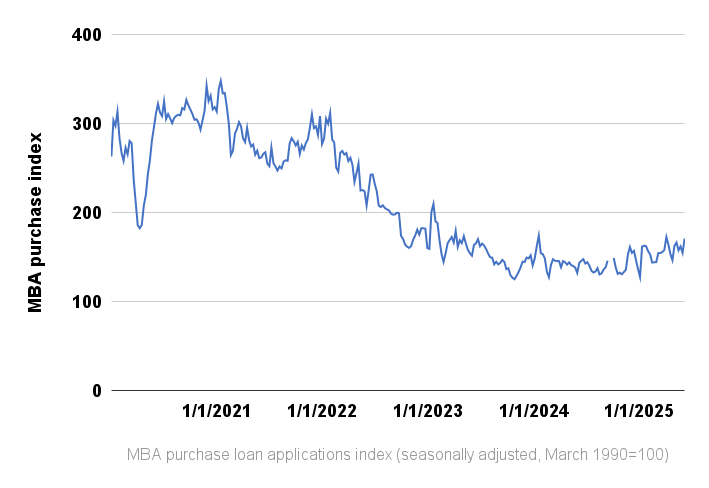
The MBA’s seasonally adjusted purchase loan index, which is benchmarked to March 1990, soared above 300 when mortgage rates plummeted to historic lows during the pandemic. But as inflation and mortgage rates surged in 2022, the index dropped below 200.
At 170.9 during the week ending June 6, the index is up 34 percent this year and approaching a 2025 high of 172.7 registered during the week ending April 4.
In addition to adjusting for seasonal factors — demand for homes usually peaks in the spring — last week’s index results included an adjustment for the Memorial Day holiday.
Get Inman’s Mortgage Brief Newsletter delivered right to your inbox. A weekly roundup of all the biggest news in the world of mortgages and closings delivered every Wednesday. Click here to subscribe.
Email Matt Carter

by Marian McPherson | Jun 11, 2025 | Industry, News Feed
New York City’s broker fee bill went into effect on Wednesday, prohibiting property owners from passing broker fees onto renters. REBNY attempted to block the bill’s enforcement but failed.
Bigger. Better. Bolder. Inman Connect is heading to San Diego. Join thousands of real estate pros, connect with the Inman Community, and gain insights from hundreds of leading minds shaping the industry. If you’re ready to grow your business and invest in yourself, this is where you need to be. Go BIG in San Diego!
New York City’s controversial broker fee bill has gone into effect. This means rental property owners — not renters — must pay broker fees when they enlist a broker to help them lease a unit.
The New York City Council passed the bill, formally known as the Fairness in Apartment Rental Expenses (FARE) Act, in November with a vote of 42 to 8. The Real Estate Board of New York (REBNY) sued the City in December to stop FARE’s enforcement and filed an injunction on Tuesday, saying the bill shouldn’t be enforced until the lawsuit ends. However, Southern District of New York judge Ronnie Abrams denied REBNY’s request.
James Whelan | Credit: REBNY
“New Yorkers will soon realize the negative impacts of the FARE Act when listings become scarce, and rents rise,” REBNY President Jim Whelan told The Real Deal.
NYC Councilmember Chi A. Ossé pitched the FARE Act for two years and finally got traction in 2024 amid record rental growth. Ossé and his 33 co-sponsors said broker fees exacerbate high rental costs, with New Yorkers typically paying five figures to rent a unit, which includes the first month’s rent, a security deposit and a broker fee of one month’s rent or 10 to 15 percent of the annual rent.
“A party that purchases or contracts a good or service should be responsible for the cost,” Ossé, who represents Brooklyn, said last year. “This is the case in every other transaction across our vast economy, and should be true for New York City Rentals as well. The FARE Act has the potential to alleviate prohibitive upfront costs for workers and growing families searching for a new home.”
“If you want a broker, great, hire them. And if you don’t want one, my bill says you don’t have to pay,” he added.
Ossé said the bill will improve affordability for New Yorkers, an outcome that Zillow-owned StreetEasy supported through a report that found upfront rental costs had grown 19.28 percent from 2023 to 2024. For renters who leased a unit with broker fees, StreetEasy said they “likely spent 42.9 percent more” in upfront costs than renters who leased a unit without broker fees.
“This is a big win for renters,” StreetEasy Senior Economist Kenny Lee said.
However, early market trends hint that FARE’s supporters might be wrong.
The Wall Street Journal tracked rental listings in the days leading up to the bill’s enforcement, and found that property owners had hiked prices by hundreds of dollars. One unit that The WSJ tracked included a notice that the price would go from $3,300 per month to $3,975 per month if it wasn’t rented before the FARE Act’s enforcement.
REBNY warned that FARE would cause higher monthly rents, as property owners look for a way to offset the cost of brokers’ fees.
“What it really is going to do is complicate the transactions even further to where effectively that cost is going to have to be accrued through higher rent,” former REBNY VP of Government Affairs Ryan Monell told Inman in June 2024. “So while you may save some money on the front end of a transaction, the reality is the cost of the broker fee isn’t actually going to be evaporated into thin air.”
“For those who decide to renew the lease year over year, it’s going to be a problem,” he added. “When you’re looking at a higher base rent for the first year you’re in an apartment, it’s going to be effectively amortized over time because when you go to renew, generally in New York City, they raise your rent, say 5 percent.”
Even as rents experience a post-enforcement pop, New York City renters still seem to see FARE as a win — for now.
The WSJ spoke to 27-year-old NYC renter Rita Liu, who spent half of her savings to get into an apartment during a previous move.
“Landlords are going to jack up the rents no matter what,” she said. “If broker’s fees aren’t a factor now, moving would be a lot more feasible.”
Despite several hiccups in their suit, including Judge Abrams’ criticism of REBNY’s claims that the Act violates First Amendment rights and limits consumer choice, the Association said it won’t give up easily.
“We will continue to litigate this case as well as explore our avenues for appeal,” REBNY President Jim Whelan said.
Email Marian McPherson
